Top 10 OTT Streaming Trends That Will Shape 2026


2026 will not reward OTT platforms that only launch fast. It will reward platforms that can stream reliably, monetize flexibly, understand users deeply, and scale without rebuilding.
The future of streaming is becoming more serious. Founders are no longer asking only, “Can we build an app?” They are asking, “Can this platform survive real traffic, rising content costs, user churn, and multi-device viewing?”
That is the real shift behind the biggest OTT trends in 2026.
Industry Context
Why OTT Streaming Trends Matter in 2026
Mordor Intelligence projects the global OTT market to grow from USD 383.52 billion in 2026 to USD 626.69 billion by 2031, expanding at a CAGR of 10.32%. That growth reflects how streaming is evolving from a fast-growing industry into a highly competitive ecosystem shaped by retention, monetization, and platform performance. That growth sounds attractive, but it also means more platforms, more content choices, and less patience from users.
For founders, OTT trends are not just industry updates. They are signals about what your platform must support before growth exposes weak infrastructure, poor discovery, and limited monetization.
OTT Growth Is Creating More Opportunity and More Competition
More viewers are moving toward online video, but attention is not unlimited. A streaming business now competes with subscription platforms, free streaming, creator-led content, live events, and short-form entertainment.
The opportunity is still large, but the easy phase is gone. In 2026, growth belongs to platforms that build around retention, data, performance, and ownership from the start.
User Expectations and Monetization Pressure Are Changing Fast
According to Deloitte’s 2026 Digital Media Trends survey, more than 6 in 10 respondents, 61% said they would cancel their favorite streaming service if monthly prices increased by USD 5. That tells us one thing clearly: pricing power has limits.
Users want better value, smoother playback, smarter recommendations, and flexible plans. Platforms that rely only on subscriptions will feel pressure, especially when viewers are already managing multiple services.
Platform Fundamentals
How Technology and User Behavior Are Reshaping OTT
Streaming is no longer just about putting content online. The real work is in delivery, discovery, pricing, personalization, analytics, and security.
Technology is reshaping the platform layer, while user behavior is reshaping the business model. Serious OTT founders need both sides working together.
Demand for Low-Latency, High-Quality Streaming
Low latency is becoming important for live sports, events, creator streams, education, and interactive formats. CDN-focused industry work now treats low-latency streaming as a major delivery challenge across platforms and end users.
Buffering is still one of the fastest ways to lose trust. Adaptive bitrate streaming helps reduce buffering by adjusting quality based on connection strength and buffer health.
Shift Toward Personalized, Data-Driven Experiences
Users do not want to search endlessly. They expect the platform to understand what they like, what they skipped, what they finished, and what they may watch next.
In 2026, personalization is not only a recommendation row. It includes search, thumbnails, onboarding, pricing, notifications, and retention signals.
The Trends
Top 10 OTT Streaming Trends to Watch in 2026
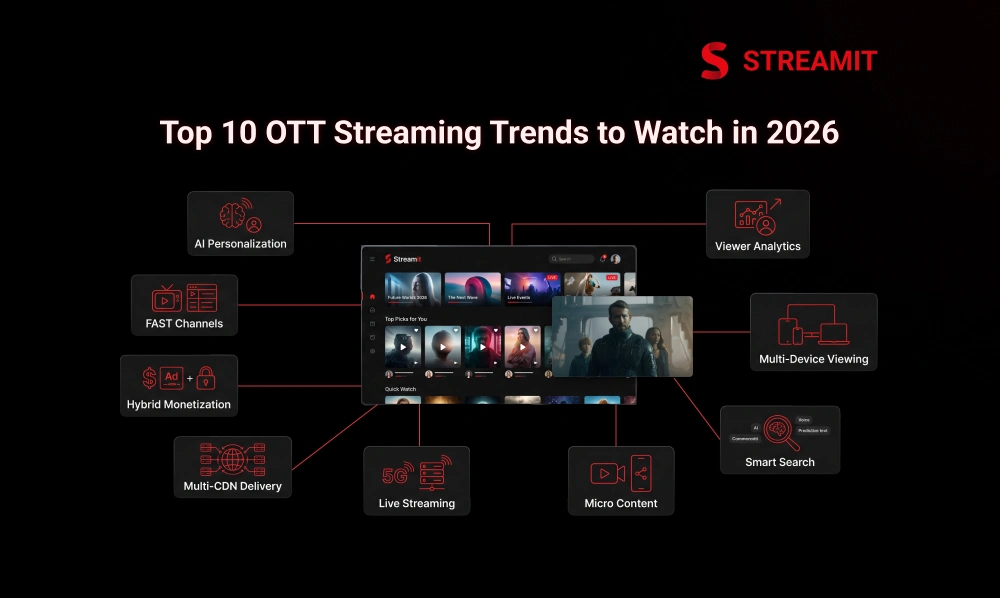
The strongest OTT trends in 2026 are not isolated features. They are connected systems that improve viewing, monetization, and platform control.
| Trend | What It Means for OTT Founders |
|---|---|
| AI personalization | Better discovery and retention |
| FAST channels | Free viewing with ad revenue |
| Hybrid monetization | More flexible revenue models |
| Multi-CDN delivery | Better performance and uptime |
| Edge and 5G | Faster streaming experiences |
| Live interaction | More real-time engagement |
| Micro content | Better discovery and habit-building |
| Smart search | Less user friction |
| Multi-device viewing | Consistent experience everywhere |
| Viewer analytics | Better business decisions |
1. AI-Powered Personalization and Recommendation Engines
AI-powered personalization will become a core part of serious OTT platforms. The goal is not to impress users with technology, but to help them find the right content faster.
Better recommendations can increase watch time, reduce drop-off, and make large content libraries feel simple to navigate. In 2026, platforms that treat personalization as an afterthought will struggle to keep users engaged.
2. Growth of FAST Channels and Free Streaming
According to EMARKETER, FAST users in the US are forecast to reach 131.4 million in 2026, representing 54% of all connected TV users. This shows how free, ad-supported viewing is becoming a serious part of the streaming future.
For OTT founders, FAST is not just “free content”. It is a monetization path for catalog content, niche programming, live feeds, and audience segments that may not convert to paid subscriptions immediately.
3. Rise of Hybrid Monetization Models
Hybrid OTT monetization will keep growing because users want choice. Some will pay for premium access, some will accept ads, and some will only pay for specific events or rentals.
The stronger model is not SVOD versus AVOD. It is a flexible mix of subscriptions, ads, rentals, pay-per-view, coupons, bundles, and pricing experiments.
4. Cloud-Based OTT Infrastructure and Multi-CDN Delivery
Cloud-based OTT infrastructure gives platforms more flexibility, but the cloud alone does not guarantee performance. Without smart architecture, storage, transcoding, and CDN costs can rise fast.
Multi-CDN delivery helps reduce dependency on one delivery path. For growing platforms, this matters because one failed CDN route should not break the viewer experience.
5. 5G and Edge Computing for Faster Streaming
5G and edge computing will push expectations around speed, especially for mobile-first markets, live viewing, sports, and interactive content.
The founder takeaway is simple: faster networks do not fix weak platforms. Your backend, encoding, CDN strategy, and player logic still need to be designed properly.
6. Live Streaming and Interactive Content Growth
Live streaming is moving beyond events. It now includes sports, creator sessions, education, fitness, auctions, worship, and community-led programming.
Interactive content adds another layer. Polls, chats, live commerce, multi-angle streams, and real-time reactions can increase engagement, but only if latency and infrastructure are handled well.
7. Short-Form and Micro Content Integration
Micro content is becoming a discovery layer. Short clips, previews, highlights, trailers, and vertical snippets can help users decide what to watch next.
Omdia’s 2026 outlook also highlights creator economy growth and microdramas as key themes in TV and video content. That makes short-form integration more relevant for platforms trying to build daily viewing habits.
8. Smarter Content Discovery and Search
Content discovery is one of the biggest hidden problems in OTT. A platform can have strong content and still lose users because the library feels difficult to navigate.
In 2026, smart search should handle typos, genres, actors, moods, languages, and user intent. Discovery should feel less like a directory and more like guidance.
9. Multi-Device and Cross-Platform Viewing
Users move between phones, tablets, laptops, smart TVs, and streaming devices. The experience should follow them without breaking watch history, profiles, playback quality, or payments.
A serious OTT TV app is not an optional upgrade anymore. For long-form content, smart TV and connected TV experiences are becoming central to user engagement.
10. Data-Driven Content Strategy and Viewer Analytics
Viewer analytics will become one of the strongest decision-making layers in OTT. Founders need to know what people watch, where they drop off, what drives renewals, and which content supports retention.
Without analytics, content strategy becomes guesswork. With the right platform analytics, teams can make better decisions on acquisition, programming, pricing, and churn management.
Challenges Ahead
Key Challenges OTT Platforms Will Face in 2026
The hardest OTT challenges in 2026 will happen after launch. Most platforms look stable in demos, but real users expose problems quickly.
The challenge is not only technical. It is financial, operational, and strategic.
High Infrastructure and Streaming Costs
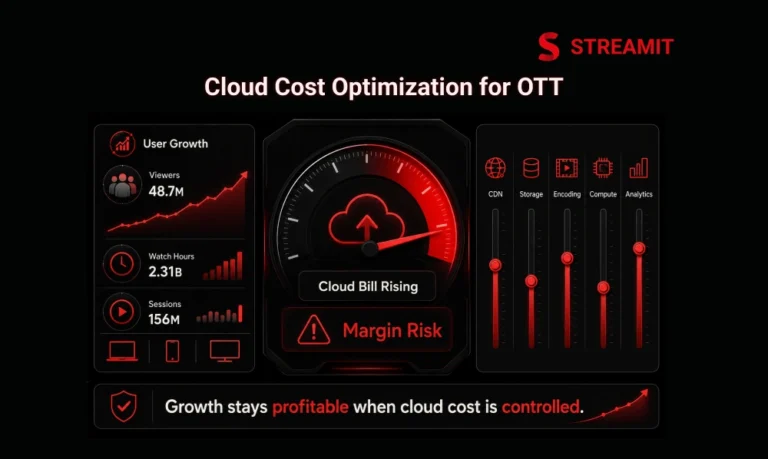
Streaming costs can grow quietly through storage, transcoding, CDN usage, traffic spikes, and inefficient encoding ladders.
Founders should not wait for bills to increase before optimizing. Cost control needs to be built into the platform architecture early.
User Retention and Churn Management
Churn will remain a serious issue because users are price-sensitive and have too many choices. Deloitte’s 2026 research shows 73% of consumers are frustrated by rising entertainment subscription prices.
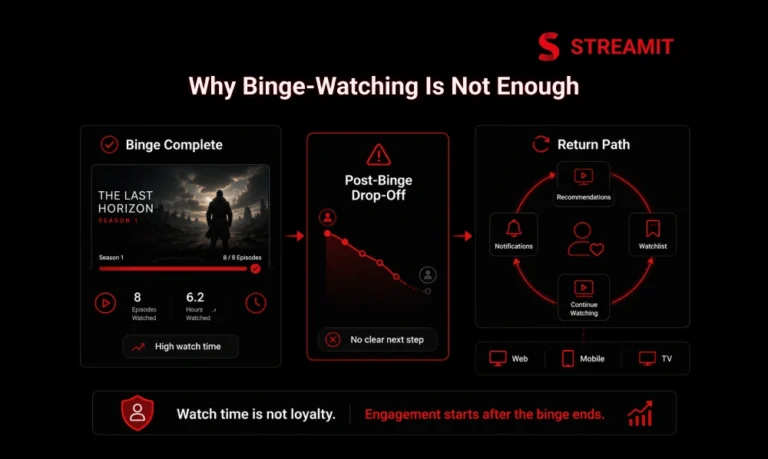
Retention depends on more than content. It needs better onboarding, recommendations, pricing, reminders, engagement journeys, and win-back systems.
Scaling Performance for Global Audiences
Global audiences create different delivery problems. Network quality, device types, payment behavior, languages, and regional content preferences all change by market.
A scalable OTT platform needs adaptive streaming, multi-CDN planning, localization, and monitoring before expansion begins.
Preparation Strategy
How OTT Platforms Should Prepare for 2026
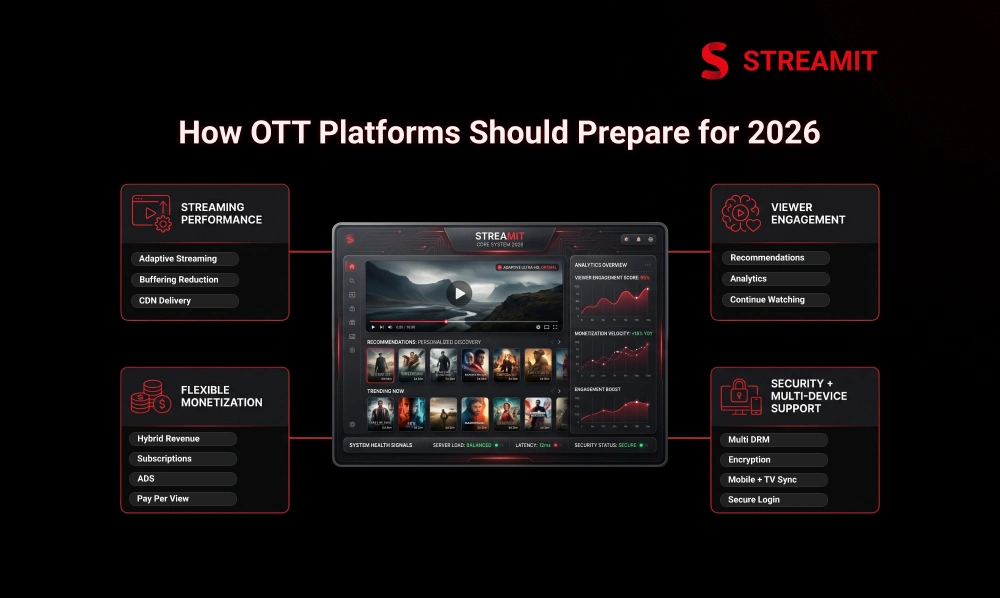
Preparation means building the foundation before growth starts, testing it.
The right OTT strategy should connect performance, monetization, engagement, security, and ownership into one operating system.
Improve Streaming Performance and Reduce Buffering
The priority is playback stability. If videos take too long to start or buffer during key moments, users do not care how good the interface looks.
Platforms should invest in transcoding, adaptive bitrate streaming, CDN optimization, device testing, and real-time monitoring.
Invest in Personalization, Analytics, and User Engagement
Personalization should be built around real viewer behavior, not generic categories. Analytics should show what users are doing and what actions can improve retention.
Engagement should also be practical. Better recommendations, smarter notifications, personalized rows, and clear continue-watching journeys can improve platform stickiness.
Adopt Flexible Monetization Models
One revenue model may not be enough in 2026. Subscription fatigue, ad-supported growth, and pay-per-view demand are pushing platforms toward hybrid monetization.
The best OTT monetization model depends on content type, audience maturity, region, and user intent. Founders should build flexibility before they need it.
Prioritize Multi-Device Support and Content Security
Multi-device support is now part of the core product. Users expect the same account, payment access, watch progress, and content quality across screens.
Security also matters. Video encryption, access control, DRM planning, and secure user authentication protect both content value and platform trust.
Platform Evaluation
What to Look For in an OTT Platform for 2026
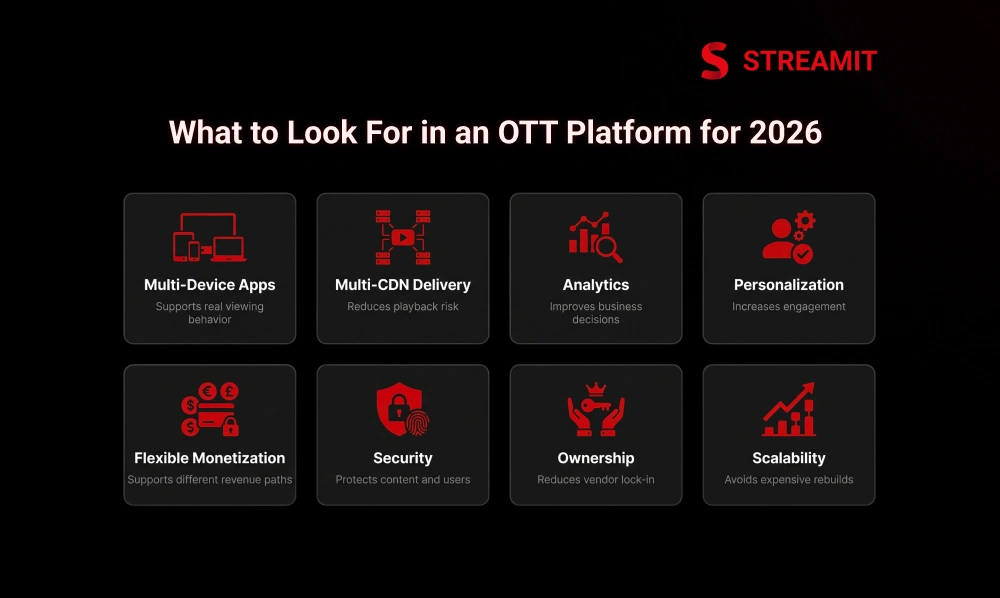
A 2026-ready OTT platform should not just help you launch. It should help you operate, scale, monetize, and improve.
Founders should evaluate platforms based on long-term control, not only feature lists.
| Capability | Why It Matters |
|---|---|
| Multi-device apps | Supports real viewing behavior |
| Multi-CDN delivery | Reduces playback risk |
| Analytics | Improves business decisions |
| Personalization | Increases engagement |
| Flexible monetization | Supports different revenue paths |
| Security | Protects content and users |
| Ownership | Reduces vendor lock-in |
| Scalability | Avoids expensive rebuilds |
Key Capabilities to Look for in an OTT Solution
A strong OTT solution should include content management, user management, subscription handling, payment gateways, streaming infrastructure, analytics, security, and multi-device apps.
It should also support growth. That means your platform should not fall apart when traffic increases, content expands, or monetization becomes more complex.
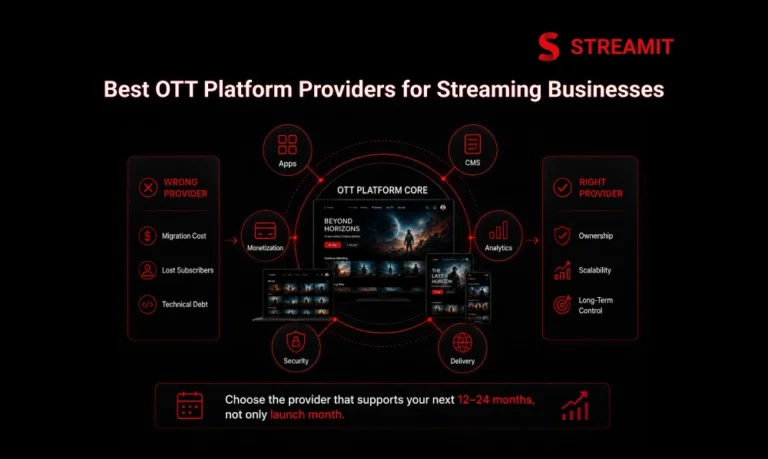
White-Label vs Custom OTT: Which Fit Makes More Sense?
White-label OTT can make sense when speed matters and the business model is clear. It helps founders launch faster without building every layer from scratch.
Custom OTT makes more sense when ownership, unique workflows, advanced monetization, deep integrations, or long-term scale matter more than speed alone.
Streamit Solution
How Streamit Helps OTT Platforms Stay Ready for 2026
Streamit is built for founders and operators who are not just launching an app. It focuses on AI-first streaming infrastructure, multi-device platforms, monetization, analytics, discovery, and performance.
The position is simple: build the streaming business properly from day one, instead of rebuilding when users, traffic, and costs expose weak decisions.
Streamit Supports Faster Launch, Smarter Monetization, and Better Viewer Experience
Streamit supports streaming websites, mobile apps, TV apps, content workflows, monetization systems, and AI-powered discovery. Its platform features include recommendation engines, transcoding, analytics, retention pricing, smart thumbnails, encryption, smart seek, and discovery systems.
For founders, this matters because the viewer experience is not one feature. It is the result of many connected systems working together.
Streamit Helps Growing OTT Platforms Improve Performance, Analytics, and Scale
Streamit also focuses on performance problems that growing OTT platforms face, including buffering, CDN reliability, infrastructure cost, broken cross-device experiences, and weak viewer intelligence.
That makes it useful for both new platforms and existing platforms that already have users but are starting to see cracks in performance, retention, or scale.
Summary
Key Takeaways
OTT Growth Is Strong – But Competition Is Sharper
The global OTT market is projected to reach USD 383.52 billion in 2026, so founders need a platform built for retention, performance, and scale, not just launch.
Subscription-Only Models Face More Pressure
Users are becoming more price-sensitive – 61% say they may cancel their favorite streaming service if the monthly price increases by just USD 5.
FAST and Ad-Supported Streaming Are Going Mainstream
FAST users in the US are forecast to reach 131.4 million in 2026, representing 54% of all connected TV users – making free streaming a serious revenue path.
Hybrid Monetization Will Be the Standard
OTT platforms should prepare for subscriptions, ads, rentals, pay-per-view, bundles, and flexible pricing instead of depending on one revenue model.
Streaming Performance Is Still the Foundation
Low latency, adaptive streaming, CDN planning, and buffering control will directly shape user trust and platform retention in 2026.
Viewer Analytics Drive Better Decisions
Platforms that understand watch behavior, drop-offs, engagement, and churn signals will make stronger content, pricing, and retention decisions than those flying blind.
AI should improve real platform outcomes
Personalization, content discovery, smart thumbnails, analytics, and retention signals should help users find value faster, not just act as surface-level features.
Multi-device support is now essential
Viewers expect smooth access across mobile, web, smart TV, and connected TV apps without losing watch history, payments, or playback quality.
Content discovery will become a competitive advantage
Strong content is not enough if users cannot find it quickly. Smarter search, recommendations, and category journeys will become critical in 2026.
Streamit helps OTT founders build for 2026 readiness
Streamit supports faster launch, scalable infrastructure, smarter monetization, analytics, personalization, and better viewer experiences for long-term OTT growth.
Final Thoughts
Conclusion
The top OTT streaming trends in 2026 point toward one bigger truth: the market is maturing. The next winning platforms will not be the ones with the most features. They will be the ones with the strongest foundation.
For founders, this is the right time to think beyond launch. Build for performance, ownership, monetization, analytics, and viewer experience from the start. That is how an OTT platform becomes a real streaming business.
FAQs
Frequently Asked Questions
-
What are the top OTT streaming trends to watch in 2026?
The top OTT trends in 2026 include AI personalization, FAST channels, hybrid monetization, multi-CDN delivery, 5G streaming, live interaction, short-form content, smart discovery, multi-device viewing, and viewer analytics.
-
What are the biggest challenges OTT platforms will face in 2026?
The biggest challenges include rising infrastructure costs, user churn, subscription fatigue, content discovery problems, global delivery performance, and the need to scale without rebuilding the platform.
-
What features are essential for OTT platform success in 2026?
Essential features include adaptive streaming, multi-device apps, smart recommendations, analytics, secure payments, flexible monetization, DRM/content protection, cloud infrastructure, and reliable CDN delivery.
-
How can OTT startups compete with big streaming platforms in 2026?
OTT startups can compete by owning a clear niche, improving discovery, using flexible monetization, building strong community engagement, and choosing scalable infrastructure from the start.
-
What is the fastest way to build a future-ready OTT platform?
The fastest way is to start with a proven OTT platform foundation that already supports streaming infrastructure, monetization, analytics, personalization, security, and multi-device delivery.