Top OTT Content Management Features Every Platform Needs


A streaming business does not break only because the app looks weak. It usually breaks when the content operation cannot keep up with growth.
For serious OTT platforms, the content management layer decides how fast teams publish, how easily viewers discover content, how reliably playback works, and how much control the business keeps over its library.
Overview
What an OTT Content Management System Actually Does
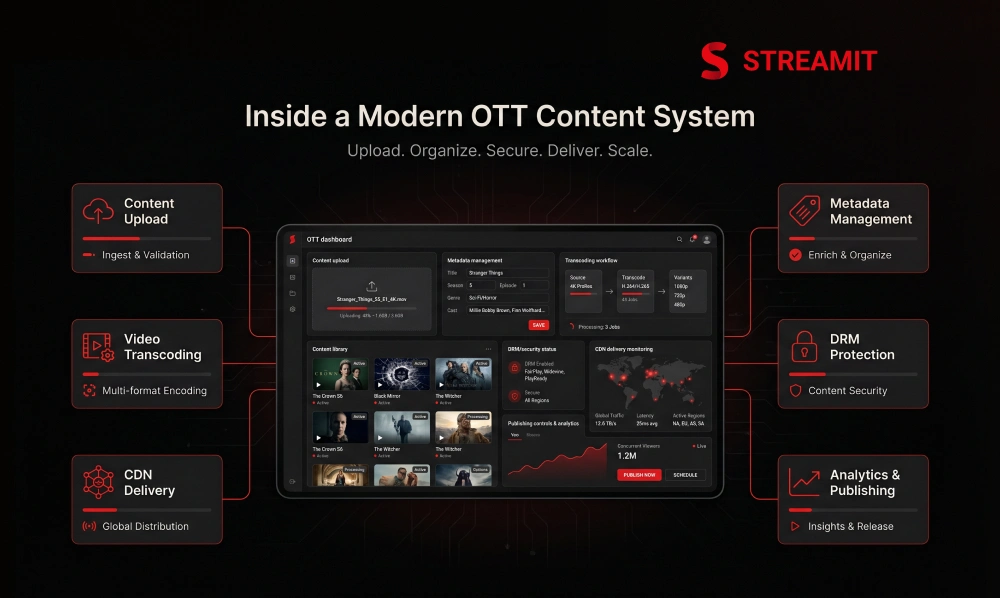
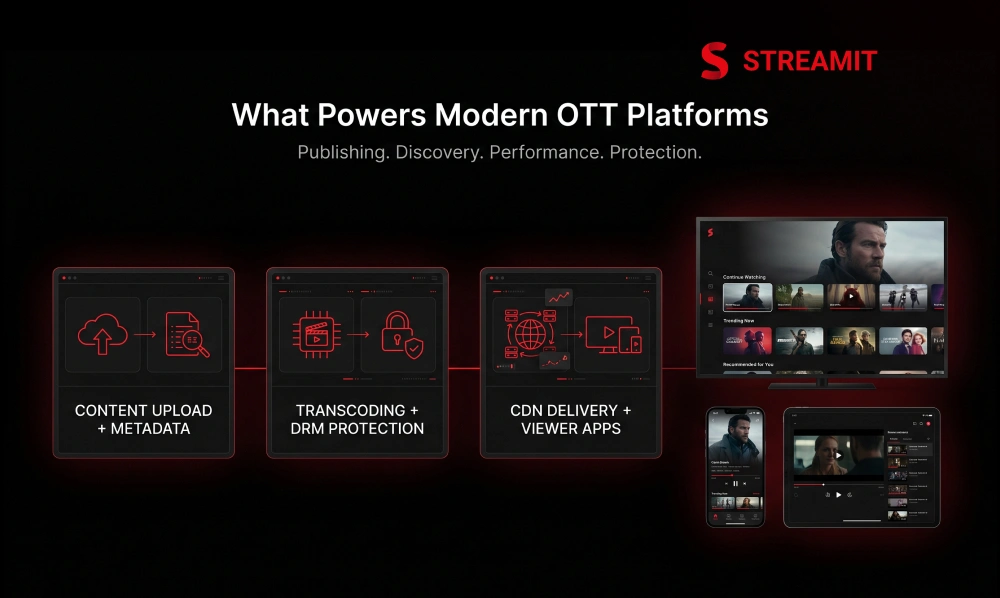
An OTT content management system is the control layer behind the streaming experience. It helps teams upload, organize, process, protect, publish, and track video content across web, mobile, and TV apps.
A serious OTT CMS does far more than keep videos in one place. It connects metadata, transcoding, delivery, search, monetization, access control, and analytics into one structured workflow. Modern OTT CMS platforms often include bulk ingestion, transcoding, metadata management, DRM, and delivery support.
How OTT Platforms Manage and Deliver Video Content
A platform may have 100 titles or 100,000 assets, but the workflow stays similar: content is uploaded, tagged, transcoded, secured, delivered through streaming infrastructure, and shown inside apps.
The difference is execution. Small gaps in metadata, encoding, or CDN logic can become major playback and discovery problems once traffic grows across devices and regions.
Why OTT CMS Impacts User Experience, Publishing Speed, and Platform Growth
A viewer does not see the CMS, but they feel it. Poor organization becomes weak search. Slow workflows become delayed releases. Weak delivery becomes buffering.
This is why OTT content management is not a back-office feature. It influences how users experience the platform, how long they stay, how fast teams publish, and how well the business scales.
Why It Matters
Why OTT Content Management Matters for Modern Streaming Platforms
A modern streaming platform is not only a video player. It is a content business with publishing pressure, audience expectations, monetization rules, security risks, and infrastructure needs.
Without a proper video CMS, teams start solving operational problems manually. That may work at launch, but it becomes expensive when the content library, user base, and device coverage expand.
Faster Publishing and Easier Content Operations
A good CMS reduces the number of manual steps between content upload and release. Teams can add metadata, assign categories, schedule releases, and publish faster.
For a growing OTT business, even saving 20 minutes per title becomes meaningful when hundreds of assets are being managed every month.
Better Content Discovery and Viewer Experience
Content discovery depends heavily on structure. Titles, genres, cast, language, thumbnails, tags, and custom metadata all help users find the right video faster.
Well-structured metadata helps OTT platforms improve search accuracy, recommendation quality, personalization, and overall content discovery.
Improved Streaming Performance and Scalability
Streaming performance is not fixed after launch. It depends on encoding, bitrate logic, CDN delivery, caching, device handling, and monitoring.
Adaptive streaming, transcoding, and CDN delivery help platforms serve video across different bandwidth conditions and device types.
Stronger Security and Content Protection
Premium content needs controlled access. DRM, encryption, user entitlement, watermarking, and role-based access help reduce piracy and unauthorized viewing.
For paid OTT platforms, weak content security is not only a technical risk. It is a revenue leakage problem.
Common Problems
Common Problems OTT Platforms Face Without a Proper CMS
Most OTT problems do not start as dramatic failures. They begin as small workflow issues that slowly affect viewers, teams, and revenue.
Here is the practical difference:
| Without Proper CMS | With Proper OTT CMS |
|---|---|
| Manual uploads and scattered files | Centralized media library |
| Weak search and poor categories | Structured metadata and discovery |
| Device playback issues | Transcoding and adaptive delivery |
| Delayed publishing | Faster workflows and scheduling |
| Higher piracy risk | DRM, encryption, and access control |
| Limited business visibility | Analytics and viewer tracking |
Manual Content Handling Slows Publishing and Updates
Manual uploads create dependency on people, folders, spreadsheets, and repeated checks. A growing content library can quickly slow down publishing if the platform depends on manual handling.
A proper content publishing system brings order to this process, making uploads, approvals, updates, and release timing easier to manage.
Weak Organization Makes Discovery Harder for Users
Valuable videos can go undiscovered if they are not tagged with the right metadata. Even good content loses value when search, filters, and categories are poorly structured.
The issue is not always content quality. Sometimes the platform simply fails to present the right title at the right moment.
Scaling Playback and Infrastructure Becomes Difficult
A small platform may survive with basic video delivery. But as users grow, poor encoding, weak CDN planning, and limited monitoring create buffering issues.
Scalable streaming needs infrastructure decisions made early, not after traffic problems appear.
Poor Security Increases Piracy and Access Risks
Without access control, platforms struggle to protect premium content. Paid users, free users, trial users, and restricted content must be handled carefully.
Security should not be added after damage is done. It should be part of the OTT CMS and delivery design from day one.
Core Features
Must-Have OTT Content Management Features
A strong OTT CMS should support both daily operations and long-term scale. A strong OTT CMS should not create more complexity; it should remove the friction from daily content operations.
Below are the core features every serious streaming platform should evaluate.
Centralized Content Library and Metadata Management
A centralized media library keeps videos, trailers, thumbnails, subtitles, categories, and publishing details in one place.
Metadata management gives each asset meaning. It helps the platform understand what the content is, who it is for, where it belongs, and how it should be discovered.
Bulk Upload and Fast Publishing Workflows
Bulk video upload is critical when teams manage large libraries. Uploading one asset at a time becomes slow and error-prone.
Fast publishing workflows allow teams to schedule releases, update content, manage status, and reduce repetitive admin work.
Video Transcoding and Multi-Device Compatibility
Video transcoding converts source files into formats and bitrates suitable for different devices, screen sizes, and network conditions.
Viewers do not watch from one fixed environment; they may switch between mobile data, desktop screens, tablets, and smart TVs. The same source file cannot serve every environment perfectly.
Smart Categorization, Search, and Content Discovery
A platform should support genres, languages, moods, creators, cast, collections, trending rows, and custom filters.
Good discovery reduces decision fatigue. It helps users move from opening the app to pressing play with less hesitation.
DRM, Security, and Access Control Features
DRM protection, encryption, access rules, user roles, and entitlement logic help protect paid and restricted content.
This is especially important for platforms using subscriptions, rentals, pay-per-view, private libraries, or premium video assets.
CDN Integration and Streaming Performance Optimization
CDN integration helps deliver video closer to users, improving load time and playback reliability.
For larger platforms, multi-CDN planning, edge caching, and monitoring can reduce risk during traffic spikes and regional demand changes.
AI-Based Personalization and Recommendation Engines
AI-based recommendations help platforms move beyond static content rows. They can use watch behavior, genre interest, completion patterns, and user context.
Personalized discovery is becoming more important because viewers expect platforms to understand what they may want next. Recent industry analysis also highlights AI-driven discovery as a way to reduce friction and improve engagement.
Monetization Management for SVOD, AVOD, and TVOD
A serious OTT CMS should support different monetization models, including subscriptions, ads, rentals, purchases, bundles, trials, and gated content.
The best setup gives founders room to test pricing without rebuilding the platform each time the business model changes.
Analytics and Viewer Performance Tracking
Analytics show what viewers watch, skip, complete, search, and return to. This helps teams make better content and product decisions.
Important metrics include watch time, drop-off points, search behavior, playback errors, device performance, and content-level engagement.
Decision Guide
How to Choose the Right OTT Content Management System
Choosing the right platform solution is not only about features. It is about whether the system can support the business you want to build 12 months from now.
A CMS that works for launch may not work for growth. Scalability, customization, security, support, and ownership matter more than a long checklist.
Look for Scalability and Infrastructure Flexibility
A scalable OTT CMS should handle larger libraries, higher traffic, more devices, and more complex delivery needs.
The key question is simple: can the platform grow without forcing a full rebuild when traffic, content, or monetization expands?
Choose a Platform That Supports Customization and Long-Term Growth
A custom OTT platform gives more control over user experience, monetization logic, content workflows, and future roadmap.
This matters for founders who do not want to be trapped inside fixed templates, limited feature sets, or rigid platform rules.
Prioritize Security, DRM, and Content Protection
Security should be treated as a business requirement, not a late technical add-on.
Look for DRM support, encrypted delivery, user entitlement, secure admin access, and clear permission controls across the CMS.
Compare Support, Reliability, and Total Long-Term Cost
Cheap systems often become expensive when teams need custom changes, better infrastructure, or migration support.
Evaluate total cost across development, support, scaling, maintenance, security, and future upgrades.
Who It Serves
Who Needs an OTT Content Management System
Any business managing video at scale needs a structured content system. The need becomes stronger when monetization, devices, and audience growth enter the picture.
OTT CMS is useful for startups, broadcasters, media companies, creators, education businesses, sports platforms, and niche subscription communities.
OTT Startups and New Streaming Platforms
OTT startups need a CMS because early decisions shape future scale. A weak setup may launch quickly but create limits later.
A structured CMS helps new platforms manage content, users, monetization, and delivery without depending on manual workarounds.
Media Companies and Broadcasters Expanding Into OTT
Broadcasters need more than digital upload tools. They need scheduling, live/VOD handling, metadata, rights control, device delivery, and analytics.
For media companies, OTT is not a side channel anymore. It is becoming a direct audience and revenue system.
Content Creators Building Subscription-Based Platforms
Creators building paid libraries need control over content access, pricing, user experience, and community ownership.
A good OTT CMS helps creators move beyond social platforms and build a direct subscription streaming business.
Streamit Platform
Build a Scalable OTT Platform With Streamit
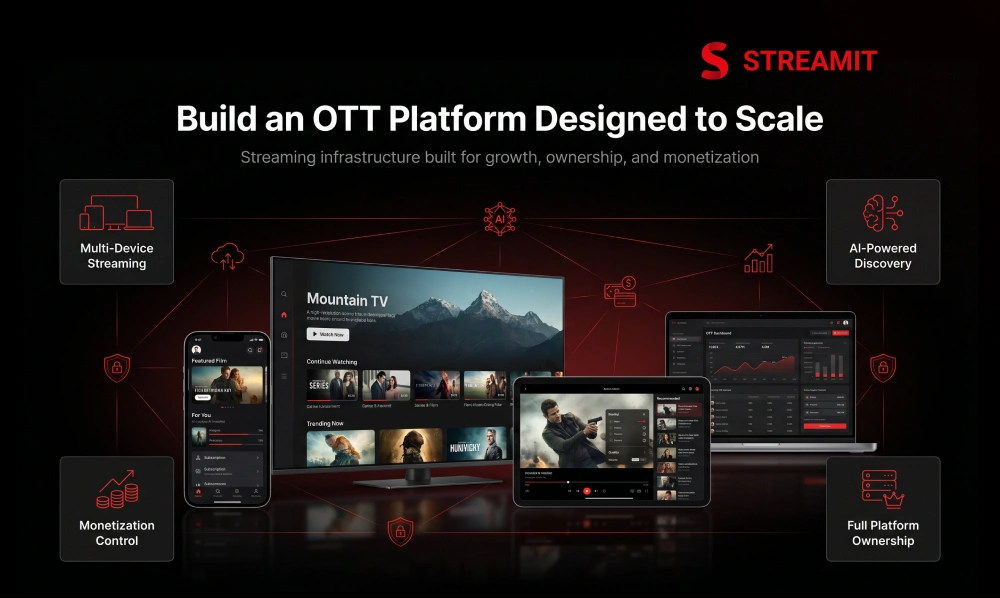
Streamit is built for streaming businesses that care about ownership, performance, monetization, and long-term control. Its positioning focuses on AI-first infrastructure, scalable delivery, full platform control, and serious OTT growth.
The goal is not to launch a basic video app. The goal is to build a streaming platform that can handle real users, real traffic, real content operations, and real revenue models.
Launch an End-to-End OTT Platform With Built-In CMS Features
Streamit helps businesses launch and manage OTT platforms across content, users, monetization, analytics, and streaming workflows.
Its custom OTT platform approach is built for real traffic, monetization, multi-device delivery, and long-term ownership.
Support Web, Mobile, and Smart TV Streaming Experiences
Modern OTT users expect content to work across mobile, web, smart TVs, and connected devices.
Streamit supports streaming experiences across web, mobile, TV, and connected devices, helping businesses manage multi-screen growth from one foundation.
Manage Monetization, Analytics, and Content From One System
A streaming business needs visibility into users, content, payments, and performance. When these systems are disconnected, decision-making becomes slow.
With Streamit, the platform can be structured around content management, analytics, monetization, AI-based insights, and long-term operational control.
Build a White-Label or Custom OTT Platform for Long-Term Growth
Some businesses need a faster white-label route. Others need a custom OTT solution with deeper flexibility and ownership.
The smarter choice depends on growth plans, content model, monetization strategy, and how much control the business needs over its roadmap.
Summary
Key Takeaways
OTT Market Demands Scale
The global OTT market is projected to reach USD 383.52 billion in 2026, making a content system built for retention and control a non-negotiable foundation.
CMS Is the Backbone of Operations
A strong OTT CMS connects uploading, organizing, publishing, protecting, monetizing, and tracking video content into one structured workflow.
Metadata Drives Discovery
Titles, genres, tags, thumbnails, cast details, and categories directly affect how users find relevant content and whether they press play or leave.
Publishing Speed Is a Growth Advantage
Bulk upload, approval workflows, and scheduled publishing allow OTT teams to release content faster without relying on manual, scattered processes.
Playback Depends on Backend Preparation
Video transcoding, adaptive streaming, CDN integration, and multi-device compatibility are what make smooth viewing across mobile, web, and TV possible.
Security Protects Revenue
DRM, encryption, access control, and user permissions reduce piracy risks and protect premium content, keeping paid content earning as intended.
Closing Thoughts
Conclusion
A streaming platform can look polished on the surface and still fail underneath if the content management system is weak.
The right OTT CMS gives the business control over its library, delivery, user experience, monetization, and future growth. That control is what separates a short-term launch from a serious streaming business.
FAQs
Frequently Asked Questions
-
What is an OTT content management system?
An OTT content management system is software that helps streaming platforms upload, organize, process, secure, publish, and track video content. It connects content operations with delivery, discovery, monetization, and analytics.
-
How does an OTT CMS process, organize, publish, and deliver streaming content?
An OTT CMS manages the full video journey from upload to playback. It organizes content with metadata, prepares it through transcoding, and delivers it across web, mobile, tablet, and smart TV apps. OTT itself delivers video over the internet to connected devices.
-
What are the must-have features in an OTT content management system?
The must-have features include centralized media library, metadata management, bulk upload, transcoding, DRM, CDN integration, search, personalization, monetization tools, and analytics. These features help platforms operate and scale properly.
-
Which is the best OTT content management system for scalable streaming platforms?
The best OTT CMS is the one that supports scalability, customization, multi-device delivery, DRM, monetization, analytics, and long-term control. For serious streaming businesses, flexibility matters more than quick-launch convenience.
-
What is the role of video transcoding in OTT content management?
Video transcoding converts videos into multiple formats and bitrates for smooth playback across devices and network conditions. It helps reduce playback issues and improves multi-device streaming performance.
-
What is the difference between OTT CMS and traditional video CMS?
A traditional video CMS mainly manages video storage and publishing. An OTT CMS goes further by supporting streaming workflows, monetization, DRM, multi-device delivery, analytics, and viewer experience.