OTT Monetization: AVOD vs SVOD vs TVOD vs FAST Compared


The first monetization decision can shape the next 12 months of platform cost, churn, product design, and growth. Most OTT founders think monetization means “how we make money.” In reality, it decides how users enter, how long they stay, what content they expect, how your platform is built, and how flexible your business becomes later.
OTT monetization is not only about choosing between ads, subscriptions, rentals, or free channels. It is about matching your content, audience behaviour, revenue target, and technology stack. That is why AVOD, SVOD, TVOD, and FAST should not be treated as simple pricing options. They are different business systems.
Ad-supported streaming is no longer a secondary option. As more advertisers move budgets into digital video and more viewers accept free or lower-cost access, ads are becoming a serious revenue layer for modern OTT platforms.
Fundamentals
What Is OTT Monetization?
OTT monetization is the way a streaming platform turns video content into revenue. It can happen through subscriptions, advertising, one-time purchases, rentals, pay-per-view events, free ad-supported channels, or a mix of these models.
The important part is this: monetization is not added after the platform is built. It should be designed into the platform from the beginning because it affects access control, billing, ads, analytics, user journeys, content packaging, and retention.
OTT Monetization Is How Streaming Platforms Make Money
A streaming platform makes money when the content, audience, and revenue model work together. For example, a fitness platform may earn through subscriptions, a sports platform may earn through pay-per-view, and a large entertainment library may use ads or hybrid access.
But the model only works when users feel the value is clear. If the price feels too high, churn rises. If the ads feel too heavy, watch time drops. If premium content is buried behind confusing access rules, conversion weakens.
AVOD, SVOD, TVOD, and FAST Are the Main OTT Monetization Models
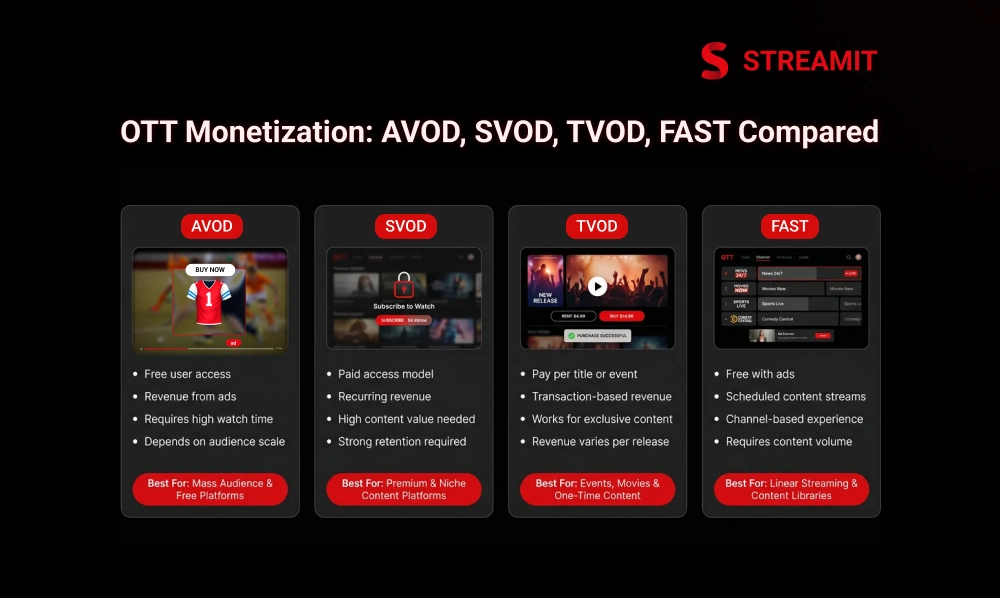
The four core OTT monetization models are AVOD, SVOD, TVOD, and FAST. AVOD earns through ads. SVOD earns through recurring subscriptions. TVOD earns through one-time purchases or rentals. FAST earns through free, scheduled, ad-supported streaming channels.
Each model creates a different platform requirement. SVOD needs strong billing and retention. AVOD needs ad logic and audience segmentation. TVOD needs secure payments and time-based access. FAST needs channel scheduling and consistent ad inventory.
The Best Model Depends on Content, Audience, and Business Goal
A model that works for a mass entertainment platform may fail for a niche education platform. A subscription model may work well when content is updated often, but it can struggle if users only need one event or one course.
The right question is not “Which model makes the most money?” The better question is “Which model fits how my audience wants to watch and pay?”
Strategy
Why Choosing the Right OTT Monetization Model Matters
A weak monetization model can make good content look like a bad product. This is where many OTT platforms quietly lose momentum. They invest in content, design, and apps, but the revenue model creates friction.
If users do not understand what is free, what is paid, what is rented, and what is included, they hesitate. That hesitation becomes lower conversion, weaker retention, and more support questions.
Your Revenue Model Shapes User Experience, Not Just Revenue
AVOD usually lowers the entry barrier because users can start watching for free. SVOD creates a stronger paid relationship but increases expectations. TVOD works when the content has clear one-time value. FAST works when users prefer a lean-back, TV-like viewing experience.
This means monetization directly shapes UX. It changes homepage design, pricing pages, content labels, upgrade prompts, ad breaks, and even how recommendations should work.
Monetization Affects Ads, Billing, Access Rules, and Product Design
An OTT platform running SVOD needs plans, renewals, failed payment handling, invoices, upgrades, downgrades, and cancellation flows. A TVOD platform needs rentals, purchase windows, payment confirmation, and secure entitlement logic.
A FAST platform needs scheduled channels, ad breaks, live-like delivery, and content programming. So the monetization model is not just a business decision. It is a product architecture decision.
The Wrong Model Can Slow Growth Even With Good Content
A platform can have strong content and still struggle if the model does not match user intent. For example, monthly subscriptions may feel unnecessary for occasional sports events. Heavy ads may hurt premium content. One-time purchases may limit recurring revenue.
When the monetization model does not fit the audience, growth becomes harder. User acquisition gets more expensive, retention drops, and scaling the platform later becomes more complex.
Model Breakdown
AVOD vs SVOD vs TVOD vs FAST Explained
| Model | Full Form | How It Earns | Best For |
|---|---|---|---|
| AVOD | Ad-Supported Video on Demand | Ads | Free access and large reach |
| SVOD | Subscription Video on Demand | Monthly or yearly plans | Loyal audiences and recurring revenue |
| TVOD | Transactional Video on Demand | Rentals, purchases, PPV | Events, premieres, premium access |
| FAST | Free Ad-Supported Streaming TV | Ads on scheduled channels | Lean-back viewing and large libraries |
The difference between these models is not only payment style. The bigger difference is user behaviour. AVOD users expect free access. SVOD users expect ongoing value. TVOD users pay for a specific moment. FAST users want a simple channel experience without choosing every title manually.
AVOD: Ad-Supported Video on Demand
AVOD lets viewers access content for free while the platform earns through ads. It works best when the main goal is to increase reach, improve discovery, and grow the audience base.
The main risk is experience. If ad load is too high or poorly placed, users may leave before revenue compounds. AVOD needs clean analytics, smart ad placement, and strong viewer segmentation.
SVOD: Subscription Video on Demand
SVOD gives users access through recurring payments. It is strong for platforms with premium libraries, niche communities, education, fitness, entertainment, or any content that users return to often.
The challenge is churn. Users compare the monthly cost with how often they watch. If content freshness, personalization, and product experience are weak, subscriptions become easy to cancel.
TVOD: Transactional Video on Demand
TVOD lets users pay for a specific title, event, rental, or premium release. It works well for sports, concerts, workshops, movie premieres, expert sessions, and limited-time access.
Its strength is high purchase intent. Its weakness is uneven revenue. One strong event can perform well, but the platform may need a larger model around it to avoid revenue gaps.
FAST: Free Ad-Supported Streaming TV
FAST offers free scheduled channels supported by ads. It feels closer to traditional TV because users can open a channel and start watching without choosing a specific title.
FAST works best when a platform has enough content depth to create channels. The challenge is operations. Scheduling, ad breaks, content rotation, and delivery reliability matter much more than many teams expect.
Comparison
Key Differences Between AVOD, SVOD, TVOD, and FAST
| Factor | AVOD | SVOD | TVOD | FAST |
|---|---|---|---|---|
| User entry | Free | Paid | Pay per title/event | Free |
| Revenue style | Ads | Recurring | Transactional | Ads through channels |
| Best content fit | Broad libraries | Premium/niche libraries | Events/premieres | Large scheduled libraries |
| Main risk | Poor ad experience | Churn | Uneven revenue | Channel operations |
| Platform need | Ad tech + analytics | Billing + retention | Payments + entitlements | Scheduling + ad delivery |
The real difference is not monetization. It is commitment. AVOD and FAST reduce commitment. SVOD increases commitment. TVOD asks for commitment only at the moment of purchase.
That is why product design should change for each model. A free model needs fast discovery. A subscription model needs value reminders. A transactional model needs urgency and trust. A FAST model needs simple channel navigation.
Fit Guide
Which OTT Monetization Model Fits Which Platform Best?
AVOD fits broad-reach platforms and price-sensitive audiences. If your goal is to grow fast and monetize attention through ads, AVOD can work well. But it usually needs scale before the revenue becomes meaningful.
SVOD fits premium libraries, niche communities, and strong retention brands. If users return weekly or daily, a subscription can create predictable revenue. But the platform must keep proving value.
TVOD fits sports, events, premieres, and high-value content moments. It is useful when users are willing to pay for one specific experience instead of joining a monthly plan.
FAST fits channel-based viewing and large content libraries. It is especially useful when users want passive viewing, and the platform can package content into themed channels.
Hybrid models fit platforms that need both reach and revenue depth. This is where many serious OTT businesses are moving because one model alone can feel too narrow.
Technical Requirements
What Your OTT Platform Must Support for Each Monetization Model
| Model | Platform Must Support |
|---|---|
| AVOD | Ad insertion, ad rules, viewer segments, analytics |
| SVOD | Plans, billing, renewals, access control, retention tools |
| TVOD | Secure checkout, rentals, purchase windows, entitlements |
| FAST | Channel scheduling, ad breaks, reliable delivery, programming tools |
| Hybrid | Flexible access rules across free, paid, ads, and premium content |
AVOD needs more than placing ads inside videos. It needs control over when ads appear, how often users see them, and how ad performance connects with watch behaviour.
SVOD needs more than a payment gateway. It needs retention systems, failed payment recovery, plan logic, user segmentation, and analytics that show why users stay or leave.
TVOD needs secure access rules. If a user rents content for 48 hours, the platform must control access clearly. FAST needs scheduling discipline because the channel experience breaks if content flow, ad breaks, or delivery is unreliable.
Trends
Why Hybrid OTT Monetization Is Growing Fast
Hybrid monetization is growing because audiences no longer fit one payment behaviour. Some users want free access. Some will pay monthly. Some only pay for premium events. Some prefer channel-style viewing.
A hybrid model lets the platform serve different user segments without forcing every viewer into one path. Ad-supported streaming has also gained momentum as more viewers choose lower-cost ad-supported access, with reporting showing strong growth in ad-supported subscriptions and viewing behaviour.
AVOD can bring reach while SVOD brings predictable revenue. TVOD can create premium revenue moments inside a larger model. FAST can expand distribution without replacing the core platform.
The key is not to add every model randomly. The key is to design a clean revenue mix where each model has a clear role.
Decision Framework
How to Choose the Best OTT Monetization Model for Your Platform
Start with content type, viewing habit, and price sensitivity. Ask: Is the content watched often? Is it event-based? Is the audience willing to pay monthly? Does free access help growth?
Then check revenue goals, churn risk, and product complexity. A subscription model may look attractive, but it needs retention. AVOD may look easy, but it needs traffic and ad control. TVOD may look profitable, but it needs strong purchase intent.
Finally, match the model to your OTT platform features and team capacity. A model that your team cannot operate properly will create more problems than revenue.
Final Decision Guide
Choose AVOD if your priority is reach, free access, and audience growth – works best with enough traffic and a clear ad strategy. Choose SVOD for predictable revenue and loyal users. Choose TVOD for premium events and one-time purchase moments. Choose FAST for free channel-based viewing with a large enough library. Choose a hybrid when one model alone feels too limiting.
Platform Solution
Why Streamit Fits Modern OTT Monetization Needs
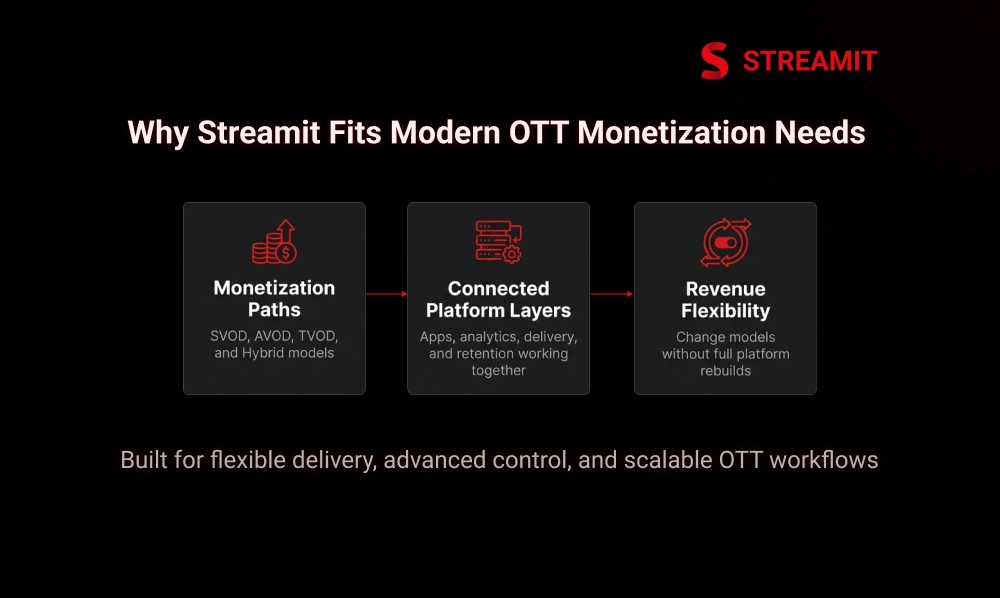
Streamit is built for founders and teams who treat streaming as a business, not just an app. Its positioning focuses on real traffic, monetization, ownership, analytics, and long-term infrastructure. Streamit’s own platform messaging highlights enterprise architecture, multi-device delivery, centralized CMS, monetization, analytics, and long-term control.
That matters because OTT monetization changes over time. A platform may start with SVOD, add TVOD for events, introduce AVOD for free users, and later create FAST-style channels for library expansion.
It Supports SVOD, AVOD, TVOD, and Hybrid Monetization Paths
A modern OTT platform should not lock the business into one revenue model forever. Streamit gives teams room to build around subscriptions, ads, transactions, or a hybrid structure based on their audience and growth stage.
That flexibility protects the business from expensive rebuilds when the revenue strategy changes.
It Connects Monetization With Apps, Analytics, Delivery, and Retention
Monetization does not work alone. It needs apps, playback, analytics, access control, user behaviour tracking, and reliable delivery to work together.
Streamit’s value is in connecting these layers so the platform can grow as a complete business system, not a collection of disconnected tools.
It Gives Teams Room to Change Revenue Models Without Full Rebuilds
The strongest OTT businesses evolve. Pricing changes. Content strategy changes. Audience behaviour changes. Revenue models change.
A platform built with flexibility gives founders more control. That is the difference between launching a streaming app and building a streaming business.
Conclusion
Conclusion
OTT monetization is not about copying what large streaming platforms do. It is about choosing the model that fits your content, audience, pricing power, and operating capacity.
AVOD, SVOD, TVOD, and FAST all work, but they work under different conditions. AVOD needs reach. SVOD needs retention. TVOD needs premium demand. FAST needs channel operations.
For serious OTT founders, the safest approach is to build with flexibility from day one. Your first model may not be your final model.
That is where Streamit fits the modern OTT reality. It gives streaming businesses a stronger foundation to build, test, adapt, and scale without treating monetization as an afterthought.
Summary
Key Takeaways
Monetization Is a Product Decision
It affects UX, billing, ads, access rules, analytics, retention, and platform architecture – not just revenue.
AVOD Is Best for Reach
It lowers the user entry barrier but needs traffic, ad control, and a careful viewer experience to generate meaningful revenue.
SVOD Is Best for Predictable Revenue
It works when content freshness, personalization, and retention systems are strong enough to justify recurring payments.
TVOD Is Best for Premium Moments
It fits events, premieres, rentals, and pay-per-view content where users have clear one-time purchase intent.
Hybrid Models Give More Flexibility
They let platforms combine reach, recurring revenue, premium purchases, and ad-supported growth in a single system.
Wrong Model Creates Hidden Costs
Poor monetization planning can force expensive rebuilds in billing, access logic, ads, and analytics as the business evolves.
FAQs
Frequently Asked Questions
-
Which OTT monetization model is best for a new platform?
The best model depends on your content and audience behaviour. New platforms often start with SVOD, AVOD, or hybrid access, depending on whether users are ready to pay immediately or need free entry first.
-
When does AVOD make more sense than SVOD?
AVOD makes more sense when your audience is price-sensitive, and your goal is reach. It works better when you can generate enough watch time and ad inventory to support revenue.
-
When is TVOD better than a monthly subscription?
TVOD is better when users only want access to one specific event, movie, class, or premium release. It works well for high-value moments that do not require a monthly relationship.
-
Can one OTT platform run AVOD, SVOD, TVOD, and FAST together?
Yes, one OTT platform can run multiple monetization models together if the architecture supports flexible access rules, billing, ads, analytics, and content packaging.
-
What hurts OTT growth more: wrong pricing or wrong model?
Both can hurt growth, but the wrong model is usually more damaging. Pricing can be adjusted faster, while the wrong model can affect platform architecture, UX, and retention.
-
Why do some SVOD platforms still struggle with churn?
SVOD platforms struggle with churn when users do not see enough ongoing value. Weak content refresh, poor discovery, limited personalization, and pricing friction can all increase cancellations.