OTT Subscriber Engagement: Why Binge-Watching Is Not Enough


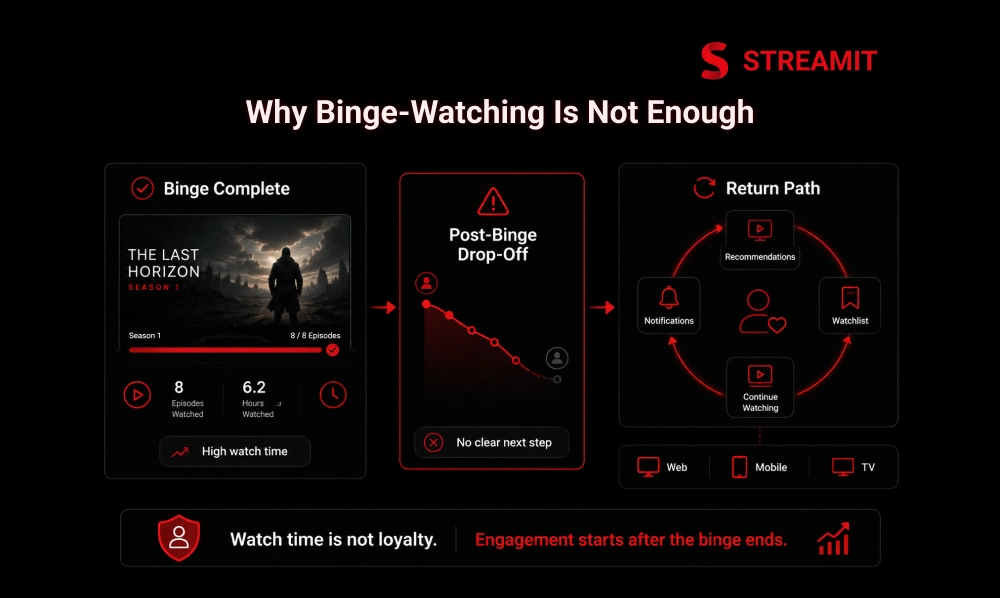
A user can watch 8 episodes in 2 days and still cancel on day 3. That is the uncomfortable truth many OTT businesses miss. Binge-watching looks strong on reports because it creates watch time, but watch time alone does not prove loyalty.
Real OTT subscriber engagement starts after the binge ends. The platform has to help users discover what to watch next, continue smoothly across devices, return without friction, and trust the viewing experience every time they open the app.
Part 1
Why Binge-Watching Alone Cannot Keep OTT Subscribers Engaged
One successful season can create traffic, but it cannot build a retention engine by itself. Binge-watching is a short-term behavior. It tells you the content worked, but it does not confirm that the platform relationship is strong.
For serious OTT businesses, the goal is not just to make users finish content. The goal is to make users feel there is always a reason to come back.
Binge-watching creates watch time, not long-term loyalty
Watch time is useful, but it can be misleading. A user may spend hours inside the platform because one title is strong, not because the platform experience is strong.
Subscriber loyalty comes from repeated value. Discovery, personalized rows, watchlists, continue watching, smooth playback, and timely reminders all matter after the main content pull fades.
Why users leave after finishing one show or season
Users often leave because the platform has no strong next step. They finish the show, scroll for a few minutes, find nothing clear, and slowly disappear.
This is where OTT churn begins quietly. The user does not always complain. They simply stop opening the app.
The post-binge drop-off problem
The post-binge period is one of the most important retention windows. If the platform does not act during this phase, the user’s habit breaks.
A strong OTT platform should know when a viewer is close to finishing a season and prepare the next content path before the drop-off happens.
Part 2
What OTT Subscriber Engagement Really Means
True engagement is not one long session; it is many meaningful returns. A healthy OTT platform brings users back across days, devices, moods, and content categories.
OTT subscriber engagement means the user is not just watching. They are searching, saving, resuming, exploring, switching devices, responding to recommendations, and returning without needing a discount every time.
Real engagement means users keep coming back
Return frequency is one of the clearest engagement signals. If users come back three or four times a week, the platform is becoming part of their routine.
This is more valuable than one weekend spike. A platform with consistent repeat visits usually has stronger subscriber retention.
Discovery, search, watchlists, and repeat visits matter
Discovery reduces the effort needed to find content. Search helps users act with intent. Watchlists help them build future viewing plans.
Together, these OTT platform features turn a content library into an experience. Without them, even a large catalog can feel small.
Multi-device viewing is a strong engagement signal
When users watch on mobile, web, and TV, the platform becomes more embedded in their lifestyle. That is a strong signal of trust.
A serious streaming app should feel consistent across devices. If the mobile app is smooth but the TV app feels broken, engagement gets weaker.
Part 3
Why Content Alone Is Not Enough to Reduce OTT Churn
Content brings users in, but experience decides whether they stay. Many OTT founders over-invest in content and under-invest in the system that helps users enjoy that content.
A strong library can still underperform if discovery is weak, playback is unstable, or the platform does not understand viewer behavior.
Content attracts users, but experience brings them back
Good content creates the first reason to subscribe. Good experience creates the second, third, and fourth reason to return.
This is why OTT user engagement depends on platform quality. The user judges the full journey, not just the video file.
Poor discovery makes a large content library feel small
If users cannot find relevant titles quickly, they assume there is nothing worth watching. That is a discovery failure, not always a content failure.
Personalized recommendation, smart thumbnails, and intent-based search help surface the right content faster.
Buffering and playback issues can break subscriber trust
Buffering feels small from the backend, but it feels personal to the viewer. One poor playback moment can damage confidence.
Adaptive streaming, reliable video delivery, and QoE tracking help protect the viewing experience when traffic, devices, and networks change.
Part 4
The OTT Engagement Loop Every Streaming Platform Needs
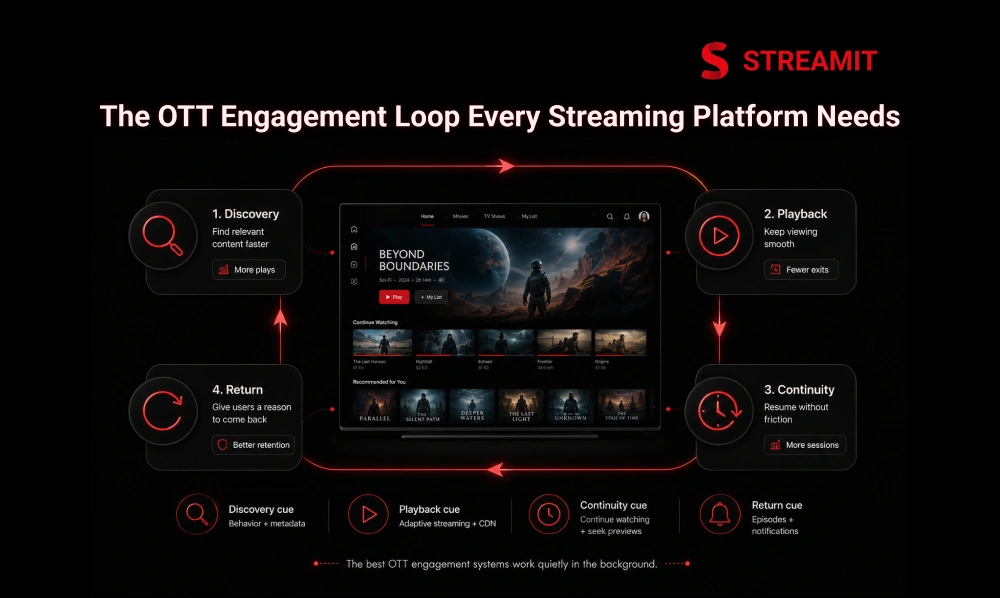
A strong OTT platform needs a loop, not just a homepage. Discovery brings users in, playback keeps them watching, continuity reduces friction, and return systems bring them back.
| Stage | What It Solves | Engagement Impact |
|---|---|---|
| Discovery | Helps users find relevant content | More plays |
| Playback | Keeps viewing smooth | Fewer exits |
| Continuity | Helps users resume easily | More sessions |
| Return | Creates a reason to come back | Better retention |
This loop should work quietly in the background. The best engagement systems do not feel forced, they feel natural.
Discovery: helping users find the right content faster
Discovery should reduce choice fatigue. Users should not need to scroll endlessly to find something relevant.
A good OTT platform uses viewing behavior, categories, metadata, and user intent to improve content discovery.
Playback: making the viewing experience smooth
Playback is where trust is either built or broken. Users may forgive a weak thumbnail, but they rarely forgive constant buffering.
Adaptive streaming, video CDN strategy, and optimized video delivery help create a stable viewing experience.
Continuity: helping users continue without friction
Continue watching, smart seek previews, and resume points make the platform feel intelligent. They save users from starting over.
Small frictions matter. Every extra click increases the chance that the user leaves.
Return: giving users a reason to come back
Return moments should be planned. New episodes, saved titles, unfinished content, and personalized notifications can all bring users back.
The key is relevance. Random notifications create noise, timely recommendations create habits.
Part 5
Personalization That Goes Beyond “Recommended for You”
Personalization should not be a decorative row on the homepage. It should shape the way users discover, resume, search, and explore content.
For OTT subscriber engagement, personalization works best when it is practical. It should help users make faster decisions.
Personalized home screens based on viewing behavior
A personalized home screen should adapt based on what users watch, skip, pause, and finish. This makes the platform feel more useful over time.
For entertainment OTT platforms, this can directly improve repeat visits and content depth.
Smart thumbnails and rows based on user interest
Smart thumbnails can make the same content feel more relevant to different users. One viewer may respond to a character, another to a theme.
Rows should also reflect user interest. Static rows are easier to manage, but dynamic rows often support better OTT user engagement.
Search results based on user intent
Search should understand what the user is trying to find, not only the exact words typed. This is especially important for large libraries.
Better OTT search reduces frustration and helps users reach content faster.
Part 6
Streaming Experience Factors That Improve Subscriber Retention
A 3-second delay can feel longer when the user is ready to watch. Performance is not a backend detail. It is part of the product experience.
Streaming infrastructure, adaptive streaming, video CDN planning, and playback monitoring all support subscriber retention.
Fast video start time reduces early exits
Users expect videos to start quickly. Slow start time creates doubt before the content even begins.
A fast start improves confidence and reduces early exits during playback.
Adaptive streaming keeps video quality stable
Adaptive streaming adjusts quality based on device and network conditions. This helps reduce buffering without forcing users to manage settings.
HLS, DASH, transcoding, and bitrate planning all play a role in stable playback.
CDN and edge caching help during high-traffic viewing
Traffic spikes can expose weak infrastructure fast. A platform that works during normal hours may struggle during premieres, matches, or major releases.
Video CDN, multi-CDN planning, and edge caching help keep delivery stable when demand rises.
Part 7
Unique OTT Engagement Ideas Most Platforms Miss
The best retention move often happens after the user stops watching. Most platforms focus on the session, but the gap between sessions is where loyalty is built.
Small, well-timed engagement ideas can reduce churn without making the platform feel aggressive.
The “next 7 days” plan after a binge ends
After a user finishes a show, the platform should create a next 7 days journey. This could include similar content, bonus clips, live sessions, or upcoming releases.
The goal is simple: do not let the user’s relationship end with one season.
The “small return reason” rule
Users do not always need a big reason to return. Sometimes a saved episode, a short clip, a new row, or a personalized reminder is enough.
Small return reasons create regular habits. Regular habits improve subscriber retention.
Silent churn signals platforms should track early
Silent churn starts before cancellation. Users search less, skip more, pause frequently, stop using watchlists, or move from TV viewing to occasional mobile viewing only.
Platform analytics should catch these signals early so the team can act before the user leaves.
Part 8
How Different OTT Niches Can Improve Subscriber Engagement
Every OTT niche has a different engagement problem. Entertainment needs discovery. Sports needs reliability. Learning and fitness need habit formation.
| OTT Niche | Main Engagement Need | Platform Focus |
|---|---|---|
| Entertainment | Content discovery | Recommendations, rows, search |
| Sports | Reliability | Low latency, CDN, live stability |
| Fitness | Habit building | Schedules, reminders, progress |
| Learning | Completion | Progress tracking, structured journeys |
| Creators | Community and access | Memberships, exclusives, direct audience data |
A custom OTT platform should reflect the business model. Copy-paste platform logic rarely works across every niche.
Entertainment OTT platforms need stronger discovery
Entertainment platforms usually have large libraries. The challenge is not only adding content, but helping users choose faster.
Smart discovery, personalized rows, and better metadata can increase content usage across the library.
Sports streaming platforms need low latency and reliability
Sports viewers care about timing. Delay, buffering, or stream failure can damage the entire experience.
Live sports streaming platforms need low latency, high availability, and tested delivery systems before major events.
Fitness, learning, and creator platforms need habit-based journeys
Fitness and learning platforms depend on routine. Users need reminders, progress, schedules, and clear next steps.
Creator platforms need exclusive access, membership control, and direct audience ownership.
Part 9
Platform Foundation Needed for Better OTT Subscriber Engagement
Engagement improves when the platform foundation is built for control. Without the right CMS, user management, analytics, and delivery systems, teams are forced to guess.
An end-to-end OTT solution should help teams manage content, understand behavior, and improve retention over time.
CMS and asset management for better content control
An OTT CMS should make it easy to manage titles, metadata, categories, thumbnails, languages, and publishing rules.
Better asset management helps the team keep the platform fresh without creating operational chaos.
User management for profiles, access, and subscriptions
User management affects the viewing experience directly. Profiles, access rules, subscription status, and entitlements must work cleanly.
If users pay but access feels confusing, trust drops quickly.
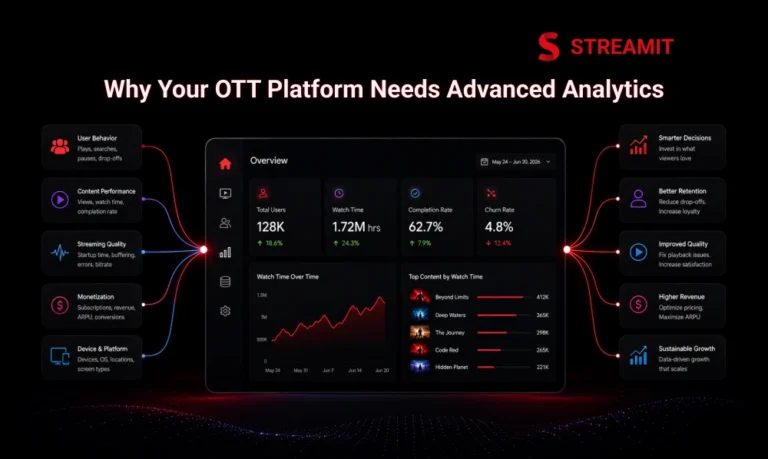
Analytics to understand what users watch, skip, search, and leave
Analytics should answer practical questions. What do users finish? Where do they drop? What do they search? Which devices create issues?
These insights help teams improve OTT retention with evidence, not guesswork.
Part 10
White Label, Low Code, or Custom OTT Solution: Which Supports Engagement Better?
The cheapest launch path can become expensive when engagement control is limited. The right choice depends on stage, budget, speed, and long-term ambition.
| Solution Type | Best For | Engagement Control |
|---|---|---|
| White label OTT solution | Fast launch | Moderate |
| Low code OTT solution | Simple workflows | Limited to moderate |
| Custom OTT solution | Serious growth | High |
The important question is not “Which is faster?” The better question is “Which gives us enough control when users grow?”
When a white label OTT solution makes sense
A white label OTT solution can work when speed matters and the engagement needs are simple. It helps teams go live without building everything from scratch.
However, teams should check how much control they get over discovery, analytics, playback, and subscriptions.
When low code OTT solutions may limit engagement control
Low code OTT solutions can be useful for basic platforms, but they may limit deeper customization.
As the platform grows, teams may need more control over personalization, data, infrastructure, and user journeys.
When custom OTT platform development gives more control
Custom OTT platform development gives teams more control over experience, performance, and long-term roadmap.
For serious streaming businesses, control is not a luxury. It protects retention, margins, and future growth.
Part 11
How to Measure OTT Subscriber Engagement and Retention
You cannot improve engagement if you only track total views. Views matter, but they do not explain loyalty.
| Metric Type | What to Track |
|---|---|
| Engagement | Return frequency, watchlist adds, search usage |
| Playback | Buffering rate, start time, playback errors |
| Retention | Churn rate, renewal rate, inactive users |
| Discovery | Click-through rate, content depth, zero-search results |
A good analytics system should connect behavior with action. Data is only useful when it helps the team make better decisions.
Engagement metrics to track
Track return frequency, average sessions per user, search usage, watchlist activity, continue-watching usage, and content variety.
These OTT engagement metrics show whether users are building a platform habit.
Playback and retention metrics to track
Track video buffering, playback errors, failed starts, device-level issues, churn rate, and inactive subscriber patterns.
These metrics help teams reduce churn before it becomes visible in revenue reports.
Part 12
Choosing an OTT Solution Built for Engagement, Not Just Streaming
Streaming is the baseline; engagement is the business layer. Any platform can play video. Fewer platforms are built to retain users when growth becomes real.
The best OTT solution should support discovery, playback, personalization, analytics, monetization, and ownership from the beginning.
Questions to ask before choosing an OTT solution provider
Ask how the platform handles traffic spikes, multi-device viewing, personalized recommendations, CDN delivery, analytics, subscriptions, and long-term ownership.
Also ask what happens when your platform grows. A good OTT solution provider should think beyond launch week.
Summary
Key Takeaways
Binge-watching does not guarantee loyalty
It may increase watch time for a short period, but real retention depends on how often users return after the binge ends.
Discovery directly affects retention
If users struggle to find the right content, even a strong content library can feel limited and lose value.
Playback quality builds subscriber trust
Buffering, slow video starts, and playback errors can damage the viewing experience and increase churn.
Personalization should support the full journey
Home screens, thumbnails, search results, watchlists, and notifications should all respond to user behavior.
Platform control becomes critical at scale
Growing OTT businesses need ownership, analytics, performance control, and flexible infrastructure, not just a basic video app.
Wrap-up
Conclusion
The next stage of OTT growth will not be won by platforms that only chase watch time. It will be won by platforms that understand user behavior, reduce friction, and create reasons to return.
Binge-watching is still valuable, but it is only one part of OTT subscriber engagement. The real opportunity is to build a platform where discovery, playback, personalization, analytics, and retention work together.
For founders and operators, this is the strategic shift. Do not build only for the first play. Build for the next visit, the next device, the next season, and the next year.
FAQs
Frequently Asked Questions
-
What is OTT subscriber engagement?
OTT subscriber engagement is how actively users watch, search, save, resume, and return to a streaming platform. It shows whether users are building a real habit beyond one viewing session.
-
Why is binge-watching not enough for OTT subscriber retention?
Binge-watching can increase watch time, but it does not always create long-term loyalty. Users may leave after finishing one show if the platform gives them no clear reason to return.
-
How can OTT platforms keep subscribers engaged after a binge ends?
OTT platforms can recommend the next content path, use continue-watching prompts, create personalized rows, and send relevant return reminders. The goal is to guide users before the post-binge drop-off begins.
-
What are the best ways to reduce OTT churn?
The best ways are better discovery, smoother playback, stronger personalization, useful analytics, and early churn signal tracking. Retention improves when teams act before users cancel.
-
What metrics should OTT platforms track for subscriber engagement?
Track return frequency, watchlist activity, search usage, content completion, playback errors, buffering, and inactive user patterns. These metrics show both interest and friction.
-
What type of OTT solution is better for subscriber engagement?
A custom OTT solution usually gives more control over discovery, analytics, playback, and user journeys. White label or low code can work for simpler launches, but control becomes important as the platform grows.