OTT Retention: The Biggest Lie Streaming Platforms Tell Themselves


Streaming founders often tell themselves a convenient story: if the content library gets bigger, retention will take care of itself.
That story sounds reasonable, but it breaks under real usage. Deloitte’s 2025 Digital Media Trends found that 39% of consumers had canceled at least one paid SVOD service in the prior six months, and churn rises above 50% for both Gen Z and millennials. That is not a content supply problem alone. It is a product, value, and experience problem.
The harder truth is this: content may win the first visit, but it rarely secures the fifth, the tenth, or the monthly renewal by itself. Mux found that even one buffering event can reduce video watch time by 39%, which means a platform can lose attention before content quality even gets a fair chance.
For serious OTT businesses, retention is not a creative slogan. It is an operating discipline. It sits at the intersection of content discovery, playback quality, pricing logic, device continuity, and habit-building product design.
Streamit’s own retention and monetization thinking points in the same direction: the platforms that grow sustainably are the ones that align content, experience, and business model instead of treating retention as a side effect.
The Biggest Lie About OTT Retention Is That Content Alone Is Enough
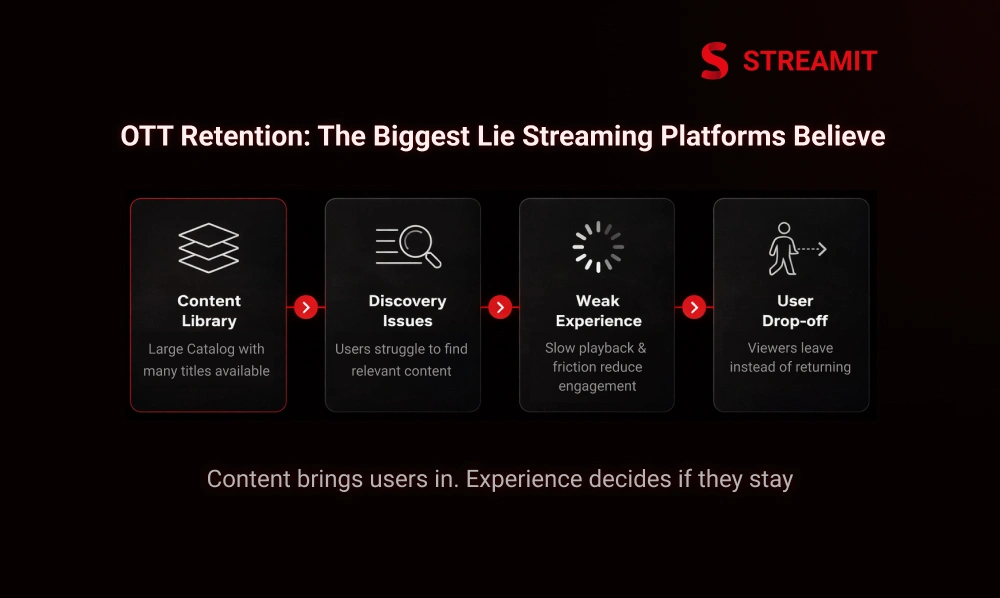
The most expensive mistake in OTT is confusing content acquisition with retention strategy. A larger library can improve acquisition, brand perception, and catalog depth, but it does not automatically create viewer loyalty. In a market shaped by price sensitivity, subscription fatigue, and rising expectations, retention belongs to the full experience, not just to the title count.
Many streaming platforms think that more content will solve retention
This is where many platforms overspend and underdiagnose. When churn rises, teams often react by buying more titles, adding more rows, and increasing release volume. That can create the appearance of momentum, but it does not fix the conditions that make viewers drift away in the first place.
More content feels like progress because it is visible. You can market it. You can pitch it. You can announce it. But viewers do not renew because the library is large in theory. They renew because the platform keeps feeling useful in practice.
A big content library does not guarantee repeat viewing
A large catalog often creates the illusion of value before it creates actual usage. Founders may point to title count as proof that the service is competitive, but viewers judge value in a much simpler way: “Did I find something worth watching quickly, and did the experience make me want to come back?”.
If the answer is no, the library becomes background noise. A thousand titles do not help if the right one is buried, mislabeled, badly surfaced, or disconnected from the viewer’s current mood. In that environment, scale becomes clutter.
Users leave when content feels hard to find or easy to forget
The content problem is often a discovery problem wearing a content costume. If users browse for too long, they feel the platform is making them work. If they leave without a strong next option, the platform becomes forgettable. And once a streaming habit becomes forgettable, churn usually follows.
This is why the strongest platforms do not just store content well. They stage it well. They make good content easier to notice, easier to choose, and easier to return to.
Content can attract users, but it does not always keep them
Acquisition answers, “Can we get attention?” Retention answers, “Can we keep earning it?” Those are different jobs. Many OTT platforms are better built for the first than the second.
A premiere, a sports event, or a strong launch campaign can drive subscriptions. But once the first burst of attention fades, viewers begin judging something else entirely: convenience, trust, continuity, and relevance. That is when retention stops being a content conversation and becomes a product conversation.
Viewers stay when the platform keeps giving them reasons to return
Retention is usually built through repeated small wins, not one big release. A useful home screen, a strong “continue watching” row, a timely reminder, a relevant recommendation, or a smooth transition from mobile to TV does more long-term work than most teams admit.
That is the founder-level shift: the return visit is not earned only by what is new. It is earned by how consistently the platform reduces friction around what matters to the user.
Retention drops when the full viewing experience feels weak
A weak end-to-end experience can quietly cancel out strong content investment. Users may like the shows and still abandon the service because playback is unstable, search feels poor, billing feels inflexible, or the interface slows them down.
Avekshaa’s OTT performance analysis makes this point clearly: slow load times, buffering, poor resolution, app crashes, and compatibility problems all damage satisfaction and raise churn risk. In other words, the library may be fine while the product around it is leaking value.
Why OTT Platforms Lose Users Even When They Have Good Content
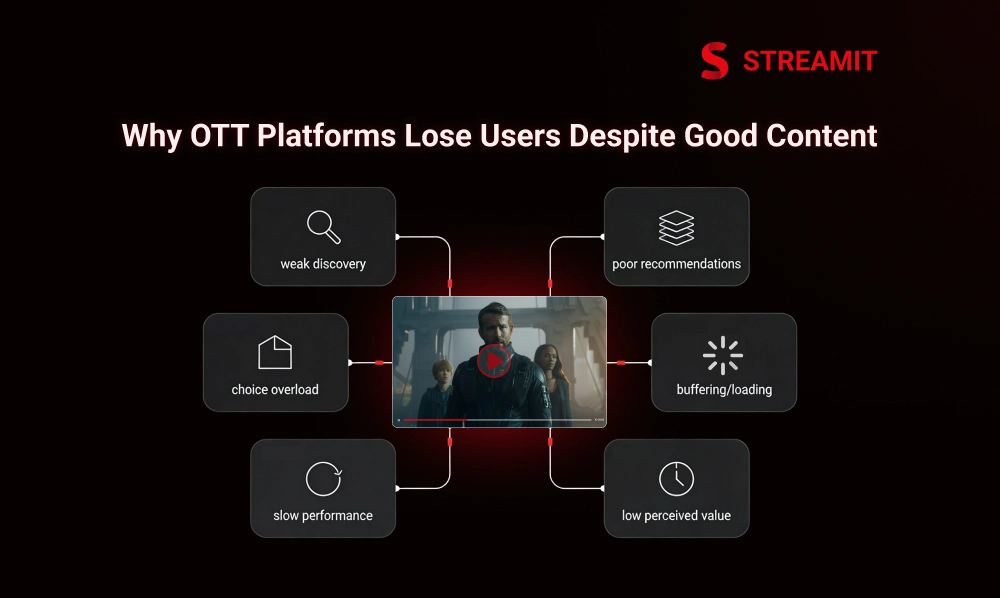
Good content does not protect a weak platform from churn. That is one of the least comfortable truths in streaming. Users do not evaluate content in isolation. They evaluate the total effort required to enjoy it.
If discovery is weak, content feels worse than it is. If playback is unstable, premium content feels disposable. If pricing feels rigid, even loyal users start reassessing the subscription. Retention falls not because the catalog lacks quality, but because the full service stops feeling worth the effort.
Poor content discovery reduces watch time and repeat sessions
When users cannot find something relevant quickly, watch time becomes fragile. Discovery is not a cosmetic layer. It is one of the core systems behind viewer retention.
The home screen, recommendations, search behavior, metadata quality, editorial rows, watchlists, and continuation logic all influence whether a user settles into viewing or exits the app. TribalScale frames personalization as the foundation of the modern user experience, not a bonus feature. That framing is correct. Discovery is how a library turns into a habit.
Too many choices can make the platform feel confusing
Choice overload is not abundance from the viewer’s perspective. It is decision fatigue. When a platform presents too many undifferentiated options, users browse longer, trust the interface less, and often leave with the feeling that nothing worth watching was available.
That creates a damaging contradiction: the platform may be content-rich, yet the user experiences it as low value. This is one reason why curation often outperforms raw volume. Clear pathways beat crowded shelves.
Weak recommendations make good content less useful
A recommendation engine does not need to be clever first. It needs to be useful. Weak suggestions waste strong titles because they surface them at the wrong time, to the wrong viewer, in the wrong order.
TribalScale’s view that the best platforms treat personalization like creative direction is useful here. Recommendations should not feel like random database output. They should feel intentional, timed, and context-aware. When that happens, content becomes easier to trust and more likely to convert into repeat sessions.
Performance issues push viewers away faster than most teams expect
Performance problems destroy patience much faster than most roadmaps account for. Founders may treat playback issues as technical debt to clean up later, but viewers treat them as broken promises in the present.
This is why performance work is not just engineering hygiene. It is retention work. It protects watch time, trust, and monetization at the same time.
Buffering, lag, and poor video quality break viewer trust
One interruption can do outsized damage. Mux’s research found that a single buffering event leads to 39% less time spent watching video, and median session length drops sharply after interruptions. That is not a small optimization story. That is direct revenue and retention risk.
In live or premium contexts, the damage is even sharper because the viewer’s expectation is higher. A sports stream, a finale, or a paid event does not get many second chances. When quality dips, trust dips with it.
Slow apps and playback errors increase drop-off
Users rarely describe technical frustration in technical language. They simply stop coming back. Slow start times, failed loads, app crashes, and playback errors show up later as reduced session depth, lower renewal confidence, and weaker word of mouth.
Avekshaa notes that repeated loading and playback issues increase churn and reduce lifetime customer value. That should change how OTT teams prioritize roadmaps. Stability is not maintenance work sitting behind growth. Stability is growth protection.
Users also leave when the value feels low
Churn often rises before users say, “The content is bad.” More often, they decide the subscription no longer feels proportionate to the time they spend, the friction they tolerate, or the alternatives now available.
This is where retention and monetization become inseparable. A price can be objectively reasonable and still feel expensive if usage keeps falling.
A subscription feels expensive when usage keeps falling
Perceived value drops faster than price changes. If a user watches less, browses more, or struggles to find something relevant, the monthly fee starts to feel heavier even if it has not changed.
Deloitte’s 2025 research points directly to rising service costs and price sensitivity as contributors to persistent churn. That is why retention teams cannot ignore pricing logic. Value is not only about what is offered. It is about whether the platform makes that value easy to feel.
Better competitors raise user expectations
Users do not compare your service to your last release. They compare it to the best experience in their stack. If another platform offers cleaner discovery, better device continuity, simpler bundles, or more flexible plans, your weaknesses become more visible.
That is part of why churn remains elevated across the sector. The market has trained users to switch, trial, cancel, and return with very little hesitation. Deloitte’s work on streaming bundles also highlights the rise of “serial churners,” reinforcing how comfortable users have become with moving between services.
This table shows how retention issues are often misread inside OTT teams. It summarizes the more useful diagnosis.
| What teams usually see | What is often really happening | Retention effect |
| Large library, weak repeat viewing | Discovery is poor, and relevance is inconsistent | Users browse more than they watch |
| Good sign-ups, weak renewals | Initial curiosity is higher than ongoing value | Churn rises after the first cycle |
| Strong content, low session depth | Playback friction is breaking engagement | Trust drops before teams notice |
| High mobile usage, weak return on TV/web | Cross-device continuity is weak | Habits fail to carry across contexts |
| Good acquisition, flat watch time | Home screen and onboarding are underperforming | The platform never becomes routine |
What Actually Improves OTT Retention
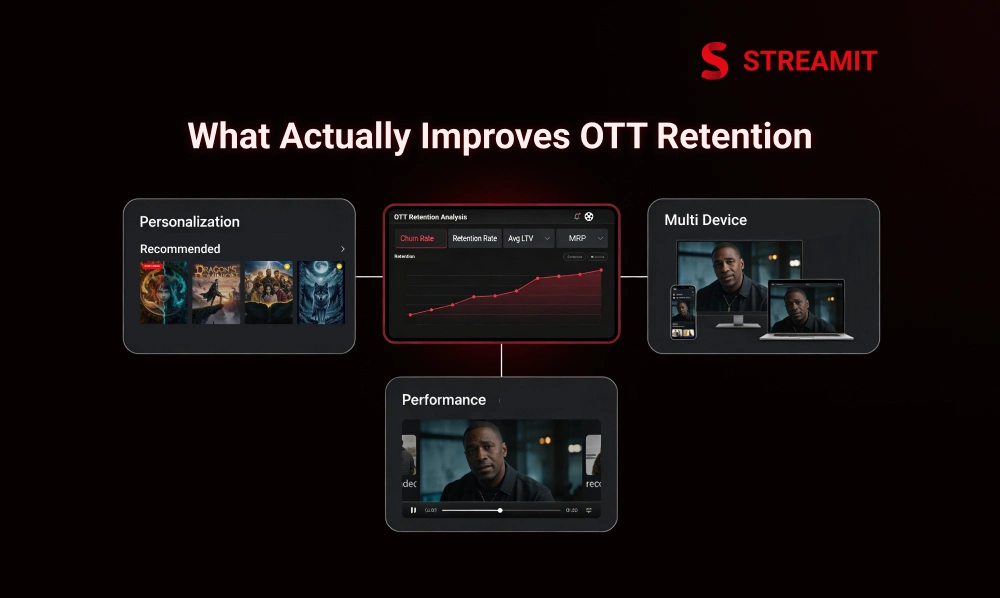
Retention improves when platforms make watching easier, faster, and more personally relevant. The strongest gains usually do not come from one dramatic feature. They come from coordinated improvements across personalization, performance, and continuity.
That is also why retention should be treated as a systems problem. Isolated upgrades help, but compounded experience improvements create the real shift.
Personalization helps users find the right content faster
The real job of personalization is not to impress. It is to reduce decision time. When users feel understood quickly, the platform starts behaving like a trusted guide rather than a crowded warehouse.
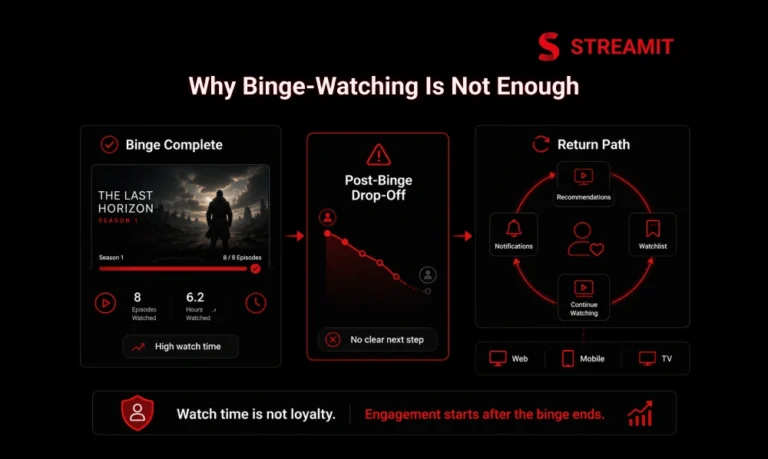
Streamit’s own retention thinking emphasizes that audiences now expect platforms to understand them, reduce friction, and give them a reason to return beyond a one-time binge. That is exactly the right lens. Personalization is valuable because it lowers effort.
Personalized rows and suggestions improve content discovery
A good home screen shortens the distance between intent and play. Personalized rows, context-aware suggestions, and meaningful “because you watched” logic can move users from browsing to watching much faster.
This does not require theatrical complexity. It requires clean behavioral logic, reliable metadata, and a recommendation system trained to prioritize relevance over noise.
Relevant content makes users more likely to come back
Return behavior improves when users feel the platform remembers them. Relevance signals continuity. It tells users that the service is not resetting every time they open it.
That matters because loyalty is often emotional in a quiet way. The user may never say, “This platform understands me.” They simply keep opening it because it feels easier than the alternatives.
Strong streaming performance protects retention
Playback quality is one of the clearest forms of product trust. Users may not notice perfect streaming memorably, but they notice broken streaming immediately.
Teams often talk about performance as an engineering KPI. That is useful internally, but the business meaning is simpler: stable playback protects time spent, protects confidence, and protects revenue.
Fast start times and stable playback keep users watching
A faster start makes the platform feel lighter, more responsive, and more dependable. Mux’s analytics guidance also notes that rebuffering percentage should ideally stay under 1%, while rates above 3% signal serious delivery problems. The implication is direct: quality thresholds matter because user tolerance is low.
Stable playback is especially important on bigger screens and during high-intent sessions. Once the viewer has committed to watching, the platform’s job is to stay out of the way.
Better performance reduces frustration and churn
Performance improvements often look small on a sprint board and large in customer behavior. Better load time, fewer errors, stronger bitrate adaptation, and stronger OTT infrastructure resilience reduce the slow accumulation of frustration that leads to cancellation later.
Avekshaa also notes that performance issues reduce ad impressions in ad-supported environments because viewers exit before more ads can be shown. That means performance protects not only subscriptions, but monetization efficiency as well.
Multi-device continuity makes the platform easier to use
A streaming habit breaks when the experience resets across devices. Viewers now expect to move between phone, TV, tablet, and web without losing context.
This is not a luxury feature. It is baseline convenience. A platform that feels fragmented across devices starts feeling smaller than it really is.
Users want to switch between mobile, TV, and web without friction
The modern viewer does not consume in one environment. They may discover on mobile, continue on TV, and revisit on the web. If the interface, access state, or playback logic feels inconsistent, the service creates unnecessary effort.
That effort is rarely dramatic enough to trigger a support ticket. It is simply enough to reduce return frequency.
Watch history and playback sync improve repeat usage
Continuation features protect momentum. Watch history, synced playback position, watchlists, and recently viewed content help users resume without rethinking. That makes repeat viewing easier and more likely.
This is where retention becomes operationally practical. A user who can resume instantly is much closer to another session than a user who has to remember, search, and manually recover context.
OTT Retention Is Also a Product and Monetization Problem
Retention gets stronger when the business model supports the user journey instead of fighting it. Too many OTT platforms treat monetization and user experience as separate conversations. In practice, they shape each other every day.
Pricing affects perceived value. Tiering affects accessibility. Ad load affects patience. Bundling affects cancellation pressure. Revenue design is part of retention design.
Retention improves when pricing matches user value
A good pricing strategy not only maximizes revenue per user. It protects fit. When the plan structure aligns with behavior, the platform keeps more users active inside the ecosystem.
This matters because not every viewer wants the same commitment level. Some want premium access. Some want lower-cost entry. Some want flexibility.
Flexible plans can reduce cancellations
Rigid pricing often turns temporary hesitation into permanent churn. Annual discounts, lighter tiers, pause options, or event-based upgrades can preserve the relationship even when full-price monthly subscriptions feel too heavy.
Deloitte reports that over half of US consumers would trade a discount for a year-long subscription, yet annual terms remain underused in many streaming offers. That gap matters because pricing flexibility can reduce the easy, monthly exit behavior the market has normalized.
Hybrid monetization can keep more users in the funnel
Not every user who leaves SVOD is lost demand. Some are simply a misfit demand. A lower-cost or ad-supported option can keep them in the ecosystem rather than forcing an all-or-nothing choice.
Streamit’s monetization framework highlights hybrid models as a practical standard for modern video businesses, while TribalScale describes FAST and AVOD as discovery engines that widen reach and create upsell paths. That is the right strategic view: hybrid monetization is not only about revenue diversity. It is also about retention elasticity.
Platforms need habit-building features, not just content uploads
Habit is one of the most undervalued assets in OTT. If users only return when they consciously remember the platform, retention will stay fragile.
The stronger model is simple: reduce the number of moments when the user has to start from zero. Keep the relationship warm between major viewing sessions.
Notifications and new-release alerts bring users back
Well-timed reminders work because they reduce memory burden. They reconnect users to unfinished series, fresh releases, saved watchlists, or upcoming live events.
Used carefully, these features do not feel aggressive. They feel helpful. They transform passive interest into timely return behavior.
Live events and fresh content drops can increase return visits
Shared moments create stronger return rhythms than static catalogs alone. TribalScale calls live programming a loyalty engine, and that is a useful framing. Live content creates urgency, community, and appointment behavior that on-demand libraries often struggle to produce on their own.
The same logic appears in sports-specific OTT analysis from AISTS, which notes that product differentiation and additional revenue experiences beyond core rights can act as retention tools. In practical terms, live events, community layers, highlights, premium windows, and non-live extensions all help a platform become more than a shelf of videos.
The OTT Retention Metrics That Show the Real Problem
Subscriber count alone hides too much. A platform can look healthy on paper while weakening underneath. Retention becomes clearer when teams measure how often users return, how deeply they watch, where they drop, and how smoothly they experience playback.
This is why serious OTT operators need a tighter measurement model. Retention is not one number. It is a pattern across behavior, quality, and value.
Retention should be measured beyond subscriber count
The right metrics reveal whether the platform is becoming part of the viewer’s routine. That is the real question.
Subscriber totals are useful for board updates, but they are too blunt for diagnosis. What matters is whether users are watching more, returning more often, and encountering less friction over time.
Churn rate, watch time, and repeat sessions matter most
These three metrics usually tell the most honest story first. Churn rate shows leakage. Watch time shows real value capture. Repeat sessions show whether the platform is becoming habitual.
If one is moving in the wrong direction, teams should not wait for renewal data to confirm the problem. The signal is already there.
Discovery and completion data show where users lose interest
You cannot improve retention if you only measure exits. You also need to measure hesitation. Recommendation CTR, search success, completion rate, watchlist usage, and drop-off by row or title type all show where the platform stops converting interest into engagement.
Logituit’s engagement framework also emphasizes measuring depth beyond raw viewing, including watchlists, ratings, and interaction patterns. That is useful because deeper interaction often signals a platform becoming stickier, not just consumed.
Testing is needed to improve retention over time
Retention rarely improves through opinion alone. It improves through testing, measurement, and disciplined iteration.
That may mean testing recommendation logic, layout order, onboarding flows, pricing presentation, trailer autoplay behavior, or the structure of the home screen. Small product decisions can compound into meaningful retention changes.
Platforms should test recommendations, pricing, and home screen changes
The home screen is not a static design asset. It is a revenue surface. The same is true of packaging and recommendation pathways.
If teams are not testing these areas, they are leaving retention improvement to instinct. For founder-led platforms, that is an avoidable risk.
Small product changes can improve long-term retention
The most durable gains often come from modest changes repeated consistently. Cleaner continue-watching logic. Better resume prompts. Faster load time. Smarter row order. Clearer plan positioning. These are not glamorous changes, but they are the kind viewers feel.
This table shows the metrics that usually expose the real retention problem faster than subscriber count alone.
| Metric | What it shows | Healthy direction | Warning sign |
| Churn rate | How many paying users leave | Stable or declining | Spikes after billing cycles or content gaps |
| Watch time per user | Real usage depth | Rising over time | Flat or falling despite new releases |
| Repeat sessions | Return behavior | Frequent weekly returns | One-time spikes with weak follow-up |
| Recommendation CTR | Discovery relevance | Strong click-through on surfaced titles | Heavy browsing, low clicks |
| Completion rate | Content fit and engagement quality | Consistent finish behavior on key titles | Early abandonment across episodes or categories |
| Rebuffer ratio | Playback stability | Kept low, ideally under 1% | Above 3% indicates serious issues |
| Playback error rate | Technical reliability | Declining over time | Repeated failures on key devices |
| Cross-device continuation | Continuity strength | Users resume easily across screens | Viewing drops when device context changes |
How Streaming Platforms Can Build a Better OTT Retention Strategy
Retention strategy gets better when teams diagnose before they add. More content, more rows, and more campaigns are often the wrong first move.
The better move is to find where value is leaking. Then fix that leak before expanding the offer.
Find the real cause of churn before adding more content
Churn is rarely one problem. It is usually a stack of smaller failures. Some users leave because the content depth is weak. Others leave because discovery is poor, the app is unstable, the price feels mismatched, or the platform never became part of their routine.
That is why retention work should start with segmentation, not assumptions. Look at device patterns, plan types, session depth, cancellation timing, and behavior before churn. Then act.
Separate content issues from performance, pricing, and UX issues
When every retention problem gets labeled “we need more content,” the diagnosis has already gone wrong. Content issues are real, but they are only one branch of the problem tree.
The more useful question is: where exactly did the value break down? Before play? During playback? At renewal? Across devices? In that answer, the roadmap becomes much clearer.
Fix the biggest drop-off points first
A practical retention strategy starts with the sharpest friction, not the broadest ambition. If playback is unstable, fix the playback. If home screen engagement is weak, fix discovery. If renewal drops after month one, revisit pricing and onboarding.
That discipline matters more than trying to improve everything at once.
Focus on the full viewing experience, not just the content library
The platforms that keep users are not just content-rich. They are decision-light. They remove effort across the whole journey.
This includes first-run onboarding, search confidence, row structure, playback quality, reminder systems, billing clarity, and continuation across devices. Users do not separate these things in their minds. They experience them as one product.
Improve onboarding, discovery, playback, and continuity together
Retention rises faster when improvements are coordinated. Better onboarding tells the platform what the user wants. Better discovery surfaces the right titles. Better playback protects the session. Better continuity protects the next one.
Viewed together, these changes do not just reduce churn. They increase the odds that the platform becomes part of a weekly routine.
Build a platform users want to return to every week
The weekly return is the real strategic goal. Not the install. Not the trial. Not even the first binge.
A platform starts becoming durable when users open it without needing a campaign to remind them. That is what strong retention really measures: whether the service has earned recurring mindshare.
The Truth About OTT Retention
Content matters. It just does not matter alone. The streaming platforms that win are not simply buying more shows. They are building a stronger system around the act of watching.
That is the real correction to the biggest lie in OTT. Retention is not the automatic result of a large library. It is the outcome of aligned product thinking.
Content matters, but it is only one part of retention
A good catalog remains essential, but it is no longer enough to carry weak execution. The market is too mature, the switching cost is too low, and viewer expectations are too shaped by better alternatives.
Founders who understand this early spend differently. They still invest in content, but they also invest in discovery, performance, continuity, pricing flexibility, and measurement discipline.
Retention improves when content, product, and performance work together
This is where the strongest OTT businesses pull away from the crowded middle. They understand that retention is created by coordination, not by volume.
When content quality, discovery relevance, and playback stability reinforce each other, the platform starts to feel dependable. That feeling is what keeps revenue more stable over time.
The platforms that win make watching easier, faster, and more valuable
That is the real retention advantage. Not louder branding. Not inflated catalogs. Not “Netflix clone” positioning.
The winners make the viewer’s decision easier. They make the stream more reliable. They make the subscription feel justified.
Key Takeaways
- The Biggest Retention Mistake: This blog explains that one of the biggest lies streaming platforms tell themselves is that content alone is enough to improve OTT retention. A large content library may attract users, but it does not guarantee they will stay.
- Content Alone Does Not Reduce Churn: Strong content can drive sign-ups, but OTT churn often happens when viewers struggle to find relevant titles, lose interest quickly, or do not feel enough value in the full platform experience.
- Content Discovery Shapes Viewer Retention: Poor content discovery reduces watch time, repeat sessions, and overall engagement. When users cannot find the right content quickly, even a strong library starts to feel weak.
- OTT Personalization Improves Return Visits: Personalization helps viewers discover relevant content faster. Features like personalized rows, smart suggestions, and relevant recommendations make users more likely to return.
- Streaming Performance Directly Affects Retention: Buffering, playback errors, lag, slow app speed, and poor video quality damage trust quickly. Strong OTT platform performance is essential for protecting viewer retention and reducing drop-off.
- Multi-Device Streaming Supports Better Retention: Users expect a smooth experience across mobile, TV, tablet, and web. Features like watch history, playback sync, and cross-device continuity make the platform easier to return to.
- Retention Is Also a Monetization Problem: OTT retention is closely tied to pricing and monetization strategy. Flexible plans, better pricing fit, and hybrid monetization models such as SVOD and AVOD can reduce cancellations and keep more users in the funnel.
- Habit-Building Features Matter: Notifications, release alerts, live events, and fresh content drops help create return behavior. Platforms improve streaming retention when they give users regular reasons to come back.
- Better OTT Retention Comes From the Full Experience: The blog’s core message is that platforms improve OTT retention when content, discovery, performance, continuity, and monetization work together. The platforms that win make watching easier, faster, and more valuable.
Netflix Retention Playbook
The Netflix retention playbook focuses on improving engagement through personalized discovery and smooth streaming performance. Platforms that combine recommendations and a strong user experience retain viewers longer.
Netflix AI Framework Playbook
The Netflix AI Framework Playbook explains how streaming platforms use AI to analyze viewer behavior and deliver personalized content recommendations. This approach improves discovery, engagement, and long-term subscriber retention across the platform.
Conclusion
The biggest lie streaming platforms tell themselves is that retention is mainly a content problem. It is not.
Content opens the door. Retention is decided by what happens after the door opens: how fast viewers find something relevant, how smoothly they can watch it, how easy it is to return on another device, and whether the pricing still feels fair as usage changes.
For founder-led OTT businesses, that distinction matters. Because once you stop treating churn as a catalog issue alone, the roadmap becomes smarter. You stop buying noise. You start building systems that protect loyalty.
That is where stronger OTT businesses are made.
FAQs
Why do OTT platforms struggle with retention even after adding more content?
Because churn is often caused by weak discovery, unstable playback, poor pricing fit, or a fragmented user experience. More titles do not fix those issues on their own.
What is the biggest lie OTT platforms tell themselves about streaming retention?
The biggest lie is that content alone is enough. Content matters, but retention improves only when content, product, performance, and monetization work together.
Why do viewers leave a streaming platform after subscribing?
Users often leave because they cannot quickly find relevant content, the platform feels unreliable, the value no longer matches the price, or a competitor offers a smoother experience.
How can OTT platforms keep users coming back every week?
They need strong discovery, stable playback, cross-device continuity, timely reminders, fresh release rhythms, and a product experience that feels easy to return to.
What really improves OTT retention besides content?
Personalization, better home screen design, faster start times, lower buffering, flexible pricing, watch history sync, and habit-building features all improve retention.
How can streaming platforms lower churn and increase subscriber loyalty?
Start by identifying the real cause of churn, then improve the highest-friction areas first. In most cases, that means fixing discovery, performance, pricing, and continuity before expanding the library.
Read Also
1. Why OTT Streaming Founders Fail Without Strong Retention
2. Netflix Retention Secrets OTT Platforms Must Learn
3. Subscriber Retention for OTT Platforms: 15 Proven Tactics to Reduce Churn
4. Smart Retention Engine: Driving Growth Through Smarter Monetization
5. 7 Reasons Why OTT Platforms Will Fail in 2026 Without Retention