Best OTT Platform Providers for Streaming Businesses


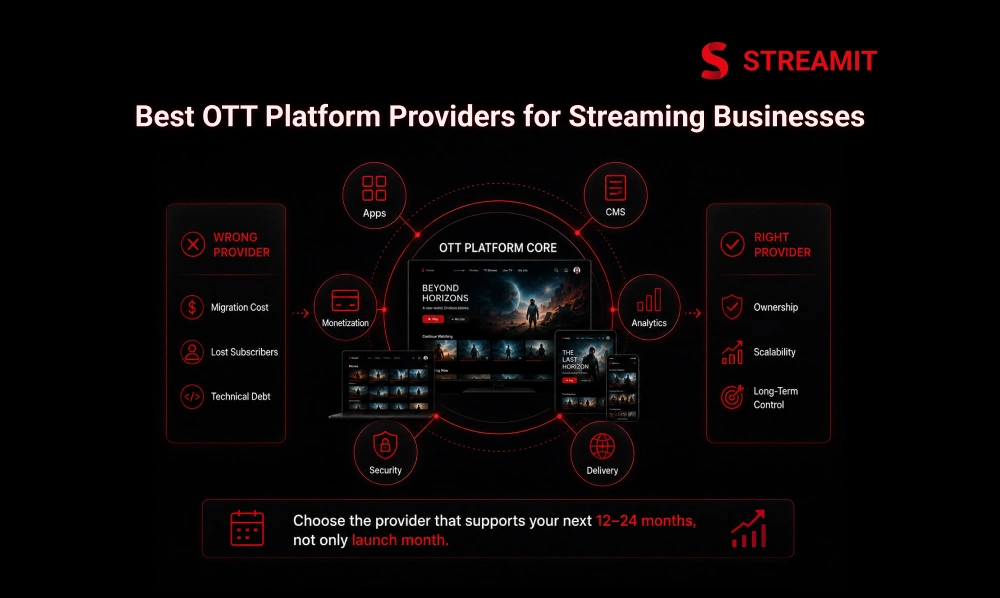
The wrong OTT platform decision can cost more in migration, lost subscribers, and technical debt than the platform itself. For a streaming business, choosing an OTT platform provider is not only about launching apps. It is about deciding who controls the audience, the revenue system, the data, and the future product roadmap.
A good OTT platform solution should support the business you are trying to build over the next 12 to 24 months, not only the app you want to launch this month. That is where most streaming businesses make the mistake. They compare features, but they do not compare ownership, flexibility, scalability, and long-term operating costs.
Foundations
What OTT Platform Providers Actually Do
A serious OTT provider solves more than playback. It solves delivery, monetization, content operations, subscriber management, and growth infrastructure. In simple terms, OTT platform providers help businesses distribute video content directly to viewers through the web, mobile, smart TVs, and connected devices.
The real value is not just the technology layer. It is the system behind the experience: how content is uploaded, how users discover videos, how payments work, how analytics are tracked, and how the platform behaves when traffic grows.
An OTT Platform Provider Is More Than Video Hosting
Video hosting stores content; an OTT platform turns content into a business. Hosting may help you upload and stream videos, but it does not always give you apps, subscription systems, branded experiences, user dashboards, analytics, or monetization control.
A proper OTT solution provider brings apps, content management, monetization, analytics, security, and streaming infrastructure together into one connected platform. That includes CMS, VOD, live streaming, payment gateways, apps, analytics, security, and support. This is why a cheap video tool often becomes expensive later.
Different Providers Solve Different Streaming Business Needs
Not every streaming business needs the same platform. A creator selling fitness memberships has different needs from a broadcaster managing live events or a media company planning a regional OTT platform.
Some OTT solution providers are better for memberships. Some are stronger for enterprise video workflows. Some focus on live streaming infrastructure. Others, like Streamit, are designed for businesses that want owned OTT apps, monetization flexibility, and long-term control across devices.
Choosing the Wrong Provider Can Slow Business Growth
The first platform decision often becomes a 2-year constraint. If the platform cannot scale, customize, or support your monetization model, your business starts adapting to the software instead of the software adapting to your business.
That is when growth becomes slower. Teams delay new pricing plans, struggle with TV app support, lose data visibility, or face migration costs. A smart OTT platform comparison should look beyond launch speed and ask: will this platform still make sense after 50,000 users?
Evaluation
What to Compare Before Choosing an OTT Platform Provider
The best OTT solution is not the one with the longest feature list. It is the one that matches your business model. Before selecting a provider, compare the platform against your content type, audience behavior, monetization strategy, and future expansion plans.
| What to Compare | Why It Matters |
|---|---|
| App support | Determines where users can watch |
| CMS | Controls content operations |
| Monetization | Affects revenue flexibility |
| Analytics | Helps improve retention |
| Security | Protects content and revenue |
| Ownership | Decides long-term control |
| Support | Impacts launch and scale |
A platform that looks affordable at the start may become expensive if it limits branding, charges heavily for add-ons, or makes migration difficult later.
Apps, Web Experience, and Multi-Device Support
Viewers do not think in devices; they think in convenience. A streaming app must work smoothly across mobile, web, tablets, smart TVs, Fire TV, Chromecast, and other connected devices.
For serious OTT businesses, multi-device support is not a premium feature. It is the foundation. Streamit, for example, positions its entertainment streaming platform around mobile, web, smart TV, Chromecast, Fire TV, synced watch progress, and multi-device delivery.
Live Streaming, VOD, CMS, and Content Management
Content operations become harder when the library grows from 50 videos to 5,000. A strong OTT CMS should make it easy to upload, organize, tag, publish, schedule, and manage videos without depending on developers for every small change.
VOD platforms and live streaming tools should work together. If your business has events, originals, courses, sports, worship, or entertainment content, the platform must support both planned publishing and real-time streaming.
Monetization, Payments, Analytics, and Subscriber Management
Revenue is not one model anymore. Many OTT businesses need subscriptions, rentals, pay-per-view, ads, bundles, and hybrid pricing. Your platform should let you test pricing without rebuilding the product.
Analytics matter because streaming growth is rarely solved by more content alone. You need to understand watch time, drop-offs, active users, renewals, payment failures, and content performance. Without that, monetization becomes guesswork.
Security, DRM, APIs, and Scalability
A streaming business without security is leaving revenue exposed. DRM, secure authentication, role-based access, protected playback, and piracy monitoring become important as content value increases.
APIs also matter. They decide how easily your OTT platform connects with payment systems, marketing tools, CRM, analytics, and custom business workflows. If the platform is closed, every new requirement becomes a negotiation.
Pricing, Ownership, Support, and Long-Term Costs
OTT platform development cost should be measured over 24 months, not just the launch month. Subscription fees, app charges, storage, bandwidth, support, customization, and migration can change the real cost.
Ownership is the quieter but more important question. Ask who controls the code, data, app stores, customer information, analytics, payment flows, and roadmap. For mid-ticket and high-ticket streaming businesses, control is often worth more than a low monthly fee.
Comparison
Best OTT Platform Providers by Streaming Business Need
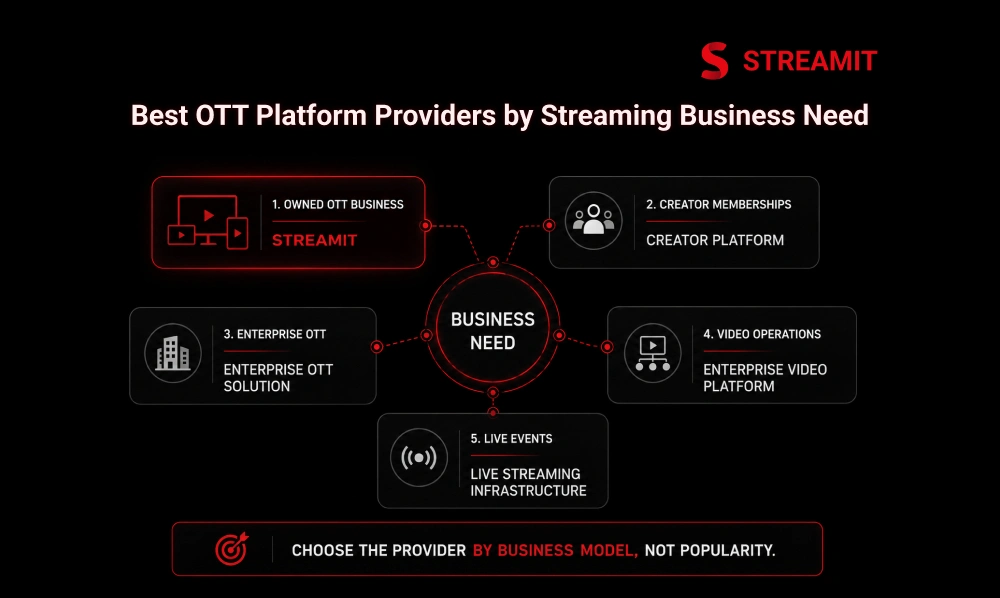
There is no single best OTT platform provider for everyone. There is only the best fit for your business model. A founder-led streaming business should compare providers based on operational need, not popularity.
| Business Need | Provider Type to Consider |
|---|---|
| Owned OTT business | Custom/owned OTT platform |
| Creator memberships | Creator monetization platform |
| Enterprise OTT | Enterprise OTT solution |
| Video operations | Enterprise video platform |
| Live events | Live streaming infrastructure |
The sharper your business needs, the easier the decision becomes.
Streamit for Businesses That Want an Owned OTT Platform
Streamit fits businesses that want to build a streaming business, not just publish videos online. It is positioned for founders, media houses, broadcasters, studios, and enterprises that need multi-device apps, monetization, CMS, analytics, security, and ownership in one OTT platform solution.
The biggest advantage is strategic control. Streamit is built for teams thinking about retention, content discovery, subscriber growth, monetization flexibility, and scalable infrastructure rather than a quick template launch.
Uscreen for Creator Membership Businesses
Creator-first platforms are useful when the business is built around a personality, community, or recurring membership. Uscreen focuses on video memberships, mobile and TV apps, live streaming, community, marketing tools, and monetization for creators and educators.
This type of provider works well when speed, community, and recurring creator revenue are the priorities. But if your business needs deeper ownership, custom workflows, or enterprise-level control, you should compare long-term limitations carefully.
Muvi and VPlayed for Enterprise OTT Platforms
Enterprise OTT platforms usually focus on broad feature depth and ready-made streaming infrastructure. Muvi One lists built-in CDN, DRM, multiple monetization models, online video player, and encoding/transcoding among its core features.
VPlayed positions itself as a customizable OTT platform for launching, managing, streaming, and monetizing video content across devices, with support for web, mobile apps, and smart TVs. These platforms may suit teams that want enterprise feature coverage, but the final choice should depend on ownership, flexibility, and support structure.
Brightcove and Kaltura for Enterprise Video Operations
Enterprise video platforms are often stronger for large-scale video workflows than founder-led OTT businesses. Brightcove positions itself around secure, scalable video hosting, sharing, streaming, and monetization for organizations.
Kaltura is often discussed in the context of enterprise video, media, telecom, learning, and large-scale video operations. It can be useful for companies with complex internal video requirements, but OTT founders should still compare app ownership, monetization control, and implementation effort.
Dacast, Wowza, and Castr for Live Streaming Infrastructure
Live-first businesses need reliability before they need beautiful interfaces. Dacast focuses on live streaming, video hosting, monetization, OTT, VOD management, APIs, and support for businesses and organizations.
Wowza is known for live streaming workflows and streaming infrastructure, including Wowza Video and Wowza Streaming Engine. Castr is often considered in live streaming and multistreaming contexts. These tools can be strong when live delivery is the core requirement, but they may not replace a full OTT business platform.
Decision Framework
The OTT Provider Test Most Businesses Skip
The real test is simple: are you buying a video tool or building a streaming company? Many businesses compare OTT platform providers too early, before they clearly define their business model.
A useful test is to map your next 12 months. Will you need TV apps, subscription plans, ad monetization, live events, analytics, regional catalogs, or multiple user roles? If yes, choose a provider that can grow with the business.
Decide Whether You Need a Video Platform or an OTT Business Platform
A video platform helps you distribute content. An OTT platform helps you generate revenue. This difference matters because streaming businesses need more than playback.
If you only need private videos or occasional live streams, a video platform may be enough. If you need subscribers, payments, branded apps, CMS, analytics, and retention systems, you need a full OTT platform solution.
Compare Long-Term Business Value, Not Just Feature Lists
Feature lists are easy to compare. Business value is harder but more important. Two platforms may both offer apps, payments, and analytics, but one may give you more control, better scalability, or easier customization.
Ask better questions. Can we change pricing easily? Can we access our subscriber data? Can we add new devices later? Can we migrate if needed? Can the platform support growth without forcing a rebuild?
Calculate Migration Cost Before Choosing Your First Provider
Migration is not just moving videos. It means moving users, payments, watch history, apps, data, SEO, and operations. That is why the cheapest first platform can become the most expensive later.
Before choosing, ask what happens if you outgrow the provider. If the answer is unclear, you are not comparing platforms properly. You are comparing launch packages.
Why Streamit
Why Streamit Fits Modern Streaming Businesses
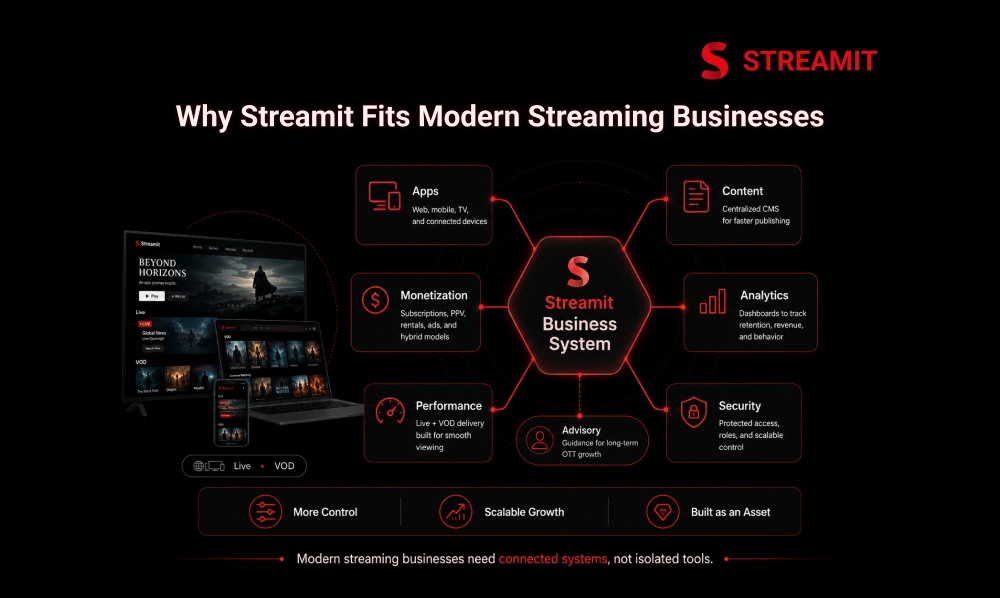
Modern streaming businesses need control, not just convenience. Streamit fits teams that want to launch with structure and scale with fewer technical compromises.
It is built around the idea that OTT is a business system: apps, content, monetization, analytics, performance, security, and advisory working together. That makes it more relevant for founders who are serious about long-term growth.
It Combines Apps, Monetization, Analytics, and Content Management
Most OTT problems are connected. Poor CMS affects publishing speed. Weak analytics affect retention. Limited monetization affects revenue. Streamit brings these layers into one platform direction.
Its entertainment streaming solution includes centralized content management, analytics dashboards, subscriptions, pay-per-view, rentals, ads, hybrid monetization, and audience engagement tools.
It Supports Live Streaming, VOD, and Multi-Device OTT Apps
A serious streaming platform must support how audiences actually watch. Some viewers watch on mobile. Some expect TV apps. Some watch live. Some binge VOD.
Streamit supports OTT and VOD use cases across mobile, web, smart TVs, Chromecast, Fire TV, and connected devices, with live and on-demand streaming possibilities depending on the business model.
It Gives Businesses More Ownership and Room to Grow
Ownership becomes more valuable as the audience grows. When the platform starts generating revenue, founders need more control over data, design, pricing, content strategy, and infrastructure.
Streamit is positioned for businesses that want to own and scale their OTT platform rather than stay locked into a generic template. For a $25K to $75K streaming project, that control is often the difference between launching an app and building an asset.
Summary
Key Takeaways
There is no single best OTT platform provider
The right choice depends on your business model, audience, content type, device needs, and growth plan.
Different businesses need different platform types
Streamit, Uscreen, Muvi, VPlayed, Brightcove, Kaltura, Dacast, Wowza, and Castr all solve different streaming needs, so the best option depends on what you are building.
Streamit fits owned OTT businesses
Streamit is a strong fit for founders, media houses, broadcasters, and studios that want apps, CMS, monetization, analytics, security, and more control.
Uscreen fits creator membership models
Uscreen can work well for creators, educators, and community-led brands that want to sell video subscriptions without building a fully custom OTT business.
Muvi, VPlayed, Brightcove, and Kaltura fit enterprise use cases
These platforms are often considered by larger teams that need enterprise video operations, broad infrastructure, and advanced streaming workflows.
Dacast, Wowza, and Castr fit live streaming needs
These tools are useful for live events, broadcasts, and real-time delivery, but they may not replace a full OTT business platform.
Feature lists are not enough
Compare ownership, scalability, customization, support, APIs, migration risk, and long-term business value before choosing a provider.
Wrap-Up
Conclusion
Most OTT platforms look similar during the demo. They become very different when your traffic, content library, and revenue expectations grow. That is why the best OTT platform providers should be judged by long-term business fit, not launch promises.
If your goal is to test a small video idea, a simple platform may be enough. But if your goal is to build, own, and scale a streaming business, Streamit gives you a stronger foundation with apps, monetization, analytics, content management, security, and room to grow.
FAQs
Frequently Asked Questions
-
How do I know if I need an OTT platform provider or custom development?
If you only need basic video delivery, a standard provider may work. If you need custom apps, ownership, advanced monetization, integrations, or scale, custom OTT development is usually the smarter direction.
-
Which OTT platform provider is best for subscription streaming businesses?
The best provider depends on your subscription model, audience size, and device needs. For a serious OTT business, choose a provider that supports subscriptions, analytics, apps, payments, and subscriber control.
-
Can I switch OTT platform providers without losing subscribers?
Yes, but it requires careful migration planning. You need to move user data, payment records, content, apps, watch history, and communication flows without damaging the viewer experience.
-
Do all OTT platform providers offer branded TV apps?
No, not every provider offers full branded TV apps. Some focus on web and mobile first, while others support smart TVs, Fire TV, Apple TV, Roku, or Chromecast, depending on the plan and setup.
-
Which OTT platform providers let me own my subscriber data?
This varies by provider and contract. Always ask who owns customer data, payment data, analytics, app accounts, and export rights before signing with any OTT solution provider.
-
What should I compare besides features when choosing an OTT platform provider?
Compare ownership, scalability, support quality, pricing structure, migration risk, customization, APIs, app roadmap, and total cost of ownership. These factors matter more as the business grows.
-
Which OTT platform provider is easiest to scale as my audience grows?
The easiest platform to scale is the one built for your expected traffic, devices, monetization model, and content operations from the beginning. Streamit is a strong fit when long-term control and scalable OTT infrastructure matter.