Muvi Alternatives for OTT Platforms and Streaming Apps


A streaming platform is not judged on launch day. It is judged after real users arrive, content grows, support requests increase, and monetization needs become more complex.
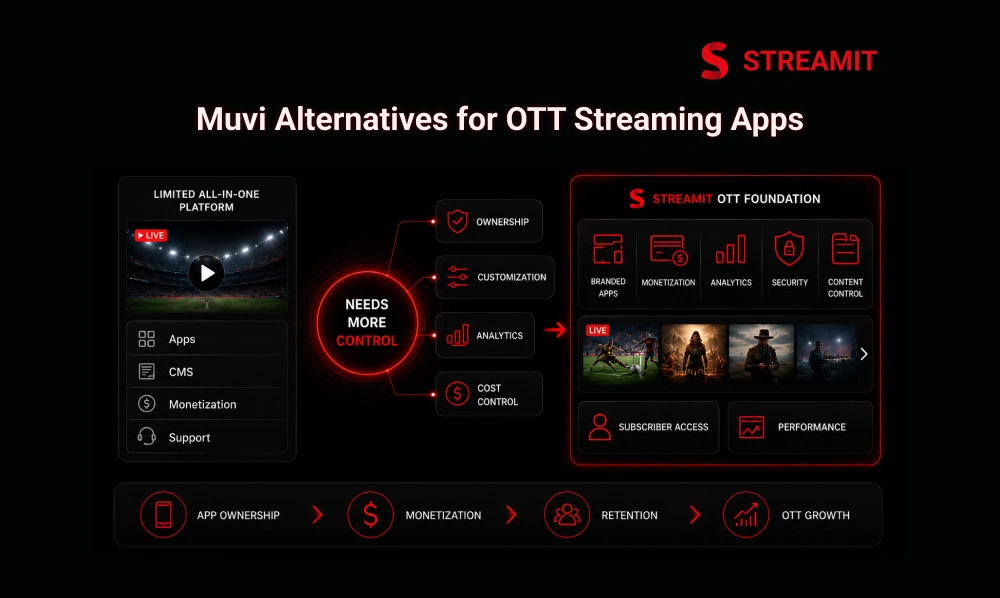
Muvi is a known option for teams that want an all-in-one OTT platform. But growing streaming brands often compare Muvi alternatives when they need more control over apps, costs, customization, ownership, and long-term platform direction.
Part 1
Why Teams Look for Muvi Alternatives
The first platform decision can shape the next 12 months of growth. A fast launch is useful, but it should not become a technical ceiling later.
Teams usually start comparing Muvi alternatives when their business moves from “we need to go live” to “we need to own the experience, revenue model, and roadmap.”
Muvi Works Well for All-in-One OTT Launches
A ready OTT solution can reduce early complexity. Muvi works well for teams that want CMS, apps, streaming, monetization, and security in one managed setup.
It helps brands launch faster without connecting multiple tools from different vendors. The trade-off appears later when deeper control becomes more important than convenience.
Growing Streaming Brands Often Need More Control Over Cost and Customization
Cost is rarely just the monthly plan. Apps, bandwidth, storage, live usage, support, custom work, and scaling needs can change the real platform cost.
Customization also matters. Once a brand needs unique pricing logic, deeper analytics, regional content rules, or app-level changes, a fixed platform can feel harder to shape.
The Right Alternative Depends on Your Apps, Monetization, and Growth Plan
There is no single best Muvi alternative for every streaming business. A fitness platform, sports broadcaster, education brand, and entertainment network need different foundations.
The smarter question is not “Which platform has more features?” It is “Which platform matches how this business will earn, scale, protect content, and retain users?“
Part 2
What to Compare in Muvi Alternatives
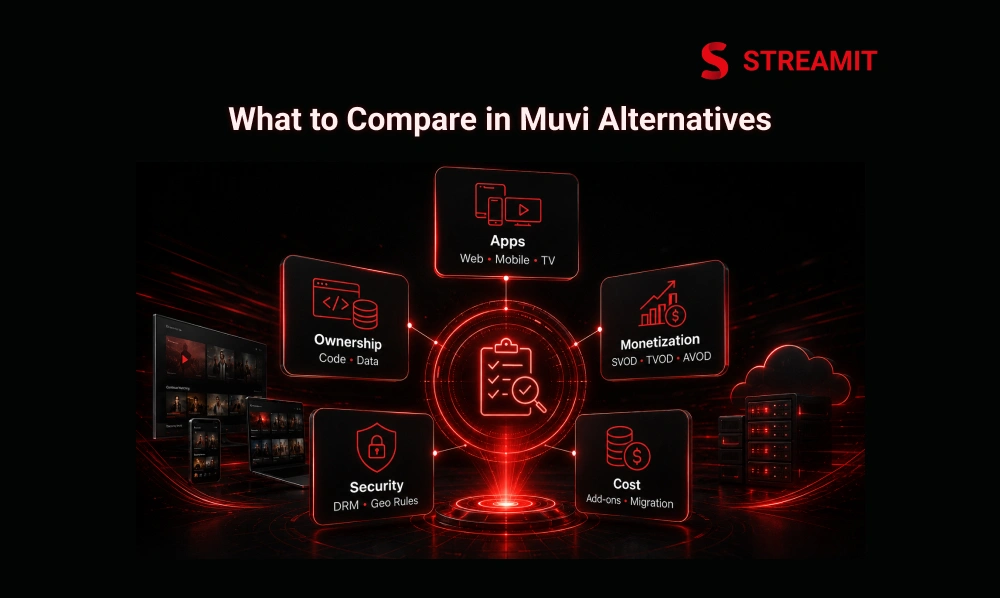
A good OTT platform comparison should look beyond launch features. The real comparison is ownership, operating cost, user experience, security, and future flexibility.
Use this simple view before shortlisting any streaming platform solution.
| Comparison Area | What to Check | Why It Matters |
|---|---|---|
| Apps | Web, mobile, TV, casting | Users expect access everywhere |
| Ownership | Code, data, infrastructure, roadmap | Prevents long-term dependency |
| Monetization | SVOD, TVOD, AVOD, bundles, coupons | Supports different revenue models |
| Security | DRM, geo-blocking, access rules | Protects premium content |
| Cost | Plans, add-ons, usage, migration | Reveals real total cost |
Web, Mobile, TV App Support, and App Ownership
A serious OTT business usually needs more than a website. Mobile apps, TV apps, casting, and consistent user experience across devices become important quickly.
App ownership is the deeper issue. If your brand cannot control design, release cycles, analytics, and user flows, growth decisions stay limited by the platform.
VOD, Live Streaming, CMS, and Content Management
Content operations become heavier after launch. Teams need clean VOD management, live workflows, metadata, categories, languages, seasons, trailers, and publishing control.
A strong OTT CMS should help teams move faster, not create operational drag. If content updates depend too much on support tickets, scale becomes harder.
Monetization, Payments, Security, and DRM
Monetization should fit the business model, not force the business into one model. Subscriptions, rentals, pay-per-view, ads, bundles, trials, and coupons all need room to work.
Security is equally important. DRM, user access rules, geo-blocking, device limits, and payment-linked entitlements protect both content and revenue.
Pricing, Add-Ons, Support, Migration, and Scaling Costs
A low starting price does not always mean a lower long-term cost. Add-ons, app fees, support upgrades, customizations, and infrastructure usage can change the math.
Migration should also be considered early. If the platform becomes hard to customize or leave, the business may pay later through delays, rebuilds, or lost subscribers.
Part 3
Best Muvi Alternatives by Streaming Business Need
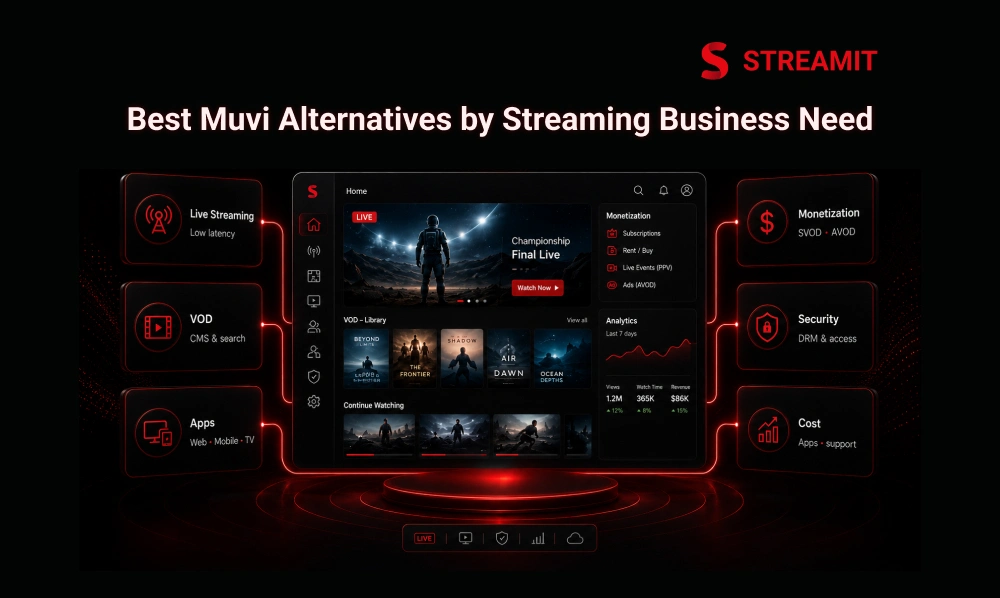
The best Muvi alternative depends on the job the platform must perform. Some teams need speed, some need ownership, and some need live-first infrastructure.
Instead of comparing platforms only by feature lists, compare them by business need.
| Business Need | Best-Fit Platform Type |
|---|---|
| Owned apps and monetization control | Streamit |
| Enterprise ownership and custom development | Custom OTT platform |
| Cost-conscious OTT launch | Packaged OTT solution |
| Live-first streaming products | Live streaming or API-first platform |
Streamit for Brands That Want Owned OTT Apps and Monetization Control
Streamit fits teams that want to build a streaming business they control, not just rent a streaming setup. It is stronger when ownership, apps, monetization, and long-term roadmap matter.
This makes it useful for brands planning web, mobile, TV, analytics, retention systems, payment flows, and content control as one connected platform.
VPlayed for Enterprise OTT Ownership and Custom Development
Enterprise OTT platforms usually appeal to teams that want deeper customization, stronger ownership messaging, and a more tailored build process.
This direction can work when a brand already understands its monetization model, app scope, content structure, and technical expectations before starting.
Ventuno or Vodlix for Cost-Conscious OTT Platform Launches
Some teams are not ready for a deeper custom OTT build. They need a more affordable way to launch, test the market, and validate audience demand.
Cost-conscious OTT solutions can be useful at this stage. The key is to check how far the platform can grow before customization, migration, or scaling costs appear.
Castr or API-First Platforms for Live and Custom Streaming Products
Live-first teams need to think differently. Stability, latency, encoding, CDN behavior, event traffic, and player reliability often matter more than standard OTT templates.
API-first platforms can also help when the product is not a typical OTT app. They give technical teams more room to build custom workflows around video delivery.
Part 4
The All-in-One Platform Test Most Teams Skip
Most teams ask, “Can this platform launch us?” The better question is, “Can this platform still fit us after 12 months of growth?“
This test protects the business from short-term comfort and long-term restriction.
Decide If You Need a Ready OTT Platform or a More Flexible Product Base
A ready OTT platform is useful when speed matters most. It helps teams launch with fewer technical decisions and a clearer starting structure.
A flexible product base makes more sense when the streaming business has custom workflows, unique monetization, stronger branding, or a serious multi-device roadmap.
Check Whether Your Main Problem Is Launch Speed, Cost, Control, or Scale
Different problems need different solutions. If launch speed is the main issue, a packaged platform may be enough.
If control, scale, or monetization complexity is the issue, the platform needs deeper evaluation. A fast launch does not solve a weak foundation.
Count Long-Term Costs Before Comparing Only Monthly Plans
Monthly pricing is only one part of OTT platform cost. The full cost includes apps, storage, bandwidth, CDN, support, payment fees, updates, and custom work.
A cheaper plan can become expensive if every growth move requires extra fees or rebuilds. Cost should be measured against the next 12 months, not only the first invoice.
Avoid Choosing a Platform That Becomes Hard to Customize or Migrate Later
Vendor lock-in often appears slowly. At first, everything feels simple because the business has fewer requirements.
Later, the team may need custom analytics, better TV apps, new payment rules, regional content, or deeper retention features. That is when platform flexibility becomes business-critical.
Part 5
Why Streamit Fits Teams Looking for a Muvi Alternative
Streamit is a better fit for teams that treat OTT as a long-term business, not just a content library. The focus is ownership, scalability, monetization, and product control.
For medium to high-value streaming projects, this matters. The goal is not to launch a clone. The goal is to build a platform that can keep improving.
It Supports Branded OTT Apps Across Web, Mobile, and TV
Modern viewers expect the same quality across devices. Web, mobile, and TV should feel connected, not like separate products stitched together.
Streamit supports branded OTT experiences across key screens, helping teams build a more consistent user journey from discovery to playback.
It Supports Monetization, Content Control, Analytics, and Retention
A streaming business needs more than video hosting. It needs access control, payment logic, content organization, viewer analytics, and retention-focused product decisions.
Streamit gives teams a stronger base to manage these layers together. That helps founders make decisions from platform data, not guesswork.
It Gives Streaming Brands a Better Base for Long-Term OTT Growth
Early shortcuts often become expensive later. A platform that cannot adapt to growth can slow down content teams, product teams, and revenue teams.
Streamit is positioned for businesses that want stronger control over the platform’s future. That makes it a practical Muvi alternative for teams planning beyond launch week.
Summary
Key Takeaways
Muvi Works for All-in-One Launches
Muvi is useful when teams want a managed platform with core OTT features in one place — ideal for fast early launches.
Alternatives Become Critical as You Grow
Growing teams often need deeper ownership, customization, app control, and cost clarity that fixed all-in-one platforms cannot provide.
Compare Total Cost, Not Monthly Plans
Apps, support, live usage, storage, migration, and custom work all add to the real cost — always model the next 12 months, not just the first invoice.
Streamit Fits Long-Term OTT Brands
Streamit is stronger for brands that want owned apps, monetization control, analytics, and a scalable platform base rather than a rented setup.
Platform Choice Must Match Business Model
Fitness, sports, education, entertainment, and media brands should not choose from the same checklist — the right platform depends on how the business earns and grows.
Avoid Vendor Lock-In Early
Platform flexibility becomes business-critical when you need custom analytics, better TV apps, new payment rules, or deeper retention features.
Conclusion
Conclusion
Choosing from Muvi alternatives is not about finding a platform with louder claims. It is about finding the right operating base for your streaming business.
If your goal is a quick OTT launch, an all-in-one platform may be enough. If your goal is a controlled, scalable, monetized streaming brand across web, mobile, and TV, Streamit becomes a stronger strategic fit.
FAQs
Frequently Asked Questions
-
Is Muvi enough for a growing OTT platform?
Muvi can be enough for teams that want a managed all-in-one OTT launch. Growing brands may need alternatives when customization, ownership, app control, or long-term cost becomes a concern.
-
What should brands compare beyond Muvi pricing?
Brands should compare app ownership, monetization flexibility, DRM, analytics, support, migration, infrastructure, and scaling costs. The real cost is usually bigger than the base plan.
-
Which Muvi alternative is better for owned OTT apps?
Streamit is a strong option for teams that want owned OTT apps across web, mobile, and TV. It also supports monetization control, content management, analytics, and long-term platform growth.
-
When is a custom OTT platform better than Muvi?
A custom OTT platform is better when the business needs unique workflows, deeper branding, custom payments, advanced analytics, or stronger control over infrastructure and roadmap.
-
What monetization features should a Muvi alternative include?
A Muvi alternative should support subscriptions, pay-per-view, rentals, ads, coupons, bundles, trials, payment gateways, and access rules. Monetization should connect directly with content permissions.