Custom OTT vs White Label OTT: Which Delivers Better ROI?


A platform can launch cheaply and become expensive within 12 months. OTT platform ROI depends on more than the first invoice.
The better model reaches revenue with acceptable risk while preserving the control the business will eventually need.
Part 1
What Better ROI Really Means for an OTT Platform
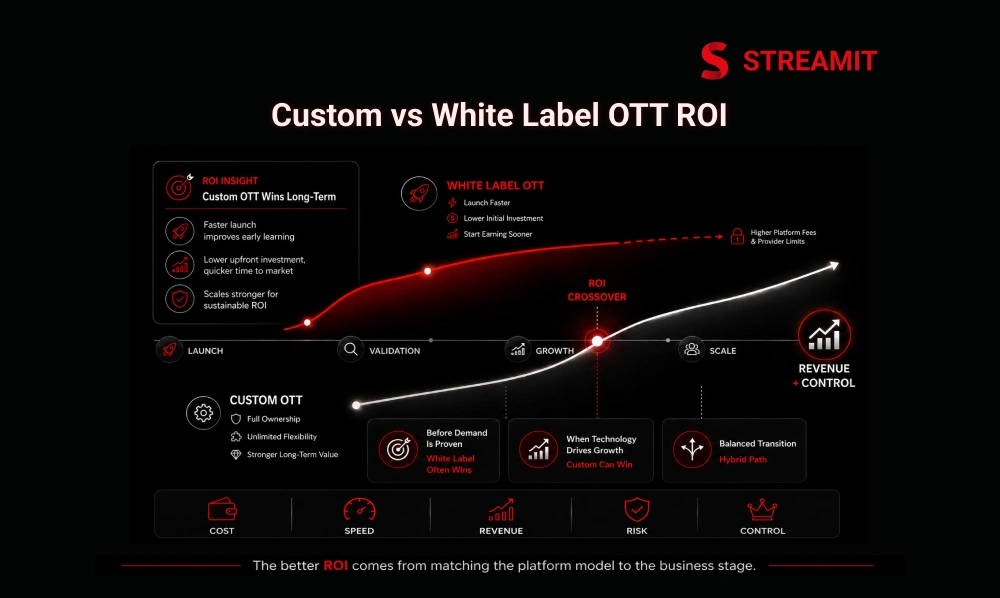
Five variables shape OTT return: cost, revenue, speed, risk, and control. Development cost alone gives an incomplete answer.
The decision must reflect business stage, demand confidence, monetization, internal capability, and the strategic value of technology.
ROI Includes Cost, Revenue, Speed, Risk, and Product Control
ROI improves when revenue arrives before complexity starts consuming it. Reliable delivery, monetization, analytics, and disciplined costs all matter.
Control also carries value. Data ownership, integration freedom, and roadmap authority can protect future margins.
The Cheapest Launch Does Not Always Create the Best Long-Term Return
A low launch price can hide expensive limitations. Add-ons, usage charges, restricted integrations, and migration work may raise ownership cost.
Building everything early can be equally wasteful when the audience has not yet validated the investment.
Business Stage Changes Which OTT Model Delivers Better ROI
Before demand is proven, speed and learning usually matter more than architectural purity. White label can reduce early technical distraction.
After validation, unique workflows, margin pressure, and control requirements may justify custom development or a hybrid path.
Part 2
How Custom and White Label OTT Create Value Differently
The models create return differently. White label compresses time and execution risk; custom development expands control and differentiation.
Neither wins automatically. The answer depends on whether the advantage comes from content, distribution, community, or technology.
White Label OTT Uses Proven Infrastructure to Start Earning Earlier
Weeks saved before launch can create months of earlier market learning. Core playback, billing, security, and app systems already exist.
Teams can test pricing, acquisition, demand, and device priorities without first funding a full engineering operation.
Custom OTT Trades Early Cost for Deeper Control and Differentiation
Custom development buys decision-making freedom, not guaranteed return. The business controls architecture, interfaces, integrations, data flows, and sequencing.
That freedom matters when proprietary technology directly improves conversion, retention, partner operations, advertising, or rights management.
The Better Option Depends on Where Your Competitive Advantage Lives
If content, community, or rights create the moat, rebuilding standard infrastructure may add little value. A proven base is often rational.
When the moat is a unique viewing, commerce, data, or partner experience, deeper customization can become essential.
Part 3
Upfront Cost and Total Cost of Ownership Compared
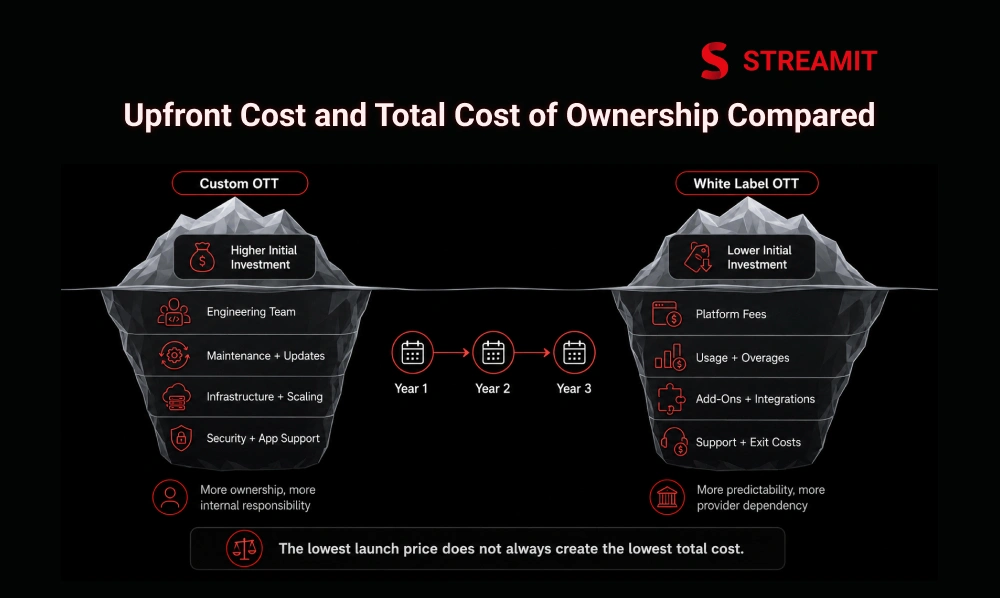
Launch cost is one line; total cost of ownership is the full statement. Model at least three years of operation.
| ROI Factor | Custom OTT | White Label OTT |
|---|---|---|
| Initial investment | Higher | Lower |
| Launch speed | Slower | Faster |
| Technical ownership | Greater | Provider-dependent |
| Maintenance burden | Internal | Usually managed |
| Long-term flexibility | High | Platform-dependent |
| Early cost predictability | Lower | Often clearer |
Include build work, subscriptions, infrastructure, support, updates, usage growth, and the cost of changing direction.
Custom OTT Requires Investment in Apps, Backend, Billing, Security, and Infrastructure
One streaming product is several connected systems. Web, mobile, TV, CMS, authentication, payments, analytics, delivery, and security must cooperate.
Every layer needs design, testing, monitoring, and ownership. Missing work usually returns later as production cost.
Engineering, Maintenance, Updates, and Scaling Continue After Launch
Launch closes the first budget, not the technical obligation. Devices, app stores, security risks, and traffic patterns keep changing.
Custom platforms require continuing engineering, QA, infrastructure management, incident response, monitoring, and product leadership.
White Label OTT Replaces Large Initial Costs With Predictable Platform Fees
Predictable fees preserve capital for content and audience growth. Providers distribute core infrastructure investment across multiple customers.
This lowers early hiring pressure and simplifies budgeting while the business learns what viewers value.
Usage Fees, Revenue Sharing, Add-Ons, and Support Can Change Long-Term ROI
A manageable fee at 1,000 users may behave differently at 100,000. Usage, apps, support, and premium features can scale separately.
Review revenue share, overages, upgrade tiers, integrations, and exit charges before comparing long-term margins.
Part 4
Time to Revenue, Break-Even, and Opportunity Cost
Every delayed month carries two costs: missing revenue and missing evidence. Real users are required to improve pricing and retention.
Time to market is therefore a financial variable, not merely a project deadline.
White Label OTT Can Test Monetization and Demand Earlier
Earlier launch turns monetization assumptions into evidence. Teams can test subscriptions, advertising, transactions, trials, and payment behaviour sooner.
The main gain is earlier knowledge about willingness to pay, acquisition cost, engagement, and friction.
Custom OTT Delays Revenue While the Product Is Built and Tested
Custom work creates commercial value only after enough of the system is production-ready. Until then, development consumes capital.
Device coverage, billing logic, playback testing, security, and approvals can extend the period before revenue begins.
Delayed Market Learning and Lost Revenue Are Part of the Real Cost
Six months without users may cost more than six months of engineering. The business also loses feedback and campaign timing.
Opportunity cost grows when competitors, rights windows, seasonal demand, partnerships, or funding milestones make timing important.
Faster Launch Does Not Guarantee Faster Break-Even Without Strong Demand
Speed exposes demand; it does not create it. Weak positioning, pricing, content depth, or acquisition can delay break-even anywhere.
Fast launch improves ROI only when learning quickly shapes content, marketing, pricing, and retention decisions.
Part 5
How Monetization and Retention Change OTT ROI
Revenue models start the equation; retention determines whether it compounds. Lifetime value depends on repeated viewing and reliable access.
Platform selection must consider payment capability and the experience delivered after payment.
Ready Revenue Models Can Shorten the Path to Paid Users
Built-in monetization removes months of avoidable plumbing. Subscriptions, ads, transactions, trials, taxes, and payment gateways can launch sooner.
Teams can compare commercial models without rebuilding checkout and entitlement logic for every experiment.
Platform Fees and Revenue Sharing Can Reduce Margins as the Business Grows
Percentage-based costs become visible when revenue succeeds. A harmless early fee may become material at scale.
Model fixed and variable charges against realistic growth, ensuring retained margin can still fund content, support, and acquisition.
Playback, Discovery, and Multi-Device Access Affect Subscriber Lifetime Value
Subscribers cannot value content they cannot play or find. Buffering, poor search, and inconsistent device experiences reduce repeat use.
Adaptive streaming, relevant discovery, and synchronised access across web, mobile, and TV support longer relationships.
Analytics Help Improve Content, Marketing, and Monetization Returns
Useful analytics connect viewing behaviour to business decisions. Starts, completion, searches, churn signals, devices, and payments reveal value leaks.
Teams can improve programming, onboarding, pricing, promotions, and infrastructure with evidence rather than opinion.
Part 6
The ROI Crossover Point and Risks Most Teams Miss
The crossover arrives when platform limitations cost more than ownership would. Its timing differs for every streaming business.
Scale, margin pressure, custom workflows, weak support, data restrictions, or a blocked roadmap may trigger it.
White Label Usually Delivers Better ROI Before Demand Is Proven
Validation rewards reversible decisions. Faster deployment and managed infrastructure let teams test demand without overbuilding.
This is safer when audience size, pricing power, viewing frequency, and acquisition economics remain uncertain.
Custom OTT Can Deliver More Value When Unique Technology Drives Revenue
Custom becomes rational when a technical capability has measurable commercial value. Proprietary personalisation or specialised partner workflows may qualify.
The case should rest on revenue, retention, efficiency, or ownership, not simply a preference for custom software.
Technical Debt, Vendor Lock-In, and Migration Costs Can Shift the Result
Both paths can create lock-in. Custom systems accumulate technical debt; white label platforms may restrict data, integrations, or exports.
Examine architecture, APIs, documentation, portability, contract terms, code ownership, and practical migration cost before committing.
Downtime, Slow Updates, and Weak Support Must Be Counted as Business Costs
Operational weakness appears in churn before the budget. Failed playback, delayed fixes, and slow releases damage trust and campaigns.
Evaluate support response, monitoring, resilience, release discipline, and escalation paths. Reliability is an ROI input.
Part 7
Which OTT Model Delivers Better ROI for Your Business?
The right solution fits today’s evidence without blocking tomorrow’s strategy. Early-stage and mature businesses need different trade-offs.
Use demand certainty, product uniqueness, internal capability, margin structure, and ownership requirements as the framework.
White Label OTT Fits Teams That Need Speed, Validation, and Lower Technical Overhead
Choose white label when the business must learn faster than it must customise. It suits lean teams and content-led advantages.
Still require credible branding, analytics, integrations, data access, transparent pricing, and room for future growth.
Custom OTT Fits Businesses With Proven Demand and Unique Product Requirements
Choose custom when constraints already limit measurable growth. Proven demand makes the larger investment easier to justify.
It fits complex rights, workflows, integrations, performance needs, or experiences standard platforms cannot support.
A Hybrid Path Can Balance Early Speed With Future Product Control
The disciplined answer is often staged ownership. Launch on a strong base, validate economics, then customise advantage-creating layers.
A hybrid plan needs clean APIs, portable data, modular architecture, and explicit ownership terms.
Part 8
How to Calculate OTT ROI Before Choosing a Platform
A useful ROI model should survive conservative, expected, and aggressive scenarios. One optimistic forecast is not enough.
Compare cash outflow, launch timing, retained margin, churn, infrastructure growth, support, and switching costs.
Compare Three-Year Ownership Cost, Not Only the Launch Price
Thirty-six months reveals costs a proposal can hide. Include development, fees, usage, staffing, maintenance, apps, security, integrations, and migration.
Separate fixed, variable, and avoidable costs to see which model becomes more efficient with growth.
Calculate Time to First Revenue and Expected Break-Even
Break-even begins with a date, not only a revenue target. Estimate launch, pricing, conversion, acquisition cost, and operating expense.
Test delayed-launch and slower-growth cases. A model requiring perfect execution is not reliable.
Model Revenue, Churn, Platform Fees, Support, and Infrastructure Growth
Small churn changes can outweigh large platform-fee differences. Model lifetime value alongside revenue and user growth.
Include refunds, failed payments, support, content, delivery usage, and plan mix to avoid overstating returns.
Check Data Ownership, Exit Terms, Integrations, and Migration Costs
A platform decision includes the cost of leaving it. Confirm ownership of customers, viewing history, metadata, payments, and analytics exports.
Review APIs, termination, migration assistance, app ownership, source-code rights, and deletion rules before signing.
Part 9
Why Streamit Fits Teams Looking for Faster OTT ROI
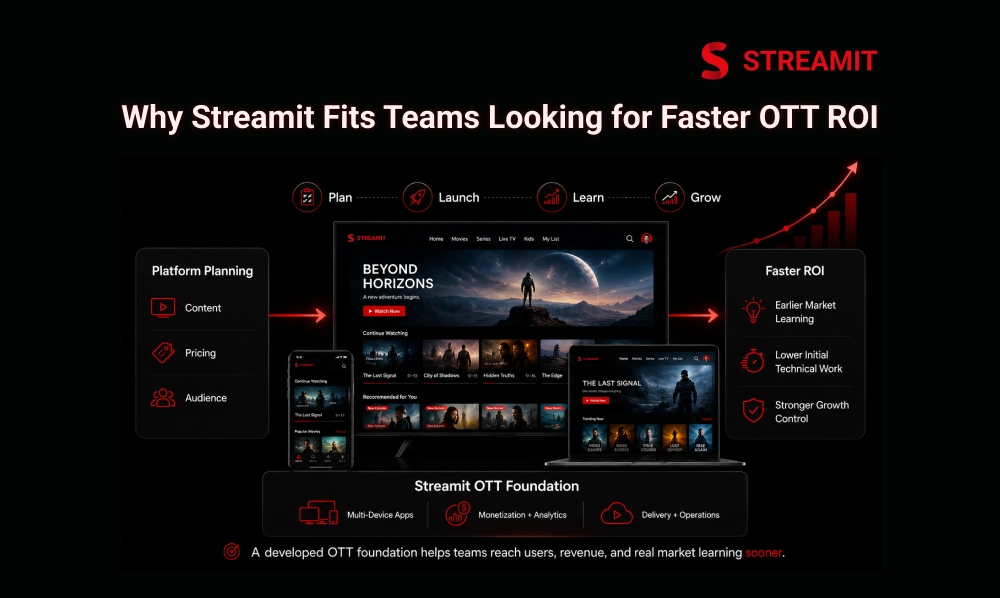
Streamit reduces the gap between platform planning and commercial learning. Teams gain a developed base without building the full stack first.
The objective is not launch at any cost. It is faster entry with ownership, performance, monetization, and growth in view.
It Reduces the Time and Technical Work Needed to Launch
Teams avoid rebuilding standard OTT foundations before testing the business. Applications, content operations, delivery, and infrastructure are already addressed.
Leadership can focus earlier on content, pricing, partnerships, acquisition, and the viewer experience.
It Supports Monetization, Multi-Device Apps, Analytics, and Retention
ROI improves when commercial and engagement systems work together. Streamit supports web, mobile, TV, monetization, analytics, discovery, and retention capabilities.
This creates a clearer path from launch to optimisation without rebuilding each device or growth feature separately.
It Gives Businesses a Strong Base Without Building the Full OTT Stack First
A strong foundation preserves capital without treating ownership as an afterthought. Businesses can expand around validated requirements.
This suits teams seeking faster entry while keeping scalability, performance, data, and long-term control visible.
Summary
Key Takeaways
ROI Is More Than Launch Cost
Revenue timing, maintenance, platform fees, retention, technical risk, and long-term control all influence actual return – the first invoice tells only part of the story.
White Label Wins Before Demand Is Proven
White label reduces initial investment and technical workload while allowing businesses to test content, pricing, and audience demand earlier and with less risk.
Custom OTT Earns Its Cost Through Technology Advantage
Deeper control becomes worthwhile only when unique integrations, workflows, or platform experiences directly improve revenue and retention at scale.
Total Ownership Cost Beats the First Proposal
Engineering, infrastructure, updates, support, revenue sharing, add-ons, and migration costs can significantly change the picture over three years of operation.
Fast Launch and Fast Break-Even Are Not the Same
Weak demand, poor monetization, or high churn can delay profitability even after a rapid market entry – speed must be paired with strong product fundamentals.
Match the OTT Model to Your Business Stage
White label suits speed and validation; custom development becomes appropriate after demand and specialised requirements are proven. Review exit terms before signing.
Conclusion
Conclusion
The better platform funds learning before complexity. With unproven demand, white label usually offers the safer return.
Custom OTT can outperform when technology drives revenue or constraints become expensive. Build around evidence, not ambition alone.
FAQs
Frequently Asked Questions
-
When Does Custom OTT Deliver Better ROI Than White Label OTT?
Custom performs better when proven demand and unique technology improve revenue, retention, operations, or strategic control. It is harder to justify during early validation.
-
Can Revenue Sharing Make White Label OTT More Expensive Later?
Yes. Percentage charges can pressure margins as revenue grows, especially beside usage fees and add-ons. Compare retained margin across several growth scenarios.
-
Does a Faster OTT Launch Always Lead to Faster Break-Even?
No. Faster launch creates earlier learning, but weak demand, pricing, content, or retention still delays break-even. Speed must improve decisions.
-
Which Hidden Costs Affect OTT Platform ROI the Most?
Maintenance, app updates, scaling, integrations, downtime, migration, add-ons, and staffing are common. Delayed market learning can be the highest hidden cost.
-
How Do Churn and Subscriber Lifetime Value Change OTT ROI?
Lower churn increases revenue per acquired subscriber and improves returns on content, marketing, and technology. Poor playback or discovery shortens lifetime value.
-
Which OTT Model Is Safer When Audience Demand Is Unproven?
White label is usually safer because it lowers initial commitment and enables earlier testing. Contracts must still protect data, pricing, integrations, and migration.