OTT Startups: Netflix Lessons for Viewer Retention


The OTT market still rewards ambition, but it punishes weak retention faster than many founders expect. A platform can generate installs, attract curiosity, and even drive early subscriber growth, yet still fail to become durable if viewers do not return often enough.
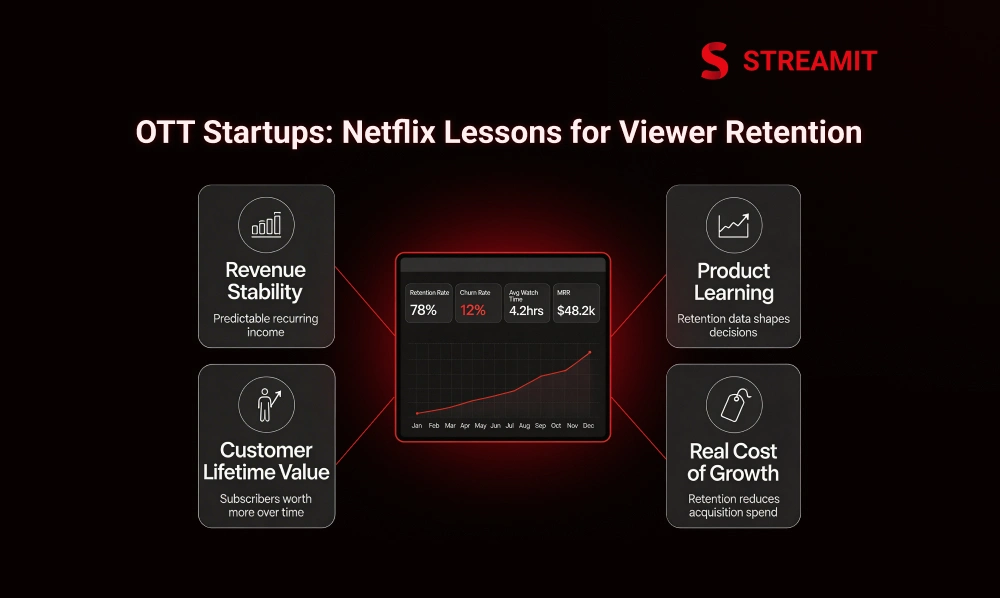
For many teams, retention is treated like something that improves later, once content volume grows or marketing becomes more efficient. That is too narrow a view. Viewer retention shapes revenue stability, customer lifetime value, product learning, and the real cost of growth.
This is where Netflix remains useful for studying. Not because startups should copy its surface-level features, but because it has spent years reducing friction between interest and viewing. It has made discovery easier, continuity smoother, and the viewing journey more consistent.
OTT startups do not need a Netflix-sized budget to apply that thinking. They need better priorities, a clearer understanding of why users leave, and a sharper view of what brings them back. Retention is not a vanity metric. It is the operating logic behind long-term growth.
Part 1
Why Viewer Retention Matters More Than Fast Growth
Fast growth can create confidence, but retention decides whether that confidence is deserved. A streaming platform can produce a strong launch, generate trial users, and even build short-term buzz, yet still struggle if the product does not create repeat viewing.
For OTT startups, retention matters because streaming is not a one-time transaction. It is a repeated behavior business. The more often viewers return, the stronger the economics become. The less often they return, the more pressure falls on acquisition, discounts, and constant promotion.
Why OTT startups cannot grow if viewers leave early
Early exits are not a minor engagement issue. They are usually a sign that the platform has not created enough value fast enough. If viewers leave after the first few sessions, the startup is not building momentum. It is replacing lost attention.
Getting new users is costly when retention is weak
Acquisition becomes much more expensive when the platform cannot keep users active. Every campaign has to work harder because too much of the audience disappears before it becomes valuable. That turns growth into a cycle of replacing users instead of building a stronger base.
For OTT startups, this usually creates the wrong internal conversation. Teams ask how to get more traffic when the bigger issue is why existing viewers are not staying. Weak retention makes marketing look less effective than it could be because too little value is being retained after the click.
Retained viewers bring more revenue over time
A retained viewer is more valuable because the relationship compounds. Subscription revenue becomes more predictable, viewing behavior becomes easier to understand, and content decisions become sharper because the platform has stronger user signals to work from.
That is why retention should not be seen as a soft product outcome. It is one of the clearest drivers of long-term OTT business growth. A user who stays active improves revenue quality more than a user who signs up and disappears.
Why retention is harder in the OTT market today
Retention has become harder because the market is noisier, more fragmented, and less patient. Viewers have more options, lower switching resistance, and a higher expectation of convenience than they did a few years ago.
Viewers have too many content choices
The modern streaming problem is not only a lack of content. It is also excess content without enough relevance. A large catalog may look strong at launch, but if viewers cannot quickly find something that feels right for them, the platform starts to feel tiring instead of valuable.
Choice overload weakens momentum. A viewer can open the app with intent and leave with fatigue. That is why better discovery often matters more than adding more titles.
Switching to another platform is very easy
OTT startups operate in a market where users can cancel, pause, switch, and return with very little effort. That means weak retention is rarely hidden for long. If the platform feels forgettable, another option is already available.
This creates a tougher standard for startups. They do not only need good content. They need a viewing experience that feels worth keeping in the weekly routine.
| Growth Reality | Weak-Retention Platform | Strong-Retention Platform |
|---|---|---|
| User acquisition | Constantly replacing lost users | Adds to an already improving base |
| Revenue quality | Volatile and short-lived | More stable and recurring |
| Product learning | Weak user signals | Better insight into behavior and content fit |
| Marketing efficiency | CAC stays under pressure | CAC improves as lifetime value rises |
| Long-term growth | Looks active but stalls early | Compounds more predictably |
Part 2
Why Most OTT Startups Struggle to Keep Viewers
Most OTT startups do not lose viewers because of one dramatic failure. They lose them through a series of smaller weaknesses that quietly reduce habit. Discovery is harder than it should be. Playback trust breaks too easily. Cross-device continuity feels unfinished. Churn signals are noticed too late.
Poor content discovery pushes viewers away
Discovery is one of the most overlooked retention layers in OTT. Many startups invest heavily in catalogs and content positioning, but underinvest in how that content is actually found. The result is simple: good content stays buried, and viewers stop browsing with confidence.
A big content library does not help if users cannot find the right content
A large library only creates value when it helps the viewer make a decision faster. If the search is weak, categories are vague, and metadata is inconsistent, more content can actually increase friction instead of reducing it.
For startups, this means content scale alone is not enough. A smaller but better-organized library can outperform a broader one if discovery is sharper and relevance feels clearer.
Weak homepages and poor recommendations reduce watch time
The homepage is not just a visual entry point. It is a retention surface. If it feels generic, stale, or disconnected from user behavior, watch time usually suffers. Viewers do not want to restart the discovery process every time they open the app.
Recommendations matter here because they reduce the effort of deciding. Even basic recommendation logic can improve session depth when it reflects watch history, genre interest, incomplete titles, and recent behavior.
A weak viewing experience breaks trust fast
Content may attract interest, but the viewing experience decides whether trust survives. If streaming quality feels unstable, the service starts to feel unreliable, no matter how good the catalog is.
Buffering, lag, and playback issues make users leave
Playback interruptions damage momentum immediately. The viewer stops focusing on the story and starts focusing on the platform. That shift is dangerous because it reframes the service as inconvenient rather than enjoyable.
Buffering, failed resume states, playback lag, and unstable quality changes create a simple outcome: users leave earlier and return less confidently. For OTT startups, this is not just a technical issue. It is a retention issue.
Poor mobile, web, and TV experience hurts repeat viewing
Viewers do not think in device silos. They may discover content on mobile, continue on the web, and finish on TV. If that transition feels inconsistent, the product feels immature.
A platform that works well on one device but poorly on another usually loses repeat usage faster than expected. Multi-device weakness is often a silent churn driver because it makes the viewing journey less natural.
Many OTT startups do not track churn early enough
Churn usually begins before cancellation. The signals appear in shorter sessions, weaker return frequency, higher browse abandonment, and declining completion behavior. Yet many OTT startups wait too long to study those patterns.
Inactive users, short sessions, and drop-offs are warning signs
A viewer does not need to cancel to become a retention risk. If they start opening the platform less often, leave sessions earlier, or browse without pressing play, the product is already losing relevance.
These signals matter because they show where user confidence is weakening. Teams that catch them early can fix the real problem before it becomes a subscription loss.
Payment failure can also cause hidden churn
Not all churn is intentional. In subscription models, failed payments, expired cards, and weak renewal flows can remove users who may still want the service. This is easy to overlook because the platform may label it as churn without understanding the cause.
For OTT startups, this means retention should include billing recovery, renewal clarity, and payment health. The product experience does not end when the stream ends.
| Retention Problem | What It Usually Means | What Teams Should Review First |
|---|---|---|
| Low search-to-play behavior | Discovery is too weak | Search, metadata, homepage logic |
| Short session length | Relevance or playback trust is falling | Recommendations, startup speed, and UX |
| Low repeat viewing | The platform is not creating a habit | Watchlist, Continue Watching, reminders |
| Drop after the first session | Onboarding is weak | First-play journey, curated starter experience |
| Lost subscribers at renewal | Hidden churn risk | Billing recovery, renewal communication |
Part 3
What Netflix Gets Right About Viewer Retention
Netflix is useful not because it has scale, but because it treats retention as a system. It reduces friction in discovery, playback, navigation, and return behavior. It does not rely on one tactic to keep users active. It builds a smoother path through the entire viewing journey.
Netflix makes content discovery feel easy
One of Netflix’s biggest strengths is that it makes choosing feel lighter. The product is designed to reduce search fatigue and lower the effort required to find the next watch.
Personalized recommendations reduce search fatigue
Recommendations work because they reduce the number of bad choices a user has to make. Instead of asking viewers to manually explore a large catalog every session, the platform narrows the field and suggests likely fits.
For OTT startups, the lesson is clear. Personalization does not need to begin as a complex system. Even simple recommendation logic based on recent viewing, genre preference, and incomplete titles can reduce decision fatigue and improve session depth.
Rows like Continue Watching and My List keep users connected
Features like Continue Watching and My List matter because they preserve intent. They help the viewer return to something they already cared about without starting over.
This is one of Netflix’s most practical retention lessons. Not every retention gain comes from finding new content. Sometimes the better move is simply making it easier to resume existing interest.
Netflix reduces friction in the viewing journey
Strong retention often comes from removing small points of friction rather than adding more visible features. Netflix has been effective because it understands that the shortest path to value usually wins.
Simple navigation helps users reach content faster
Clear navigation lowers cognitive effort. A viewer should not have to re-learn the product every time they open it. The route to watch history, saved titles, and relevant categories should feel obvious.
OTT startups often overcomplicate this layer. They add too many menus, too many content rows, or too many promotional surfaces. The result is slower access and weaker session momentum.
Smooth playback helps keep viewers engaged
A stream that starts quickly and plays reliably creates trust. A stream that hesitates, buffers, or breaks context immediately reduces confidence.
Netflix’s retention lesson here is straightforward: the player experience is part of the product, not a backend detail. Smooth playback protects watch time and makes repeat viewing easier to earn.
Netflix uses data to improve retention again and again
One of Netflix’s deeper advantages is not just that it personalizes. It learns continuously. It uses behavior signals and testing to refine how the product performs over time.
Viewer behavior shapes recommendations and content decisions
Behavior data matters because it reveals what viewers actually do, not what teams assume they do. Completion rate, browse paths, genre preference, rewatching, skipped titles, and viewing time all help show where real interest exists.
OTT startups should use these signals not only for recommendations, but also for homepage layout, curation decisions, reminder strategy, and even future content planning.
Testing helps improve the experience over time
Testing matters because retention is rarely improved by instinct alone. Layouts, content rows, onboarding flows, thumbnails, and notifications all perform differently depending on the audience and platform.
The Netflix lesson is not “test everything at enterprise scale.” It is “keep learning what reduces friction.” Even small controlled improvements can compound into stronger retention over time.
| Netflix Lesson | Why It Works | Startup Version |
|---|---|---|
| Personalized recommendations | Reduces search fatigue | Behavior-based suggestions from watch history |
| Continue Watching | Preserves intent | Reliable resume states across devices |
| My List / saved titles | Supports future return | Watchlist with simple access and reminders |
| Simple navigation | Cuts decision time | Clear paths to content, profile, and history |
| Continuous testing | Improves experience over time | Test onboarding, rows, and engagement flows |
Part 4
Key Netflix Lessons OTT Startups Should Apply First
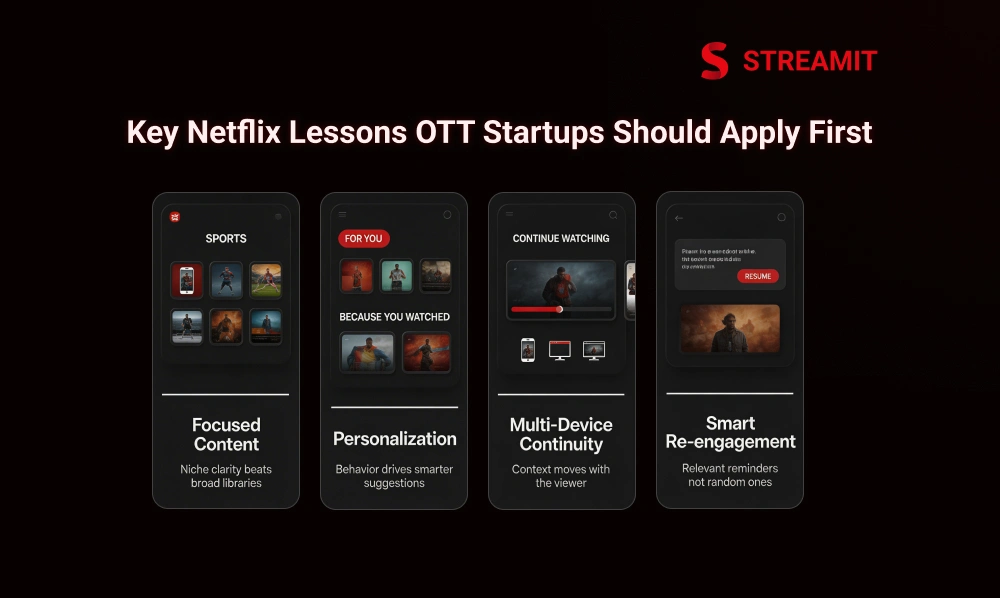
The right lesson is not to copy Netflix’s interface. It is to adopt its priorities. OTT startups should begin with the features and systems that reduce friction, increase relevance, and support repeat viewing.
Build a focused content experience, not just a large library
A focused catalog usually creates better retention than a broad but unclear one. Viewers stay longer when the platform has a stronger identity and a more coherent reason to exist.
A clear niche helps OTT startups attract the right viewers
Niche clarity improves fit. A platform built around sports, regional entertainment, spirituality, education, fitness, or creator-led content has a better chance of attracting viewers who know why they are there.
That clarity helps retention because the platform feels intentional rather than generic. It becomes easier to recommend the right titles and easier for users to build a viewing habit.
Fresh and relevant content gives viewers a reason to return
Freshness matters because it signals movement. A platform does not need constant catalog expansion, but it does need a visible sense of activity. New releases, resurfaced content, relevant rows, and timely updates all give viewers a reason to open the app again.
Retention weakens when the service feels static, even if the catalog is technically large.
Make personalization a core retention feature
Personalization should not be treated as a premium enhancement. For OTT startups, it is one of the most practical ways to improve viewer retention without depending only on more content spend.
Use watch history and behavior to suggest relevant content
Behavior-driven suggestions help the platform feel more useful. Watch history, partial completions, preferred genres, repeat themes, and time-of-day patterns all provide useful starting points for smarter recommendations.
The goal is not perfect prediction. The goal is to reduce the distance between opening the app and starting the next valuable session.
Personalize the homepage, watchlist, and viewer journey
Personalization should shape more than one content row. It should influence how the homepage feels, how the watchlist is prioritized, and how unfinished or saved content is surfaced.
The more the platform remembers user intent, the less effort the next session requires.
Create a smooth multi-device viewing experience
Cross-device continuity is now a baseline expectation. Viewers expect their profile, history, and playback state to move with them.
Users should move easily between phone, web, and TV
Switching devices should not feel like starting over. If a viewer begins on mobile and continues on TV, the product should preserve context smoothly.
That kind of convenience reduces unnecessary friction and strengthens repeat usage. A platform feels more mature when device switching feels natural.
Continue Watching should sync properly across devices
Continue Watching only works as a retention feature when it is reliable. If progress is wrong, episodes are missing, or the row feels inconsistent across devices, it stops preserving intent and starts creating friction.
For OTT startups, this is a small product detail with a large retention effect.
Re-engage viewers before they leave
Re-engagement works best when it supports existing interest rather than interrupting the user with generic promotion.
Use email and push notifications to bring users back
Smart reminders can help viewers return to unfinished content, saved titles, new episodes, or content linked to past behavior. They reduce the effort of remembering and support more frequent re-entry into the platform.
Remind users about relevant content, not random content
The quality of re-engagement matters more than the volume. Generic notifications weaken trust. Relevant reminders strengthen it.
Users return more easily when the platform respects their interests rather than broadcasting the same message to everyone.
Part 5
How OTT Startups Can Improve Viewer Retention Without a Netflix Budget
Retention improvement does not need to begin with large-scale product reinvention. Most OTT startups can improve viewer retention by getting a few high-leverage areas right first.
Start with the retention basics first
Foundational product fixes usually create more value than advanced feature work. Startups often overestimate the value of complexity and underestimate the value of reliability.
Fix discovery, playback, and watchlist features first
If users can find content faster, watch without interruption, and save intent for later, the platform has already solved several common churn drivers.
Those basics are less glamorous than large recommendation systems, but they usually produce stronger early retention gains.
Build profiles, Continue Watching, and simple personalization early
These features create continuity. They make the platform feel less generic and more useful from the first week onward.
Even simple versions of these systems can improve repeat behavior because they reduce the need for users to restart their journey every time.
Focus on the first 7 days of the viewer journey
The first week often determines whether the user is exploring or forming a habit. If the product fails to create value quickly, later re-engagement becomes harder.
Help new users find content fast
New users should not face a blank, overwhelming experience. The platform should guide them toward likely-fit content early through onboarding, starter rows, or curated paths.
The faster a new user reaches something satisfying, the better the retention foundation becomes.
Give them a reason to return after the first session
A first session is helpful. A second session is what starts habit. That is why unfinished titles, saved content, upcoming releases, and relevant reminders matter so much.
Retention improves when the session ends with a visible next step.
Use a few key metrics to guide retention decisions
OTT startups do not need a huge analytics stack to start improving retention. They need a handful of useful signals tied to real product and subscriber behavior.
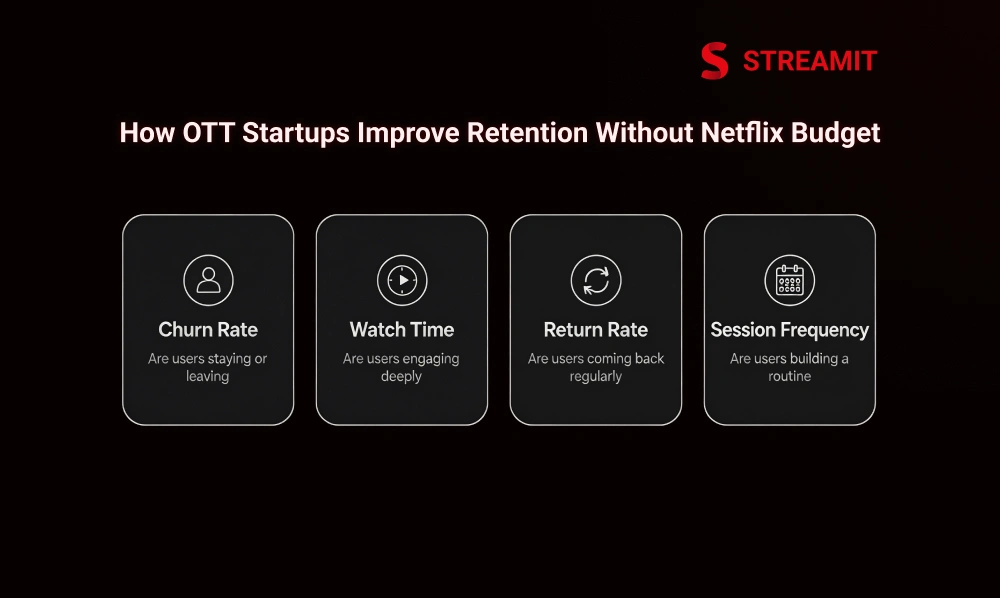
Track churn rate, watch time, return rate, and session frequency
These metrics show whether users are staying, engaging deeply, returning regularly, and building a routine. They help teams understand whether the platform is becoming part of user behavior or remaining occasional.
Use these metrics to improve product and content decisions
Metrics matter only when they change action. If watch time drops, inspect discovery and playback. If the return rate weakens, inspect freshness and re-engagement. If churn rises, inspect value, billing, and session quality together.
| Metric | What It Reveals | Why It Matters |
|---|---|---|
| Churn rate | How much of the audience is leaving | Shows retention leakage |
| Watch time | Depth of engagement | Reflects relevance and playback quality |
| Return rate | How often do viewers come back | Shows habit strength |
| Session frequency | Whether usage is becoming routine | Indicates retention quality |
| Search-to-play rate | How quickly content is found | Reveals discovery friction |
Part 6
Common Viewer Retention Mistakes OTT Startups Should Avoid
Many retention failures come from strategic misprioritization, not lack of effort. Teams often build what looks impressive instead of what improves repeat viewing.
Copying Netflix features without knowing why they work
The most common mistake is feature imitation without system thinking. A platform can copy rows, autoplay, watchlists, or recommendations without understanding the operating logic behind them.
Fancy features do not help if the basics are weak
If search is weak, playback is inconsistent, or the homepage feels generic, advanced OTT features will not save retention. Surface complexity cannot compensate for foundational weakness.
Most startups need stronger basics before they need broader feature sets.
Spending too much on growth and too little on retention
Acquisition can hide product weakness for a while, but it rarely fixes it. If users do not stay, growth spend becomes less efficient every month.
Traffic means little when users do not stay
Traffic may look healthy in reports, but it means little if session value is weak and return behavior is declining. Real OTT growth depends on turning attention into repeat usage, not just into installs or trials.
Ignoring churn signals and viewer behavior
Small signs of weakness usually arrive before major retention problems. Teams that ignore them often end up solving the issue later at a much higher cost.
Small warning signs often become bigger retention problems
Browse abandonment, lower completion, weaker weekly return behavior, and renewal friction often look minor in isolation. Together, they describe a platform losing relevance.
Retention decay becomes easier to fix when it is noticed early. That is why product behavior should be watched as closely as subscriber counts.
Summary
Key Takeaways
Retention Over Fast Growth
OTT startups do not fail only because they lack users — they fail because too few users stay long enough to create durable growth.
Reduce Friction Like Netflix
Netflix’s most useful lesson is not interface imitation — it is friction reduction across discovery, playback, continuity, and re-engagement.
Fix Basics First
Better discovery, smoother playback, and stronger cross-device continuity usually improve retention faster than feature expansion.
Focus on Day 1–7
Startups without a Netflix-sized budget can still improve retention by fixing basics and focusing hard on the first seven days of the viewer journey.
Use Behavioral Data
Track churn rate, watch time, return rate, session frequency, and search-to-play rate — then use those signals to drive product and content decisions.
Retention Drives Revenue
Viewer retention matters more than fast acquisition when revenue depends on repeat viewing and recurring subscriber value.
Conclusion
Conclusion
The real challenge for OTT startups is not getting noticed once. It is becoming worth returning to repeatedly. That is where viewer retention becomes the most honest measure of product quality.
Netflix remains relevant as a reference because it shows what happens when a platform reduces friction consistently. Discovery feels easier. Playback feels more dependable. Saved intent is preserved. Product decisions improve through behavior data and testing. The lesson is not scaled for its own sake. It is discipline.
For founders, that is the important shift. Strong OTT growth does not come only from launching fast or acquiring aggressively. It comes from building a platform that keeps earning the next session. In streaming, retention is not the reward that comes after growth. It is the condition that makes growth worth keeping.
Play Books
Netflix Retention Playbook
The Netflix retention playbook focuses on improving engagement through personalized discovery and smooth streaming performance. Platforms that combine recommendations and a strong user experience retain viewers longer.
Visit Netflix Retention PlaybookNetflix AI Framework Playbook
The Netflix AI Framework Playbook explains how streaming platforms use AI to analyze viewer behavior and deliver personalized content recommendations. This approach improves discovery, engagement, and long-term subscriber retention across the platform.
Visit Netflix AI Framework PlaybookFAQs
Frequently Asked Questions
-
Why is viewer retention important for OTT startups?
Viewer retention matters because it improves recurring revenue, lowers dependency on constant acquisition, and gives the platform stronger behavioral data to improve product and content decisions.
-
What can OTT startups learn from Netflix about viewer retention?
They can learn to reduce friction across the full viewing journey. That includes discovery, recommendations, navigation, playback quality, saved intent, and ongoing product improvement.
-
Why do most OTT startups struggle to keep viewers engaged?
They often underinvest in discovery, playback reliability, cross-device continuity, and early churn tracking. Good content alone does not create enough repeat behavior.
-
Why does multi-device support matter for OTT startups?
Because viewers expect to move between mobile, web, and TV without losing context. Smooth cross-device continuity makes repeat usage easier, and the platform feels more mature.
-
What viewer retention metrics should OTT startups track first?
They should start with churn rate, watch time, return rate, session frequency, and search-to-play rate. These metrics reveal where value is being created or lost.
-
How can OTT startups reduce churn without a Netflix-sized budget?
They can focus on high-impact basics first: improve discovery, stabilize playback, build watchlists and Continue Watching, guide new users better, and use smarter reminders tied to real behavior.
-
What are the biggest viewer retention mistakes OTT startups should avoid?
They should avoid copying Netflix features without understanding the system behind them, overspending on acquisition while retention is weak, and ignoring small user behavior signals that point to churn risk.
Read Also
Read Also
1. Netflix-Like OTT Platform: Complete Build Guide
2. Netflix Retention Secrets OTT Platforms Must Learn
3. The Subscriber Retention Secrets Netflix Doesn’t Want Streaming Platforms to Know
4. 10 Powerful Netflix Retention Strategies Every Brand Should Use
5. 7 Psychological Tricks Netflix Uses to Keep Viewers in a Loop