Why OTT Streaming Founders Fail Without Strong Retention


OTT looks attractive from the outside. Audiences are streaming more, video continues to dominate digital consumption, and subscription-based media businesses still seem full of opportunity. That surface-level momentum is exactly why many founders misread the category.
A streaming platform can look healthy at launch and still be structurally weak underneath. Signups rise, paid campaigns perform, one strong title pulls in attention, and early dashboards create confidence. Then the pattern changes. Viewers stop returning, renewals flatten, cancellation rates rise, and revenue becomes harder to predict.
Many OTT founders make the same mistake. They think the problem is acquisition or content, when the real issue is often retention.
Retention is what turns subscriber activity into real business growth. It protects content ROI, reduces dependence on paid growth, and improves long-term customer value.
A platform with weak retention does not truly grow. It only keeps replacing the users it loses, which is why retention is a core driver of sustainable OTT growth.
Why Retention Is the Real Growth Engine in OTT Streaming
Growth in OTT is often misdiagnosed. Founders talk about demand generation, CAC efficiency, brand partnerships, or content launches, but the real driver of long-term growth is much simpler: how many subscribers choose to stay.
In subscription businesses, a smaller audience with better retention is usually more valuable than a larger audience with faster churn. That is because retained subscribers do more than continue paying. They watch more, discover more, refer more, and create more predictable revenue over time.
When retention is weak, growth begins to slow even if top-line acquisition still looks strong. A platform may continue adding users every month, yet still struggle to improve net subscriber count, profitability, or confidence in the business model. That is not a demand problem. It is a retention problem hiding behind acquisition activity.
Why does OTT growth slow down when retention is weak
The early stage of an OTT platform can be misleading. New launches naturally create curiosity. Paid campaigns amplify that attention. Content releases create spikes. Founders see movement and assume the machine is working.
If 1,000 people join and 300 quickly leave, growth has already become expensive. If that pattern repeats every month, the business starts operating with constant replacement pressure.
Weak retention slows growth because the platform never gets enough time to compound user value. Marketing keeps filling the funnel, but churn keeps emptying it. The result is a business that looks active but behaves frantically.
New user acquisition cannot fix a high churn problem
Acquisition is useful, but it is not a cure for churn. In fact, aggressive acquisition often hides the real issue for longer.
A founder may see trial starts increasing and assume product-market fit is improving. But if users leave after one billing cycle, the platform is not building durable growth. It is financing a short-lived activity.
| Indicator | Strong Retention Platform | Weak Retention Platform |
| New subscribers this month | Healthy | Healthy |
| Renewal confidence | High | Low |
| Revenue predictability | Stable | Volatile |
| Dependence on paid growth | Lower over time | Increases over time |
| Content ROI | Improves with scale | Gets diluted by churn |
Acquisition should accelerate a healthy system, not compensate for a leaking one.
Weak retention hurts revenue, content ROI, and long-term growth
Every OTT platform eventually runs into the same financial truth: content is expensive, infrastructure is expensive, and poor retention makes both harder to justify.
If subscribers leave too early, even good content starts looking inefficient on paper. A show may drive a wave of registrations, but if those viewers do not stay, the platform captures only a fraction of the possible value from that investment.
Weak retention hurts more than monthly revenue. It affects planning. Founders become less certain about what to acquire, what to produce, how much to spend, and where growth is really coming from. Over time, that uncertainty slows decision-making and increases dependence on guesswork.
Why do OTT users leave faster than users in many other products
OTT retention is harder than retention in many other subscription categories because the product itself has low structural lock-in.
Most streaming users can cancel in under a minute and lose almost nothing operationally. That single fact changes the economics of the business. It means value must be renewed constantly, not assumed.
OTT has low switching costs and easy cancellation
Subscribers do not need training to switch platforms. They do not need to migrate workflows, move teams, or relearn habits. They simply leave when interest drops.
That creates a very different retention challenge from categories where users become embedded over time. In OTT, the relationship is more fluid. Convenience helps, but ongoing relevance matters more.
Viewers can binge, leave, and come back later
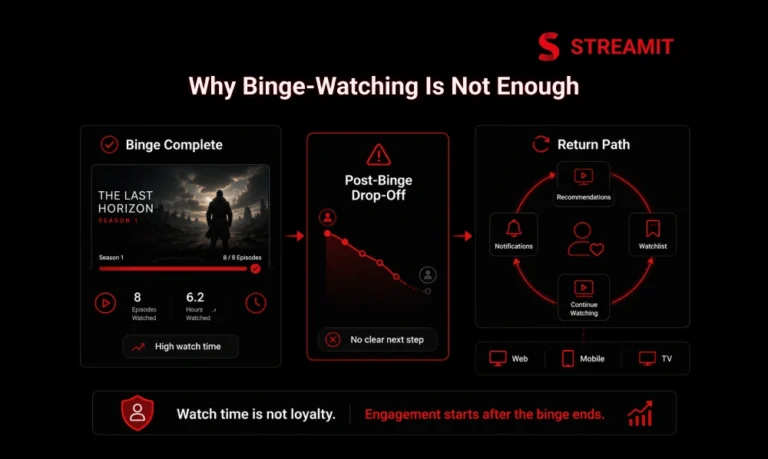
Streaming behavior is often episodic. A user may subscribe to one title, complete it quickly, and decide there is no immediate reason to stay.
This is one of the most overlooked realities in OTT strategy. Founders assume a successful launch converts into stable recurring revenue. It often does not. It converts into a short window of attention that must be extended through better planning, discovery, and follow-up engagement.
More streaming choices make retention harder for founders
The viewer’s attention is now distributed across many platforms, devices, and formats. That means the standard for retention is no longer “good enough content.” It is a stronger combination of relevance, convenience, performance, and habit-building.
Founders are not only competing against similar platforms. They are competing against subscription fatigue, limited screen time, and the growing willingness of users to rotate services based on what is worth paying for this month.
What Strong Retention Means in an OTT Streaming Business
Retention in OTT is not just about lowering cancellations. It is about building a system that keeps subscribers engaged, active, and commercially valuable over time.
A strong retention model means the platform continues to justify its place in the subscriber’s monthly budget. That justification can come from content, product experience, pricing fit, personalization, or all of them working together.
OTT retention vs OTT churn
Retention and churn are often discussed together, but founders need to understand them differently.
Retention shows how well the platform holds its subscribers over time. Churn shows how much of the subscriber base is slipping away. One reflects platform strength. The other exposes platform fragility.
Voluntary churn in OTT platforms
Voluntary churn happens when viewers choose to cancel. This is the form of churn most founders focus on first, and for good reason. It often reflects the platform’s real value gap.
Users voluntarily churn when they no longer see enough reason to keep paying. Sometimes that reason is obvious, such as content gaps or price sensitivity. Sometimes it is less obvious, such as weak discovery, poor renewal messaging, or a lack of post-binge engagement.
Involuntary churn from failed payments and renewals
Involuntary churn is less visible but often easier to reduce. It happens when subscribers intended to remain active, but failed payments, expired cards, or renewal issues quietly interrupt access.
Many founders spend heavily to acquire new users while losing existing ones through preventable billing failure. That is a strategic mistake. Silent churn is still churn.
The Key OTT retention metrics founders should track
Retention improves when founders monitor the right signals early, not after revenue starts falling.
A 5% drop in watch frequency can matter more than a vanity spike in app downloads. OTT retention is shaped by behavioral, financial, and technical signals working together.
Churn rate and retention rate
These are still the core metrics. They provide the simplest view of subscriber health and whether the business is getting stronger or weaker over time.
But they are lagging indicators. They tell you what happened, not why it happened.
Watch time, session frequency, and completion rate
These are stronger operational signals. When watch time declines, when sessions become less frequent, or when completion rate falls, churn risk often follows.
Founders should treat these metrics as early warnings, not just reporting lines.
ARPU, CLV, and reactivation rate
Retention is not only about keeping users active. It is about keeping economically valuable users active.
ARPU helps founders understand revenue quality. CLV shows whether the business is building durable subscriber value. Reactivation rate reveals whether churn is permanent or recoverable.
Playback failures, startup time, and rebuffering ratio
Streaming quality has a direct effect on retention, especially on mobile, smart TV, and lower-bandwidth environments.
Technical friction is often underestimated because it sits between product and infrastructure. Users, however, do not separate those things. They simply decide whether the experience feels reliable enough to continue paying for.
| Metric Group | What Founders Should Watch | Why It Matters |
| Subscriber health | Churn rate, retention rate | Shows whether the base is holding |
| Engagement | Watch time, session frequency, completion rate | Reveals habit strength and content fit |
| Revenue quality | ARPU, CLV, reactivation rate | Shows commercial durability |
| Streaming quality | Startup time, playback failures, rebuffering ratio | Identifies technical causes of churn |
Why OTT Streaming Founders Fail Without Strong Retention
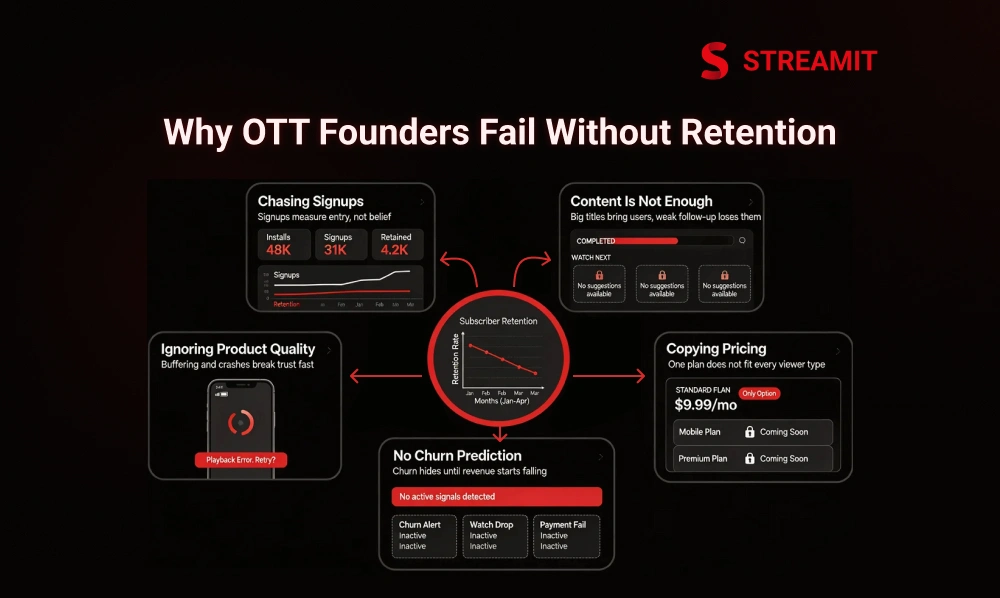
Low demand is not what breaks most OTT platforms. Weak retention does. Signups and early traction may look promising, but they do not create real growth unless subscribers stay long enough to build consistent revenue.
The main mistake is focusing too much on acquisition and too little on retention. Founders invest in content and marketing, but often overlook discovery, user experience, streaming quality, pricing fit, and renewal behavior.
Strong retention turns short-term traction into long-term OTT growth. It improves customer lifetime value, protects content ROI, and gives subscribers a reason to stay, watch more, and renew.
They chase signups more than subscriber retention
The easiest numbers to celebrate are usually the least durable. App installs, signups, trials, and launch spikes all create a sense of traction.
But signups only measure entry. Retention measures belief. A subscriber who stays is saying the platform remains worth paying for. That signal matters far more than the initial click.
Paid growth looks good at first, but hides churn
Paid growth creates activity quickly. That speed can be useful in the early stages. It can also become dangerous because it delays an honest diagnosis.
If churn is high, paid acquisition creates an illusion of momentum while the underlying system remains weak. Revenue may hold for a while, but only because the platform is spending to cover structural losses.
Retention gets ignored until revenue starts falling
Many founders only take retention seriously when renewals soften, CAC rises, or content spend becomes harder to justify. By then, the platform is already reacting late.
Retention should not be treated as a fix. It should be treated as a design principle from the beginning.
They think content alone will save the platform
Content matters. But content alone is not a retention strategy. It is one input into a larger system.
A strong title can create subscriber interest, but it cannot guarantee subscriber continuity. That depends on what happens before, during, and after the content is consumed.
Big titles bring users in, but weak follow-up content pushes them out
One major release can pull in a large audience. But when that audience finishes the title, the platform needs a next step. Without it, the platform becomes event-driven rather than subscription-worthy.
Founders often overestimate the lifetime effect of marquee content and underestimate the importance of what sustains engagement between big moments.
Content without discovery and personalization does not hold viewers
A deep library has little retention value if users cannot find what fits them. Discovery is where content strategy becomes product strategy.
When personalization is weak, viewers see the same interface, the same generic rows, and the same missed opportunities. In that environment, content can exist without creating watch depth.
They ignore product and streaming quality
Subscription businesses depend on repeated experience. That makes product quality especially important in OTT.
A few seconds of delay can do more damage than founders expect because trust in streaming is fragile. Viewers expect playback to work. They do not reward platforms for basic reliability; they punish them when it is missing.
Buffering, crashes, and startup delay break trust fast
Performance issues do not always cause immediate cancellation, but they quietly weaken the relationship. Each buffering event, startup delay, or crash reduces confidence in the product.
That confidence matters. A viewer who does not trust the platform is more likely to leave when pricing changes, when content runs out, or when alternatives appear.
Poor onboarding and confusing navigation reduce retention early
The first session matters more than many founders assume. If signup is clumsy, discovery feels cold, or the home screen fails to guide a user toward value, early retention drops.
A platform should help a new subscriber reach a satisfying first watch quickly. If it does not, that user may still count as acquired, but the retention clock is already running against the business.
They copy pricing instead of testing pricing
Many OTT founders copy competitor pricing instead of testing what suits their own audience. But OTT pricing works only when it matches viewer behavior, content value, and market sensitivity.
Pricing should support retention, not just signups. Testing different plans, tiers, and billing options helps founders find what keeps subscribers active for longer.
One plan does not fit every viewer type
Heavy users, casual users, live-event users, and regional audiences do not behave the same way. A single pricing structure rarely fits all of them well.
Founders who fail to segment pricing usually create avoidable churn among users who might have stayed on a lighter, cheaper, or more flexible plan.
Price increases without value and communication drive churn
Price changes are not only financial decisions. They are trust decisions.
When users feel surprised, cornered, or unconvinced by the value behind a price increase, cancellation becomes more likely. Communication before billing matters almost as much as the pricing itself.
They do not build systems to predict churn early
Many OTT founders react to churn only after subscribers start leaving. But by then, the damage is already visible in revenue and engagement.
Early churn signals like lower watch time, fewer sessions, failed payments, or repeat playback issues help founders act before cancellation happens. Without these systems, subscriber loss stays hidden until it becomes costly.
No churn alerts means no early action
If watch frequency drops, searches rise without play starts, or complaints cluster around a device or region, the platform is receiving early warnings. Founders need systems that turn those signals into action.
No billing recovery means silent subscriber loss
A failed renewal should trigger recovery flows, not revenue leakage. Billing recovery is one of the clearest examples of retention work that is operational, not theoretical.
The Biggest Reasons OTT Subscribers Churn
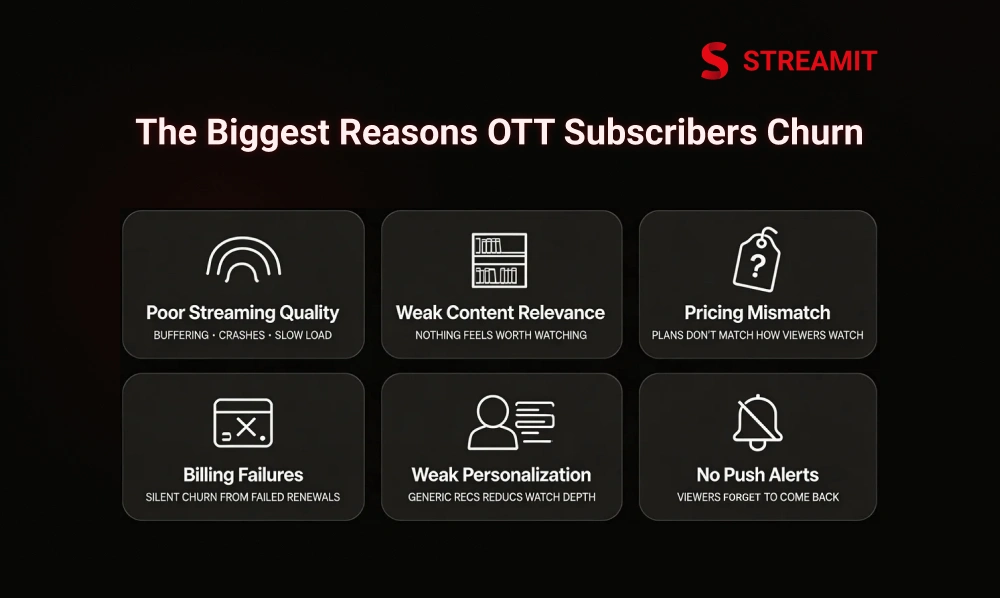
OTT subscribers usually do not cancel for one single reason. Churn often happens when several small gaps build up over time, such as weak content relevance, poor streaming quality, limited personalization, pricing mismatch, or billing friction. When the platform stops feeling useful, easy, or worth the cost, users leave.
One of the biggest churn drivers is a weak viewing experience. Buffering, startup delays, app crashes, hard navigation, and poor content discovery reduce trust quickly. Even strong content cannot hold subscribers for long if the overall experience feels frustrating or inconsistent across devices.
Pricing and engagement also play a major role. Many users subscribe to one title, binge it, and cancel if there is no strong reason to stay. Others drop off because the plan does not match their budget, payment fails during renewal, or the platform does not re-engage them with relevant recommendations, reminders, or watch-next suggestions.
Weak content relevance and shallow content libraries
Weak content relevance is one of the biggest reasons OTT subscribers churn. A large library may look impressive, but it does not help much if viewers cannot find content that matches their interests. People stay subscribed when the platform consistently gives them something worth watching, not just a high content count.
Shallow content libraries create a similar problem. When users finish a few strong titles and see little else that feels relevant, they lose the reason to continue paying. In OTT, retention depends less on having more content and more on having the right content mix that keeps viewers engaged over time.
Viewers leave when the content does not match their interests
Content mismatch is one of the clearest drivers of voluntary churn. If users do not feel understood, they stop exploring.
Relevance matters more than raw volume because viewers evaluate a service based on what feels worth watching now, not how many titles exist in total.
Long gaps between good releases increase cancellations
Even satisfied users can drift when there is too much time between meaningful releases. A platform that goes quiet invites churn.
Retention improves when the release calendar creates continuity, not only peaks.
Regional, local, and language gaps hurt retention
Global catalogs are not enough in many markets. Viewers respond strongly to content that feels culturally close, linguistically accessible, and locally relevant.
Platforms that ignore this often mistake weak retention for weak demand.
Poor user experience and low streaming quality
Poor user experience and low streaming quality are major reasons why OTT subscribers leave. Viewers expect fast loading, smooth playback, easy navigation, and a reliable experience across devices. When they face buffering, playback errors, app crashes, or confusing content discovery, frustration builds quickly.
In streaming, even small performance issues can damage trust. A platform may have strong content, but if watching feels slow, unstable, or difficult, users are less likely to return or renew. Retention improves when the product feels simple, fast, and dependable every time they use it.
Buffering, low video quality, and playback errors
Playback failure breaks the core promise of the product. Users do not subscribe to wait, retry, or guess whether the stream will hold.
Slow app load time and startup delay
Every delay creates emotional drag. Over time, that drag reduces session starts and weakens habit formation.
App crashes and device compatibility problems
OTT is inherently cross-device. If the product works well on one screen and poorly on another, the brand experience becomes inconsistent. That inconsistency often shows up later as churn.
Hard-to-use search, navigation, and content discovery
Viewers should not have to work hard to find something worth watching. When navigation feels heavy or search fails to help, the platform turns content abundance into decision fatigue.
Pricing and plan mismatch
Pricing and plan mismatch often push OTT subscribers to cancel even when they like the content. A single pricing model does not suit every viewer. Some want flexible monthly access, while others respond better to lower-cost, longer-duration, or mobile-first plans. When the plan feels expensive or poorly matched to usage, users are more likely to leave.
Retention improves when pricing reflects how people actually watch. Founders who offer the right plan structure, clear value, and better flexibility can reduce churn and keep more subscribers active over time.
Users subscribe to one show, then cancel
This is one of the most common OTT patterns. It is not always a sign of weak content. Sometimes it is a sign of weak retention design around that content.
Monthly, quarterly, and yearly plans need different use cases
Plan duration should reflect behavior. A casual viewer may want flexibility. A committed viewer may value savings for a longer commitment. A live-event user may need a very different structure entirely.
Budget packs and mobile-first plans can reduce churn in price-sensitive markets
Founders who only design for premium consumption often miss retention opportunities in segments that want lighter entry points, not full-price packages.
Billing and payment failures
Billing and payment failures are a major cause of OTT churn, especially because they often happen silently. Subscribers may want to continue, but expired cards, failed renewals, or payment processing issues can stop the subscription without warning.
This kind of involuntary churn reduces revenue without reflecting actual user interest. Payment reminders, smart retry logic, and smooth renewal systems help protect recurring revenue and keep active subscribers from dropping off unnecessarily.
Expired cards and failed renewals cause silent churn
When payment fails, the subscriber may disappear without dissatisfaction ever being the issue. That makes this form of churn especially frustrating and especially solvable.
Payment reminders and retry logic protect recurring revenue
Simple recovery systems often preserve subscribers who were never trying to leave in the first place.
Weak personalization and weak engagement loops
Weak personalization and weak engagement loops make it harder for OTT platforms to keep subscribers active. When recommendations feel generic, and the platform does not guide users toward relevant content, viewers lose interest faster. A large library alone is not enough if users cannot quickly find something they want to watch.
Engagement also drops when there are no useful reminders to bring viewers back. Features like continue-watching prompts, watchlist nudges, and relevant push alerts help keep the platform active in the user’s routine. Without them, even interested users may stop returning and eventually cancel.
Bad recommendations reduce watch depth
When recommendations feel generic, watch depth drops. The user consumes less, discovers less, and feels less reason to stay.
No push alerts, watchlist prompts, or continue-watching nudges
Useful reminders help users reconnect with unfinished interests. Without them, even a good platform can become forgettable.
How Founders Should Map the OTT Retention Funnel
Founders should map the OTT retention funnel across the full subscriber journey, from signup to renewal and win-back. This helps identify where users lose interest and where retention starts to weaken.
The early stage should focus on reducing friction and helping users reach value fast. A smooth signup, simple checkout, and quick access to relevant content improve the chances of early engagement.
The later stage should focus on keeping users active and lowering churn risk before cancellation happens. A clear retention funnel helps founders manage retention as a growth system, not just a metric.
From signup to first play
The journey from signup to first play is one of the most important stages in OTT retention. This is where users form their first impression of the platform and decide whether it feels easy, useful, and worth exploring further.
A smooth signup flow, simple checkout, and fast access to relevant content help users reach value quickly. When the first experience feels clear and friction-free, the chances of early engagement and long-term retention become much stronger.
Reduce friction in signup, checkout, and trial start
Any hesitation at this stage reduces the chance of habit formation later. Fewer steps, cleaner payments, and simpler onboarding increase the odds that the user actually begins using the service.
Help users reach the first valuable watch fast
The platform should guide the user toward something clearly worth watching as quickly as possible. Time-to-first-value matters in OTT just as much as in software.
From first watch to first week engagement
The stage from first watch to first week engagement is where early interest turns into a user habit. After the first title, the platform should quickly guide viewers toward the next relevant piece of content to keep them active.
Strong recommendations, clear watch-next options, and simple discovery prompts help maintain momentum during this period. If users stay engaged in the first week, the chances of retention and future renewal become much higher.
Recommend the next best title right away
A strong watch-next system extends the session and increases the chance of return. This is where retention starts feeling intentional instead of accidental.
Use onboarding prompts to guide discovery
A few light preference signals can significantly improve early recommendations and reduce cold-start emptiness.
From active use to renewal
The stage from active use to renewal is where OTT platforms must keep showing clear value. Subscribers are more likely to renew when they continue finding relevant content, enjoying a smooth experience, and staying engaged between major releases.
Consistent watch activity, timely recommendations, and clear renewal communication help strengthen this stage. When users feel the platform still offers enough value before the billing date, the chances of renewal become much higher.
Keep users warm between major releases
Not every retention moment has to be a blockbuster. Small releases, curated collections, and timely prompts help keep the service active in the user’s mind.
Show value before the billing date arrives
Renewal reminders should reinforce relevance, not just announce payment timing.
From cancellation risk to win-back
The stage from cancellation risk to win-back focuses on users who are losing interest or are close to leaving. A drop in watch time, fewer sessions, or failed renewals can signal that retention is weakening before cancellation actually happens.
Founders should identify these users early and respond with the right action, such as pausing plans, saving offers, sending reminders, or running win-back campaigns. This stage helps reduce subscriber loss and gives the platform a better chance to recover users who may still return.
Spot low-engagement users before they cancel
When engagement falls, the platform should know. Waiting for the cancellation click is too late.
Use pause plans, save offers, and win-back campaigns
Not every subscriber needs the same retention move. Some need flexibility. Some need a reminder. Some need a better plan option.
How Better Content Strategy Improves OTT Retention
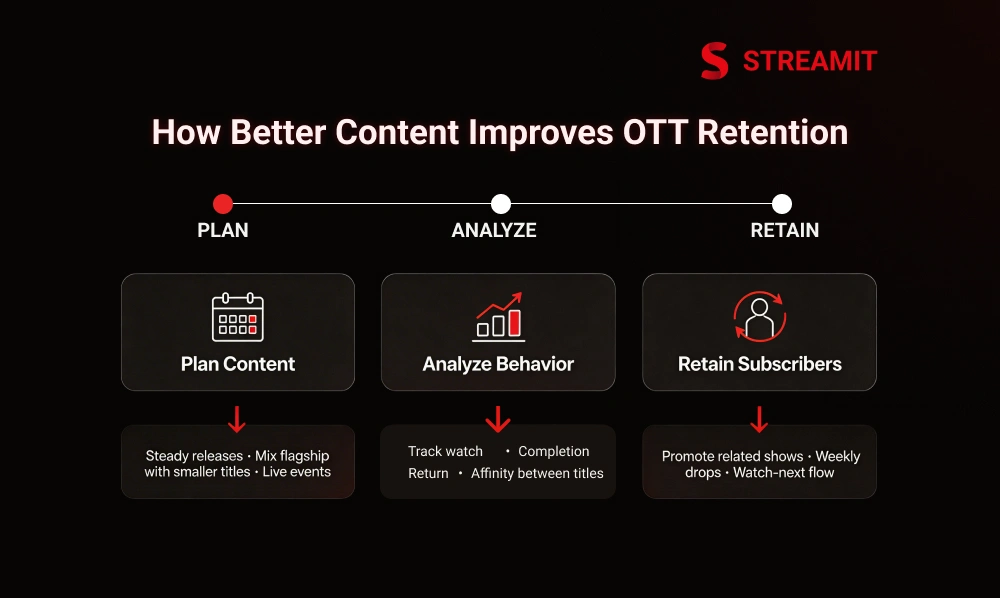
A better content strategy improves OTT retention by giving subscribers more reasons to stay beyond the first title they came for. Strong retention does not come only from big launches. It comes from a steady content plan that keeps viewers engaged over time and reduces the gap between one watch and the next.
When content is planned for retention, founders focus on consistency, relevance, and real viewer behavior. This means keeping a steady release flow, understanding what audiences actually watch, and guiding them to related content before interest drops.
A stronger content strategy also reduces churn after major releases. Follow-up recommendations, smaller releases, and better timing help turn short-term attention into longer-term subscriber value.
Build a content strategy for retention, not only for launches
Building a content strategy only around launches creates short bursts of attention, but it does not support long-term retention. In OTT, subscribers stay longer when the platform continues giving them relevant reasons to return after the initial release.
A stronger strategy focuses on retention, not just launch momentum. That means planning a steady content flow, balancing major titles with smaller releases, and making sure viewers always have something meaningful to watch next.
Keep a steady release calendar
A predictable cadence gives viewers reasons to return. It reduces the platform’s dependence on rare spikes.
Mix flagship titles with regular, smaller releases
Not everything needs to be a major event. Smaller, consistent releases can stabilize engagement between bigger content moments.
Use originals, exclusives, and live events to keep people coming back
Distinctive programming strengthens identity. Identity strengthens retention because users associate the service with something they cannot easily replace elsewhere.
Use content analytics to decide what to produce and promote
Using content analytics helps founders make better decisions about what to produce, acquire, and promote. Instead of relying on assumptions, they can study what viewers actually watch, complete, return to, and ignore.
This makes content strategy more effective for retention. When platforms understand which genres, formats, languages, or titles drive deeper engagement, they can invest more confidently in content that keeps subscribers active for longer.
Track what viewers watch, finish, and return to
Completion and repeat viewing reveal stronger signals than impressions alone.
Study affinity between titles to improve watch-next flows
Content relationships matter. If users often move from one genre, language, or creator to another, those paths should shape discovery design.
Use cohort, genre, language, and geography data
Retention improves when content planning reflects real audience segments rather than broad assumptions.
Reduce churn after a major show or event ends
Reducing churn after a major show or event ends is important because many users subscribe to a single title and leave once it is over. If the platform does not guide them toward the next reason to stay, interest drops quickly.
Founders can reduce this churn by promoting related content before the main title ends, improving watch-next recommendations, and planning follow-up releases that keep viewers engaged. This helps turn short-term attention into longer-term subscriber retention.
Promote related shows before the main title ends
Do not wait until the session is over. The handoff to the next title should happen while interest is still active.
Use weekly drops or split releases when it fits the content
Release format can influence retention. In some cases, pacing content helps extend subscriber value more effectively than dropping everything at once.
How Product Experience and Streaming Quality Protect OTT Growth
Product experience and streaming quality protect OTT growth by shaping how viewers feel every time they use the platform. Strong content may bring users in, but retention becomes harder when playback is slow, navigation is confusing, or the app feels unreliable across devices.
A smooth and consistent experience helps subscribers stay engaged for longer. Fast loading, easy content discovery, stable playback, and seamless cross-device use all reduce frustration and build trust over time.
In OTT, growth is not protected by content alone. It is protected when the product feels simple, reliable, and worth returning to every session.
Fix the moments that make viewers leave
Fixing the moments that make viewers leave is essential for stronger OTT retention. Many subscribers do not cancel because of one major issue, but because of repeated friction, such as slow login, buffering, playback errors, or hard navigation.
When founders identify and improve these weak points, the overall viewing experience becomes smoother and more reliable. Reducing these friction moments helps keep users engaged, improves satisfaction, and protects long-term OTT growth.
Slow onboarding and hard login flows
If getting into the product feels harder than it should, engagement weakens before it begins.
Playback failure, buffering, and poor startup speed
Performance is not just an engineering metric. It is a trust metric.
Broken payments, account issues, and upgrade friction
When core account actions feel confusing or unreliable, subscribers begin questioning the platform’s overall maturity.
Build a strong cross-device experience
Building a strong cross-device experience is important because OTT users watch content across mobile, web, smart TV, and tablets. If the experience feels inconsistent on different devices, it becomes harder to keep viewers engaged.
A connected experience should save watch progress, preferences, and history across every screen. When users can switch devices without losing continuity, the platform feels smoother, more reliable, and easier to return to.
Mobile, web, smart TV, and tablet should feel connected
Consistency across environments improves habit strength. Users should not feel like they are switching products when they switch devices.
Save progress, preferences, and watch history across devices
Cross-device continuity is a retention feature, not just a convenience feature.
Use QoE analytics and product analytics together
Using QoE analytics and product analytics together helps founders understand both technical performance and viewer behavior in one place. QoE data shows issues like buffering, startup delay, and playback failures, while product analytics reveals how those issues affect watch time, session frequency, and churn.
When both are tracked together, founders can find where retention is weakening faster. This makes it easier to spot churn risk by device, region, network, or content type and take action before subscriber loss grows.
Track playback health with viewer behavior in one place
Watching performance metrics and behavior separately creates blind spots. Together, they reveal what is actually causing user drop-off.
Find churn risk by device, region, network, and content type
Patterns are rarely uniform. Some churn issues are technical and highly localized. Others are content-driven. Good analytics helps founders tell the difference.
Pricing and Packaging Strategies That Reduce OTT Churn
Pricing and packaging directly affect OTT churn because subscribers stay longer when the plan matches how they actually watch. If pricing feels too expensive, too rigid, or poorly suited to user needs, cancellations rise quickly.
A stronger strategy focuses on flexibility, value, and clarity. The right mix of plans, along with clear renewal communication and easier downgrade or pause options, helps protect long-term retention, not just drive signups.
Choose pricing that matches how people actually watch
Choosing pricing that matches how people actually watch helps OTT platforms reduce unnecessary churn. Not every subscriber uses the service in the same way. Some prefer monthly flexibility, while others respond better to longer plans, lower-cost options, or mobile-first access.
When pricing reflects real viewing behavior, the platform feels more relevant and easier to keep. A better fit between usage and plan structure improves retention by giving subscribers an option that matches their needs and budget.
Monthly, quarterly, and annual plans each serve a different user
Shorter commitments reduce entry friction. Longer commitments improve retention and revenue visibility when matched to the right audience.
Ad-supported, mobile-only, and budget plans can widen retention
Not every subscriber wants the full premium package. Smart packaging can retain users who might otherwise churn completely.
Reduce renewal friction and price shock
Reducing renewal friction and price shock is important because many OTT subscribers cancel when billing feels sudden, confusing, or higher than expected. Even interested users may leave if the renewal process creates uncertainty or the price increase is not supported with clear value.
Platforms can lower this risk by communicating renewal details early, reminding users of the value they receive, and offering flexible options such as downgrade, pause, or lighter plans. A smoother renewal experience helps protect trust and keeps more subscribers active.
Communicate renewal value clearly before billing
The message should remind users what they are staying for, not only what they are about to be charged.
Offer downgrade, pause, or lighter plan options before cancel
Flexibility often preserves more lifetime value than forcing a hard keep-or-leave decision.
Test pricing instead of guessing what works
Testing pricing instead of guessing what works helps OTT founders make better decisions based on real subscriber behavior. A plan that drives signups is not always the one that improves retention, so relying on assumptions can lead to avoidable churn.
By testing plan duration, pricing tiers, bundles, and offers, founders can learn which options keep subscribers active for longer. This makes pricing a retention strategy, not just a conversion tactic.
Test plan duration, offers, and bundles by cohort
Different audiences respond differently to the same pricing logic.
Learn which plans improve retention, not just conversions
The best-converting plan is not always the best-retaining plan. Founders who confuse the two often optimize for short-term activity at the expense of long-term value.
Using Data to Predict and Reduce OTT Churn
Using data to predict and reduce OTT churn helps founders act before subscribers leave. By tracking signals like lower watch time, fewer sessions, failed payments, playback issues, or weaker content engagement, they can spot retention problems early.
A data-driven approach also makes churn easier to understand and fix. It helps teams identify at-risk users, quality issues, and weak content or pricing areas, so they can take the right action before subscriber loss grows.
The most useful churn signals founders should watch
The most useful churn signals are the early changes that show subscriber interest is starting to drop. A decline in watch time, fewer viewing sessions, lower completion rates, more searching with fewer play starts, repeated buffering, and failed payments can all signal that a user is moving closer to cancellation.
These signals matter because they appear before churn becomes visible in revenue. When founders track them closely, they can identify at-risk subscribers earlier and take action with better recommendations, renewal support, or re-engagement efforts before the user leaves.
Drop in watch time and session frequency
When usage softens, churn risk often follows.
More search but fewer play starts
This usually signals a discovery problem, not necessarily a content problem.
Repeat buffering and playback complaints
Technical frustration compounds quickly, especially among otherwise engaged users.
Failed payments and upcoming renewal risk
Billing signals should trigger retention workflows immediately.
Build simple churn segments that are easy to act on
Building simple churn segments helps founders act faster on subscriber loss. Instead of treating all users the same, they can group them by clear patterns such as new users dropping early, binge-and-leave viewers, inactive high-value users, or users affected by failed payments.
This makes retention efforts more focused and effective. Each segment can be matched with the right action, such as better onboarding, renewal reminders, save offers, or win-back campaigns.
New subscribers are at risk in the first 7 to 30 days
This group usually needs activation help and faster content relevance.
Binge-and-leave users
This group needs post-consumption pathways, not generic promotions.
Seasonal and event-driven users
This group often responds better to timing-based offers and scheduling clarity.
High-value users are going inactive
This group deserves the most strategic retention attention because the revenue impact is higher.
Turn analytics into retention actions
Turning analytics into retention actions means using data to improve what users experience next, not just to track past behavior. If engagement drops or playback issues increase, founders should respond with better recommendations, renewal support, or re-engagement steps.
Analytics matters most when it leads to action. In OTT, the goal is to use churn signals to keep more subscribers active and reduce avoidable loss.
Better recommendations and home screen changes
If discovery is failing, the interface should adapt.
Better notifications, offers, and win-back campaigns
Messaging should reflect behavior, not just calendar timing.
Better content planning and release timing
The goal is not only to know why users leave, but to design the next month so fewer of them do.
A Practical OTT Retention Plan for Founders
A practical OTT retention plan helps founders turn retention into clear action. Instead of treating churn as a broad issue, it focuses on improving the key areas that affect subscriber behavior and long-term growth.
It starts with the basics, such as onboarding, first play experience, content discovery, streaming quality, and cancellations. Then it moves into stronger systems like better recommendations, pricing tests, payment recovery, and re-engagement efforts.
A clear retention plan helps founders reduce churn, protect revenue, and build a more stable OTT business over time.
What to do in the first 30 days
In the first 30 days, founders should focus on finding the biggest weak points in the subscriber journey. This includes auditing onboarding, first play experience, buffering, cancellations, and content discovery to see where retention starts to drop.
They should also set up core dashboards for churn, engagement, and streaming quality. This gives a clearer view of user behavior early and helps build a stronger base for improving retention over time.
Audit onboarding, first play, buffering, and cancellations
Look for the clearest friction points in the early user journey and the most common technical breakpoints.
Set up core dashboards for churn, retention, and QoE
If retention is not visible weekly, it will stay theoretical.
What to do in the first 90 days
In the first 90 days, founders should improve the systems that directly affect retention. This includes better content discovery, stronger recommendations, pricing tests, and payment recovery.
The goal is to reduce churn with smarter product, pricing, and engagement improvements. This helps build stronger subscriber value over time.
Improve content discovery and recommendation flows
This is often one of the fastest retention wins.
Launch pricing tests and payment recovery flows
Both changes can reduce avoidable churn without waiting for new content cycles.
What to do over the next 6 months
Over the next 6 months, founders should build the systems that support long-term retention. This includes improving release cadence, strengthening reactivation campaigns, using churn signals more effectively, and making the cross-device experience more reliable.
The focus should be on turning retention into an ongoing growth system. When content, product experience, and subscriber recovery improve together, OTT growth becomes more stable and sustainable.
Build release cadence, reactivation campaigns, and churn prediction
Retention becomes scalable when it is operationalized, not improvised.
Improve cross-device experience and playback reliability
These are foundational improvements that compound over time.
The OTT Retention Stack Founders Need
The OTT retention stack founders need is a set of tools that helps reduce churn and improve subscriber retention. It supports better decisions across content, product, billing, and user engagement.
A strong stack usually includes QoE monitoring, product analytics, recommendation systems, and payment recovery tools. These help founders understand viewer behavior and spot retention issues early.
It should also include CRM, push, email, and in-app messaging tools. When these systems work together, founders can keep more subscribers active and build a stronger OTT business.
Video analytics and QoE monitoring tools
Video analytics and QoE monitoring tools help founders track how well the streaming experience is performing. They show issues like buffering, startup delay, playback failure, and video quality problems that can hurt viewer satisfaction.
These tools are important because streaming quality has a direct impact on retention. When founders can spot technical issues early, they can improve the viewing experience and reduce churn more effectively.
Product analytics and cohort dashboards
Product analytics and cohort dashboards help founders understand how subscribers behave over time. They show patterns in watch time, session frequency, retention, and churn across different user groups.
These insights make it easier to identify where engagement is falling and which cohorts need attention. With better visibility, founders can take clearer action to improve retention.
Recommendation and personalization systems
Recommendation and personalization systems help OTT platforms guide viewers toward content that matches their interests. Instead of showing the same experience to everyone, they make content discovery more relevant and easier.
These systems support retention by improving watch depth and keeping users engaged for longer. When viewers quickly find something worth watching next, they are more likely to return, stay active, and continue their subscription.
Billing, dunning, and payment recovery tools
Billing, dunning, and payment recovery tools help reduce subscriber loss caused by failed payments and renewal issues. They support reminders, retry logic, and recovery flows that protect recurring revenue.
These tools are important because many users churn without intending to leave. With better payment recovery systems, OTT platforms can keep more subscribers active and reduce silent churn.
CRM, push, email, and in-app engagement tools
CRM, push, email, and in-app engagement tools help OTT platforms stay connected with subscribers outside active viewing sessions. They support reminders, watchlist nudges, renewal messages, and re-engagement campaigns that bring users back.
These tools improve retention by keeping the platform present in the user’s routine. When communication feels timely and relevant, subscribers are more likely to return, stay engaged, and continue their subscription.
Common Founder Mistakes That Quietly Kill OTT Retention
Common founder mistakes quietly kill OTT retention when platforms focus more on short-term growth than long-term subscriber behavior. Signups and installs may create momentum, but that momentum fades quickly if users do not stay engaged.
A common mistake is investing in content, pricing, and reach while giving less attention to discovery, streaming quality, billing recovery, and user experience. These weak points may seem small, but together they increase churn over time.
What makes them dangerous is that they often stay hidden early on. The platform may still look active, but without strong retention systems, growth does not truly compound. It only replaces the subscribers it loses.
Focusing on downloads instead of watch behavior
Focusing on downloads instead of watch behavior is a common mistake in OTT. Downloads may show initial interest, but they do not reveal whether users are actually watching, returning, or staying subscribed.
Watch time, session frequency, and completion rate give a much clearer picture of retention. Founders who focus on these signals make better decisions about what keeps subscribers active over time.
Spending on content but ignoring content discovery
Spending on content but ignoring content discovery is a costly mistake in OTT. A platform may have strong titles, but if viewers cannot find them easily, that content does little to support retention.
Content discovery helps users move from interest to watch time. When search, recommendations, and navigation are weak, even valuable content stays underused, and subscribers are more likely to lose interest.
Launching on many devices without enough testing
Launching on many devices without enough testing can quietly damage OTT retention. A platform may be available across mobile, web, smart TV, and tablet, but if the experience feels unstable or inconsistent, users lose trust quickly.
Founders should not treat device reach as success on its own. Cross-device growth supports retention only when playback, navigation, login, and watch continuity work smoothly on every screen.
Ignoring involuntary churn and failed payments
Ignoring involuntary churn and failed payments is a common mistake that quietly reduces OTT revenue. Many subscribers do not leave by choice. They drop off because of expired cards, failed renewals, or payment issues that go unresolved.
This kind of churn is often preventable. With payment reminders, retry logic, and recovery flows, founders can keep more subscribers active and protect recurring revenue.
Treating churn as only a marketing problem
Treating churn as only a marketing problem is a common mistake in OTT. While marketing can help bring users in or win some back, subscriber loss usually starts deeper in the product, content, pricing, billing, or viewing experience.
Retention improves when founders see churn as a cross-functional issue, not just a campaign issue. In OTT, users stay when the full platform experience gives them enough reason to keep watching and renewing.
How to Measure if Your OTT Retention Strategy Is Working
Measuring whether your OTT retention strategy is working means looking beyond signups and focusing on whether subscribers stay active, engaged, and willing to renew. Retention is improving when users return more often, watch more consistently, and face fewer reasons to cancel.
Founders should track both weekly and monthly metrics. Weekly signals like watch time, play starts, buffering, cancellations, and at-risk cohorts help spot problems early, while monthly metrics such as retention rate, churn rate, ARPU, CLV, and reactivation rate show whether long-term subscriber value is getting stronger.
A retention strategy is working when the platform sees more repeat sessions, better completion rates, lower churn after renewals or major releases, and stronger performance across key user groups. These signs show that subscribers are not just joining, but continuing to find value in the platform.
Weekly metrics founders should review
Weekly metrics founders should review should focus on the signals that show whether subscriber engagement is staying strong or starting to weaken. Metrics like watch time, play starts, buffering, cancellations, and low-engagement user groups help founders spot retention issues early.
These weekly insights are useful because they show where action is needed before churn grows further. When founders review them regularly, they can respond faster and improve retention with better product, content, or engagement decisions.
Watch time, play starts, buffering, and cancellations
These metrics help detect movement early.
Top at-risk cohorts and devices
The goal is to know where retention is weakening before it spreads.
Monthly metrics founders should review
Monthly metrics founders should review should focus on the broader signals that show whether OTT retention is improving over time. Metrics like retention rate, churn rate, ARPU, CLV, reactivation rate, and plan or content performance help founders understand long-term subscriber value.
These metrics are important because they show whether the platform is building a healthier and more stable subscriber base. When reviewed regularly, they help founders measure if retention efforts are actually reducing churn and strengthening growth.
Retention rate, churn rate, ARPU, CLV, and reactivation
These metrics reveal whether short-term improvements are translating into stronger economics.
Which content, plans, and channels hold users best
This helps founders understand what kind of growth is actually durable.
Signs that your retention strategy is actually improving
Signs that your retention strategy is improving include more repeat sessions, better completion rates, lower churn, and stronger renewals. These signals show that subscribers are staying active and finding more value in the platform.
When users return more often and cancel less, it usually means retention efforts are working. This reflects stronger long-term subscriber behavior, not just short-term growth.
More repeat sessions and better completion rates
These signals show that users are building deeper habits.
Lower churn after major releases or renewals
This shows the platform is reducing the volatility that often follows content peaks or billing moments.
| Review Cadence | Metrics to Track | What Improvement Looks Like |
| Weekly | Watch time, play starts, buffering, cancellations, at-risk cohorts | Fewer friction events, better repeat usage |
| Monthly | Retention rate, churn rate, ARPU, CLV, reactivation | More durable revenue and lower subscriber loss |
Key Takeaways
- Retention Drives OTT Growth: This blog makes it clear that OTT growth depends more on retention than on acquisition alone. Signups can create early momentum, but long-term success comes from keeping subscribers active, engaged, and ready to renew.
- Weak Retention Quietly Breaks the Business Model: Many OTT founders do not fail because demand is low. They fail because churn stays high, revenue becomes unstable, and growth never gets the chance to compound over time.
- Subscriber Churn Has More Than One Cause: OTT users usually do not leave for a single reason. Content gaps, weak discovery, poor streaming quality, pricing mismatch, failed payments, and low engagement often combine to push subscribers toward cancellation.
- Content Strategy Should Be Built for Retention: Strong OTT retention does not come only from major launches. It comes from a steady release flow, a relevant content mix, smarter follow-up recommendations, and better planning after a major title or event ends.
- Product Experience Protects Subscriber Trust: Even strong content cannot hold viewers for long if the platform feels slow, confusing, or unreliable. Smooth playback, fast startup, clear navigation, and cross-device consistency all play a direct role in retention.
- Pricing Works Best When It Matches Viewer Behavior: OTT pricing should reflect how subscribers actually watch. Flexible plans, better packaging, and tested pricing models help platforms reduce churn more effectively than copying competitor pricing.
- Data Helps Founders Act Before Churn Grows: The blog highlights that churn can often be predicted early through lower watch time, fewer sessions, failed payments, playback issues, and weak engagement signals. Better data helps founders respond before subscriber loss becomes larger.
- A Clear Retention Funnel Strengthens the Subscriber Journey: Founders should map retention across the full OTT journey, from signup and first play to engagement, renewal, and win-back. This makes it easier to see where users drop off and where the platform needs improvement.
- A Practical Retention Plan Creates Long-Term Stability: OTT retention improves when founders take structured action over time. Better onboarding, stronger recommendations, pricing tests, payment recovery, and re-engagement flows all help build a more stable streaming business.
- The Right Retention Stack Supports Sustainable OTT Growth: QoE monitoring, product analytics, personalization systems, billing recovery, and engagement tools work best when connected. Together, they help founders reduce churn, improve subscriber value, and build stronger long-term growth.
Netflix Retention Playbook
The Netflix retention playbook focuses on improving engagement through personalized discovery and smooth streaming performance. Platforms that combine recommendations and a strong user experience retain viewers longer.
Netflix AI Framework Playbook
The Netflix AI Framework Playbook explains how streaming platforms use AI to analyze viewer behavior and deliver personalized content recommendations. This approach improves discovery, engagement, and long-term subscriber retention across the platform.
Conclusion
OTT founders often spend too much time asking how to get more users and not enough time asking why existing users do not stay longer. That is the real strategic gap.
The streaming businesses that last are not always the loudest or the fastest at launch. They are the ones that build for continuity, earning subscriber trust through relevant content, smooth discovery, reliable playback, pricing clarity, and strong renewal logic.
Most OTT platforms do not fail because demand disappears. They fail because retention was not built seriously enough from the start. That also means the path to stronger growth is not just more marketing or more content spend. It is building the systems that make subscriber value last beyond the first spike of attention. In OTT, success is not measured by who arrives first, but by who keeps coming back.
FAQs
1. What is a good retention rate for an OTT platform?
A good retention rate depends on the content model, pricing structure, market, and subscriber behavior, but the broader principle is simple: the platform should be holding enough subscribers each month to make acquisition more efficient over time. Founders should benchmark retention alongside watch behavior, renewals, and churn source rather than using one isolated number.
2. What is the difference between churn and retention in OTT?
Retention measures how many subscribers stay active over a given period. Churn measures how many leave. Retention shows platform strength. Churn shows where that strength is breaking down.
3. Why do users cancel OTT subscriptions?
Most users cancel because the service no longer feels valuable enough to justify the monthly cost. That usually happens due to weak content relevance, long release gaps, binge-and-leave behavior, poor streaming quality, weak personalization, pricing mismatch, or billing friction.
4. How do buffering and app issues affect OTT retention?
They reduce trust quickly. When playback stalls, startup feels slow, or the app crashes across devices, the viewer begins to question the reliability of the service. Those small moments often push otherwise interested users closer to cancellation.
5. Which OTT metrics matter most for retention?
The most useful retention metrics combine subscriber health, engagement, revenue quality, and streaming quality. Founders should consistently review churn rate, retention rate, watch time, session frequency, completion rate, ARPU, CLV, reactivation rate, playback failures, startup time, and rebuffering ratio.
Read Also
1. Netflix Retention Secrets OTT Platforms Must Learn
2. Subscriber Retention for OTT Platforms: 15 Proven Tactics to Reduce Churn
3. Why Streaming Startups Fail Within 18 Months?
4. Starting Your Own OTT Platform in India: The Real Numbers No One Tells You
5. Smart Retention Engine: Driving Growth Through Smarter Monetization