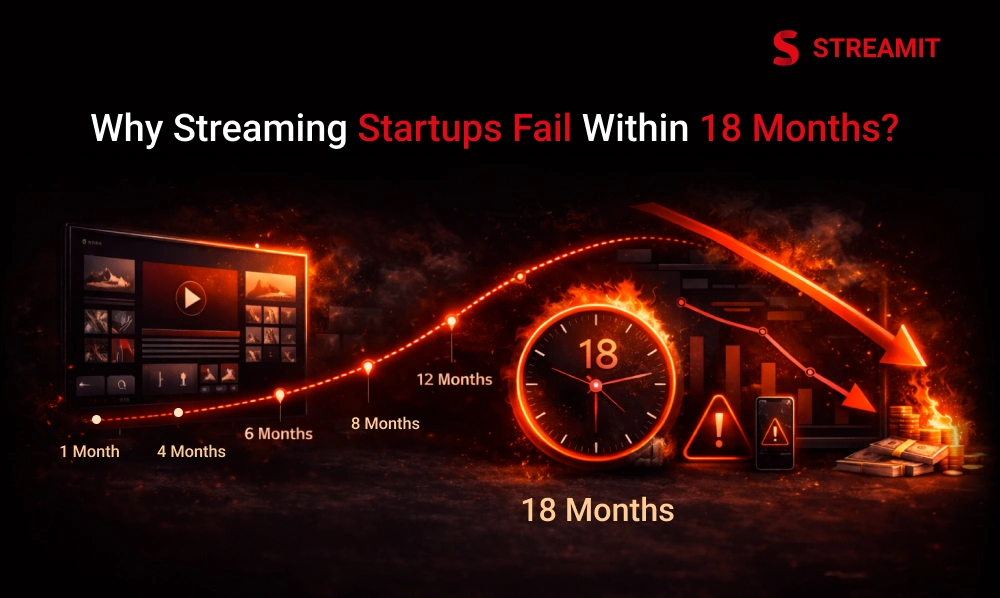
Why Streaming Startups Fail Within 18 Months?

Launching a streaming platform looks attractive from the outside. Global video consumption is rising, OTT platforms are multiplying, and digital audiences continue shifting away from traditional television.
But the numbers tell a different story. Nearly 70–90% of startups fail, and streaming businesses often collapse faster than most digital ventures, a reality highlighted by studies from Startup Genome and CB Insights, which estimate that about 90% of startups shut down. The combination of high infrastructure costs, aggressive competition, and complex technology makes the first 18 months especially fragile.
For founders, the challenge is rarely content alone. Streaming businesses fail because the economics, technology, and retention strategy behind the platform are poorly designed. The platforms that survive are not necessarily the ones with the biggest libraries. They are the ones with a clear niche, efficient infrastructure, and disciplined execution.
This article breaks down the real reasons streaming startups fail within the first 18 months and outlines practical strategies to build a platform that survives beyond the early phase.
The Harsh Reality of Streaming Startups
Most founders assume streaming growth is driven primarily by content. In reality, the infrastructure, economics, and retention systems determine survival.
Launching a streaming platform involves far more than hosting videos and building an app. OTT startups operate in one of the most capital-intensive and technically demanding digital markets.
While the streaming industry continues expanding globally, the majority of new entrants fail to maintain traction after launch. The reasons are often structural rather than creative.
Startup Failure Rates in the First 18 Months
Studies suggest that nearly 30% of startups fail within the first two years, according to data from the U.S. Bureau of Labor Statistics (BLS), and streaming startups often face even higher early-stage risks due to infrastructure costs and intense market competition.
The first 18 months determine whether a platform has product-market fit, sustainable economics, and a clear audience.
During this period, founders must simultaneously validate demand, build infrastructure, acquire users, and establish monetization.
Most platforms fail because these four elements rarely align at the same time.
Why Are Streaming Startups Even More Risky?
Streaming platforms compete in one of the most saturated digital markets in the world.
Unlike many SaaS products, streaming platforms compete directly with global entertainment giants and highly funded OTT services.
The result is a crowded ecosystem where user attention becomes the scarcest resource.
Even a technically sound platform can struggle if it fails to differentiate.
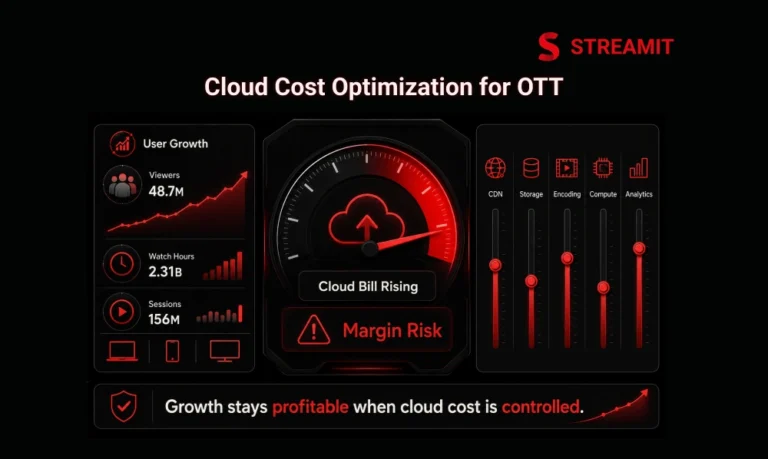
The Hidden Costs of Running a Streaming Platform
Many founders underestimate the operational cost of video delivery.
Video streaming requires continuous spending on infrastructure, bandwidth, encoding, storage, and security.
These expenses scale directly with user growth.
What appears affordable during early testing can become financially unsustainable when the platform gains traction.
Typical Cost Structure of a Streaming Platform
| Cost Category | Description | Impact on Startup |
| CDN & Bandwidth | Video delivery across global networks | Major ongoing cost |
| Video Storage | Content hosting and backup | Scales with library size |
| Encoding & Transcoding | Preparing videos for multiple devices | High compute requirement |
| DRM & Security | Content protection from piracy | Required for premium content |
| App Development | Mobile, TV, and web applications | Large upfront investment |
| Maintenance & DevOps | Platform monitoring and scaling | Continuous cost |
The Streaming Market Looks Big, But It Is Brutal
The global OTT market continues growing rapidly, but growth does not automatically translate into opportunity for new platforms.
Large markets attract large competition. Streaming is no longer an emerging industry, it is a mature, competitive ecosystem dominated by companies with massive budgets and deep content libraries.
For startups, the challenge is not launching a platform. The challenge is surviving inside the market.
Too Many Platforms, Too Little Attention
Consumers today have access to dozens of streaming platforms competing for the same limited viewing time.
User attention has become the primary battleground.
A new streaming service is not competing with a single competitor. It is competing with every entertainment option available on a viewer’s screen.
Without a clear niche or community, new platforms struggle to gain consistent engagement.
User Expectations Are Higher Than Ever
Modern viewers expect instant playback, flawless video quality, and seamless device compatibility.
Even minor performance issues can damage trust.
Buffering, login problems, or inconsistent video quality can quickly push users toward competing platforms.
In streaming, technical performance directly affects user retention.
Big Players Control the Market
Platforms like Netflix, Disney+, and Amazon Prime Video dominate global streaming traffic. These companies invest billions of dollars annually into content and infrastructure.
For startups, competing directly with such platforms is rarely a viable strategy. Success typically comes from specialization rather than scale.
Most Streaming Startups Start With the Wrong Focus
Many founders treat streaming platforms as content businesses, when they are actually infrastructure businesses.
Content may attract initial attention, but long-term survival depends on technology, retention, and sustainable economics.
The wrong priorities during the early phase often create structural weaknesses.
Focusing Only on Content
Content alone rarely guarantees platform success.
Many streaming startups assume acquiring large content libraries will automatically generate viewers.
But without strong discovery systems, personalization, and performance infrastructure, even good content struggles to reach its audience.
Ignoring Technology and Infrastructure
Streaming platforms are fundamentally technical products.
Backend architecture determines scalability, playback stability, and global delivery performance.
Platforms that delay infrastructure investment often experience severe performance issues when user traffic increases.
Copying Netflix Without a Clear Niche
Attempting to replicate global streaming giants is one of the most common startup mistakes. Large platforms succeed because of scale, brand power, and massive investment.
Startups succeed by focusing on specific audiences, genres, or communities. Niche positioning creates clarity that large platforms cannot easily replicate.
The Real Reasons Streaming Startups Fail in the First 18 Months
The collapse of streaming startups rarely happens because of one mistake. It usually results from several structural issues accumulating simultaneously.
Weak monetization, unstable infrastructure, unclear audience targeting, and poor retention strategies often compound into a failure cycle.
Understanding these patterns early helps founders design more resilient platforms.
No Clear Product-Market Fit in Streaming
Many streaming platforms launch before validating whether a real audience exists for their content or positioning.
Without product-market fit, user acquisition becomes expensive and retention becomes unpredictable.
Streaming platforms succeed when they serve a specific community with consistent value.
Trying to Serve Everyone
Attempting to attract all audiences leads to diluted positioning and unclear messaging.
No Specific Genre or Community Focus
Platforms without niche focus struggle to build loyal viewer communities.
No Clear Value Proposition
Users rarely adopt new platforms unless the benefit is obvious and distinct.
Weak Monetization Strategy
Monetization mistakes quietly undermine many streaming startups. Choosing the wrong revenue model can create unsustainable economics.
Without clear monetization logic, user growth does not translate into revenue.
Choosing the Wrong Revenue Model
Subscription models fail when audiences are unwilling to pay.
Pricing Without Market Research
Pricing must align with content value and audience expectations.
High Churn and Low Retention
Churn quickly erodes recurring revenue.
Common OTT Monetization Models
| Model | Description | Best For |
| SVOD | Subscription-based streaming | Premium content platforms |
| AVOD | Ad-supported streaming | Large audience platforms |
| TVOD | Pay-per-view or rental | Event-based content |
| Hybrid | Combination of subscription and ads | Scalable OTT businesses |
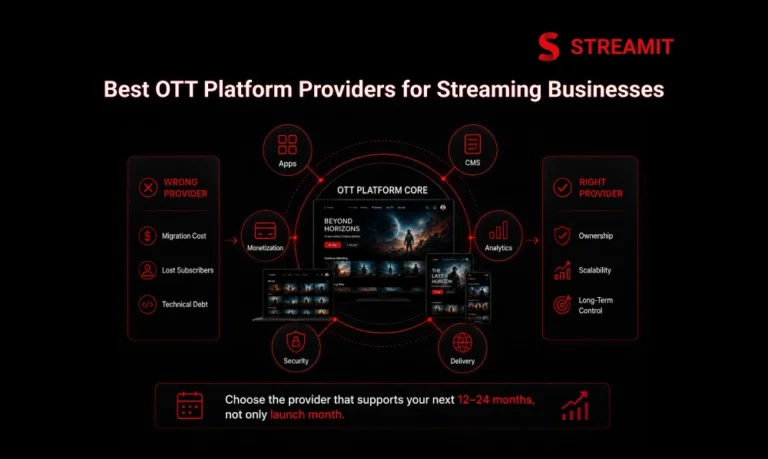
High Infrastructure Costs and Poor Tech Decisions
Video delivery is expensive, and poor technical decisions amplify those costs dramatically. Infrastructure inefficiencies often drain capital faster than expected.
Many streaming platforms fail because their tech stack cannot scale efficiently.
Overpaying for CDN and Bandwidth
Video delivery costs increase significantly with user growth.
No Multi-CDN Strategy
Single CDN setups can lead to performance instability.
Poor Video Quality and Buffering Issues
Playback issues quickly damage viewer trust.
Bad QoE Leads to Fast Drop-Off
Users abandon platforms when streaming quality declines.
Burning Cash Without a Clear Growth Plan
Many streaming startups raise funding before building sustainable business models. Rapid spending without structured growth planning accelerates failure.
Startups must balance marketing, infrastructure, and content investment carefully.
Overspending on Marketing Too Early
Customer acquisition costs can quickly exceed revenue potential.
Ignoring Unit Economics
Understanding lifetime value and acquisition cost is essential.
Depending Only on Investor Funding
Investor capital cannot replace sustainable revenue models.
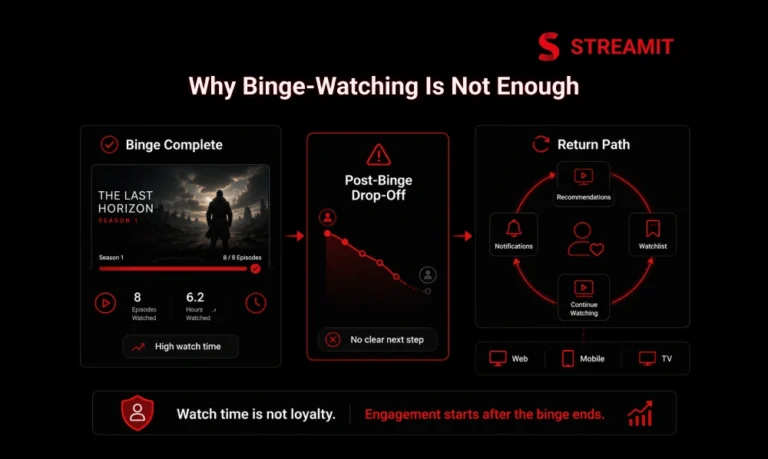
Poor Retention and Weak Community Building
Retention determines the survival of streaming platforms. Acquiring users is expensive, but keeping them engaged determines long-term growth.
Platforms that ignore engagement systems struggle to build loyal audiences.
No Engagement Strategy
Users disengage without ongoing interaction mechanisms.
No Push Notifications or Personalization
Personalization increases watch time and reduces churn.
No Data-Driven Decisions
Analytics reveal viewer behavior and platform weaknesses.
Scaling Too Fast Without Strong Foundation
Premature scaling is a frequent cause of startup collapse. Expanding before infrastructure and economics stabilize creates operational instability.
Founders often prioritize growth metrics over platform resilience.
Expanding to Too Many Regions Too Early
Global expansion increases operational complexity dramatically.
Launching Too Many Features
Feature overload distracts teams from core platform performance.
Technical Downtime During Traffic Spikes
Infrastructure failures during peak traffic damage credibility.
Weak Leadership and Execution Problems
Even strong ideas fail when execution discipline is weak. Streaming businesses require both media expertise and technical leadership.
Without experienced decision-making, platforms struggle to navigate early challenges.
Founder Without Industry Experience
Understanding streaming economics and infrastructure is essential.
No Clear Roadmap
Product development requires structured milestones.
Slow Decision-Making
Startups must move faster than large competitors.
How Streaming Startups Can Survive Beyond 18 Months?
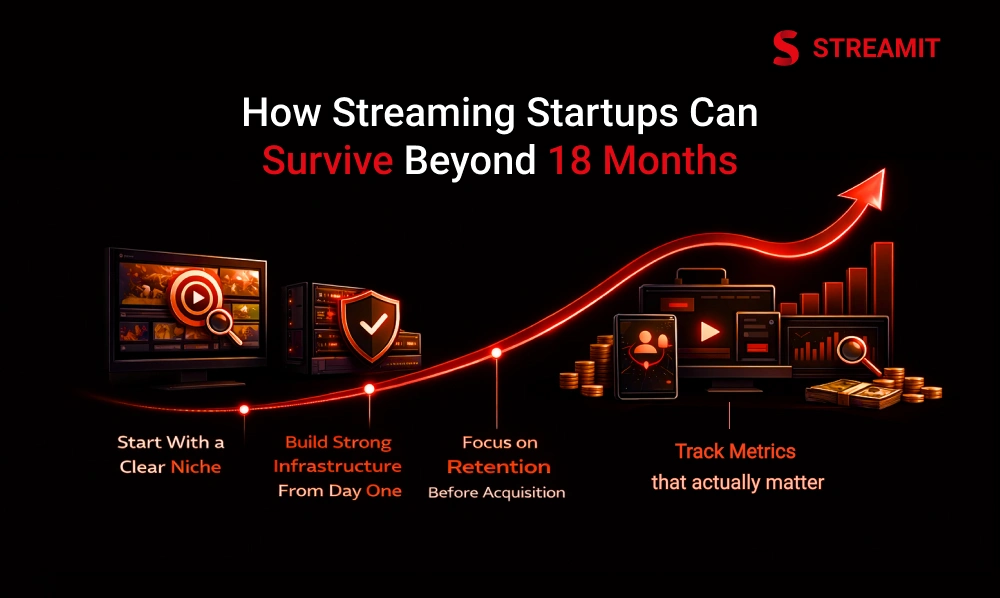
The difference between failure and survival is rarely luck. It is strategy, discipline, and infrastructure design.
Streaming startups that survive typically begin with focused audiences, efficient technology, and clear monetization.
Success comes from solving specific problems rather than competing directly with global platforms.
Start With a Clear Niche
Most successful streaming platforms grow by serving a specific audience rather than trying to compete with every platform in the market. Focusing on a niche helps reduce competition and makes it easier to build a loyal viewer base.
Instead of targeting everyone, startups should focus on a defined genre, region, or community where content and audience demand naturally align.
Validate Product-Market Fit Early
Many streaming startups fail because they launch a full platform before confirming whether real demand exists. Validating product-market fit early helps founders understand if their content, pricing, and user experience actually resonate with a defined audience.
Instead of building a large platform immediately, startups should test the concept with an MVP, gather viewer feedback, and refine the offering before scaling infrastructure and marketing efforts.
Choose the Right Monetization Model
Monetization determines whether a streaming platform becomes a sustainable business or an expensive experiment. Choosing the right monetization model ensures that user growth translates into predictable revenue and long-term financial stability.
Founders should evaluate whether subscription (SVOD), advertising (AVOD), pay-per-view (TVOD), or a hybrid model best fits their audience behavior, content type, and market expectations.
Build Strong Infrastructure From Day One
Many streaming startups fail not because of weak content, but because their infrastructure cannot support real user demand. Video platforms require reliable architecture that can handle traffic spikes, maintain playback stability, and deliver content smoothly across devices.
Building strong infrastructure early helps prevent costly performance issues later. A scalable OTT architecture ensures consistent video delivery, reduces buffering problems, and prepares the platform for long-term growth without constant technical disruptions.
Invest in Performance and Low Latency
Viewers rarely tolerate delays or buffering, even for a few seconds. Streaming platforms must prioritize fast playback startup times and smooth video delivery to keep users engaged.
Investing in optimized encoding, efficient delivery networks, and low-latency streaming technologies ensures that content loads quickly and plays consistently across different devices and network conditions.
Use Multi-CDN for Stability
Relying on a single CDN can create performance risks when traffic spikes or regional outages occur. A multi-CDN strategy distributes video delivery across multiple networks to improve reliability and global coverage.
By balancing traffic between different CDN providers, streaming platforms can maintain stable playback, reduce buffering, and ensure consistent performance for viewers across different geographic regions.
Focus on QoE, Not Just QoS
Streaming performance is not only about technical delivery metrics, but about how viewers actually experience the platform. While QoS measures backend network performance, QoE reflects whether users experience smooth playback, fast startup, and consistent video quality.
Platforms that prioritize QoE focus on minimizing buffering, improving playback stability, and ensuring the overall viewing experience remains reliable across devices and network conditions.
Focus on Retention Before Acquisition
Acquiring users is expensive, but losing them is even more costly for streaming startups. Many platforms invest heavily in marketing to attract new viewers while overlooking the systems needed to keep them engaged.
Prioritizing retention ensures that users continue watching, subscribing, and returning to the platform. When engagement and satisfaction are strong, growth becomes more sustainable and marketing efforts deliver better long-term results.
Improve Onboarding Experience
The first few minutes on a streaming platform often decide whether a user stays or leaves. A smooth onboarding process helps viewers quickly understand the platform, discover relevant content, and begin watching without confusion.
Clear navigation, simple sign-up flows, and personalized recommendations during onboarding can significantly improve early engagement and increase the chances that new users return.
Personalize Content Recommendations
Most viewers decide what to watch within seconds, and strong recommendation systems make that decision easier. Personalization helps users quickly discover content that matches their interests instead of searching through large libraries.
By analyzing viewing behavior and preferences, streaming platforms can suggest relevant titles, improve watch time, and reduce the chances of users leaving the platform due to poor content discovery.
Build Community Around Content
Streaming platforms grow stronger when viewers feel connected not only to the content, but also to the community around it. A sense of community encourages users to return, discuss content, and stay engaged beyond a single viewing session.
Features like watchlists, comments, fan discussions, and exclusive content updates can help build deeper relationships with audiences and turn casual viewers into loyal followers of the platform.
Track Metrics That Actually Matter
Many streaming startups track surface-level numbers like downloads or total users, but those metrics rarely explain real platform health. What truly matters are the indicators that reveal how viewers behave, how much they engage, and whether the business model is sustainable.
By focusing on meaningful performance metrics, founders can identify problems early, optimize user experience, and make strategic decisions that improve retention, revenue, and long-term platform stability.
Churn Rate
Churn rate shows how many users stop using or cancel their subscription within a given period. For streaming startups, a high churn rate often signals problems with content value, user experience, or pricing strategy.
Tracking churn helps founders understand retention health and identify where users drop off. Reducing churn rate through better engagement and personalized experiences is critical for sustainable platform growth.
Average Watch Time
Average watch time reflects how long viewers stay engaged with content during a session. For streaming platforms, higher watch time usually indicates stronger content relevance and a smoother viewing experience.
Tracking this metric helps founders understand whether users are genuinely engaged or leaving after short interactions, making it a key signal of platform value and retention potential.
Customer Acquisition Cost (CAC)
Customer Acquisition Cost measures how much a platform spends to gain a single new user. For streaming startups, this includes marketing expenses, advertising campaigns, promotions, and partnership costs.
Tracking CAC helps founders understand whether user growth is financially sustainable. When acquisition costs rise faster than revenue, the platform’s long-term economics quickly become unstable.
Lifetime Value (LTV)
Lifetime Value measures the total revenue a streaming platform earns from a user during their entire relationship with the service. It reflects how valuable each viewer becomes over time through subscriptions, purchases, or ad revenue.
When LTV is higher than Customer Acquisition Cost (CAC), the platform can grow sustainably. Tracking this metric helps founders understand whether their retention and monetization strategies are financially healthy.
Buffering Ratio and Startup Time
Buffering ratio and startup time are key indicators of streaming performance and viewer experience. Startup time measures how quickly a video begins playing after a user presses play, while buffering ratio shows how often playback pauses during a session.
Monitoring these metrics helps platforms identify performance issues early. Faster startup and lower buffering rates significantly improve viewer satisfaction and reduce the chances of users abandoning the stream.
A Simple Survival Framework for Streaming Startups
Most streaming startups fail not because the idea was wrong, but because execution lacked structure. In the early stages, founders often try to solve too many problems at once, building complex platforms before validating the fundamentals.
A simple and disciplined framework helps streaming startups focus on what actually matters: defining the right audience, validating demand, building efficient infrastructure, and scaling only after the platform proves sustainable.
Step 1: Define Your Niche
Successful streaming platforms rarely begin by targeting a broad audience. Defining a clear niche helps startups focus on a specific group of viewers whose interests, language, or content preferences are underserved.
A well-defined niche allows the platform to build stronger engagement, clearer branding, and a loyal audience base before expanding into larger markets.
Step 2: Validate Demand
Before investing heavily in infrastructure and content libraries, founders need clear proof that real viewers want the platform. Validating demand helps reduce risk and ensures the idea resonates with a specific audience.
Testing the concept through small launches, pilot content, or an MVP platform allows startups to gather feedback, measure engagement, and refine their offering before scaling operations.
Step 3: Build Lean Tech Stack
Early-stage streaming startups benefit more from efficient infrastructure than from complex technology. A lean tech stack helps reduce operational costs while still delivering stable streaming performance.
Instead of overbuilding features, founders should focus on essential components like reliable video delivery, scalable backend systems, and efficient content management that can grow as the platform expands.
Step 4: Test Monetization Early
Many streaming startups delay monetization experiments until later stages, which often leads to unstable revenue models. Testing monetization early helps founders understand how willing their audience is to pay and which model works best.
By experimenting with subscriptions, ads, or pay-per-view options early on, platforms can identify sustainable revenue streams and refine their pricing strategy before scaling user acquisition.
Step 5: Optimize Before Scaling
Scaling a streaming platform too early often exposes weaknesses in infrastructure, user experience, and monetization. Optimization ensures the platform is stable, efficient, and ready to handle larger audiences.
Before expanding into new regions or increasing marketing spend, startups should refine performance, improve retention systems, and strengthen their technical foundation to support sustainable growth.
Conclusion
The failure of streaming startups is rarely caused by a lack of ambition or creativity. Most platforms collapse because the underlying business structure cannot sustain growth.
Streaming is one of the most technically demanding digital industries. Success requires a balance of infrastructure efficiency, clear audience positioning, disciplined monetization, and strong retention strategy.
Founders who treat streaming as a long-term platform business rather than a short-term content experiment dramatically improve their chances of survival.
In the end, streaming platforms do not fail because audiences stop watching video. They fail because the systems behind the screen were not built to last.
Build a Streaming Platform That Scales
FAQs
1. Why do most streaming startups fail within 18 months?
Most streaming startups fail because they launch without product-market fit, underestimate infrastructure costs, and struggle with user retention. Weak monetization and poor technical performance often accelerate failure.
2. What is the biggest mistake streaming startups make in the early stage?
The most common mistake is focusing only on content while ignoring infrastructure, monetization, and user experience.
3. How much does it cost to run a streaming platform?
Costs vary depending on scale, but infrastructure, bandwidth, storage, development, and maintenance can quickly reach tens of thousands of dollars per month.
4. What is a good churn rate for a streaming startup?
Healthy streaming platforms typically aim for monthly churn rates below 5–7%, though early-stage platforms often experience higher churn.
5. What metrics should streaming startups track from day one?
Key metrics include churn rate, average watch time, customer acquisition cost, lifetime value, buffering ratio, and playback startup time.
6. When should a streaming startup scale globally?
Global expansion should only happen after achieving product-market fit, stable infrastructure, and sustainable monetization.
Read Also
1. Streaming Issues: 7 Reasons Why Your OTT App Is Failing
2. 7 Best OTT Security Solutions for Streaming Platforms
3. Top OTT Solution Providers for Modern Streaming Platforms
4. 5 Proven Retention Tactics Every Streaming Platform Can Steal from Netflix
5. 7 Reasons Why OTT Platforms Will Fail in 2026 Without Retention