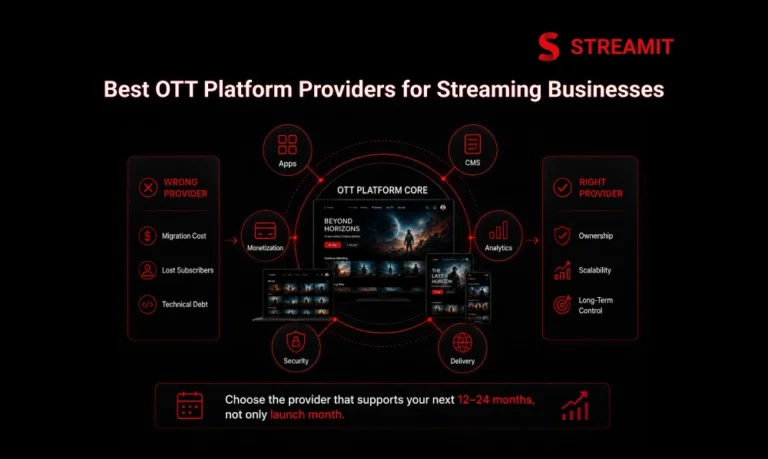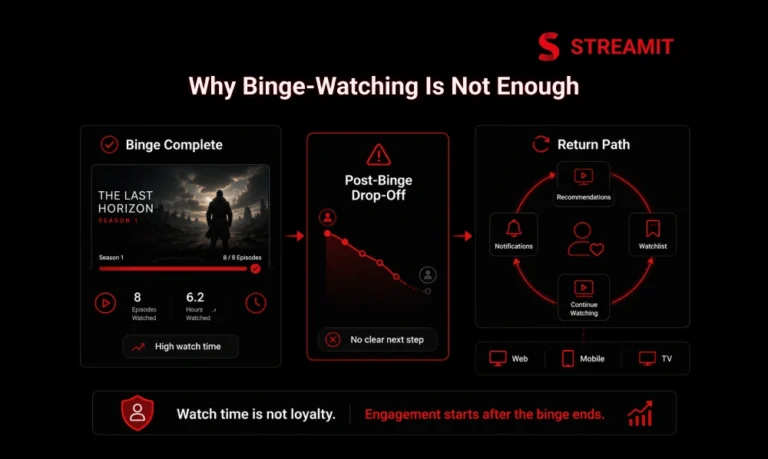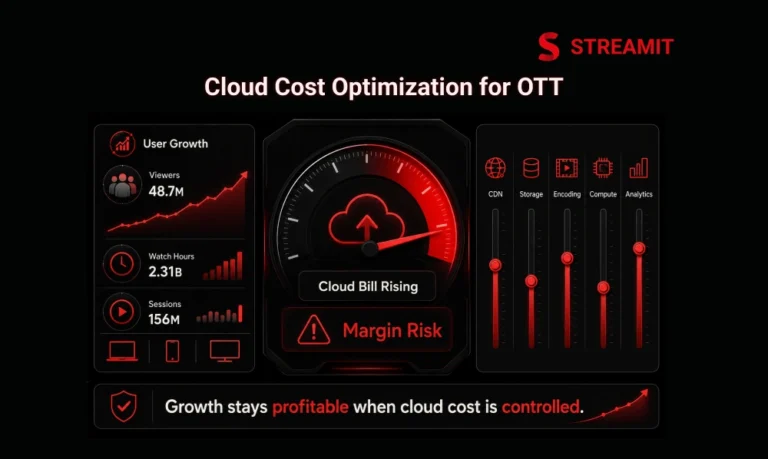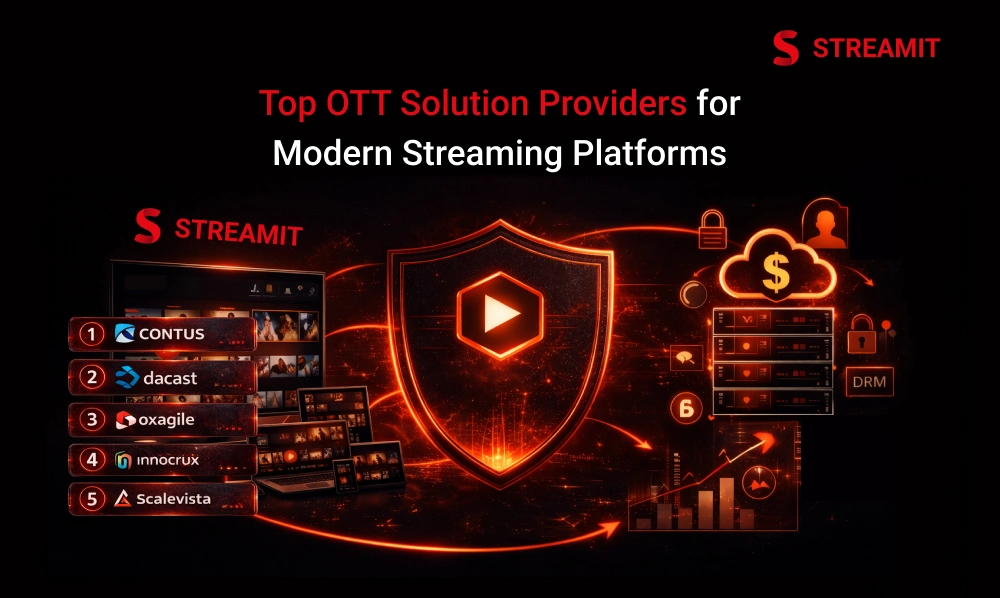
Top OTT Solution Providers for Modern Streaming Platforms

According to the Ericsson Mobility Report, video streaming accounts for around 70% of global mobile network traffic, highlighting how dominant streaming has become in internet usage. The way audiences watch content has completely shifted, from scheduled cable programming to on-demand, multi-device digital experiences. This transformation has opened massive opportunities for businesses, creators, and enterprises to launch their own OTT streaming platforms.
Modern streaming is no longer just about hosting videos. It is about performance, personalization, monetization, analytics, and security, all working together without buffering or downtime. That’s where OTT solution providers play a critical role.
In this detailed guide, we’ll explore how OTT streaming platforms work, why businesses are investing in them, the different types of OTT solution providers, and a comparison of the top OTT solution providers for modern streaming platforms, including Streamit, Muvi, Uscreen, Dacast, VPlayed, Vodlix, Contus, Oxagile, Innocrux, and Scalevista.
Understanding OTT Streaming Platforms
Over-the-top (OTT) platforms now account for a major share of digital media consumption, replacing traditional broadcast models at an unprecedented pace. Businesses, startups, and enterprises are leveraging OTT video streaming to connect directly with their audience without relying on cable or satellite providers.
An OTT streaming platform allows content owners to distribute video content via the internet, accessible across devices such as smartphones, smart TVs, tablets, and web browsers. It offers flexibility, scalability, and complete ownership of content and revenue models.
As digital infrastructure improves globally, OTT platforms are becoming more advanced, integrating AI-driven personalization, cloud scalability, and secure delivery systems.
What Is an OTT Streaming Platform?
An OTT streaming platform is a digital system that delivers video content over the internet instead of traditional cable or satellite networks. It enables users to watch content anytime, anywhere, on any device.
The OTT platform definition includes content hosting, streaming infrastructure, content management systems, user authentication, monetization modules, and analytics tools, all in one ecosystem.
How OTT Streaming Platforms Work?
OTT platforms work by storing video content on cloud servers and delivering it to users via content delivery networks (CDNs). When a user presses play, the video is streamed in small data packets optimized for their internet speed.
Advanced OTT streaming technology uses adaptive bitrate streaming to ensure smooth playback, even when network conditions fluctuate.
Role of Internet in OTT Streaming
Internet-based streaming enables direct video delivery without cable operators, ensuring faster scalability and global reach.
Difference Between OTT and Traditional TV
OTT vs cable TV lies in flexibility, personalization, and on-demand access, while DTH relies on scheduled programming and hardware-based distribution.
Why Are Businesses Investing in OTT Platforms?
According to industry market reports such as Statista and Grand View Research, the global OTT market is projected to exceed $300 billion within this decade, driven primarily by subscription growth and rising digital video consumption. Businesses are recognizing OTT as more than entertainment, it’s a powerful digital revenue engine.
From media companies to fitness brands and educational institutions, OTT platforms offer direct audience engagement, higher margins, and measurable performance insights.
With lower distribution costs and global accessibility, launching an OTT platform has become a strategic growth move.
Growing Demand for On-Demand and Live Streaming
Video on demand platforms allow users to watch content at their convenience, increasing engagement and retention.
Live streaming solutions enable real-time interaction for sports, webinars, and events, creating stronger audience connections.
Better Control Over Content and Revenue
OTT monetization models give businesses full control over pricing strategies, ad placements, and subscription tiers.
Content ownership ensures creators are not dependent on third-party algorithms or platform restrictions.
Global Reach With Lower Distribution Cost
Global OTT streaming allows businesses to scale internationally without investing in physical infrastructure.
A scalable streaming platform grows with user demand, reducing operational risks.
What Are OTT Solution Providers?
Building a streaming platform from scratch requires expertise in infrastructure, app development, security, analytics, and monetization. OTT solution providers simplify this complexity by offering ready-made or customized streaming ecosystems.
OTT service providers help businesses design, develop, deploy, and maintain OTT streaming platforms tailored to their goals.
They serve as technology partners, ensuring high performance, security, and scalability.
Role of OTT Solution Providers in Streaming Ecosystem
OTT platform providers manage backend infrastructure, video hosting, CMS integration, OTT app deployment, and payment systems.
They act as OTT technology partners, helping brands focus on content while they handle technology.
OTT Solution Provider vs OTT Platform
An OTT provider builds and manages the technology, while an OTT platform is the final product used by viewers.
The comparison depends on whether you need a ready-made SaaS solution or custom-built infrastructure.
Types of OTT Solution Providers
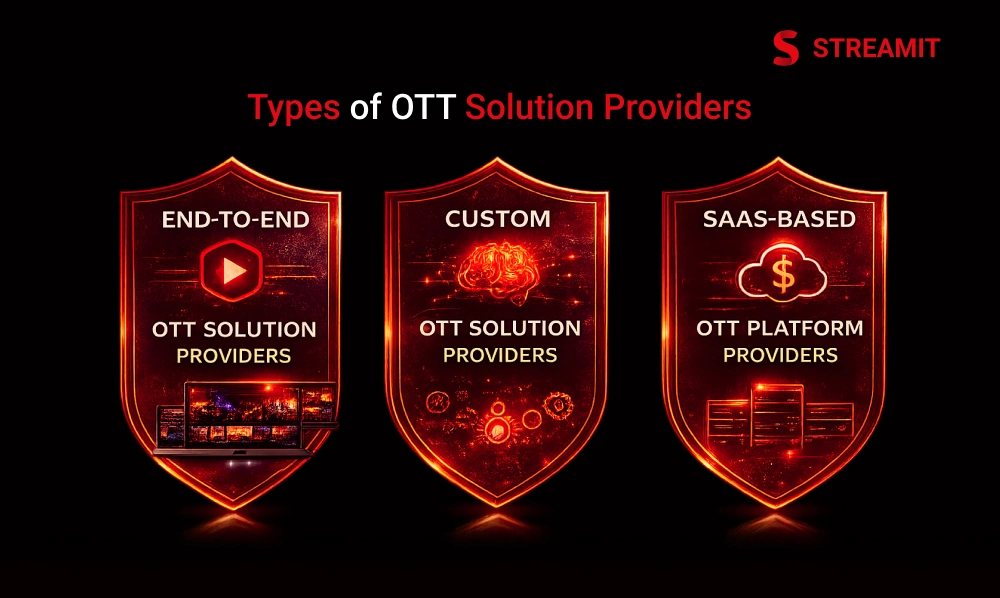
Not all OTT solutions are built the same, some offer full end-to-end ecosystems while others specialize in customization or SaaS deployment. Understanding these categories helps businesses choose the right approach.
Each type comes with its own flexibility, cost structure, and scalability model.
End-to-End OTT Solution Providers
End-to-end OTT platforms offer complete infrastructure, from video hosting to app deployment and monetization.
They provide a complete OTT solution for businesses looking for faster time-to-market.
Custom OTT Solution Providers
Custom OTT development focuses on tailored features, unique UI/UX, and specific business requirements.
White-label OTT platforms allow brands to maintain identity while leveraging proven technology.
SaaS-Based OTT Platform Providers
SaaS OTT platforms are cloud-based and subscription-driven. They are ideal for businesses seeking quick launch and lower initial investment.
Key Features to Look for in OTT Solution Providers
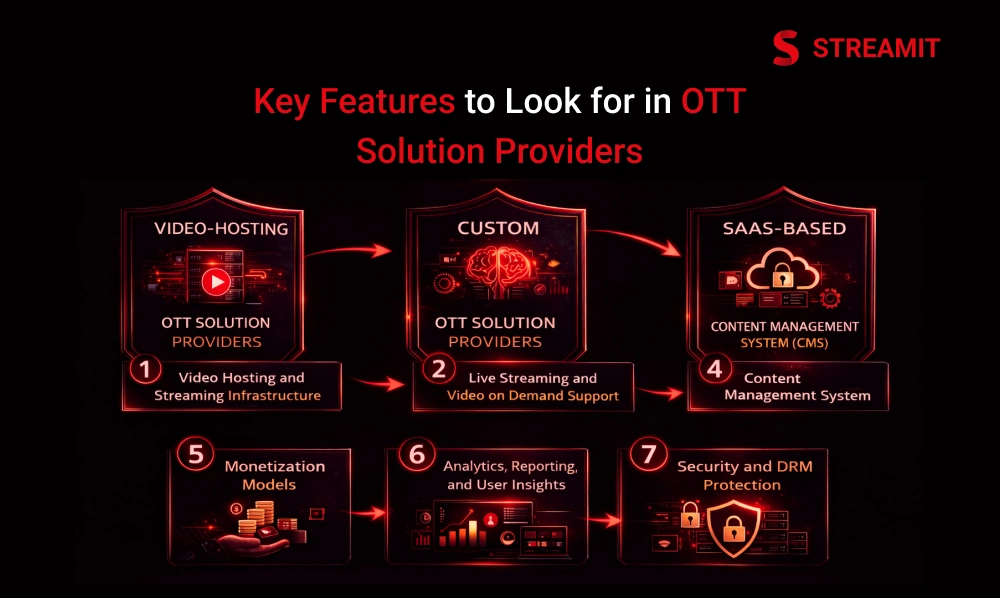
High-performing OTT platforms maintain 99.9% uptime and support millions of concurrent users during peak hours. Choosing the right provider requires evaluating features beyond just video hosting.
A strong OTT solution checklist includes scalability, multi-device support, monetization flexibility, security, and analytics.
Video Hosting and Streaming Infrastructure
Reliable video streaming infrastructure ensures buffer-free playback and global delivery. OTT cloud hosting leverages CDNs to minimize latency.
Live Streaming and Video on Demand Support
Live streaming OTT capabilities support real-time broadcasting. A VOD platform enables organized content libraries and playback control.
Multi-Device and Multi-Platform Support
OTT apps must function across smartphones, tablets, web browsers, and smart TVs. Cross-platform compatibility increases audience reach.
Mobile, Web, Smart TV, and TV Apps
Android TV app, Apple TV app, and Fire TV app integration expand accessibility across ecosystems.
Content Management System (CMS)
An OTT CMS simplifies video uploads, metadata tagging, and content organization. Video content management tools streamline operations.
Monetization Models
OTT monetization models determine revenue generation strategies. AVOD, SVOD, and TVOD options offer flexible pricing.
Subscription-Based Monetization (SVOD)
SVOD platforms provide recurring revenue through subscription OTT models.
Ad-Supported Monetization (AVOD)
AVOD platforms generate income via ad-based streaming.
Pay-Per-View Monetization (TVOD)
TVOD streaming enables pay-per-view OTT content sales.
Analytics, Reporting, and User Insights
OTT analytics track viewer behavior and streaming performance metrics. These insights guide content and revenue decisions.
Security and DRM Protection
OTT security includes encryption and DRM video protection. This prevents piracy and unauthorized access.
Industries Using OTT Solution Providers
From entertainment to education, more than 15 major industries now leverage OTT streaming as a primary distribution channel. The flexibility of OTT platforms allows customization across sectors.
Different industries use OTT use cases tailored to their audience needs.
Media and Entertainment
Entertainment OTT platform for media companies helps launch and manage digital streaming services worldwide. It expands audience reach while enabling flexible revenue models.
Education and E-Learning
E-learning streaming platforms create structured digital classrooms with organized lessons and on-demand access. They make education flexible, scalable, and accessible from anywhere.
Fitness and Wellness
Fitness OTT platforms allow trainers and brands to offer online workout streaming through subscription models. They help users access guided sessions anytime, anywhere.
Sports and Live Events
Sports streaming platforms deliver live matches and events to audiences worldwide through OTT technology. They provide real-time access with high-quality streaming across devices.
Religious and Community Streaming
Religious OTT platforms help communities stay connected through live and on-demand digital services. They make spiritual content accessible anytime, anywhere.
Top OTT Solution Providers for Modern Streaming Platforms
The competition among OTT solution providers is growing rapidly as more businesses enter the streaming market. However, only a few companies truly stand out for their innovation, scalability, and consistent performance. Below is a comparison of the leading OTT providers.
1. Streamit – All-in-One OTT Solution for Modern Streaming
Streamit offers a complete OTT ecosystem designed for modern streaming businesses. It provides end-to-end OTT solutions including CMS, monetization models, analytics, multi-device apps, and DRM protection.
Streamit is an all-in-one OTT solution designed for modern streaming platforms. It offers end-to-end infrastructure, built-in monetization models, and seamless multi-device support. The platform focuses on performance, scalability, and secure video delivery for growing digital businesses.
Streamit focuses on performance-driven architecture, ensuring buffer-free playback and scalable growth for startups and enterprises.
Key Highlights of Streamit, All-in-One OTT Solution:
- End-to-end OTT infrastructure with cloud-based scalability
- Built-in CMS for easy video content management
- Support for SVOD, AVOD, and TVOD monetization models
- Multi-device compatibility (Mobile, Web, Smart TV, TV Apps)
- Advanced analytics and user insights dashboard
It enables businesses to launch live and on-demand streaming services with strong DRM security, advanced analytics, and full white-label customization, ensuring performance, reliability, and long-term growth.
2. Muvi
Muvi offers an all-in-one OTT platform designed to help businesses launch and manage their own streaming services without heavy technical complexity. It provides a ready-made SaaS-based ecosystem that supports both live streaming and video-on-demand across multiple devices.
Muvi focuses on ease of deployment, scalability, and built-in monetization tools, making it suitable for businesses that want a faster go-to-market strategy. Its platform is structured to support content owners who prefer a managed solution rather than custom development from scratch.
Key Highlights of Muvi OTT Solutions:
- SaaS-based end-to-end OTT platform
- Multi-device app support (Web, iOS, Android, Smart TV)
- Built-in CMS for video content management
- Support for SVOD, AVOD, and TVOD monetization
- White-label branding and customization
It enables businesses to launch branded OTT platforms quickly while maintaining control over content, monetization, and audience experience.
3. Uscreen
Uscreen is a subscription-focused OTT platform that helps creators and businesses monetize video content through branded streaming services. It provides a user-friendly, SaaS-based environment designed for launching membership-driven video platforms with minimal technical complexity.
Uscreen is particularly popular among independent creators, fitness brands, and educators who want to build recurring revenue through subscription models. The platform emphasizes ease of use, built-in marketing tools, and community engagement features.
Key Highlights of Uscreen OTT Solutions:
- SaaS-based OTT platform with quick deployment
- Strong focus on SVOD and membership monetization
- Branded apps for Web, iOS, Android, and TV
- Built-in video hosting and content management
- Integrated payment gateways and subscription billing
It enables creators and businesses to build subscription-based streaming platforms that combine content delivery, audience engagement, and recurring revenue growth.
4. Dacast
Dacast is widely recognized for its reliable video hosting and professional live streaming capabilities. It provides businesses with a stable and secure infrastructure designed to deliver high-quality streaming experiences across global audiences.
Dacast focuses on simplicity, performance, and dependable delivery, making it a strong choice for organizations that prioritize smooth playback and consistent uptime. Its platform is especially suitable for businesses looking for a dependable SaaS-based OTT solution.
Key Highlights of Dacast OTT Solutions:
- Secure video hosting with global CDN delivery
- Professional live streaming support
- Video-on-Demand (VOD) management
- Built-in paywall and monetization tools
- API access for custom integrations
It enables businesses to stream live events and on-demand content with confidence, ensuring stable performance, monetization flexibility, and secure video distribution.
5. VPlayed
VPlayed is a customizable OTT platform solution designed for businesses that require flexible streaming infrastructure and advanced feature control. It offers both SaaS-based and fully customizable deployment models to support diverse industry needs.
VPlayed focuses on delivering scalable video streaming ecosystems with strong monetization capabilities and multi-device accessibility. It is often chosen by enterprises and media companies that want greater technical flexibility along with white-label branding.
Key Highlights of VPlayed OTT Solutions:
- End-to-end OTT platform with customizable architecture
- Support for live streaming and Video-on-Demand (VOD)
- Multi-device compatibility (Web, Mobile, Smart TV, TV Apps)
- SVOD, AVOD, and TVOD monetization support
- White-label branding and UI customization
It enables businesses to launch feature-rich OTT platforms with strong monetization options, performance optimization, and long-term scalability.
6. Vodlix
Vodlix is a cloud-based OTT platform designed to help businesses launch and manage their own branded video streaming services. It offers a SaaS-driven environment that supports both live streaming and on-demand video delivery across multiple devices.
Vodlix focuses on ease of deployment, built-in monetization tools, and scalable infrastructure, making it suitable for content owners who want a ready-to-launch OTT solution. Its platform is structured to provide flexibility while reducing technical complexity.
Key Highlights of Vodlix OTT Solutions:
- SaaS-based end-to-end OTT platform
- Live streaming and Video-on-Demand (VOD) support
- Multi-device app compatibility (Web, Mobile, Smart TV)
- Built-in CMS for video content management
- Support for SVOD, AVOD, and TVOD monetization
It enables businesses to quickly launch branded OTT platforms with flexible monetization, reliable streaming performance, and secure content management.
7. Contus
Contus delivers enterprise-grade OTT app development and scalable streaming solutions tailored to specific business needs. It focuses on building customizable OTT ecosystems with strong backend architecture and seamless multi-device experiences.
Contus enables businesses to design feature-rich platforms with advanced integrations, performance optimization, and long-term scalability. Its approach is ideal for enterprises looking for tailored OTT solutions rather than ready-made templates.
Key Highlights of Contus OTT Solutions:
- Custom OTT app development for Web, Mobile, and Smart TV
- Enterprise-level streaming architecture
- White-label platform customization
- Integration with third-party payment gateways
- Support for SVOD, AVOD, and TVOD monetization models
- Cloud-based scalable infrastructure
It empowers enterprises to launch highly customized OTT platforms that combine flexibility, performance, and strong revenue capabilities for sustainable digital growth.
8. Oxagile
Oxagile specializes in delivering custom OTT solutions with a strong focus on development flexibility and enterprise-grade architecture. It helps organizations build complex streaming ecosystems tailored to specific operational and audience needs.
Oxagile is known for handling large-scale OTT projects that require advanced integrations, high-performance infrastructure, and scalable backend systems. Its approach is ideal for enterprises looking for deeply customized streaming platforms rather than off-the-shelf solutions.
Key Highlights of Oxagile OTT Solutions:
- Custom OTT platform development
- Enterprise-level system architecture
- Multi-platform app development (Web, Mobile, Smart TV)
- Advanced API and third-party integrations
- Scalable cloud-based infrastructure
It enables enterprises to build sophisticated OTT ecosystems that combine flexibility, scalability, and long-term operational control.
9. Innocrux
Innocrux provides scalable and white-label OTT solutions tailored for businesses looking to launch branded streaming platforms. It focuses on combining advanced streaming technology with flexible customization to meet diverse industry requirements.
Innocrux supports both live and on-demand video delivery with strong backend infrastructure and multi-device accessibility. The platform is designed for organizations that want performance-driven streaming along with monetization flexibility.
Key Highlights of Innocrux OTT Solutions:
- White-label OTT platform development
- Support for live streaming and Video-on-Demand (VOD)
- Multi-device compatibility (Web, Mobile, Smart TV)
- SVOD, AVOD, and TVOD monetization support
- Custom UI/UX branding options
It enables businesses to build branded OTT ecosystems that combine scalability, security, and revenue optimization for long-term digital growth.
10. Scalevista
Scalevista specializes in custom OTT software development for businesses that require tailored streaming solutions. It focuses on building scalable, high-performance OTT platforms aligned with specific operational and audience needs.
Scalevista supports enterprises seeking full development control, advanced integrations, and flexible architecture rather than ready-made SaaS templates. Its solutions are designed to handle complex streaming workflows with long-term scalability in mind.
Key Highlights of Scalevista OTT Solutions:
- Custom OTT platform development
- Enterprise-grade streaming architecture
- Multi-device app development (Web, Mobile, Smart TV)
- Advanced API and third-party integrations
- Scalable cloud infrastructure
It enables businesses to build highly customized OTT ecosystems with strong technical foundations, scalable performance, and long-term operational flexibility.
Comparison of Top OTT Solution Providers
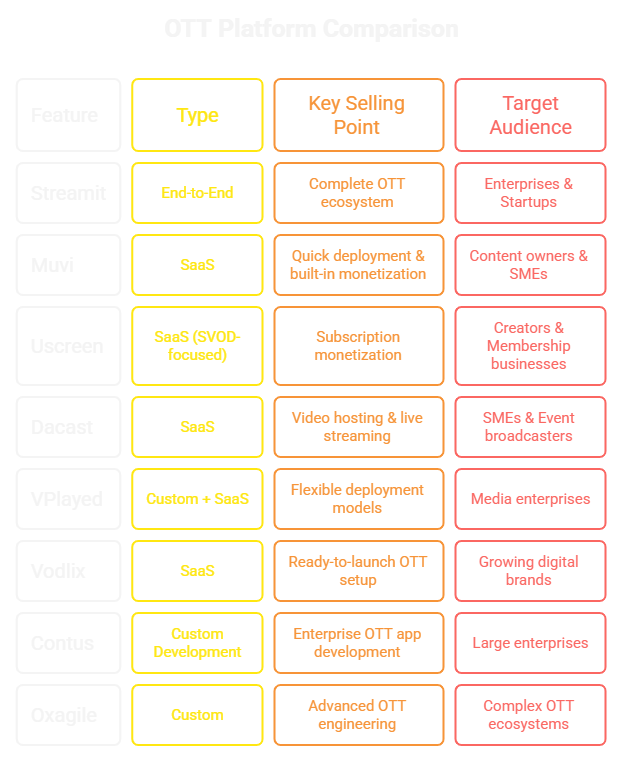
With hundreds of OTT vendors in the market, selecting the right technology partner requires a clear comparison of capabilities, flexibility, and scalability. Some providers focus on SaaS convenience, while others specialize in full-scale custom development for enterprises.
Below is a structured comparison of leading OTT solution providers to help businesses evaluate the best fit for their streaming goals.
How to Choose the Right OTT Solution Provider?
Selecting the wrong OTT partner can lead to scalability issues, revenue loss, and poor user experience. Strategic evaluation is crucial.
Consider your long-term streaming goals before making a decision.
Define Your Business Goals
Start by clearly defining your OTT business strategy and long-term vision. Identify your target audience, content plan, and expected revenue model before choosing a solution.
Check Scalability and Performance
Choose a platform that delivers high-performance streaming without buffering or downtime. Make sure the architecture is scalable to handle growing traffic and future expansion.
Evaluate Pricing and Monetization Support
Carefully evaluate the provider’s OTT pricing structure and overall cost transparency. Ensure the available revenue models align with your long-term business goals.
Look for Post-Launch Support and Maintenance
Reliable OTT support services help maintain smooth performance after launch. Ongoing maintenance and technical assistance ensure long-term platform stability and growth.
Cost of Working With OTT Solution Providers
OTT platform costs vary widely, from a few thousand dollars for SaaS setups to six-figure investments for custom builds. Budget planning is essential.
Costs depend on features, app development, hosting, and maintenance.
Factors Affecting OTT Platform Cost
Streaming platform pricing varies based on scalability requirements, level of customization, and backend infrastructure. The more advanced the features and performance needs, the higher the overall cost.
Custom OTT vs SaaS OTT Cost Comparison
Custom OTT development involves a higher upfront investment but provides greater flexibility and control. SaaS OTT pricing follows a subscription model, making it more budget-friendly at the start.
Custom OTT vs SaaS OTT Comparison Table
Future Trends in OTT Streaming Platforms
The next wave of OTT growth will be driven by AI, interactivity, and hyper-personalized experiences. Streaming is evolving beyond passive viewing.
Technology advancements will reshape user engagement and monetization.
AI-Powered Content Recommendations
AI in OTT improves content personalization by analyzing user behavior and preferences. This helps increase viewer engagement and long-term retention.
Interactive and Live Commerce Streaming
Interactive OTT combines streaming with live commerce to enable real-time product promotions and direct sales. It creates a more engaging and revenue-driven viewing experience.
Regional and Niche OTT Platforms
Niche OTT platforms focus on specific languages, communities, or interest groups. They deliver tailored content that builds stronger audience connection and loyalty.
Conclusion
Great streaming platforms should feel simple and effortless for users. Videos need to load quickly, play smoothly without buffering, and provide a consistent experience across web, mobile, and smart TV devices. When the technology works quietly in the background, viewers stay focused on content instead of performance issues.
Security and reliability also play a major role in long-term success. Platforms must ensure safe access, stable infrastructure, and protection against piracy or unauthorized usage. A secure and well-maintained environment helps build user trust and protects revenue streams over time.
Choosing the right OTT provider, therefore, is a strategic decision rather than a technical one. The ideal partner offers scalability, flexible monetization options, and ongoing support, enabling your platform to grow steadily without unnecessary complexity.
FAQs
1. Why are OTT platforms growing so fast?
OTT platforms are growing rapidly due to increased internet penetration and widespread mobile usage. Rising demand for flexible, on-demand content is further accelerating this growth.
2. What are OTT solution providers?
They act as technology partners that design, develop, and manage OTT streaming platforms. Their role is to handle the technical backbone while businesses focus on content and growth.
3. What types of OTT solution providers are available?
OTT solution providers are generally categorized into end-to-end, custom, and SaaS-based models. Each type offers different levels of flexibility, control, and investment.
4. What features should an OTT solution provider offer?
An OTT provider should include video hosting, multi-device support, monetization options, analytics, and DRM security. These features ensure smooth streaming and protected content.
5. Which industries use OTT solution providers?
OTT solution providers serve industries like media, education, fitness, sports, and religious organizations. They help each sector deliver content digitally and scale globally.
6. Who are the top OTT solution providers for modern streaming?
Leading OTT solution providers include Streamit, Contus, Dacast, Oxagile, Innocrux, and Scalevista.
Read Also
1. Streamit vs Muvi: 7 Features You Can’t Ignore in 2026
2. 5 Proven Retention Tactics Every Streaming Platform Can Steal from Netflix
3. Why Most Streaming Platforms Fail at Retention (and How to Fix It Like Netflix)
4. From Idea to Launch: How a White Label OTT Platform Speeds Up Your Streaming Journey
5. 7 Reasons Why OTT Platforms Will Fail in 2026 Without Retention