10 Ways a White Label OTT Platform Speeds Up Your Launch


Most OTT launches do not fail because the idea is weak. They slow down because the platform has too many unfinished decisions. Apps, backend, billing, playback, security, content workflows, analytics, and app store approvals all move at different speeds.
A white label OTT platform helps because it gives founders a ready streaming foundation instead of starting every system from zero. The real value is not “launch fast at any cost.” The value is launching faster while keeping the platform stable enough to grow.
Foundation
What a White Label OTT Platform Actually Gives You
A white label OTT platform gives you the core streaming stack before you start designing the business around it. That usually includes apps, CMS, user accounts, monetization, video delivery, security, and analytics.
It is not only a template with your logo. For serious streaming businesses, it should act like a launch foundation that reduces build time while still giving enough room for brand, content, pricing, and growth decisions.
A White Label OTT Platform Gives You a Ready-to-Launch Streaming Foundation
The biggest time saving comes from not rebuilding common OTT systems from scratch. Instead of spending months creating login, subscription, video playback, CMS, device apps, and access control separately, you start from a working base.
That means the team can focus on content structure, user experience, branding, pricing, and launch readiness. These are the decisions that actually shape the business.
White Label vs Custom OTT Platform: Speed, Control, and Trade-Offs
White label wins on speed. Custom wins on deeper control. The right choice depends on whether your first goal is market entry or long-term product differentiation.
A white label OTT solution is useful when you want to launch quickly with proven systems. Custom OTT platform development makes more sense when your workflow, user journey, monetization, or ownership requirements are too specific for a fixed structure.
| Route | Best For | Main Strength | Main Trade-Off |
|---|---|---|---|
| White label OTT platform | Faster market entry | Speed and lower setup complexity | Less deep customization |
| Custom OTT platform | Long-term product control | Ownership and flexibility | Longer build cycle |
| Hybrid route | Serious founders | Faster launch now, more control later | Needs better planning |
When White Label Makes More Sense Than Building From Scratch
White label makes sense when the launch window matters more than inventing every system. If your content is ready, the audience is waiting, or the business model needs validation, building from scratch can slow momentum.
It also makes sense when your team does not want to manage every technical layer in the first version. You can launch, learn from real users, and then decide what needs deeper customization.
Speed Drivers
Why White Label OTT Platforms Launch Faster
A streaming platform has too many moving parts for speed to come from development alone. Speed comes from reducing decisions, reducing dependencies, and using systems that already work together.
White label OTT platforms launch faster because apps, backend, video systems, payments, security, and CMS are already connected. That removes many handoff delays between design, development, infrastructure, and QA.
Pre-Built Apps and Backend Remove Months of Development Work
Frontend and backend usually consume the largest share of early OTT build time. Web, mobile, TV apps, admin panels, user accounts, and content management all need to work together.
With a white label streaming platform, these layers already exist. The team can customize branding, refine user flows, configure features, and prepare launch assets instead of writing every module from scratch.
Built-In Monetization, Security, and Playback Features Reduce Setup Time
Monetization, security, and playback are not add-ons. They are launch-critical systems. If subscriptions, ads, rentals, DRM, encryption, or adaptive streaming are delayed, the launch gets delayed too.
A stronger white label OTT platform includes these systems earlier. That helps the business test revenue flows, user access, video playback, and content protection before launch pressure begins.
Fewer Technical Decisions Mean Faster Go-Live
Every technical decision has a hidden cost: planning, development, testing, integration, and maintenance. White label reduces that decision load.
Instead of choosing every library, gateway, video workflow, CMS structure, hosting layer, and player behavior separately, the platform gives a working path. For founders, that means fewer open loops before go-live.
Core Advantages
10 Practical Ways a White Label OTT Platform Speeds Up Launch
The real speed advantage appears across the full platform, not in one feature. Apps, billing, security, playback, analytics, and support all contribute to launch readiness.
Here are the 10 areas where a white label OTT platform usually saves the most time.
1. Ready-Made Apps for Web, Mobile, and TV Reduce Frontend Time
Multi-device apps can easily turn one launch into five separate projects. Web, iOS, Android, smart TV, and connected devices each have different designs and technical requirements.
A white label OTT platform speeds this up by offering ready app structures. Your team can focus on brand, navigation, content layout, and launch testing instead of building every screen from scratch.
2. Pre-Built CMS and User Management Shorten Backend Setup
A streaming business needs a backend before it needs a beautiful homepage. Content upload, categories, users, plans, permissions, and access rules must work properly.
A pre-built CMS and user system reduce backend development time. This gives operators a central place to manage the platform from day one.
3. Built-In SVOD, AVOD, and TVOD Remove Monetization Delays
Revenue models should be ready before launch, not patched after users arrive. SVOD, AVOD, and TVOD each need different access rules, billing logic, and user journeys.
A white label OTT solution with built-in monetization helps teams launch with subscriptions, ads, rentals, or hybrid models faster. It also gives founders more room to test pricing without rebuilding the platform.
4. Integrated DRM and Content Protection Reduce Security Work
Premium content needs protection before distribution begins. DRM, video encryption, secure access, and anti-piracy controls are important for platforms handling paid or licensed content.
DRM systems such as Widevine, FairPlay, and PlayReady are commonly used to protect video across different devices and environments. Integrated protection saves setup time and reduces launch risk.
5. Streaming Infrastructure Is Already Configured for Playback
Playback quality is where users judge the platform in seconds. If the video is slow, unstable, or inconsistent, even strong content feels weak.
White label platforms usually come with streaming workflows already configured. That can include encoding, adaptive streaming, storage, delivery, and player setup.
6. CDN and Performance Layers Help You Launch With Fewer Playback Issues
A fast launch still needs stable delivery. CDN, edge caching, and adaptive bitrate streaming help reduce playback friction when users are watching across different networks and devices.
Adaptive streaming works by offering multiple video quality levels and allowing the player to switch based on bandwidth conditions. That helps protect the user experience when network speed changes.
7. Multi-Device Distribution Makes Rollout Easier
OTT is not a one-screen business anymore. A viewer may discover content on mobile, continue on the web, and watch deeply on TV.
White label OTT platforms help by supporting multi-device rollout from one connected foundation. That reduces the complexity of launching separate experiences for every screen.
8. Built-In Analytics Help You Make Faster Launch Decisions
A launch without analytics is just a guess with a publish button. Founders need to know what users watch, where they drop off, and which plans convert.
Built-in analytics help teams make faster decisions after launch. Instead of waiting for custom reporting, the platform can show early signals around content, users, revenue, and engagement.
9. QA, Staging, and Vendor Support Reduce Launch Risk
The last 10% of the launch often creates the most stress. Bugs, broken flows, payment issues, device problems, and app submission errors can delay the final release.
White label vendors usually provide staging environments, testing support, and launch guidance. This reduces the chance of discovering critical issues after users arrive.
10. Ongoing Maintenance and Updates Lower Post-Launch Overhead
Launch is not the finish line. It is the first pressure test. Updates, security patches, device changes, feature improvements, and performance tuning continue after release.
A managed white label OTT platform reduces the burden on internal teams. It keeps the platform moving while the business focuses on content, audience, retention, and growth.
Time Savings Breakdown
Where White Label OTT Saves the Most Time
White label OTT saves the most time where the work is repetitive, technical, and already proven. That includes apps, backend, billing, playback, security, and device support.
It saves less time in areas that depend on your business decisions, such as content strategy, brand positioning, pricing, and audience development.
| Area | Time Saved | Why It Matters |
|---|---|---|
| Apps | High | Multi-device builds take time |
| Backend | High | CMS, users, and access rules are complex |
| Billing | High | Monetization needs testing |
| Playback | Medium to high | Video delivery must be stable |
| Branding | Medium | Approval cycles can still slow progress |
| Content operations | Lower | Metadata and assets still need manual planning |
App Development, Backend Setup, and Billing Usually Save the Most Weeks
Apps, backend, and billing are the biggest launch accelerators. They involve multiple teams, workflows, and testing cycles.
When these are already available, the launch moves from “build everything” to “configure, customize, test, and publish.” That is a major shift.
Playback, Security, and Device Support Move Faster When Pre-Integrated
Playback, security, and device support become faster when they are not treated as separate projects. These systems need to work together.
A white label OTT solution helps because the foundation is already integrated. That reduces late-stage technical surprises.
Vendor Experience Can Remove Common Launch Delays
Experienced OTT teams know where launches usually get stuck. Content ingestion, app approvals, billing tests, device behavior, and playback edge cases all need planning.
A good vendor does more than provide software. They guide decisions that prevent avoidable delays.
Remaining Bottlenecks
What Still Slows an OTT Launch Even With White Label
White label speeds up the platform, but it does not remove every launch bottleneck. Founders still need to prepare content, make branding decisions, approve app assets, and plan compliance.
This is where many teams underestimate the work. The technology may be ready, but the business still needs launch discipline.
Content Preparation and Metadata Still Take Time
Your content library can slow the launch even when the platform is ready. Videos need thumbnails, titles, descriptions, tags, categories, language details, and access rules.
Poor metadata also affects discovery. A clean content structure helps users find value faster.
Branding Decisions and UX Changes Can Slow Approvals
Branding looks simple until every screen needs approval. Logos, colors, banners, onboarding, navigation, plan pages, and content layouts all require decisions.
The more custom the UX becomes, the more time approvals can take. White label helps, but scope control still matters.
App Store Submission and Compliance Reviews Still Need Planning
App store approval is not fully controlled by the development team. Submission assets, policies, privacy details, in-app purchases, and device testing must be prepared properly.
Apple says most submissions are reviewed quickly, but incomplete submissions can delay review. Google Play reviews can also take longer in some cases, especially when more checks are required.
Vendor Selection
What to Compare Before Choosing a White Label OTT Vendor
The best white label OTT vendor is not the one with the longest feature list. It is the one that matches your launch timeline, growth model, device needs, ownership expectations, and monetization plan.
Founders should compare what happens after launch, not only what happens before launch.
Compare Device Coverage, Monetization, Security, and Analytics
Start with the systems that directly affect users and revenue. Device coverage, payment models, video protection, playback stability, and analytics should be reviewed carefully.
A weak platform may launch quickly but create problems once real users arrive. Speed without stability is expensive.
Check Customization Depth, API Access, and Long-Term Flexibility
A white label platform should not trap your roadmap. Ask how much you can customize, what APIs are available, and whether the system can support future workflows.
The goal is not only to launch. The goal is to avoid rebuilding too soon.
Look Beyond Features and Ask About Support, Scalability, and Ownership
Support and ownership matter more when the platform starts growing. A cheap launch can become expensive if you cannot control data, infrastructure, integrations, or roadmap.
Founders should ask direct questions about scalability, code access, data control, support response, and migration options.
Streamit’s Approach
How Streamit Supports Faster Launch Without Limiting Long-Term Growth
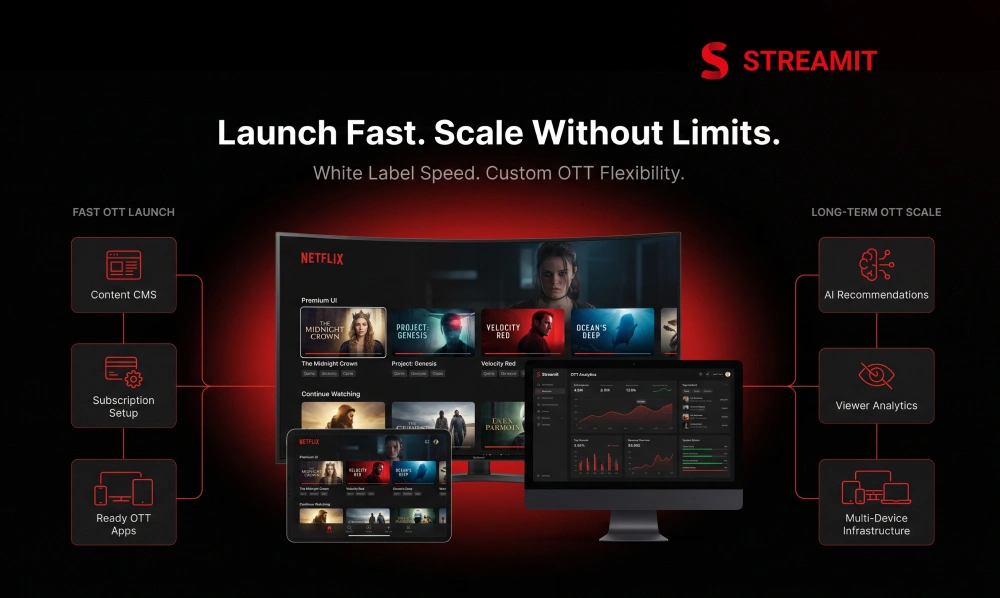
Streamit is built for founders who want speed without turning the platform into a short-term shortcut. The focus is on streaming infrastructure, ownership, monetization, performance, and long-term control.
Streamit positions streaming as a business foundation, not just an app build. Its platform direction includes web, mobile, smart TV, infrastructure, monetization, analytics, security, and long-term scalability.
Use Streamit’s White Label Route When Speed to Market Matters Most
Use the white label route when you need to validate, launch, and start learning faster. This is useful when the brand, content, and revenue model are clear enough to go live.
Streamit can help founders move faster by using a ready streaming foundation while still keeping the bigger growth picture in view.
Use Streamit’s Custom Route When You Need Deeper Product Control
Use the custom route when the business model needs deeper control. This may include unique workflows, advanced monetization, custom discovery, regional expansion, or complex infrastructure needs.
Streamit is not positioned as a locked SaaS platform. Its focus is on ownership, flexibility, and long-term control for serious streaming businesses.
Build on a Stack Designed for Performance, Monetization, and Scale
The right OTT stack should survive real usage, not just launch-day demos. Playback, billing, analytics, security, and content operations need to work under pressure.
Streamit’s approach focuses on enterprise-grade architecture across web, mobile, and smart TV, with monetization and security built into the foundation.
Choose Streamit When You Need Faster Launch Now and More Control Later
The strongest launch strategy is not white label or custom. It is choosing the right path for the stage you are in. Some founders need speed first. Others need control first.
Streamit supports both conversations. The aim is to help businesses launch intelligently now without blocking future ownership, scale, and product evolution.
Summary
Key Takeaways
White Label Speeds Up Launch
It reduces repeated development work across apps, backend, billing, playback, and security – the systems that consume the most time.
Connected Systems Drive Speed
CMS, monetization, analytics, video delivery, and user access work together from the start, eliminating handoff delays between teams.
Monetization Must Be Ready Early
SVOD, AVOD, TVOD, rentals, and hybrid models should be part of the platform foundation from day one, not patched in after launch.
Security Cannot Wait Until Launch
DRM, encryption, authentication, and content protection need to be built into the platform before any content distribution begins.
Planning Still Matters
Content, metadata, branding, app approvals, compliance, and payment testing can still slow the launch even when the platform is ready.
Vendor Choice Shapes Long-Term Growth
Customization depth, scalability, API access, support quality, ownership, and data control determine what happens after your first launch.
Conclusion
Conclusion
A fast OTT launch only matters if the platform can keep growing after launch. That is where many white label decisions become risky. The platform may help you go live, but it must also support performance, monetization, analytics, ownership, and future control.
A white label OTT platform can be the right move when you want to enter the market faster without rebuilding every system. With Streamit, the goal is to launch faster while still building toward a serious streaming business, not just another app in the store.
FAQs
Frequently Asked Questions
-
What usually delays a white label OTT launch the most?
Content preparation, branding approvals, payment configuration, app store submissions, and final QA usually create the most delays. The platform may be ready, but the launch assets still need proper planning.
-
Can I migrate my existing videos and subscribers without a full rebuild?
Yes, in many cases, but it depends on your current platform, data structure, payment system, and content format. A proper migration plan should review videos, metadata, users, subscriptions, and access rules before launch.
-
Can a white label OTT platform support local payment gateways?
Yes, many white label OTT solutions can support local payment gateways through integrations or API-based setups. The important part is checking gateway compatibility before committing to the vendor.
-
When does white label OTT become too limiting for growth?
It becomes limiting when your business needs unique workflows, deeper personalization, advanced monetization, custom analytics, or stronger infrastructure control. That is when a custom or hybrid route becomes more practical.
-
How do I compare OTT vendors beyond feature lists?
Compare ownership, scalability, support quality, device coverage, security, monetization flexibility, API access, and post-launch roadmap. Features matter, but long-term control matters more.
-
Do I need source code or API access before choosing a vendor?
For a serious OTT business, yes, at least API access should be discussed early. Source code, data access, and integration control become important when the platform grows beyond the first launch.