10 Streaming Features Every OTT Service Needs


Launching an OTT service is no longer the difficult part. Many platforms can get to market with a content library, a working app, and basic playback. The real challenge begins after launch, when viewers start comparing the experience against everything else they already use.
That is where most OTT services start separating into two groups. One group keeps users watching because the platform feels smooth, relevant, and dependable. The other group loses momentum because too many small experience gaps begin to add up.
Streaming features sit at the center of that difference. They shape how fast videos load, how easily viewers discover content, how smoothly they continue watching across devices, and how confidently operators manage retention and monetization over time.
For OTT businesses that want long-term growth, features should not be treated like decorative add-ons. They should be treated like infrastructure for watch time, trust, and retention.
Foundation
Why Streaming Features Matter for Every OTT Service
A streaming platform grows when viewers return often enough to build a habit, and that habit depends heavily on the product experience. Strong streaming features reduce friction across playback, discovery, navigation, and continuity, turning interest into repeat viewing.
Why content alone is not enough to grow an OTT platform
A large content library may attract users, but experience decides whether they stay. If search, playback, and content surfacing feel weak, even strong content becomes harder to use and easier to leave.
Viewers leave when the streaming experience feels weak
Viewers often leave because of repeated small frictions, not one major problem. Buffering, weak search, poor progress saving, and inconsistent device performance slowly reduce trust in the platform.
Better features help OTT services keep users watching
Better streaming features reduce the effort needed to start and continue watching. Tools like Continue Watching, smart discovery, and personalized recommendations help viewers move from interest to playback faster.
How the right streaming features improve OTT growth
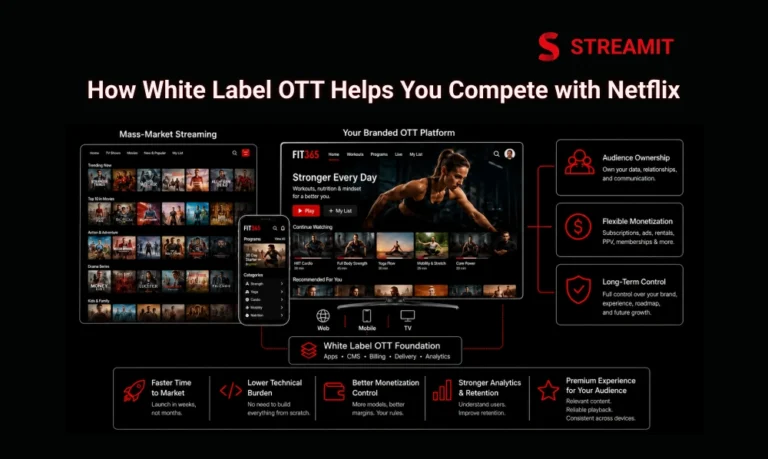
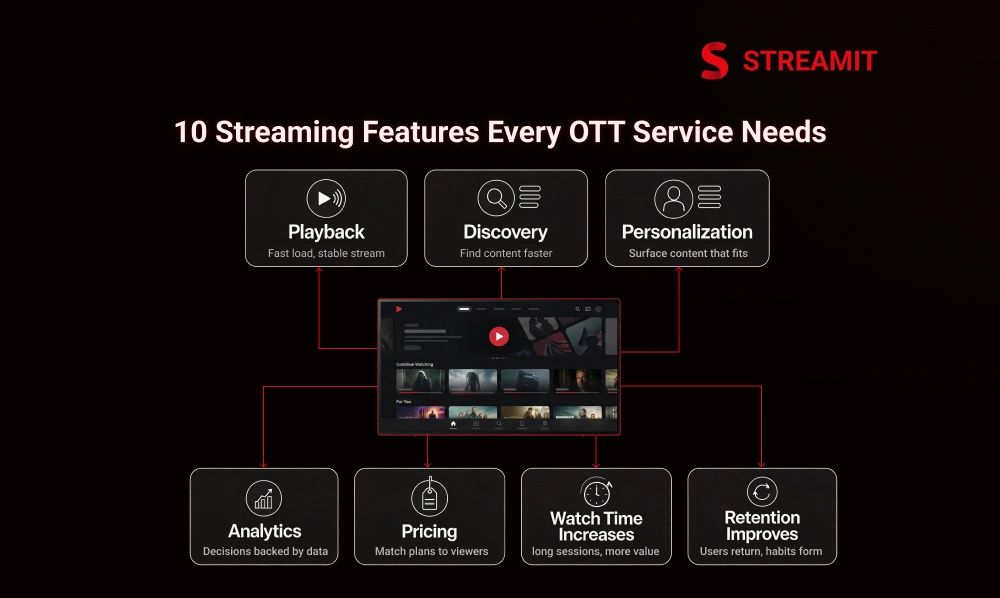
OTT growth becomes stronger when features improve both user experience and business outcomes. Better playback, discovery, personalization, analytics, and pricing all help the platform scale more effectively.
Better playback and discovery increase watch time
Playback and discovery shape the first moments of every session, which often decide how long the user stays. A stable stream and easier content discovery make sessions smoother, longer, and more valuable.
Better personalization and pricing improve retention
Retention improves when the platform feels more relevant to each type of viewer. Personalization keeps content surfacing useful, while smarter pricing helps respond better to different user states.
Viewer Expectations
What Users Expect From a Modern OTT Platform
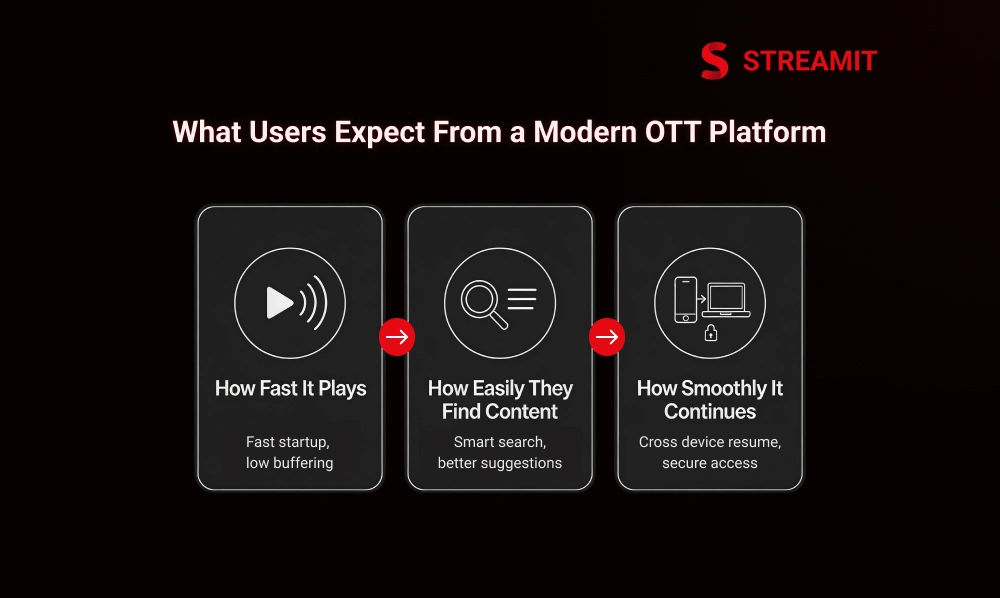
Today’s viewers expect a streaming service to work smoothly from the start without extra effort. Fast playback, low buffering, strong search, saved progress, and secure access are now standard expectations.
Fast playback with low buffering on every device
Users expect streaming to feel quick, stable, and consistent across mobile, web, and TV. If playback feels weak on any key screen, the platform starts to feel less dependable.
Easy content discovery with personalized suggestions
Most viewers want to find relevant content quickly without browsing for too long. Better search, smarter suggestions, and clearer content surfacing make the platform feel more useful and easier to return to.
Smooth viewing with resume playback and secure access
Viewers expect to pause on one device and continue on another without losing their place. At the same time, they want the platform to protect content and user data without adding visible friction to the experience.
Core Features
10 Streaming Features Every OTT Platform Must Have
These features are not just product add-ons. They shape how an OTT platform performs, how easily viewers find content, and how effectively the service supports retention, monetization, and long-term growth.
1. Multi-CDN for Stable and Low-Buffer Streaming
Multi-CDN is one of the most practical features for OTT services that care about playback reliability at scale. Instead of depending on a single delivery path, the platform can route traffic more intelligently based on performance and availability.
This matters because delivery conditions are not always stable. Regional congestion, network shifts, and sudden traffic spikes can quickly weaken playback if the architecture has too little flexibility.
A stronger delivery setup gives the platform a better chance of preserving watch time when usage becomes more demanding.
How Multi-CDN improves playback reliability
Playback reliability improves when the platform can shift delivery across multiple content distribution paths instead of depending on one network to perform well in every situation.
That additional control helps reduce the chance of visible buffering and unstable playback. For the user, the experience feels smoother. For the platform, delivery becomes more resilient under changing conditions.
This is especially important for services that want to grow without rebuilding their playback layer later.
Why Multi-CDN matters during traffic spikes
Traffic spikes are where weaker streaming setups usually start showing their limits. A new release, premium live event, or sudden demand surge can turn small delivery inefficiencies into major user frustration.
Multi-CDN helps because it gives the system more room to respond when one path becomes weaker. It reduces the platform’s dependence on a single network during high-pressure moments.
For OTT services building for long-term scale, that kind of reliability matters early, not only after problems appear.
2. HLS and DASH Transcoding for Better Playback on Every Device
A single video file cannot create the best experience for every device, screen size, and network condition. That is why transcoding remains one of the most important playback features in OTT.
HLS and DASH support help the platform deliver content more intelligently across different environments. Instead of forcing the same quality and format everywhere, the service can adapt playback more effectively.
This matters because viewers do not all watch under the same conditions. A strong OTT platform should be ready for that from the start.
How transcoding supports different screens and internet speeds
Transcoding allows the platform to generate multiple versions of the same video so playback can match the viewer’s connection and device capability more accurately.
That means someone on weaker mobile data can still get a stable experience, while someone on a large smart TV with strong bandwidth can watch at a higher quality level.
Without this flexibility, the platform forces too much inconsistency into the viewing experience.
Why adaptive playback helps reduce buffering
Adaptive playback reduces buffering by adjusting the stream more intelligently when bandwidth changes. Instead of failing abruptly, the platform can maintain continuity more smoothly.
This protects the session because the user is less likely to experience repeated interruptions. It also improves perceived quality because stability often matters more than forcing the highest resolution at the wrong moment.
For OTT platforms, that makes adaptive playback one of the most important layers behind a dependable player experience.
3. AI Recommendation Engine for Personalized Content Suggestions
Recommendation engines matter because they reduce decision fatigue. In most OTT services, the viewer does not need more content choices alone. The viewer needs better direction.
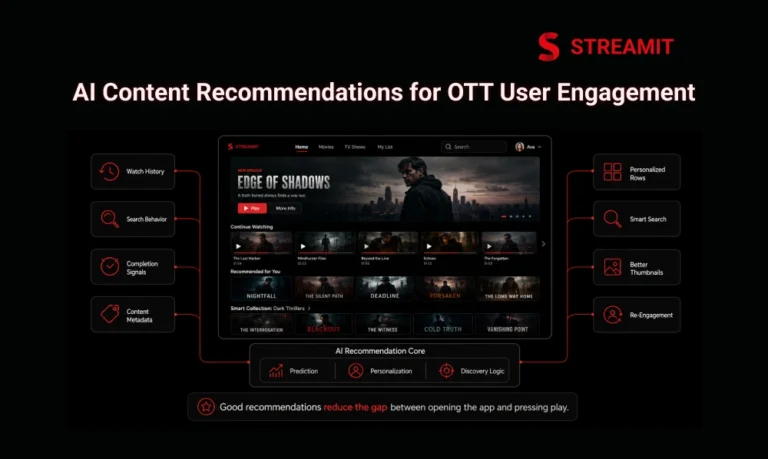
A recommendation engine helps the platform surface titles based on behavior, preferences, viewing patterns, and engagement signals. That makes the homepage feel more useful instead of more crowded.
For OTT operators, this feature is valuable because it supports both watch time and repeat usage without depending only on content expansion.
How personalized recommendations increase watch time
When viewers see titles that feel more aligned with their interests, they spend less time browsing and more time watching. That change matters because session momentum is easier to protect when discovery feels more relevant.
Recommendations help move the user from interest to playback faster. They reduce the effort of making the next decision, especially when the catalog is large.
That is why good recommendations usually improve watch time indirectly but meaningfully.
Why recommendation engines improve viewer retention
Retention improves when the platform feels less generic over time. Users are more likely to return when they believe the product understands what they are likely to enjoy next.
A good recommendation engine supports that feeling by making each session more responsive to prior behavior. The homepage feels more alive, and the service gives viewers stronger reasons to come back.
Over time, that makes recommendation logic one of the most important retention layers in OTT.
4. AI Discovery Engine for Smarter Search and Content Discovery
Search is often weaker than it should be in OTT products. Many platforms still behave as if users will search with perfect spelling, exact titles, and complete certainty.
Real viewers do not behave that way. They search with typos, vague phrases, actor names, theme words, or half-remembered titles. That is why stronger discovery systems matter so much.
A smarter discovery engine helps translate imperfect intent into better results. That makes the entire platform feel easier to use.
How smart search helps users find content faster
Smart search improves speed because it reduces the number of failed attempts between user intent and a playable title. Instead of returning empty or rigid results, the platform can respond more intelligently to imperfect input.
This is especially useful on mobile and TV, where typing is slower and users want faster results with less effort.
When search works well, users stay in the viewing flow. When it does not, even strong content becomes harder to access.
Why better discovery reduces user drop-off
Poor discovery creates a silent drop-off. Users often leave not because they dislike the platform’s catalog, but because finding something worth watching feels harder than it should.
Better discovery reduces that friction. It helps viewers move forward with more confidence and less fatigue.
That is why content discovery deserves more product attention than many OTT teams give it. It affects both engagement and the perceived usefulness of the catalog.
5. AI Smart Thumbnails to Improve Content Clicks
Thumbnails play a bigger role in OTT performance than many teams admit. A title cannot be watched if it does not earn the click first.
Smart thumbnails improve content presentation by making visuals more relevant to different user interests and viewing contexts. That helps more titles compete for attention without changing the entire interface.
For OTT services, this is one of the more efficient ways to improve discovery performance at the content surface level.
How better thumbnails increase click-through rate
A stronger thumbnail gives the viewer a clearer reason to choose one title over another. It improves the first impression without requiring longer browsing or more product complexity.
This matters because small changes in click-through behavior can influence content utilization across the homepage and recommendation rows.
When better visuals lead to more clicks, the platform gets more value from the catalog it already has.
Why personalized visuals improve title selection
Different viewers respond to different visual cues. One user may react to cast-focused artwork, while another responds better to mood, action, or genre emphasis.
Personalized visuals help the platform present the same title in a way that feels more relevant to different segments. That increases the chance of a stronger content match at the browsing stage.
This is why smart thumbnails should be seen as a discovery feature, not just a design feature.
6. Continue Watching for a Smooth Cross-Device Experience
Continue Watching is one of the simplest features to recognize and one of the easiest to underestimate. When it works well, users barely notice it. When it fails, the friction becomes immediate.
This feature matters because modern viewing behavior is fragmented across devices. People start content on mobile, continue on TV, and revisit later on web or tablet.
A strong Continue Watching system preserves that continuity. It makes the platform feel dependable and easier to return to.
Why resume playback matters for user convenience
Resume playback matters because it protects user intent. If someone leaves a title halfway, the next session should begin with as little restart effort as possible.
This convenience feels small, but it compounds. It reduces friction across repeat sessions and makes the product feel better organized around real viewing behavior.
That is why resume playback is more than a nice feature. It is part of what makes the platform feel mature.
How cross-device syncing supports retention
Cross-device syncing supports retention because it fits the way people actually watch. Users do not think in terms of one device journey anymore.
When the platform remembers progress accurately across screens, it becomes easier for viewers to continue their relationship with the content. That increases the chance of repeat usage.
If syncing feels weak or inconsistent, the service starts to feel less trustworthy, especially for long-form content consumption.
7. Smart Seek Previews for Faster Video Navigation
Smart seek previews improve player navigation by helping viewers move through a video with more precision. Instead of dragging blindly across the timeline, they can preview where they are going before releasing the seek action.
This becomes especially useful in long-form content, where finding a specific moment quickly matters more. It improves the sense of control inside the player.
For OTT services, it also helps the player feel more advanced without adding unnecessary complexity to the user experience.
How Seek Previews improves the video player experience
Seek previews improve the player because they reduce guesswork. Users can navigate more efficiently and avoid repeated back-and-forth attempts to find the right scene.
That makes the player feel more responsive and less frustrating, especially in content where viewers revisit moments often.
Small navigation improvements like this can have an outsized effect on the perceived quality of the platform.
Why this feature matters for long-form content
Long-form content creates more navigation demand than short clips. Viewers may want to revisit a key scene, skip to a specific section, or move through an extended piece of content without wasting time.
Seek previews support that behavior naturally. They make longer videos easier to control and reduce frustration in high-intent viewing sessions.
For platforms focused on films, education, sports, events, or detailed episodic content, this feature becomes especially valuable.
8. AI-Powered Analytics for Better OTT Decisions
Analytics should do more than report views. Strong OTT analytics should help teams understand how users behave, where sessions weaken, and which actions could improve retention or monetization.
That is what makes analytics valuable at an operational level. Instead of only showing what happened, the system helps the team understand where attention, revenue quality, and churn risk are shifting.
For growing OTT services, this kind of visibility becomes essential because late insight usually leads to late action.
What OTT teams should track beyond views and clicks
Views and clicks are surface-level numbers. They help, but they do not explain enough on their own.
OTT teams should also watch session duration, completion patterns, return frequency, content abandonment, churn signals, device usage trends, and content-type performance. These metrics reveal where the platform is creating value and where it is quietly losing it.
A stronger analytics layer helps connect those signals back to product decisions.
How analytics help improve retention and monetization
Retention and monetization improve when teams can identify risk earlier. If users begin watching less, abandoning more, or returning less often, the platform should notice before cancellations increase.
Analytics make that possible. They help teams improve recommendations, adjust surfacing logic, refine onboarding, and intervene more intelligently with pricing or re-engagement strategies.
That is why analytics are not just reporting tools. They are part of the decision system behind stronger OTT growth.
9. Retention Pricing to Reduce Churn and Improve Conversions
Pricing is often treated too statically in OTT. Many services create a few plans and assume that pricing work is done.
In reality, pricing affects retention, conversion timing, and perceived value throughout the user lifecycle. A stronger retention pricing system helps the platform respond more intelligently to different user states.
This matters because churn is not always caused by content dissatisfaction alone. Sometimes the offer structure is too rigid for the user’s behavior or stage.
How pricing logic can help keep users subscribed
Pricing logic can support subscription retention by making the offer more relevant to the user’s context. A new user, an active binge viewer, and an at-risk subscriber do not always respond best to the same approach.
Smarter pricing systems help teams create better timing, stronger upgrade paths, and more useful retention interventions. That makes monetization feel more aligned with actual usage behavior.
For OTT operators, that means pricing can become a retention tool instead of only a billing tool.
Why smart offers work better than fixed pricing alone
Fixed pricing is easy to manage, but it can leave too much value unprotected. Smart offers work better because they allow the platform to respond with more flexibility when risk or opportunity changes.
This does not mean discounting everything. It means using better logic to decide when a trial, upgrade, renewal offer, or win-back message is more likely to work.
That approach usually supports stronger conversions and better subscriber stability over time.
10. End-to-End Encryption for Secure Streaming
Security should not be treated like a later upgrade once the platform becomes large. Serious OTT services need stronger protection early because trust affects both content value and business credibility.
End-to-end encryption helps protect video delivery, platform access, and user-related data across the streaming environment. It supports both content security and viewer trust.
For premium OTT services, that matters because weak protection can damage growth, reputation, and long-term control.
Why OTT platforms need stronger video and user data protection
OTT platforms hold valuable content assets and user information at the same time. That creates two security responsibilities that need to be handled carefully.
Stronger protection helps reduce the risk of unauthorized access, asset misuse, and data exposure. It also supports better confidence among partners, content owners, and subscribers.
That is why security should be considered part of the core platform foundation.
How security supports trust and long-term platform growth
Trust is one of the quietest but most important growth layers in streaming. Users expect the service to work safely even if they never directly talk about encryption or access control.
A more secure OTT platform supports that trust by protecting what users and operators both care about. It also helps the business grow with more control instead of adding protection only after risk becomes visible.
For long-term OTT growth, security is not just technical hygiene. It is part of platform maturity.
| Feature | Viewer Benefit | Business Value |
|---|---|---|
| Multi-CDN | More stable playback | Better resilience during scale |
| HLS/DASH Transcoding | Better playback across devices | Lower friction across networks |
| Recommendation Engine | More relevant suggestions | More watch time and repeat usage |
| Discovery Engine | Easier content search | Less browse fatigue and drop-off |
| Smart Thumbnails | Better title selection | Improved click-through and content use |
| Continue Watching | Easier session continuity | Stronger cross-device retention |
| Smart Seek | Faster navigation | Better long-form player experience |
| Analytics | Smarter product decisions | Better retention and monetization actions |
| Retention Pricing | More relevant offers | Lower churn and better conversions |
| End-to-End Encryption | Safer streaming experience | Stronger trust and platform control |
Platform Selection
How to Choose an OTT Platform With the Right Streaming Features
Choosing an OTT platform should not be about counting how many features appear in a sales deck. It should be about understanding which features improve the viewing journey and which ones help the business scale with fewer rebuilds.
The best platform usually combines playback quality, discovery strength, personalization, retention support, and security in one connected system. That matters more than a long feature list with weak coordination underneath it.
For serious OTT businesses, the right stack should protect performance, control, and long-term flexibility.
Look for features that improve playback, discovery, and retention together
Playback, discovery, and retention should not be evaluated in isolation. A platform may have a good player but poor discovery, or useful recommendations but weak continuity across devices.
The stronger choice is usually the one where these layers support one another. Better playback keeps the session alive. Better discovery improves content access. Better retention systems help the session become a habit.
That kind of integration creates a much stronger foundation for growth.
Choose a platform that supports scale, personalization, and security
Founders and operators at a serious buying stage usually need fewer future limitations, not more short-term promises. That is why scale, personalization, and security matter so much in platform evaluation.
Scale protects the viewing experience as traffic grows. Personalization keeps the platform relevant over time. Security protects trust, ownership, and business stability.
A platform that handles these three areas well is better prepared for long-term OTT growth.
Built-in features are better than adding tools later
Built-in systems usually create a cleaner operational structure than patching multiple essential tools together later. When core features are fragmented, data becomes harder to connect, and the product becomes harder to optimize.
That does not mean every tool must come from one source. But the most important layers should work together with less operational friction.
For OTT services that want control and long-term efficiency, a deeper built-in capability is often the better path.
Strategy
Why These Streaming Features Matter Before You Build Your OTT Service
Many OTT teams think feature planning can wait until after launch. In practice, that usually creates unnecessary product debt.
The earlier the platform is designed around playback quality, discovery, continuity, retention support, and security, the easier it becomes to grow without fixing too many preventable weaknesses later.
That is why these features matter before launch, not just after traction appears.
The right feature stack helps reduce churn from the start
Churn usually begins before a user actually cancels. It starts when the platform becomes less useful, less smooth, or less relevant than expected.
A stronger feature stack helps reduce that risk early by improving the first sessions, making continuity easier, and supporting stronger content access from the beginning.
That gives the platform a better chance of building a habit instead of only chasing acquisition.
A stronger streaming experience supports long-term growth
Long-term OTT growth depends on repeat usage, stronger session quality, and better retention over time. A stronger streaming experience supports all three.
When the product feels fast, relevant, dependable, and secure, the business becomes easier to scale because fewer parts of growth are fighting against a weak user experience.
That is why strong streaming features are not only product upgrades. They are a business infrastructure.
Summary
Key Takeaways
Features Are Growth Infrastructure
OTT growth depends on more than content. Strong streaming features improve playback, discovery, continuity, personalization, monetization, and trust across the full viewer journey.
Playback and Stability Come First
Multi-CDN and HLS/DASH transcoding protect watch time by delivering stable, low-buffer streaming across every device and network condition at scale.
Personalization Drives Retention
Recommendation engines, discovery engines, and smart thumbnails help viewers find relevant content faster, reducing browsing fatigue and improving repeat usage over time.
Continuity Builds Habit
Continue Watching and smart seek previews make cross-device viewing smoother and help users resume long-form content easily — two features that quietly compound retention.
Analytics Unlock Smarter Decisions
AI-powered analytics move OTT teams beyond views and clicks to reveal churn signals, session patterns, and content performance data that drive better retention and monetization.
Security Is a Business Requirement
End-to-end encryption protects content assets and user data while building the long-term trust that platform growth and premium content licensing depend on.
Conclusion
Conclusion
OTT platforms do not usually lose momentum because the idea was weak. They lose momentum because the experience beneath the idea was not strong enough to support repeat viewing at scale.
That is why these 10 streaming features matter so much. They shape how the platform performs, how easily viewers discover content, how well the service preserves intent across sessions, and how intelligently the business protects retention and monetization.
For founders and operators, the important shift is simple. Do not think about these features as optional polish after launch. Think about them as the foundation that makes growth worth keeping.
FAQs
Frequently Asked Questions
-
What are the must-have streaming features for an OTT service?
Modern OTT services need stable delivery, adaptive playback, discovery, personalization, analytics, retention tools, and strong security.
-
Which OTT platform features improve watch time and user retention?
Playback quality, recommendations, smart discovery, Continue Watching, and analytics improve watch time and viewer retention.
-
Why is Multi-CDN essential for stable OTT streaming?
Multi-CDN improves streaming stability by reducing buffering and handling traffic spikes more reliably.
-
How do recommendation engines help OTT services keep users watching?
Recommendation engines keep users watching by surfacing more relevant content with less browsing effort.
-
Why do OTT platforms need better search and content discovery features?
Better discovery helps viewers find the right content faster and reduces drop-off caused by search frustration.
-
How does Continue Watching improve the cross-device OTT experience?
Continue Watching makes cross-device viewing smoother by saving progress and helping users resume content easily.
-
How do OTT analytics help improve retention and monetization?
OTT analytics help teams improve retention and monetization by revealing viewer behavior, churn risk, and content performance.
-
Why should every OTT service include end-to-end encryption?
End-to-end encryption protects content and user data while strengthening trust in the platform.