End-to-End Encryption for Secure OTT Streaming

More than 5 billion videos are streamed daily, yet most platforms still treat security as an add-on rather than an architectural decision. In practice, a single data breach rarely causes damage because of immediate loss alone, it damages trust, and trust is what sustains long-term platform value.
End-to-End Encryption addresses this at the infrastructure level. It protects content and user data across the entire lifecycle, from upload to storage to playback, without introducing friction to performance or user experience.
This is not about adding protective layers after deployment. It is about designing a streaming system where security is embedded from the first request to the final frame delivered.
Why Streaming Platforms Are Prime Targets?
Video platforms handle continuous data movement across APIs, CDNs, storage layers, and user devices. This constant exchange makes them structurally attractive targets, not because they are weak, but because of the volume and value of what they manage.
Today’s streaming platforms support far more than entertainment. They host enterprise training, premium educational content, internal corporate communications, and subscription-driven media libraries. As platforms scale, the exposure surface grows proportionally.
Security risks therefore do not increase suddenly, they expand gradually alongside platform growth.
What Makes Streaming Vulnerable?
Streaming systems operate through segmented delivery, frequent API interactions, and distributed storage environments. Each of these components introduces potential exposure points if left unprotected.
Users often access platforms from public networks, while content moves through multiple infrastructure layers. Without integrated encryption, protection becomes fragmented rather than continuous.
The Cost of Ignoring Encryption
A single exposed file, compromised user database, or leaked administrative credential rarely results in immediate operational failure. The larger impact is reputational, it signals a lack of structural control.
For enterprise platforms, trust erosion typically costs more than the initial incident itself.
What Is End-to-End Encrypted Streaming?
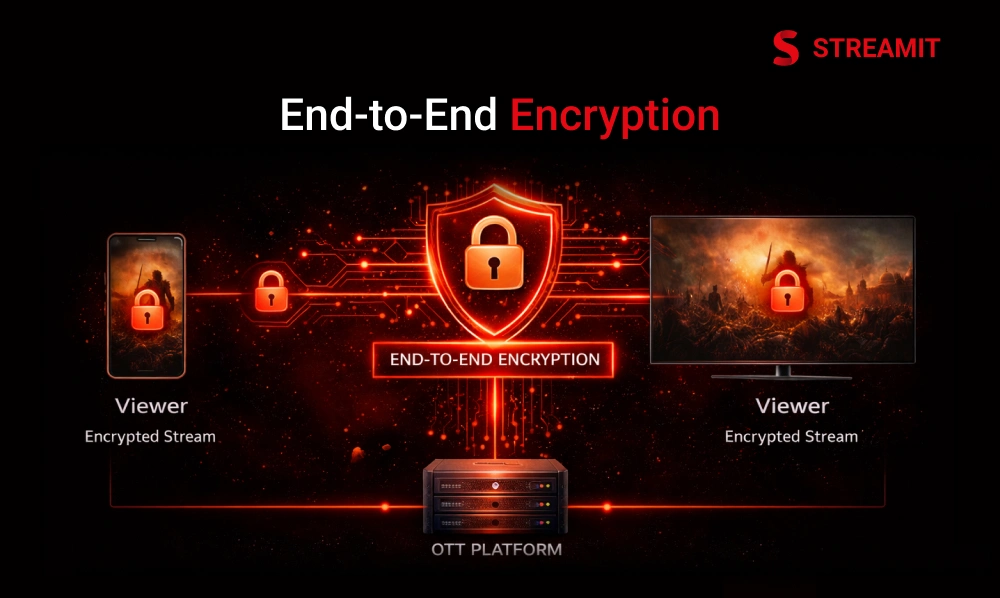
End-to-End Encrypted Streaming ensures that both content and user data remain protected while moving across networks and while stored within infrastructure. Protection does not exist at isolated points, it remains continuous across the entire streaming lifecycle.
This approach combines encryption for data in transit and encryption for data at rest, forming a closed trust loop around platform operations.
The objective is not visible security measures, but uninterrupted protection that operates without impacting performance.
Dual Layers of Protection
One layer secures communication between users and the platform, ensuring that transmitted data cannot be intercepted or altered. The second layer protects stored content, ensuring that even direct infrastructure access does not expose usable files.
Together, these layers create consistent protection across both movement and storage.
Security That Feels Invisible
Well-designed encryption should not change how a platform feels to use. Users should experience normal playback performance while protection operates entirely in the background.
The absence of visible friction is not a sign of weak security, it is a sign of mature architecture.
Why Securing the Connection Comes First?
Most data exposure risks occur during transmission rather than storage. The moment a user opens an application or initiates playback, data begins moving across public networks.
Without encryption at this stage, information can be monitored, intercepted, or manipulated before it reaches secure infrastructure layers.
Connection-level encryption ensures that data remains protected from the first interaction onward.
What Happens When a User Opens the App?
As soon as the platform loads, a secure connection is established automatically. Authentication checks, certificate validation, and encrypted API communication occur before any content exchange begins.
Users remain unaware of this process because it is designed to operate seamlessly.
Streaming Over Public Wi-Fi
When someone streams over public Wi-Fi, their data travels across a shared network that anyone nearby could potentially monitor. With proper encryption in place, that stream stays protected and unreadable, even on open connections.
Without TLS: Anyone on the same network could potentially inspect traffic.
With TLS: All data appears scrambled to outsiders.
What TLS Actually Protects?
TLS protects every piece of data exchanged between the user and the platform while it’s in transit. From login details and session tokens to video streams and API requests, everything travels through a secure, encrypted connection.
- Login credentials
- Session tokens
- API requests
- HLS playlists
- Video segment delivery
The User Experience in Action
From the viewer’s perspective, everything feels normal, fast loading, clear video, instant playback. Behind the scenes, multiple layers of encryption operate silently.
Let’s walk through the journey.
Step 1: User Logs In or Opens the App
Secure connection established via HTTPS. No exposed credentials.
Step 2: User Browses Content
Thumbnails, metadata, and API responses are encrypted. Nothing travels in plain text.
Step 3: User Presses Play
Encrypted video segments begin streaming. A secure key request is made. Only the authorized session receives it.
Step 4: Playback Begins
Decryption happens in memory on the device. No raw video file is exposed publicly.
Why Storage Encryption Matters More Than Ever?
Even when transmission is secure, stored content remains a high-value target if left unprotected. Cloud infrastructure, by its nature, distributes data across environments that must be secured independently.
Encryption at rest ensures that stored files remain unusable even in the event of unauthorized infrastructure access.
Protection therefore continues beyond active sessions and persists throughout the data lifecycle.
What Gets Encrypted?
Everything stored within the platform is encrypted before it rests on the server. This includes video files, thumbnails, user information, billing records, backups, and system logs, ensuring nothing remains in plain, readable form.
- Video files
- Thumbnails
- User information
- Billing records
- Backups
- Logs
What Is AES-256?
AES-256 is a widely trusted encryption standard used to protect sensitive data across industries like banking, healthcare, and government systems. It converts readable information into unreadable code that can only be unlocked with the correct secure key.
AES-256 is a widely trusted encryption standard used by:
- Banks
- Governments
- Enterprise systems
It transforms files into unreadable data without the correct key.
What Happens If Storage Is Compromised?
If storage is ever compromised, the files inside remain encrypted and unreadable. Without the correct decryption keys, the data is nothing more than scrambled code and cannot be used.
How Uploaded Content Is Protected?
Protection begins at the moment content enters the platform. Files are encrypted before storage occurs, ensuring that no unprotected version exists within the infrastructure at any stage.
This sequence reverses traditional approaches where content is stored first and secured later. The result is continuous protection from ingestion to playback.
What If a Hacker Downloads the File?
If a hacker manages to download the file, what they receive is still encrypted data, not a playable video. Without the proper decryption key, the file remains unusable and meaningless.
How Encryption Keys Are Protected?
Encryption keys are securely stored and never exposed to the public environment. They are rotated regularly and can only be accessed by authorized parts of the system under strict controls.
Keys are:
- Securely stored
- Rotated periodically
- Restricted by access rules
Data Protection Layers Overview
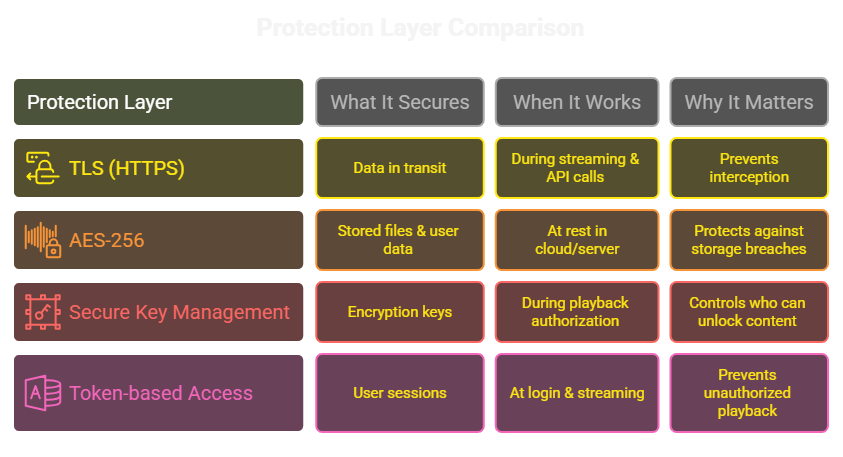
How Does Everything Connect Together?
True security is not built on isolated features but on a continuous loop of protection that never breaks. From the user’s device to the cloud and back again, encryption remains active at every stage of the journey.
The trust loop looks like this:
User → TLS Connection → Secure Key Handling → AES-256 Storage → Authorized Decryption → Playback → User
Platform Securely Handles Keys
Encryption keys are never made publicly accessible or embedded in open environments. They remain securely stored within controlled systems to prevent unauthorized exposure.
They are:
- Requested securely
- Delivered only to authorized sessions
- Used temporarily
Decryption Only When Necessary
Decryption happens only at the exact moment it is required for authorized playback. Once the session ends, access is revoked, ensuring the content never remains exposed longer than necessary.
Files are decrypted:
- During playback
- In controlled environments
- In memory
What Happens in Different Risk Scenarios?
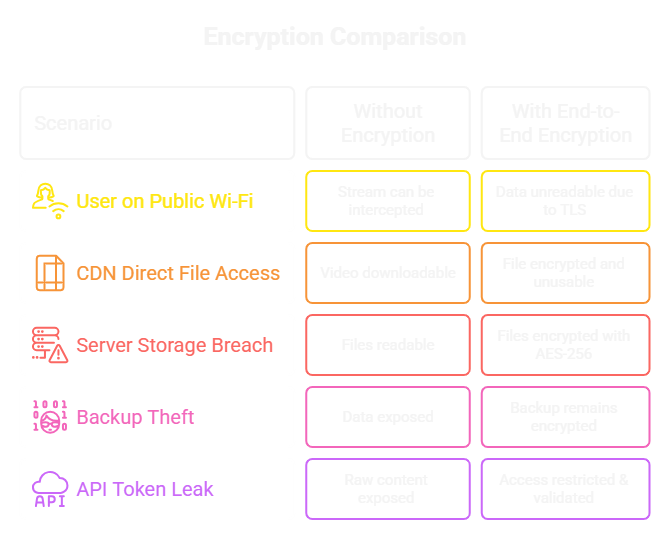
Why Does This Feels Enterprise-Grade?
Enterprise clients do not evaluate security based on individual features. They assess whether protection is embedded into system architecture.
Platforms designed with integrated encryption demonstrate long-term reliability, operational maturity, and reduced risk exposure.
This distinction is often what separates scalable infrastructure from short-term solutions.
Compliance Alignment
Encryption aligns with global data protection standards and regulatory requirements. It strengthens compliance while reducing potential legal risks.
Supports frameworks such as:
- GDPR
- ISO standards
- Data protection regulations
Lower Legal Risk
Strong encryption reduces the legal impact of potential security incidents. Even if a breach occurs, protected data significantly limits exposure and liability.
The Critical Role of Key Management
Over 80% of encryption failures happen not because of weak algorithms, but because of poor key management. The lock may be strong, but if the key is mishandled, security collapses. End-to-End Encrypted Streaming is not just about encrypting files. It is about controlling who can unlock them, and when.
Encryption keys are treated like controlled digital assets. They are never exposed publicly, never hard-coded into apps, and never left unprotected.
How Keys Are Handled in the Platform?
Encryption keys are generated and stored securely, separate from the actual content they protect. Access is tightly controlled and granted only to authorized system components when needed.
Keys are:
- Generated securely
- Stored separately from content
- Rotated periodically
- Delivered only after strict validation
Why Separation Matters?
If someone accesses storage, they get encrypted files. If someone intercepts traffic, they get encrypted packets. Without keys, nothing works.
The key system becomes the brain of the security architecture.
Session-Based Key Authorization
Access to decryption keys is granted only for the duration of an authorized session. Once the session ends, the authorization expires automatically, preventing any long-term exposure.
Keys are issued:
- Per session
- Per authorized user
- For limited time
What Really Happens When a Viewer Presses Play?
The most sensitive moment in streaming occurs when playback begins. This is the point where content transitions from secured storage to active viewing. Because data is being unlocked for a user session, strong controls are critical at this stage.
When a user clicks play:
- The app verifies authentication.
- The server validates subscription or permissions.
- A secure key request is generated.
- The encrypted video segments are delivered.
- Decryption happens in memory on the device.
Decryption Happens in Memory Only
Decryption takes place temporarily within the device’s memory during authorized playback. Once the session ends, no unprotected version of the file remains stored on the system.
The video is decrypted temporarily:
- Inside the application environment
- In volatile memory
- Not stored as an open file
Why Direct URL Access Fails?
Direct URL access fails because the video files stored on the server or CDN remain encrypted. Without the correct session-based key and authorization, the downloaded data appears scrambled and cannot be played.
If someone tries:
- Copying the video URL
- Downloading a segment manually
- Accessing CDN files directly
Device-Level Protection
More than 60% of streaming today takes place on mobile devices, smart TVs, and tablets rather than traditional desktops. This shift means protection cannot be limited to browser environments alone. Security must function consistently across every device where content is accessed.
End-to-End Encrypted Streaming works across:
- Web applications
- Android devices
- iOS devices
- Smart TVs
- Connected devices
Native Handling of Secure Streams
Modern devices and browsers are built to support secure streaming protocols by default. This allows encrypted content to be delivered and played smoothly without requiring additional steps from the user.
Modern browsers and mobile platforms already support:
- TLS encryption
- Secure media extensions
- Hardware acceleration
Hardware Acceleration for Smooth Decryption
Decryption is optimized to run efficiently alongside video playback. As a result, users experience smooth streaming without delays or buffering caused by security processes.
Devices use built-in processing capabilities to:
- Decode encrypted segments
- Render video smoothly
- Maintain high resolution
How Content Delivery Networks Stay Secure?
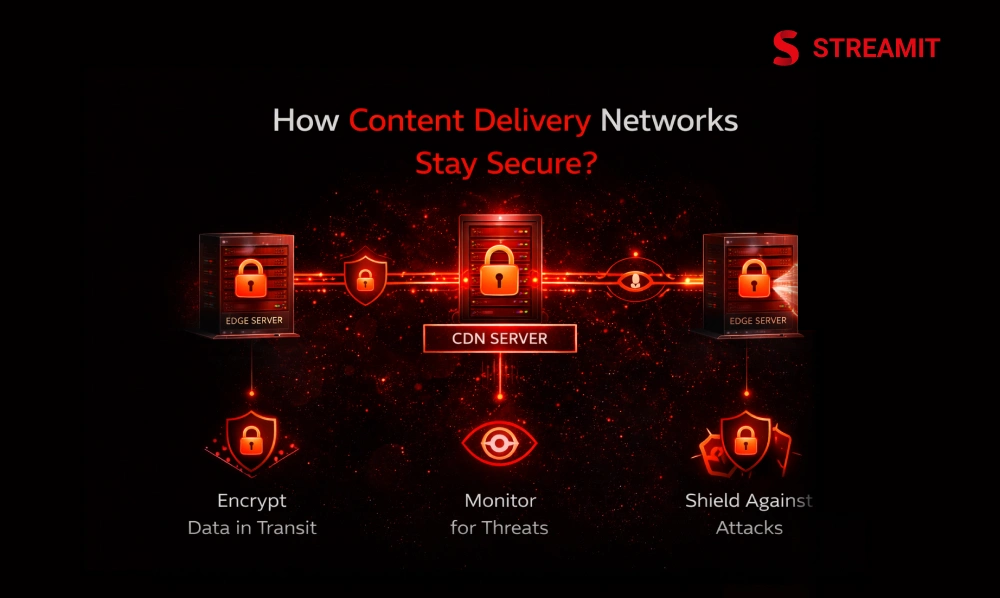
Streaming platforms depend on content delivery networks to distribute videos quickly across regions and continents. While speed is essential for a smooth viewing experience, it cannot come at the cost of security. Strong control mechanisms ensure content remains protected even as it travels globally.
With encrypted storage:
- CDNs store encrypted files
- They deliver encrypted segments
- They never hold usable raw video
Secure Token-Based Access
Access to video content is granted through time-limited tokens that validate each request. Once the token expires, the link becomes unusable, preventing unauthorized sharing or reuse.
When a video request is made:
- A time-bound token is attached
- The CDN validates it
- Access expires automatically
Uniform Protection at Global Scale
No matter where users access the platform, the same encryption standards remain in place. Security does not weaken with distance, scale, or geographic expansion.
Whether streaming in:
- India
- Europe
- North America
- Southeast Asia
Does Encryption Slow Streaming?
High-quality streaming depends on low latency and uninterrupted playback. If security introduces delays or friction, users are quick to move elsewhere. That’s why the architecture is designed to ensure encryption works seamlessly without affecting performance.
Because:
- TLS is optimized at the protocol level
- AES-256 is computationally efficient
- Devices use hardware support
- CDNs cache encrypted segments
Segment-Based Streaming Helps
Video content is delivered in small encrypted segments rather than as a single large file. This allows secure, continuous playback while maintaining speed and stability.
Each segment:
- Is encrypted
- Is requested securely
- Is decrypted instantly
Security Without User Friction
Security operates quietly in the background without adding extra steps for the viewer. Users simply press play and enjoy uninterrupted streaming while protection remains fully active behind the scenes.
There are:
- No security pop-ups
- No additional logins
- No extra loading screens
Real-World Situations Where Encryption Makes the Difference
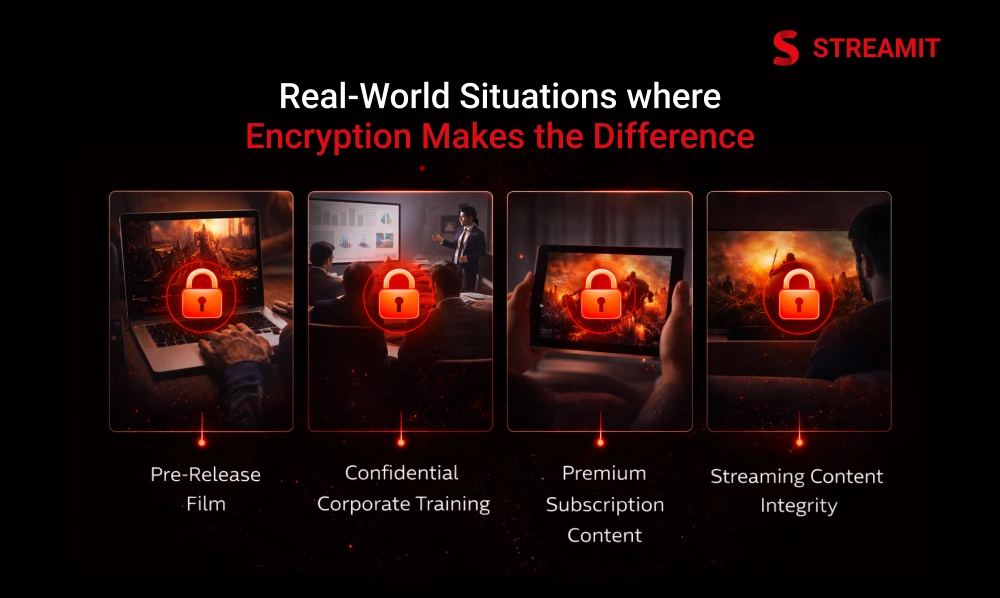
In real-world scenarios, encryption becomes the difference between controlled access and costly exposure. Whether it’s a pre-release film, confidential corporate training, or premium subscription content, protection must hold under pressure. Strong encryption ensures that even in high-risk situations, sensitive content remains secure.
Scenario 1: Film Release Before Launch Date
A production company may upload a trailer weeks before its official public release. During this period, strong encryption ensures the content remains protected from leaks or unauthorized access.
Risk: Leak before announcement.
With AES-256 storage: Even if files are accessed early, they remain unreadable.
Scenario 2: Corporate Training Platform
A company may host internal leadership videos meant only for employees. Encryption ensures that sensitive discussions and strategic information remain accessible only to authorized viewers.
Risk: Confidential information exposure.
With End-to-End Encryption: Only logged-in employees can access content.
Scenario 3: Subscription-Based Premium Content
A fitness platform may offer exclusive workout programs to paying subscribers. Encryption helps prevent unauthorized sharing, ensuring that only active members can access the premium content.
Risk: Link sharing and piracy.
With token validation and encrypted segments: Unauthorized sharing becomes ineffective.
Scenario 4: Educational Institution
Universities often host paid course libraries for enrolled students. Encryption ensures that lectures and study materials remain accessible only to authorized users and cannot be redistributed easily.
Risk: Download and redistribution.
With session-bound decryption: Extraction becomes significantly harder.
How Does This Support Compliance?
Regulations today increasingly require that user data be protected both while it is being transmitted and while it is stored. Failing to meet these standards can lead to serious legal and financial consequences. Platforms that prioritize encryption reduce regulatory risk and strengthen their compliance posture.
End-to-End Encrypted Streaming supports:
- Data protection policies
- Privacy-first architecture
- Responsible content handling
Why Compliance Is Easier?
When encryption is built into the core architecture, meeting regulatory requirements becomes more straightforward. Clear security controls and documented safeguards simplify audits and compliance reviews.
When encryption is built into infrastructure:
- Audits become smoother
- Documentation becomes simpler
- Risk assessments show stronger posture
Making Security Visible Without Showing Code
Decision-makers are less concerned with technical complexity and more focused on clear, practical understanding. They want to see how protection works in real-world scenarios, not just hear about algorithms. A strong demo should translate security into visible, relatable outcomes.
Step 1: Open the Platform
Point out the HTTPS lock icon visible in the browser’s address bar. It reassures viewers that the connection is encrypted and secure from the very first interaction.
Step 2: Try Accessing Video Without Login
Attempt to open a video without logging into the platform first. The system will block access, demonstrating that authorization is required before any content can be viewed.
Step 3: Attempt Direct File Access
Try opening a video file directly through its URL to simulate unauthorized access. Instead of playable content, the system returns encrypted data, showing that files cannot be used without proper authorization.
Step 4: Download a Storage File
Download a file directly from storage to demonstrate what happens outside the normal playback flow. Even after downloading, the file remains encrypted and cannot be opened without the correct decryption key.
Step 5: Show Admin Control Panel
Display the admin control panel to highlight how access and permissions are managed. This shows that security is not only automated but also governed through clear administrative controls.
Why Does This Build Business Confidence?
Strong security practices demonstrate responsibility and long-term thinking, which reassures clients and partners. When businesses see that their content and data are protected at every level, it builds confidence in the platform’s reliability and stability.
It shows:
- Professional infrastructure
- Long-term thinking
- Reduced operational risk
Investor Perspective
From an investor’s perspective, strong encryption reduces operational risk and potential financial exposure. It signals that the platform is built with long-term stability, regulatory awareness, and brand protection in mind.
Strong encryption:
- Lowers breach probability
- Reduces legal exposure
- Increases platform credibility
Designed for Millions of Users
The architecture is designed to scale seamlessly as user numbers grow. Whether serving thousands today or millions tomorrow, the security framework remains stable and dependable. Protection does not weaken as the platform expands.
The architecture supports:
- Distributed storage
- Global CDNs
- Multi-region key handling
- Automated rotation
Automated Security Operations
Security operations are automated to run seamlessly in the background. This ensures consistent protection without requiring ongoing manual intervention.
From Infrastructure to Competitive Advantage
Security decisions increasingly influence enterprise purchasing decisions before feature comparisons even begin. Buyers evaluate whether a platform can maintain control as it scales, not just whether it performs well initially.
End-to-End Encryption therefore functions not only as protection, but as a signal of long-term platform readiness.
It communicates operational discipline rather than marketing positioning.
The Shift in Buyer Expectations
Five years ago, encryption was impressive. Today, it is expected. But implementation quality is what separates serious platforms from basic ones.
Security as a Brand Message
Security can be communicated as a core brand value rather than just a technical feature. When platforms openly emphasize protection and responsibility, it strengthens credibility and builds lasting trust with users and partners.
Streaming platforms that openly communicate protection:
- Build trust faster
- Reduce friction in sales cycles
- Improve enterprise conversion rates
Threat Scenarios
Threat scenarios highlight how a platform responds under real-world pressure. By anticipating risks such as interception, unauthorized access, or storage breaches, strong encryption ensures that even targeted attacks result in minimal exposure.
Scenario 1: Network Interception Attempt
In a network interception attempt, an attacker tries to monitor data as it travels between the user and the platform. With TLS encryption in place, the intercepted information remains unreadable and unusable.
Scenario 2: Direct CDN Scraping
In a direct CDN scraping attempt, an attacker tries to pull video files directly from the delivery network. Since the files are encrypted, the downloaded content remains unreadable without authorized decryption keys.
Scenario 3: Database Breach
In a database breach, an attacker may gain access to stored records or internal data. However, with encryption in place, the information remains unreadable without the authorized decryption keys.
Scenario 4: Stolen Storage Access Credentials
In a stolen storage credentials scenario, an attacker gains access to the storage environment itself. Even then, encrypted files remain protected and unusable without the secure keys required for decryption.
Comparing Encrypted vs Non-Encrypted Streaming
Why Do Users Feel Safer, Even If They Don’t See Encryption?
Users feel safer when a platform consistently behaves in a reliable and professional manner. Visible cues like secure connections and clear privacy practices build subconscious trust. Even if encryption works silently in the background, its presence strengthens overall confidence in the platform.
When your platform shows:
- HTTPS lock icons
- Clear privacy policies
- Secure messaging about data handling
Confidence in Premium Content
Content creators and businesses feel more confident uploading premium material when strong protection is in place. Encryption reassures them that their exclusive content remains secure from unauthorized access or leaks.
Content creators feel safer uploading:
- Pre-release films
- Paid training programs
- Private company material
Confidence in Personal Data
Users are more willing to share personal details when they trust the platform’s security standards. Encryption ensures that sensitive information remains protected from unauthorized access or misuse.
Users sharing:
- Email addresses
- Payment information
- Viewing habits
Revenue Impact of Secure Infrastructure
Subscription-based platforms rely heavily on protecting exclusive content to sustain revenue. If premium material is easily leaked or shared without control, it directly impacts earnings and long-term growth.
End-to-End Encryption:
- Reduces piracy risk
- Protects exclusive material
- Supports subscription pricing
Enterprise Sales Acceleration
Strong security infrastructure helps reduce objections during enterprise sales discussions. When protection standards are clearly demonstrated, decision-making becomes faster and more confident.
Long-Term Retention
Platforms that consistently protect user data and premium content build lasting trust over time. This reliability strengthens customer loyalty and supports long-term subscriber retention.
Conclusion
Effective security should not interrupt the viewing experience or introduce operational complexity. Its role is to operate continuously, quietly, and predictably across every stage of the streaming lifecycle.
End-to-End Encrypted Streaming reflects this principle. It protects content, user data, and platform infrastructure without altering performance or usability. Protection begins at ingestion, remains active during storage and delivery, and expires automatically when sessions end.
This is not a protective layer added after development. It is an architectural choice that prioritizes control, stability, and long-term platform trust.
For organizations managing premium content or enterprise data, the value of encryption becomes most visible not during normal operation, but during attempted exposure, when unauthorized access results only in unusable data.
Explore the End-to-End Encryption demo and experience how protection remains active at every stage, from the first secure connection to the final byte delivered.
FAQs
1. Does encryption slow down streaming performance?
No. TLS and AES-256 are optimized and widely supported by modern devices. Playback remains smooth and buffer-free because decryption happens efficiently, often using hardware acceleration.
2. How does the streaming platform manage encryption key access?
The platform stores encryption keys within secure, isolated systems and never exposes them to users or public environments. Access is granted only to verified sessions for a limited duration, ensuring that decryption is tightly controlled and temporary.
3. How can OTT platform admins manage access to content?
Admins set roles and permissions to control who can view or play content, keeping videos secure and accessible only to authorized users.
4. Does encryption change the viewer’s streaming experience?
No. Viewers experience the same smooth playback, while encryption operates silently in the background without adding steps or interruptions.
5. Why is End-to-End Encryption important for streaming businesses?
Because content and user data are core assets. Protecting them protects revenue, reputation, and long-term growth.