How Adaptive Streaming Works- ABR, Transcoding & Video Quality

It only takes one pause for a video to load before most viewers lose patience and click away. This single insight explains why modern video platforms succeed or fail not on content alone, but on delivery. In a world of short attention spans and infinite alternatives, users don’t wait for videos to load, don’t adjust settings, and don’t troubleshoot playback issues. They leave.
Adaptive Streaming, combines adaptive bitrate delivery with efficient video preparation to handle this challenge at scale. It ensures that every viewer,regardless of device, location, or network quality,receives a smooth, uninterrupted viewing experience.
What Is Adaptive Streaming (ABR + Transcoding)?
A single video shouldn’t deliver the same experience to every viewer. Adaptive Streaming is built on the idea that playback must adjust to each user’s device and network conditions, ensuring the video feels smooth and reliable wherever it’s watched.
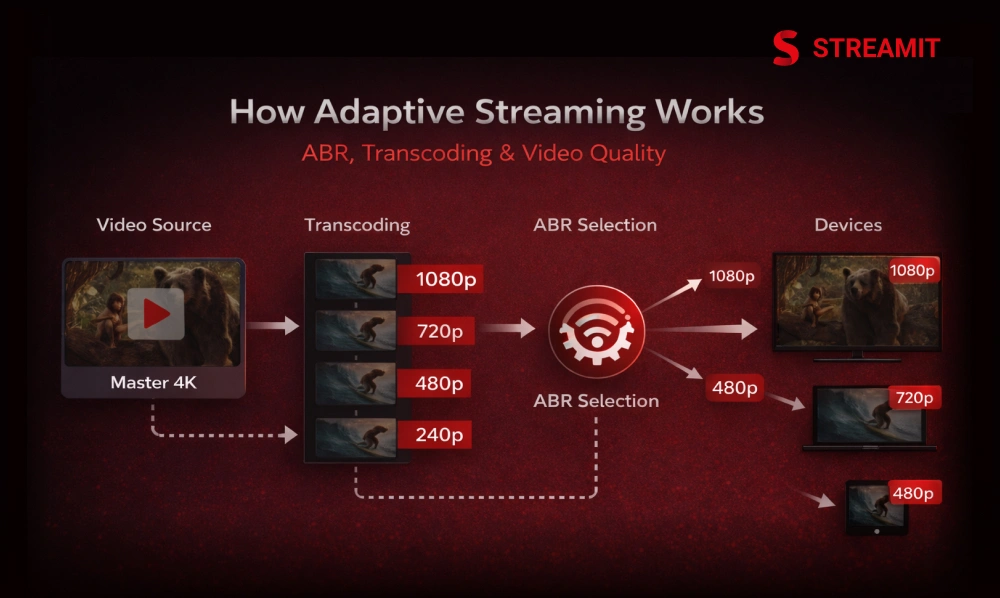
Adaptive Streaming is a method of delivering video where playback quality dynamically adjusts in real time based on the viewer’s device, screen size, and internet conditions. Instead of sending a single, heavy video file to everyone, the platform intelligently delivers the most suitable version of the same content to each viewer.
This is made possible through two key components:
- Transcoding – preparing multiple optimized versions of a single video
- Adaptive Bitrate (ABR) – selecting and switching between those versions in real time
The result is a viewing experience where:
- Videos start instantly
- Buffering is virtually eliminated
- Quality adjusts automatically
- Playback feels smooth and uninterrupted
From the viewer’s perspective, there is no visible complexity. They press play, and the video simply works.
How It Feels to the Viewer?
When Adaptive Streaming is working right, users don’t notice it. They see seamless video, crisp visuals when possible, and continuous playback. That invisibility is what sets top platforms apart.
Why Traditional Video Streaming No Longer Works?
Internet speeds are never consistent, and viewers watch videos on a wide range of devices. Traditional streaming treats every viewer the same, ignoring these differences, which often leads to buffering, delays, and a poor viewing experience.
When platforms rely on a single video file, they assume all viewers have similar conditions. In reality:
- Some users are on high-speed broadband
- Others rely on unstable mobile data
- Every device is different, some handle tasks effortlessly, while others take their time and show every little lag.
- Network quality can change every few seconds
A single video file cannot adapt to these variables.
This leads to common failures:
- Buffering on slow networks
- Pixelated video on mobile devices
- Playback errors on certain browsers or TVs
- High abandonment rates mid-video
Users rarely complain about these issues. Instead, they associate them with poor platform quality and move on.
Adaptive Streaming is designed specifically to handle variability rather than fight it.
The Problem With One-Size-Fits-All Delivery
Without Adaptive Streaming, a viewer on high-speed broadband and one on unstable mobile data receive the exact same video stream. This leads to problems: the user with unstable data suffers from constant buffering, while the user with high-speed internet may feel the quality is underwhelming. Adaptive Streaming resolves this by customizing the video delivery to match each viewer’s specific conditions.
Understanding Transcoding in Simple Terms
Transcoding sets up the video so it can play smoothly later. It happens before any viewer presses play.
When you upload a master video,usually the highest-quality version,the platform automatically creates multiple optimized versions of that video. Each version is designed to perform best under different conditions.
These versions typically differ in:
- Resolution (240p, 360p, 720p, 1080p, 4K)
- Bitrate (how much data is delivered per second)
- Compression settings
- Device compatibility
Think of transcoding as preparing the same message in different languages and formats so it can be understood by everyone.
Once transcoding is complete, the platform has a ladder of quality options ready for delivery. This preparation is what allows Adaptive Streaming to work seamlessly during playback.
The Video Ladder Concept
Each transcoded version forms a ladder of quality options. ABR uses this ladder to pick the right rung in real time, ensuring smooth playback regardless of network or device.
Why Multiple Video Versions Matter?
Different viewers need different versions of the same video. A user watching on a 5G connection with a large TV expects crisp, high-resolution playback. A user on a congested mobile network expects smooth playback without interruptions,even if quality is lower.
If both users receive the same file:
- One will experience buffering
- The other will be under-served
Transcoding ensures that both users get what they actually need, not what the platform assumes.
This approach prioritizes experience over uniformity, which is essential for modern video delivery.
Experience Over Uniformity
The goal is a consistent experience, not identical video quality. Modern streaming prioritizes playback continuity above all else. By focusing on smooth delivery rather than perfect resolution, platforms ensure viewers stay engaged and enjoy the content without frustration.
How Adaptive Bitrate (ABR) Streaming Works in Real Life?
ABR works quietly in the background, constantly adjusting video quality as network conditions change. It makes small, real-time choices based on available bandwidth and device performance, ensuring playback stays smooth without the viewer ever noticing the shifts.
When a viewer clicks play:
- The platform detects the viewer’s device type and screen resolution
- It measures current network speed and stability
- It selects the most suitable video version
- Playback begins instantly
As the video continues, the system keeps monitoring conditions.
If network speed drops:
- The system switches to a lower bitrate version
- Playback continues without buffering
If network conditions improve:
- The system increases video quality
- The viewer benefits automatically
These switches happen between small video segments and are invisible to the viewer. There are no pauses, reloads, or interruptions.
This continuous adjustment is what makes Adaptive Streaming feel smooth and reliable.
ABR in Action
Even if network speed drops mid-video, playback remains uninterrupted, and quality adjusts automatically, keeping the experience smooth and seamless.
The Role of HLS and MPEG-DASH in Adaptive Streaming
HLS and MPEG-DASH define how video is packaged and delivered to viewers. They break videos into smaller segments that can be sent efficiently over the internet, allowing the player to adjust quality as network conditions change. This makes adaptive streaming reliable across different devices and network speeds, even when serving large audiences.
What Is HLS (HTTP Live Streaming)?
HLS is a widely adopted streaming protocol originally developed to ensure reliable video delivery on Apple devices. Over time, it has become a global standard supported across most modern platforms.
HLS works by:
- Breaking video into small segments
- Delivering those segments over standard HTTP
- Allowing the player to request different quality segments dynamically
This approach enables real-time quality switching without disrupting playback.
What Is MPEG-DASH?
MPEG-DASH is an open, codec-agnostic streaming standard designed for flexibility and efficiency. It supports a wide range of devices, browsers, and codecs.
Together, HLS and DASH provide:
- Broad device compatibility
- Efficient bandwidth usage
- Scalable, adaptive delivery
They are not experimental technologies. They are the foundation of modern streaming platforms.
Why These Protocols Matter
HLS and DASH make adaptive streaming reliable across all devices and network speeds, even for large audiences.
Single-File Video Delivery vs Adaptive Streaming
This comparison explains why modern platforms never rely on single-file delivery.
The Modern Streaming Standard
Seamless, adaptable playback is now a user expectation, not an optional feature. Platforms that fail to deliver it risk losing viewers and engagement.
Why Adaptive Streaming Feels “Netflix-Grade”?
Netflix-grade streaming is defined by what viewers never notice. There are no pauses, no sudden drops in quality, and no moments that break immersion, the video simply plays smoothly, letting the content take center stage.
Users don’t notice buffering because it simply doesn’t occur, and they don’t notice quality changes because every switch feels smooth and natural. Device differences disappear because playback works consistently across screens and platforms. This level of invisibility is intentional and carefully designed into the streaming experience.
Netflix-grade experiences share common traits:
- Instant video start
- No buffering, even on unstable networks
- Automatic quality adjustment
- Consistent playback across devices
Adaptive Streaming delivers all of these by default, which is why it has become the baseline expectation rather than a premium feature.
Invisible Quality
The beauty of Netflix-grade delivery is its invisibility. Users focus on content, not playback. Every adjustment happens quietly in the background, ensuring uninterrupted enjoyment.
Real-World Examples from Leading Streaming Platforms
Every major streaming platform relies on Adaptive Streaming. Netflix continuously adapts video quality for millions of users simultaneously, optimizing experience per second. Amazon Prime Video ensures smooth playback across devices, regions, and network conditions. Disney+ Hotstar performs reliably even in bandwidth-constrained markets. YouTube switches quality automatically without user input.
These platforms do not advertise Adaptive Streaming. They assume it. Because when it fails, users notice instantly.
The Silent Backbone of Streaming
No platform advertises ABR, but every top platform uses it. Playback quality is their competitive edge. Users may not see it, but they notice instantly when it’s missing.
The Direct Business Impact of Buffer-Free Playback
Video delivery quality has a direct impact on revenue and retention. Smooth, reliable playback keeps viewers engaged, reduces drop-offs, and builds trust in the platform. When users enjoy a consistent viewing experience, they are more likely to stay longer, return often, and convert into paying customers.
Buffering increases:
- Drop-off rates
- Negative app reviews
- Customer support costs
Smooth playback improves:
- Watch time
- Engagement
- Conversion rates
- Subscription retention
This relationship is direct, measurable, and proven across industries.
Measurable ROI
Investing in Adaptive Streaming isn’t just technical, it drives tangible business outcomes. Platforms that prioritize smooth, reliable playback see higher engagement, retention, and revenue.
Business Benefits of Adaptive Streaming
Adaptive Streaming turns video delivery into a competitive advantage instead of a risk.
Competitive Advantage
Platforms with ABR and Transcoding outperform those relying on traditional streaming in both user satisfaction and business metrics.
Viewer Psychology and the Cost of Buffering
Human attention online is brutally unforgiving. Studies consistently show that viewers form an opinion about a video experience within the first few seconds. Playback delays, buffering wheels, or sudden quality drops immediately signal unreliability,even if the content itself is valuable.
Buffering doesn’t just interrupt a video. It interrupts trust.
From a viewer’s perspective, buffering triggers several negative reactions at once:
- Loss of immersion
- Doubt about platform reliability
- Frustration that breaks emotional engagement
- A subconscious decision to leave
What makes buffering especially dangerous is that users rarely articulate why they leave. They don’t submit feedback forms or complain loudly. They simply abandon the video and reduce future usage.
Adaptive Streaming directly addresses this psychological threshold by ensuring continuity. Even when quality must be reduced, playback never stops,and that continuity preserves trust.
Competitive Advantage
A minor quality drop is preferable to interruption. Playback stability preserves loyalty. Consistent, uninterrupted video keeps viewers engaged and builds long-term trust.
Why Viewers Prefer Consistency Over Quality?
A slightly lower-quality video that plays smoothly always beats a high-quality video that buffers. This principle guides every successful streaming platform.
Most viewers cannot consciously differentiate between minor resolution changes, especially on mobile screens. What they do notice is interruption. Adaptive Streaming prioritizes uninterrupted playback over fixed visual perfection.
This is why adaptive bitrate algorithms are designed to:
- Favor stability over peak quality
- Respond quickly to network drops
- Recover quality gradually when conditions improve
The goal is not maximum resolution,it’s maximum satisfaction.
Satisfaction Trumps Resolution
Viewers notice interruptions more than minor quality changes. Adaptive Streaming delivers on that principle.
Mobile-First Reality: Where Streaming Actually Happens
The majority of video consumption today happens on mobile devices, where network conditions and usage patterns change constantly. Viewers move between Wi-Fi and mobile data and use different devices throughout the day, which fundamentally changes how streaming must be delivered.
Mobile networks are:
- Highly variable
- Often congested
- Sensitive to movement and signal strength
A user may start watching a video indoors on Wi-Fi, then move outside onto mobile data, then enter a low-signal area,all within minutes.
Without Adaptive Streaming, playback fails under these conditions.
With Adaptive Streaming, the system automatically adjusts quality in response to every change, maintaining smooth playback throughout.
Seamless Mobile Experience
Whether moving between Wi-Fi and mobile data or low-signal areas, playback remains uninterrupted. Adaptive Streaming ensures viewers enjoy a smooth experience wherever they are.
Why Mobile Networks Demand Adaptive Streaming?
Mobile bandwidth fluctuates constantly, often changing from moment to moment as users move between locations. Unlike fixed broadband, mobile connections are far less predictable, which makes flexible and responsive video delivery essential.
Adaptive Streaming accounts for this volatility by:
- Monitoring real-time throughput
- Switching bitrates seamlessly
- Avoiding aggressive buffering
This makes it possible to deliver long-form content, live sessions, and high-engagement video experiences even on imperfect mobile connections.
Performance on the Move
Adaptive Streaming ensures viewers can enjoy content anywhere, without compromise. It automatically adjusts to changing network conditions, keeping playback smooth and reliable at all times.
Global Streaming Is Not One Network
Streaming at a global scale means operating in unpredictable network environments. Connection quality can vary widely from one region to another, making it essential for streaming systems to adapt to very different conditions.
In many emerging markets:
- Mobile data is the primary internet source
- Speeds fluctuate widely
- Network congestion is common
A single video setup simply doesn’t work in such varied conditions.
Adaptive Streaming ensures that:
- Users in low-bandwidth regions still receive smooth playback
- Quality scales appropriately without failure
- Platforms can reach wider audiences without compromise
This is why Adaptive Streaming is essential for global expansion.
Scaling Without Sacrifice
ABR ensures users worldwide enjoy consistent viewing, crucial for global expansion. By adapting to varying network conditions, it helps platforms reach wider audiences without sacrificing experience.
The Reality of Network Variability in India and Emerging Markets
Markets like India clearly show why Adaptive Streaming is essential rather than optional. Wide variations in network quality, device types, and usage conditions demand a streaming approach that can adjust in real time to deliver a consistent experience.
Users may experience:
- Rapid switching between 4G and 5G
- Congested networks during peak hours
- Variable signal strength within short distances
Adaptive Streaming absorbs this instability and converts it into a usable viewing experience. Instead of buffering or failing, the video adapts.
This capability directly enables scale in high-growth regions.
High-Growth Market Readiness
Platforms can scale in emerging markets without playback failures. Adaptive Streaming absorbs network instability, ensuring viewers always enjoy smooth, uninterrupted video.
Device Fragmentation and Playback Consistency
Viewers rarely rely on a single device to watch content. They switch between phones, tablets, laptops, and TVs, often within the same day. Streaming must adapt seamlessly across these devices to maintain a consistent viewing experience.
A single platform may need to support:
- Low-end Android phones
- High-end iPhones
- Laptops with different browsers
- Smart TVs and casting devices
Each of these environments has different decoding capabilities and performance constraints.
Transcoding prepares video versions that match these capabilities, while Adaptive Streaming ensures the correct version is delivered to each device.
The result is consistent playback everywhere.
Unified Experience Across Devices
No matter the device, users enjoy the same reliable viewing. Adaptive Streaming automatically delivers the best version for each device, keeping playback consistent everywhere.
Cross-Device Viewing Behavior
Modern viewing journeys are spread across multiple devices rather than confined to one screen. Viewers start watching on one device and continue on another, making seamless playback across platforms a basic expectation.
A viewer might:
- Start watching on a phone
- Continue on a laptop
- Finish on a TV
Adaptive Streaming ensures continuity across these transitions by delivering optimized playback on each device without requiring manual adjustments.
This consistency reinforces brand reliability.
Supporting the Modern Viewing Journey
From phone to laptop to TV, playback remains optimized. Adaptive Streaming ensures viewers can switch devices seamlessly without losing continuity or quality.
Adaptive Streaming and Content Length
Longer videos expose delivery issues far more than short clips. While brief buffering might be tolerable in short-form content, it quickly becomes disruptive in longer sessions where consistency matters.
Educational sessions, movies, fitness programs, and live events all require stable playback over extended periods. Any interruption breaks focus, reduces engagement, and weakens the overall experience.
Adaptive Streaming makes long-form viewing viable by continuously adjusting delivery as conditions change. It maintains stability throughout the session, ensuring the video remains watchable from start to finish.
Long-form video demands consistent delivery, not momentary performance. Adaptive Streaming ensures playback stays stable from start to finish, even as conditions change.
Stability for Long-Form Content
Education, fitness, movies, and live events all benefit from uninterrupted delivery. Adaptive Streaming keeps viewers engaged throughout, no matter how long the content lasts.
The Relationship Between CDN and Adaptive Streaming
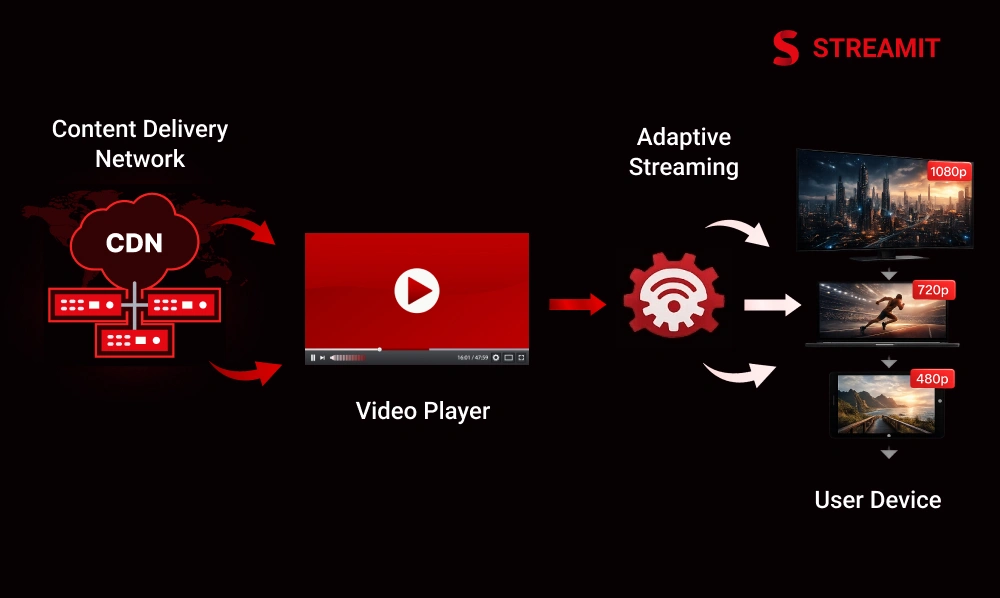
Content Delivery Networks and Adaptive Streaming are designed to work hand in hand. CDNs bring video closer to viewers, while Adaptive Streaming adjusts playback in real time, ensuring smooth delivery across varying network conditions.
While CDNs optimize where content is delivered from, Adaptive Streaming optimizes how it is delivered.
Together, they:
- Reduce latency
- Improve reliability
- Scale delivery globally
Adaptive Streaming ensures that even when CDN conditions vary, playback remains smooth.
Optimization at Every Layer
CDNs handle proximity; ABR handles playback. The combination is seamless. Together, they ensure videos load quickly and play smoothly for viewers everywhere.
Cost Efficiency Through Adaptive Streaming
Adaptive Streaming isn’t only about improving the viewing experience; it’s also about efficiency. By delivering the right quality at the right moment, it reduces wasted bandwidth, lowers delivery costs, and ensures resources are used where they matter most.
By delivering only the bitrate required at any moment, platforms avoid unnecessary bandwidth usage. This reduces:
- Data transfer costs
- Infrastructure strain
- Wasted resources
Over time, this efficiency becomes a significant operational advantage.
Efficient Resource Usage
Optimized delivery saves money while improving experience. By reducing unnecessary bandwidth usage, Adaptive Streaming makes video delivery more efficient and cost-effective.
Adaptive Streaming as a Retention Strategy
Retention is built through reliability. When playback is consistently smooth, users begin to trust the platform without thinking about it. Over time, that silent trust turns into habit, loyalty, and repeat engagement.
Adaptive Streaming creates a dependable experience that encourages:
- Longer sessions
- Repeat visits
- Subscription loyalty
This is why delivery quality is tightly linked to long-term growth.
Reliable Experiences Drive Growth
Playback stability is a key retention lever in modern streaming. Consistently smooth video keeps users engaged, builds trust, and encourages repeat visits.
Adaptive Streaming Across Industries
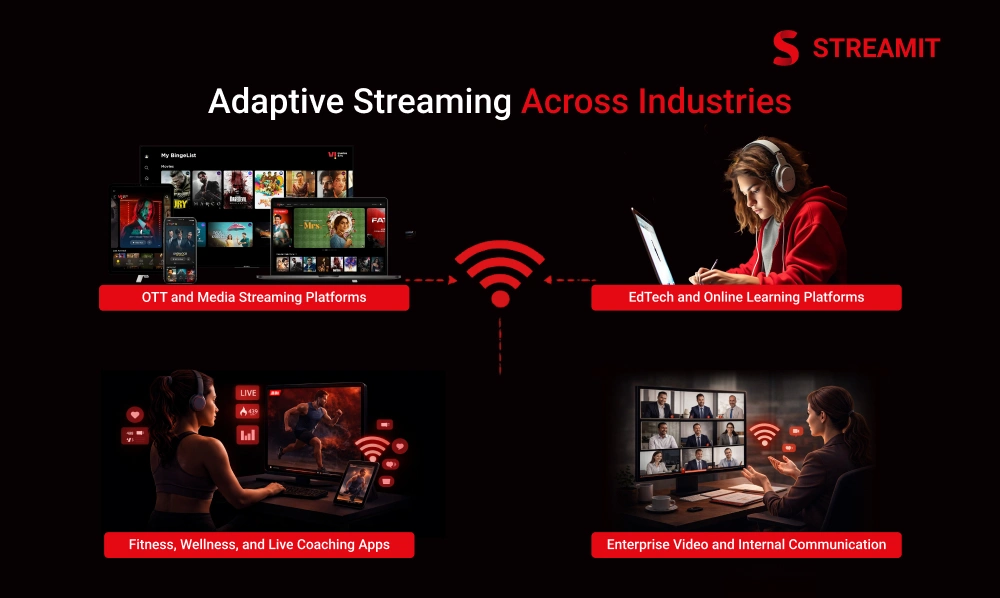
Adaptive Streaming is not limited to entertainment platforms. Any product that relies on video as a core experience depends on smooth, uninterrupted delivery to meet user expectations. From education and fitness to enterprise communication, reliable streaming plays a critical role in keeping users engaged and confident in the platform.
OTT and Media Streaming Platforms
OTT platforms operate in the most demanding streaming environment. Users expect cinematic quality, instant playback, and zero buffering across devices.
Adaptive Streaming enables OTT platforms to:
- Deliver consistent quality across regions
- Handle traffic spikes during premieres
- Maintain playback during network congestion
Without Adaptive Streaming, OTT platforms struggle to scale sustainably.
EdTech and Online Learning Platforms
Learning breaks when video breaks. Educational platforms depend on long-form video sessions, where consistency is critical. Buffering interrupts focus, affects comprehension, and often leads learners to abandon courses altogether.
Adaptive Streaming ensures:
- Stable playback during long lectures
- Accessibility in low-bandwidth regions
- Reliable delivery on mobile devices
This directly improves course completion rates and learner satisfaction.
Fitness, Wellness, and Live Coaching Apps
Fitness content depends on continuous, uninterrupted playback. When a workout pauses because of buffering, it disrupts rhythm and breaks motivation. Smooth delivery keeps users focused, engaged, and moving without interruption.
Adaptive Streaming supports:
- Live and on-demand sessions
- Seamless playback during movement
- Reliable delivery on mobile networks
This consistency keeps users engaged and returning.
Enterprise Video and Internal Communication
Enterprises increasingly rely on video for communication. Town halls, training sessions, and internal announcements must work reliably across offices, devices, and network environments.
Adaptive Streaming ensures:
- Consistent playback for distributed teams
- Reduced IT support issues
- Scalable internal video delivery
The End-to-End Adaptive Streaming Workflow
From upload to playback, every step is carefully optimized to ensure smooth delivery. Each stage works together to prepare, deliver, and adapt the video so it plays reliably across different networks and devices.
Step 1: Uploading the Master Video
The process begins with a high-quality master video as the single source. From it, optimized versions are created for different devices and network conditions.
Step 2: Automated Transcoding
Once the master video is uploaded, it’s automatically converted into multiple versions at different qualities. Each version is optimized to perform smoothly across devices and network conditions.
Step 3: Segmenting for Streaming
After transcoding, the video is split into smaller segments that the player can request as needed. This allows the stream to adjust quality in real time without interrupting playback.
Step 4: Adaptive Playback Delivery
When a viewer presses play, the system continuously checks the connection and device in real time. It delivers the best possible video quality at every moment, keeping playback smooth and uninterrupted.
How Sales Teams Should Explain Adaptive Streaming?
Adaptive streaming makes sure every viewer gets smooth playback, no matter their device or internet connection.
Sales conversations should focus on:
- Reduced churn due to smooth playback
- Higher engagement and watch time
- Global readiness without complexity
A simple framing works best:
“One video. One link. Perfect playback everywhere.”
How Sales Teams Should Explain Adaptive Streaming?
Experience often communicates value better than explanation. When users encounter smooth, uninterrupted playback, they immediately understand the quality of the platform without needing technical details or descriptions.
A strong demo should:
- Play the same video under different network conditions
- Show uninterrupted playback
- Highlight automatic quality adjustment
This allows prospects to feel the value instantly.
Common Myths About Adaptive Streaming
There are several common myths about Adaptive Streaming, from the idea that it’s only for large platforms to the belief that it’s too complex to implement. In reality, it benefits platforms of all sizes by improving playback reliability and viewer experience. Most of the technical work happens automatically, making it far more accessible than many assume.
Myth 1: Adaptive Streaming Is Only for Large Platforms
Even small platforms see immediate value from smoother playback and improved reliability. Better viewing experiences keep users engaged longer, reduce drop-offs, and help build trust that drives stronger retention over time.
Myth 2: Users Want Manual Quality Controls
Most users prefer the platform to handle video quality automatically rather than adjusting settings themselves. Automatic adaptation ensures a smooth viewing experience without any effort, letting viewers focus entirely on the content.
Myth 3: Adaptive Streaming Is Too Complex
Modern streaming platforms take care of all the tricky technical stuff for you. From adjusting video quality on the fly to making sure playback is smooth, they handle it automatically. That means you can focus on sharing great content with your audience, without stressing over the complicated behind-the-scenes work.
Measuring Success with Adaptive Streaming
Success isn’t about how complicated your setup is, it’s about how engaged your audience is. A platform should make streaming effortless so you can focus on creating great content. The real goal is keeping viewers watching and coming back, not tweaking endless settings.
Key indicators include:
- Reduced buffering incidents
- Increased average watch time
- Lower abandonment rates
These metrics directly reflect delivery quality.
The Future of Adaptive Streaming
Streaming expectations will only increase as audiences demand higher quality and smoother experiences. Platforms need to keep up so viewers aren’t left waiting or frustrated. The focus should be on delivering seamless playback, letting content shine without technical hiccups getting in the way.
Future developments will focus on:
- Smarter adaptation algorithms
- Better performance on unstable networks
- Deeper integration with analytics
Adaptive Streaming will remain foundational infrastructure.
Final Summary
Great streaming should feel invisible. There should be no buffering, no sudden drops in quality, and no moments that pull viewers out of the experience. Video should start instantly, adapt quietly in the background, and keep playing without effort. Adaptive Streaming is built to deliver that kind of reliability, so viewers stay focused on the content, not the connection.
Adaptive Streaming isn’t something you fully grasp by reading about it. You understand it when playback continues smoothly as network conditions change, devices switch, and quality adjusts without interruption. On the preview page, you’ll see how ABR and transcoding work together to prepare every stream, adapt in real time, and keep video flowing under real-world conditions.
Experience Adaptive Streaming in action and see how smooth playback is meant to feel.
FAQs
1. What Is Adaptive Streaming in Simple Terms?
Adaptive Streaming adjusts video quality in real time as network speeds change. This keeps playback smooth and interruption-free for every viewer.
2. Is Adaptive Streaming Expensive to Implement?
Adaptive Streaming helps save costs over time. By delivering only what each viewer needs, it reduces wasted bandwidth and improves efficiency.
3. How does Adaptive Bitrate (ABR) actually work?
ABR continuously checks your network and device while the video plays. It adjusts quality on the fly so playback stays smooth without you noticing any changes.
4. What is video transcoding, and why do we need multiple versions of a video?
Transcoding creates multiple versions of the same video at different qualities. This lets the platform deliver the best version for each viewer’s device and internet speed.
5. How do HLS and MPEG-DASH help Adaptive Streaming?
HLS and MPEG-DASH split videos into small segments the player can load as needed. This lets the video adjust quality smoothly without interrupting playback.
6. Why does traditional video streaming often fail?
Traditional streaming sends the same video to everyone. When networks and devices vary, this causes buffering and poor playback.
7. Why do viewers prefer uninterrupted playback over the highest quality?
Viewers notice interruptions far more than small quality changes. Smooth playback keeps people watching, while buffering quickly drives them away.