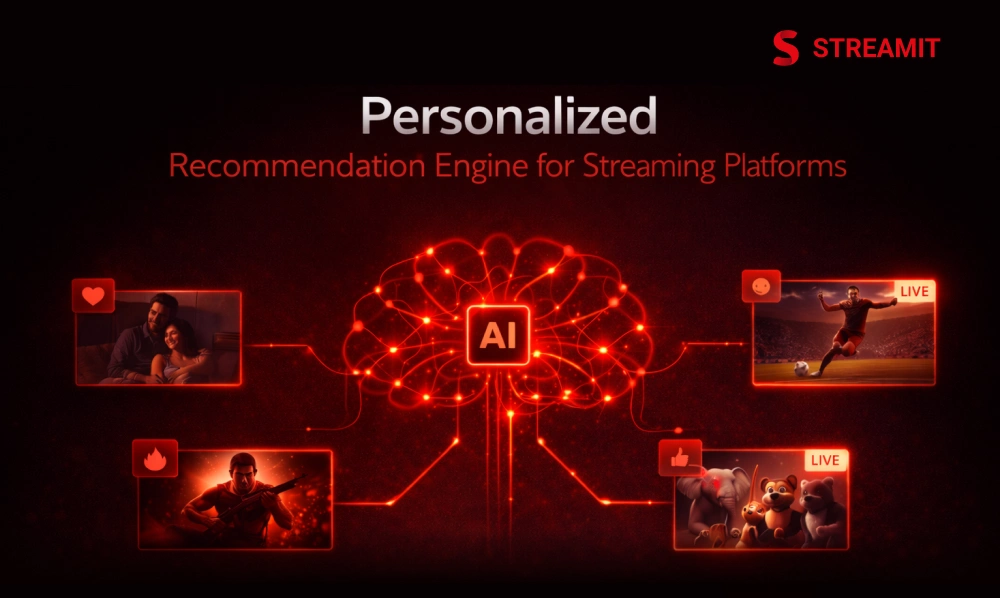
Personalized Recommendation Engine for Streaming Platforms

Over 80% of what people watch on leading OTT platforms today comes from recommendations.
That number alone explains why discovery is no longer a secondary feature hidden behind menus. For modern streaming platforms, discovery is the product experience. If viewers cannot find something relevant quickly, even the strongest content library loses its value.
Streaming businesses rarely struggle because they lack content. They struggle because users hesitate, scroll endlessly, and quietly leave without pressing play. That hesitation is expensive, invisible, and completely preventable when discovery is handled correctly.
If you’re serious about doing this right, you’re in the right place.
Why viewers leave when discovery feels hard
More than half of streaming sessions end without a viewer ever pressing play when content discovery feels confusing. People open the app with intent, scroll for a while, hesitate, and then quietly leave. There’s no frustration loud enough to report,just a moment where interest fades.
This kind of drop-off rarely looks like a technical problem. Nothing crashes, nothing buffers, and no errors appear on the screen. Yet the impact becomes clear over time, reflected in engagement charts, declining retention, and growing churn numbers.
Discovery friction doesn’t spark complaints or support tickets. It simply creates exits. And because those exits happen silently, they’re often the hardest problem for streaming platforms to notice, and the most expensive to ignore.
Choice Overload: Why Too Many Options Make Viewers Quit
Modern OTT platforms offer thousands of titles, yet that abundance often works against the viewer. Instead of feeling excited, people scroll endlessly, reading descriptions, jumping between rows, and second-guessing their choices. The more they browse, the harder it becomes to settle on something to watch.
This hesitation is a clear sign of decision fatigue. When viewers are left to choose on their own, scrolling slowly replaces watching. Time-to-first-play stretches out, attention drops, and many sessions end before any content actually starts.
The solution isn’t adding more titles or more rows. What viewers really need is help choosing, one relevant option surfaced at the right moment, making the decision feel easy instead of overwhelming.
Recommendations are now part of the streaming experience, not a “feature”
Recommendations are no longer just an extra feature in a streaming app, they shape the entire experience. They decide what appears on the home screen, what grabs attention first, and subtly guide nearly every viewing choice a user makes. Without them, even the most attractive content library can feel overwhelming.
When personalization works as it should, the platform feels intuitive. Users find something to watch quickly, scroll less, and enjoy the app without thinking about the next step. It creates a seamless, effortless experience where discovery feels natural rather than forced.
On the other hand, if recommendations are weak or generic, no amount of high-quality streaming can save the experience. Users hesitate, sessions end early, and engagement drops. Discovery is no longer optional, it has become inseparable from usability. This is where the search ends.
What a “Personalized Recommendation Engine” means in simple words
A Personalized Recommendation Engine is like a quiet guide for viewers, helping them decide what to watch next without any effort. Instead of forcing users to browse endlessly or make choices from hundreds of options, it gently surfaces content they’re most likely to enjoy.
The engine learns from viewing behavior and patterns, while also understanding the content itself. Over time, it adapts, improving its suggestions without the viewer needing to explain their preferences or tweak settings. Every interaction helps the system get smarter and more relevant.
The beauty of this approach is that it removes friction instead of adding more steps. Users don’t have to hunt, search, or experiment, they simply find the right content quickly, making the viewing experience smooth, intuitive, and enjoyable.
The 3 simple jobs it must do
A recommendation engine that truly delivers results doesn’t get lost in complex algorithms or flashy features. Its focus is simple: it’s about helping viewers find the right content quickly and keeping them engaged. The goal is outcomes, not unnecessary complexity.
At its core, the engine does three things exceptionally well. First, it suggests titles that are genuinely relevant to each viewer. Second, it ranks these titles in a way that makes sense, so the most likely choices appear first. And third, it minimizes the time a viewer spends deciding, turning browsing into watching.
Everything beyond these core functions is secondary. A strong recommendation system doesn’t overpromise or overcomplicate. It delivers a smooth, reliable experience for viewers, this is what “no compromise” looks like in action.
What makes recommendation engines work in OTT
Every recommendation a streaming platform makes is essentially a small wager on a viewer’s attention. It’s not just a suggestion, it’s a choice the platform makes on behalf of the user, hoping they’ll engage and keep watching.
For that bet to succeed, it can’t be based on guesswork. It needs clean, reliable data that accurately reflects user behavior. Every click, pause, or watch history entry becomes part of the system’s understanding of what the viewer wants.
Equally important is thoughtful design. The recommendation engine must be built to handle real-world conditions, different devices, varied user habits, and an ever-changing content library. When data, design, and system reliability come together, that quiet bet on attention pays off with engagement and satisfaction.
The two big inputs: user signals and content understanding
All effective OTT recommendation engines depend on two key inputs: understanding the viewer and understanding the content. Each plays a critical role in delivering suggestions that feel relevant and timely.
Neither input works well on its own. Knowing what a user likes is not enough without understanding the content, and knowing the content alone won’t connect it to the right audience. Both must be carefully considered and balanced to make recommendations that truly guide viewers.
User signals OTT platforms already have
Most streaming platforms already gather a wealth of behavioral signals every time a viewer interacts with content. Actions like watch history, completion rate, pauses, rewinds, skips, searches, clicks, and impressions paint a clear picture of what a viewer is truly interested in.
These signals are far more reliable than ratings or surveys because they show what users actually do, not what they say they like. Every action tells a story, and when used thoughtfully, this behavioral data becomes the foundation for recommendations that feel natural and relevant.
Content signals OTT platforms must organize
A recommendation engine can only suggest content it truly understands. Without clear and consistent metadata, the system has no way of connecting the right titles to the right viewers, making recommendations unreliable.
Metadata includes essential details like genre, language, cast, director, themes, mood, and format. When this information is missing, inconsistent, or inaccurate, the engine struggles to rank content effectively.
The outputs users actually see (real streaming surfaces)
Users don’t see the algorithms working behind the scenes, they only see the results on their screens. Every scroll, every row, every thumbnail, and every title arrangement shapes their experience and influences what they decide to watch next.
They experience screens, rows, thumbnails, and titles arranged in a specific order. That presentation determines whether a session continues or ends.
Home screen rows
The home screen is the single most important space in any streaming app. It’s the first thing a viewer sees, and it sets the tone for the entire experience. Personalized rows like “Continue Watching,” “Because You Watched,” or “Top Picks for You” carry the most weight, guiding users toward content they’re likely to enjoy.
It’s not about showing as many titles as possible, it’s about showing the right ones in the right order. The first few recommendations are critical; they can keep a viewer engaged or push them to exit the app. Thoughtful ranking here has a far greater impact than simply adding more content to the rows.
Search and related titles
Search on a streaming platform is never truly neutral. When done well, personalized search results guide viewers to content they are most likely to enjoy, reducing dead ends and making discovery feel effortless. Instead of scrolling endlessly or abandoning the app, users find what they want quickly, keeping engagement high.
Related titles play a crucial role after a show or movie ends. By suggesting similar content, the platform encourages viewers to continue watching, extending session length and preventing abrupt stopping points. Thoughtful search and related recommendations keep the experience smooth, intuitive, and satisfying.
Notifications and email or push recommendations
Re-engagement is most effective when it feels natural and timely. Notifications that are personalized to a viewer’s interests or recent activity grab attention without feeling intrusive, encouraging users to return to the app. Generic messages, on the other hand, are easily ignored or muted, failing to bring people back.
By focusing on relevance and context, personalized notifications create a seamless connection between the viewer and the platform. They remind users of content they care about, helping maintain engagement and session continuity. When done right, this approach ensures that quality matters, and the viewer’s attention stays where it belongs.
Types of recommendation approaches used in streaming
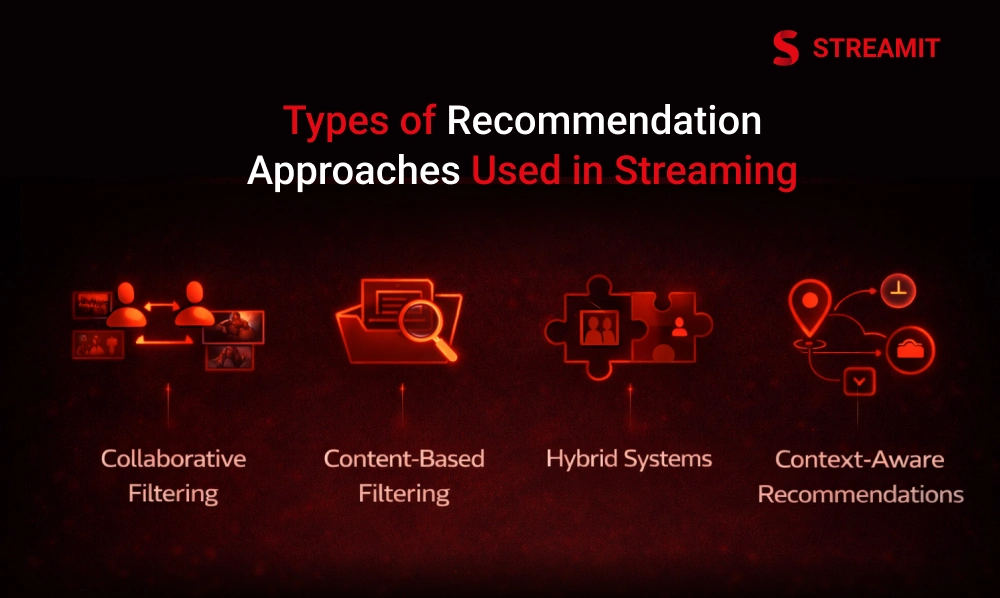
No single recommendation approach can handle all the challenges of a real-world streaming platform on its own. Each method has strengths and weaknesses, and relying on just one often leaves gaps in relevance, diversity, or responsiveness.
The most effective systems combine multiple techniques to cover these gaps. By blending approaches, platforms can handle large user bases, a wide variety of content, and the cold start problem for new users or new titles.
Collaborative filtering
Collaborative filtering works by analyzing the viewing habits of many users to find patterns. It identifies what people with similar tastes have watched and enjoyed, then recommends those titles to others with matching preferences. This makes it very effective for delivering relevant suggestions at scale.
Despite its strengths, collaborative filtering faces challenges with new users or newly added content. Without historical data, the system has little to reference, making early recommendations less accurate. Platforms often need additional methods to bridge this gap until enough viewing behavior is collected.
Content-based filtering
Content-based filtering works by looking at the characteristics of each title and finding similarities between them. It examines details like genre, mood, themes, and other attributes to suggest content that matches a viewer’s interests.
This approach is especially useful in cold start situations, such as when a new title is added or a new user joins the platform. However, its effectiveness depends heavily on the quality and consistency of the metadata.
Hybrid recommendation systems
Most OTT platforms eventually adopt hybrid recommendation systems because no single approach covers all scenarios. Hybrid systems combine insights from user behavior, content similarities, and business rules to create more accurate and relevant suggestions.
By blending these methods, hybrid systems can handle a wide range of users, content types, and situations more reliably. This approach ensures that recommendations remain consistent and engaging, making it the solution that serious streaming platforms ultimately rely on.
Context-aware recommendations
Context plays a quiet but powerful role in personalization. What someone wants to watch often changes based on the time of day, the device they’re using, or even where they are. A short video might fit a mobile session during a commute, while a long series feels right on a TV in the evening.
When platforms ignore these signals, recommendations lose relevance. By considering context and session intent, streaming apps can meet viewers in the moment and suggest content that actually fits their situation. That attention to context directly translates into better engagement and longer sessions.
The full architecture of a recommendation engine for OTT
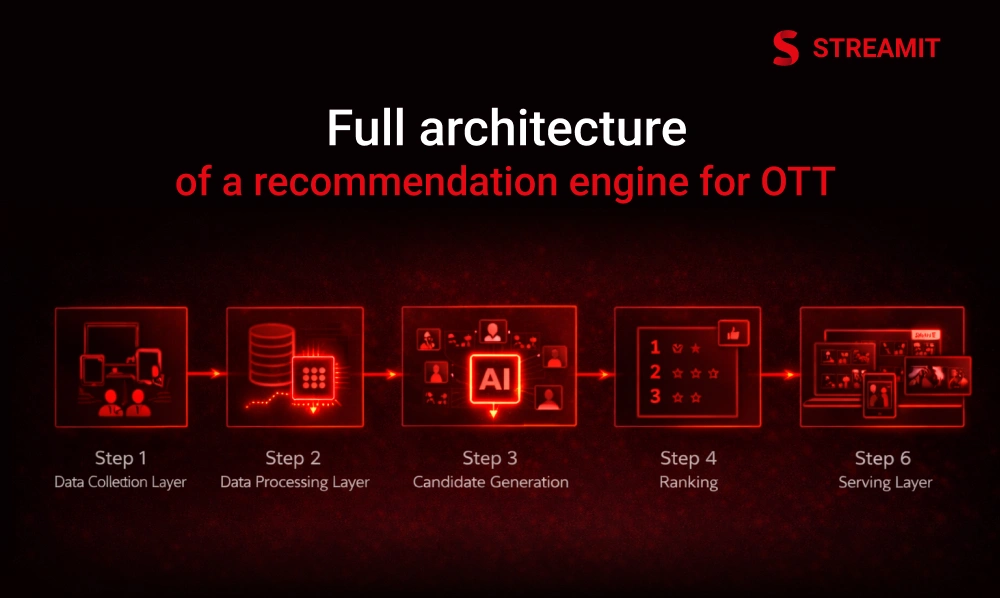
Personalization is not driven by a single model working in isolation. It is a connected system where data, logic, and presentation are all linked, each layer supporting the one that follows. When one part is weak, the entire experience feels off to the viewer.
Strong personalization comes from how these layers work together, signals feeding insights, insights shaping rankings, and rankings appearing clearly on the screen. When the system is connected end to end, recommendations feel natural, reliable, and easy to trust.
Step 1 - Data collection layer
Everything in personalization starts with accurate event tracking. Without reliable events, recommendations turn into guesswork instead of something you can build and trust. Clean data is what separates a system that feels intentional from one that feels random.
Must-track events list for OTT
- In OTT platforms, play events show clear interest, while pause and stop events reveal hesitation or uncertainty. Completion events signal satisfaction, and actions like search, clicks, impressions, and dwell time fill in the gaps.
- Together, these signals create a complete and honest picture of viewer behavior, making personalization possible.
Step 2 - Data processing layer
Raw events on their own are messy and hard to use. They need to be cleaned, organized, and turned into clear profiles that the system can actually work with. This includes building user profiles, content profiles, and connecting behavior across devices so the same viewer isn’t treated like a stranger every time they switch screens.
Identity and profiles across devices
- This processing layer is where personalization becomes practical. It turns scattered actions into meaningful signals, helping the platform understand both the viewer and the content.
- When this step is done well, recommendations feel consistent, relevant, and grounded in real behavior rather than assumptions.
Step 3 - Candidate generation
Candidate generation focuses on one simple question: what content makes sense to recommend to this viewer right now? At this stage, the system isn’t trying to be perfect, it’s trying to be sensible. It pulls together a shortlist of options based on signals like popularity, similarity to past watches, viewing history, and freshness.
Common candidate sources used in OTT
- Speed is critical here. This step needs to return good options quickly so the app stays responsive and smooth.
- A fast, reliable shortlist gives the next layers something solid to work with, setting the foundation for recommendations that feel timely and relevant.
Step 4 - Ranking
Ranking is the step that decides what viewers actually see first on the screen. It takes the shortlisted content and orders it using signals like how likely someone is to start watching, finish a title, how fresh the content is, and how varied the list feels. This ordering quietly shapes every viewing decision.
Common candidate sources used in OTT
- Even small changes in ranking can have a big impact on engagement. Moving the right title up by just one or two positions can mean the difference between a viewer pressing play or leaving the app.
- That’s why ranking is one of the most influential parts of the entire recommendation system.
Step 5 - Re-ranking
Re-ranking is what makes recommendations feel human instead of mechanical. It steps in after the initial ordering to remove repetition, avoid showing too many similar titles, and create a list that feels balanced and intentional.
By blending familiar choices with a bit of exploration, re-ranking helps users discover new content without losing what they already enjoy. This balance prevents filter bubbles and keeps the experience fresh, varied, and engaging over time.
Step 6 - Serving layer
The serving layer is where recommendations are delivered to the app in real time through APIs. This is the moment when all the work behind the scenes meets the viewer, and it needs to happen instantly and reliably.
Low latency is critical here. Even small delays can make the interface feel slow or unresponsive, breaking the flow of discovery. When recommendations load quickly and smoothly, the experience feels effortless, and viewers stay engaged.
Core components of an OTT recommendation engine
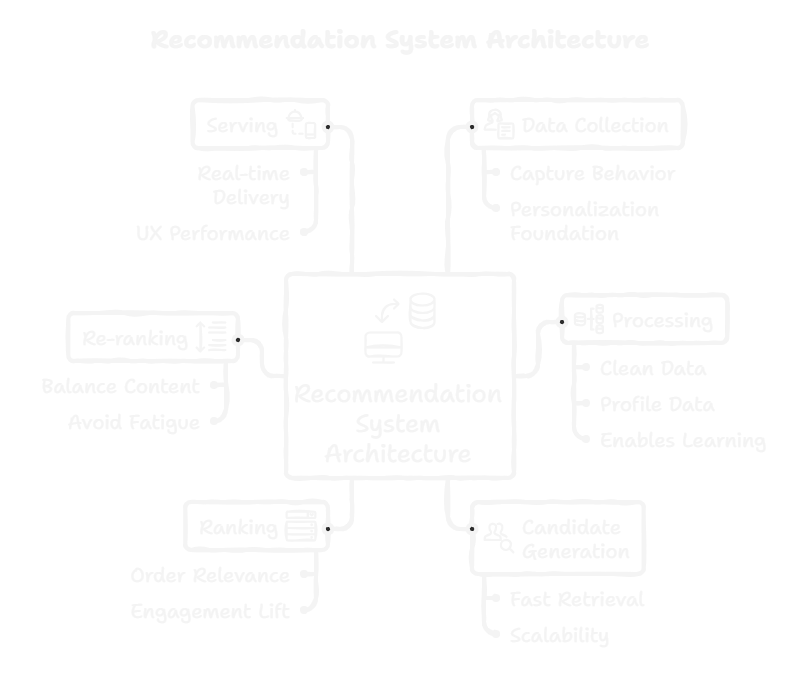
Data you need (and how to keep it simple)
The serving layer is where recommendations are delivered to the app in real time through APIs. This is the moment when all the work behind the scenes meets the viewer, and it needs to happen instantly and reliably.
Most streaming platforms already have enough data to begin personalizing the experience. The problem is rarely a lack of information, it’s how usable that information actually is.
Clean, consistent data matters far more than sheer volume. When signals are reliable and well-structured, even a modest dataset can drive meaningful personalization. Without that consistency, more data only adds noise and confusion.
Low latency is critical here. Even small delays can make the interface feel slow or unresponsive, breaking the flow of discovery. When recommendations load quickly and smoothly, the experience feels effortless, and viewers stay engaged.
User behavior signals
Implicit feedback like watch time, completion rate, and skips gives the clearest view into what viewers truly care about. These signals are honest because they reflect real behavior, not opinions or ratings filled out after the fact.
The strength of implicit feedback is that it scales naturally. It captures insight from every session without asking users to do anything extra, making personalization smoother, more accurate, and less intrusive.
Metadata strategy
A solid metadata strategy is the backbone of effective recommendations. Clear, consistent tagging, like genre, cast, language, and themes, helps the system understand content and connect it with the right viewers. Good metadata turns a large catalog into a navigable, engaging experience.
Minimum metadata fields for OTT catalogs
The best place to start is with the basics. Clear metadata like genre, language, cast, and release year gives the system enough structure to understand and organize your catalog in a meaningful way.
Advanced metadata for better personalization
As the platform matures, you can go deeper. Adding details like mood, pacing, themes, and audience clusters allows for more nuanced recommendations that feel thoughtful and personal, rather than generic or repetitive.
Cold start problem and how OTT platforms solve it
New users don’t need a long history to get good recommendations. Simple onboarding questions and regional popularity signals provide enough direction to make early suggestions feel relevant and welcoming.
Cold start fixes for new users
New content follows a similar path. Metadata similarity and controlled exploration help introduce fresh titles to the right audiences without disrupting the experience.
Cold start fixes for new content
Cold start is a challenge, but with the right approach, it never has to block personalization.
Personalization use-cases that move OTT business metrics
Personalization only matters when it creates measurable impact. If it doesn’t improve watch time, retention, or engagement, it’s just noise dressed up as strategy.
What counts are real outcomes, faster starts, longer sessions, and viewers coming back more often. When personalization moves these numbers, it proves its value and earns its place in the product.
Start watching fast
Reducing time-to-first-play has an immediate impact on how users experience a streaming platform. When viewers find something to watch quickly, they feel confident in the platform and are more likely to settle in and stay.
Faster starts lead to stronger sessions and better retention. The less time users spend deciding, the more time they spend watching and that shift alone can change overall engagement in a meaningful way.
Keep watching
Reducing time-to-first-play has an immediate impact on how users experience a streaming platform. When viewers find something to watch quickly, they feel confident in the platform and are more likely to settle in and stay.
Faster starts lead to stronger sessions and better retention. The less time users spend deciding, the more time they spend watching and that shift alone can change overall engagement in a meaningful way.
o-first-play has an immediate impact on how users experience a streaming platform. When viewers find something to watch quickly, they feel confident in the platform and are more likely to settle in and stay.
Faster starts lead to stronger sessions and better retention. The less time users spend deciding, the more time they spend watching and that shift alone can change overall engagement in a meaningful way.
Bring users back
Personalized reminders and win-back messages work because they feel relevant, not disruptive. When a message reflects what a viewer actually cares about, it reads as a helpful nudge rather than a pushy notification.
This relevance is what reduces churn. Instead of spamming users, thoughtful reminders bring them back at the right moment, making re-engagement feel natural and respectful.
Improve catalog value
Long-tail discovery helps surface content that would otherwise stay buried deep in the catalog. These titles may not be trending, but for the right viewer, they can be exactly what they’re looking for.
By guiding users to these hidden gems, platforms get more value from the content they already own. It keeps discovery fresh, supports diverse tastes, and proves that great viewing experiences aren’t limited to the top of the charts.
Business impact of personalization
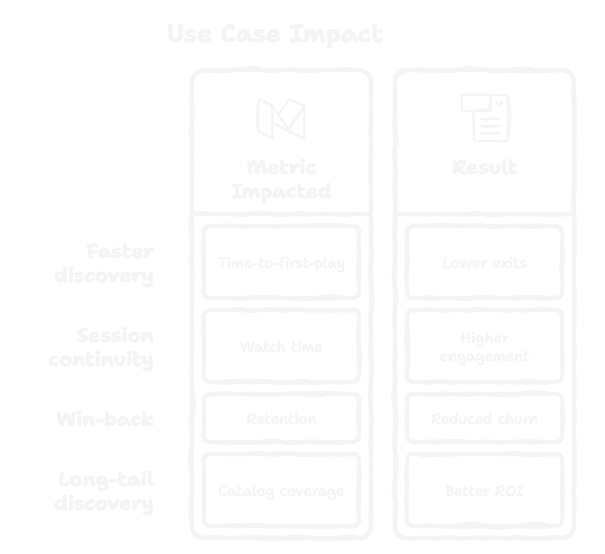
How Netflix Approaches Personalized Recommendations
Netflix has set the gold standard for personalized streaming experiences. Recommendations are treated not as a single model, but as an interconnected system. Their homepage ranking, A/B testing frameworks, and continuous experimentation ensure that viewers find content effortlessly. StreamIt draws inspiration from these approaches, combining similar strategies to help OTT platforms optimize engagement.
Why Netflix Treats Recommendations as a System (Not One Model)
Netflix treats personalization as a multi-layered system. It uses multiple models to handle different goals: recommending what to watch next, surfacing new content, or re-engaging inactive users. This system-based approach ensures reliability and adaptability. The key takeaway: personalization isn’t a single algorithm, it’s a connected framework.
Foundation-Model Direction for Recommendations
Netflix has begun integrating foundation models to enhance their recommendation engine. By using embeddings and representation learning at scale, they capture deeper patterns in content and user behavior. These models help predict what viewers will enjoy, even for new titles or niche content. Large-scale personalization ensures that recommendations feel natural, intuitive, and engaging.
Continuous Improvement Methods
Netflix continuously improves recommendations through A/B testing and experimentation loops. Metrics such as engagement rate, completion rate, and session length guide updates. StreamIt emphasizes similar practices, allowing platforms to refine recommendations, test new ranking strategies, and ensure results are measurable and impactful.
Build vs Buy - Choosing the Right Path for Your Platform Size
When implementing a personalized recommendation engine, platforms face a Build vs Buy decision. Choosing the right path depends on team size, content complexity, and growth plans.
Option A - Use Amazon Personalize for Fast Rollout
AWS Personalize allows for quick deployment of managed recommendation systems with real-time updates. It’s ideal for small teams or MVP streaming apps.
What do you still need even if you use Amazon Personalize?
Even with Amazon Personalize, platforms still need event tracking, metadata management, and cold-start strategies to achieve optimal performance.
What do you still need even if you use Amazon Personalize?
Small OTT teams, MVP apps, or platforms needing fast deployment without heavy infrastructure.
Option B - Use a Vendor like Spideo
Vendors like Spideo provide OTT personalization platforms that deliver streaming discovery tools out-of-the-box. These solutions are plug-and-play and reduce operational complexity while maintaining high-quality recommendations.
Option C - Build In-House (When Full Control is Needed)
For platforms requiring full control, building in-house is the only choice. This involves:
- People: Data engineers, ML engineers, MLOps teams
- Infrastructure: Cloud or on-prem pipelines, model serving
- Timeline: Weeks to months depending on complexity
What “in-house” really means?
In-house development allows complete control over ranking, re-ranking, and business rules, but requires a mature engineering setup.
Metrics That Prove Your Recommendation Engine Is Working
Effective personalization isn’t about flashy interfaces, it’s about real business outcomes.
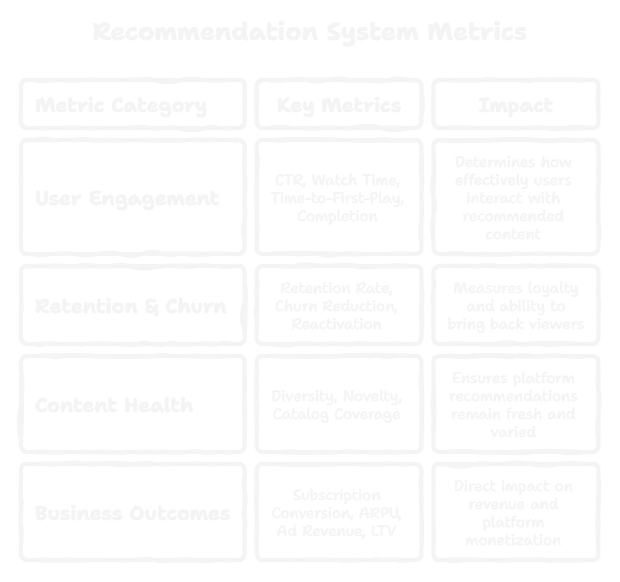
User Engagement Metrics
- CTR: Click-through rates on personalized rows
- Watch Time: How long viewers engage with content
- Time-to-First-Play: Speed at which users start watching
- Completion Rate: Percentage of content finished
Retention and Churn Metrics
- Churn Reduction: Fewer users abandoning the platform
- Retention Lift: Returning viewers across sessions
- Reactivation Rate: Win-back of dormant users
Content Health Metrics
- Diversity: Avoid repetitive recommendations
- Novelty: Surface new or under-discovered content
- Catalog Coverage: Ensures long-tail content is utilized
Business Metrics
- Subscription Conversion: Paid upgrades or subscriptions
- ARPU: Average revenue per user
- Ad Revenue Lift: Monetization through targeted recommendations
- LTV: Lifetime value of viewers
Key Recommendation Engine Metrics
Common Failures in OTT Recommendation Engines (And How to Avoid Them)
Even the most advanced recommendation engines can stumble if the basics aren’t done right. Strong algorithms alone aren’t enough, clean data, clear metadata, and proper testing are what make personalization reliable and effective.
Over-Personalization That terminate Discovery
Focusing too much on a viewer’s past behavior can create a filter bubble, reducing exploration and new content discovery. Recommendations must balance familiarity with novelty.
How Metadata Quality Shapes Recommendations
Inconsistent tagging or incomplete metadata prevents algorithms from understanding content. Genre, cast, themes, and mood must be standardized.
Not Separating Candidate Generation and Ranking
A common mistake is merging content retrieval with ranking. Candidate generation identifies potential titles, ranking decides what users see first. Separating these layers improves scalability and quality.
No Feedback Loop
Without continuous experimentation and A/B testing, engines stagnate. Recommendations must evolve with content trends and viewer behavior.
Common Failures in OTT Recommendation Engines (And How to Avoid Them)
A personalized recommendation engine is best rolled out step by step. Begin with collecting key data and setting up baseline suggestions, then introduce hybrid models and improved ranking, and finally fine-tune through ongoing testing to create a system that consistently delivers smarter, more relevant recommendations.
Launching a recommendation engine is a phased process:
Phase 1 (2–4 Weeks): Data + Baseline Recommendations
- Track key events (play, pause, completion)
- Implement popularity models
- Enable basic personalization for quick wins
Phase 2 (4–8 Weeks): Hybrid Recommendations + Better Ranking
- Combine collaborative filtering, content-based filtering, and business rules
- Improve ranking models
- Begin handling cold-start users and new content
Phase 3 (Ongoing): Experimentation + Model Upgrades
- Continuous A/B testing and personalization tuning
- Re-ranking improvements
- Embedding-based recommendation updates
Implementation Timeline
Security, Privacy, and Compliance Basics for Personalization
Personalization only works when users trust the platform. Protecting privacy, following regulations like GDPR, and collecting only the data that’s necessary ensures recommendations feel helpful without compromising security or user confidence.
Personalization must respect user privacy and regulations:
What Data to Avoid Collecting
- Sensitive personal data like health, financials, or location unless necessary
- Always minimize data collection to what’s essential
Consent and Controls Users Expect
- Users should manage recommendations, privacy settings, and delete history
- GDPR and similar frameworks guide these practices
Choosing a Recommendation Engine Partner for Your Streaming Platform
Choosing the right recommendation engine partner makes a big difference. The right partner helps you launch quickly, avoids common pitfalls, and ensures the personalization system is accurate, reliable, and delivers real value to your viewers.
Evaluation Checklist
- Latency: Does the system respond quickly?
- Accuracy: Are recommendations relevant?
- Diversity: Are suggestions varied?
- Integration: How easily does it plug into your stack?
- Reporting & Experimentation: Are analytics and A/B testing supported?
Questions to Ask in a Demo
- Does the API support real-time updates?
- How is cold-start handled?
- Can models be explained and tuned?
- Is A/B testing supported out-of-the-box?
“Take a moment, this is how effortless discovery feels.” A strong demo shows personalized rows, live updates, and smooth handling of new users or content, proving the system works seamlessly in real-world viewing, not just on paper.
See a live demo of Personalized Recommendations
Let’s see how the recommendation engine guides viewers naturally, making content discovery easy, intuitive, and stress-free. It highlights personalized rows that adapt to each viewer, real-time updates that respond to user actions instantly, and cold-start handling that ensures even new users or content get relevant suggestions. Together, these features demonstrate a system that works reliably and smoothly in the real world.
FAQs
1. What is a personalized recommendation engine for streaming platforms?
It’s a system that suggests shows and movies based on your viewing habits, so you find content you actually want to watch.
2. How does a streaming recommendation engine know what I like?
It tracks what you watch, skip, and finish, learning your preferences over time to give smarter suggestions.
3. Can a recommendation engine save me time while browsing?
Yes! It highlights content you’ll enjoy right away, so you spend less time scrolling and more time watching.
4. How can a recommendation engine help me find new shows or movies?
Absolutely. It suggests fresh content and hidden gems that match your taste but you might not find on your own.
5. Do small streaming platforms benefit from recommendation engines?
Yes. These engines work for both small and large platforms, making every user’s experience more personal.
6. Does the recommendation engine update its suggestions over time?
Yes, as your watching habits change, it adapts to keep recommendations relevant.
7. How does a personalized recommendation engine improve viewer engagement?
By showing content users actually enjoy, it keeps them watching longer, returning more often, and feeling satisfied with the platform.