How AI Subtitles Improve Multi-Language OTT Streaming Apps


A 500-title catalog offered in 5 languages creates 2,500 subtitle assets. That scale makes manual-only localization slow, expensive, and difficult to maintain.
AI subtitles reduce the first layer of work, not the need for judgment. Engagement improves only when the final output is accurate, readable, natural, and easy to control.
Overview
Why AI Subtitles Matter in Multi-Language OTT
Language is often a product barrier disguised as a content problem. A viewer may like the story yet leave because following the dialogue requires too much effort.
Subtitles expand reach without changing the original production. They give OTT teams a practical localization layer before committing to the higher cost of dubbing every title.
Subtitles Improve Accessibility, Reach, and Viewer Understanding
One subtitle track can support several viewing situations. It helps multilingual audiences, people with hearing loss, viewers in noisy places, and users who process written information better.
Accessibility depends on completeness, not visible words alone. Good captions include important sounds and speaker context, while translated subtitles preserve dialogue clearly enough to prevent repeated rewinding.
AI Helps OTT Teams Add Language Support Faster
A workflow repeated across 10 languages multiplies the same transcription and timing work 10 times. AI can create the first draft, so specialists focus on review.
Speed matters only when it does not lower quality. Teams can process new releases and back catalogs faster while reserving human attention for difficult language pairs and priority titles.
How It Works
What AI Subtitles Actually Do in OTT Apps
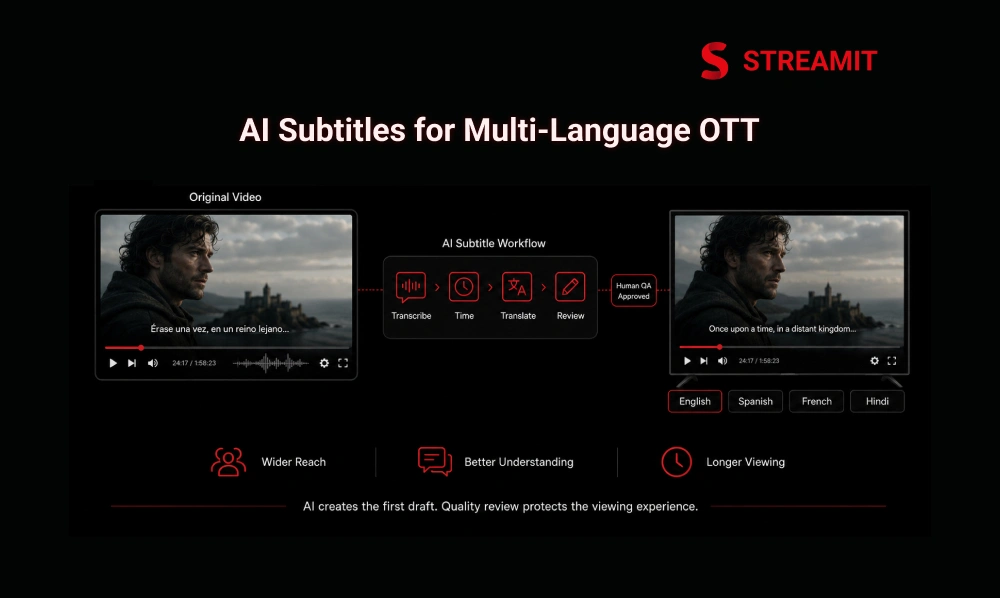
AI subtitles are a connected workflow, not one feature. The system converts speech into text, aligns it with playback, translates selected languages, and prepares player-ready files.
Several hidden systems shape the visible result. Audio quality, timestamp accuracy, formats, CMS rules, player compatibility, and review standards all influence whether subtitles feel dependable.
They Combine Transcription, Timing, Translation, and Formatting
Four linked steps turn spoken audio into a usable subtitle track. A weakness in one step can create correct words at the wrong time or fluent text with incorrect meaning.
The goal is a repeatable production path. Each file should move through generation, language review, technical validation, CMS attachment, device testing, and controlled publication.
| Stage | Core Task | Main Risk |
|---|---|---|
| Transcription | Convert speech into source text | Names, accents, background noise |
| Timing | Align lines with dialogue | Early or delayed text |
| Translation | Adapt meaning into another language | Lost context or tone |
| Formatting | Create supported subtitle files | Readability or device failure |
| Review | Check language and playback | Errors reaching viewers |
The Goal Is Better Understanding, Longer Viewing, and Wider Reach
A successful subtitle becomes almost invisible. Natural wording and timing reduce mental effort, allowing viewers to stay with the story rather than interpret awkward lines.
That smoother experience supports completion and return behavior. It also lets teams test a title in several markets before funding deeper localization.
User Engagement
How AI Subtitles Improve OTT User Engagement
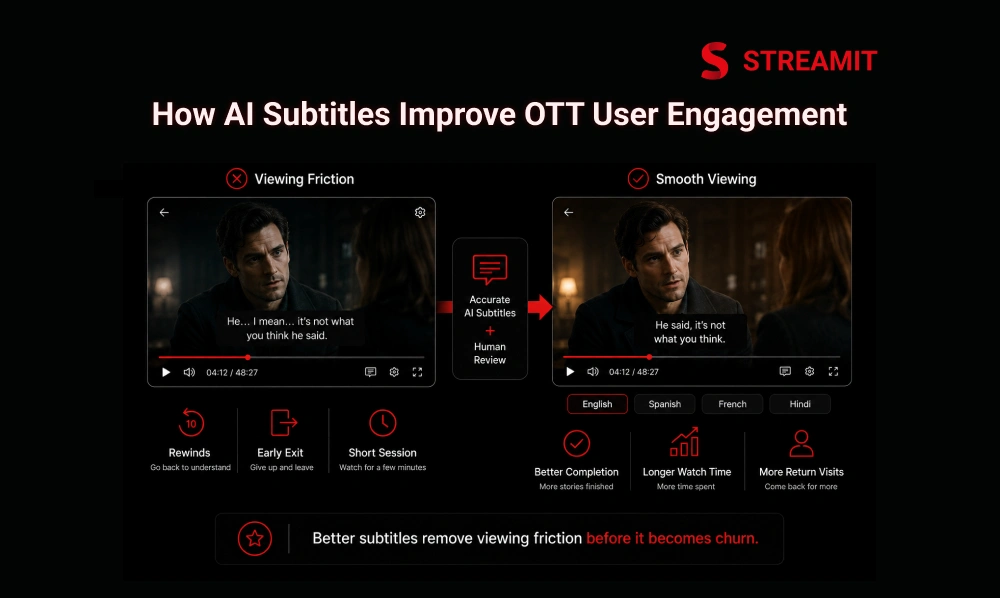
Engagement often falls before a viewer reports a problem. Poor timing or unclear language may first appear as rewinds, early exits, short sessions, or abandoned playback.
Well-implemented subtitles remove those small interruptions. They make more content understandable and give multilingual households greater control over how each person watches.
They Reduce Friction for Viewers Watching Outside the Original Language
The first 5 minutes often decide whether foreign-language content feels accessible or tiring. Accurate subtitles establish names, relationships, and context before confusion builds.
Language control must also feel effortless. Users should find, switch, and retain subtitle preferences across devices without restarting playback or covering important visual details.
They Improve Completion, Watch Time, and Return Behavior
Ten mistimed lines in one scene can damage trust more than a minor spelling error. Timing connects text with the correct speaker, expression, and action.
Reliable subtitles reduce avoidable viewing effort. When viewers follow the story comfortably, they are more likely to continue, finish, and return to related content.
They Help More Users Discover and Stay With Regional Content
Regional content cannot build demand when new audiences cannot understand its value. Subtitles lower the risk of trying unfamiliar films, classes, documentaries, sports, or creator content.
Discovery also requires localized metadata. Translated titles, descriptions, genres, and search terms should work with subtitle availability before the viewer reaches the player.
Quality Control
Why AI Alone Is Not Enough
Even 95% word accuracy means roughly 1 error in every 20 words. Those mistakes can affect names, jokes, technical terms, instructions, or story context.
AI should be treated as production leverage, not final authority. It creates consistent first drafts at scale, while review protects meaning, timing, and audience trust.
Bad Transcription and Raw Translation Create Meaning Errors
One incorrect source word can spread across every translated language. Correcting the first transcript is more efficient than repairing the same mistake in multiple files.
Literal translation creates another problem. Idioms, humor, slang, and cultural references may be grammatically correct while still sounding unnatural or communicating the wrong idea.
Human QA Still Matters for Context, Tone, and Cultural Accuracy
A 90-minute title contains hundreds of decisions beyond basic translation. Reviewers assess reading speed, line breaks, speaker changes, local phrasing, sensitive terms, and scene context.
Review depth should match business risk. Flagship releases, children’s content, education, health, live events, and culturally sensitive titles deserve stronger checks than low-risk archive content.
Implementation
Best Practices for Implementing AI Subtitles in OTT
The strongest strategy begins with demand, not the highest language count. Three well-managed languages create more value than 20 options with poor quality and inconsistent support.
Implementation must connect editorial, technical, and product teams. Translators cannot solve language selection, metadata, publishing, file delivery, or player behavior alone.
Start With Priority Languages and High-Demand Content
The first 20% of a catalog may generate most subtitle demand. Begin with popular releases, evergreen titles, strong series, and languages visible in search or audience data.
This creates a measurable rollout instead of a catalog-wide guess. Teams can compare usage and completion before expanding into lower-demand languages and titles.
Use AI for Speed but Add Human Review for Important Titles
A two-layer model is stronger than choosing automation or manual work. AI handles first drafts; qualified reviewers approve meaning, tone, timing, and technical readability.
Review depth should follow commercial importance. A homepage release or paid event needs stricter checks, but every subtitle should pass basic formatting and playback validation.
Connect Subtitle Workflows With CMS, Metadata, and Language Selection
A subtitle file has little value when the CMS cannot manage it properly. Each track needs a language code, version status, title relationship, and device availability.
Language preference should behave like user state. The platform should remember choices and align subtitle defaults, metadata, recommendations, and interface language where appropriate.
Common Pitfalls
The Multi-Language Mistake Most OTT Teams Make
Many teams add languages after their catalog and player workflows are fixed. Localization then becomes repeated manual work, with inconsistent behavior across web, mobile, and TV.
The real mistake is architectural, not linguistic. Every new language should not create another technical exception, publishing bottleneck, or disconnected workflow.
They Treat Subtitles as a Compliance Feature Instead of a Growth Layer
Compliance asks whether subtitles exist; growth asks whether viewers use them successfully. Availability alone reveals nothing about quality, completion, demand, or abandonment.
Subtitles can also improve catalog economics. They support accessibility, test regional demand, extend title value, and show where dubbing may produce stronger returns.
They Add Languages Late Instead of Designing for Them Early
Retrofitting 5 apps is harder than defining one platform-wide language model. Late localization exposes hard-coded labels, limited metadata, unsupported scripts, and inconsistent controls.
Early design does not require a global launch. It means building structures for multiple scripts, subtitle tracks, preferences, and localized metadata without later re-platforming.
ROI & Growth
Business Impact of AI Subtitles in OTT
Subtitle ROI should be measured through behavior, not file volume. Producing 1,000 tracks means little when viewers cannot find, read, or complete content with them.
Language data can guide wider investment. Usage patterns reveal which markets deserve more localized content, marketing, dubbing, pricing, or distribution partnerships.
Better Language Access Can Improve Watch Time and Completion
A viewer who understands the full story has fewer reasons to stop. Clear subtitles remove comprehension gaps that can otherwise look like weak content performance.
Compare behavior before and after localization. Starts, early exits, completion, watch time, rewinds, subtitle activation, and next-title plays provide a useful performance picture.
Subtitle-Led Localization Can Expand Reach Before Bigger Dubbing Costs
Testing 5 subtitle languages requires less commitment than producing 5 complete audio versions. It provides market evidence before teams invest in casting, recording, and mixing.
Subtitles and dubbing should work in sequence. Subtitles establish reach and identify demand; dubbing can deepen convenience where viewing data supports the cost.
Platform Requirements
What a Good OTT Platform Must Support for AI Subtitles
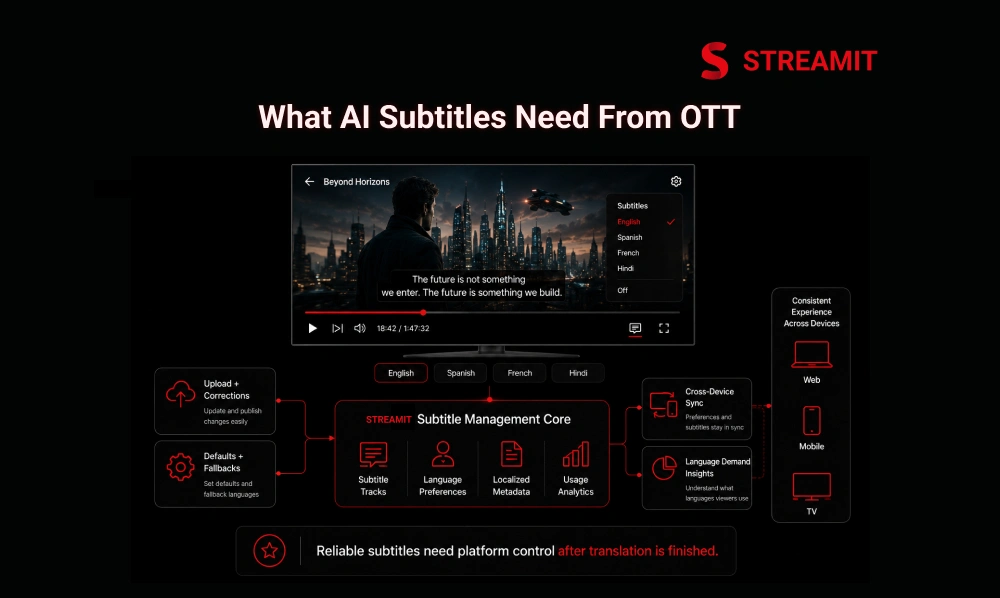
Subtitle quality still depends on platform architecture after translation is finished. The system must store, deliver, switch, update, and measure tracks consistently across supported screens.
Evaluate workflows rather than feature checkboxes. Ask how corrections publish, preferences sync, fallback languages work, metadata connects, and usage is reported.
Subtitle Tracks, Language Switching, and Multi-Language Metadata
Every title needs more than a folder of subtitle files. It requires clear language labels, defaults, fallbacks, supported formats, localized metadata, and reliable player controls.
Metadata completes the discovery path. Users should browse, search, understand, and start content in their preferred language before selecting a subtitle track.
Analytics for Subtitle Usage, Completion, and Language Demand
Three useful starting metrics are activation, completion, and repeat use. Together, they show whether subtitles are discovered, whether viewers stay, and whether demand continues.
Strong reporting also connects language behavior with device context. A track may perform well on mobile but poorly on TV because controls or text are harder to use.
| Metric | What It Can Reveal |
|---|---|
| Activation rate | Demand and discoverability |
| Completion by language | Comprehension and content fit |
| Early exits after activation | Timing, translation, or readability problems |
| Language switching | Wrong defaults or unclear labels |
| Repeat use | Sustained language value |
| Device-level usage | Player and interface differences |
Platform Solution
Why Streamit Fits Multi-Language OTT Use Cases
Multi-language streaming needs a connected platform foundation. Streamit supports subtitle-led experiences alongside content delivery, discovery, analytics, and user controls rather than treating language as an isolated add-on.
That matters when the catalog and audience grow. New languages should remain manageable across devices without forcing founders into custom rebuilding for every region.
It Supports Subtitle Workflows, Multi-Language Delivery, and Better UX
Streamit supports multi-language subtitles within a broader OTT environment. Teams can offer language options while maintaining playback, content management, and cross-device experience.
The larger advantage is architectural alignment. Subtitle workflows, localized presentation, and viewer controls can be planned inside the platform instead of connected later through separate tools.
Summary
Key Takeaways
AI Accelerates, Humans Protect Quality
Use automation for transcription and translation drafts, then add human review for context, timing, tone, and cultural accuracy – AI is leverage, not the final authority.
Availability Alone Does Not Drive Engagement
Viewers need accurate text, readable timing, simple language switching, and consistent playback across web, mobile, and TV for subtitles to actually improve their experience.
Design for Multi-Language from the Start
Adding subtitle tracks, localized metadata, and language preferences late creates unnecessary technical and operational complexity that grows with every new market.
Measure Behavior, Not File Volume
Track activation, completion, early exits, language switching, repeat usage, and device-level performance – these reveal whether subtitles are genuinely useful, not just present.
Subtitles Validate Demand Before Dubbing
Testing subtitle languages requires far less investment than full audio localization, providing real market evidence before committing to casting, recording, and mixing costs.
Connect Workflows Across the Whole Platform
The CMS, metadata, video player, analytics, and language settings must work together – isolated subtitle workflows create inconsistent multilingual experiences at scale.
Conclusion
Conclusion
The multilingual advantage is not the number of languages a player knows. It is the ability to make content understandable and discoverable while maintaining controlled operations.
AI subtitles provide a faster starting point, not a shortcut around quality. Combined with human QA and solid platform workflows, they support engagement, reach, and long-term growth.
FAQs
Frequently Asked Questions
-
What is the biggest multilingual mistake OTT teams make?
The biggest mistake is adding languages after the platform architecture is fixed. This creates manual publishing work, inconsistent metadata, weak language switching, and expensive cross-device rework.
-
What should OTT teams track beyond subtitle availability?
Track activation, early exits, completion, watch time, rewinds, switching, repeat use, and device performance. These signals show whether subtitles are present or genuinely useful.
-
When should OTT teams choose subtitles before dubbing?
Choose subtitles when testing demand, localizing a large catalog, or entering several markets carefully. Dubbing becomes easier to justify once subtitle behavior shows sustained demand.
-
What is the first sign AI subtitles are hurting user experience?
Rising early exits, rewinds, or language switching after activation are early warnings. Complaints about timing, names, or unnatural wording confirm the problem.
-
Why do viewers leave even when subtitles are available?
Viewers leave when subtitles are hidden, mistimed, poorly translated, too fast, visually intrusive, or inconsistent across devices. Availability cannot compensate for a weak experience.
Read Also
Read Also
1. What Is Streamit? AI-First OTT Platform for Streaming Businesses
2. OTT Platform Development Cost in 2026: Full Breakdown
3. OTT Platform Architecture: Setup & Hosting Costs Explained
4. How to Create Your Own OTT Platform From Scratch
5. Subscriber Retention for OTT Platforms: 15 Proven Tactics to Reduce Churn