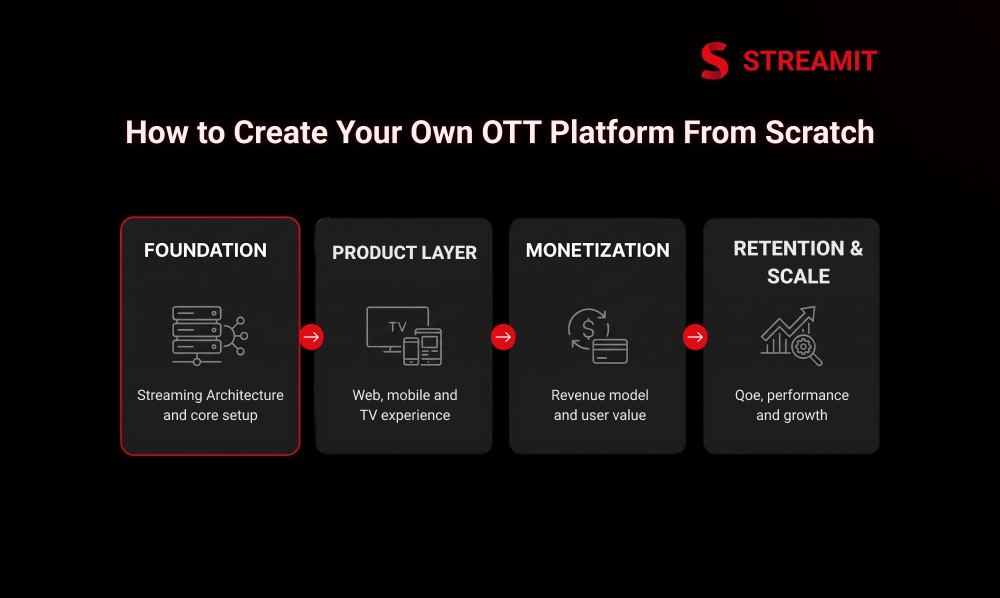
How to Create Your Own OTT Platform From Scratch


Most OTT platforms do not fail in 1 month. They fail in 12 months, when traffic rises, playback weakens, and the product cannot evolve without a rebuild. That is the real reason serious founders stop thinking of OTT as “an app” and start treating it as infrastructure, product, monetization, and retention working as one system. That is why serious OTT businesses focus on production-ready streaming architecture built for real traffic, long-term ownership, and sustainable growth across web, mobile, and smart TVs.
One buffering event can reduce the amount of video watched by 39%, and Mux says rebuffering should stay under 1% because anything above 3% signals serious delivery problems. That is why building an OTT platform from scratch is not mainly about launching fast. It is about choosing a foundation that can protect QoE, retention, and monetization before poor delivery teaches viewers not to come back.
Foundation
What Is an OTT Platform and How Do OTT Platforms Work?
An OTT platform is not just 1 player on 1 screen. It is a complete business system that delivers content directly over the internet across multiple devices. It is better understood as a production-ready platform built for web, mobile, and smart TVs, with a stronger focus on ownership, flexibility, and long-term control than on basic SaaS convenience.
For businesses, the difference is simple: cable distributes channels, while OTT distributes experiences. In OTT, the service owns the content flow, the app experience, the subscription logic, the analytics layer, and the future roadmap. That is why businesses now evaluate OTT platforms less like media software and more like revenue infrastructure.
Simple Definition of an OTT Platform for Businesses, Creators, and OTT Solution Providers
For a founder, an OTT platform is 1 owned destination where content, audience, and revenue can grow together. For creators, it can mean direct subscriptions, memberships, or premium access. For broadcasters and larger media teams, it means managing content, users, monetization, and distribution from one coordinated system instead of patching tools together.
For OTT solution providers, the real job is not shipping screens fast. It is reducing the number of future rebuilds. Streamit explicitly frames its work around business-model fit, platform ownership, monetization flexibility, and infrastructure that can evolve after launch. That is a stronger lens than “launch your Netflix clone,” because serious buyers care more about control than novelty.
How OTT Platforms Deliver Video Through Internet-Based Streaming Infrastructure
OTT delivery usually depends on 4 connected layers: content management, encoding, delivery, and playback. Content is uploaded and organized, video is encoded into multiple renditions, the CDN distributes it closer to viewers, and the player adapts playback based on device and network conditions. Cogniteq highlights CDN efficiency, analytics, monetization, and multi-device support as core parts of the stack.
What viewers experience as “smooth streaming” is really a chain of backend decisions working properly. When this chain is weak, buffering rises, discovery feels slower, and retention becomes harder. The strongest OTT platforms bring adaptive playback, analytics, recommendation systems, retention flows, and security together as one connected production system instead of treating them as separate add-ons.
OTT video delivery works differently from traditional TV and cable systems
Traditional TV pushes fixed distribution, while OTT reacts in real time to devices, bandwidth, geography, and user behavior. That makes OTT more flexible, but it also creates more technical pressure. The platform has to manage quality, latency, playback stability, and user identity without the predictability of old broadcast pipelines.
OTT platforms combine apps, websites, players, and backend infrastructure
A modern OTT product is usually 3 products at once: the viewer experience, the operations system, and the delivery engine. That means your website, mobile apps, TV apps, CMS, access control, payment systems, analytics, and playback stack all need to behave like one platform. That is why fragmented launch setups often feel cheap later, even if they looked efficient in the beginning.
Platform Types
Types of OTT Platforms You Can Create for Different OTT Solutions
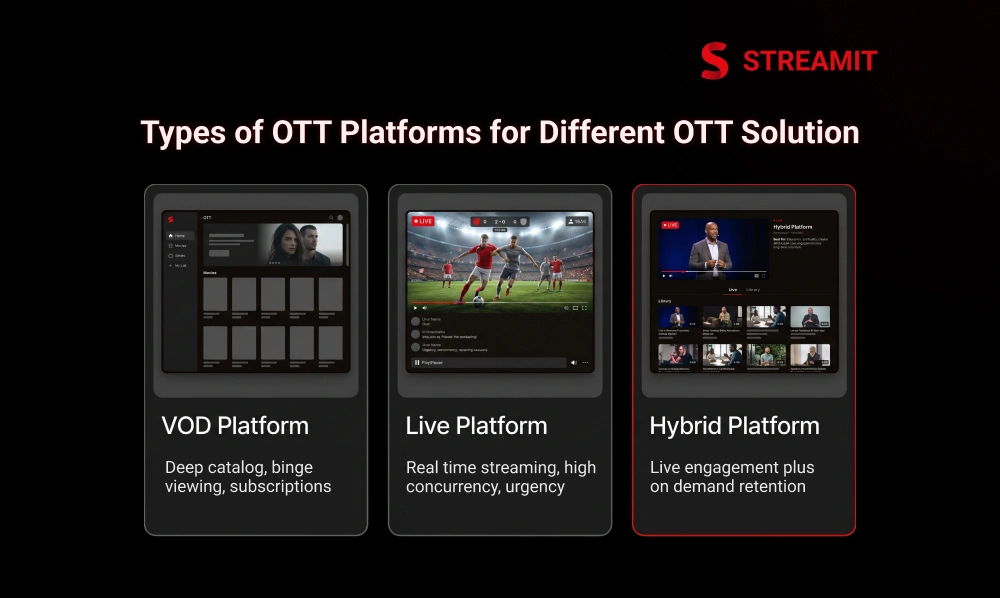
There are at least 3 practical OTT directions founders usually choose from: VOD, live, and hybrid. The right choice depends less on trend and more on viewing behavior, monetization logic, and how often your audience returns. That range can be seen across entertainment, sports, creator-led platforms, education, fitness, spirituality, and podcast use cases.
| Platform Type | Best For | Core Business Logic |
|---|---|---|
| VOD platform | Entertainment, film libraries, courses | Deep catalog value, binge behavior, subscriptions |
| Live platform | Sports, events, fitness, live podcasting | Urgency, concurrency, recurring sessions |
| Hybrid platform | Education, spirituality, and creator businesses | Live engagement plus long-term library retention |
This structure matches how OTT platform models are usually grouped in the market. Entertainment and movie platforms depend on VOD depth, sports and fitness platforms rely on live reliability, and hybrid models work best when live sessions continue creating value through an on-demand library afterward.
VOD Platforms for Entertainment Streaming Platforms and Movie Streaming Websites
VOD platforms win when library depth creates repeat value over time. This model suits entertainment brands, regional movie libraries, and premium niche catalogs where discovery, content organization, and recommendation quality influence retention more than event-driven urgency.
Live Streaming Apps for Live Sports Streaming Platforms, Fitness Streaming Platforms, and Podcast Streaming
Live platforms are judged in seconds, not in features. If the stream breaks during a match, class, or live show, the audience does not care how polished the CMS is. High-concurrency infrastructure is critical for sports and live events, while fitness and podcast platforms often benefit from a mix of live sessions and on-demand access.
Hybrid OTT Platforms for Entertainment Apps, Spiritual Streaming, and Online Learning Platforms
Hybrid platforms usually have the strongest long-term retention logic because 1 live moment can keep generating value later as library content. That makes them useful for education, spiritual communities, expert-led memberships, and creator ecosystems where engagement starts live but compounds through on-demand access, progress tracking, and repeat viewing.
Strategy
Why Businesses Choose Custom OTT Platform Development Instead of Relying on Third-Party Platforms
The real tradeoff is not build versus buy. It is control now versus flexibility later. Ownership, roadmap freedom, and reduced platform lock-in are often major strategic advantages, especially for businesses planning to grow beyond a simple packaged launch.
Full control over content, branding, monetization, and OTT User Engagement
A custom platform gives you control across 4 areas that matter most: brand, pricing, data, and experience. That means you can shape how your apps look, how payments work, how content is surfaced, and how engagement systems behave. White-label branding is also often presented as a way to control navigation, visual style, and overall platform identity.
Better long-term growth, Subscriber Retention, and Reduce Churn potential
Retention gets more expensive when the product cannot evolve after launch. High OTT churn shows that retention is not just a supporting metric – it is central to the business. A custom foundation makes it easier to improve discovery, performance, packaging, and monetization over time without running into platform limits later.
Step by Step
How to Create Your Own OTT Platform From Scratch Step by Step
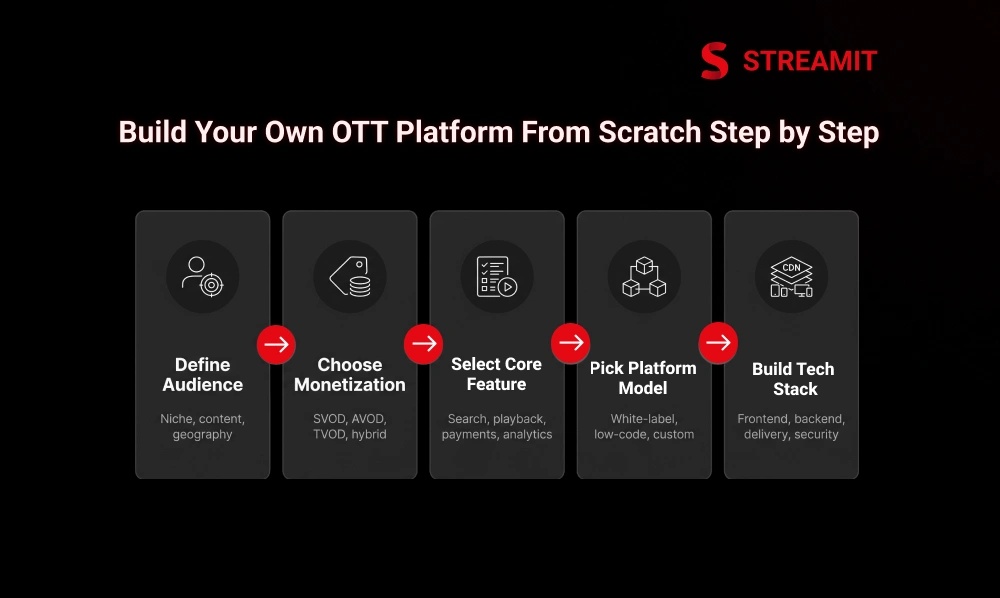
The first 5 decisions usually shape the next 12 to 24 months of cost, scale, and product flexibility. That is why most strong OTT guides begin with niche, content, monetization, feature scope, and platform model before getting into technical details. Different providers may explain it differently, but the logic is usually the same: strategy comes first, and technology follows it.
-
1
Define your audience, niche, and OTT content strategy
It is where weak OTT projects usually become expensive. You need clarity on who the platform is for, why they return, what content cadence you can sustain, and whether your value is broad entertainment or narrow expertise. A vague niche makes every later decision more expensive.
-
2
Choose the right OTT monetization model for your OTT solution
Your monetization model changes product behavior from day 1. It affects pricing, watch patterns, churn sensitivity, payment flows, content packaging, and even app UX. Monetization should be designed into the platform from the beginning, not treated as something to add later.
-
3
Select core OTT platform features and streaming features
Feature selection should start with the 20% that protects the other 80% of your business. Search, playback, access control, payments, analytics, and content organization are not glamorous, but they prevent friction that silently increases churn.
-
4
Choose between white label OTT solutions, low code OTT solutions, or custom development
This is usually a 3-lane decision: speed, convenience, or control. White-label and low-code approaches reduce complexity early, while custom development increases flexibility and long-term differentiation. White-label options are often the faster and simpler choice, while custom development makes more sense when the platform needs unique capabilities, deeper control, and room for long-term scale.
-
5
Build the right OTT tech stack, video delivery system, and streaming website
Your stack is not just a technical choice. It is your future operating model. Frontend, CMS, delivery, playback, security, and analytics need to work together cleanly enough that the team can keep improving the product after launch.
Step 1: Define your audience, niche, and OTT content strategy
It is where weak OTT projects usually become expensive. You need clarity on who the platform is for, why they return, what content cadence you can sustain, and whether your value is broad entertainment or narrow expertise. A vague niche makes every later decision more expensive.
Choose the right niche, language, geography, and content format for your OTT platform
One strong niche in 1 clear geography usually beats an unfocused “global platform” at launch. Specialized OTT use cases such as creators, education, fitness, diaspora, and spirituality usually create a clearer product strategy and stronger monetization logic than a broad, generic entertainment pitch.
Step 2: Choose the right OTT monetization model for your OTT solution
Your monetization model changes product behavior from day 1. It affects pricing, watch patterns, churn sensitivity, payment flows, content packaging, and even app UX. Monetization should be designed into the platform from the beginning, not treated as something to add later.
SVOD, AVOD, TVOD, and hybrid monetization models for OTT platforms
Most serious OTT businesses end up using 3 broad choices: subscriptions, ads, transactions, or a hybrid of them. The right model depends on audience intent, content frequency, and pricing tolerance. Hybrid setups are often strongest because they let revenue expand without re-platforming.
Step 3: Select core OTT platform features and streaming features
Feature selection should start with the 20% that protects the other 80% of your business. Search, playback, access control, payments, analytics, and content organization are not glamorous, but they prevent friction that silently increases churn.
Must-have OTT platform features like search, playback, profiles, payments, and analytics
Five baseline systems usually matter most in an MVP: discovery, playback, user identity, payments, and analytics. Profiles, search, recommendations, monetization, and reporting are all important core features, while analytics and retention tools play a direct role in improving watch time and long-term customer value.
Advanced streaming features like Adaptive Streaming, Multi CDN, Edge Caching, and Mobile Optimisation
Advanced delivery features matter when the platform becomes operationally serious. Adaptive playback, delivery optimization, smart seek previews, personalization, retention systems, and end-to-end encryption often mark the difference between a basic OTT setup and a platform built for real-world scale.
Step 4: Choose between white label OTT solutions, low code OTT solutions, or custom development
This is usually a 3-lane decision: speed, convenience, or control. White-label and low-code approaches reduce complexity early, while custom development increases flexibility and long-term differentiation. White-label options are often the faster and simpler choice, while custom development makes more sense when the platform needs unique capabilities, deeper control, and room for long-term scale.
When white label OTT solution providers make sense for faster launches
White-label solutions make sense when time-to-market matters more than deep product differentiation. They are often positioned as accessible, subscription-based options for teams that want built-in features with less technical complexity. That can be a practical choice for creators or businesses in the early testing stage.
When custom OTT platform development is better for control, scalability, and differentiation
Custom development becomes the better decision when 3 things matter: ownership, roadmap freedom, and scale under pressure. This approach becomes especially valuable when the goal is to avoid the limits of locked SaaS models and build a platform foundation that can evolve over time without forcing major rebuilds later.
Step 5: Build the right OTT tech stack, video delivery system, and streaming website
Your stack is not just a technical choice. It is your future operating model. Frontend, CMS, delivery, playback, security, and analytics need to work together cleanly enough that the team can keep improving the product after launch.
Frontend apps and OTT front-end solutions for web, mobile, and smart TV experiences
A serious OTT launch usually needs 3 front-end priorities: web, mobile, and TV. Cross-device parity should be treated as a baseline part of the platform, not as something to add later, because audience behavior rarely stays limited to one screen.
Backend, CMS, OTT asset management solution, and streaming infrastructure
The backend decides whether operations stay simple after month 6. Content workflows, user access, metadata, payments, reporting, and library management all live here. A centralized CMS and operations layer is essential for managing real OTT workflows efficiently at scale.
Video CDN, video encoding, video transcoding, and playback optimization for better QoE
CDN, encoding, and playback optimization directly shape retention. Well-designed CDNs help reduce latency and improve load times, and even a single buffering event can significantly reduce viewing time. That is why delivery architecture is not just a backend concern, but a direct factor in watch time and viewer retention.
DRM, video encryption, and OTT Security Solutions for secure content delivery
Security usually starts with 3 DRM standards: Widevine, FairPlay, and PlayReady. Multi-DRM is important for protecting content across Android, iOS, desktop, and smart TVs, while secure access controls also play a key role in real-world OTT content protection.
Budget
What It Costs to Build an OTT Platform From Scratch
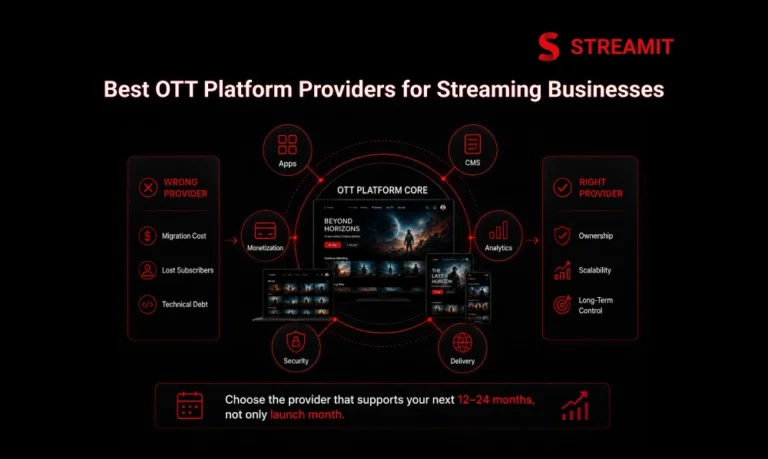
The biggest pricing mistake is comparing launch cost without comparing future constraint cost. A low upfront number can become expensive if it forces migration, limited monetization, or weak product control later. Platforms that cannot scale properly often face disruptive migrations soon after growth begins.
The main factors that affect OTT platform development cost
Cost usually moves on 5 levers: feature depth, device coverage, delivery complexity, security, and customization. Add live streaming, TV apps, advanced analytics, DRM, regional expansion, or deeper CMS logic, and the budget rises quickly. That is why accurate estimates only happen after scope clarity.
MVP vs enterprise OTT platform cost and feature scope
Many creators can start with platform-based OTT solutions at around $100 to $200 per month, while custom OTT websites often begin in the $5,000 to $30,000+ range before ongoing hosting and maintenance costs are added. Those figures are useful as directional benchmarks, but they should not be mistaken for like-for-like comparisons because the business tradeoffs are different.
| Approach | Lower Upfront Barrier | Higher Long-Term Control | Best Fit |
|---|---|---|---|
| White label / low code | Yes | Limited | Fast launch, testing, simpler teams |
| Custom MVP | Moderate | Stronger | Niche platforms with specific needs |
| Enterprise custom OTT | No | Highest | Businesses planning scale, complexity, and multi-device depth |
The better question is not “what is cheaper?” but “what becomes more expensive later?” For medium to high-ticket OTT businesses, control over roadmap, revenue models, data, and performance often has more strategic value than short-term launch savings.
Decision Framework
Should You Build, Buy, or Customize an OTT Platform Solution?
Choosing to build, buy, or customize an OTT platform comes down to how much control, speed, and long-term flexibility your business needs. Buying works for faster launches, but customization or custom development makes more sense when scalability, ownership, and future growth matter more.
When white label OTT solutions are the better choice for speed and lower upfront cost
White-label platforms are usually the better answer when speed is the business advantage. They reduce technical burden, simplify launch, and let smaller teams validate demand before committing to heavier custom architecture.
When is custom OTT platform development the better choice for long-term growth
Custom becomes stronger when your business cannot afford vendor-shaped limits. If your roadmap includes multiple monetization models, specialized UX, advanced retention flows, large libraries, high concurrency, or deep ownership requirements, a custom foundation usually ages better.
How to choose the right OTT solution provider for your platform goals
Choose the partner that can answer 4 questions clearly: who owns the platform, how it scales, how monetization evolves, and what happens after launch. A strong OTT partner should be evaluated as a long-term business foundation, not just a quick-launch solution, because serious founders need room for scale, control, and future growth.
Launch
How to Launch Your OTT Platform Without Hurting QoE, Security, and Retention
Launching an OTT platform is not just about making it live. It is about ensuring smooth playback, strong content protection, and a viewer experience that builds trust from the first session, because weak QoE, poor security, and early friction can hurt retention much faster than most teams expect.
Test apps, video delivery, playback quality, and device compatibility before launch
Launch quality is often decided by the last 2 weeks, not the first 2 months. Cross-device testing, playback stability, start time, and buffering behavior need real attention before rollout because poor first impressions damage both trust and retention.
Prepare OTT website, streaming app, and app store rollout for launch
A launch is really 1 coordinated rollout across web, mobile, and TV surfaces. That includes app readiness, metadata, billing flows, onboarding, content organization, and customer support paths. If any of those feel unfinished, the audience notices quickly.
Protect content and user data with DRM, encryption, and OTT security solutions
Security should be live before day 1, not after the first piracy scare. End-to-end encryption, secure access control, and multi-DRM all play an important role in protecting OTT content, while Widevine, FairPlay, and PlayReady help extend that protection across devices and browsers.
Growth
How to Scale OTT Platforms After Launch With Better Streaming Features and Retention Tactics
Scaling an OTT platform after launch means improving more than traffic capacity. It requires better streaming performance, stronger discovery, smarter retention tactics, and the flexibility to expand across devices, regions, and use cases without weakening the viewer experience.
Improve video delivery, buffering rate, and playback performance as traffic grows
Keeping rebuffering under 1% is a smarter growth target than chasing vanity launch numbers. When delivery degrades, watch time and monetization both weaken. As traffic grows, CDN strategy, edge delivery, adaptive playback, and performance monitoring matter more, not less.
Use content personalization, analytics, and smarter discovery to increase OTT User Engagement
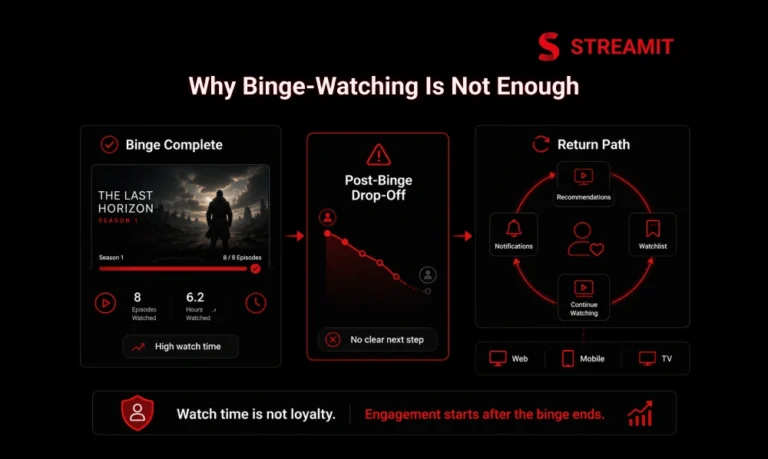
Retention improves when the platform gets better at the next click, not just the current stream. That is why recommendations, analytics, smart thumbnails, and retention systems matter so much. As the audience grows, discovery and engagement also need to improve, or churn can quietly increase over time.
Expand across more regions, devices, and use cases without rebuilding your OTT stack
The real scaling win is not adding 1 more device. It is avoiding 1 more rebuild. Long-term architecture is what allows an OTT platform to expand into new regions, devices, and revenue models without having to rebuild from scratch each time.
Summary
Key Takeaways
Strategy Before Technology
Defining the right niche, audience, geography, and content strategy early makes every platform decision stronger. A vague niche makes every later decision more expensive.
Monetization Shapes Everything
SVOD, AVOD, TVOD, and hybrid models all influence pricing, retention, and UX. Monetization must be designed into the platform from day one, not added later.
Custom Development Pays Off at Scale
Custom OTT development gives businesses more control over branding, scalability, and long-term ownership – and typically ages much better than locked SaaS solutions.
Buffering Is a Business Risk
One buffering event can cut watch time by 39%. Rebuffering above 3% signals serious delivery problems. Delivery architecture is a direct driver of watch time and revenue.
Security Must Be Live Before Launch
DRM, encryption, and secure delivery using Widevine, FairPlay, and PlayReady need to be in place before the platform goes live – not added after the first incident.
Scaling Means Avoiding Rebuilds
The real win of long-term architecture is enabling new regions, devices, and revenue models without forcing a complete rebuild each time the business grows.
Conclusion
Conclusion
A strong OTT platform is rarely the cheapest thing to launch, but it is often the cheapest thing to keep scaling. That is the mindset serious founders should use. When content, performance, security, monetization, and retention are treated as one system from the start, the platform becomes more than a streaming product. It becomes a durable business asset.
That is also where Streamit fits naturally in this conversation. Its messaging is built around ownership, scalable architecture, monetization flexibility, multi-device delivery, and long-term control rather than short-term launch shortcuts. For businesses that want to build something they can actually grow into, that is the right foundation to evaluate.
FAQs
Frequently Asked Questions
-
What types of OTT platforms can I create?
You can build VOD, live, or hybrid OTT platforms for entertainment, sports, creators, education, fitness, spirituality, and podcast use cases.
-
What is the typical budget for launching a streaming platform?
It can start at around $100 to $200 per month for platform-based options, while custom platforms may cost $5,000 to $30,000+ upfront, plus ongoing maintenance.
-
What affects the timeline for building a streaming platform?
The timeline depends on features, devices, integrations, and the development approach. Faster options launch sooner, while custom builds take longer but offer more control.
-
How can I scale and grow my OTT platform?
Improve buffering, playback quality, analytics, discovery, personalization, and device coverage while keeping the architecture flexible enough to add regions and monetization models later.
-
How can Streamit help in creating my OTT platform?
Streamit positions itself as a long-term OTT platform partner focused on ownership, scalable infrastructure, monetization systems, multi-device delivery, and strategic growth.
-
Should I build a custom OTT platform or use a SaaS solution?
Choose SaaS or white-label when speed and simplicity matter most. Choose custom when long-term control, scalability, and deeper differentiation matter more.