Edge Caching for OTT: Faster Streaming, Less Buffering


In the first few seconds of playback, viewers decide whether your platform feels premium or unreliable. That decision happens quietly. It is not made by your homepage design alone, your content catalog alone, or your pricing alone. It is made by how fast the stream starts, how stable it feels, and whether the platform behaves confidently under load.
For many OTT teams, buffering is still treated like a technical inconvenience. That is too small a view. Buffering reduces watch time, weakens session momentum, and slowly turns platform friction into churn. In a market where viewers already have too many choices, delivery quality is no longer a backend concern.
A platform can look modern for 30 days and still fail in 12 months if delivery does not scale. This is where edge caching becomes strategically important. It helps OTT platforms move content closer to viewers, reduce repeated origin requests, improve startup speed, and create a more stable playback path for both VOD and live streaming.
Edge caching is not a magic switch. It is a delivery discipline. When done well, it improves performance, reduces operational pressure, and gives OTT businesses more control over scale, cost, and viewer trust.
Part 1
What Is Edge Caching in OTT Streaming?
Edge caching in OTT streaming means storing video content and related delivery assets closer to the viewer instead of serving every request from a distant origin server. In practical terms, it allows the platform to deliver common content faster because the data does not need to travel the full distance each time a user presses play.
That matters because OTT delivery is repetitive by nature. The same shows, the same manifests, the same thumbnails, and the same segments may be requested by thousands or millions of viewers. If those requests are always sent back to the origin, the delivery path becomes slower and more expensive than it needs to be.
Edge Caching Meaning in Simple Words
Edge caching is a way of keeping content near the audience so streaming feels faster. Instead of pulling every piece of video from one central system, the platform stores reusable content on edge servers that sit closer to where viewers actually are.
For OTT platforms, this means less waiting, less unnecessary traffic to the origin, and a better chance of smooth playback during both regular viewing and traffic spikes.
What “edge” means in content delivery
The “edge” refers to servers or infrastructure points placed closer to end users. These are distributed across regions, so content can be delivered from nearby locations rather than from one central source.
In streaming, edge locations reduce the distance between the viewer and the content. That shorter path matters because speed in OTT is heavily influenced by how far data has to travel.
What “caching” means in video streaming
Caching means storing a copy of content so it can be delivered quickly on future requests. In OTT, that often includes video segments, manifests, posters, subtitles, metadata, and playback-related assets.
When those assets are cached, the platform avoids fetching them from the origin every time. That reduces delay and lowers origin pressure.
How Edge Caching Works for OTT Platforms
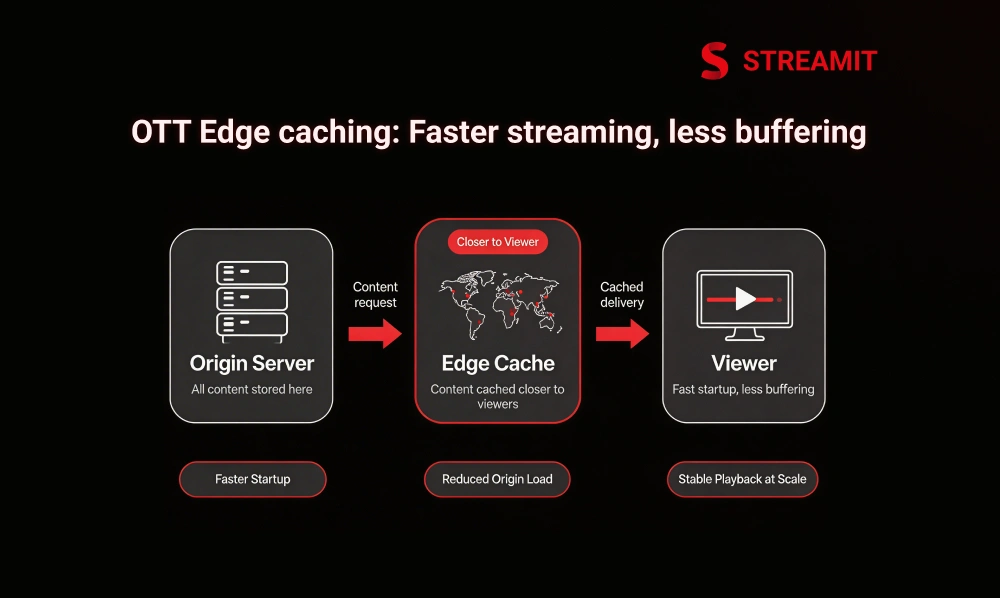
The player begins by requesting video content such as manifests and segments. If the requested object is already stored at the nearest edge server, the content is delivered immediately from there. If it is not, the edge server retrieves it from the origin or an upstream cache, stores it, and then serves it to the viewer.
This process sounds simple, but it has a major effect on performance. Once the commonly requested content is cached close to demand, playback becomes faster, and origin dependency drops.
Viewer requests video content
Every streaming session starts with a request. The player asks for a manifest, then begins requesting video segments based on bitrate selection and playback progress.
The quality of this first interaction matters because startup delay often sets the tone for the whole session.
Content served from the nearest edge location
If the content exists at a nearby edge location, the response is quicker because the travel distance is shorter. That reduces startup time and helps the player build a healthy playback buffer faster.
For OTT viewers, this creates a simpler experience. The stream starts sooner and feels more responsive.
The origin server is used only when needed
The origin remains important because it is the source of truth. But in a strong edge caching setup, it should not carry every request. It should be used when the cache misses, when new objects are needed, or when content must be refreshed.
That design is healthier for scale. It protects the origin from becoming the default bottleneck.
Edge Caching vs Traditional Centralized Delivery
Traditional centralized delivery sends most requests back to a central origin or a limited number of core servers. That approach can work at a smaller scale, but it becomes fragile as audience size, geography, and concurrency grow.
Edge caching distributes that load. It shifts repeat demand away from the origin and closer to the audience, which improves responsiveness and reduces delivery strain.
Why does centralized delivery cause more delay
Centralized delivery creates longer network paths, more dependency on shared backbone routes, and more exposure to congestion. Even if the origin is powerful, the distance still creates a delay.
As OTT platforms expand into new regions, centralized delivery usually stops feeling efficient much sooner than expected.
Why edge delivery feels faster to users
Edge delivery feels faster because it reduces the number of long-distance trips required to start and sustain playback. That helps with first-frame speed, segment delivery, and overall playback stability.
The viewer may never know the term “edge caching”, but they feel the result almost immediately.
Part 2
Why OTT Platforms Need Edge Caching Today
Viewer tolerance for delay is lower than most teams think. A platform may survive a few weak sessions, but repeated friction quietly damages habit formation. In OTT, habit is everything. If playback feels unreliable, the service becomes easier to ignore.
Modern streaming audiences expect fast startup, stable playback, and consistency across devices and regions. Those expectations are no longer reserved for the largest platforms. They now apply to any service that wants to be taken seriously.
Rising Viewer Expectations for Instant Playback
Viewers have been trained by mature consumer platforms to expect immediacy. They do not separate content value from delivery speed. If a stream takes too long to start, the platform already feels weaker.
That is why OTT teams cannot treat startup time as a minor metric. It is one of the clearest signals of product quality.
Buffering Hurts Watch Time, Retention, and Revenue
Buffering breaks momentum. Once playback stalls, the viewer is forced to think about the platform instead of the content. That shift is dangerous because engagement weakens the moment the experience becomes visible in the wrong way.
For subscription platforms, that means weaker retention. For ad-supported platforms, it means lower session value. For premium or event-driven platforms, it means a weaker brand impression exactly when performance matters most.
Global Audiences Create Delivery Problems
A platform with viewers across multiple regions cannot rely on one delivery path and expect equal performance everywhere. Different geographies face different latency conditions, network routes, congestion patterns, and last-mile realities.
Edge caching helps OTT platforms localize delivery quality even when the business itself is global.
Live Events and Peak Traffic Increase Pressure
Live events expose weaknesses fast. During a major match, concert, or release drop, many viewers request the same content at nearly the same time. That pattern puts intense pressure on origin infrastructure if caching is weak.
Edge caching absorbs much of that repeat demand. It makes the system more resilient when concurrency rises sharply.
Part 3
Main Problems Edge Caching Solves in OTT
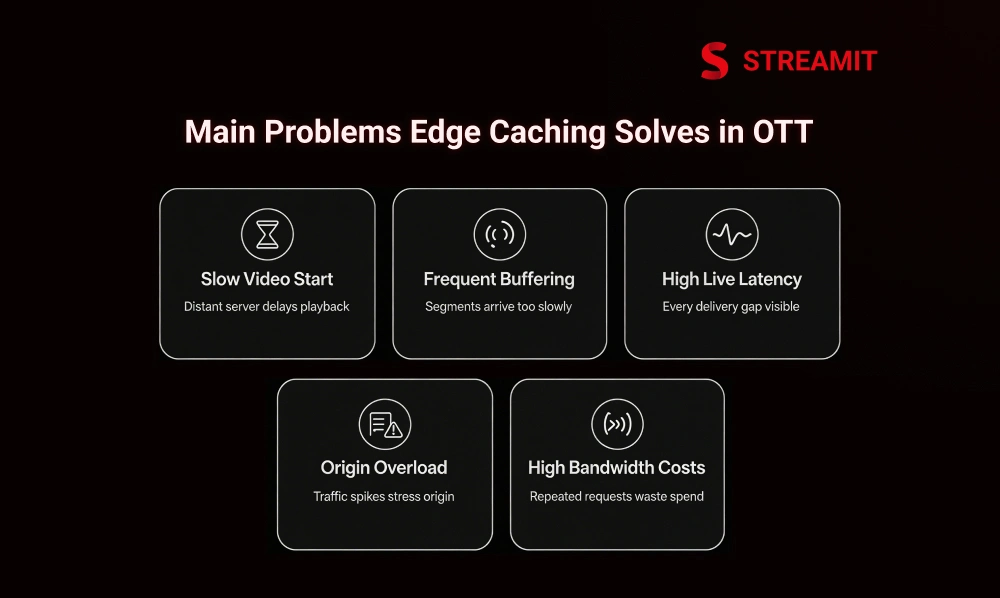
Edge caching solves several common OTT delivery problems at once. It improves speed, reduces repeated origin requests, and supports better playback consistency across traffic conditions.
That is why it should not be viewed only as a latency feature. It is a broader performance and scalability layer.
-
Slow Video Start Time
If the first manifest and first segments come from a distant server, the startup slows down. Even a short delay can make the platform feel hesitant. Edge caching improves startup by putting those early playback assets closer to the viewer.
-
Frequent Buffering During Playback
Playback buffering often happens because segments do not arrive quickly or consistently enough. Edge caching reduces that risk by shortening delivery paths and reducing dependency on the origin for repeated requests. The result is a stronger chance that the player stays ahead of playback.
-
High Latency for Live Streaming
Live streaming is sensitive because the platform has less room to hide delays. When content is live, every delivery inefficiency becomes more visible. Edge caching helps reduce that pressure by distributing live traffic closer to the audience.
-
Origin Server Overload During Traffic Spikes
Without effective caching, traffic spikes can force the origin to handle too many repeated requests. That creates stress, slows response time, and increases the risk of service instability. Edge caching protects the origin by offloading repeat demand.
-
High Bandwidth and Delivery Costs
Serving the same content repeatedly from the origin is not just slower — it is also less efficient financially. Caching commonly requested assets at the edge lowers unnecessary bandwidth use across the delivery path, making streaming infrastructure more cost-efficient over time.
Part 4
Edge Caching vs CDN vs Edge Computing vs Open Caching
These terms are often used together, but they solve different problems. Understanding the difference helps OTT teams design better infrastructure decisions instead of buying into vague architecture language.
| Term | Main Role | OTT Relevance |
|---|---|---|
| Edge Caching | Stores reusable content near users | Faster delivery, lower origin load |
| CDN | Distributed content delivery network | A broader network layer that includes edge nodes |
| Edge Computing | Runs logic closer to users | Useful for real-time decisions and dynamic features |
| Open Caching | Standardized shared caching framework | Helps scale delivery across providers, CDNs, and ISPs |
What a CDN Does in OTT
A CDN distributes content across multiple locations so it can be delivered more efficiently to viewers. It routes requests, manages geographic delivery, and reduces dependency on a single central source.
For OTT, the CDN is the broader delivery network. Edge caching is one of the most important functions inside it.
How Edge Caching Fits Inside a CDN
Edge caching is how the CDN actually improves performance for repeated requests. Without effective edge caching rules, a CDN still exists, but it may not deliver its full performance value.
In other words, a CDN gives you the delivery framework. Edge caching makes that framework efficient.
What Edge Computing Adds Beyond Caching
Edge computing adds processing power closer to the user. Instead of only storing content near the audience, it allows certain decisions and operations to happen near the audience, too.
That can support more advanced OTT use cases where low latency and local responsiveness matter.
Processing closer to viewers
Edge computing can support local request handling, logic execution, routing decisions, or lightweight transformations closer to the user. That reduces the need to send every request back to a central system before a decision is made.
Better support for personalization and live features
Some OTT features become more practical when they are handled closer to the user. This may include personalization logic, low-latency interactions, or region-sensitive experiences. Used carefully, edge computing can extend what edge caching already improves.
What Open Caching Means for OTT Delivery
Open Caching is a standards-based approach that helps different participants in the delivery ecosystem work together through shared caching principles.
For OTT, it matters because scale is not always solved by adding more vendor layers. Sometimes it is improved by making the ecosystem itself more interoperable.
Shared caching layer between providers, CDNs, and ISPs
Open Caching creates a shared model where content owners, CDNs, and network operators can align around more efficient caching and request routing. That can improve delivery reach and reduce unnecessary duplication.
Why open caching matters for scale and cost
As OTT platforms grow, delivery costs and complexity grow with them. Open Caching creates a path toward better operational efficiency, especially in environments where content travels repeatedly through overlapping delivery chains. For the long-term scale, that matters more than many teams initially expect.
Part 5
How Edge Caching Works Inside an OTT Delivery Architecture
Edge caching works best when it is treated as part of the full OTT delivery stack, not as an isolated switch inside the CDN console. Its efficiency depends on ingest, transcoding, packaging, cache keys, TTLs, and origin protection working together.
This is why strong streaming platforms are engineered across layers, not patched at one layer.
Video Ingest, Transcoding, Packaging, and Origin
OTT delivery begins when video is ingested, transcoded into multiple renditions, packaged into streaming formats, and stored behind an origin. The origin acts as the main source of content, while the edge exists to distribute repeated access more efficiently.
A weak origin design will still create problems, even if the edge layer is strong. Both have to be aligned.
HLS and DASH segments at the delivery layer
HLS and DASH break the video into smaller segments that can be delivered over HTTP. This structure makes streaming more flexible and helps players adjust quality based on conditions.
It also makes caching more practical because these segments can be stored and reused efficiently.
Why cache-friendly packaging matters
Packaging choices affect cache performance. If manifests, segments, and related assets are not structured cleanly, caching becomes less efficient.
Cache-friendly packaging improves reuse, reduces duplication, and helps the edge layer deliver more value.
CDN Edge Nodes and Regional Delivery
CDN edge nodes hold content close to the audience. In many architectures, regional or mid-tier layers help coordinate requests before they reach the origin.
That layered approach makes delivery more stable and helps reduce repeated pulls from the source.
Cache Hits, Cache Misses, and Origin Fetches
A cache hit happens when the requested asset is already stored at the edge. A cache miss happens when the edge does not have it yet and must fetch it from the origin or an upstream cache.
This difference matters because hit-heavy delivery feels fast and efficient, while miss-heavy delivery drifts back toward centralized behavior.
| Event | What Happens | Platform Impact |
|---|---|---|
| Cache Hit | Asset served from the edge | Faster playback, lower origin traffic |
| Cache Miss | Edge fetches from the origin | Slower response, more origin dependency |
| Repeated Misses | The same content is often pulled from origin | Lower efficiency, higher operational strain |
What happens on a cache hit
The asset is served quickly from the nearest available cache. Playback starts faster, and the origin remains untouched for that request. This is the outcome that strong OTT delivery systems try to maximize.
What happens on a cache miss
The edge server requests the asset from the origin, receives it, stores it, and then serves it to the viewer. This is a normal part of caching, but too many misses reduce the benefit of the edge layer. Persistent misses usually indicate a policy or architecture issue.
How repeated origin pulls hurt performance
Repeated origin pulls increase delay, bandwidth use, and origin load. They also reduce confidence during traffic spikes because the system remains too dependent on the source layer.
That is why hit ratio is not just a technical metric. It is a health signal for the architecture.
Why Origin Shielding Matters
Origin shielding adds another protective layer between edge nodes and the origin. It consolidates repeated requests before they reach the source.
For OTT platforms handling large traffic volumes or multi-CDN setups, origin shielding helps prevent the source from being hit by too many duplicate fetches.
How Edge Caching Helps VOD and Live Streaming
VOD and live both benefit from caching, but the pattern is different. VOD benefits from stable reuse across a content library. Live benefits from handling synchronized traffic at scale.
A mature OTT platform understands both patterns and designs for each one intentionally.
Edge caching for on-demand content
On-demand libraries benefit from keeping popular segments, artwork, subtitles, and metadata close to viewers. This improves repeated viewing and lowers delivery strain over time. VOD caching is especially valuable for titles with steady demand across regions.
Edge caching for live events and sports
Live events create synchronized demand. Large audiences often request the same content almost at once, which makes strong edge replication and origin protection essential. That is why sports and large live releases are some of the clearest use cases for serious edge caching.
Part 6
Key Edge Caching Strategies for Faster OTT Streaming
Edge caching works best when guided by strategy, not by defaults. The strongest OTT teams make deliberate decisions about what should be cached, how long it should stay cached, and how different content types should behave.
Cache Popular Video Segments Near Viewers
Popular content should be placed near the audience that requests it most. This improves hit ratio and reduces the need for repeated long-distance fetches.
In OTT, popularity patterns often become clear quickly. The caching strategy should reflect that reality.
Use Dynamic Edge Caching for Frequently Requested Content
Not all valuable content is static. Some dynamic responses still benefit from controlled caching at the edge.
Used carefully, this can improve responsiveness without breaking the logic behind the experience.
Use Client-Side Prefetching for Faster Navigation
Prefetching helps the platform prepare likely next assets before the user explicitly requests them. That reduces perceived delay during browsing and navigation.
When used wisely, it creates a smoother product flow between discovery and playback.
Prefetch previews, metadata, and likely next assets
Preview images, metadata, next-page assets, and likely next-watch content are good prefetch candidates because they are lightweight and often reused. This makes the product feel more responsive without requiring full content delivery ahead of time.
Keep prefetching smart, so bandwidth is not wasted
Prefetching should remain selective. Aggressive prefetching can waste bandwidth, especially on mobile networks or lower-confidence user paths. The goal is not to preload everything. The goal is to reduce friction intelligently.
Warm the Cache Before Big Releases and Live Events
Cache warming prepares the system before traffic arrives. If the platform knows a release or event will create demand, it can pre-position relevant content in advance.
This reduces cold-cache behavior at the worst possible time.
Set the Right TTL for Different Content Types
TTL determines how long content stays cacheable before it must be refreshed or revalidated. This should vary by content type, not follow one rule for everything.
| Content Type | Suggested TTL Direction | Why |
|---|---|---|
| Live playlists | Short | Changes often and must stay fresh |
| VOD segments | Longer | Stable and highly reusable |
| Posters and thumbnails | Longer | Static assets with repeated requests |
| Personalized responses | Selective | Risk of low reuse and fragmentation |
Short TTL for fast-changing content
Fast-changing assets such as live manifests and time-sensitive responses should not remain cached too long. Freshness matters more than long-term reuse in those cases. A short TTL protects accuracy.
Longer TTL for stable assets
Stable assets such as posters, images, and reusable VOD segments benefit from longer TTLs. These are ideal candidates for stronger edge efficiency. Longer reuse lowers unnecessary origin traffic.
Separate Browser Cache and Edge Cache Rules
Browser cache and edge cache serve different purposes. The browser cache controls what stays on the user’s device. The edge cache controls what stays in the delivery network.
Treating them separately helps avoid stale-user issues while still getting edge efficiency.
Part 7
How Edge Caching Reduces Buffering in OTT
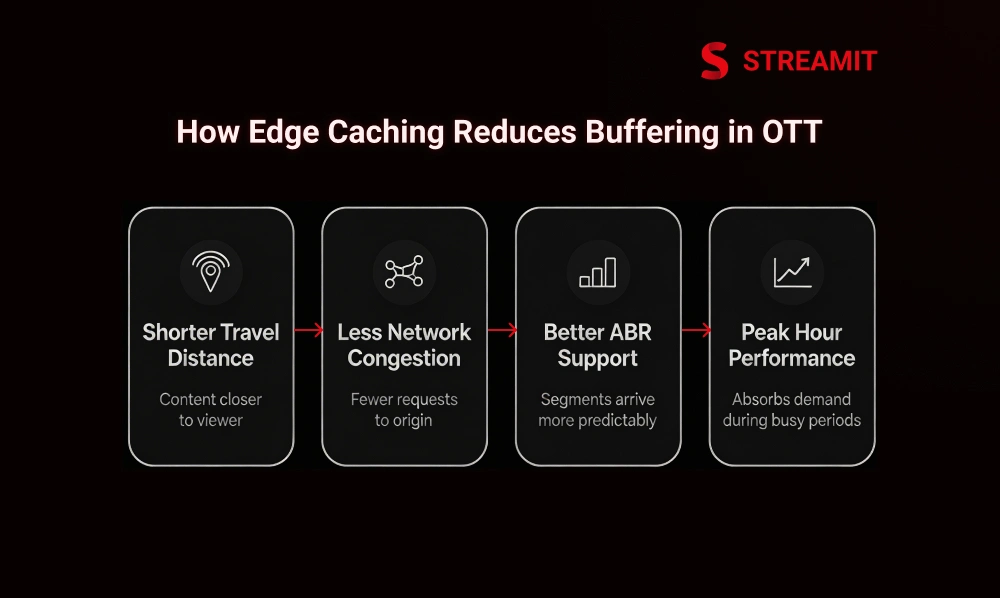
Buffering happens when the player cannot receive data quickly or consistently enough to stay ahead of playback. Edge caching reduces that risk by improving delivery timing across the playback session.
That makes it one of the most practical tools for improving real-world viewing quality.
Shorter Travel Distance Means Faster Delivery
The closer the content is to the viewer, the faster it can usually be delivered. That shorter path helps the player load the next required segment more reliably.
In streaming, reduced distance often translates directly into reduced friction.
Less Congestion Between Origin and Viewer
When content is served from the edge, fewer requests must travel through the full network path back to the origin. That reduces congestion exposure and improves consistency.
Consistency matters because OTT viewers notice instability more than they notice architecture.
Better Support for Adaptive Bitrate Streaming
Adaptive bitrate streaming depends on timely delivery across multiple quality levels. If segments arrive too slowly, the player may downshift quality or buffer.
Edge caching supports ABR by making segment delivery more predictable.
How ABR and edge caching work together
ABR helps the player choose the right quality level. Edge caching helps the platform deliver those quality variants more smoothly. Together, they improve playback resilience under changing conditions.
Why the ABR ladder affects cache efficiency
A wider ABR ladder means more variants, more segment objects, and more storage pressure at the edge. If the ladder is too wide without a clear need, cache efficiency can decline.
That is why the bitrate strategy should be shaped by real device and audience needs, not by excess.
Better Performance During Peak Hours
When traffic rises sharply, edge caching absorbs repeated demand more effectively than a centralized path. That makes playback more stable during busy periods.
For OTT businesses, this is where infrastructure discipline becomes visible to the viewer.
Part 8
Edge Caching for Mobile OTT Performance
Mobile viewing introduces more network uncertainty than many OTT teams model for. Latency, packet loss, and retransmissions are more common in mobile conditions, which makes delivery quality harder to sustain.
This is why a platform that performs well on desktop broadband may still feel weak on mobile.
Why Mobile Users Face More Latency and Packet Loss
Mobile users move through changing signal conditions, variable congestion, and inconsistent last-mile environments. These issues affect playback even when the app itself is well built.
For streaming, that means segment delivery must be resilient, not merely fast under ideal conditions.
How Mobile Edge Computing Improves OTT Delivery
Mobile edge computing brings storage and compute closer to the mobile user, improving responsiveness and reducing the need to push everything through longer paths.
For OTT, this can strengthen playback and support more location-sensitive experiences.
Caching closer to mobile users
When content is cached near mobile users, fewer segments must travel unnecessarily through congested network paths. This helps stabilize playback, especially for popular regional content.
Reducing retransmissions and network delay
Lower delay can reduce the chance of repeated retransmissions and improve effective bandwidth use. That is important for OTT because mobile performance problems often come from instability, not only from raw bandwidth shortages. A smarter path is often more valuable than a theoretically larger one.
Mobile Use Cases for Edge Delivery
Edge delivery is especially useful when mobile traffic is regional, dense, or latency-sensitive. This includes live venue experiences, local event coverage, or mobile-heavy regional viewing patterns.
These are use cases where proximity creates a direct product advantage.
VOD content caching at the mobile edge
Popular VOD titles consumed heavily in one region can be served more efficiently when cached close to that demand. This reduces strain on longer delivery routes and improves user experience.
Local replay, local ads, and venue streaming
Venue streaming, local replay features, and region-specific ad delivery all benefit from being handled closer to the audience. These experiences become stronger when infrastructure is designed for locality instead of only for centralized reach.
Part 9
Edge Caching for Live Streaming, Sports, and Big OTT Releases
Live streaming is where weak infrastructure stops being theoretical. If a platform performs poorly during a major event, users do not care how good the roadmap looks. They remember the failure.
That is why live, sports, concerts, and premiere drops demand more deliberate edge planning than standard content delivery.
Why Live Streaming Needs Lower Delay
Live experiences lose value when the delay is too high. For sports, that disrupts social engagement. For concerts, it weakens immersion. For real-time experiences, it breaks the point of being live.
Edge caching helps by reducing delivery inefficiencies across highly repeated requests.
How Edge Delivery Helps During Millions of Concurrent Viewers
Mass concurrency creates synchronized demand for the same objects. The edge layer is well-suited to handle that because it can serve common assets locally instead of forcing each request back to the source.
This is one of the clearest reasons OTT delivery must be designed for scale before scale arrives.
Why Sports, Concerts, and Premiere Drops Need Cache Planning
These events are predictable traffic spikes. That means teams have a chance to prepare, warm up, shield, and test beforehand.
If performance fails during a scheduled major event, it is usually not because the traffic was surprising. It is because the preparation was incomplete.
How Predictive Caching Supports Big Events
Predictive caching uses expected demand patterns to place content where it will likely be needed before traffic peaks.
That improves readiness and helps the platform absorb burst traffic more confidently.
Part 10
Technical Best Practices for Edge Caching in OTT
A strong edge caching strategy is usually built on several small, good decisions rather than one dramatic feature. Simplicity, consistency, and operational clarity matter more than flashy architecture language.
Keep Cache Keys Clean and Simple
Cache keys determine when one response is treated as different from another. If the key includes too many unnecessary variations, the cache fragments.
Clean keys improve reuse and raise overall cache efficiency.
Avoid Too Many Unneeded Renditions
More renditions are not always better. Too many quality variants create more objects to store, more complexity to manage, and more pressure on caching efficiency.
OTT teams should encode for practical value, not for excess.
Use Modern Video Compression and Codec Strategy
Codec decisions affect bandwidth use, device compatibility, and delivery economics. A good codec strategy supports both viewer experience and infrastructure efficiency.
The right answer is rarely ideological. It depends on the audience and playback surface.
H.264, H.265, and AV1 planning
H.264 remains widely compatible. H.265 can help with higher-efficiency delivery, especially for premium video quality use cases. AV1 can improve compression efficiency where device support and workflow maturity allow. Codec choice should support the business, not just the benchmark.
Balance quality, compatibility, and cache efficiency
The best codec plan is one that balances compression gains with practical playback support and manageable operational complexity. A technically elegant plan that breaks compatibility is not a strong OTT strategy.
| Codec | Strength | Limitation | OTT Use Case |
|---|---|---|---|
| H.264 | Wide compatibility | Less efficient than newer codecs | Broad device support |
| H.265 | Better compression | Licensing and compatibility considerations | Premium and higher-resolution delivery |
| AV1 | Strong efficiency potential | Heavier workflow and varying support | Forward-looking optimization strategy |
Use Real-Time Monitoring Across Regions
Monitoring should cover not only global averages but also region-specific behavior. One weak geography can damage user trust even if the global dashboard looks healthy.
Regional observability makes performance issues easier to isolate and fix.
Add Smart Error Handling and Recovery
Playback systems should recover gracefully when conditions weaken. That includes retry logic, sensible fallback behavior, and smooth bitrate adaptation.
The goal is not perfection under all conditions. The goal is resilience under imperfect conditions.
Part 11
Common Edge Caching Mistakes That Still Cause Buffering
Many OTT teams assume that adding a CDN automatically solves playback problems. It does not. Weak rules, fragmented caches, and poor planning can still leave the user with a buffering experience.
-
Caching Too Little Content at the Edge
If only a small portion of useful content is cached, the edge layer cannot carry enough of the load. The origin still becomes too involved, limiting the performance benefit.
-
Caching the Wrong Content
Low-value or rarely requested assets do not improve edge performance much. Strong caching starts with understanding what viewers actually request most often. The cache should serve demand, not assumptions.
-
Using Bad TTL Rules
A poor TTL policy either refreshes content too often or keeps it too long. Both reduce delivery quality in different ways. TTL decisions must reflect content behavior.
-
No Cache Warming Before Major Traffic
If the platform knows a traffic spike is coming and still enters with cold caches, it is accepting avoidable risk. Major events should not begin in a cold state.
-
No Origin Shielding
Without shielding, the origin may receive repeated duplicate requests from multiple edges or delivery paths. That weakens scale efficiency and increases source pressure.
-
Over-Personalization That Breaks Cache Efficiency
Personalization matters, but excessive response variation can destroy cache reuse. OTT teams should separate what truly needs to be unique from what can still be shared efficiently. Not every personalized experience needs to bypass the edge.
-
Ignoring Mobile and Regional Performance Gaps
A platform can feel strong in one region and weak in another. It can also feel strong on desktop and weak on mobile. Ignoring these gaps creates false confidence inside the team and frustration outside it.
Part 12
How to Implement Edge Caching for an OTT Platform Step by Step
Implementation should begin with diagnosis, not with vendor defaults. The strongest rollout sequence starts by understanding where performance is already failing and where the biggest gains are likely to come from.
-
1Audit Your Current Streaming Problems
Measure where playback breaks down today. Look at startup delay, rebuffering, drop-offs, region-specific issues, and device-specific behavior. Without a real audit, caching changes may improve the wrong layer first. Check startup time, rebuffering, and watch drop-offs – these metrics reveal whether users are waiting too long, buffering too often, or leaving before the stream delivers enough value. Map performance by geography, device type, and event type to reveal where the delivery path is weakest.
-
2Identify Which Content Should Be Cached
Not everything deserves equal cache priority. Popular VOD segments, commonly requested assets, release-driven content, and regionally hot libraries should come first. Strong caching begins with content classification.
-
3Choose the Right CDN and Edge Strategy
Choose based on geography, concurrency, cost tolerance, redundancy needs, and long-term control. A small platform may start with one CDN. A larger or risk-sensitive platform may need multi-CDN planning. A single CDN is simpler to manage; multi-CDN can improve resilience and flexibility but also adds complexity. The choice should reflect business risk and delivery exposure. For some OTT businesses, combining CDN delivery with open caching principles creates a more scalable long-term model.
-
4Set Cache Rules, TTL, and Purge Logic
Define what should be cached, for how long, and under what refresh or purge conditions. These rules should be content-aware and operationally clear. Loose or inconsistent rules reduce the value of the edge layer.
-
5Protect the Origin with Shielding and Load Planning
Add origin shielding, plan for release traffic, and make sure the source layer is not exposed to preventable demand surges. This is a basic infrastructure discipline for OTT growth.
-
6Tune ABR, Packaging, and Codecs for Better Cache Efficiency
Delivery efficiency improves when packaging, ladder design, and codec planning are aligned with cache behavior. These choices should be made as one system, not in isolation.
-
7Add Cache Warming and Prefetching Where It Helps
Use warming for high-confidence events and selective prefetching for high-probability user actions. Both should reduce friction without creating waste.
-
8Monitor, Test, and Improve Continuously
Caching is never done once. Content patterns change, regions change, devices change, and viewer behavior changes. OTT delivery needs continuous tuning if it is expected to stay premium.
| Step | Focus | Outcome |
|---|---|---|
| 1 | Audit playback issues | Clear view of current bottlenecks |
| 2 | Prioritize cacheable content | Better cache value from the start |
| 3 | Select delivery strategy | Architecture aligned to scale |
| 4 | Define rules and TTLs | Stronger cache behavior |
| 5 | Protect origin | Lower source pressure |
| 6 | Tune packaging and ABR | Better playback and efficiency |
| 7 | Warm and prefetch intelligently | Smoother launches and navigation |
| 8 | Monitor and improve | Long-term delivery stability |
Part 13
Metrics to Track After Adding Edge Caching
Metrics should show both technical impact and business impact. If the cache layer is improving but retention signals are not, the team still needs deeper analysis.
A good dashboard does not stop at infrastructure.
Cache Hit Ratio
Shows how often content is being served from cache instead of the origin. A stronger hit ratio usually means better reuse and better delivery efficiency. One of the clearest infrastructure success signals after rollout.
Video Startup Time
Measures how quickly playback begins. One of the most important user-facing indicators of delivery quality. A faster start often improves how premium the service feels immediately.
Rebuffer Ratio & Buffer Events
Show how often playback is interrupted and how much viewing time is lost to buffering. Among the most direct signals of viewer friction.
Latency for Live Streams
Too much delay weakens real-time value. Teams should monitor overall delay and regional variations in delay. Live performance rarely improves by assumption — it improves by measurement.
Origin Offload
Shows how much traffic the edge layer is absorbing away from the source. Lower origin dependency usually means better scalability.
Bandwidth & Egress Cost
If caching is working well, repeated origin delivery should decline, and certain traffic costs should improve. The financial story should follow the technical story over time.
Watch Time, Session Length & Retention
Caching is not just about engineering efficiency. It should support stronger sessions, healthier watch time, and lower performance-related churn. If user behavior does not improve, the work is not fully done.
QoE and QoS Signals
QoE focuses on the viewer experience. QoS focuses on network and system performance. The strongest OTT teams track both, because technical health and user health are not the same thing.
| Metric | What It Tells You | Why It Matters |
|---|---|---|
| Cache Hit Ratio | Reuse efficiency | Indicates edge effectiveness |
| Startup Time | Time to first playback | Shapes first impression |
| Rebuffer Ratio | Playback interruption level | Direct viewer friction signal |
| Live Latency | Delay in live delivery | Critical for real-time value |
| Origin Offload | Reduced source dependency | Supports scale and resilience |
| Egress Cost | Delivery efficiency | Connects infra changes to spend |
| Watch Time | Viewer engagement | Links performance to product value |
| QoE / QoS | User and system health | Gives a fuller performance picture |
Part 14
Business Benefits of Edge Caching for OTT Platforms
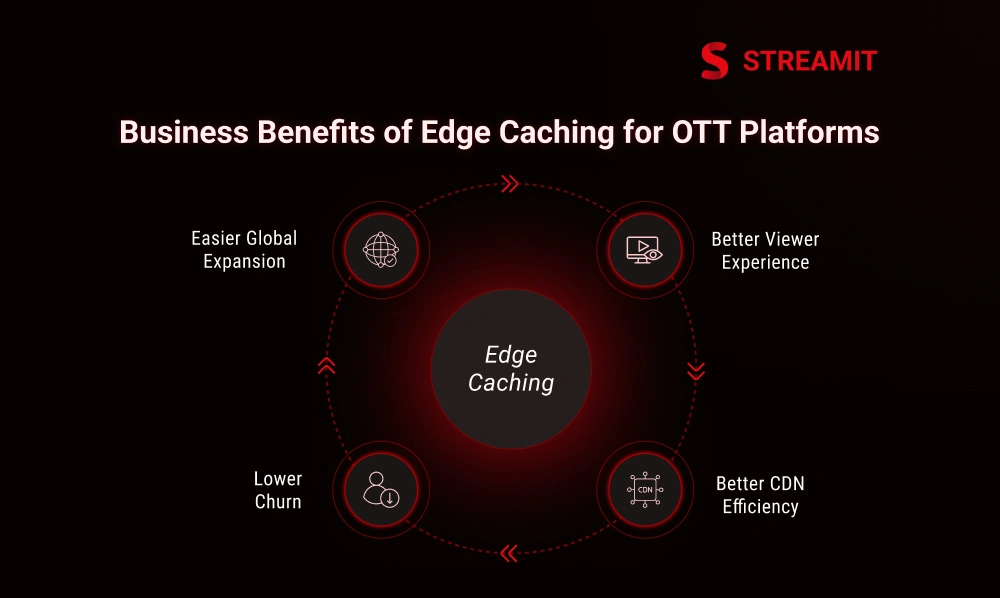
The business case for edge caching is simple: it helps the platform behave better under real conditions. That improves user confidence, protects growth, and gives the team more control over scaling costs and operational risk.
Better Viewer Experience
Smoother startup and more stable playback improve how the platform feels. Viewers may not describe that in technical terms, but they respond to it. A reliable experience always feels more premium.
Lower Churn from Performance Problems
When performance problems are reduced, fewer viewers leave because the platform feels frustrating or unstable. That makes edge caching a retention lever, not just a technical feature.
Better Use of CDN and Network Spend
A stronger cache layer reduces unnecessary repeated origin traffic and improves delivery efficiency. Network spend is used more intelligently instead of simply expanding with traffic.
Easier Global Expansion
If content is already being delivered through a stronger edge model, serving new regions becomes a less difficult operation. Global scale becomes more manageable when the architecture is already distributed.
Better Support for Premium, 4K, 8K & Interactive Use Cases
High-quality and interactive experiences place more pressure on delivery. Edge caching helps create a stronger foundation for those workloads. Premium use cases deserve premium delivery behavior.
Part 15
Is Edge Caching Right for Every OTT Platform?
Not every OTT platform needs the same depth of edge strategy from day one. But most platforms with real growth ambition will need it sooner than they think.
The question is not whether edge caching is fashionable. The question is whether the platform can keep scaling confidently without it.
Best Fit for Fast-Growing OTT Platforms
If traffic, geography, or concurrency is increasing, edge caching becomes increasingly valuable. It protects performance while growth is still manageable.
That is a better time to invest than after repeated service pain.
Best Fit for Live, Sports, News, and Event Streaming
These categories are especially sensitive to performance, synchronization, and traffic spikes. For them, strong edge design often moves from optional to necessary very quickly.
Best Fit for Global and Multi-Region Platforms
A globally distributed audience almost always benefits from content being delivered closer to demand.
The more regions you serve, the more edge proximity matters.
Cases Where Basic CDN Setup May Be Enough at First
Early-stage, regionally concentrated, mostly VOD platforms may start with a simpler CDN setup if traffic is stable and concurrency is modest.
But even in that case, measuring startup time, rebuffering, and origin load early is the smart move.
💡 Key Insight
Edge caching becomes more valuable as platforms grow across regions, devices, and live traffic conditions. The strongest results come from good delivery discipline: clean cache keys, sensible TTLs, origin shielding, cache warming, efficient ABR ladders, and real monitoring.
Summary
Key Takeaways
Delivery Quality Is a Product Decision
Buffering is not a technical inconvenience — it reduces watch time, weakens session momentum, and quietly drives churn. OTT teams that treat delivery as a backend concern underestimate how much it shapes viewer trust.
Edge Caching Moves Content Closer to Demand
By storing video segments, manifests, and assets near viewers, edge caching reduces startup time, lowers origin dependency, and improves playback stability for both VOD and live content.
Strategy Beats Defaults
Adding a CDN is not enough. The strongest results come from deliberate decisions: clean cache keys, content-aware TTLs, origin shielding, and intentional ABR ladder design working together as one system.
Live Events Demand Advance Planning
Sports, concerts, and premiere drops are predictable traffic spikes. Platforms that enter them with cold caches accept avoidable risk. Cache warming and origin protection are non-negotiables for event-driven OTT.
Mobile and Regional Gaps Are Real
A platform that feels strong on desktop or in one region may still feel weak on mobile or in another geography. Ignoring these gaps creates false internal confidence and viewer frustration outside it.
Metrics Must Cover Both Infra and User Outcomes
Cache hit ratio and origin offload tell you if the edge layer is working. Watch time, session length, and rebuffer ratio tell you if viewers are actually experiencing the benefit. Both matter.
Conclusion
Conclusion
The real test of an OTT platform is not how it looks when traffic is light. It is how it behaves when expectations are high. That is where edge caching proves its value.
It helps the platform feel faster, but more importantly, it helps the platform stay composed. It reduces unnecessary origin pressure, improves playback stability, supports a broader scale, and creates a stronger foundation for both VOD and live delivery.
For founders and teams building long-term OTT businesses, that is the real case for edge caching. Not hype. Not a checkbox. A better control layer for performance, retention, and scale.
FAQs
Frequently Asked Questions
-
What is edge caching in OTT?
Edge caching in OTT means storing video content and related assets on servers closer to viewers so that playback can start faster and rely less on the origin.
-
How does edge caching reduce buffering?
It reduces buffering by shortening delivery distance, lowering repeated origin requests, and helping video segments arrive more consistently during playback.
-
What is the difference between edge caching and a CDN?
A CDN is the broader delivery network. Edge caching is one of the core methods inside the network that stores reusable content near users.
-
How do ABR and edge caching work together?
ABR helps the player switch quality levels based on conditions. Edge caching helps those quality variants arrive more reliably, which supports smoother playback.
-
What metrics should OTT teams track after adding edge caching?
OTT teams should track cache hit ratio, startup time, rebuffer ratio, live latency, origin offload, egress cost, watch time, session length, and QoE or QoS signals.