How an OTT Platform Stands Out in the Streaming Market


The streaming market is growing, but growth has not made the business easier. It has made it more demanding. New services continue to enter the space, audience expectations keep rising, and the gap between a platform that gets noticed and a platform that gets retained is now much wider than it used to be.
For many founders, that creates a misleading starting point. They assume the challenge is still about building an app, acquiring content, and launching with enough confidence to look competitive. But the market has moved past that stage.
Viewers already have access to multiple OTT platforms. They are no longer impressed by the existence of another service. They are paying attention to whether it feels different, whether it works without friction, and whether it gives them a reason to stay.
That shift matters because the streaming market has plenty of options, but very little real differentiation. A platform stands out when it understands its audience and delivers a smoother, more relevant viewing experience.
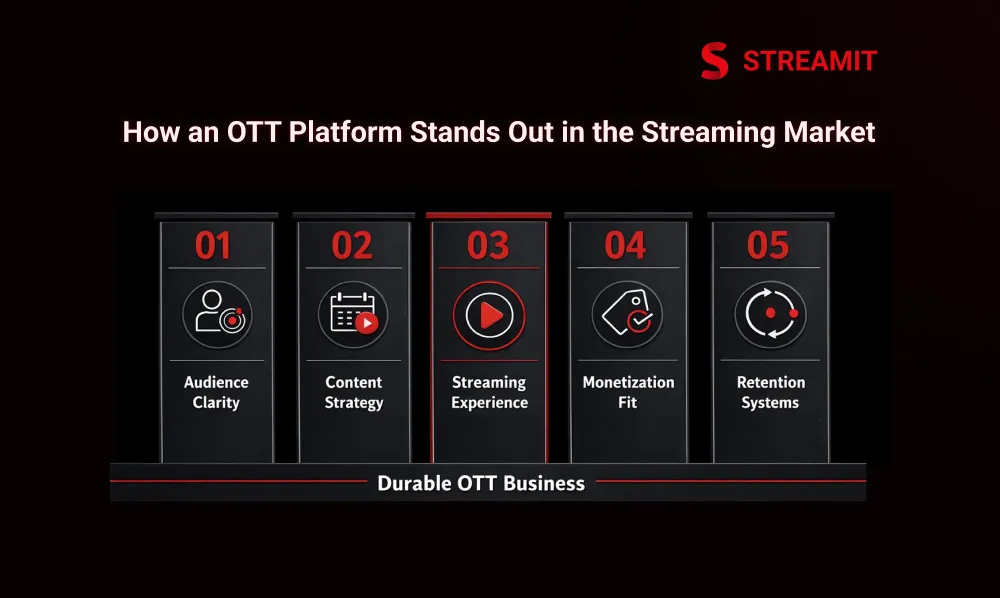
This is where a serious OTT platform starts to stand out. Not through hype, and not through clone-like positioning, but through stronger product thinking. The most durable OTT businesses are not built around launch alone. They are built around audience clarity, content strategy, streaming experience, monetization fit, and retention systems that hold up over time.
Why It Is Harder Than Ever for an OTT Platform to Stand Out
The difficulty is not simply that there are more streaming services. The real issue is that many of them feel strategically alike. Their content categories overlap, their features look familiar, their pricing is structured in similar ways, and their viewing journeys often feel interchangeable. That makes the market crowded in a deeper sense. It is not just crowded with platforms. It is crowded with sameness.
Viewers now approach OTT with more choice and less patience. They do not need a dramatic reason to leave one service for another. A slightly better experience somewhere else is often enough. That changes how a platform should think about competition. It is no longer competing only on content breadth. It is competing on convenience, discoverability, relevance, and reliability at the same time.
The streaming market is full of similar OTT platforms
A large number of OTT platforms still rely on a familiar formula. They launch with standard homepage rows, common subscription structures, generic browsing patterns, and feature sets that feel expected rather than distinctive. That is not inherently wrong, but it does create a real problem. If the user experience feels familiar in a shallow way, viewers struggle to understand why this particular platform deserves long-term attention.
In the current streaming market, that lack of clarity is expensive. Viewers do not spend much time trying to decode a platform’s value. They make quick judgments based on what they see, how fast they can reach something useful, and how smooth the product feels in the first few sessions.
Viewers have more choices and lower switching costs
Streaming audiences are increasingly comfortable moving in and out of services. They subscribe to a specific release, a sports event, a regional content collection, or a short viewing phase, and then they move on. This has made churn a structural part of the market rather than a temporary challenge.
When switching costs are low, even small weaknesses start carrying more weight. A cluttered homepage, poor recommendations, confusing onboarding, or unstable playback can quietly weaken retention. Users may not always complain. They simply return less often and renew less reliably.
Many platforms offer similar content and features
Standard features such as profiles, watchlists, on-demand access, and multi-device streaming are now basic expectations. They still matter, but they no longer create meaningful separation on their own. The same applies to broad content libraries that look large but do not feel curated or strategically defined.
When many platforms offer similar genres, similar interface patterns, and similar promises, the surrounding experience becomes more important. Viewers begin to notice how easily they can find content, how intelligently the platform responds to their behavior, and how dependable the product feels across devices.
Standing out now depends on more than just launching an app
Launching an OTT streaming platform is not the same as becoming competitive in the streaming market. Launch proves that something has been built. It does not prove that the platform has a strong content position, a useful discovery layer, a viable monetization strategy, or the product discipline needed to retain viewers over time.
That distinction is important because too many OTT platform development decisions are still optimized for shipping rather than for staying relevant. A platform may look complete at launch and still be strategically weak underneath. That weakness tends to show up later through churn, shallow watch time, poor conversion, and limited loyalty.
Users compare content, experience, and convenience together
Viewers do not separate the OTT experience into internal business categories. They do not think in terms of content team, product team, and engineering team. They experience the platform as one connected system. They ask whether the content is worth watching, whether they can find it quickly, and whether playback feels reliable.
That means content alone rarely carries the experience. A strong content library can still underperform if the overall path to content feels heavy, slow, or inconsistent. In the streaming market, convenience is not a secondary feature. It is part of the value.
Why Content Alone Is Not Enough in the Streaming Market
There is still a tendency in OTT to over-credit content and under-credit the product around it. Content is often treated as the main engine of growth, while discovery, navigation, streaming quality, and retention design are treated as supporting functions. In practice, that thinking usually creates an incomplete platform.
Content matters because it creates interest. It gives viewers a reason to visit, subscribe, or sample the platform. But content is only one layer of the business. What determines long-term growth is whether the product can turn that initial interest into repeat behavior.
Good content can attract users, but it does not guarantee retention
A strong show, exclusive live event, or niche content library can absolutely pull users into the platform. But that moment of attraction does not automatically lead to long-term engagement. If the user journey after entry feels weak, the commercial value of the content becomes much smaller than founders expect.
This is where many OTT businesses lose momentum. They invest in content but underinvest in the systems that make content usable, visible, and easy to return to. The result is a platform that gets sampled more than it gets retained.
Strong content fails when discovery is weak
Discovery is where a large portion of content value is either realized or wasted. Viewers cannot appreciate what they cannot find. If the content library is difficult to navigate, weakly categorized, or buried behind generic rows and poor search, even strong titles start losing commercial power.
That problem becomes more serious as the library grows. A bigger catalog without stronger discovery does not always create more value. In many cases, it simply creates more friction.
Great shows cannot fix a poor viewing experience
A premium title cannot fully compensate for buffering, playback errors, confusing menus, or awkward device transitions. If the platform experience feels frustrating, the user does not separate that frustration from the content itself. The session feels weaker, and the brand feels less reliable.
This is why the strongest OTT platforms treat viewing experience as part of content strategy. The platform has to deliver the content well, not just own it.
The Best OTT platforms combine content with product strength
The platforms that stand out understand that content and product are inseparable in practice. Content creates intent, but product quality determines whether that intent turns into satisfaction, habit, and revenue. Discovery, personalization, streaming quality, and retention are not side systems. They are what make content commercially durable.
Content brings users in, but experience keeps them watching
That idea sounds simple, but it changes how a platform should be built. If experience is treated as an afterthought, the service becomes harder to use even when the catalog is attractive. If experience is treated as a strategic layer, content becomes easier to discover, easier to continue, and easier to return to.
At that point, the platform starts behaving more like a mature streaming business and less like a library with an app around it.
| Platform Layer | Weak OTT Approach | Strong OTT Approach | Why It Matters |
| Content Strategy | Broad but generic | Focused, relevant, and differentiated | Gives the platform a clearer identity |
| Content Discovery | Static rows and weak search | Smart homepages, strong categories, useful filters | Reduces browsing friction |
| Personalization | Same experience for all users | Behavior-driven recommendations and tailored journeys | Increases relevance and engagement |
| Streaming Experience | Inconsistent playback and UX | Smooth viewing across mobile, web, and TV | Builds trust and satisfaction |
| Retention Design | Reactive re-engagement | Continuity features and data-led optimization | Improves long-term growth |
A Strong Content Strategy Helps an OTT Platform Get Attention
In a crowded streaming market, content strategy needs to do more than fill a library. It has to give the platform a recognizable shape. Viewers should be able to understand what the service stands for, what kind of content it does well, and why it deserves attention.
That does not always mean scale. In many cases, it means sharper positioning. A platform that knows exactly what kind of audience it serves and what kind of content identity it wants to build often moves faster than one trying to look universally appealing.
Original, exclusive, and niche content builds platform identity
A strong OTT platform benefits from content that is easier to associate with the brand. Original content supports ownership. Exclusive content supports differentiation. Niche content supports focus. Together, they make the platform more memorable and easier to position in a crowded market.
This is especially important for platforms that do not want to compete through endless breadth. Identity often matters more than volume when the goal is long-term loyalty rather than short-term sampling.
Exclusive content gives viewers a reason to choose one platform
Exclusive content gives viewers a clear answer to a simple question: why this platform, not another one. That can come through premium originals, exclusive regional licensing, creator-led content, live rights, or time-sensitive access that cannot be replicated elsewhere.
The commercial value here is not only in attraction. It is also in defense. Exclusive access makes comparison harder and improves the platform’s ability to shape pricing, retention, and perceived value.
Niche and regional content can help an OTT platform stand out faster
For many OTT businesses, niche and regional content is a more realistic growth path than trying to resemble mass-market platforms. It allows the service to become highly relevant to a specific audience instead of vaguely relevant to a broad one.
That kind of focus often creates stronger viewer loyalty, clearer messaging, and better product decisions. When the audience is well defined, content strategy becomes sharper, and the overall platform feels more intentional.
A balanced content library keeps viewers engaged for longer
A strong content strategy should not rely only on standout titles. It should also support habit formation. Some content draws new users in. Some help create a routine. Some encourage repeat watching or casual return sessions. The balance between these roles affects engagement depth and perceived value.
That is why library planning matters beyond acquisition. A platform that feels useful across different contexts usually retains better than one built around only periodic spikes of interest.
A mix of live, on-demand, and repeat-watch content improves value
Live content creates urgency. On-demand content supports flexibility. Repeat-watch content supports comfort and familiarity. When an OTT platform combines these well, it becomes more adaptable to real viewing behavior.
This also strengthens OTT monetization options. Different content types support different pricing logic, ad opportunities, and usage patterns, which matters when the platform is trying to grow without becoming overly dependent on one format.
Content Discovery Is One of the Biggest Reasons OTT Platforms Win
Discovery is often where platforms either unlock their content value or quietly suppress it. A library can be rich, but if the path through it feels weak, users will not experience that richness in a meaningful way. In practice, viewers judge the platform by how easily they can reach something relevant.
That is why content discovery should be treated as a serious strategic layer inside OTT platform development. It influences viewing time, engagement, retention, and even how large or useful the library feels.
Viewers should find relevant content quickly
The first job of an OTT platform is not only to display content. It is to reduce the time between user intent and actual playback. The faster a viewer can move from opening the platform to choosing something relevant, the better the overall experience tends to feel.
When this part of the journey is weak, the platform starts creating decision fatigue. Browsing becomes work, and users begin to feel that the service asks too much from them before delivering value.
Smart homepages, categories, and filters reduce browsing time
A strong homepage should guide rather than overwhelm. It should help viewers understand what is new, what is relevant, and where to start based on their likely interests. Categories and filters reinforce that logic by helping users narrow the library without friction.
This is one of the most practical ways an OTT streaming platform can improve usability. Better structure reduces wasted motion and increases the chance that the viewer starts watching before intent fades.
Better search and navigation improve viewing time
Search and navigation are often underestimated because they do not look flashy in product presentations. But in day-to-day use, they shape whether the platform feels intelligent or frustrating. If users can locate titles quickly, session depth improves. If they cannot, drop-off risk rises.
The real point is not merely technical accuracy. It is relevance and trust. Search should help viewers believe that the platform understands what they are looking for, even when their intent is partial or exploratory.
Metadata and recommendations improve discoverability
Behind the visible interface, metadata and recommendation logic play a major role in content discoverability. These systems help determine what appears where, how titles relate to one another, and whether the platform can surface useful suggestions beyond exact-title search.
When they are weak, the platform feels repetitive or random. When they are strong, discoverability improves without the user needing to think about why.
Better metadata helps content appear in the right places
Better metadata improves the ability of content to show up in relevant contexts across the platform. It supports stronger rows, more accurate search behavior, better filtering, and more precise recommendation logic. This is one of the quiet foundations of OTT discoverability.
A platform with strong tagging and content structuring can make the same library feel significantly more useful than a platform with weak metadata discipline.
Recommendation engines help viewers keep watching
Recommendations help sustain momentum. They reduce the gap between one session and the next choice. When the system understands user behavior well enough to surface relevant suggestions, the platform starts feeling more personal and more efficient.
That matters because OTT personalization is not only about making the interface look smart. It is about reducing decision fatigue and extending engagement in a way that feels natural.
OTT Personalization and User Experience Make the Platform Feel Better
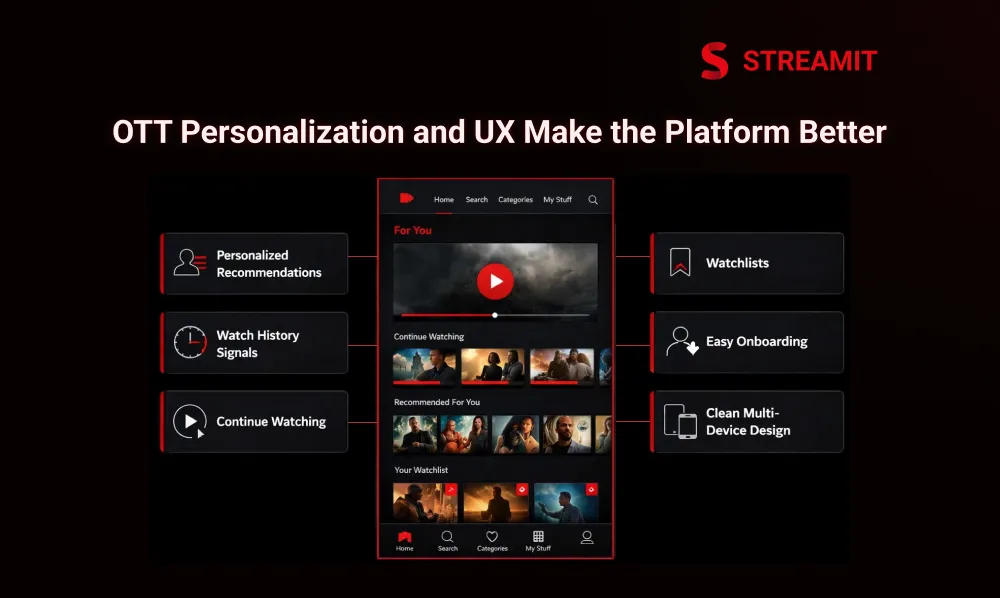
Personalization and user experience are often what give a platform its emotional texture. Viewers may not talk about them in technical language, but they absolutely feel the difference. The service either feels responsive, relevant, and easy to move through, or it feels generic and heavy.
In a market where many OTT platforms already offer comparable access and similar content categories, this layer becomes far more important than it first appears.
Personalization makes content feel more relevant to each viewer
A personalized OTT experience reduces the distance between user behavior and content relevance. Instead of asking every viewer to browse through the same static presentation, the platform adapts based on interests, history, and usage patterns. That makes the service feel more tailored and more efficient.
This is one of the clearest ways an OTT platform improves viewer retention. The easier it is for users to find something that feels right for them, the more likely they are to return.
Watch history, preferences, and behavior should shape recommendations
The strongest recommendation systems learn from actual behavior rather than from only static profile settings. Watch history, completion behavior, time-of-day patterns, content affinity, and repeat actions all reveal what the viewer is likely to want next.
Used well, those signals improve relevance without making the experience feel intrusive. They help the platform act more intelligently and reduce the friction that often weakens engagement.
Personalized rows, continue watching, and watchlists improve engagement
Some of the most effective personalization tools are also the simplest. Continue Watching, watchlists, recently viewed content, and tailored content rows create continuity between sessions. They help viewers resume intent quickly instead of rebuilding it from scratch every time.
That continuity is a meaningful part of the streaming experience. It makes the service feel more convenient, and convenience is one of the strongest drivers of repeat use.
A simple user experience improves both discovery and retention
A strong OTT UX is not about design excess. It is about removing unnecessary effort. The interface should help the viewer feel oriented, capable, and comfortable across devices. If the product becomes cluttered or inconsistent, the value of the content starts getting diluted by interaction friction.
This is why UX should be treated as a growth layer, not just a visual one. A cleaner experience can improve discovery, satisfaction, and retention at the same time.
Easy onboarding helps users reach content faster
Onboarding should move viewers toward value, not away from it. The platform should help users understand what it offers, personalize lightly where useful, and reach meaningful content without delay. If the first session feels overloaded with steps or unclear choices, early intent starts weakening.
For OTT platform development, this means onboarding should be disciplined. It should support conversion without slowing down access.
Clean design across mobile, TV, and web builds trust
A clean multi-device UX gives the platform a sense of consistency. The layouts do not need to be identical, but the logic should remain coherent across mobile, web, and smart TV. That helps viewers feel familiar with the service, no matter where they open it.
Trust grows when the platform feels predictable in the right ways. That predictability is a major part of what turns a one-time viewer into a returning user.
Streaming Quality and Multi-Device Support Shape Viewer Retention
The most beautifully positioned OTT platform still loses value if the product breaks during playback. This is where streaming quality becomes inseparable from business performance. Users do not experience technical reliability as a background detail. They experience it as part of the service itself.
A platform that buffers, stutters, crashes, or behaves inconsistently across devices creates a sense of instability. Even when the content is strong, the service starts feeling less dependable and, therefore, easier to replace.
Poor performance makes users leave quickly
When an OTT platform performs badly, the damage is immediate. Viewers rarely wait patiently through repeated playback issues when other options are close at hand. This makes performance one of the fastest routes to churn in the streaming market.
The strategic point here is simple. App performance is not only a technical KPI. It is a retention variable.
Slow load times and buffering hurt the viewing experience
Nothing makes streaming feel less premium than delay and interruption. Slow startup time, mid-session buffering, and quality instability all weaken the sense that the platform is professionally built. They increase friction at the exact moment the user expects the experience to feel effortless.
In practical terms, reducing these issues often improves satisfaction more than adding another surface-level feature ever will.
Playback problems reduce trust in the platform
Trust is fragile in OTT. A few poor sessions can create a lasting impression that the platform is unreliable. That impression affects not only current watch time but also future intent. Users begin approaching the service with lower confidence, which makes them less likely to return spontaneously.
This is one reason serious OTT platform development should plan for real usage conditions, not only for launch readiness.
Multi-device support is now a basic viewer expectation
Viewers expect streaming to move with them. They may start on mobile, continue on web, and finish on smart TV. That behavior is now standard, which means multi-device streaming is not a premium extra. It is a baseline expectation.
For a platform trying to grow in a competitive market, that changes the product requirement. Device support is no longer about simply being present on multiple screens. It is about delivering a coherent and dependable experience across them.
Users expect smooth playback across mobile, web, and smart TV
Each device context creates different demands. Mobile viewing may happen in short bursts. Smart TV viewing may be longer and more immersive. Web sessions may involve faster browsing and account actions. A strong OTT platform should respond well to each without feeling fragmented.
If the product experience breaks at device transitions, the overall platform starts feeling incomplete, no matter how strong the content catalog may be.
Cross-device sync improves convenience and session continuity
Cross-device continuity is one of the clearest examples of how convenience shapes viewer retention. Resume points, viewing history, watchlists, preferences, and profile state should carry naturally across devices. When they do, the platform becomes much easier to live with.
This is not a small usability detail. It is part of what makes the service feel modern, reliable, and worth returning to.
| Growth Focus | What the Platform Should Improve | Business Outcome |
| Streaming Quality | Faster startup, lower buffering, reliable playback | More trust and longer sessions |
| Multi-Device Experience | Stable viewing across mobile, web, and TV | Better accessibility and usage depth |
| Cross-Device Continuity | Synced progress, watchlists, and user state | Higher convenience and repeat use |
| Monetization Fit | Pricing and access aligned with audience value | Stronger conversion and revenue quality |
| Retention Systems | Re-engagement, behavioral insight, content continuity | Lower churn and better long-term growth |
Monetization and Retention Decide Long-Term OTT Platform Growth
At some point, every OTT platform has to prove that it is not only attracting users but building a durable business. That is where monetization and retention become central. A platform can generate attention without being economically healthy. It can also drive early installs without creating real long-term value.
The stronger businesses understand that growth quality matters more than shallow growth optics. They focus on audience fit, pricing logic, engagement depth, and returning behavior rather than chasing raw top-of-funnel numbers alone.
The right monetization model helps an OTT platform compete better
There is no universal OTT monetization model that works for every platform. Subscription, ad-supported access, transactional viewing, and hybrid structures can all work when they align with content strategy and audience behavior. The real decision is not which model looks strongest in theory. It is the model that fits how viewers actually want to consume and pay.
That is where many OTT businesses either sharpen or weaken their competitive position. A strong monetization structure supports adoption without undermining the viewer relationship.
Pricing should match audience value and content strategy
Pricing sends a signal about what the platform believes it is worth. If the price feels misaligned with the content offer or the quality of experience, users hesitate. If the model feels too cheap for a premium proposition, the business may struggle to sustain quality and perceived value over time.
This is why pricing should be treated as part of strategy, not just finance. It has to match audience expectations and the role the platform wants to play in the streaming market.
Hybrid monetization can widen reach in a crowded streaming market
Hybrid models can be especially useful in a market where audience budgets, usage patterns, and content intensity vary widely. They allow the platform to capture casual viewers through lower-friction access while still creating premium paths for users who want more depth or fewer interruptions.
For many platforms, this is a practical way to widen reach without flattening the business model into a single revenue assumption.
Retention matters more than short-term user acquisition
User acquisition matters, but it becomes expensive very quickly if the product does not retain. A platform that keeps reacquiring shallow traffic without improving repeat use usually ends up with weak economics and unstable growth.
Retention is what turns content, UX, and monetization into a business system. It reflects whether the platform is becoming part of viewer’s habit rather than merely benefiting from temporary attention.
Re-engagement features help bring viewers back
Re-engagement works when it is connected to real viewer intent. Resume prompts, relevant content alerts, watchlist reminders, and behavior-based nudges can all help users come back when they are timely and useful.
The goal is not to push more messages. It is to make returning feel easier than dropping off.
Behavior data helps improve content and product decisions
Behavior data is what allows the platform to improve with discipline. It helps teams see where users drop off, what content creates deeper engagement, what parts of the UX slow viewers down, and where monetization is creating friction or value.
Used well, this data becomes one of the strongest foundations for streaming platform growth. It moves decision-making away from assumptions and toward actual user behavior.
How to Build an OTT Platform That Stands Out in the Streaming Market
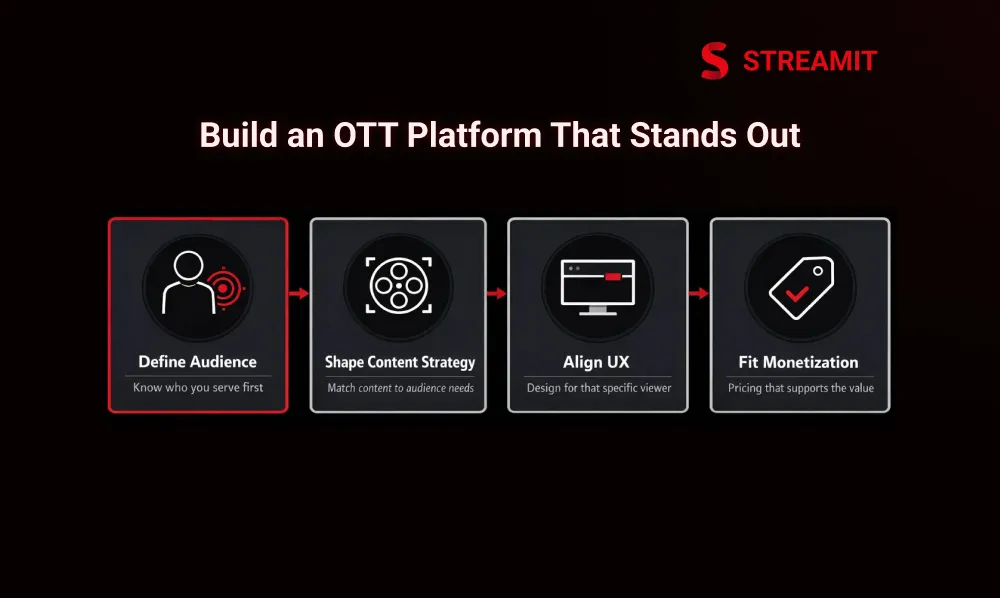
Building a standout OTT platform requires a clearer starting point than many teams assume. The strongest platforms are rarely built by trying to imitate the broadest players in the market. They are built by understanding a specific audience, shaping a coherent content strategy, and creating a product experience that feels deliberate rather than generic.
That is where serious OTT platform development differs from surface-level execution. It is not about launching with every possible feature. It is about building the systems that create real differentiation and long-term control.
Start with a clear audience, content focus, and product direction
Audience clarity is often where a good OTT strategy begins. If the platform does not know who it serves, content decisions become vague, UX choices become inconsistent, and monetization logic starts drifting. The result is usually a product that looks active but feels unfocused.
A platform that starts with a sharper audience definition tends to make better decisions across the board. It knows what kind of content it should emphasize, what kind of viewing patterns it should support, and what kind of experience its users are likely to value most.
Define who the platform serves before building features
This is one of the most common mistakes in streaming product planning. Teams often jump too quickly into features without fully clarifying who the service is for and what problem it should solve in that viewer’s life. That creates platforms with lots of functionality but very little strategic center.
A better approach is to define the audience first. Once that is clear, features become easier to prioritize and far easier to justify.
Match content, UX, and monetization to that audience
Content, user experience, and monetization should reinforce one another. If the audience is niche and high-intent, the platform should reflect that through stronger curation, clearer positioning, and pricing that supports the value. If the audience is broader and more casual, discovery and access models may need to be more flexible.
This alignment is one of the clearest differences between a platform that feels designed and one that feels assembled.
Focus on the areas that actually create differentiation
Real OTT differentiation rarely comes from surface-level feature lists. It usually comes from a smaller set of areas that influence daily viewer behavior more directly: content discovery, personalization, streaming quality, multi-device continuity, and retention systems.
These are the layers that shape whether the platform becomes easier to choose and harder to leave. They do not always look dramatic in a demo, but they matter more in real usage.
Prioritize discovery, personalization, performance, and retention
These four areas deserve disproportionate attention because they influence the full lifecycle of viewing. Discovery helps users reach relevant content. Personalization improves relevance. Performance protects trust during playback. Retention systems make it easier to come back.
If a platform gets these right, it starts to feel materially stronger even without trying to mimic the size or noise of the largest services in the market.
Avoid common mistakes like weak UX, poor discovery, and generic strategy
Many OTT platforms do not fail because they lack ambition. They struggle because their strategy remained too generic. Weak discovery, inconsistent UX, shallow retention design, and unclear audience focus all create slow-moving problems that are easy to ignore at first and difficult to fix later.
Avoiding those mistakes is often more valuable than adding another layer of surface complexity. The market is already crowded enough. A platform stands out when it removes friction better, not when it merely adds more.
Key Takeaways
- Standing Out Takes More Than Launching: This blog showed that an OTT platform stands out through clear positioning, better product decisions, and a stronger streaming experience.
- Content Alone Is Not Enough: Good content can attract viewers, but retention depends on discovery, personalization, performance, and ease of use.
- Content Discovery Drives Engagement: Smart homepages, better search, filters, and metadata help viewers find relevant content faster and keep watching.
- Personalization Improves Viewer Retention: Personalized recommendations, Continue Watching, and watchlists make the platform feel more relevant and engaging.
- User Experience Builds Long-Term Trust: Clean design, easy onboarding, and smooth navigation across devices improve satisfaction and platform trust.
- Streaming Quality Shapes Platform Success: Buffering, slow load times, and playback issues reduce trust, engagement, and long-term retention.
- Multi-Device Streaming Is Now a Basic Expectation: Viewers expect seamless playback across mobile, web, and smart TV with strong cross-device continuity.
- Monetization Should Match Audience Behavior: SVOD, AVOD, TVOD, and hybrid models work best when aligned with content strategy and viewer needs.
- Retention Matters More Than Short-Term Acquisition: Re-engagement features and behavior-based improvements help turn early interest into long-term usage.
- The Strongest OTT Platforms Are Built with Strategy: Clear audience focus, better discovery, stronger performance, and long-term thinking create lasting differentiation.
Conclusion
Standing out in the streaming market is no longer about launching an app with enough features to look complete. It is about building an OTT platform that feels more relevant, more dependable, and more intentional than the many alternatives around it.
That means content strategy still matters, but it cannot work alone. Discovery has to be strong enough to surface value quickly. Personalization has to make the experience feel more useful over time. Streaming quality has to protect trust. Multi-device support has to feel seamless. Monetization has to match audience behavior. Retention has to be designed into the platform rather than added as an afterthought.
For founders and platform owners, that is actually good news. It means the path to differentiation is not only about bigger budgets or louder launches. It is all about making better structural decisions. The OTT platforms that last are usually the ones that take product quality, audience fit, and long-term control seriously from the beginning.
That is what makes a platform stand out. Not the promise of being another streaming app, but the reality of becoming a better streaming business.
FAQs
What makes an OTT platform stand out in the streaming market?
An OTT platform stands out when it combines strong content positioning with better product execution. Viewers notice whether the platform feels easy to use, relevant to their interests, reliable across devices, and worth returning to.
Is content alone enough to make an OTT platform successful?
No. Content can attract users, but it does not guarantee retention. If discovery is weak, streaming quality is poor, or the user experience feels generic, even strong content may fail to create long-term platform value.
Why is content discovery important for OTT platform growth?
Content discovery helps viewers find relevant titles faster. Better search, smarter navigation, useful filters, stronger metadata, and improved recommendations all reduce browsing friction and support engagement.
How does OTT personalization improve viewer retention?
OTT personalization improves viewer retention by making the experience feel more relevant. Recommendations, Continue Watching, watchlists, and tailored rows help users reach useful content faster and return more naturally.
Why does streaming quality matter for OTT platform success?
Streaming quality affects trust. If viewers experience buffering, crashes, slow load times, or unreliable playback, they are more likely to leave and less likely to return. Strong performance is a core part of the streaming experience.
Which OTT monetization model works best in a crowded streaming market?
There is no single model that works for every platform. SVOD, AVOD, TVOD, and hybrid models can all work when they align with audience behavior, content strategy, and platform goals.
Read Also
1. Starting Your Own OTT Platform in India: The Real Numbers No One Tells You
2. Netflix-Like OTT Platform: Complete Build Guide
3. Why Streaming Startups Fail Within 18 Months?
4. Streaming Issues: 7 Reasons Why Your OTT App Is Failing
5. Top OTT Solution Providers for Modern Streaming Platforms