Starting Your Own OTT Platform in India: The Real Numbers No One Tells You

This guide is written for founders, filmmakers, and directors who want to understand the real costs and actual steps involved in launching an OTT platform in India — without the technical jargon, without vague estimates, and without sugarcoating.
India’s streaming market is one of the fastest-growing in the world. But most guides either oversimplify the opportunity or bury you in tech specs. What follows is a ground-level breakdown of everything you need to launch and operate a streaming platform here.
Part 1
Understanding Your Monthly Recurring Costs
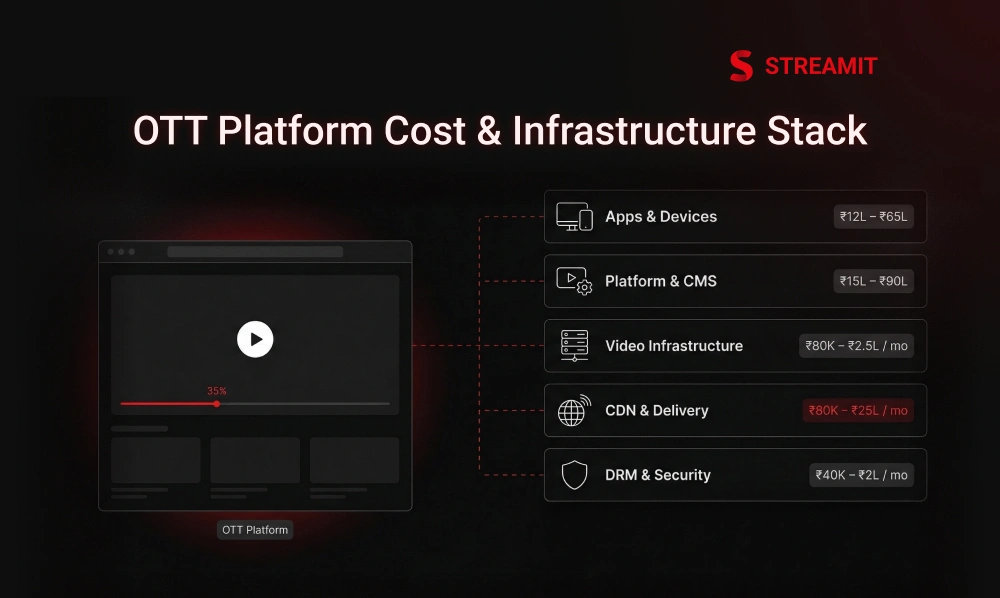
Running an OTT platform is like running a digital cinema hall. Your costs depend on how many people “walk in” and how much data they consume. There are two major cost buckets to understand from day one.
The #1 Cost Driver: Video Delivery (Bandwidth)
In the streaming world, bandwidth is king. This is the cost of moving video from your servers to the user’s phone or TV. Every time a user clicks “Play,” you pay a small fee for the data they use.
📐 The Simple Math
One user watching an HD movie for 1 hour uses about 1.8 GB of data. If you have 300 people watching 1 hour every day, you’re streaming approximately 16 TB of data per month. At typical Indian CDN rates, that number starts to matter very quickly.
The Digital Warehouse: Storage & Infrastructure
Fixed monthly costs cover servers, database (storing passwords, watchlists, payment history), and security infrastructure. These stay relatively constant regardless of viewership.
Transcoding is a one-time cost per title. When you upload a movie, it gets converted into multiple formats — compressed for slow 3G, larger for 4K TVs. Every new piece of content triggers this cost.
Monthly Cost Estimates: The Reality Check
Here is what you can realistically expect to spend at each stage of growth. These are Indian market estimates:
| Stage | Total Users | Daily Active | Est. Monthly Cost | Cost / User |
|---|---|---|---|---|
| Launch | 1,000 | 300 / day | ₹80,000 – ₹2,50,000 | ₹80 – ₹250 |
| Growth | 10,000 | 3,000 / day | ₹6,50,000 – ₹25,00,000 | ₹65 – ₹250 |
| Scale | 10,00,000 | 3,00,000 / day | ₹3.3 Cr – ₹20 Cr | ₹30 – ₹200 |
💡 Founder’s Tip
Don’t be scared of rising costs. Higher costs mean more people are watching — which almost always means more subscription or ad revenue coming in. Your cost-per-user drops from ₹250 at launch to as low as ₹30 at a million users. Unit economics improve at scale.
Part 2
How to Get Content for Your Platform
Content is the soul of your OTT. Without compelling films and shows, even the most technically perfect platform will fail. If you don’t have your own productions, you need to license content from others. Here’s exactly how that works.
Step 1: Identify Your Content Source
-
01Independent Filmmakers
Ideal for niche or regional content. Many talented indie filmmakers in India are actively looking for distribution partners. Licensing rates tend to be lower and negotiations more flexible — though you’ll need to verify chain of title carefully.
-
02Production Houses
Established companies with libraries of movies and shows. Higher upfront costs but more legally airtight documentation. They typically have existing rate cards and standard contract templates which speeds up the process.
-
03Content Aggregators
Middlemen who represent multiple small producers — the easiest entry point for new platforms. Companies like Ultra Media and Shemaroo give you access to large libraries through a single deal. Ideal while building your initial catalogue.
Step 2: The Letter of Intent (LOI)
When reaching out to a production house or filmmaker, send a formal Letter of Intent (LOI). This signals you’re a serious buyer and sets the stage for negotiation.
A good LOI includes: who you are, what your platform is about, which specific titles you want, the territory (e.g. “India only” or “worldwide”), your proposed licensing period, and a strong pitch for why their content will reach a new audience on your platform.
Step 3: Essential Legal Documents
To legally stream any movie in India, you must have all four of these documents in place before content goes live:
Content License Agreement
The primary contract granting you the right to stream. Defines territory, exclusivity, duration, and payment terms.
Chain of Title
Proof that the seller actually owns the rights. Missing this creates major legal liability down the line.
Censor Certificate (CBFC)
Required for public exhibition in India. Without a valid certificate you cannot legally exhibit the film.
Metadata & Assets
High-res posters, trailers, subtitles, and the master video file. Poor quality assets damage your credibility immediately.
Step 4: Key Licensing Terms Explained
Exclusive vs. Non-Exclusive
“Exclusive” means only your platform can stream the title. “Non-exclusive” means the producer can sell it to others like YouTube or Prime simultaneously. Exclusivity commands a premium but builds unique platform value.
MG (Minimum Guarantee)
An upfront payment to the producer regardless of viewership. Think of it as an advance against royalties. Higher MGs buy you better content and exclusivity terms.
Revenue Share
You pay the producer a percentage of what you actually earn from their content. Typically 20–50% depending on the deal. Lower risk for you, but harder to negotiate with major houses.
Windowing
The time period after theatrical release before a film can be licensed for OTT. Currently a matter of industry negotiation in India — typically 4–8 weeks for major studios.
Part 3
Who to Contact: Indian Production Houses & Aggregators
A curated list of production houses and aggregators worth reaching out to, organized by the type of content they represent:
Big Players
Yash Raj Films · Dharma Productions · Red Chillies Entertainment
Major Bollywood blockbusters. Expect high MGs and strict exclusivity terms, but unmatched catalogue depth.
Regional & Indie
SVF (Bengali) · Geetha Arts (Telugu) · Neelam (Pa. Ranjith)
Award-winning regional cinema. More flexible licensing terms. Excellent for niche platform positioning.
Digital / Web Series
TVF (The Viral Fever) · Pocket Aces
Youth-centric web series with strong subscriber affinity. Great for building a younger, engaged base.
Aggregators
Ultra Media · Shemaroo · Eros Now
Large libraries across languages. Best starting point for new platforms needing fast catalogue volume.
🎯 Niche Strategy Tip
Don’t try to compete with Netflix on catalogue breadth. Own a niche. “The home of independent Tamil horror” or “India’s only platform for rural documentary films” gives you a cleaner brand story, lower content costs, and a more loyal subscriber base than a generic catalogue ever could.
Summary
Why Now Is the Right Time to Start
India’s OTT market grew from near-zero to 500+ million streaming users in under a decade. Regional-language content is the next frontier — and the founders who move now will own the most defensible positions before the market consolidates further.
You Own the Data
Your own platform gives you full visibility into who watches what, when, and for how long. That data is worth more than the subscription fee itself.
No Middlemen
Traditional distribution and YouTube’s 45% cut extract enormous value. Direct-to-consumer keeps the majority of revenue with you.
Instant Global Reach
A filmmaker in Kerala can reach a diaspora audience in London or Toronto the moment their film goes live. Geography is no longer a barrier.
Start Niche, Scale Smart
Focus on a specific genre or language to keep costs low. Niche platforms build more loyal audiences and are far cheaper to operate at early stage.
🚀 Final Advice
Start small. Focus on a specific niche — like “Regional Horror” or “Independent Documentaries” — to keep initial costs low. Validate your audience and pricing model with 1,000 paying subscribers before investing in scale. The OTT founders who win understand their unit economics before they optimize for growth.