Why Zero Buffer Streaming Fails Without Multi‑CDN

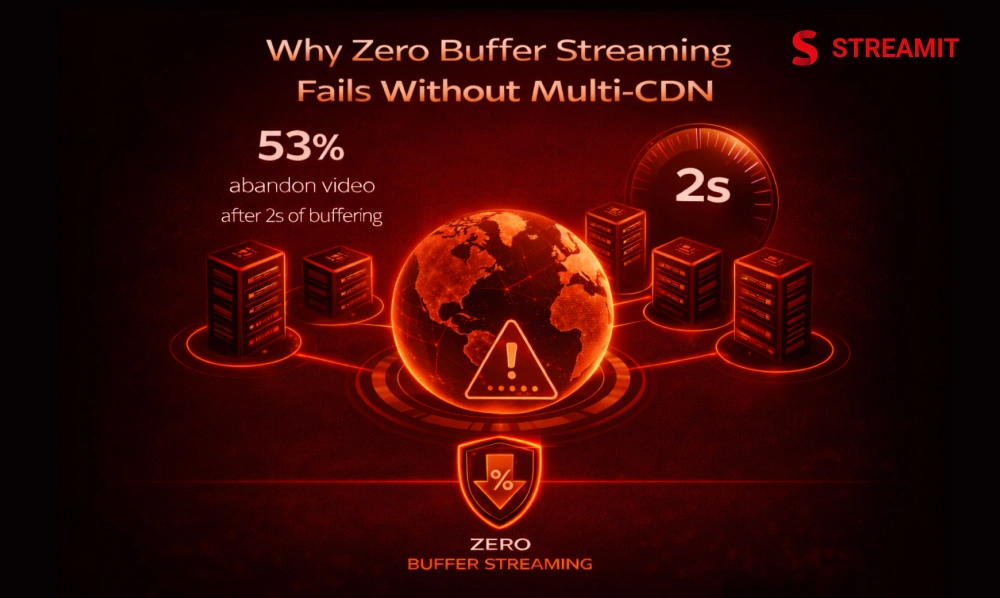
More than 53% of viewers leave a video if it buffers longer than two seconds. That single stat explains why buffering is no longer a “technical issue”, it’s a business risk.
In today’s on-demand world, viewers don’t wait. They don’t troubleshoot. They don’t blame their network. Whether you run an OTT platform, an EdTech app, a live sports service, or an enterprise video portal, playback reliability directly affects retention, revenue, and brand trust.
Built to solve this exact problem at its core, Zero Buffer Streaming relies on studied engineering choices rather than marketing promises eliminating buffering by addressing its root causes instead of masking the symptoms.
This blog explains how the approach works, why traditional CDNs fail under real-world conditions, and how intelligent Multi-CDN switching transforms the entire playback experience.
The Everyday Reality of Streaming Failures
Buffering is rarely caused by a single failure. It’s usually dead by a thousand small delays.
The user hits play, but slow responses cause delays. The video starts late, and playback keeps stuttering.
From the viewer’s perspective, it looks like “bad internet”. From the platform’s perspective, the problem is far more complex.
Common Day-to-Day Streaming Challenges
- Users switching between 4G and 5G networks on mobile
- ISPs throttling traffic during peak hours
- CDN edge nodes overloaded in certain regions
- Sudden traffic spikes during live events
- Regional routing inefficiencies
Each of these can break playback,even if your infrastructure looks perfect on paper.
Why Single CDN Streaming Fails at Scale
A single CDN assumes one network can perform well everywhere, all the time. That assumption no longer holds.
Even top-tier CDNs experience:
- Regional congestion
- ISP-specific slowdowns
- Temporary outages
- Inconsistent edge performance
When your platform relies on just one CDN, every viewer is forced through the same delivery path,whether it’s optimal or not.
Real-World Scenario: Sports Final Night
Imagine a regional sports streaming app broadcasting a championship final.
As viewership spikes, traffic floods a nearby delivery path, slowing responses and frustrating thousands of fans mid-match.
Nothing actually broke. The platform was up. The CDN was operational. But trust was already lost.
What Zero Buffer Streaming Actually Means
Zero Buffer Streaming is not about eliminating buffering completely, it’s about preventing buffering from ever reaching the viewer.
Instead of reacting after playback fails, the system proactively chooses the best possible delivery path for every session.
That’s where intelligent Multi-CDN switching comes in.
How Zero Buffer Streaming Works: High-Level Overview
Every playback session is treated as a real-time decision, not a static configuration.
Step-by-Step Playback Flow
User clicks Play
The moment the user taps Play, the video player sends a playback request to the platform. Along with this request, basic context is already available, such as the user’s region, device type, network (Wi-Fi / 4G / 5G), and recent playback conditions. No video is streamed yet. This pause is intentional and happens in milliseconds.
Platform evaluates real-time CDN performance data
Before choosing where to stream from, the platform checks the latest CDN health data. This data is continuously collected in the background and includes real performance signals from nearby regions and ISPs. The system looks at how each CDN is performing right now, not historical averages alone.
Best-performing CDN is selected instantly
Using the real-time data, the system scores each available CDN for this specific playback session.The CDN with the highest score meaning the lowest latency, fastest segment delivery, and highest stability is selected as the primary delivery path. A secondary CDN is also identified as a fallback, in case conditions change.
Player receives the optimal stream link
Once the decision is made, the player is given the correct HLS or DASH manifest URL mapped to the selected CDN.This ensures the very first request for video segments goes to the fastest and healthiest delivery path, instead of relying on a default or static CDN.
Playback starts with minimal startup delay
With the optimal CDN already chosen, the first video segments arrive quickly and the buffer fills smoothly. Playback begins almost immediately, without trial-and-error retries or visible delays. From the viewer’s perspective, the video simply starts fast and plays normally unaware that multiple delivery decisions were made behind the scenes.
Why this matters
By making these decisions before playback begins, Zero Buffer Streaming prevents the most common causes of startup delay and early buffering, instead of reacting after the experience is already broken.
Intelligent CDN Selection: Performance-Based, Context-Aware
Zero Buffer Streaming does not rotate CDNs blindly. It chooses based on live performance signals.
Key Signals Used in CDN Scoring
- Time to First Byte (TTFB)
- Segment download speed
- Error rates
- Historical regional performance
- ISP-specific latency trends
Each CDN is continuously scored. The fastest and healthiest option wins.
Switching Before Playback Starts
The best time to prevent buffering is before playback begins.
When a user opens a video:
- The system checks stored CDN performance scores
- It predicts which CDN will deliver the fastest startup
- The player is handed the optimal manifest URL
The viewer never knows a decision was made,they only see instant playback.
Switching During Playback (Failover Without Disruption)
Even the best CDN can degrade mid-session. Zero Buffer Streaming monitors playback health continuously.
If the system detects:
- Rebuffering events
- Segment download failures
- Rising latency
The player seamlessly switches to a backup CDN without restarting playback.
What the viewer experiences:
A sudden traffic surge overwhelms nearby servers, yet playback continues without interruption. Having backup systems is one thing, but real reliability ensures the video keeps playing smoothly, no matter which servers or networks are affected.
CDN Delivery Architecture Explained Simply
Think of CDNs as delivery routes whose performance constantly changes with traffic, location, and time. Zero Buffer Streaming doesn’t force everyone onto one highway. It dynamically picks the fastest route for every viewer.
Multi-CDN Delivery Structure
- Origin storage hosts master video files
- Multiple CDNs cache and deliver segments
- Player requests segments from the selected CDN
- Failover happens automatically if needed
- Origin storage hosts master video files
This architecture removes single points of failure entirely.
DRM Protection Without Playback Delays
Security should never slow down streaming.
Zero Buffer Streaming integrates DRM without adding latency.
DRM Flow in Practice
- Player requests playback
- License request is triggered
- DRM server validates access
- License is granted
- Encrypted segments are decrypted locally
All of this happens in parallel with CDN selection, so users never wait.
Real-World Use Cases
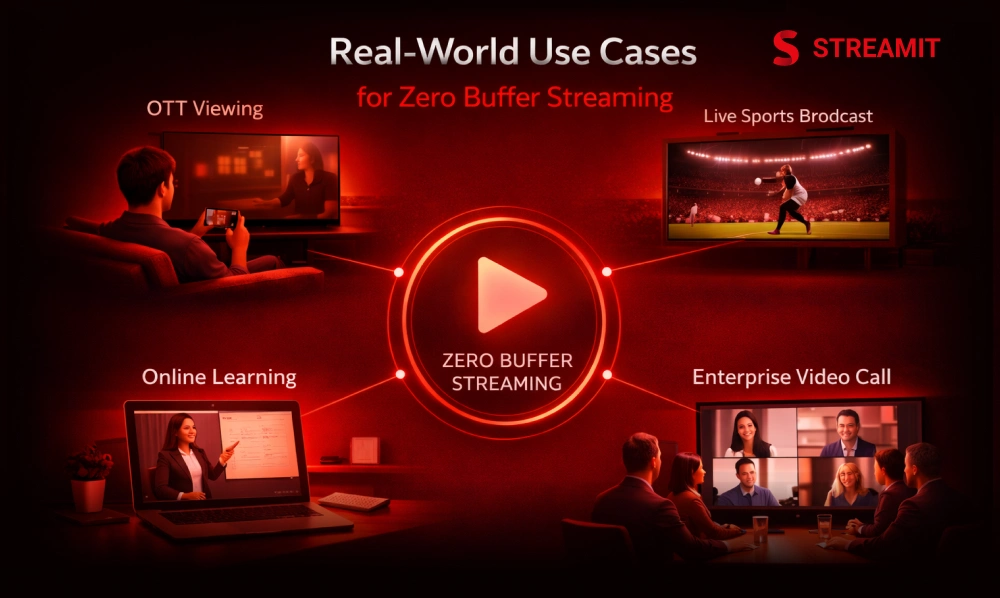
OTT Platforms
OTT users are unforgiving. One buffering incident often means a canceled subscription.
Zero Buffer Streaming ensures:
- Faster app launches
- Smooth binge sessions
- Reliable playback during peak hours
Live Sports Streaming
Live sports magnify every weakness. Multi-CDN switching absorbs traffic spikes, protects against regional failures, and keeps streams stable during critical moments.
EdTech Platforms
Students don’t complain,they disengage. Zero Buffer Streaming keeps:
- Recorded lectures smooth
- Live classes interruption-free
- Mobile playback consistent
Enterprise & Internal Video
Town halls, training sessions, and investor updates demand reliability. Buffer-free playback protects credibility when it matters most.
Performance Impact That Actually Matters
Platforms using intelligent Multi-CDN switching report:
These gains directly translate into revenue and engagement.
Trust Is Built on Invisible Reliability
Users rarely praise smooth playback,but they immediately notice when it fails.
Zero Buffer Streaming builds trust quietly:
- No excuses
- No buffering wheels
- No apologies
- Just video that plays
What Actually Causes Buffering Behind the Scenes
Buffering is almost never caused by the video file itself. Most problems occur between the viewer and the CDN edge. Videos are delivered in small chunks called segments. The player requests these segments continuously. If even a few arrive late or fail, playback stalls.
Most Common Hidden Causes
- CDN edge congestion in a specific city or ISP
- Inefficient routing between ISP and CDN
- Sudden traffic spikes overwhelming one delivery path
- Temporary packet loss on long-distance routes
- ISP throttling during peak hours
None of these appear as “outages” on status pages, yet they impact real users every day.
Why Traditional Failover Is Not Enough
Many platforms believe they are protected because they have a backup CDN. In practice, this backup often activates too late.
Traditional failover:
- CDN A fails completely
- Health check notices the failure
- Traffic is switched to CDN B
The problem: by the time a CDN is marked “down,” users have already experienced buffering, errors, or failed playback.
Zero Buffer Streaming avoids this by switching based on performance degradation, not complete failure.
Performance-Based Switching vs Failure-Based Switching
Waiting for failure is waiting too long.
Zero Buffer Streaming switches when it detects early warning signs:
- Rising segment download times
- Increasing retry counts
- Buffer levels dropping faster than expected
This allows the player to escape a bad route before playback collapses.
How Zero Buffer Streaming Makes Decisions in Real Time
Zero Buffer Streaming is one simple idea: decisions must be made faster than problems appear. Everything else flows from that principle.
This section breaks down the technical logic in a way that’s understandable for both technical and non-technical readers.
CDN Scoring: How the “Best” CDN Is Chosen
Not all performance signals are equal. Zero Buffer Streaming assigns weight to metrics that directly affect playback.
Core Metrics Used in CDN Scoring:
- Time to First Byte (TTFB): How quickly the first segment arrives
- Segment Download Time: Consistency matters more than raw speed
- Error Rate: Even small spikes indicate instability
- Historical Reliability: Short-term spikes are balanced against long-term trends
- ISP-Specific Performance: A CDN may work better on Airtel than Jio, or Comcast than Verizon
Each metric contributes to a rolling performance score. The CDN with the highest score for that specific viewer is selected.
Why Geography Alone Is Not Enough
Many systems choose CDNs based only on geography. This is outdated thinking.
Two users in the same city may:
- Use different ISPs
- Be on different network types (fiber vs mobile)
- Experience completely different routing paths
Zero Buffer Streaming considers geography, ISP, and recent performance together, creating a truly optimized path for each viewer.
Segment-Level Monitoring Explained Simply
Playback health is judged segment by segment, not minute by minute.
Each video segment acts like a small health check:
- Was it delivered on time?
- Did it require retries?
- Did it arrive slower than expected?
If multiple segments show stress, the system prepares to switch routes before the buffer empties.
Mid-Playback Switching Without Restarting Video
The hardest part of Multi-CDN switching is hiding it from the viewer.
Zero Buffer Streaming achieves this by:
- Keeping segment formats identical across CDNs
- Maintaining continuous playback buffers
- Switching at segment boundaries
From the viewer’s perspective, nothing changes.
Why DNS-Based Switching Falls Short
DNS switching is too slow for modern streaming.
Limitations of DNS switching:
- Propagates slowly across networks
- Aggressively cached by ISPs and devices
- Cannot react mid-session
Zero Buffer Streaming operates at the player and session level, not at the DNS level, enabling real-time adaptation.
Handling Sudden Traffic Surges Gracefully
Traffic spikes don’t break systems; bad distribution does.
When demand surges:
- New sessions are spread across multiple CDNs
- Existing sessions remain stable
- No single path collapses
This controlled distribution prevents cascading failures.
DRM and Security at Scale
Security must scale without friction. Zero Buffer Streaming integrates DRM so that:
- License requests are cached intelligently
- DRM servers are regionally optimized
- Security checks do not block playback startup
Protected content remains protected without buffering penalties.
Compliance Without Compromise
Studios, broadcasters, and enterprises demand compliance. Zero Buffer Streaming supports:
- Content encryption standards
- Regional access controls
- Device-level restrictions
All while keeping playback smooth.
Industry Deep Dives
OTT Platforms
OTT platforms live or die by retention. Acquisition is expensive, and losing users to buffering is unforgivable.
Common OTT Pain Points:
- Peak-hour congestion
- Device fragmentation
- Global audience distribution
Zero Buffer Streaming stabilizes the experience across devices and regions.
Binge Watching Without Interruptions
Binge sessions amplify small issues. One buffer early can end the session.
With Zero Buffer Streaming:
- The first episode starts fast
- Subsequent episodes reuse optimized routes
- Long sessions remain stable
This directly improves completion rates.
Live Sports & Events
Live events expose infrastructure weaknesses instantly. Fans expect zero delay, zero interruption, especially during decisive moments.
Zero Buffer Streaming:
- Absorbs flash crowds
- Prevents regional outages from spreading
- Keeps streams alive during peak intensity
EdTech & Learning Platforms
Education depends on continuity. A broken lecture breaks focus.
Students on:
- Budget devices
- Shared networks
- Unstable mobile data
Benefit most from intelligent routing that keeps playback smooth.
Media & Broadcasters
Broadcast-grade reliability is expected, not optional.
Zero Buffer Streaming enables:
- Large-scale simulcasts
- Regional news distribution
- Reliable ad insertion
Decision-Maker Perspectives
Product Teams
Product teams care about user experience. Fewer playback issues mean:
- Better reviews
- Higher ratings
- Lower churn
Business Leaders
Business leaders care about outcomes. Buffer-free playback leads to:
- Longer watch time
- Higher ad completion
- Stronger subscriptions
Build vs Buy: A Practical Reality Check
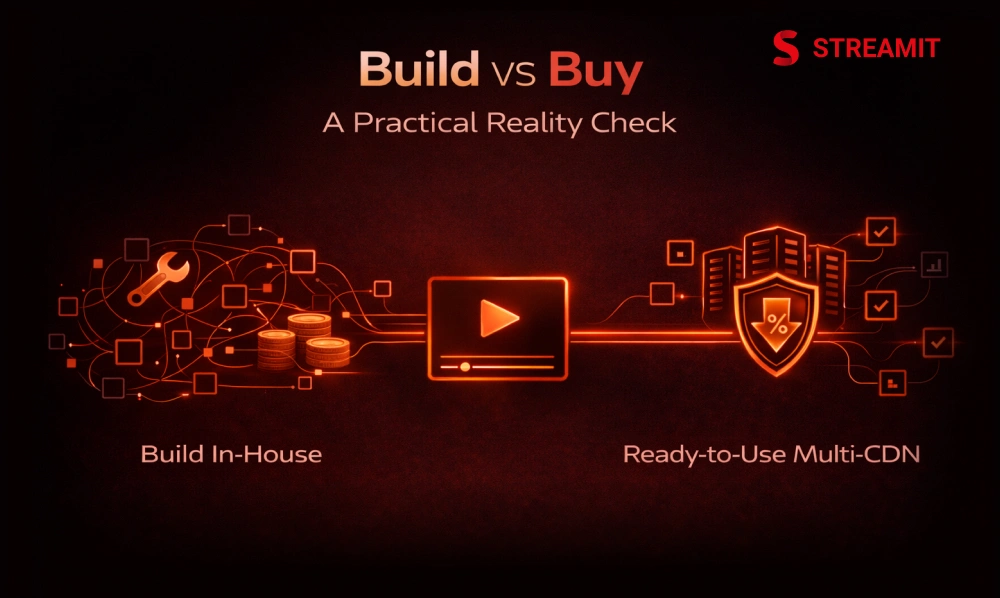
Building Multi-CDN logic in-house is expensive and slow. Teams often underestimate:
- Maintenance overhead
- Edge-case complexity
- Continuous optimization work
Zero Buffer Streaming delivers this as a ready-to-use capability.
Common Mistakes Teams Make
- Relying on a single “premium” CDN
- Treating buffering as a user issue
Reacting instead of predicting
Where Zero Buffer Streaming Fits Best
This solution is ideal for platforms that:
- Stream at scale
- Value retention
- Cannot afford playback failures
- Stream at scale
Looking Ahead: Why Streaming Will Only Get Harder
The truth is, video delivery is becoming more complex, not simpler. Expectations rise faster than infrastructure improves.
Viewers now expect:
- Instant startup
- Zero interruptions
- Consistent quality across devices
At the same time, platforms face:
- Fragmented networks
- Rapid device turnover
- Exploding concurrency during live events
Zero Buffer Streaming is designed for growing complexity, not just today’s conditions.
The Impact of 5G and Edge Computing
Faster networks don’t eliminate buffering,they shift where problems appear.
5G improves last-mile speed but also:
- Encourages higher bitrates
- Increases traffic bursts
- Exposes weaknesses in backhaul and CDN interconnects
Edge computing helps bring content closer, but only when routing decisions are smart.
Zero Buffer Streaming continuously reevaluates delivery paths to adapt.
Why “Good Enough” Streaming Is No Longer Enough
Users now compare your playback experience to the best app they use, not just competitors.
A flawless experience on one platform raises expectations everywhere else.
- One buffering incident feels unacceptable
- Recovery must be invisible
Reliability becomes a brand trait
Executive Summary for Decision Makers
If you remember only three things, remember these:
- Buffering is a delivery problem, not a user problem
- Single-CDN strategies cannot handle real-world variability
- Intelligent Multi-CDN switching prevents problems before users notice
Zero Buffer Streaming operationalizes these ideas.
A Practical Rollout Approach
Zero Buffer Streaming does not require a risky, all-or-nothing migration.
Most platforms roll it out in phases:
- Enable Multi-CDN for a subset of traffic
- Monitor playback health improvements
- Expand gradually to full traffic
This reduces risk while delivering immediate value.
Measuring Long-Term Success
Success is measured by consistency, not one perfect day.
Over time, teams should expect:
- Fewer critical incidents
- Lower operational stress
Predictable playback behavior during peak events
Why Reliability Is the Ultimate Competitive Advantage
Features can be copied. Pricing can be matched. Reliability cannot be faked.
When your video just works:
- Users stay longer
- Complaints drop
- Trust compounds quietly
Zero Buffer Streaming builds this advantage invisibly.
Final Thoughts
Great streaming shouldn’t call attention to itself. It should simply work. There should be no spinning wheels, no awkward pauses, and no glitches that need explaining. Viewers expect their video to start instantly and continue playing smoothly every single time. Zero Buffer Streaming is built to deliver exactly that experience, ensuring content flows effortlessly in the background while audiences stay focused, engaged, and satisfied.
Zero Buffer Streaming is not something you understand fully by reading about it.
It becomes clear when you see playback continue while delivery paths change in real time.
On the preview page, you’ll experience how the system selects the best CDN, adapts instantly to network shifts, and keeps video playing smoothly under real conditions.
View the Zero Buffer Streaming Preview and see how intelligent Multi-CDN delivery actually works.
FAQs
1. Can we control which CDNs are preferred?
Yes. Business rules, cost considerations, and regional priorities can be configured.
2. Isn’t one good CDN already enough?
No. CDN performance changes by region, ISP, and time, even for premium providers.
3. Will switching CDNs interrupt playback?
No. Switching happens silently without reloads or visible pauses.
4. Can we control which CDNs are preferred?
Yes. Business rules, cost limits, and regional priorities can be configured.
5. Does Zero Buffer Streaming work for live streaming?
Yes. It prevents buffering by keeping video segments arriving on time during live playback.