7 Best OTT Security Solutions for Streaming Platforms

More than 5 billion people stream video daily, and global OTT revenues are moving toward the $300 billion mark. At this scale, security is no longer a technical afterthought, it is a business stability layer.
Most streaming platforms do not fail because of poor content or weak marketing. They fail quietly when security gaps begin to erode revenue, user trust, and platform integrity over time.
As OTT ecosystems expand across web, mobile, smart TVs, and global delivery networks, the risk surface multiplies. Piracy networks evolve faster than most security stacks. Account abuse scales silently. And a single breach can undo years of brand credibility in hours.
This guide breaks down the 7 most critical OTT security solutions, not as feature checklists, but as strategic protection layers that safeguard content ownership, revenue continuity, and long-term platform control.
What Is OTT Security and Why It Matters for Streaming Platforms?
Streaming platforms operate in one of the most exposed digital environments. Content travels through public networks, multiple devices, cloud infrastructure, and third-party delivery systems, creating multiple points of vulnerability.
OTT security is not a single tool. It is a structured framework designed to protect four core assets:
- Video content
- Applications
- User data
- Revenue channels
Without strong security architecture, platforms face predictable outcomes: piracy leakage, credential abuse, regulatory risks, and long-term revenue erosion.
Security, therefore, is not just protection. It is operational continuity.
Meaning of OTT Security Solutions
OTT security solutions combine technologies and policies that protect streaming ecosystems at every layer.
These typically include encryption, DRM, anti-piracy systems, access control, application shielding, and infrastructure monitoring, working together to reduce exposure.
Why are OTT Streaming Platforms Easy Targets?
OTT platforms attract attackers for one simple reason: high value and high scale.
Unlike static digital products, streaming ecosystems are dynamic. They involve content licensing, payments, live distribution, and millions of concurrent users, all operating simultaneously.
This complexity creates multiple entry points for exploitation.
High-Value Video Content
Premium content such as live sports, new releases, and exclusive programming carries significant resale value in illegal markets.
Large User Base and Payment Data
Streaming platforms manage vast volumes of subscriber data, including payment credentials, making them attractive for data breaches.
Multi-Device Access Environment
OTT apps run across operating systems and device types, increasing the need for consistent, cross-platform security enforcement.
Common Security Challenges Faced by OTT Platforms
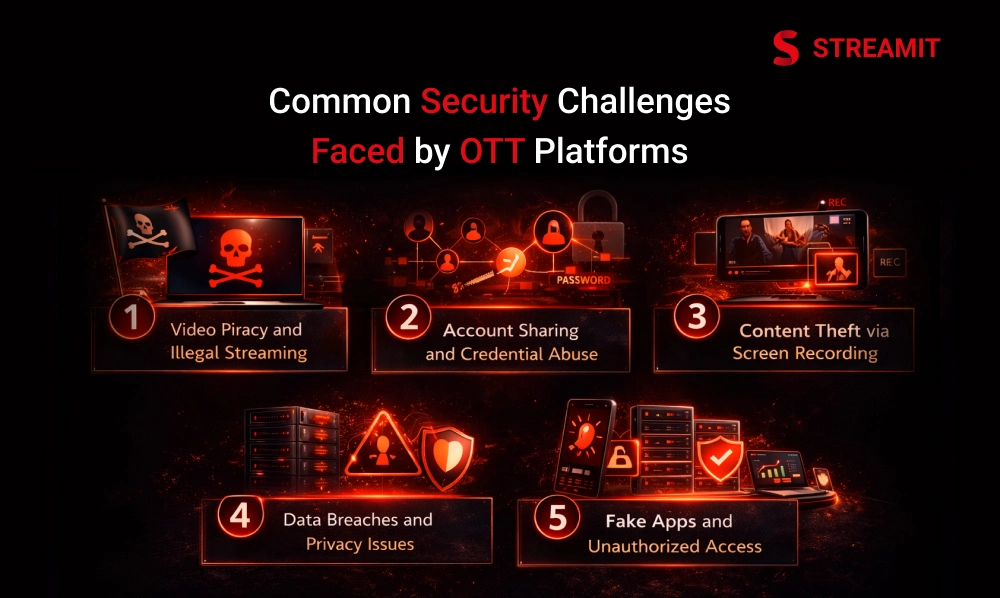
Industry studies suggest that up to 30% of OTT revenue loss is linked directly to piracy and credential abuse.
Most of these losses do not happen dramatically. They accumulate silently, through account sharing, unauthorized streams, and undetected content leaks.
Understanding these patterns is the first step toward building effective protection.
Video Piracy and Illegal Streaming
Illegal redistribution through IPTV networks and torrent ecosystems remains the largest threat to premium content platforms.
Modern piracy operates as a structured business model, not random user behavior.
Account Sharing and Credential Abuse
Credential stuffing attacks exploit leaked passwords to gain unauthorized access, often at scale. Beyond security risks, uncontrolled sharing directly impacts subscription revenue.
Content Theft via Screen Recording
Even encrypted streams can be recorded using external devices or software. Without traceability mechanisms like watermarking, identifying leak sources becomes nearly impossible.
Data Breaches and Privacy Issues
Unauthorized database access can lead to severe regulatory and reputational consequences. For OTT businesses operating globally, compliance risks are as critical as technical risks.
Fake Apps and Unauthorized Access
Modified apps can bypass payments, disable security checks, or distribute pirated content. Application integrity is therefore a key security priority.
How Security Impacts OTT Business Growth?
A single piracy incident during a major live event can result in millions of dollars in lost revenue within hours.
Security is often perceived as a cost center. In reality, it is a revenue protection system.
Platforms with structured security architectures consistently demonstrate:
- Higher subscriber retention
- Stronger brand credibility
- Lower operational risk
Security, when designed correctly, becomes a growth enabler rather than a technical overhead.
Revenue Loss Due to Piracy
Illegal streams reduce paid subscriptions and ad impressions. Piracy impact on OTT platforms is measurable and severe.
User Trust and Brand Reputation
Users expect secure transactions and safe streaming experiences. Streaming platform credibility depends on strong protection systems.
Legal and Compliance Risks
Regulations such as GDPR require strict user privacy controls.Non-compliance can result in heavy fines and operational restrictions.
Key Layers of OTT Security Architecture
Effective OTT protection operates as a multi-layered system rather than relying on one solution. Each security layer addresses a specific risk within the streaming ecosystem. Since threats evolve across content, apps, networks, and users, no single tool can provide complete protection.
Core Layers of OTT Security:
- Content protection (DRM and encryption)
- Application security (shielding and tamper detection)
- Network security (secure delivery and CDN protection)
- User access control (authentication and session management)
- Monitoring and compliance tracking
A resilient security architecture typically includes four interconnected layers:
Content Protection Layer
This layer focuses on controlling how video content is accessed, decrypted, and played. It prevents unauthorized copying and redistribution.
Application Security Layer
Application security protects OTT apps from reverse engineering, tampering, and unauthorized modifications.
It ensures platform integrity across devices.
Network and Streaming Security Layer
Secure delivery protocols protect video streams as they travel across CDNs and networks. This layer safeguards against interception and data leaks.
User and Access Control Layer
Authentication and session management ensure only authorized users can access content within defined limits.
Technologies Used in OTT Security Solutions
Modern OTT security stacks use multiple technologies working together instead of relying on a single protection method. Each layer secures a different part of the streaming ecosystem, from content and apps to networks and users. This multi-layer approach ensures stronger, more reliable protection against evolving threats.
Key Elements in a Multi-Layer Security Stack:
- Content protection through DRM and encryption
- Application security with app shielding
- Network security via secure CDN and HTTPS delivery
- User security through authentication and access control
- Monitoring systems for real-time threat detection
DRM (Digital Rights Management)
DRM controls how content is accessed, ensuring playback occurs only on licensed devices and authorized user accounts.
How DRM Protects OTT Content?
DRM content protection encrypts video files so they cannot be accessed or copied without proper authorization. It securely delivers decryption keys only to licensed users and approved devices, ensuring controlled and protected playback.
Popular DRM Systems for OTT
Widely used DRM systems include Google Widevine, Apple FairPlay, and Microsoft PlayReady. These technologies enable secure video playback across web browsers, mobile devices, and smart TVs while preventing unauthorized access.
Video Encryption and Secure Streaming
Encryption protects video data both when it is stored and while it is being delivered to users. It converts content into an unreadable format so unauthorized parties cannot intercept or misuse it. Only authorized systems and devices with the correct decryption keys can access and play the video.
Key Benefits of Encryption in OTT:
- Secures video files stored on servers
- Protects streams during network transmission
- Prevents data interception and tampering
- Ensures controlled access through decryption keys
- Strengthens overall streaming platform security
AES Encryption for OTT Streams
AES video encryption converts video segments into an unreadable, encrypted format to prevent unauthorized access. Only authorized players with the correct decryption key can decode and play the content securely.
HTTPS and Secure CDN Delivery
Secure CDN delivery ensures that encrypted video data moves safely from origin servers to end users without exposure. It minimizes the risk of interception, tampering, or data leaks during content distribution.
Anti-Piracy and Watermarking Solutions
Watermarking embeds invisible, traceable identifiers directly into video streams without affecting playback quality. These identifiers are linked to specific users or sessions. If content is leaked, platforms can quickly trace the exact source of the piracy.
Key Benefits of Watermarking in OTT:
- Identifies the source of leaked content
- Deters piracy through traceability
- Works without affecting viewing experience
- Supports real-time monitoring for live streams
- Strengthens overall content protection strategy
Static vs Dynamic Watermarking
Dynamic watermark OTT systems insert user-specific identifiers into video streams in real time during playback. This allows platforms to instantly trace leaked content back to the exact subscriber or session responsible.
App Shielding and Runtime Protection
App shielding protects OTT applications from reverse engineering and unauthorized modifications. It secures the app’s internal code and prevents attackers from analyzing or altering its functionality. This helps maintain platform integrity and reduces risks like cloning, tampering, or payment bypass.
Key Functions of App Shielding:
- Code obfuscation to hide sensitive logic
- Detection of tampering and unauthorized changes
- Protection against reverse engineering attempts
- Blocking playback on rooted or jailbroken devices
- Runtime threat monitoring and response
Preventing Reverse Engineering
App reverse engineering protection hides source code to make it difficult for attackers to read or analyze. This reduces the risk of tampering, cloning, or extracting sensitive logic from the application.
Blocking Rooted and Jailbroken Devices
Rooted device detection in OTT platforms identifies devices that have been modified or jailbroken. It prevents content playback on compromised devices to reduce the risk of piracy and security breaches.
User Authentication and Access Control
Authentication systems verify user identity before granting access to streaming content. They control how many devices can be connected and manage active sessions in real time. This ensures that only authorized users access the platform while reducing account sharing and misuse.
Key Controls in Authentication Systems:
- Secure login verification (password, OTP, biometric options)
- Multi-Factor Authentication (MFA) for added protection
- Device registration and device limit management
- Concurrent session control and automatic session expiry
- Suspicious login detection and alert mechanisms
- IP and geo-location monitoring for unusual access patterns
Multi-Factor Authentication (MFA)
OTT MFA security adds an extra layer of verification beyond just a password. It may require a one-time code, biometric confirmation, or device approval to ensure only authorized users can log in.
Device Limits and Session Control
OTT device management limits the number of devices that can access an account at the same time. This helps prevent account sharing and reduces the risk of unauthorized simultaneous logins.
Security Needs for Different OTT Use Cases
Not all OTT platforms face the same level or type of threats, as live sports platforms often experience piracy spikes within seconds of going on air. Security strategies must therefore align with specific business models and the nature of the content being streamed. Below are key OTT use cases and the security requirements that support each one.
Security for Live Streaming Platforms
Live streaming platform security focuses on real-time encryption to protect content as it is broadcast. It also relies on rapid piracy detection systems to identify and shut down illegal streams instantly.
Security for VOD Platforms
VOD security solutions protect stored video libraries from unauthorized access and duplication. They use encryption, DRM, and access controls to ensure only paying users can stream the content.
Security for Sports OTT Platforms
Sports OTT platform security requires dynamic watermarking to trace leaks back to individual users in real time. It also depends on aggressive monitoring systems to quickly detect and shut down illegal live streams.
Security for White-Label OTT Platforms
White label OTT streaming platform security provides customizable protection tailored to different brand requirements and deployment models. It also ensures scalable security measures that can grow alongside platform expansion and user demand.
Top 7 OTT Security Solutions for Streaming Platforms
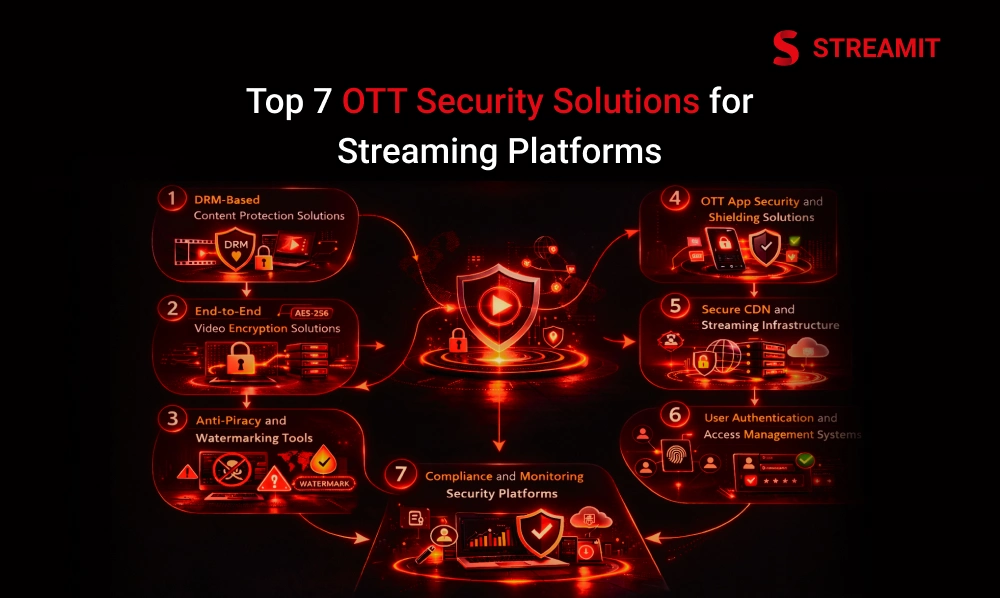
Most OTT platforms do not need every possible security tool. They need the right combination aligned with their business model and risk profile.
The following seven solutions form the core of a robust OTT security strategy.
- DRM-Based Content Protection
- End-to-End Video Encryption
- Anti-Piracy Watermarking
- Application Shielding and Runtime Protection
- Secure CDN Infrastructure
- User Authentication and Access Management
- Compliance Monitoring and Threat Detection
Each solution addresses a distinct layer of platform protection.
1. DRM-Based Content Protection Solutions
OTT DRM solutions prevent unauthorized playback by encrypting content and controlling how it is accessed. They ensure videos can only be streamed on approved devices and by licensed users.
2. End-to-End Video Encryption Solutions
Secure OTT streaming encrypts content at the origin server and keeps it protected throughout delivery. This ensures the video remains secure until it reaches the authorized end user for playback.
3. Anti-Piracy and Watermarking Tools
Watermark security embeds unique identifiers into video streams to track content ownership. If the content is redistributed illegally, it helps identify the exact source of the leak.
4. OTT App Security and Shielding Solutions
Mobile OTT protection safeguards applications from being cloned, modified, or repackaged by attackers. It helps maintain app integrity and prevents tampering that could bypass payments or security controls.
5. Secure CDN and Streaming Infrastructure
OTT CDN security strengthens the video delivery network against interception and malicious attacks. It ensures a secure, reliable infrastructure for streaming content to users without disruption.
6. User Authentication and Access Management Systems
OTT access management controls how subscriptions are activated and how user sessions are handled. It ensures only authorized users can access content within defined limits and device rules.
7. Compliance and Monitoring Security Platforms
OTT security monitoring continuously tracks platform activity to detect suspicious behavior and vulnerabilities. It also supports regulatory compliance by generating real-time alerts and audit logs for faster response.
Comparison of Key OTT Security Solutions
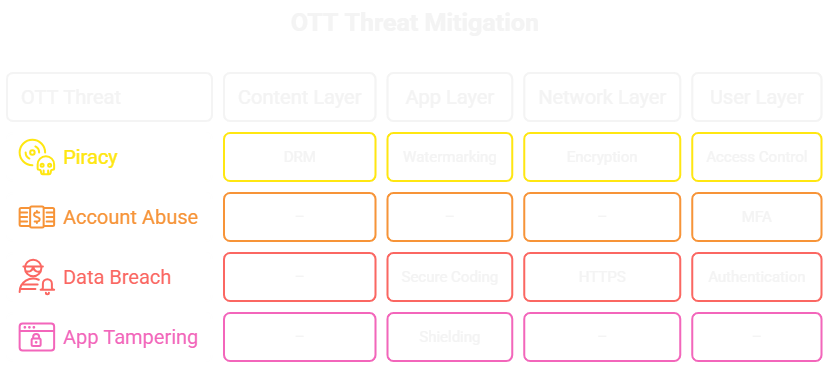
OTT Threat vs Security Layer Mapping
How to Choose the Right OTT Security Solution?
Choosing the wrong security stack can increase operational costs by up to 25% without delivering meaningful protection. Many platforms invest in tools that overlap or fail to address their real risk areas. That’s why evaluating security needs carefully before implementation is essential for both cost efficiency and long-term safety.
Here’s how to choose OTT security solutions effectively.
Based on Content Type
Choosing the wrong security stack can increase costs by up to 25% without significantly improving protection. Platforms must carefully assess their actual risks and requirements before investing in security solutions.
Based on Audience Size
Large audiences require scalable OTT security systems that can handle high traffic without performance issues. As user numbers grow, security measures must expand seamlessly to maintain consistent protection.
Based on Platform (Web, Mobile, Smart TV)
Multi-platform OTT security ensures consistent protection across web, mobile, and smart TV applications. It maintains the same level of content, app, and user security regardless of the device used.
Based on Budget and Business Goals
OTT security cost planning should be aligned with overall revenue goals and business strategy. Investing wisely ensures strong protection without overspending or limiting growth potential.
OTT Security Best Practices for Long-Term Protection
Continuous monitoring can reduce response time to security incidents by nearly 60%, helping platforms act before damage spreads. It allows teams to detect unusual activity and address vulnerabilities in real time. Security is not a one-time setup but an ongoing process that requires constant attention and improvement.
Follow these streaming security tips for sustainable protection.
Regular Security Audits
OTT security audits help identify vulnerabilities and weak points before they can be exploited. Regular assessments ensure the platform stays updated against evolving threats and compliance requirements.
Continuous Monitoring and Threat Detection
OTT threat monitoring continuously tracks platform activity to identify unusual or suspicious behavior. Real-time detection allows teams to respond quickly before security incidents escalate.
Educating Users and Teams
OTT security awareness educates users and internal teams about safe practices and potential threats. This reduces the risk of phishing attacks, credential misuse, and accidental security breaches.
Future Trends in OTT Security Solutions
AI-driven systems are expected to detect piracy within minutes instead of hours. Emerging technologies are reshaping OTT security trends.The future of OTT security will combine automation, analytics, and decentralization.
AI-Based Piracy Detection
AI piracy detection OTT systems automatically scan online platforms to identify illegal streams and copied content. This enables faster detection and quicker action to reduce revenue loss.
Blockchain for Content Protection
Blockchain OTT security provides transparent and tamper-resistant licensing records for digital content. It helps track ownership and distribution rights with greater accountability and trust.
Advanced Behavioral Analytics
OTT user behavior analysis monitors login activity to identify unusual or high-risk patterns. It helps detect potential account sharing, credential abuse, or unauthorized access attempts early.
Conclusion
Security in streaming platforms should not be visible. It should operate quietly in the background, ensuring content remains protected, accounts remain secure, and revenue streams remain stable.
Strong OTT security is not about reacting to threats. It is about designing systems where vulnerabilities never become business risks.
When implemented correctly, security does not interrupt the viewing experience. It strengthens it, allowing platforms to scale confidently while maintaining control over their content, users, and long-term growth.
FAQs
1. What are the biggest security risks for OTT platforms?
Video piracy, credential stuffing, data breaches, and app tampering are the most common OTT platform threats.
2. How do OTT security solutions protect video content?
They use DRM, encryption, watermarking, and authentication systems to restrict unauthorized access.
3. What is DRM and how does it secure OTT platforms?
DRM encrypts content to prevent unauthorized access or copying. It allows playback only on approved devices and for licensed users.
4. What are the best OTT security solutions for streaming platforms?
The best solutions include DRM, encryption, anti-piracy tools, app shielding, secure CDN, access control, and compliance monitoring.
5. Can AI help detect piracy on OTT platforms?
Yes, AI-based monitoring tools can identify illegal streams and suspicious patterns in real time.
Read Also
1. 7 Reasons Why OTT Platforms Will Fail in 2026 Without Retention
2. The Subscriber Retention Secrets Netflix Doesn’t Want Streaming Platforms to Know
3. The Psychology of Retention: How Netflix Keeps Viewers Hooked for Years
4. 5 Proven Retention Tactics Every Streaming Platform Can Steal from Netflix
5. Personalization vs. Content Quantity: What Drives Streaming Retention in 2025