OTT Personalization vs Content Quantity: What Drives Retention


In 2026, retention is no longer the side metric behind growth. It is the metric that decides whether growth is real.
Many OTT platforms still spend heavily on acquisition, assuming that more sign-ups automatically mean stronger business performance. That assumption no longer holds. In a crowded streaming market, retention is what separates temporary attention from durable revenue.
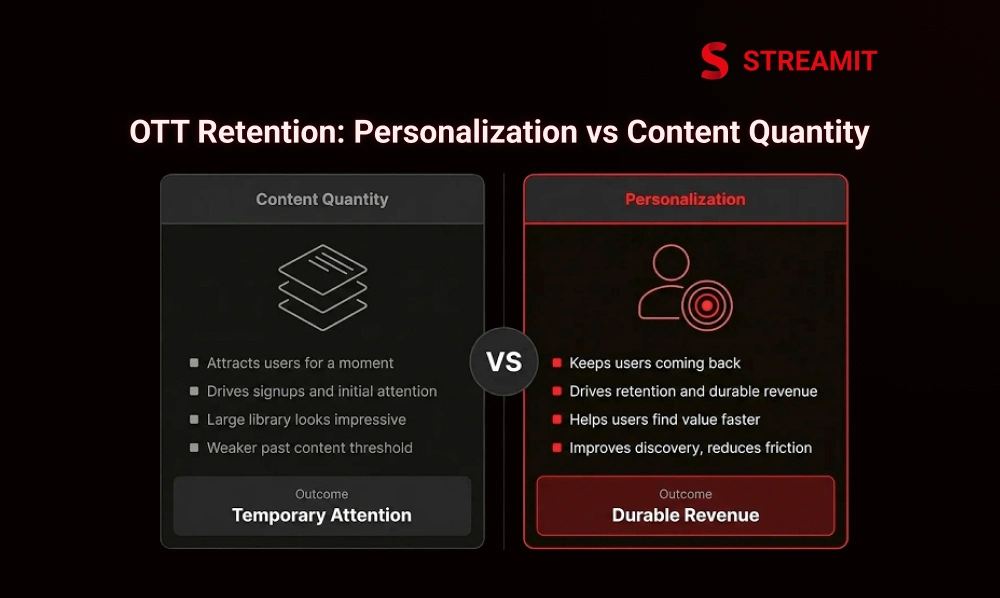
A larger content library can attract users for a moment. But attention and retention are not the same thing. Viewers may sign up because a platform looks large or promises variety, yet they stay only when the platform continues to feel useful, relevant, and worth paying for.
That shifts the real question. It is no longer just about how much content an OTT platform has. It is about how quickly and consistently users can find something worth watching.
Content quantity still matters. No platform can retain users with a weak or stale library. But once a platform reaches a reasonable content threshold, personalization becomes a stronger retention lever. It improves discovery, reduces friction, and helps users find value faster.
Why Streaming Retention Matters More Than Subscriber Growth
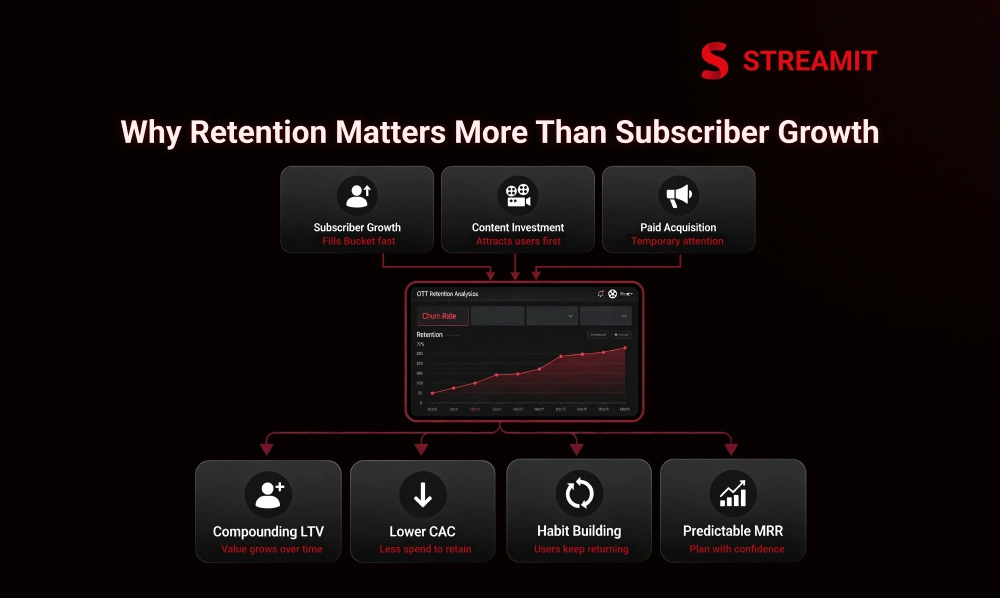
Subscriber growth still matters, but it is no longer the clearest sign of strength. A platform can show rising sign-ups and still have weak long-term economics if users leave too quickly.
Retention matters more because it reflects real product value. It shows whether the platform is good enough to keep earning attention after the first visit, the first month, or the first major release.
Why Retention Is the Real Growth Metric for OTT Platforms
Growth can be purchased for a while through ads, promotions, bundling, and launch campaigns. Retention cannot be bought in the same way. It has to be earned through a better viewing experience, stronger relevance, and steady perceived value.
For OTT platforms, retention is the growth metric that tells the truth. It reveals whether users are building habits around the product or simply testing it and moving on.
Retention supports long-term revenue
A retained subscriber creates compounding value. They continue paying over time, consume more content, and often become easier to upsell, re-engage, or retain than newly acquired users.
This makes retention one of the strongest drivers of predictable revenue. A platform with stable retention can plan content, pricing, and product investment with more confidence than one that depends heavily on replacing lost users every month.
High churn makes growth expensive
High churn quietly weakens the business, even when top-line growth looks healthy. If users leave too quickly, the platform keeps paying to fill the same bucket.
That makes growth expensive and unstable. Instead of building momentum, the platform keeps re-buying attention. Over time, that puts pressure on margins, content budgets, and marketing efficiency.
Why Many OTT Platforms Struggle to Retain Users
Many OTT platforms do not struggle because demand is low. They struggle because the viewing experience does not create enough ongoing value after sign-up.
In most cases, churn is not caused by one issue alone. It comes from a mix of weak discovery, too much choice, inconsistent freshness, limited differentiation, and poor alignment between user expectations and actual experience.
Viewers have too many platform choices
Viewers no longer compare one OTT platform against another in a narrow way. They compare every platform against all available entertainment options, including YouTube, short-form video apps, live sports, social feeds, and free ad-supported services.
That level of choice makes switching easier than ever. If a user does not find enough value quickly, they can leave without much friction and move to another option.
Poor content discovery increases drop-off
A strong library is only useful when viewers can actually navigate it. If users open the app and feel uncertain about what to watch, the experience becomes tiring instead of engaging.
Poor content discovery slows down the path to value. That creates friction early, increases decision fatigue, and raises the likelihood of drop-off before meaningful viewing even begins.
OTT Personalization vs Content Quantity: What Each One Really Means
This comparison often gets oversimplified. Content quantity and personalization are not interchangeable ideas. They operate in different parts of the OTT product.
Content quantity affects what is available. Personalization shapes what is visible, relevant, and watchable for each viewer.
What Content Quantity Means in OTT
Content quantity refers to the scale and breadth of a platform’s content offering. It includes the number of titles, genres, languages, formats, and release frequency within the library.
A large content base is often seen as a retention advantage because it suggests more reasons for users to stay. But content volume alone does not guarantee that users will experience that value.
More titles, genres, languages, and fresh releases
A broader library reaches a wider audience. Different users come with different tastes, language preferences, time constraints, and viewing moods.
That is why content quantity often includes more than the title count. It also includes genre diversity, regional content, niche categories, and a steady flow of fresh releases that keep the platform from feeling static.
Bigger content libraries aim to keep users engaged
The basic logic is straightforward. If users believe there is always more to explore, they are more likely to remain subscribed.
A larger library can support longer engagement by offering alternatives after a series ends, a film is completed, or a seasonal trend fades. It gives the platform more chances to stay relevant across different viewing moments.
What OTT Personalization Means
OTT personalization is the process of shaping the platform experience around each user’s interests and behavior. It turns into the same library into different experiences for different viewers.
This includes recommendation systems, homepage layout, personalized rows, search relevance, viewing suggestions, and content prioritization based on user signals.
Personalized homepages, search, and content suggestions
Personalization often begins with what the viewer sees first. A personalized homepage can highlight relevant titles instead of generic content blocks that may not match the user’s intent.
The same applies to search and content suggestions. When the platform understands likely interests, it can reduce effort and improve the chances of an immediate play.
Recommendations based on viewing behavior and user interest
Good personalization is not random. It is driven by signals such as watch history, completion patterns, genre preference, time of viewing, device behavior, and repeat interactions.
That makes the experience feel more useful over time. Instead of forcing the viewer to scan the full catalog, the platform helps narrow the decision based on likely relevance.
How Content Quantity Helps OTT Retention
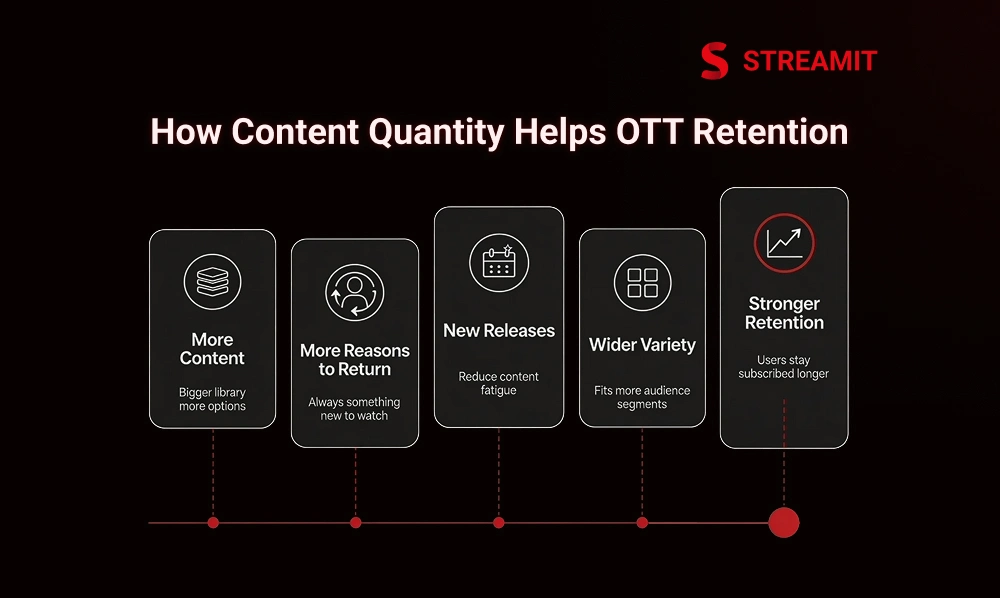
Content quantity does contribute to retention. A platform cannot hold users for long if the library feels too limited, too repetitive, or too narrow for the audience it serves.
More content creates more opportunities for continued use. It gives subscribers additional reasons to return and reduces the risk that the platform feels exhausted after one or two sessions.
More Content Gives Users More Reasons to Stay
A deeper content library increases the chances that different users will find something that fits their taste. It also helps the same user find different kinds of value over time.
This matters because retention is rarely built on one title alone. It depends on whether the platform continues to offer enough variety and freshness after the first attraction point.
New releases help reduce content fatigue
Even strong catalogs can feel stale when there is nothing new to notice. Fresh releases create movement inside the platform and give existing users a reason to check back.
New content reduces fatigue by making the service feel active. It creates new entry points for both current and returning viewers.
Wider content variety improves audience fit
No OTT audience is fully uniform. Some viewers want prestige drama, others want regional cinema, short-form entertainment, documentaries, or family viewing options.
A wider content mix improves audience fit by making the platform useful across more segments. That helps reduce the risk of losing users simply because the library feels too narrow.
Where Content Quantity Falls Short
Content quantity becomes less effective when it grows faster than discovery quality. At that point, the library may become harder to use even as it becomes bigger.
More content is only beneficial when users can navigate it with confidence. Otherwise, the scale begins to create friction instead of value.
More content does not help if users cannot find it
A user does not judge the platform by total catalog size alone. They judge it by what they can discover within the first few minutes of a session.
If a platform has thousands of titles but poor navigation, weak metadata, or irrelevant recommendations, the library feels less useful than it actually is.
Bigger libraries can create choice fatigue
Choice sounds valuable in theory, but too much unmanaged choice creates hesitation. Users begin browsing more and watching less.
That is where bigger libraries can backfire. Instead of feeling rich and supportive, they begin to feel noisy and difficult, especially when the interface does little to reduce decision pressure.
How OTT Personalization Improves Streaming Retention
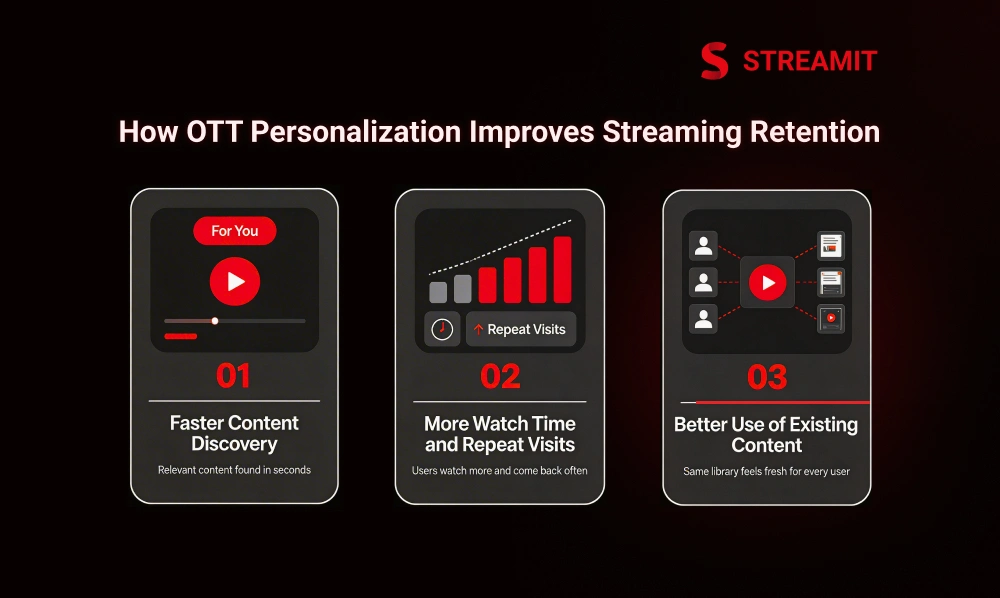
Personalization improves retention because it works directly on the experience users have every time they open the platform.
Instead of depending only on more content investment, it makes existing content easier to discover, easier to enjoy, and more likely to lead to repeat viewing.
Personalization Makes Content Discovery Faster
Discovery speed is one of the most practical retention advantages personalization creates. The faster a user finds something relevant, the more likely they are to continue using the service.
This matters because many churn problems begin before playback. They begin when users open the app and do not know where to go next.
It reduces browsing time
Long browsing sessions are often a sign of friction, not engagement. Users may scroll for several minutes without committing to anything meaningful.
Personalization reduces this browsing burden by narrowing the field. It helps users move from intent to playback faster, which makes the experience feel smoother and more efficient.
It helps users find value earlier
The earlier a user sees value, the better the retention outcome tends to be. This is especially important in the first session and the first few weeks of subscription.
When a platform quickly shows relevant titles, the user understands why the product is worth keeping. That early value perception can shape long-term behavior.
Personalization Increases Watch Time and Repeat Visits
Retention is not just about keeping a subscription active. It is also about keeping usage active. Personalization supports both by increasing the likelihood that users watch more and come back more often.
Relevant discovery leads to stronger session depth. Stronger session depth supports repeat behavior over time.
Relevant recommendations improve session depth
When recommendations feel accurate, users are more likely to continue watching after the first title. They may move from one episode to another, from one film to a related suggestion, or from one category into a longer session.
That deeper engagement matters because it signals a stronger connection between viewer preference and platform experience.
Users are more likely to continue watching on the platform
Repeat usage is usually built through consistency, not novelty alone. A platform earns repeat visits when users trust that it will regularly surface something worth watching.
Personalization strengthens that trust. It makes the platform feel familiar, useful, and increasingly aligned with the viewer’s taste.
Personalization Helps OTT Platforms Use Existing Content Better
One of the strongest advantages of personalization is economic. It helps OTT businesses get more value from the content they already own or license.
Instead of relying only on constant library expansion, the platform can improve how content is surfaced, distributed, and consumed.
It brings more visibility to the right titles
Not every strong title becomes visible on its own. Some content needs better placement, better timing, or better matching with the right audience segment.
Personalization helps solve that. It increases the chances that valuable but under-seen content reaches viewers who are most likely to engage with it.
It improves retention without relying only on more content spend
Content acquisition is expensive. Production is expensive. Licensing is expensive. Personalization gives OTT platforms another way to improve retention without depending only on bigger content budgets.
That makes it strategically attractive, especially for platforms that want stronger performance without overspending to create the appearance of scale.
OTT Personalization vs Content Quantity: Which One Drives Retention More?
Both matter, but they do not influence retention in the same way.
Content quantity supports retention by creating enough breadth and freshness. Personalization drives retention more directly by making that content easier to discover and more relevant to each viewer.
Why Personalization Has a Stronger Direct Impact on Retention
Personalization affects what the user experiences in the moment. It changes the path from homepage to playback, from search to discovery, and from first watch to repeat watch.
That gives it a more immediate influence on retention than content volume alone.
Retention improves when users quickly find relevant content
Users stay longer when they do not have to work too hard to find something worthwhile. Relevance lowers friction and makes the platform feel more valuable within the same session.
That is why personalization often produces stronger retention movements faster than simply adding more titles to the library.
Personalization builds habit, not just one-time viewing
A large library may attract one-time viewing around a specific release. Personalization builds the daily or weekly habit that keeps users returning between major content events.
That habit is what strengthens retention over time. It turns the platform from an occasional destination into a recurring part of the user’s entertainment routine.
Why Content Quantity Still Matters
This is not an argument against content depth. Personalization is powerful, but it cannot solve everything.
A platform still needs enough variety, freshness, and quality in the library for personalization to work meaningfully.
Personalization cannot fix a weak content library
If the catalog is too thin, outdated, or poorly aligned with audience demand, personalization has very little to work with.
It may improve visibility, but it cannot manufacture value where the underlying content strategy is weak.
Fresh content still gives users a reason to return
Fresh content remains an important return trigger. It creates momentum, restarts attention, and gives subscribers a new reason to re-open the platform.
The strongest retention model does not choose between new content and personalization. It uses new content to attract interest and personalization to extend that interest into deeper usage.
The Metrics That Show What Is Really Driving OTT Retention
Retention should not be judged only by subscriber count. A platform needs metrics that explain whether users are finding value, staying active, and building repeat behavior.
The right metrics show whether content quantity is helping, whether personalization is working, and where the friction points actually exist.
Retention and Churn Metrics
These metrics reveal whether the platform is holding onto users over time or losing them too quickly.
They are essential because they connect product experience directly to business performance.
30-day and 90-day retention
Thirty-day retention shows whether early value was delivered. It tells you if the platform made a strong enough impression in the first month.
Ninety-day retention goes deeper. It shows whether users stayed long enough to form a meaningful habit and perceive continued value.
Monthly churn rate
Monthly churn shows the share of subscribers who leave within a given period. It is one of the clearest signs of whether the platform is retaining enough value to justify continued payment.
On its own, churn is useful. But it becomes far more actionable when paired with user segments, content behavior, billing plans, and viewing frequency.
Engagement Metrics
Engagement metrics help explain why users stay or leave. They show how much users are actually interacting with the platform, not just whether they are still technically subscribed.
This makes them useful as early indicators of retention health.
Watch time and return frequency
Watch time reflects how deeply users are consuming the platform. Return frequency shows how often they come back.
Together, these metrics reveal whether the service is becoming part of the user’s routine or remaining occasional and fragile.
Completion rate and drop-off rate
Completion rate helps measure whether content matches viewer expectations and sustains interest until the end.
Drop-off rate helps identify where engagement weakens. When many users stop early, it may point to content mismatch, poor recommendation quality, or weak packaging.
Discovery and Recommendation Metrics
These metrics help measure the quality of the discovery layer itself.
They are especially important in a discussion about personalization because they reveal whether the platform is actually helping users find relevant content faster.
Search-to-play rate
Search-to-play rate shows how often a user who searches for something ends up watching something.
A high rate suggests the platform’s search experience is clear, relevant, and useful. A low rate often signals metadata problems, poor ranking, or weak search relevance.
Recommendation: click-through and play-through rate
Recommendation click-through rate shows whether recommendations look interesting enough to earn attention.
Play-through rate goes one step further. It shows whether those clicks actually result in meaningful viewing, which is a stronger sign of recommendation quality.
How OTT Platforms Should Balance Personalization and Content Quantity
The goal is not to pick one and ignore the other. The goal is to know which one should lead and how they should work together.
For most OTT businesses, the stronger strategy is to build enough content value to stay credible, then use personalization to increase the return on that content.
Build Retention Around User Behavior, Not Just Content Volume
Content decisions should not happen in isolation from audience behavior. The platform needs to understand what users watch, how they browse, when they return, and where they stop.
That behavioral insight should guide both content planning and personalization strategy.
Use viewer data to guide content and recommendation decisions
Viewer data helps show where the library is performing well and where it is underserving demand.
It also helps improve recommendation accuracy by identifying patterns in taste, timing, and engagement depth.
Focus on matching the right content to the right user
The best OTT experiences are not built only by increasing volume. They are built by increasing relevance.
That means surfacing the right title to the right person at the right moment, rather than assuming the same content journey will work for everyone.
Combine Fresh Content With Better Personalization
Fresh content and personalization work best together. One creates return triggers. The other converts those triggers into longer sessions and repeat behavior.
This balance is what creates more durable retention.
New content brings users in
Fresh releases, seasonal drops, marquee titles, and regional launches create moments of attention.
They help generate curiosity, reactivation, and new viewing opportunities that bring users back into the platform.
Personalization keeps them active longer
Once users return, personalization helps extend the session by showing what to watch next, what fits their taste, and what part of the catalog deserves attention now.
That is where retention deepens. Not at the moment of arrival, but in what happens after.
Key Takeaways
- Retention Over Subscriber Growth: This blog highlighted that OTT success in 2026 depends more on retention than raw subscriber growth, because long-term platform value comes from keeping viewers engaged, active, and subscribed over time.
- Personalization Drives Retention More Directly: OTT personalization plays a stronger direct role in retention by helping viewers discover relevant content faster, reducing browsing friction, and improving the overall viewing experience.
- Content Quantity Still Supports Retention: A large content library still matters because it gives users more variety, freshness, and reasons to return, but content volume alone is not enough to keep subscribers loyal.
- Discovery Is the Real Retention Layer: The blog emphasized that poor content discovery increases drop-off, while personalized homepages, better search, and relevant recommendations make existing content more valuable.
- More Content Can Create Choice Fatigue: Bigger libraries may look impressive, but they can overwhelm users if the platform does not guide them properly. Too many options without relevance can reduce watch time instead of improving it.
- Personalization Improves Watch Time and Repeat Visits: Relevant recommendations help users go deeper into the catalog, watch more content per session, and return more often, which directly strengthens subscriber retention.
- Content Alone Cannot Fix Churn: A platform may continue adding titles, genres, and fresh releases, but churn will remain high if users struggle to find the right content quickly and consistently.
- Retention Metrics Matter More Than Vanity Metrics: The blog showed that OTT platforms should focus on meaningful metrics like 30-day retention, 90-day retention, churn rate, watch time, return frequency, search-to-play rate, and recommendation performance.
- The Best OTT Strategy Is Balance, Not Excess: Successful OTT platforms do not rely only on content scale or only on personalization. They balance fresh content with strong personalization to create a better long-term retention model.
- Strong Content Plus Strong Personalization Wins: The core conclusion of the blog is that the best OTT retention strategy is built on both a valuable content library and a strong personalization system, where fresh content attracts users, and personalization keeps them engaged longer.
Netflix Retention Playbook
The Netflix retention playbook focuses on improving engagement through personalized discovery and smooth streaming performance. Platforms that combine recommendations and a strong user experience retain viewers longer.
Netflix AI Framework Playbook
The Netflix AI Framework Playbook explains how streaming platforms use AI to analyze viewer behavior and deliver personalized content recommendations. This approach improves discovery, engagement, and long-term subscriber retention across the platform.
Conclusion
In 2026, OTT personalization drives retention more directly than content quantity.
That does not make content depth irrelevant. It simply means that once a platform has enough real content value, the next retention gains usually come from improving discovery, relevance, and user fit.
Personalization Drives Retention More Directly
Personalization shapes the daily experience of the platform. It decides how quickly users find something useful, how often they return, and how deeply they engage.
That makes it a stronger direct driver of retention than content volume alone.
It improves discovery, relevance, and repeat usage
When users see relevant content faster, the platform feels easier to use and more worth keeping.
That creates stronger repeat usage, better engagement depth, and a more durable reason to stay subscribed.
Content Quantity Supports Retention, But Does Not Lead It Alone
Content quantity still supports retention by giving users variety, freshness, and a broader audience fit.
But it does not lead to retention on its own when discovery remains weak.
The best OTT retention model is strong content plus strong personalization
The strongest OTT strategy is not content versus personalization. It is content multiplied by personalization.
Fresh content gives users a reason to come back. Personalization gives them a reason to stay longer, watch more, and return. That is what drives stronger OTT retention in 2026.
FAQs
Does OTT personalization improve streaming retention more than content quantity?
Yes, in most cases it does. Content quantity supports retention, but personalization has a more direct effect because it improves discovery, relevance, and speed to value.
What drives OTT retention more: personalization or more content?
Personalization usually drives retention more directly, while content supports the experience by giving users enough variety and freshness to stay interested.
Can content quantity alone reduce OTT churn?
Not consistently. More content can help, but it cannot fully solve churn if users struggle to find relevant titles or if the viewing experience feels confusing.
Why do users leave OTT platforms with large content libraries?
Users often leave because the library feels difficult to navigate, not because it is too small. Poor discovery, weak relevance, and content overload can all reduce perceived value.
How does OTT personalization improve content discovery?
It improves discovery by showing more relevant titles based on viewing behavior, user interest, and engagement patterns. This reduces browsing friction and helps users reach playback faster.
How should OTT platforms balance personalization and content quantity?
They should build enough content depth to remain useful, then invest in personalization to make that content easier to discover, more relevant, and more effective at driving repeat viewing.
Read Also
1. Netflix Retention Secrets OTT Platforms Must Learn
2. Subscriber Retention for OTT Platforms: 15 Proven Tactics to Reduce Churn
3. 10 Powerful Netflix Retention Strategies Every Brand Should Use
4. Why Most Streaming Platforms Fail at Retention (and How to Fix It Like Netflix)
5. 7 Reasons Why OTT Platforms Will Fail in 2026 Without Retention