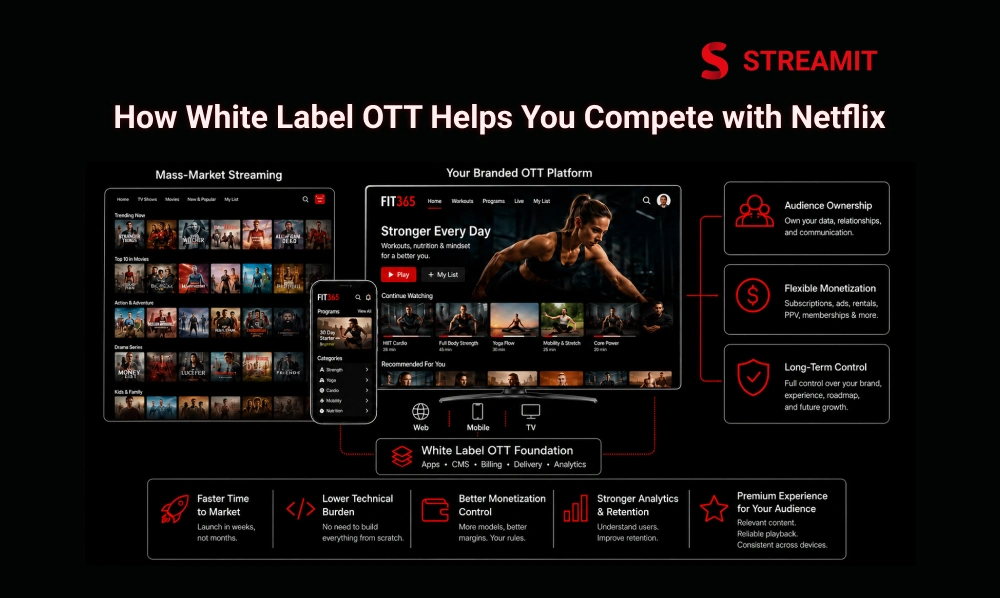
How White Label OTT Platforms Help You Compete with Netflix


The real competitive gap is not catalog size. It is control over audience, delivery, and economics. A white label OTT platform provides a proven streaming foundation without requiring every technical layer to be built from zero.
Three decisions shape the outcome: audience, revenue, and ownership. When these are clear, a focused service can compete through relevance, reliability, and stronger subscriber relationships rather than sheer scale.
Strategy
Why Competing With Netflix Does Not Mean Copying Netflix
A global streaming leader solves a global problem; a focused OTT business should solve a specific one. Copying its interface, catalog size, or release strategy adds cost without creating a clear reason to subscribe.
Use a white label OTT platform as infrastructure, then differentiate through programming, audience knowledge, community, access, and monetization. Technology should support the business model, not become it.
Smaller Platforms Win With Niche Focus, Not Massive Catalog Size
One clearly defined audience can be more valuable than ten disconnected content categories. Niche platforms can organize discovery around interests, goals, regions, languages, creators, sports, or professional communities.
That focus improves OTT user engagement because viewers understand the service immediately. It also supports subscriber retention by becoming a useful destination rather than another library requiring endless browsing.
Brand Ownership and Audience Relevance Matter More Than Scale Alone
A smaller platform can own 100% of a valuable audience relationship while holding only a fraction of the market. That relationship includes subscriber data, communication, pricing, and viewing behavior.
A serious white label OTT solution should make the brand visible and the vendor invisible. OTT retention and monetization depend on whether the business can learn and act without third-party delays.
Platform
What a White Label OTT Platform Actually Gives You
A complete platform is not one app; it is five connected layers. It combines viewer products, content operations, payments, video delivery, and data within one OTT platform solution.
Its value is not pre-made decisions. It is a structured technical foundation that lets the business focus on content, positioning, pricing, partnerships, and growth.
A Ready Streaming Stack With Apps, CMS, Billing, and Delivery
Four systems must work together before a viewer presses play: identity, entitlement, content, and delivery. A capable setup connects apps with an OTT asset management solution, subscriber controls, payments, and playback infrastructure.
Billing status and video access should never work separately. If payment succeeds but content remains locked, trust falls quickly. Strong OTT streaming solutions keep payments, access rules, catalog data, and delivery synchronized.
| Platform Layer | What the Foundation Should Provide | What the Business Must Decide |
|---|---|---|
| Viewer experience | Web, mobile, and TV applications | Brand, journeys, navigation, and accessibility |
| Operations | CMS, users, catalog, access, and reporting | Team workflows and publishing rules |
| Monetization | Subscriptions, ads, rentals, or hybrid models | Pricing, packaging, offers, and margins |
| Delivery | Encoding, adaptive playback, CDN, and protection | Quality targets, regions, and traffic planning |
| Growth | Analytics, search, discovery, and engagement tools | Retention priorities and audience strategy |
Faster Launch Than Building Everything From Scratch
The first launch should validate the business, not fund an avoidable engineering experiment. A reusable foundation reduces the need to rebuild authentication, subscriptions, content management, player logic, and device support.
A low code OTT solution is useful when speed does not create permanent limits. The real comparison is short-term convenience versus the control that future custom OTT platform development may require.
Branded Web, Mobile, and TV Apps Under Your Own Business
A streaming business is judged across three screens: mobile, desktop, and television. Branding and core behavior must remain consistent across each experience.
A streaming website may drive sign-ups, while mobile and OTT TV apps drive viewing. Users should retain one account, content history, and subscription relationship across the streaming app ecosystem.
Advantage
How White Label OTT Helps Brands Compete Smarter
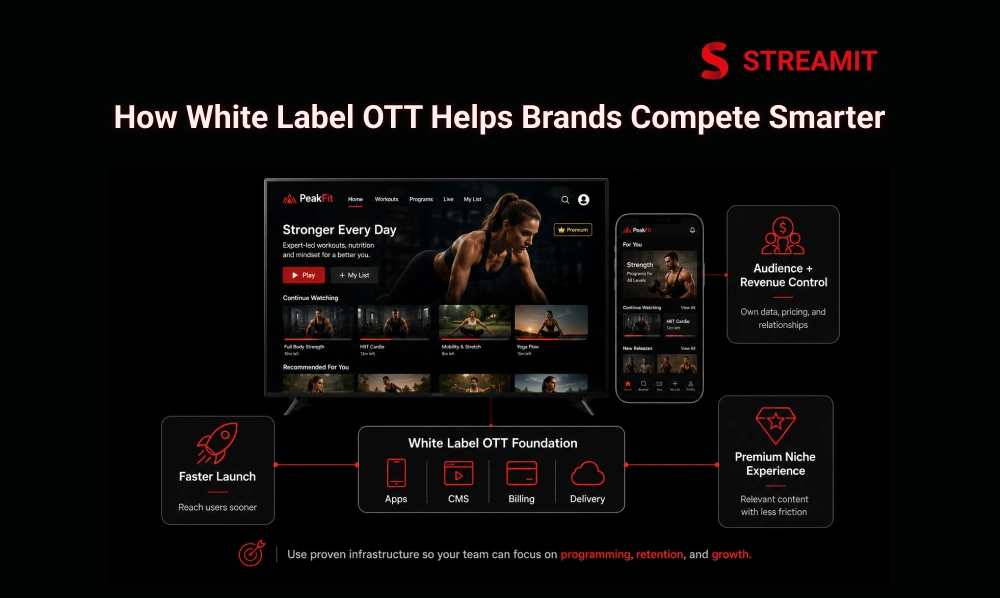
Competing smarter means investing where the audience can feel it. A white label OTT platform handles repeatable infrastructure, so the business can focus on programming, product decisions, retention, and growth.
Technical responsibility remains, but its focus changes: select the right architecture, integrations, ownership model, and operating partner instead of building every component.
It Shortens Time to Market and Reduces Technical Burden
Every month spent rebuilding standard infrastructure is a month without audience feedback. A proven video streaming OTT solution shortens launch by providing foundations for delivery, apps, users, payments, and administration.
Lower initial OTT platform development cost matters only when the architecture can grow. The OTT solution provider should explain hosting, concurrency, support, releases, and customization before signing.
It Supports Direct Monetization and Better User Ownership
Revenue becomes more strategic when the platform controls the offer and customer relationship. Subscriptions, advertising, pay-per-view, rentals, memberships, and hybrid packaging can serve different viewing patterns.
Platform analytics should show more than total plays. Connecting acquisition, conversion, viewing, cancellation, and revenue helps teams test smarter monetization instead of changing prices through assumptions.
It Helps Brands Build a More Premium Experience for a Specific Audience
Premium does not mean louder design; it means less friction at important moments. Fast discovery, reliable playback, clear access, useful recommendations, and consistent cross-device behavior shape perceived quality.
The right OTT platform features depend on the audience. Content personalization may suit broad libraries, while progress tracking, live access, or scheduled releases may matter more for learning, fitness, or creator platforms.
Due Diligence
Features and Buyer Checks That Matter Most
A polished demo can hide six months of operational limits. Buyers should evaluate post-launch traffic, catalog growth, pricing changes, devices, integrations, support, and migration.
The best OTT solution is not the longest feature list. It is the white label OTT solution provider that clearly explains performance, ownership, limitations, responsibilities, and total cost.
Multi-Device Apps, Strong Playback, and Reliable Delivery
Playback becomes the product once a viewer selects a title. Adaptive streaming adjusts quality as network conditions change, while encoding, CDN delivery, and player logic reduce interruptions.
Device coverage must be verified. Web, mobile, and OTT smart TV apps have different controls, operating systems, release cycles, and testing requirements; reliable video delivery needs a plan for each.
Monetization, DRM, Analytics, and Retention Support
Four commercial systems protect platform value: monetization, security, measurement, and retention. A provider should support today’s revenue models without blocking future packaging.
DRM, authentication, and access controls protect content, while analytics show where value is lost. OTT retention tools should expose failed payments, drop-off, weak discovery, inactivity, and cancellation patterns.
Ownership, CMS Flexibility, Integrations, and Total Cost Must Be Clear
The cheapest launch can become the most expensive migration. Confirm ownership of data, code, app-store accounts, domains, analytics, payments, and metadata before committing.
The OTT CMS should support real publishing workflows. Integration access, API limits, customization, support fees, infrastructure charges, and exit terms all affect the true OTT platform development cost.
| Buyer Check | What to Verify Before Signing | Risk When It Is Unclear |
|---|---|---|
| Device coverage | Exact platforms, versions, ownership, and update process | Missing audiences and delayed releases |
| Playback | Encoding, adaptive streaming, CDN, monitoring, and concurrency | Buffering, failures, and weak retention |
| Monetization | Supported models, payment ownership, fees, and entitlements | Revenue leakage and limited pricing |
| CMS and integrations | Workflow flexibility, APIs, webhooks, and third-party access | Manual work and slow product changes |
| Ownership and exit | Data export, code access, accounts, migration support, and terms | Lock-in, rebuilds, and lost history |
| Total cost | Setup, infrastructure, support, apps, upgrades, and overages | Unplanned operating expenses |
Fit Assessment
Where White Label OTT Works Best and Where It Falls Short
Fit matters more than category labels. White label OTT works when the foundation is standard, and the advantage sits in content, audience, distribution, or experience.
It becomes less suitable when differentiation depends on unique workflows, complex real-time interaction, uncommon rights logic, or infrastructure outside the provider’s architecture.
It Works Best for Niche Media, Creators, Learning, Fitness, and Broadcasters
Five categories benefit from a proven base: niche media, creator memberships, structured learning, online fitness, and broadcasters. Each needs dependable streaming without inventing the delivery stack.
Content creator streaming platforms can use memberships and exclusive releases. An online fitness streaming solution may prioritize progress, while media streaming solutions may focus on schedules, rights, regional access, and catalog depth.
It Falls Short When Deep Product Control or Unique Workflows Matter Most
A template becomes a constraint when differentiation depends on logic it cannot express. Complex marketplaces, unusual recommendations, multi-party rights, custom advertising, or specialized live interaction may require custom OTT solutions.
Teams then need greater control over OTT platform architecture and OTT tech solutions. A hybrid approach can reuse proven streaming components while custom-building the workflows that create competitive value.
The Wrong Vendor Can Create Migration and Rebuild Problems Later
Vendor risk often appears after success, not before launch. Growth exposes limits around data exports, infrastructure, device releases, pricing, APIs, analytics, and support.
Strong OTT solution providers discuss the roadmap before launch. They should clarify what can change, who owns each layer, how scaling costs behave, and how the business can exit without losing its operating history.
Solution
Why Streamit Fits Brands That Want to Compete Smarter
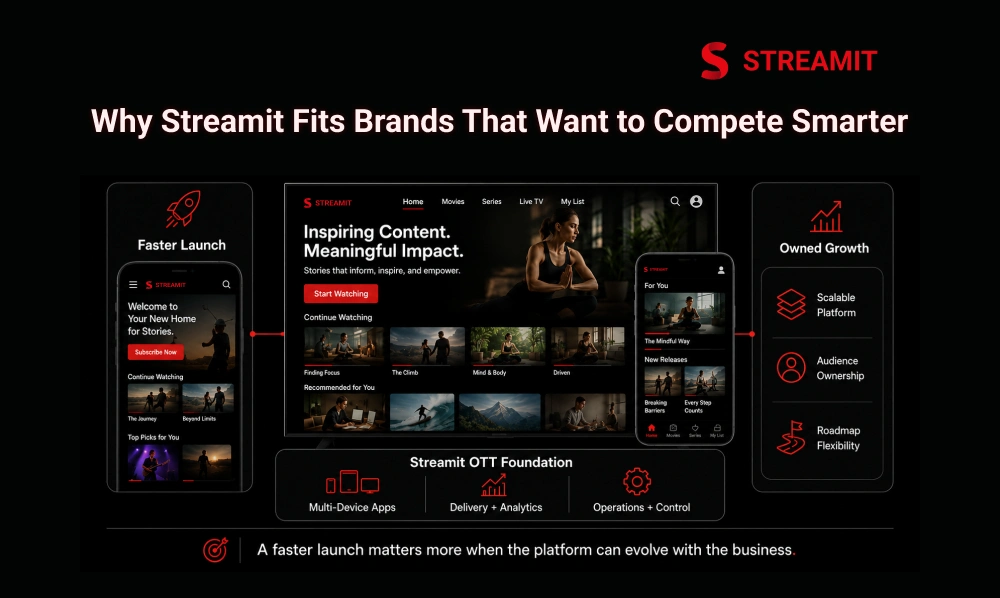
Streamit is designed for businesses treating streaming as a long-term model, not a short campaign. It combines a proven foundation with ownership, performance, monetization, and growth planning.
Serious brands need more than a fast white label OTT platform. They need an OTT streaming solution that can evolve with audience behavior, device priorities, catalog size, and commercial requirements.
It Supports Multi-Device Apps, Delivery, Analytics, and Growth Features
Four capabilities must mature together: apps, delivery, intelligence, and operations. Streamit supports TV, web, and mobile experiences, centralized management, adaptive streaming, and platform analytics.
This creates a clearer path from launch to optimization. Playback, discovery, reporting, and retention can improve as one viewer journey rather than separate projects.
It Gives Brands a Faster Path to a More Owned Streaming Business
Speed matters only when it preserves long-term control. Streamit helps brands move faster with an established OTT platform solution while keeping ownership, scalability, and roadmap flexibility central.
The result is a scalable OTT platform shaped around the business, not a fixed white label OTT solution that becomes difficult to change.
Summary
Key Takeaways
Niche Focus Beats Catalog Size
A smaller OTT platform can compete by serving a clearly defined audience with relevant content, stronger discovery, and a more focused viewing experience.
Platform Ownership Protects Growth
Brands should maintain control over subscriber data, monetization, infrastructure, app accounts, analytics, and future product decisions.
Billing and Access Must Be Synchronized
If payment succeeds but content remains locked, users lose trust quickly and support issues increase – these systems should never work in isolation.
Reliable Playback Drives Retention
Adaptive streaming, stable video delivery, and consistent performance across devices directly influence engagement and subscriber retention.
Cheapest Launch Is Not Lowest Cost
Infrastructure charges, app maintenance, integrations, support, customization, and migration costs must be evaluated before selecting a white label OTT solution.
The Right Vendor Scales With You
Buyers should evaluate how the platform handles traffic spikes, larger catalogs, new markets, additional devices, and changing monetization models.
Closing
Conclusion
Strong streaming businesses do not win by looking identical to the largest platform. They win by serving a defined audience, owning the relationship, protecting playback, and making disciplined decisions.
A white label OTT platform accelerates that path when ownership, delivery, CMS, monetization, and roadmap are clear. Streamit offers a faster route to a controlled, scalable business built for what follows launch.
FAQs
Frequently Asked Questions
-
Can a Niche OTT Platform Compete Without a Huge Content Library?
Yes. A focused catalog can perform well when it serves a clear audience and is organized around strong discovery, programming, and repeat viewing. Relevance often creates more value than volume without direction.
-
Who Owns Subscriber Data on a White Label OTT Platform?
Ownership depends on the provider and contract. The business should confirm control over subscriber profiles, viewing history, payment relationships, analytics, exports, and deletion rules before signing.
-
How Much Branding Control Should an OTT Provider Offer?
The platform should support more than a logo and color change. Serious control includes navigation, content presentation, domains, app-store presence, messaging, layouts, and the overall journey across web, mobile, and TV.
-
Can White Label OTT Support Netflix-Style Retention Features?
Yes, many platforms can support recommendations, watchlists, continue-watching, notifications, profiles, and analytics. The more important question is whether those features can be configured around the brand’s audience and retention strategy.
-
What Should Scale First When an OTT Platform Goes Viral?
Start with authentication, APIs, entitlement, playback delivery, CDN capacity, payments, and monitoring. A traffic spike becomes a business problem when users can arrive but cannot sign in, pay, access, or play content.
Read Also
Read Also
1. How to Create a Video Streaming Website Like Netflix
2. White Label OTT Platform Explained: A Practical Guide
3. 10 Ways a White Label OTT Platform Speeds Up Your Launch
4. Top 10 OTT Streaming Trends That Will Shape 2026
5. What Is Streamit? AI-First OTT Platform for Streaming Businesses