Video Streaming App Development Company for OTT Growth


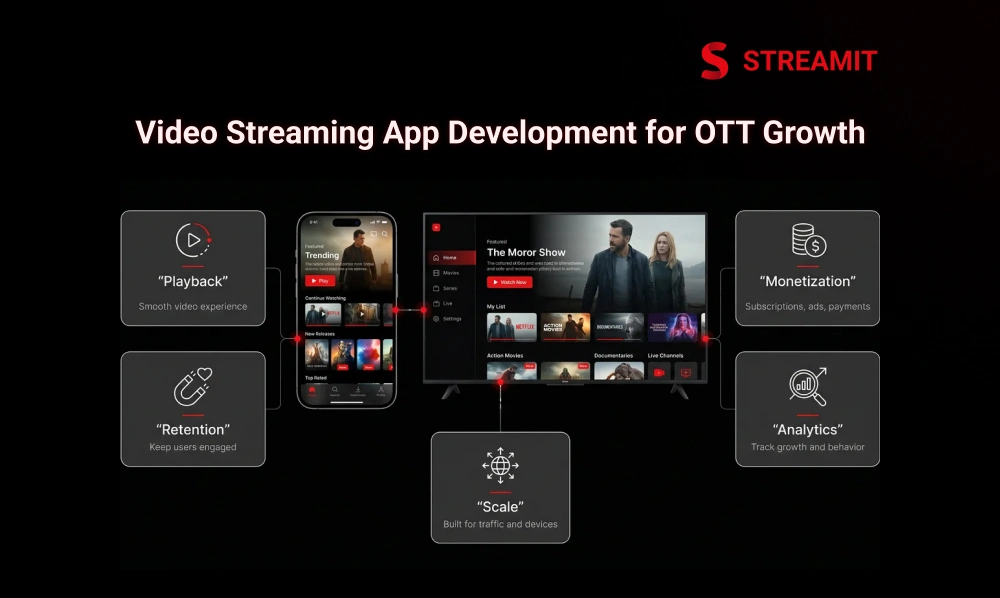
A streaming app is not just a video player with a login screen. It is a business system built around playback, retention, monetization, analytics, and scale.
Many OTT brands start with one goal: launch fast. But after launch, the real pressure begins. Users switch devices, payments fail, traffic spikes, content grows, and the platform has to keep performing without constant rebuilds.
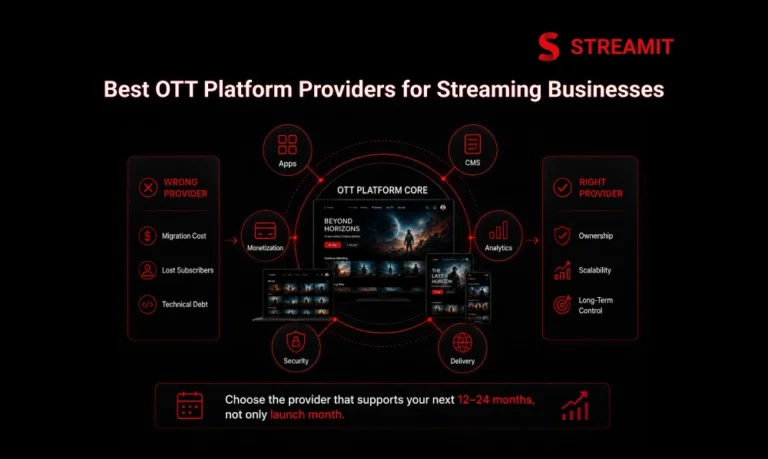
That is why choosing the right video streaming app development company matters. The right partner does not just build an app. It builds the product foundation for OTT growth.
Foundation
Why OTT Brands Need a Video Streaming App Development Company
OTT growth depends on 3 things working together: product experience, streaming infrastructure, and revenue control. If one of these breaks, the platform may still look good but fail to retain users.
A normal app development team may build screens. A streaming-focused team understands playback quality, multi-device behavior, content access, subscription logic, video delivery, and post-launch scale.
OTT Platforms Need More Than Basic App Development
Basic app development focuses on pages, buttons, and user flow. OTT app development goes deeper because video performance affects user trust directly.
An OTT platform solution must support content libraries, watch history, payments, search, recommendations, admin control, and device syncing. These are not optional features for growth-focused streaming brands.
Streaming-Specific Problems Need Streaming-Specific Experience
Streaming platforms face problems that normal apps rarely face. Buffering, DRM, encoding, CDN delivery, smart TV behavior, metadata structure, and playback quality all need specific technical planning.
If these areas are ignored early, the platform may launch but struggle later when real traffic, devices, and paying users enter the system.
Growth Depends on Playback, Retention, and Monetization Working Together
OTT growth is not only about getting more users. It is about keeping users watching and converting them into long-term revenue.
Smooth playback improves trust. Better discovery improves watch time. Flexible monetization improves conversion. When these layers work together, the platform becomes easier to grow.
Product Requirements
What OTT Growth Really Demands From the Product
A good OTT product must support 5 connected layers: apps, content, users, revenue, and analytics. If the product only solves one layer, growth becomes harder after launch.
For serious OTT brands, the product must be built for daily usage, device switching, content discovery, subscriber retention, and future monetization experiments.
The Product Must Work Across Web, Mobile, TV, and User Sessions
Users do not stay on one device. They may browse on mobile, subscribe on the web, and watch on TV.
A streaming app should remember watch history, login sessions, subtitles, payment access, and resume playback across devices. This is where multi-device OTT becomes important.
The Product Must Keep Users Watching With Better Discovery and UX
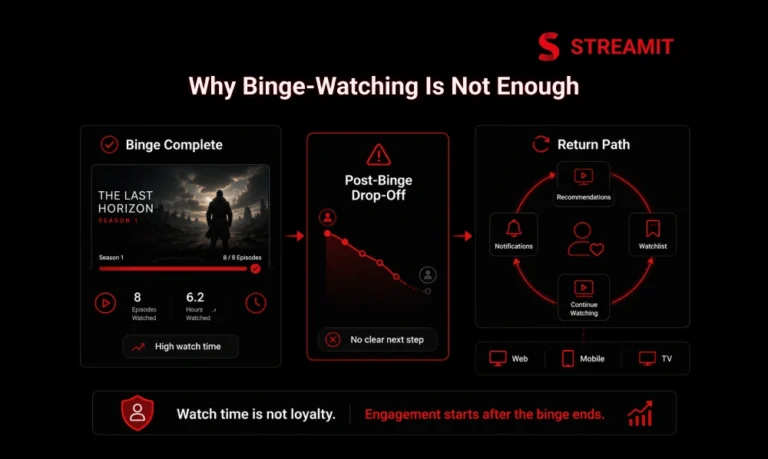
The best content can underperform if users cannot find it quickly. Discovery is not a design feature. It is a retention feature.
Search, filters, recommendations, categories, watchlists, and continue watching reduce friction and help users move faster from opening the app to pressing play.
The Product Must Support Revenue, Analytics, and Scale From Early Stages
A scalable OTT platform should not block future business models. Even if the first version is simple, the architecture should support subscriptions, ads, pay-per-view, coupons, and bundles later.
| Growth Need | Product Requirement |
|---|---|
| Retention | Continue watching, watchlists, recommendations |
| Revenue | Subscriptions, ads, PPV, coupons |
| Scale | CDN, cloud setup, caching |
| Control | Admin panel, analytics, access rules |
Core Services
Core Services a Video Streaming App Development Company Should Offer
A serious video streaming app development company should offer more than app screens. It should help build the full OTT ecosystem.
That includes apps, websites, admin panels, live streaming, VOD libraries, payment systems, DRM, analytics, ads, and third-party integrations.
OTT App Development for Web, Mobile, and Smart TV
OTT app development should cover web, Android, iOS, Android TV, Fire TV, and smart TV experiences based on the business model.
Each device has different user behavior. Mobile needs speed. TV needs remote-friendly navigation. The web often handles discovery, subscription, and account management.
Build for Android, iOS, Android TV, Fire TV, and Web
A strong OTT app development company should plan device coverage from the start. Adding TV apps later can become expensive if the base architecture is weak.
The platform should support consistent login, access, playback, and user data across all major devices.
Keep the User Experience Consistent Across Devices
Consistency does not mean every screen looks the same. It means users feel the same brand and access the same journey everywhere.
Watch history, resume playback, saved content, and subscriptions should move smoothly across devices.
Video Streaming Website and OTT Admin Panel Development
A video streaming website helps with discovery, SEO, subscriptions, content browsing, and user onboarding.
The OTT admin panel helps the internal team manage the business without depending on developers for every small update.
Manage Content, Users, Plans, and Platform Operations
The admin panel should manage videos, categories, banners, plans, users, coupons, access rules, analytics, and platform settings.
A weak admin panel slows operations. A strong one gives the team control.
Live Streaming and VOD Platform Development
Live streaming and VOD platforms need different planning. VOD focuses on libraries and discovery. Live focuses on timing, traffic, and stability.
A strong OTT streaming solution should support both if the business model needs it.
Support Live Events, Continuous Channels, and On-Demand Libraries
Live events need stable delivery and access control. Continuous channels need scheduling. VOD libraries need structure, metadata, and recommendations.
The platform should fit the content format rather than forcing every business into a single model.
Prepare for Both Launch Day and Traffic Spikes
Launch traffic is different from test traffic. The platform may work for 100 users but fail when thousands join.
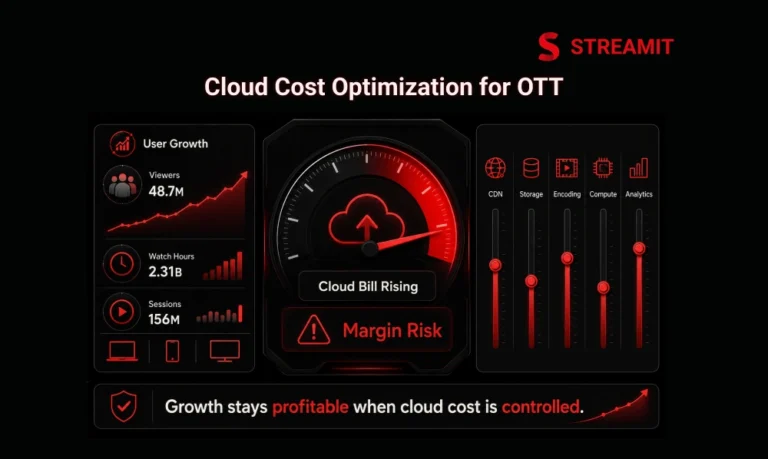
Scalable OTT platforms require strong cloud architecture, reliable CDN setup, smart caching, performance monitoring, and proper load management.
Third-Party Integrations for Payments, DRM, Analytics, and Ads
OTT platforms need payment gateways, DRM, ads, analytics, email tools, CRM systems, and marketing integrations.
These integrations should be planned carefully because they affect revenue, content protection, and user insights.
Growth Features
Features That Actually Help OTT Brands Grow After Launch
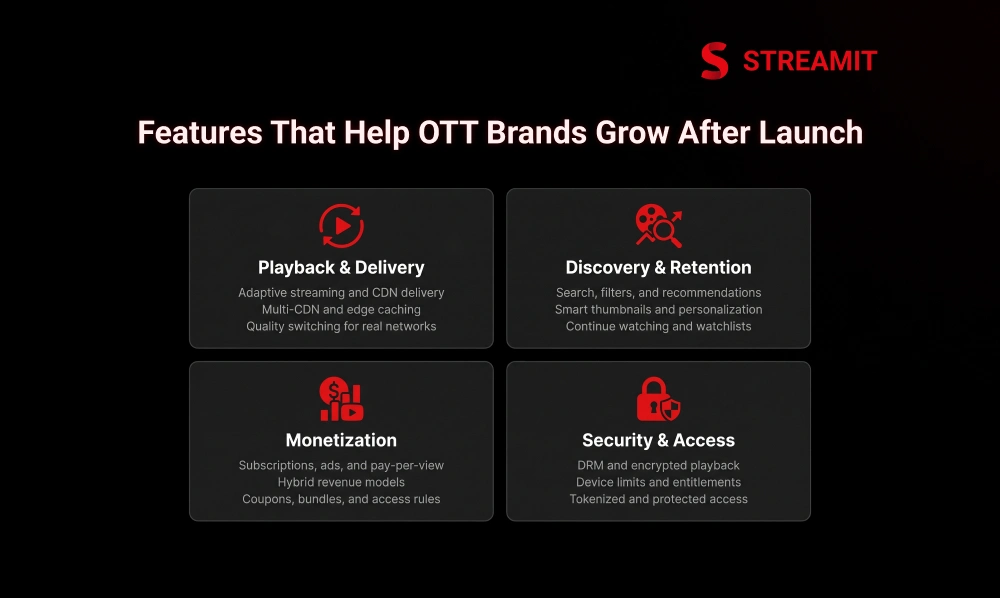
Launch features help the platform go live. Growth features help the platform keep users, revenue, and performance stable.
Many platforms launch with login and playback, but struggle later because they lack discovery, monetization flexibility, security, and analytics.
Smooth Playback With Adaptive Streaming and Better Video Delivery
Playback quality directly affects trust. Users rarely understand technical reasons. They just leave when the video buffers.
Adaptive streaming, CDN delivery, transcoding, compression, and quality switching help improve playback across real network conditions.
Multi-CDN, Edge Caching, and Smarter Delivery Setup
Multi-CDN reduces dependency on one delivery route. Edge caching brings content closer to users.
Together, these help reduce buffering and improve streaming performance.
Transcoding and Quality Switching for Real Network Conditions
Every user has a different connection speed. Transcoding prepares multiple video qualities. Adaptive quality switching helps the platform serve the right quality based on the user’s network.
Discovery Features That Improve Watch Time and Retention
Discovery decides how quickly users find something worth watching. This directly affects watch time.
Strong discovery includes search, filters, recommendations, categories, smart thumbnails, watchlists, and continue watching.
Search, Filters, Recommendations, and Smart Thumbnail Logic
Search and filters help users find known content. Recommendations help users discover new content.
Smart thumbnails can improve content interest by showing visuals that match user behavior.
Continue Watching, Watchlists, and Resume Playback
Continue watching reduces effort for returning users. Resume playback makes the platform feel personal and useful.
Watchlists create future intent and give users a reason to return.
Monetization Features That Support OTT Growth
OTT monetization should be flexible from the early stage. A platform should not be locked into one revenue model forever.
Subscriptions, ads, rentals, pay-per-view, coupons, bundles, and hybrid models help brands test what works.
Subscriptions, Ads, Pay-Per-View, and Hybrid Revenue Models
SVOD works for regular content libraries. AVOD works for larger free audiences. TVOD works for premium events or one-time access.
Hybrid monetization gives OTT brands more flexibility.
Coupons, Bundles, Offers, and Access Rules
Coupons and offers help improve conversion. Bundles help increase order value. Access rules control who can watch what based on plan, payment, region, or user type.
Security Features That Protect Content and Revenue
Content security protects both the content and the business model.
DRM, encryption, tokenized access, device limits, and entitlement checks help reduce misuse and unauthorized access.
Widevine, FairPlay, PlayReady, and Tokenized Access
Widevine, FairPlay, and PlayReady support protected playback across different device ecosystems.
Tokenized access adds another layer by allowing only approved sessions to access video streams.
Device Rules, Entitlements, and Protected Playback
Device rules limit account sharing. Entitlements decide what content each user can access. Protected playback is important for premium content, licensed libraries, and paid events.
Growth Blockers
What Slows OTT Growth After Launch
Most OTT growth issues become visible only after real users start using the product. The app may look fine in testing, but struggle under real behavior.
Common growth blockers include poor TV support, weak metadata, shallow analytics, rigid backend logic, and slow post-launch support.
TV App Updates and Device Support Become Harder After Launch
TV apps need different navigation, testing, store approval, and playback behavior.
If TV support is not planned early, updates become harder, and the viewing experience becomes inconsistent.
Weak Metadata and Analytics Quietly Hurt Discovery and Revenue
Bad metadata makes content harder to find. Weak analytics makes user behavior harder to understand.
Without clean metadata and analytics, teams cannot improve discovery, recommendations, retention, or monetization.
Poor Backend Decisions Block New Monetization Features Later
A weak backend may support one plan today but fail when the business needs bundles, coupons, PPV, ads, or regional access.
This is why OTT platform architecture should be planned around future revenue models.
Weak Support Becomes a Growth Problem, Not Just a Service Problem
OTT platforms need continuous improvement after launch. Devices change, users complain, payments fail, and new features are needed.
Post-launch support becomes part of growth, not just maintenance.
Use Case Breakdown
Different OTT Businesses Need Different Development Priorities
Every OTT business uses video, but every OTT business does not need the same platform.
Entertainment, sports, fitness, learning, creator, and podcast platforms all need different feature priorities.
-
Entertainment and Media Platforms Need Scale, Discovery, and Retention
Entertainment platforms need strong libraries, categories, search, recommendations, and watch history. They also need analytics to understand what content drives engagement and renewals.
-
Sports and Live Event Platforms Need Low Latency and Purchase Flows
Sports platforms need stable live delivery, low latency, pay-per-view, ticket access, and traffic spike handling. The purchase flow must be quick because users often buy close to event time.
-
Fitness, Coaching, and Learning Platforms Need Access Control and Structured Content
Fitness and learning platforms need programs, course flow, progress tracking, and restricted access. The goal is not only watching – the goal is to help users follow a structured journey.
-
Creator and Podcast Platforms Need Brand Control and Flexible Monetization
Creators need direct audience ownership, flexible pricing, exclusive content, and branded experiences. They need a platform that does not limit how they package or sell content.
Planning & Budget
Timeline, Cost, and Delivery Model for OTT App Development
OTT development cost depends on system depth, not just screen count. A simple app costs less. A full OTT platform needs more planning, integrations, testing, and infrastructure.
The right model depends on the stage of the business, launch timeline, device needs, and long-term roadmap.
MVP Timeline vs Full OTT Platform Timeline
An MVP may include login, content upload, playback, subscriptions, and basic admin control.
A full OTT platform may include TV apps, DRM, analytics, AI discovery, ads, multi-CDN, and advanced monetization.
What Increases Cost: Devices, Live Features, DRM, AI, and Scale
Cost increases with smart TV apps, live streaming, DRM, analytics, AI recommendations, complex payments, and scale planning.
These features add cost because they affect infrastructure, testing, and long-term stability.
Build From Scratch vs White-Label vs Custom Hybrid
White-label is faster but less flexible. Custom development gives more control but takes longer. A custom hybrid model can balance faster launch with long-term ownership.
Selection Criteria
How to Choose the Right Video Streaming App Development Company
The right company should understand streaming as a business, not just an app category.
Look beyond design samples. Check whether they understand playback, infrastructure, TV apps, monetization, analytics, security, and post-launch growth.
-
Check OTT Portfolio, Device Experience, and Live/VOD Capability
Review whether the company has experience with OTT apps, VOD platforms, live streaming, and TV apps. A good partner should understand how different devices and content formats affect the product.
-
Check Infrastructure, Security, and Performance Readiness
Ask about CDN, adaptive streaming, caching, DRM, monitoring, and traffic spikes. These answers show whether the team is ready for real streaming pressure.
-
Check Monetization, Analytics, and Product Growth Support
A strong team should understand subscriptions, ads, PPV, coupons, analytics, churn signals, and watch time. This helps the platform grow after launch.
-
Check Post-Launch Support, Ownership, and Roadmap Flexibility
The platform should give you control over content, users, monetization, and data. Avoid setups where every future change needs a rebuild or heavy dependency.
Why Streamit
Why Streamit Is a Strong Choice for OTT Growth
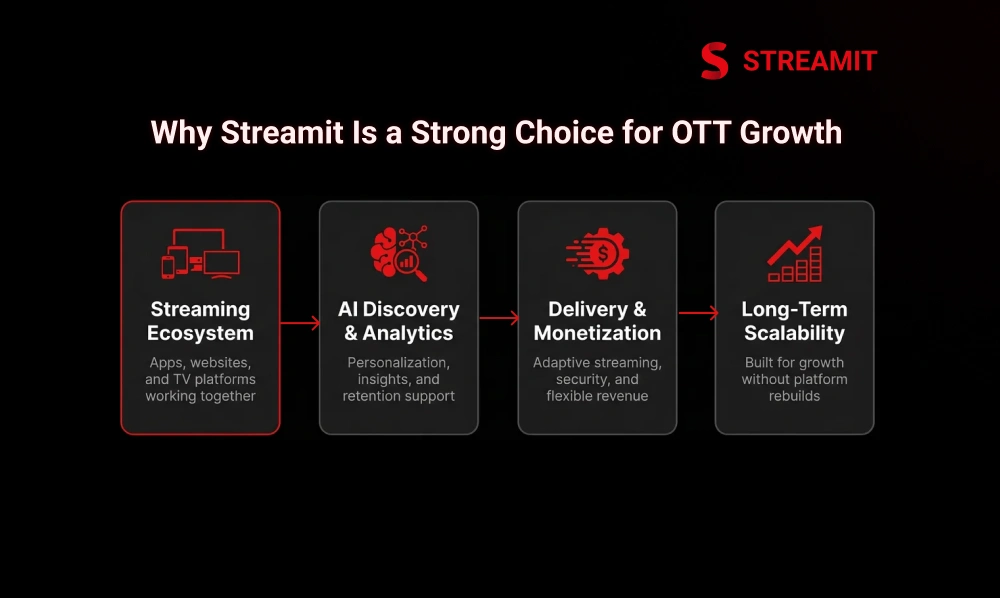
Streamit is built for OTT brands that want more than a basic video app. It focuses on apps, websites, TV apps, admin systems, AI discovery, analytics, delivery, monetization, and scalable OTT architecture.
It is designed for teams that want long-term control, not short-term launch energy.
Built for Streaming Apps, Websites, and TV Apps
Streamit supports the full streaming ecosystem across apps, websites, and TV experiences. This helps OTT brands build a connected product instead of separate, disconnected platforms.
Built Around AI Discovery, Analytics, and Retention
Streamit focuses on smarter discovery, personalization, platform analytics, and retention support. These layers help users find more content and help teams understand what is working.
Built With Better Delivery, Security, and Monetization Flexibility
Streamit supports better delivery planning, secure access, adaptive streaming, and flexible monetization. This helps OTT brands prepare for real users, real revenue, and real scale.
Built for Teams That Want Growth Without Rebuilding Later
Streamit is useful for teams that want a scalable OTT architecture from the start. The goal is not just to launch – the goal is to build a platform that can grow without constant rebuilding.
Summary
Key Takeaways
Architecture Drives OTT Growth
A strong video streaming app development company should understand playback, monetization, analytics, security, and retention together – not just app design.
Multi-Device Is a Business Requirement
Web, mobile, and TV apps should feel connected across sessions, payments, watch history, and content access – not like separate products.
Discovery Is a Retention Feature
Search, filters, recommendations, smart thumbnails, continue watching, and watchlists keep users engaged and reduce churn after launch.
Monetization Needs Early Flexibility
Subscriptions, ads, pay-per-view, bundles, coupons, and hybrid models should be planned from the start – not retrofitted later when revenue pressure arrives.
Post-Launch Performance Is Part of Growth
OTT platforms need continuous support, roadmap flexibility, analytics, security, and product iteration after going live – not just launch delivery.
Growth Slows Without the Right Foundation
Buffering, weak metadata, limited analytics, poor TV support, and rigid backends are the most common growth blockers OTT brands face after launch.
Conclusion
Conclusion
A video streaming app development company should help OTT brands build a product that survives real users, real traffic, and real business pressure.
The goal is not only to launch an app. The goal is to build a streaming platform that supports playback, discovery, monetization, analytics, security, and scale together.
For serious OTT brands, the right development partner becomes more than a vendor. It becomes the team that helps turn a streaming idea into a product that can grow with control.
FAQs
Frequently Asked Questions
-
When does an OTT brand need a video streaming app development company?
An OTT brand needs one when it wants more than basic video playback. If the business needs apps, TV support, subscriptions, analytics, security, and scale, it needs streaming-specific development.
-
What slows OTT growth the most after launch?
OTT growth slows because of buffering, weak discovery, poor metadata, limited analytics, rigid monetization, and poor device support. These issues reduce watch time and retention.
-
How important is Smart TV support for OTT growth?
Smart TV support is important because many users prefer long-form viewing on larger screens. A weak TV app can reduce engagement even if the mobile app works well.
-
What helps reduce buffering in OTT apps?
Adaptive streaming, video CDN, multi-CDN setup, edge caching, transcoding, compression, and cloud infrastructure help reduce buffering. These improve playback across different networks.
-
Why does metadata matter for OTT growth?
Metadata helps users and recommendation systems understand content better. Strong titles, tags, genres, thumbnails, and descriptions improve search and discovery.
-
Which monetization features should an OTT app support first?
Most OTT apps should start with subscriptions, payment gateways, access rules, coupons, and basic plan management. Ads, PPV, bundles, and hybrid models can follow.
-
Do OTT apps need DRM from day one?
DRM is important from day one if the platform has premium, licensed, or paid content. For simple validation, lighter protection may work, but serious platforms should plan DRM early.
-
How can I select the best OTT app development company for my platform?
Choose a company that understands streaming infrastructure, playback, apps, TV devices, monetization, analytics, security, and post-launch support. Do not choose only based on low cost or design samples.