How Netflix’s Recommendation System Boosts Watch Time


In streaming, watch time does not grow only because the content library is large. It grows when users find something worth watching before they lose interest. That is the real power of the Netflix recommendation system.
For OTT platforms, the lesson is simple but often missed: recommendations are not just a product feature. They are a retention system, a discovery system, and a revenue protection system working together.
Overview
What Is the Netflix Recommendation System?
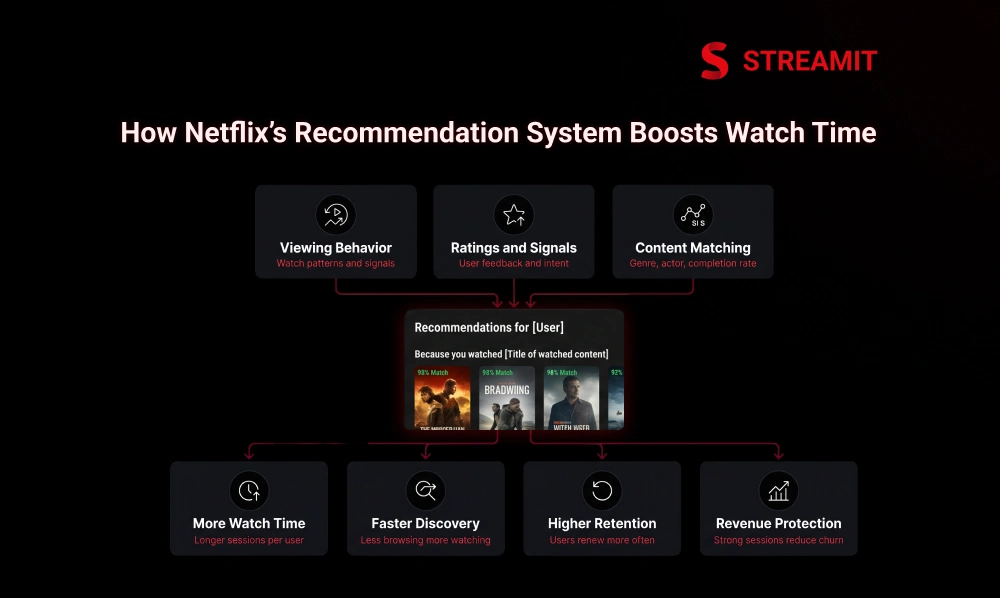
The Netflix recommendation system uses viewing behavior, ratings, and user signals to predict and suggest content each user is most likely to watch next.
The deeper insight is this: the system is not trying to show every title. It is trying to reduce the user’s decision time. A large catalog can become a problem when users do not know what to watch. The recommendation engine turns that catalog into a personalized viewing path.
What a Recommendation System Means in Streaming
A streaming recommendation system studies how users interact with content and then suggests titles that match their interests. It can recommend based on similar users, similar content, viewing patterns, genres, actors, completion rate, and recent activity.
For a viewer, it feels simple: “Here is something you may like”. For the platform, it is a complex engagement layer. Good content recommendations reduce browsing friction, improve content discovery, and help users start watching faster.
Why Recommendations Matter for OTT Platforms
OTT platforms do not lose users only because of bad content. They also lose users because users cannot find the right content quickly enough. When discovery fails, the user leaves, even if the platform has good shows inside.
A recommendation system helps solve the “too many choices” problem. Instead of forcing every viewer to search manually, the platform guides them toward relevant titles, similar content, continue-watching rows, and personalized home sections.
Engagement
Why Watch Time Matters for Netflix
Watch time is one of the strongest signals of viewer engagement. If users keep watching, it usually means the platform is helping them find value. If they stop watching quickly, the platform has either shown the wrong content or created too much friction.
For subscription streaming, watch time is not just a metric. It is a warning signal for retention. A user who watches regularly has more reasons to renew. A user who struggles to find something every week slowly becomes a cancellation risk.
What Watch Time Means in Streaming Analytics
Watch time means the total amount of time a user spends watching content on a platform. It can be tracked per session, per user, per title, per category, or per device.
Completion rate, repeat visits, session length, drop-off points, and binge behavior all help platforms understand what keeps users engaged.
How Watch Time Impacts Retention and Revenue
Higher watch time usually means users are getting more value from the platform. When users feel the service understands their taste, they are less likely to cancel.
A recommendation system protects revenue by increasing the number of successful viewing sessions. In a subscription model, every strong session gives the user another reason to stay.
Personalization
How Netflix Uses Personalization to Increase Watch Time
Netflix uses personalization to make the platform feel different for each user. Two users may open the same app and see different rows, title rankings, artwork, and suggestions based on their behavior.
This is where watch time starts to compound. If the first recommendation works, the user watches. That watch creates more data. More data improves the next recommendation. Over time, the platform becomes better at predicting what keeps that user engaged.
What Personalized Content Recommendations Are
Personalized content recommendations are suggestions based on a user’s viewing behavior, preferences, feedback, and interaction patterns. They are not random content blocks.
The system studies intent through behavior. What someone finishes, skips, pauses, searches, replays, or abandons often says more than what they manually rate.
Why Personalization Keeps Users Watching Longer
Personalization keeps users watching because it removes friction. The user does not need to restart the discovery process every time they open the app.
The best recommendation systems do not only ask, “What is popular?” They ask, “What is relevant for this user right now?” That difference is what separates generic content libraries from high-retention streaming platforms.
Deep Dive
How the Netflix Recommendation System Works
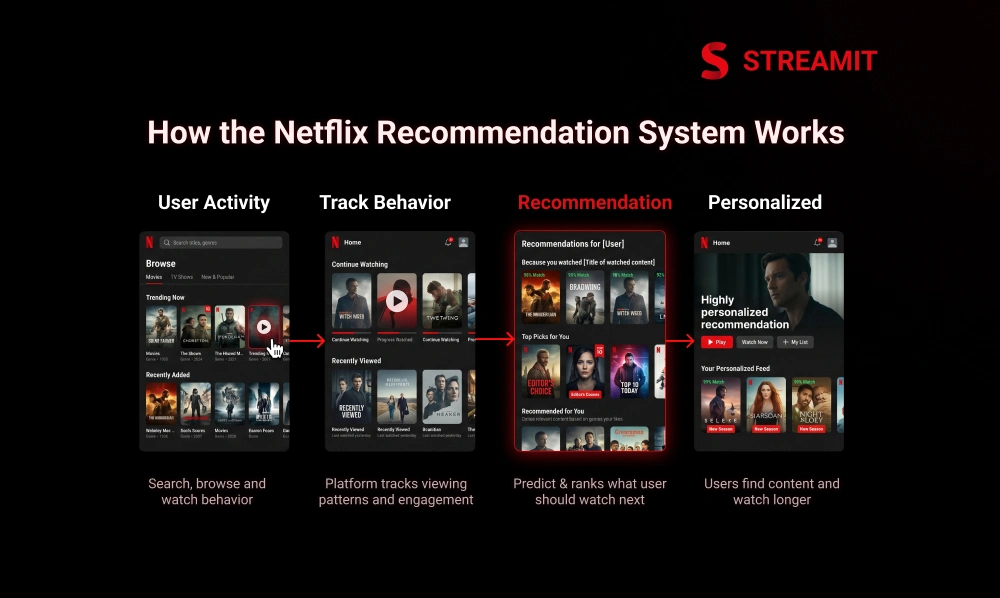
Netflix’s recommendation system works by collecting user signals, ranking content, testing performance, and continuously updating recommendations based on fresh behavior. Netflix says its homepage ranking personalizes the choice of rows, the titles inside each row, and the order of titles.
The system is not one single algorithm. It is a decision layer across the entire product experience. Search, homepage rows, thumbnails, similar titles, continue-watching sections, and next-title suggestions all contribute to watch time.
What User Data Netflix Collects
Netflix uses interaction data such as viewing history, ratings, watch duration, device type, language preference, time of day, and title metadata. It also uses signals from users with similar tastes.
For OTT platforms, the lesson is clear: recommendation quality depends on tracking quality. If your platform does not track meaningful user behavior, it cannot personalize well.
| Data Signal | What It Reveals | How It Helps Watch Time |
|---|---|---|
| Viewing history | User taste and habits | Suggests relevant titles |
| Watch duration | Interest depth | Improves ranking quality |
| Likes or ratings | Direct feedback | Refines preferences |
| Search behavior | Active intent | Improves discovery |
| Device data | Viewing context | Optimizes experience |
| Time of day | Usage pattern | Improves timing relevance |
Viewing History and Watch Duration
Viewing history tells the platform what the user has already watched. Watch duration tells the platform how deeply the user engaged with it.
A finished episode is stronger than a clicked thumbnail. That is why watch duration matters. It separates curiosity from real interest.
Ratings, Likes, and Dislikes
Ratings, likes, and dislikes are direct user feedback. They help the system understand what a user actively enjoyed or rejected.
But feedback alone is not enough. Many users do not rate every title, so strong recommendation systems also depend on passive behavior like watch time, skips, and repeats.
Search, Browsing, and Device Data
Search data shows what the user is actively trying to find. Browsing behavior shows what caught attention but may not have converted into viewing.
Device data adds another layer of context. A user may watch short episodes on mobile and longer films on TV. The recommendation system becomes stronger when it understands these patterns.
How Netflix Predicts What You Will Watch Next
Netflix predicts what users may watch next by comparing user behavior, title attributes, similar audience patterns, and recent activity. Its system estimates the likelihood that a member will enjoy a specific title based on multiple factors.
The prediction is not about being perfect. It is about increasing the chance of a successful next click. Even small improvements in relevance can increase session length at scale.
How Netflix Continuously Improves Recommendations
Netflix updates recommendations based on each visit, including what users start watching, finish watching, and rate. Its data, algorithms, and computation systems feed into each other to keep recommendations relevant.
This feedback loop is the real moat. The more users interact, the more the system learns. The more it learns, the better the user experience becomes.
Technology
Algorithms Behind Netflix Recommendations
Netflix recommendations use a mix of recommendation approaches, including collaborative filtering, content-based filtering, ranking models, machine learning, and newer personalization models. Netflix Research lists recommendations as an active research area, showing that personalization is treated as an ongoing system, not a one-time feature.
The practical point for OTT founders is this: you do not need Netflix-level complexity on day one. You need the right roadmap. Start with clean data, basic personalization, and strong analytics before moving into advanced AI models.
Collaborative Filtering
Collaborative filtering recommends content based on patterns from similar users. If two users have similar watch behavior, the system can suggest titles one user liked to the other.
This works well when the platform has enough users and enough interactions. For smaller OTT platforms, collaborative filtering becomes stronger as the audience grows.
Content-Based Filtering
Content-based filtering recommends titles based on content attributes. These can include genre, language, actors, themes, tags, duration, release year, and content type.
This method is useful even with fewer users. If a viewer watches crime documentaries, the platform can recommend similar documentaries based on metadata.
Machine Learning and AI Models
Machine learning models can process larger patterns across user behavior, content metadata, ranking signals, and engagement outcomes. Netflix’s 2025 engineering work on foundation models focuses on using large-scale interaction histories and content information for personalized recommendations.
The goal is not to “add AI” for branding. The goal is to make better decisions at the right moment in the user journey. That is where recommendation models create business value.
| Recommendation Method | Best Use Case | OTT Maturity Level |
|---|---|---|
| Popular titles | New users, low data | Beginner |
| Content-based filtering | Genre and metadata matching | Beginner to mid-level |
| Collaborative filtering | Similar-user behavior | Mid-level |
| ML ranking models | Personalized ordering | Advanced |
| Foundation-style models | Large-scale personalization | Enterprise |
Impact
How Netflix Recommendations Increase Watch Time
Netflix recommendations increase watch time by reducing search time, improving relevance, encouraging session continuation, and lowering drop-off. A 2026 research paper on personalized recommendations found that replacing the current recommender with matrix factorization or popularity-based recommendations could reduce engagement by 4% and 12%, respectively.
That finding matters because it shows recommendation quality is not cosmetic. It directly affects engagement. Better targeting helps users watch more of what they actually value.
Faster Content Discovery
Faster content discovery means users spend less time searching and more time watching. This is one of the biggest reasons recommendation systems matter.
Every extra minute spent searching is a risk. If users feel the platform is making them work too hard, they exit before the content even begins.
Encouraging Binge Watching
Recommendations can encourage binge watching through episode continuation, similar titles, next-up suggestions, and personalized rows. These features remove the gap between one viewing decision and the next.
Binge behavior is not accidental. It is designed through continuity. When the next relevant title is already visible, the user has fewer reasons to stop.
Reducing User Drop-Off
User drop-off happens when viewers exit because nothing feels relevant. Recommendations reduce this by giving users a better next option.
The biggest drop-off often happens before playback, not during playback. If the platform fails at discovery, even a strong streaming infrastructure cannot save the session.
Product Features
Key Recommendation Features Used by Netflix
Netflix uses several recommendation features across the interface, including personalized homepage rows, ranked titles, continue-watching modules, similar content sections, search personalization, and artwork personalization.
The product lesson is important: recommendations should not sit in one section only. They should shape the full viewing journey from homepage to playback to the next session.
Personalized Homepage Rows
Personalized homepage rows organize titles into sections that feel relevant to each user. Netflix states that rows, title choices, and title order are personalized.
This turns the homepage into a living discovery system. Instead of showing one generic catalog, the platform creates different entry points for different viewing moods.
Personalized Artwork and Thumbnails
Personalized artwork means different users may see different visual representations of the same title. Netflix’s engineering team has publicly discussed artwork personalization as part of getting the right title in front of the right user at the right time.
This matters because the thumbnail is often the final decision trigger. A title may be relevant, but the wrong artwork can reduce the chance of a click.
Continue Watching and Similar Content Modules
Continue Watching helps users resume content without friction. Similar Content helps users move from one completed title to another related option.
These modules increase watch time because they reduce decision fatigue. The platform does not make the user start from zero every time.
Business Value
Business Benefits of a Recommendation System for OTT Platforms
A recommendation system helps OTT platforms improve retention, discovery, engagement, content ROI, and long-term subscription value. It is not only a user experience feature.
For a serious OTT business, recommendations become part of the revenue engine. Better discovery increases content consumption. Better consumption improves perceived platform value.
Higher User Retention and Subscription Renewals
When users consistently find relevant content, they are more likely to return. More return visits create more watch time, and more watch time supports subscription renewal.
Retention is rarely solved by one feature. It is solved by repeated moments where the user feels the platform is worth opening again.
Better Content Performance and Discovery
Recommendations help more titles get discovered beyond the obvious homepage placements. This is important for platforms with deep libraries.
Without recommendations, your most visible content gets most of the attention. With recommendations, niche and mid-library titles can find the right audience.
Improved Content Investment Decisions
Recommendation data can show which genres, formats, languages, and themes drive watch time. This helps OTT teams make better content investment decisions.
The platform should not only ask what users clicked. It should ask what users completed, returned to, and watched next. That is where content strategy becomes sharper.
Challenges
Challenges in Building a Recommendation System Like Netflix
Building a recommendation system is not just about choosing an algorithm. It requires clean data, scalable infrastructure, privacy discipline, experimentation, and product thinking.
Most platforms fail here because they want advanced personalization before fixing basic tracking. If the data layer is weak, the recommendation layer will also be weak.
Cold Start Problem for New Users
The cold start problem happens when a platform does not have enough data about a new user. Without history, the system cannot personalize accurately.
The solution is to start with simple onboarding choices, popular content, location-safe preferences, and early behavior signals. Netflix also asks new profiles to choose a few liked titles to jump-start recommendations.
Data Privacy and User Trust
Recommendation systems depend on user behavior data, so privacy matters. Users need confidence that their data is handled responsibly.
Personalization should never feel invasive. OTT platforms should collect only useful data, explain privacy clearly, and protect user information with strong backend controls.
Bias and Filter Bubble Risks
Recommendation systems can accidentally over-recommend the same type of content. This can limit discovery and create a narrow viewing experience.
A smart system balances relevance with variety. Users should get familiar choices, but also fresh options that expand viewing behavior.
Strategy
What OTT Platforms Can Learn From Netflix’s Recommendation Strategy
OTT platforms should not copy Netflix feature-for-feature. That usually leads to expensive complexity without clear business value.
The better lesson is strategic: build recommendation maturity step by step. Start with user behavior tracking, then content metadata, then basic recommendation logic, then advanced ranking models.
Start With Basic Personalization
Basic personalization can include recently watched titles, popular in category, similar content, language preference, and genre-based rows.
You do not need a full AI engine to start improving discovery. Even simple personalization can reduce friction if it is built properly.
Track Watch Time and Retention Metrics
OTT platforms should track watch time, completion rate, session length, repeat visits, search exits, content skips, and churn behavior.
The recommendation system is only as strong as the metrics behind it. If you do not measure retention, you cannot improve it.
Scale Recommendation Complexity Over Time
Recommendation complexity should grow with the platform. A small platform needs clean metadata and event tracking first. A scaling platform needs ranking logic, experimentation, and model improvement.
Do not overbuild early. Do not underbuild forever. The right roadmap protects both budget and long-term control.
Implementation
How to Build a Recommendation System for Your OTT Platform
Building an OTT recommendation engine starts with data design, not algorithm selection. The platform must track meaningful viewing events before it can personalize effectively.
The strongest recommendation systems are built into the platform architecture from the beginning. Adding personalization later is possible, but it usually costs more and creates messy data gaps.
Set Up User Tracking and Analytics
Track events like play, pause, resume, search, watch duration, completion, skip, add to watchlist, remove from watchlist, and device usage.
Clean event tracking is the foundation. Without it, the system cannot understand what users actually do inside the product.
Choose the Right Recommendation Algorithms
Start with rules and metadata-based recommendations. Then add collaborative filtering once you have enough user behavior. Later, add machine learning ranking models.
The right algorithm depends on your data maturity, not your ambition. A simple model with clean data will outperform a complex model with poor tracking.
Use the Right Recommendation Tools and Infrastructure
Your recommendation system needs event tracking, data storage, metadata management, analytics dashboards, model training pipelines, and fast API delivery.
The hidden challenge is performance. Recommendations must load fast enough to improve the user experience, not slow it down.
| Stage | Recommendation Focus | What to Build |
|---|---|---|
| Stage 1 | Basic discovery | Popular, trending, genre rows |
| Stage 2 | User-based relevance | Watch history, continue watching |
| Stage 3 | Personalization | Similar content, user preference |
| Stage 4 | Ranking | Personalized row order |
| Stage 5 | Advanced AI | Predictive and adaptive models |
Play Books
Netflix Retention Playbook
The Netflix retention playbook focuses on improving engagement through personalized discovery and smooth streaming performance. Platforms that combine recommendations and a strong user experience retain viewers longer.
Visit Netflix Retention PlaybookNetflix AI Framework Playbook
The Netflix AI Framework Playbook explains how streaming platforms use AI to analyze viewer behavior and deliver personalized content recommendations. This approach improves discovery, engagement, and long-term subscriber retention across the platform.
Visit Netflix AI Framework PlaybookFinal Thoughts
Conclusion
Watch time is not created by content alone. It is created by the relationship between content, user behavior, and discovery. Netflix’s recommendation system works because it understands that users do not want to browse endlessly. They want the right title at the right moment.
For OTT founders, this is the real lesson: recommendations should be treated as infrastructure, not decoration. If your platform can help users find better content faster, you improve engagement, retention, and revenue quality.
A recommendation engine does not need to be complex on day one. But it does need to be planned from day one. Start with tracking. Build clean metadata. Measure watch time. Learn from user behavior. Then scale the system intelligently.
That is how OTT platforms move from “content library” to “viewer habit”. And in streaming, habit is where long-term revenue lives.
Summary
Key Takeaways
Recommendations Are a Revenue System
They directly control what users watch, how long they stay engaged, and whether they return to your platform – not just a discovery feature.
Watch Time Is a Retention Signal
Watch time is the clearest signal of user satisfaction and an early indicator of churn risk – treat it as a business metric, not just an analytics number.
Personalization Reduces Friction
Showing the right content at the right time with minimal user effort separates high-retention platforms from generic content libraries.
Data Quality Defines Recommendation Quality
User data is not just for analytics – it is the foundation that defines how accurate and effective your recommendation system will be.
Build Recommendations in Layers
Recommendation systems evolve in stages, starting simple and becoming more intelligent as data grows. Do not overbuild early or underbuild forever.
Discovery Spans the Entire Product
Content discovery is not limited to one section – it spans homepage rows, search results, thumbnails, and playback flows throughout the user journey.
FAQs
Frequently Asked Questions
-
What is the Netflix recommendation system, and how does it work?
The Netflix recommendation system suggests content based on viewing history, ratings, watch duration, title details, device usage, and similar user behavior. It ranks titles and homepage rows to help users find content faster.
-
How does Netflix predict what you will watch next?
Netflix predicts what users may watch next by studying past behavior, recent activity, title metadata, and patterns from users with similar tastes. The goal is to increase the chance of a successful next viewing session.
-
How does Netflix reduce churn using content personalization?
Netflix reduces churn by making content discovery easier and more relevant. When users consistently find shows or movies they enjoy, they are more likely to return and renew their subscription.
-
What can OTT platforms learn from Netflix’s recommendation strategy?
OTT platforms can learn that recommendations should be built gradually with clean tracking, strong metadata, and clear retention metrics. The goal is not to copy Netflix, but to improve discovery and watch time.
-
How does Netflix use AI and machine learning for content recommendations?
Netflix uses machine learning to analyze user behavior, content information, rankings, and feedback loops. These systems help personalize homepage rows, title order, search results, and artwork recommendations.
Read Also
Read Also
1. Netflix-Like OTT Platform: Complete Build Guide
2. How Personalized Watchlists Improve OTT User Engagement
3. Netflix Retention Secrets OTT Platforms Must Learn
4. Creating Personalized Watchlists and Enhancing Viewer Engagement
5. 10 Powerful Netflix Retention Strategies Every Brand Should Use