Multi CDN vs Single CDN: Which Is Best for OTT Streaming?


Most OTT platforms do not fail because they picked the wrong player skin or launched one quarter late. They fail because delivery looks stable in testing and fragile in production. Once traffic spreads across regions, ISPs, devices, and peak-time spikes, CDN choice stops being a backend detail and becomes a revenue decision.
A buffer ratio above 2% was linked to a 30% higher chance of churn in research cited by AWS. This is what makes the debate important. Multi CDN vs single CDN is not just a technical infrastructure choice. It is really about how much buffering, downtime risk, and delivery complexity your OTT business is prepared to handle as it grows.
Streamit’s positioning already reflects this reality. It presents performance, scale, and platform intelligence as key priorities, with multi-CDN delivery featured as part of a high-performance OTT infrastructure. That is the right way to evaluate this decision: not by asking what is cheaper today, but by asking what keeps playback stable as the platform grows.
Fundamentals
What Is a CDN in OTT Streaming and Why Does It Matter?
A CDN, or content delivery network, is the layer that moves video closer to the viewer instead of forcing every request back to a distant origin. In OTT, that matters because every extra round trip shows up as startup delay, buffering, or playback instability when demand rises. Leaseweb describes a CDN as a network of globally distributed points of presence that sends data to users as quickly as possible.
For OTT teams, a CDN is not only about speed. It shapes cost-to-serve, peak-event stability, cache efficiency, and how much pressure lands on the origin during live and VOD traffic. CacheFly notes that CDNs help OTT platforms scale peak demand by distributing content geographically, reducing latency, and supporting dynamic resource allocation during heavy concurrency.
How a CDN Works in OTT Video Delivery
In simple terms, the origin stores the source assets, while edge servers cache and deliver manifests, segments, and other assets from locations closer to viewers. When caching is configured well, a large share of repeat requests can be served from the edge instead of the origin.
A 95.1% cache hit ratio means only 2 out of 41 requests miss the cache. Cloudflare uses that example to explain why cache hit ratio matters: the higher the hit ratio, the less often the origin is touched. For OTT, that translates into lower origin stress and more stable delivery during spikes.
Why OTT Platforms Need a CDN
OTT platforms need a CDN because video is unforgiving. Viewers can tolerate a little quality change, but they rarely forgive startup delay, repeated rebuffering, or stream failures. Mux recommends prioritizing startup time, rebuffering ratio, and playback failure rate because those metrics correlate most directly with abandonment.
CDNs also matter because OTT traffic is uneven. VOD libraries create repeated demand for popular titles. Live sports and premieres create sudden concurrency. Global expansion creates regional inconsistency. A CDN gives the platform a delivery layer that can absorb those patterns more gracefully than an origin-centric setup.
CDNs reduce latency, buffering, and playback failures
Many viewers leave after one rebuffering event longer than 2 seconds. Mux also notes that strong platforms often keep rebuffering at 0.5% or less. That is why CDN performance is a viewer problem, not just an infrastructure problem.
CDNs improve QoE across regions, devices, and peak traffic
A viewer on mobile data in one country and a viewer on connected TV in another will not experience the same network conditions. CDN routing, PoP coverage, and protocol support, such as HTTP/3 and QUIC, all affect how consistently the platform performs across those differences.
Single CDN
What Is a Single CDN Setup for OTT Streaming?
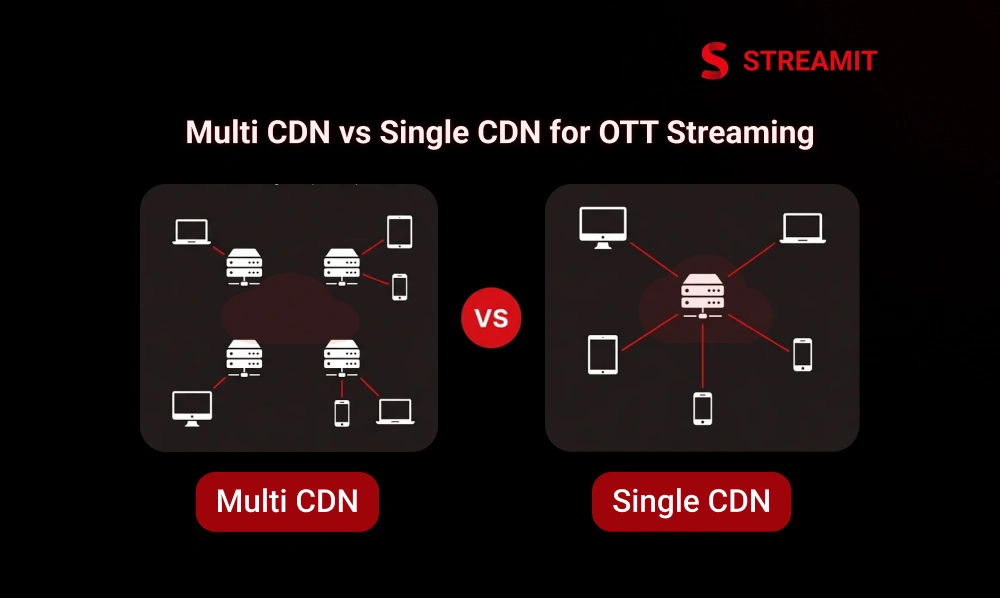
A single CDN setup means one provider handles delivery for your platform. That provider may still have a large global footprint and solid internal redundancy, but your external delivery strategy depends on one network, one vendor relationship, and one control model.
How Single CDN Architecture Works
In a single CDN model, DNS and routing logic send users into one provider’s PoP network. That provider decides which edge location serves the viewer and how traffic is handled within its infrastructure. AWS describes this as serving users from the best PoP location within the provider’s own network, based on ongoing latency and load conditions.
Benefits of a Single CDN Setup
Single CDN is easier to deploy, monitor, and govern. One dashboard, one set of logs, one contract, and fewer routing decisions usually mean lower operational burden. It also tends to be the more predictable option for regional OTT services or platforms with modest concurrency and limited engineering bandwidth.
Limitations of a Single CDN Setup
The weakness is concentration risk. If performance degrades in a key geography or if the provider has an outage, your delivery options narrow quickly. You also have less leverage on regional optimization and less flexibility when pricing or service quality shifts.
Multi CDN
What Is a Multi CDN Setup for OTT Streaming?
Multi CDN means using two or more CDN providers and steering traffic between them based on rules, geography, or real-time performance. Mux defines it as using multiple CDNs to deliver video more reliably, performantly, and sometimes more affordably.
How Multi CDN Architecture Works
The control plane sits above the CDNs. That control layer can be DNS-based, application-aware, or player-aware. It measures which provider is healthier or faster and routes traffic accordingly. Spyrosoft describes multi-CDN systems as smart traffic controllers that automatically route traffic to the best-performing provider and fail over if one has problems.
Common Multi CDN Routing Models
There is no single routing model that fits every OTT business. The right model depends on traffic shape, failure tolerance, and how much control you need during playback.
Primary-secondary failover
One CDN handles normal traffic, and another acts as backup. This is the simplest multi-CDN model and often the best first step for OTT teams that want resilience without building an advanced traffic engine. Vercara lists primary-fallback as a common implementation approach.
Active-active traffic sharing
Traffic is split across two or more CDNs at the same time, often by weight, region, or content type. This improves capacity sharing and can reduce congestion during heavy demand. DNS-based steering is the most common starting point for this approach.
Geo-based and real-time performance routing
This is the more mature model. Traffic is routed according to geography, ISP behavior, latency, or real-time health. Spyrosoft and Vercara both describe performance-driven routing as the model that selects the best provider at the moment of request, rather than relying on static assumptions.
Benefits of a Multi CDN Setup
Multi CDN improves redundancy, lets platforms match providers to regional strengths, and gives teams more control over cost-performance trade-offs. Leaseweb notes that different providers often have strengths in different geographies, while Spyrosoft adds that multiple providers can improve reliability, latency, and vendor flexibility.
Challenges of a Multi CDN Setup
The downside is complexity. Observability becomes harder because each provider may define latency, error classes, and cache behavior differently. CacheFly warns that without normalized data across providers, comparison becomes guesswork. Multi-CDN also adds certificate management, security consistency, log aggregation, and more complicated incident response.
Comparison
Multi CDN vs Single CDN: The Differences That Matter Most
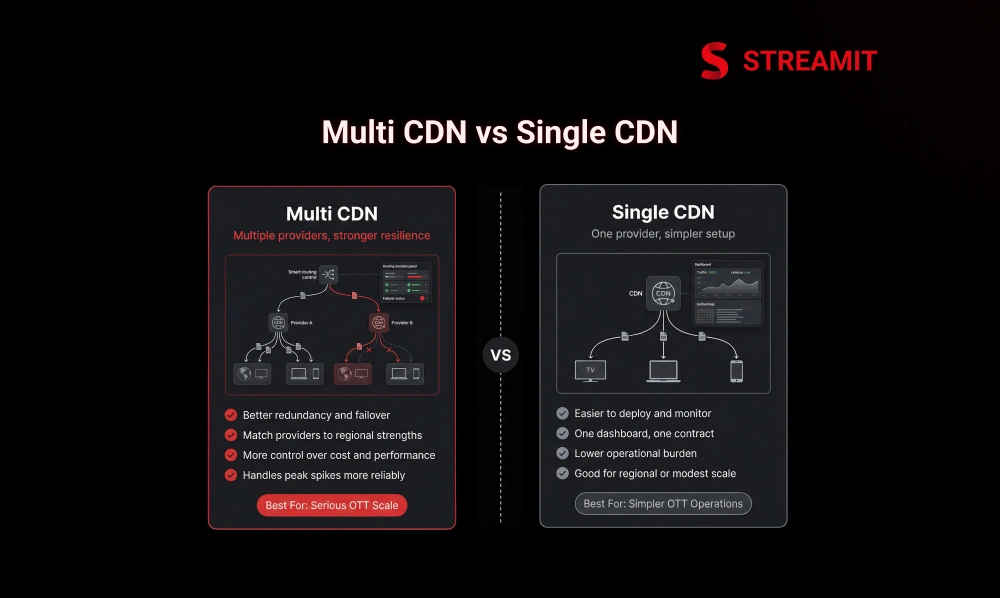
The real difference is not theoretical resilience. It is operational optionality. Single CDN says, “one provider should be enough.” Multi CDN says, “We do not want one provider deciding our performance ceiling.”
| Decision Area | Single CDN | Multi CDN |
|---|---|---|
| Regional reach | Strong where the provider is strongest | Stronger when matched to each region |
| Buffering during spikes | Depends on one network’s headroom | Load can be shared or rerouted |
| Outage exposure | Higher external dependency | Better failover options |
| Operations | Simpler | More complex |
| Cost control | Easier to forecast | More flexible, harder to govern |
| Vendor leverage | Lower | Higher |
Regional Performance and Video Latency
A single CDN can perform very well in the regions where it has strong PoP density and network relationships. But regional dominance is rarely uniform. Leaseweb explicitly notes that one single CDN may be stronger in Europe while another may perform better elsewhere.
Buffering, Peak Traffic, and Playback Stability
Peak traffic is where weak delivery architecture becomes visible. CacheFly explains that CDNs help OTT platforms absorb sudden spikes in viewership without compromising performance, and multi-CDN extends that advantage by preventing one network from becoming the only bottleneck.
Redundancy, Failover, and Outage Protection
With single CDN, resilience exists mainly inside the vendor’s own infrastructure. With multi-CDN, resilience extends across vendors. That distinction matters when the issue is not just one failed node, but a regional weakness, DNS problem, provider-wide incident, or major traffic surge.
Cost Efficiency and Traffic Routing Control
Single CDN often looks cheaper on paper because contracts and monitoring are simpler. Multi CDN can be cheaper in practice when routing lets you send premium traffic through premium providers and lower-priority traffic through lower-cost routes. That said, savings disappear quickly if routing logic, monitoring, and engineering overhead are poorly managed.
Performance
How Multi CDN Improves OTT Streaming Performance
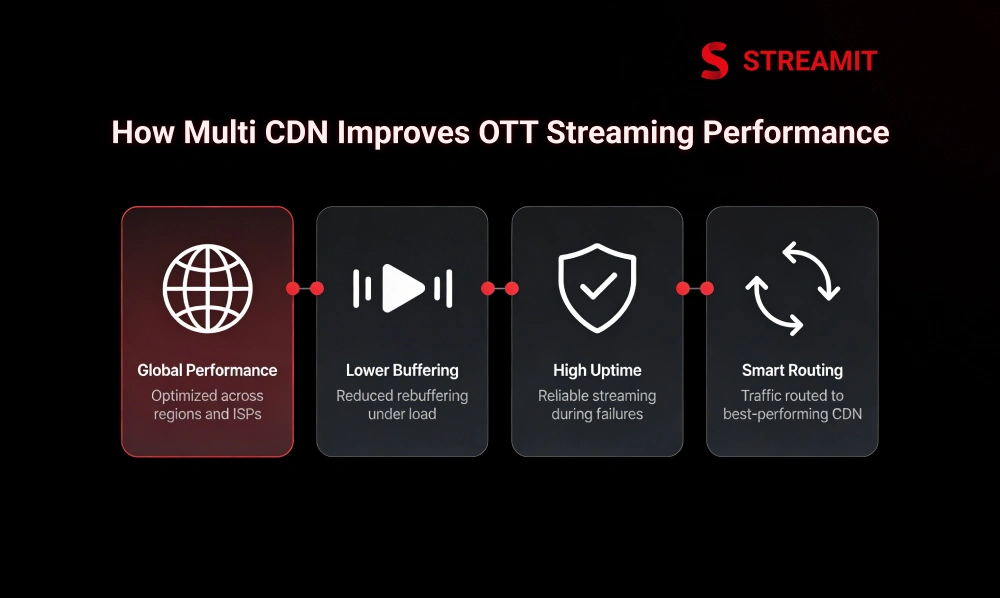
Multi CDN improves performance because it acknowledges a truth many teams learn too late: internet quality is uneven, and no single network wins everywhere.
Better Performance Across Countries, ISPs, and Device Types
A multi-CDN strategy can route users to the provider that performs best in their geography or on their network conditions. That is especially useful when the same stream is being watched across multiple countries and device types at once.
Lower Rebuffering During High-Concurrency Events
When one provider starts to congest during a live event, multi-CDN gives you room to shift traffic instead of hoping the problem clears on its own. For sports, premieres, and high-intent live events, that optionality is often worth more than the raw bandwidth savings of a simpler setup.
Stronger Uptime for Live and Premium Streaming
Live and premium tiers are where delivery mistakes become visible fastest. Multi-CDN helps keep playback available when one provider slows down or fails, provided failover logic and cache consistency are tested properly.
Smarter Delivery for Global OTT Growth
For global OTT growth, the point is not to collect more vendors. It is to gain better control over where traffic goes, why it goes there, and what happens when conditions change. That is a business-control advantage as much as a technical one.
Cost & Operations
Cost and Operational Trade-Offs of Multi CDN vs Single CDN
The cheapest architecture is usually the one you can operate well. A theoretically optimal setup that the team cannot monitor or troubleshoot is not efficient. It is fragile.
Direct Costs: Bandwidth, Requests, and Provider Pricing
Multi CDN can lower delivery cost by matching traffic to regionally efficient providers. It can also increase cost if you duplicate premium providers without a clear routing strategy. Pricing flexibility is a benefit, but only when traffic policies are deliberate.
Hidden Costs: Engineering, Monitoring, and Routing Logic
CacheFly points out that multi-CDN requires normalized observability, centralized telemetry, and coordinated incident response. That means engineering time, tooling, and process design, not just extra contracts.
When Managed Multi CDN Makes More Sense Than DIY
Managed multi-CDN makes more sense when the OTT business needs resilience and routing control but does not want to build its own steering, observability, and failover stack. DIY only pays off when the platform has enough scale and internal expertise to justify deeper control. Medianova and Fastly both frame the trade-off this way: the value is real, but so is the operating burden.
Decision Guide
Which Is Best for OTT Streaming?
The best answer depends less on ideology and more on traffic profile, business model, and the cost of failure.
Choose Single CDN If You Need Simplicity and Predictable Operations
If your OTT platform is regional, mostly VOD, early stage, or lightly staffed on the engineering side, single CDN is often the right starting point. It is simpler to deploy, easier to troubleshoot, and usually good enough until traffic diversity or outage risk becomes a real business issue.
Choose Multi CDN If You Need Global Scale, Reliability, and Performance Control
If your platform serves multiple countries, depends on live events, runs premium subscriptions, or treats QoE as a retention lever, multi-CDN is usually the stronger long-term choice. The more expensive downtime becomes, the stronger the case for reducing single-vendor exposure.
Best Choice by OTT Business Model and Growth Stage
| OTT Scenario | Better Starting Fit | Why |
|---|---|---|
| Regional VOD startup | Single CDN | Lower complexity, predictable ops |
| Fast-growing subscription OTT | Hybrid path to Multi CDN | Retention risk grows with scale |
| Live sports or event streaming | Multi CDN | Higher concurrency and outage sensitivity |
| Global content platform | Multi CDN | Region and ISP variation matter more |
| E-learning or creator platform with stable traffic | Single CDN, then review | Often simpler until it reaches expands |
Early-stage or regional OTT platforms often start with single CDN
Early-stage or regional OTT platforms often begin with a single CDN because it is easier to manage and keeps operations simpler. For steady traffic and limited reach, it usually delivers reliable streaming without added complexity.
High-growth, live, or global OTT platforms benefit more from multi CDN
High-growth, live, or global OTT platforms benefit more from multi CDN because traffic is less predictable and delivery risks are higher. A multi CDN setup improves redundancy, performance control, and playback stability across regions and peak-demand events.
Implementation
How to Implement Multi CDN Without Overcomplicating Your OTT Stack
A mature multi-CDN rollout should feel controlled, not dramatic. The goal is smarter routing, not a bigger dashboard problem.
Audit Traffic by Region, ISP, and Content Type
Start by measuring where viewers are, which ISPs cause issues, and whether pain is concentrated in live, premium, or long-tail VOD traffic. Without that baseline, multi-CDN becomes a generic upgrade instead of a targeted fix.
Choose the Right CDN Mix and Routing Strategy
Begin with the simplest routing model that solves the real problem. For many teams, that means regional or primary-failover routing first, then evolving into performance-based steering only where it adds clear value.
Add QoE Monitoring, Failover Testing, and Traffic Validation
Do not trust theoretical failover. Test it. Mux emphasizes startup time, rebuffering ratio, and playback failure rate as the QoE metrics that matter most, and CacheFly stresses the need for normalized observability across providers.
Metrics
Metrics You Must Track to Judge CDN Performance Properly
CDN performance should never be judged by delivery speed alone. OTT platforms need to track the right mix of QoE and QoS metrics to understand how CDN decisions affect buffering, playback stability, viewer experience, and long-term retention.
QoE Metrics
Three metrics usually tell the truth first: startup time, rebuffering ratio, and playback failure rate. Those are the leading indicators of whether viewers feel the delivery layer is working. Mux recommends starting there before expanding into bitrate, resolution, and broader engagement analysis.
QoS and CDN Metrics
Track TTFB, throughput, edge latency, cache hit ratio, error rate, and geographic performance. Vercara recommends these as core indicators for multi-CDN monitoring, while Cloudflare explains why cache hit ratio remains one of the clearest signs of CDN efficiency.
| Metric | What Does It Tell You | Why It Matters for OTT |
|---|---|---|
| Startup time | How fast does the playback begin | Viewer patience is low |
| Rebuffering ratio | Time spent buffering | Strong predictor of abandonment |
| Playback failure rate | Sessions that fail to start or continue | Direct revenue and trust risk |
| TTFB | Edge responsiveness | Early latency signal |
| Throughput | Delivery capacity under load | Important during live peaks |
| Cache hit ratio | How much traffic stays off the origin | Cost and stability signal |
| Geographic performance | Region-by-region delivery quality | Reveals coverage gaps |
Summary
Key Takeaways
CDN Choice Drives Revenue
For OTT platforms, CDN strategy shapes buffering, startup speed, playback stability, and how reliable the platform feels during real traffic – making it a revenue decision, not just a backend one.
Single CDN Works at the Start
A single CDN setup is easier to manage and monitor, and is often enough for early-stage or regional OTT platforms with predictable traffic patterns and limited engineering resources.
Multi CDN Scales with You
When OTT platforms grow across regions, handle live traffic, or depend on premium viewing experiences, multi CDN delivers better redundancy, stronger failover, and more delivery control.
No Single Network Wins Everywhere
Different CDNs perform differently across countries, ISPs, and device environments. Multi CDN lets platforms route traffic more intelligently instead of depending on one provider everywhere.
Business Stage Determines the Best Fit
Regional VOD platforms may do well with single CDN, while live, high-growth, or global OTT platforms usually benefit more from multi CDN. Match the setup to your actual traffic and failure risk.
Track QoE Metrics First
Startup time, buffering rate, playback failures, and uptime matter more than raw delivery speed. The right CDN setup consistently protects viewer experience at scale and supports long-term retention.
Conclusion
Conclusion
Single CDN is not wrong. It is often the right first decision for a platform that values speed of execution and predictable operations.
But most serious OTT businesses eventually learn the same lesson: growth makes delivery variability impossible to ignore. Once your audience becomes more global, more live, or more revenue-critical, a single CDN stops being a convenience and starts becoming a concentration risk. That is where multi-CDN earns its place. It gives the platform more room to protect playback, shape cost, and keep control as demand becomes less predictable. That is the kind of infrastructure choice founders usually appreciate later, not just at launch.
FAQs
Frequently Asked Questions
-
Is Multi CDN better than Single CDN for OTT streaming?
Yes, Multi CDN is better for OTT platforms that need stronger reliability, better global performance, and safer failover. Single CDN is better when simplicity and lower operational overhead matter more.
-
How many CDNs should an OTT platform use?
Most OTT platforms use 1 CDN to start, while 2 CDNs is often enough for better redundancy and wider coverage.
-
What is the difference between Managed Multi CDN and DIY Multi CDN?
Managed multi-CDN outsources routing and orchestration complexity; DIY gives more control but needs more engineering effort.
-
What is the best CDN setup for global OTT platforms?
The best setup for global OTT platforms is usually a multi-CDN setup with smart routing and failover. It improves global performance, reliability, and playback stability.
-
What metrics should OTT platforms track to evaluate CDN performance?
Track startup time, rebuffering ratio, playback failures, TTFB, throughput, error rate, cache hit ratio, and geographic performance.
-
What are the biggest risks of using a Single CDN?
Higher vendor dependency, weaker regional optimization, and more exposure when one provider has issues.
Read Also
Read Also
1. 10 Streaming Features Every OTT Service Needs
2. Edge Caching for OTT: Faster Streaming, Less Buffering
3. Cloud vs On-Premise Hosting for Your OTT Platform Guide
4. Why Video Streaming App Development Needs Multi-Device Support
5. Lowest Latency Video Streaming: 7 Proven Ways to Reduce Delay