White Label OTT vs Custom OTT Development: Which Is Better?


Most OTT decisions are not really about technology. They are about how much speed, control, cost predictability, and long-term ownership your business actually needs.
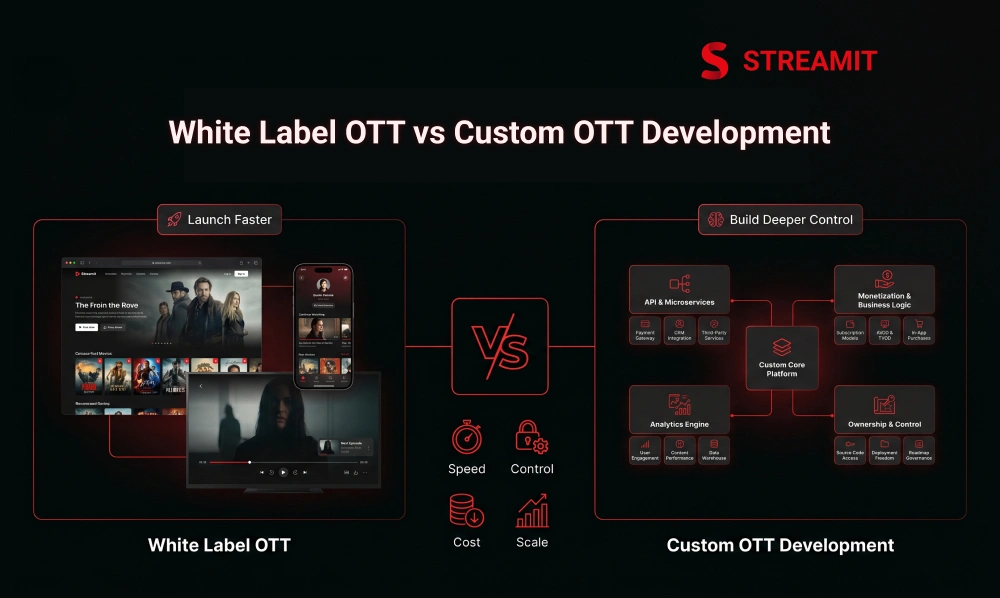
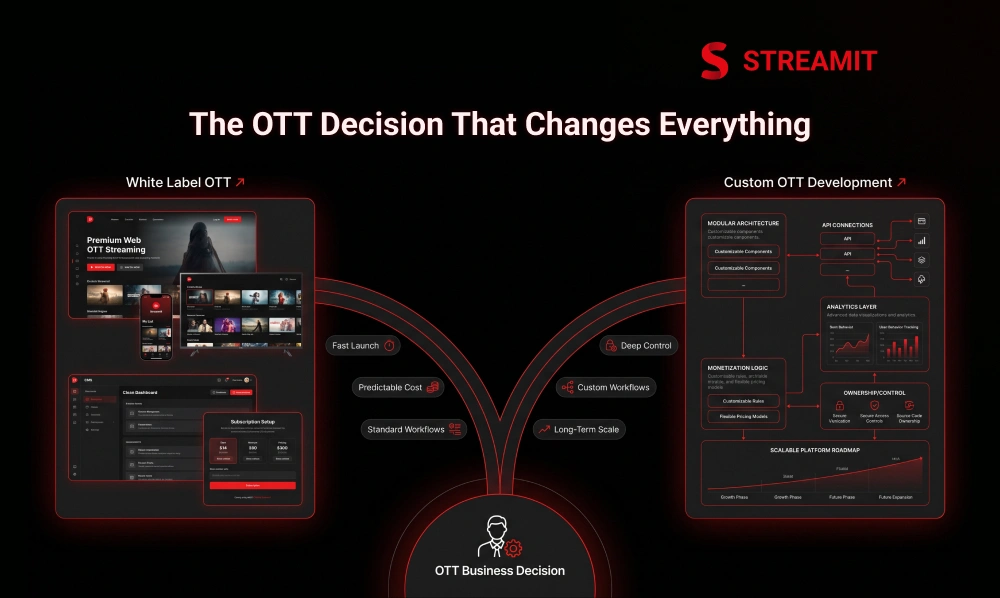
A white label OTT solution helps you launch faster with a ready-made platform under your brand. At the same time, custom OTT development gives you deeper control over product architecture, workflows, and the future roadmap. The better option depends on your stage, business model, team capacity, and how much the platform itself affects your competitive advantage.
Overview
What Is the Difference Between White Label OTT and Custom OTT Development?
The simple difference is this: white label OTT starts from an existing platform, while custom OTT development starts from your business requirements.
Both can work. The wrong choice is not choosing white label or custom. The wrong choice is choosing without understanding what your business will need after launch.
White Label OTT Uses a Ready-Made Platform You Can Brand
A white label OTT platform gives you a pre-built streaming foundation that can be branded with your logo, colors, domain, content, and user experience. Industry references define white label OTT as a ready-made streaming platform that businesses can rebrand as their own.
This works well when your main priority is getting live quickly without building every core feature from scratch. You are choosing a faster, more structured path with less technical load.
Custom OTT Development Builds the Platform Around Your Exact Needs
Custom OTT development means the platform is designed around your exact workflows, integrations, monetization logic, content operations, and user experience.
This gives more freedom, but it also increases responsibility. Every feature, device app, API, performance layer, and operational system has to be planned, built, tested, and maintained.
The Real Decision Is About Speed, Control, and Risk
The real decision is not which option wins, but which trade-off your business can manage.
White label OTT usually reduces launch risk. Custom OTT usually increases product freedom. The decision becomes clearer when you compare launch deadline, budget, technical team, and roadmap depth.
Why It Matters
Why This OTT Choice Matters More Than Most Teams Think
The platform choice affects more than the first launch. It shapes how your team will operate when traffic grows, users complain, content expands, and monetization becomes more complex.
Many OTT businesses fail not because the idea was weak, but because the foundation was chosen for launch day only.
It Affects Launch Speed, Cost, and Product Control
White label OTT usually gives faster time to market because core systems are already available. Some industry comparisons place white label launches in weeks or a few months, while custom builds often need longer timelines.
Custom OTT gives stronger control, but that control comes with higher cost, longer planning, and more internal decision-making.
It Shapes What Your Team Has to Build, Operate, and Maintain
A custom platform does not stop at development. Your team also owns maintenance, upgrades, security, performance, device updates, and infrastructure decisions.
A white label OTT solution shifts much of that operational load to the provider, which lets your team focus more on content, users, and growth.
Comparison
White Label OTT vs Custom OTT Development Compared
| Factor | White Label OTT | Custom OTT Development |
|---|---|---|
| Launch speed | Faster | Slower |
| Upfront cost | Lower to moderate | Higher |
| Customization | Limited to supported options | Deep control |
| Ownership | Provider-controlled core | Business-controlled architecture |
| Maintenance | Mostly provider-managed | Team-managed |
| Best for | Fast launch and validation | Differentiation and long-term control |
This table gives the practical view, but the right decision depends on where your business is today and where it expects to be in 12 to 24 months.
Time to Market
White label OTT is usually better when speed matters more than deep product uniqueness. You can launch faster because many core systems already exist.
Custom OTT takes longer because the team has to define, design, build, test, and stabilize the product before real users arrive.
Cost Structure
White label OTT usually has more predictable setup and platform costs. That makes it easier for teams to plan early budgets.
Custom OTT can become expensive because the cost is not limited to development. Infrastructure, QA, DevOps, app updates, and future feature work all add up.
Control and Customization
White label OTT gives branding, configuration, and supported customization. It is strong when your use case fits common OTT workflows.
Custom OTT gives more control over frontend, backend, APIs, user journeys, monetization rules, and product logic.
Multi-Device Apps and Platform Coverage
White label OTT can make multi-device launch easier across web, mobile, and TV apps when those apps are already part of the solution.
Custom OTT gives more flexibility, but every device adds design, development, testing, store approval, and maintenance complexity.
Scalability and Operational Risk
White label OTT can reduce operational risk when the provider already supports streaming infrastructure, delivery, billing, and app maintenance.
Custom OTT can scale well, too, but only when architecture, cloud setup, monitoring, CDN strategy, and engineering maturity are strong from the start.
Feature Readiness on Day One
White label OTT usually gives faster access to standard OTT features such as CMS, subscriptions, video playback, apps, analytics, and user management.
Custom OTT allows more specific features, but feature maturity takes time because every workflow must be built and improved through real use.
White Label Path
When White Label OTT Makes More Sense
White label OTT makes sense when your biggest risk is delay, not differentiation.
It is a strong path for teams that need to validate the business, launch across devices, and avoid spending most of their budget on infrastructure before the audience is proven.
You Need to Launch Fast and Validate the Business Early
If your content, pricing, and audience are still being tested, white label OTT is often the smarter first move.
You can learn from real users earlier instead of spending months building assumptions.
You Want Predictable Cost and Lower Technical Overhead
White label OTT gives clearer cost planning because the core platform is already available.
This matters for founders who want to control burn rate and avoid turning every product change into a full engineering project.
Your Use Case Fits Standard OTT Workflows Well
If your platform needs standard content categories, subscriptions, user accounts, video playback, and basic analytics, white label can work well.
Entertainment, fitness, learning, coaching, and niche content platforms often start here because the workflows are known.
Custom Development Path
When Custom OTT Development Makes More Sense
Custom OTT development makes sense when your platform is not just a delivery channel, but a business advantage.
If your user experience, monetization model, data flow, or operational workflow is unique, custom development gives more room to build the product properly.
Your OTT Product Is a Core Competitive Advantage
If technology is central to how you win, white label limits may appear too early.
Custom OTT gives you the ability to design architecture, data systems, and product experiences that match your market strategy.
You Need Specialized Workflows or Integrations
Custom development is stronger when your OTT platform needs deep CRM, ERP, payment, analytics, recommendation, licensing, or partner integrations.
It also helps when internal teams need admin workflows that standard OTT platforms do not support well.
You Need Long-Term Product Freedom More Than Fast Launch
Custom OTT is better when roadmap freedom matters more than fast deployment.
You can make deeper product decisions without waiting for a provider’s roadmap, supported extensions, or platform rules.
Hard Lessons
What Teams Usually Realize Too Late
Most teams understand the first launch cost. Fewer understand the cost of version two.
Version two is where the real platform test begins: more users, more devices, more content, more monetization pressure, and more edge cases.
White Label Limits Often Show Up Only After the Business Starts Growing
White label limits may not hurt in month one. They usually appear when you need advanced monetization, deeper APIs, unusual user journeys, or custom data control.
That is why teams should check flexibility before launch, not after growth starts.
Custom Complexity Feels Bigger After Live Traffic and Real Users Arrive
Custom OTT feels exciting during planning because everything is possible.
After launch, every bug, delay, traffic spike, playback issue, app update, and support problem belongs to your team.
The Hardest Part Is Usually Version Two of the Product
The first version proves that the platform can launch. The second version proves whether the platform can grow.
A serious OTT roadmap should plan for upgrades, performance tuning, analytics, monetization experiments, and multi-device consistency from day one.
Business Fit
Which Option Fits Different OTT Business Types Best
| OTT Business Type | Better Fit | Reason |
|---|---|---|
| Broadcasters and sports | White label or hybrid | Speed, live events, device coverage |
| Entertainment and media | Depends on scale | Content depth and roadmap matter |
| Fitness and learning | White label first | Standard workflows often fit |
| Creator-led platforms | White label | Faster launch and lower overhead |
| Enterprise OTT | Custom or hybrid | Deeper control and integrations |
The best model depends on how much the platform needs to be different from standard streaming behavior.
Broadcasters and Sports Platforms
Broadcasters and sports platforms often need fast deployment, live streaming readiness, pay-per-view options, and stable performance during traffic spikes.
White label or hybrid models can work well if speed and reliability matter more than owning every layer from day one.
Entertainment and Media Platforms
Entertainment and media platforms need strong content discovery, user retention, subscriptions, and multi-device viewing.
White label works for fast launch, while custom makes sense when personalization, content rights, or audience segmentation becomes more advanced.
Fitness, Learning, and Coaching Platforms
Fitness, learning, and coaching platforms often follow predictable OTT workflows such as courses, episodes, subscriptions, and member access.
White label OTT can be a practical choice unless the business needs specialized learning paths, community features, or certification systems.
Creator-Led and Niche Content Platforms
Creator-led platforms usually need speed, brand control, and direct audience ownership.
A white label OTT solution can help creators launch without becoming a full technology company too early.
Decision Guide
Final Decision: Which Is Better for Your OTT Business?
There is no universal winner. White label OTT is better when speed, cost control, and simplicity matter most. Custom OTT is better when control, ownership, and differentiation matter more.
A mature decision looks beyond the first app launch and asks what the platform must support after growth starts.
Choose White Label If Speed, Simplicity, and Predictable Cost Matter Most
Choose white label OTT if you need to launch quickly, reduce technical overhead, and validate your streaming business early.
It is especially useful when your use case fits standard OTT flows, and your team wants to focus on content, marketing, and monetization.
Choose Custom If Product Control and Deep Differentiation Matter Most
Choose custom OTT development if the product experience, data structure, integrations, or monetization logic must be built around your business.
This is a better fit when your platform is part of your long-term competitive advantage.
Choose Based on Your Launch Deadline, Budget, Team Capacity, and Roadmap
Your decision should come from four questions: how fast do you need to launch, what can you afford, who will maintain it, and what will version two need?
If those answers are not clear, the safest path is usually a platform strategy that allows speed now and more control later.
Streamit Advantage
Why Streamit Can Fit Teams Deciding Between White Label and Custom
Streamit is positioned for serious streaming businesses that need technology, infrastructure, consultancy, and AI-driven insights across the full OTT journey.
That makes it relevant for teams that do not want a cheap app, but also do not want to carry unnecessary technical risk too early.
It Gives Faster OTT Launch Paths for Teams That Need Speed
Streamit can help teams move faster by reducing the complexity of building the complete OTT stack from scratch.
For founders, that means less time stuck in platform setup and more time spent on content, users, and revenue.
It Supports Multi-Device Apps, Monetization, and Better Streaming Delivery
A serious OTT business needs more than a web app. It needs mobile, TV, monetization, analytics, and stable delivery.
Streamit’s positioning focuses on performance, infrastructure, scale, and streaming business growth, not just app development.
It Gives Room to Grow Without Locking the Product Too Early
The strongest OTT foundation is not only fast. It is flexible enough to support future decisions.
For teams comparing white label and custom OTT, Streamit offers a balanced route: launch with a solid foundation, then scale with more control.
Summary
Key Takeaways
White label OTT accelerates market entry
It is useful when you want to launch quickly, validate your content business early, and avoid building the full OTT infrastructure from scratch.
Custom OTT delivers deep product control
It is the right path when your platform needs custom workflows, deeper integrations, unique user journeys, and long-term ownership over the technology.
White label reduces early technical pressure
It helps teams focus more on content, branding, users, and monetization instead of handling every backend, app, and streaming infrastructure layer themselves.
Custom OTT gives freedom – and responsibility
It offers better flexibility over architecture, features, monetization, and roadmap, but your team must also manage scaling, maintenance, testing, and future upgrades.
The better choice depends on business stage
White label fits teams that need speed, simplicity, and predictable cost, while custom OTT fits teams that need deeper differentiation and long-term product control.
Streamit fits teams that want a practical growth path
It supports streaming businesses with performance, infrastructure, technology, consultancy, and scalable OTT execution from launch to expansion.
Conclusion
Conclusion
White label OTT and custom OTT development solve different business problems.
If your priority is fast launch and early validation, a white label OTT solution is often the smarter choice. If your priority is product ownership and deep differentiation, custom OTT development gives more control.
For most serious OTT businesses, the best answer is not extreme. Build the foundation that helps you launch without delay, scale without panic, and keep enough control for the roadmap that comes next.
FAQs
Frequently Asked Questions
-
When will white label OTT stop being enough?
White label OTT may stop being enough when your business needs deeper API control, advanced monetization, custom user journeys, or unique backend workflows. The limits usually appear after growth begins, not during setup.
-
When is custom OTT worth the extra cost?
Custom OTT is worth the cost when your platform experience, data, integrations, or operating model directly affects your competitive advantage. It is not worth it if you only need standard OTT workflows.
-
What do teams underestimate in white label OTT?
Teams often underestimate future customization limits, provider dependency, API restrictions, and roadmap control. White label is fast, but every platform has boundaries.
-
What becomes harder after launch in custom OTT?
Maintenance, scaling, app updates, bug fixing, monitoring, and infrastructure optimization become harder after launch. Custom gives control, but it also gives responsibility.
-
Which option gives more control over OTT monetization later?
Custom OTT development gives more long-term control over monetization logic. White label OTT can support common models, but advanced pricing, bundles, and experiments may depend on provider flexibility.