How to Develop a Video Streaming Website for OTT Brands


Most OTT websites do not fail because they lack content. They fail because the platform was not built to support real users, real payments, and real scale.
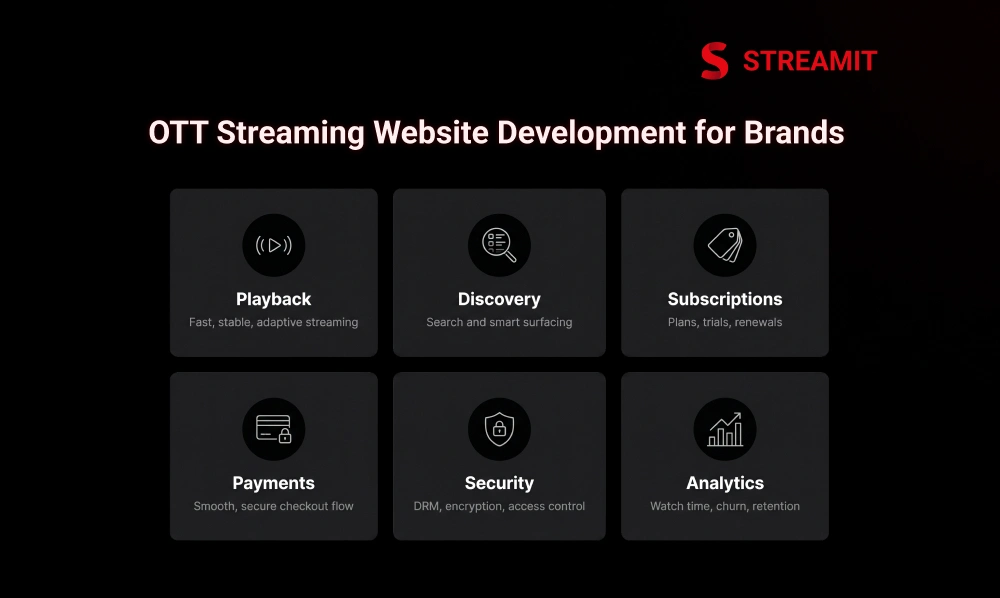
A video streaming website is not just a place to upload videos. For OTT brands, it becomes the system that handles playback, discovery, subscriptions, payments, security, analytics, and retention.
If the foundation is weak, users feel it quickly. Video buffers. Search feels poor. Payments become confusing. Content becomes hard to manage. That is why video streaming website development needs platform thinking, not just web design.
Foundation
Why OTT Brands Need More Than a Basic Video Website
A basic website can display videos, but an OTT website has to run a streaming business. It must connect users, content, plans, payments, devices, and data in one smooth flow.
For OTT brands, the goal is not only to launch. The goal is to create an OTT platform that can grow without breaking when users, content, and revenue models expand.
A Streaming Website for OTT Brands Must Do More Than Host Videos
A real OTT website needs user accounts, content categories, secure playback, subscription access, payment flow, watch history, and admin control.
If these systems are missing, the website may look complete but fail when real users start watching, paying, and returning.
OTT Growth Depends on Playback, Discovery, and Monetization Working Together
Playback keeps users watching. Discovery helps users find content. Monetization turns attention into revenue.
If one of these parts is weak, growth slows. A good OTT platform solution connects all three from the beginning.
A Weak Website Foundation Creates Playback Problems and Rebuilds Later
Poor architecture creates issues in streaming quality, billing, analytics, device support, and content management.
The cheaper shortcut at launch can become an expensive rebuild later.
Strategy
What to Plan Before You Develop a Video Streaming Website
Before choosing technology, define the business model. A sports platform, an entertainment OTT platform, an education library, and a fitness platform all need different user journeys.
Planning early helps avoid unnecessary features and protects the platform from future limitations.
Define Your OTT Niche, Audience, and Content Strategy
Start with your audience. Who watches your content, why do they watch, and how often will they return?
Then structure the content around that behavior. Categories, collections, seasons, tags, languages, and thumbnails all affect discovery.
Choose the Right Monetization Model Before Development Starts
Subscription, ads, pay-per-view, rentals, and hybrid models all need different access rules.
If monetization is planned late, your payment flow, reporting, and content access may need major changes later.
Decide If You Need a Web-Only Product or a Full OTT Ecosystem
A web-only streaming website works well for MVPs and early validation.
A full OTT ecosystem is better when users expect mobile apps, TV apps, synced watch history, and multi-device viewing.
Set the Scope Early: MVP Website or Full OTT Platform
An MVP should focus on content browsing, secure playback, accounts, payments, and basic analytics.
A full OTT platform adds apps, DRM, advanced analytics, recommendations, live streaming, and stronger infrastructure.
| Scope | Best For | Focus |
|---|---|---|
| MVP Website | Early launch | Playback, payments, content |
| Growth Platform | Scaling brands | Apps, analytics, retention |
| Full OTT Ecosystem | Mature OTT teams | Web, mobile, TV, DRM, scale |
Development
Step-by-Step Process to Develop a Video Streaming Website
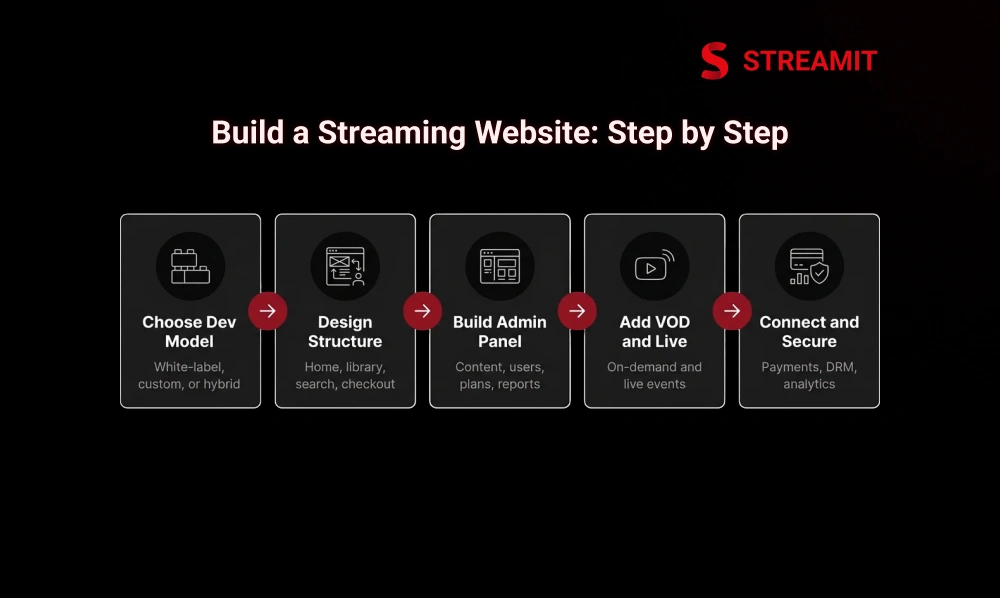
A strong OTT website is built in layers. First comes strategy, then UX, admin control, streaming delivery, monetization, security, and analytics.
This keeps the product clean instead of forcing disconnected tools together later.
Choose Your Development Model
Your development model should match your timeline, budget, control needs, and growth plan. The wrong choice may help you launch faster, but limit you when the business starts growing.
-
White-Label for Faster Launch
A white-label OTT solution works when speed matters and the feature set is simple. It is useful for quick launches, but it may limit customization, ownership, and future flexibility.
-
Custom Build for More Control
Custom OTT platform development gives more control over UX, backend logic, monetization, and infrastructure. It works best for brands that see streaming as a serious long-term business.
-
Hybrid Build for Speed Plus Flexibility
A hybrid build combines ready components with custom development where control matters most. This approach helps brands move faster without locking themselves into a rigid system.
Design the Website Structure and User Flow
OTT website design should help users move from landing to browsing, watching, subscribing, and returning.
The design should reduce confusion, not add visual noise.
Plan Home, Library, Search, Detail Pages, and Checkout Flow
The home page should explain the value quickly. The library should make content easy to browse.
Search, detail pages, pricing, and checkout should guide the user toward watching or subscribing with minimum friction.
Make the Experience Work Across Web, Mobile, and TV Sessions
Users may discover content on mobile, continue on the web, and later expect TV access. Even if you start with the web, the architecture should not block multi-device growth later.
Build the Admin Panel and Content Workflow
The admin panel decides how easily your team can manage the platform after launch.
It should help teams update content, users, plans, reports, banners, access rules, and metadata without daily developer dependency.
Manage Videos, Users, Plans, Reports, and Access Rules
A strong admin dashboard gives control over uploads, categories, subscriptions, coupons, user roles, and reports.
This makes the OTT platform easier to operate as the content library grows.
Add Live Streaming and VOD Support Based on Product Need
VOD platforms need strong libraries, search, filters, and watch history.
Live streaming platforms need scheduling, real-time delivery, access control, and traffic spike planning.
Support Live Events, Continuous Channels, or On-Demand Libraries
Live events, continuous channels, and VOD libraries all need different workflows.
A good OTT video solution should support the right format instead of forcing every brand into the same structure.
Connect Payments, Ads, DRM, and Analytics
Payments support subscriptions and purchases. Ads support free viewing. DRM protects premium content. Analytics shows what users actually do.
Together, these systems turn a streaming website into a business platform.
Features
Core Features Every OTT Video Streaming Website Needs
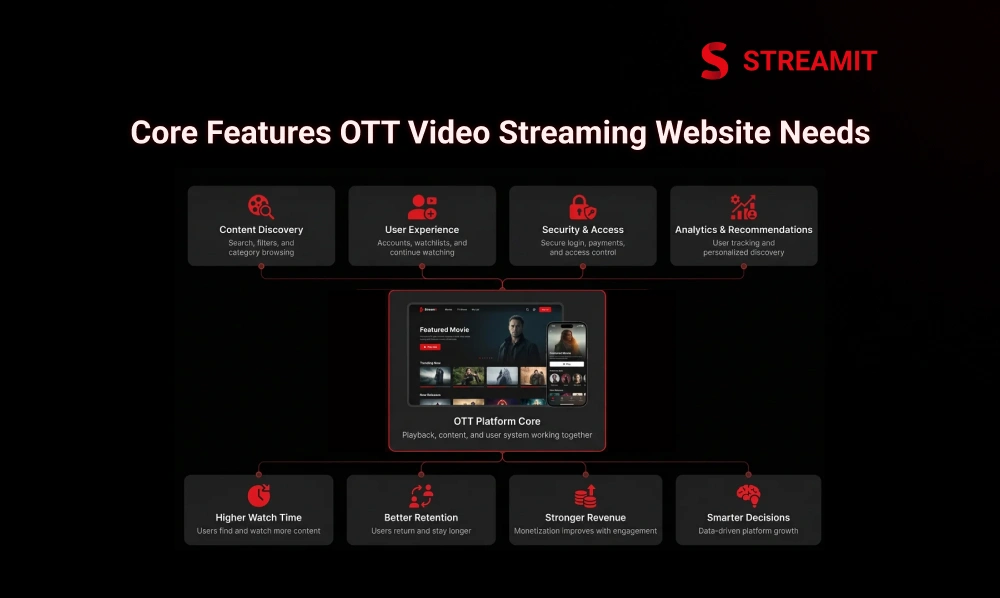
The best OTT features are not always the most advanced. They are the ones users and teams need every day.
A strong platform should support discovery, secure access, playback, retention, and business control.
-
Content Library, Search, Filters, and Category Browsing
Users should be able to find content quickly through categories, filters, tags, and search. Weak discovery makes even a large content library feel small.
-
User Accounts, Watchlists, and Continue Watching
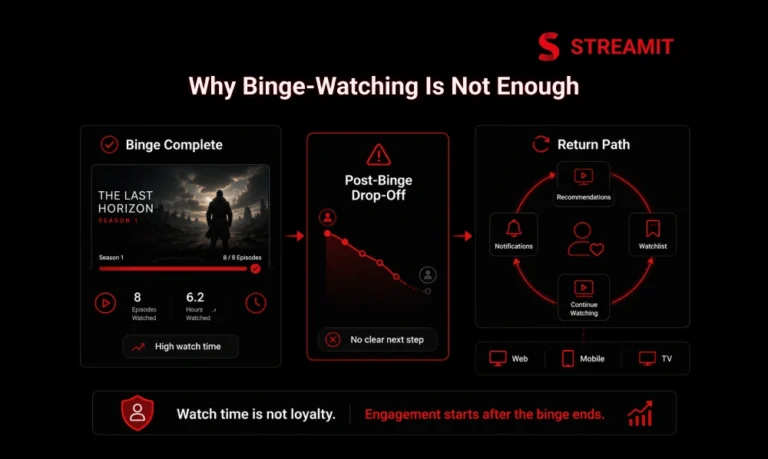
User accounts help save history, preferences, subscriptions, and access rules. Watchlists and continue watching make it easier for users to return without starting again.
-
Multi-Language Support, Subtitles, and Accessibility
Subtitles, language support, and readable interfaces make content easier to consume across regions. Accessibility also improves the experience for users who need captions, clear controls, and simple navigation.
-
Secure Login, Payments, and Access Control
Users should only access the content their plan allows. Secure login, payment protection, and access rules help protect revenue and reduce misuse.
-
Analytics, Recommendations, and User Behavior Tracking
Analytics helps teams understand watch time, drop-offs, searches, conversions, and churn signals. Recommendations can improve discovery when they are based on real behavior, not random promotion.
Infrastructure
Streaming Technology Behind a High-Quality OTT Website
Streaming quality is noticed most when it fails. Buffering, slow loading, and poor video quality damage trust fast.
That is why infrastructure matters as much as design.
Adaptive Streaming and Better Playback Quality
Adaptive streaming adjusts video quality based on the user’s network and device. This helps reduce buffering and creates smoother playback across different internet conditions.
Use HLS or DASH Based on Device and Playback Needs
HLS and DASH are common adaptive streaming methods. The right choice depends on devices, browsers, DRM needs, and playback goals.
Use Transcoding and Multi-Bitrate Delivery for Real Network Conditions
Transcoding creates multiple video versions from one file. Multi-bitrate delivery helps users watch smoothly even when network quality changes.
CDN, Multi-CDN, and Edge Caching for Smoother Delivery
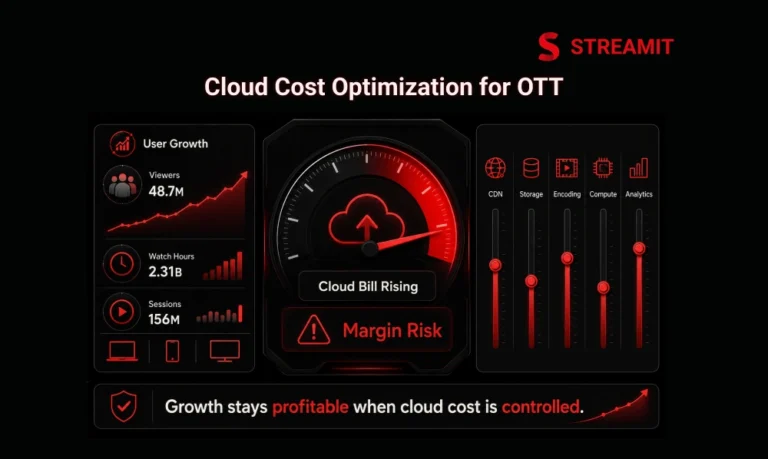
A video CDN helps deliver content from locations closer to the user. Multi-CDN and edge caching can improve reliability during high traffic or global usage.
Reduce Buffering During Peak Traffic and Global Usage
Peak traffic exposes weak infrastructure quickly. A stronger delivery setup helps protect playback during launches, live events, and popular releases.
Backend, Database, and API Setup for OTT Operations
The backend manages users, content, billing, access, analytics, and playback logic. If the backend is weak, every future feature becomes harder to build.
Support Users, Metadata, Billing, and Playback Logic in One System
Disconnected systems create confusion for both users and operators.
A good OTT platform architecture keeps user data, metadata, billing, and playback rules connected.
Revenue
Monetization and Revenue Setup for an OTT Website
Monetization should be designed before development starts. Each revenue model affects payment flow, access rules, user experience, and reporting.
Subscription (SVOD)
Works best when users see ongoing value. The platform should support plans, renewals, upgrades, cancellations, coupons, and trials.
Ad-Based (AVOD)
Works when the goal is reach and free access. Needs strong watch time, ad logic, analytics, and careful placement to avoid hurting retention.
Pay-Per-View (TVOD)
Works well for sports, events, workshops, concerts, and exclusive releases. The platform needs secure payment, timed access, and a clear purchase flow.
Hybrid Models
Lets brands combine free content, subscriptions, and premium purchases. Gives more flexibility for audiences with different levels of intent.
Protection
Security and Content Protection for OTT Websites
Content protection protects revenue, licensing, and trust. OTT websites need security across login, payments, playback, user access, and device usage.
Widevine, FairPlay, and PlayReady for Protected Playback
DRM helps protect premium video playback across major device ecosystems. It is important for paid libraries, licensed content, and serious OTT businesses.
Tokenized URLs, Device Limits, and Access Rules
Tokenized URLs reduce direct link sharing. Device limits reduce account misuse. Access rules define who can watch what, when, and under which plan.
Rights Management Matters as Much as Playback Protection
Rights management controls regional access, plan-based access, expiry, and content availability.
This is important for broadcasters, sports platforms, studios, and premium content owners.
Growth Barriers
What Slows OTT Website Growth After Launch
Most growth problems appear after real users start using the platform. Weak discovery, poor analytics, rigid backend logic, and device gaps quietly reduce retention.
-
Weak Metadata and Search Hurt Discovery More Than Teams Expect
Metadata helps users and systems understand content. Poor titles, tags, thumbnails, categories, and descriptions make content harder to find.
-
TV and Device Support Gets Harder as the Product Grows
Many OTT brands start with the web, then need mobile and TV apps later. If APIs and backend logic are not planned early, device expansion becomes harder.
-
Poor Backend Choices Make New Revenue Features Harder Later
New plans, coupons, rentals, bundles, and PPV should not require a rebuild. Flexible backend logic makes revenue experiments easier.
-
Weak Analytics Makes It Hard to Fix Churn and Improve Watch Time
Without analytics, teams guess. With analytics, they can study watch time, drop-offs, failed searches, plan conversions, and churn signals.
Planning
Cost, Timeline, and Team Model for OTT Website Development
OTT website development cost depends on complexity, not just the number of pages.
Streaming infrastructure, DRM, live features, apps, analytics, and monetization all affect the budget.
What Changes the Timeline: Content Scope, Devices, DRM, and Live Features
A simple MVP can move faster.
A full OTT ecosystem with apps, DRM, live streaming, and advanced analytics needs deeper planning and testing.
What Changes the Cost: UX, Infrastructure, and Monetization Complexity
Custom UX, scalable infrastructure, multi-CDN, DRM, PPV, subscriptions, and analytics increase development effort.
The goal is not the cheapest build. The goal is to build the right solution for the business stage.
In-House Team vs Agency vs OTT Development Partner
An in-house team gives control but needs strong leadership.
A general agency may miss OTT complexity. An OTT development partner brings streaming-specific product and infrastructure thinking.
Partner Selection
How to Choose the Right Partner to Develop Your Video Streaming Website
Do not judge an OTT partner only by its design portfolio.
Check whether they understand playback, CDN, DRM, payments, analytics, content workflows, and scale.
-
Check OTT Website Experience, Not Just General Web Portfolio
OTT website development is different from normal website development. The partner should understand streaming flows, subscriptions, video delivery, admin control, and user retention.
-
Check Playback, Security, and Infrastructure Readiness
Ask how they handle buffering, DRM, CDN setup, transcoding, and traffic spikes. If they only talk about design, they may not be ready for streaming complexity.
-
Check Monetization, Analytics, and Growth Support
A good partner should help with subscriptions, ads, PPV, hybrid revenue, and analytics. This helps the platform grow after launch.
-
Check Post-Launch Support, Ownership, and Upgrade Flexibility
Launch is only the start. You need clear ownership, post-launch support, upgrade options, and flexibility for future devices and revenue models.
Platform Choice
Why Streamit Is a Strong Choice for OTT Website Growth
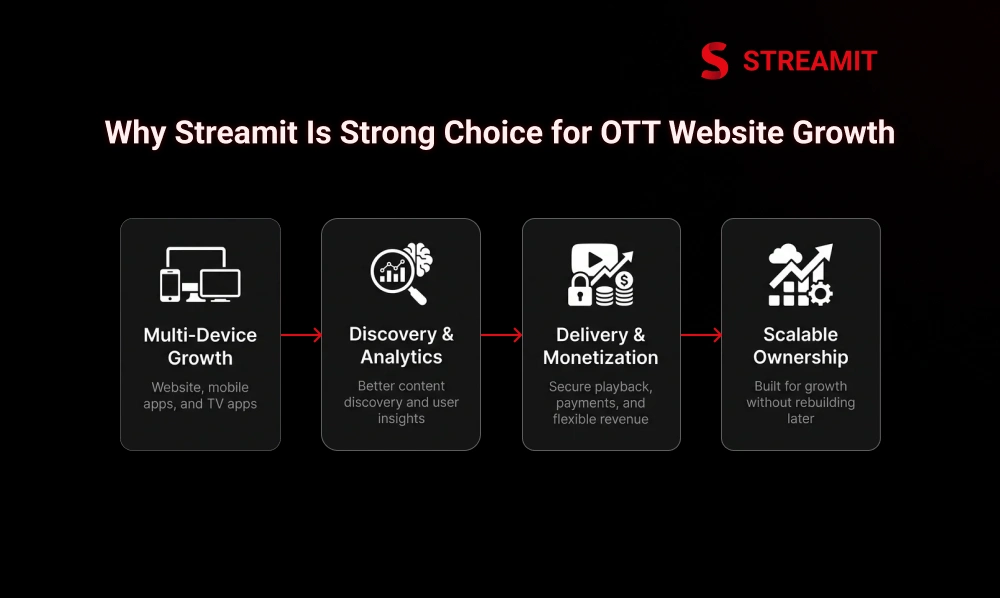
Streamit is built for OTT brands that want more than a basic streaming website.
It supports the larger goal of building a streaming business with playback, discovery, monetization, analytics, security, and scale.
Built for Streaming Websites, Apps, and TV Apps
Streamit helps brands plan beyond one website. It supports the path from web launch to mobile apps, TV apps, and multi-device OTT growth.
Built Around Better Discovery, Analytics, and Retention
Streamit focuses on helping users find content and helping teams understand behavior. This supports better watch time, better decisions, and stronger retention.
Built With Better Delivery, Security, and Monetization Flexibility
Streamit supports the key systems OTT brands need: delivery, protection, payments, analytics, and flexible monetization. This helps brands avoid building a platform that becomes limited too early.
Built for Teams That Want Growth Without Rebuilding Later
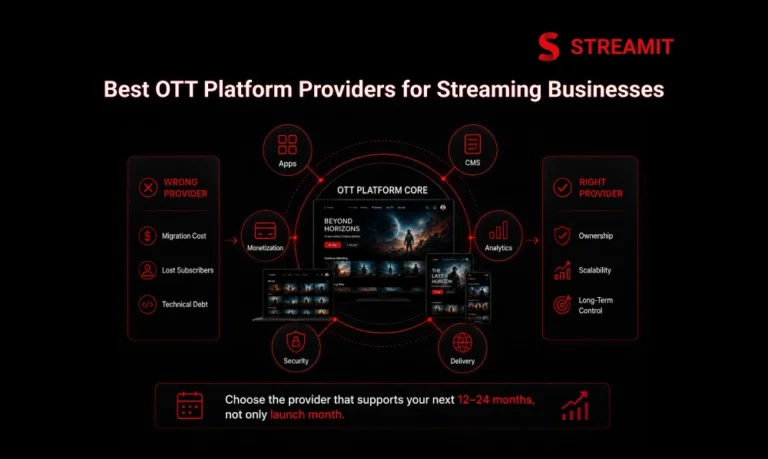
The strongest OTT platforms are built for the next stage, not only the first launch. Streamit is a strong fit for teams that want ownership, scalability, and long-term control.
Conclusion
Conclusion
Developing a video streaming website for OTT brands is not about creating a Netflix-style interface. It is about building the right system for your own content, audience, revenue model, and growth plan.
A strong OTT website should help users discover content, watch smoothly, pay easily, return often, and trust the experience.
Behind the scenes, it should give your team control over content, users, plans, analytics, access, and future upgrades. That is what turns a streaming website into a scalable OTT business platform.
Summary
Key Takeaways
Platform Thinking, Not Just Web Design
A streaming website must manage playback, discovery, users, payments, analytics, and retention – not just display video files.
Plan Before You Build
Audience, content strategy, monetization model, devices, and launch scope should be defined before a single line of development begins.
Playback Quality Affects Trust Immediately
Buffering and poor delivery hurt retention even when the content itself is strong. Infrastructure investment pays off in user trust.
Monetization Must Be Architected In
Subscriptions, ads, PPV, and hybrid models each need different access and payment logic – bolting them on later is costly and disruptive.
Security Protects Revenue and Licensing
DRM, tokenized URLs, device limits, and access control are essential for premium content owners and rights-managed libraries.
Choose a Partner Who Understands Streaming
Design alone is not enough. Evaluate partners on playback expertise, CDN and DRM knowledge, monetization depth, and post-launch support.
FAQs
Frequently Asked Questions
-
What should I plan before I develop a video streaming website?
Plan your audience, content type, monetization model, device roadmap, admin workflow, and launch scope. These choices shape the platform architecture and development cost.
-
Do I need a web-only OTT website or a full OTT ecosystem from the start?
A web-only OTT website works for MVPs and focused libraries. A full ecosystem is better when users expect mobile apps, TV apps, and synced viewing.
-
What helps reduce buffering on a video streaming website?
Adaptive streaming, transcoding, video CDN, multi-CDN, edge caching, and strong backend planning help reduce buffering and improve playback quality.
-
Why does metadata matter in OTT website development?
Metadata helps users find content and helps the platform understand content better. Strong titles, tags, genres, and thumbnails improve discovery and watch time.
-
What slows OTT website growth after launch the most?
Weak search, poor metadata, limited analytics, buffering, rigid monetization, and poor device support slow growth after launch.
-
Should I choose white-label, custom build, or hybrid OTT development?
Go with a white-label solution when your priority is a faster launch, choose custom development when you need deeper control, and use a hybrid approach when you want quicker execution without losing flexibility. The best option depends on your long-term roadmap, budget, and ownership expectations.
-
What increases the cost of OTT website development the most?
Cost increases with custom UX, live streaming, DRM, apps, scalable infrastructure, advanced monetization, analytics, and recommendation systems.