Best Practices for Scaling OTT Platforms Efficiently


Most OTT platforms do not break at launch. They break when real traffic, more devices, heavy content libraries, payments, recommendations, and playback demand start working together.
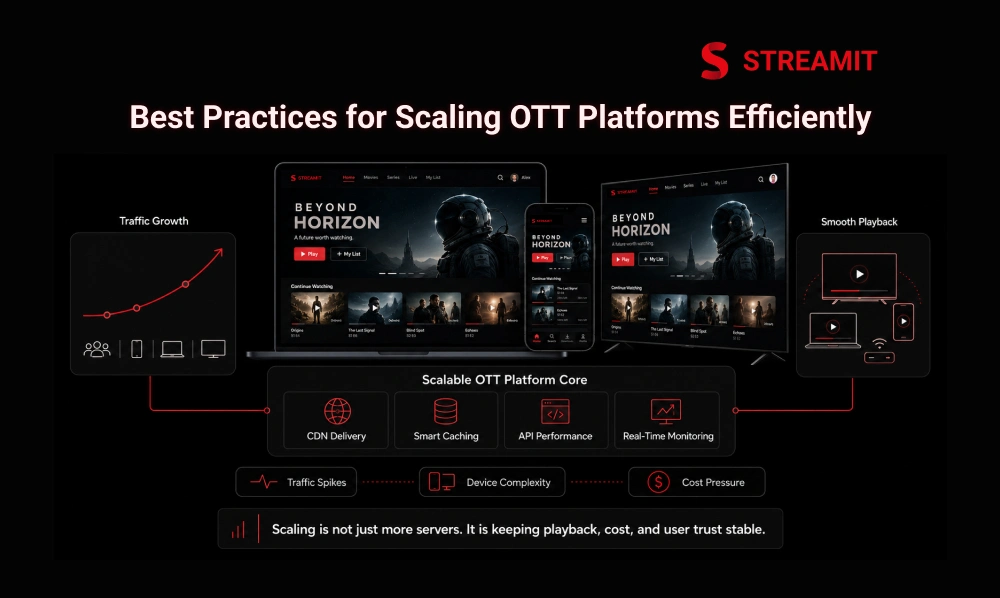
Scaling an OTT platform efficiently means building a system that can handle growth without slow browsing, buffering, rising cloud costs, or broken user access. It is not just about adding servers or using a CDN. It is about planning infrastructure, delivery, caching, analytics, security, and operations from the start.
For serious streaming businesses, scalability directly affects viewer trust, subscriber retention, and long-term control. This guide covers the best practices that help OTT platforms grow without becoming unstable, expensive, or difficult to manage.
Part 1
Why Scaling OTT Platforms Efficiently Matters
Most OTT platforms do not fail because people stop watching video. They fail because the system behind the video cannot keep up.
Scaling an OTT platform is not just about adding more servers. It is about protecting playback, cost, user trust, and product control as demand grows.
OTT Growth Brings Traffic Spikes, Device Complexity, and Higher Viewer Expectations
A 5,000-user platform and a 500,000-user platform are not the same product technically.
As traffic grows, users come from web, mobile, TV apps, browsers, older devices, weak networks, and peak-hour viewing patterns. Every layer starts carrying more pressure.
The hard part is not only more users. It is more unpredictable users.
One campaign, new release, live event, influencer mention, or sports match can create sudden demand before the team has time to react.
Efficient Scaling Is About Stability, Cost Control, and Viewer Trust
Scaling without cost discipline can quietly damage margins.
A platform may stay online but still waste money through poor cloud usage, repeated origin hits, weak caching, oversized encoding, or unnecessary low-latency infrastructure.
Viewer trust is built when the platform feels invisible.
Users do not care how complex the backend is. They only care that the app opens, content loads, payment works, and playback continues.
A Platform That Grows Fast but Breaks Under Load Will Lose Users Fast
Growth exposes weak architecture faster than any audit.
Small issues in APIs, billing, caching, recommendations, or device sync become apparent when thousands of users behave simultaneously.
A broken first impression is expensive.
If users face buffering, login issues, failed payments, or blank home screens during peak demand, many will not wait for a technical explanation.
Part 2
What Efficient Scaling Really Means in OTT
Efficient scaling means handling growth without turning the platform into a cost machine.
It is the ability to serve more viewers, more devices, more content, and more business rules without having to rebuild the product every few months.
It Means Handling More Users Without Breaking Playback or UX
Playback is only one part of the viewing experience.
The platform also needs fast login, smooth browsing, responsive search, quick recommendations, accurate progress sync, and reliable subscription checks.
A scalable OTT platform protects the full user journey.
From homepage load to video start, every request should be designed to survive real traffic, not just demo traffic.
It Means Scaling the System Without Wasting Cloud and Delivery Cost
Bad scaling often looks successful until the invoice arrives.
If every request hits the origin, every page reloads dynamic data, and every asset is overprocessed, growth becomes more expensive than it should be.
Efficient infrastructure separates what must be real-time from what can be cached, queued, or precomputed.
That decision alone can reduce pressure across APIs, databases, and delivery layers.
It Means Preparing for Normal Growth and Sudden Spike Traffic
Normal growth is gradual. Event traffic is violent.
A platform may handle daily viewing well but still fail when thousands of users arrive within the same few minutes.
Scaling plans should account for both patterns.
VOD, live, sports, education, fitness, and broadcaster-led OTT products all need different assumptions about traffic shape.
Part 3
The First Scaling Decisions to Make Before Traffic Grows
The best scaling decisions happen before the platform becomes popular.
Early planning decides whether the business gets a flexible streaming platform or a fragile product that needs expensive rebuilding later.
| Decision Area | Why It Matters |
|---|---|
| Content model | Defines delivery, CMS, and storage needs |
| Device priority | Shapes app architecture and QA |
| Live vs VOD | Changes latency, traffic, and reliability planning |
| Custom rules | Affects billing, access, and admin workflows |
Decide If Your Product Is Mostly Video On Demand, Live, or Hybrid
VOD platforms scale around libraries. Live platforms scale around moments.
A movie or learning platform needs strong catalog delivery, metadata, and recommendations. A live platform needs event readiness, latency planning, and failure control.
Hybrid platforms need the most careful structure.
They cannot treat live as a simple feature added on top of a VOD product.
Decide Which Devices Matter First: Web, Mobile, TV, or All Three
Every device adds cost, testing, and support complexity.
TV apps behave differently from mobile apps. Web users browse differently from connected TV users. Ignoring this early creates inconsistent experiences.
Device priority should follow business reality.
If the audience watches long-form content, TV may matter early. If discovery and short sessions matter, mobile may lead.
Decide Where You Need Flexibility and Where You Need Standardization
Not every part of the platform should be custom.
Billing rules, access logic, recommendations, and analytics may need flexibility. Core infrastructure, encoding, security, and delivery need discipline.
Good architecture protects both speed and control.
Teams should customize where the business is different and standardize where reliability matters more.
Part 4
Core Architecture and Infrastructure Best Practices
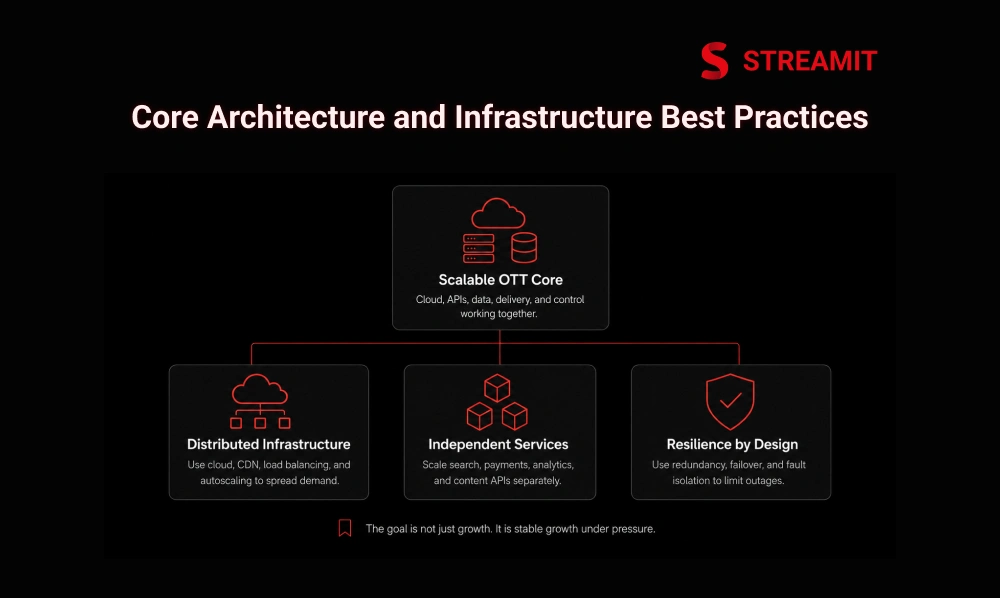
The core architecture decides how expensive growth becomes.
A strong OTT platform spreads demand across cloud infrastructure, CDNs, APIs, databases, queues, caches, and monitoring layers.
Use Cloud Infrastructure, CDNs, and Load Balancing to Spread Demand
A CDN helps delivery, but it is not the whole scaling plan.
The platform still needs healthy origins, load-balanced APIs, resilient databases, and controlled backend traffic.
Cloud infrastructure should be designed around demand patterns.
Autoscaling, queue-based processing, edge delivery, and failover planning help the platform absorb pressure without panic.
Break the Platform Into Services That Can Scale Independently
Not every service grows at the same speed.
Search, recommendations, payments, content APIs, watch history, and analytics may face different traffic loads.
Independent scaling gives teams more control.
Instead of scaling the whole system for one heavy feature, the platform can add capacity where pressure actually exists.
Design for Redundancy, Failover, and Fault Isolation
Failure should be contained, not allowed to spread.
If recommendations fail, playback should still work. If analytics slows down, checkout should not break.
Fault isolation turns incidents into manageable problems.
The goal is not to promise zero failure. The goal is to stop one failure from becoming a full platform outage.
Part 5
Delivery Best Practices for Smooth Playback at Scale
Playback quality is where users judge the entire platform.
Even when the backend is strong, poor encoding, weak packaging, or bad delivery decisions can create buffering and quality drops.
Use Adaptive Bitrate Streaming to Reduce Buffering Under Mixed Network Conditions
Not all users have the same network, device, or screen size.
Adaptive bitrate streaming helps the player switch quality based on real conditions instead of forcing one fixed version.
This protects continuity.
A small quality drop is usually better than a stalled video, especially on mobile networks and shared Wi-Fi.
Optimize Encoding, Transcoding, and Packaging for Device Compatibility
One master video is not enough for serious OTT delivery.
Content needs multiple resolutions, bitrates, formats, and packaging options so different devices can play smoothly.
Encoding strategy should balance quality and cost.
Over-encoding wastes storage and delivery budget. Under-encoding creates poor playback on real devices.
Treat Low Latency as a Special Case, Not a Default Setting
Low latency is valuable, but it is not free.
Sports, auctions, betting, and interactive events may need it. Regular VOD and standard live streams often do not.
Defaulting everything to low latency can increase complexity.
The better approach is to apply it where the business case justifies the tradeoff.
Part 6
The Scaling Layer Most Teams Ignore
Many OTT platforms break before the video file even starts playing.
Homepage APIs, recommendations, search, metadata, and CMS workflows often become bottlenecks before delivery fully fails.
Homepage APIs, Recommendation Rows, and Search Can Break Before Playback Does
The homepage is usually heavier than it looks.
It may call banners, continue watching, trending rows, personalized rows, subscription status, watch history, and language filters.
If this logic is not optimized, users feel the platform is slow before playback begins.
That first screen needs careful API design and caching.
Smart Caching Must Cover Static Data, Dynamic Data, and Cache Invalidation
Caching is not just storing files.
OTT platforms need caching for thumbnails, metadata, homepage rows, search results, user permissions, and frequently requested content.
The difficult part is knowing when cached data should change.
Poor cache invalidation creates outdated content, wrong access, and broken personalization.
CMS, Metadata, and Content Workflows Must Scale Too
Content operations become a product problem at scale.
As the library grows, teams need structured metadata, tagging, rights management, language versions, thumbnails, scheduling, and approval flows.
A weak CMS slows the business even if playback works.
Teams should not need developers for every content update.
Part 7
Data, Security, and Monitoring Best Practices
Scaling increases both traffic and risk.
More users means more sessions, payments, devices, viewing data, access rules, and attack surfaces to manage.
Separate Storage, Metadata, User Activity, and Analytics Pipelines
One database should not carry every job.
Content files, metadata, user activity, reports, and analytics events have different storage and processing needs.
Separation improves performance and clarity.
It also helps teams debug issues faster when one pipeline becomes slow.
Secure Content, Sessions, and Device Access as Traffic Grows
Access control gets harder with more users and more devices.
The platform needs secure login, strong session handling, DRM where required, device limits, token validation, and controlled content access.
Security should not be added after growth.
By then, weak rules may already be affecting revenue, licensing, and user trust.
Monitor Playback, API Health, Cache Performance, and Incident Signals in Real Time
Averages hide user pain.
A platform may look healthy overall while users in one region, device type, or network are facing repeated buffering.
Monitoring should connect technical signals to viewer experience.
Teams need visibility into startup time, playback errors, API latency, cache hit rates, payment failures, and device-specific issues.
Part 8
Live Events Need a Different Scaling Plan
Live traffic compresses pressure into a narrow window.
Unlike VOD, users arrive together, react together, refresh together, and complain together.
Live Traffic Is More Compressed and Less Forgiving Than Normal OTT Growth
A live event can turn minutes into a stress test.
If the stream fails at the start, users may miss the moment they came for.
This is why live readiness needs separate planning.
Capacity, latency, backup feeds, CDN rules, and monitoring must be tested before event day.
Third-Party Dependencies Become a Bigger Risk During Peak Demand
An OTT platform is only as strong as its dependencies during peak time.
Payment gateways, authentication providers, email systems, analytics tools, ad systems, and DRM providers can all add risk.
Teams should identify what can fail outside their own code.
Fallback plans matter more during live events than during normal viewing.
Stress Testing Must Match Real Event-Day Conditions
A generic load test is not enough.
Real event testing should simulate login surges, homepage refreshes, payment attempts, stream starts, device variety, and geographic spread.
The goal is not just to pass a number.
The goal is to understand where the platform bends before users find it.
Part 9
What Usually Breaks First When OTT Platforms Try to Scale
The first failure is often not the most visible one.
Many OTT problems begin quietly in APIs, caching, personalization, billing, or monitoring before users see buffering.
| Breaking Point | What Users Notice |
|---|---|
| Slow APIs | Blank screens or delayed loading |
| Weak caching | Heavy backend load |
| Billing drift | Wrong access or failed renewals |
| Poor monitoring | Late incident response |
APIs Slow Down Before Video Delivery Fully Fails
APIs are the nervous system of an OTT platform.
They control login, content lists, subscriptions, watch history, entitlements, search, and playback authorization.
When APIs slow down, the whole app feels broken.
Even perfect video delivery cannot save a platform that cannot load the right screen.
Personalization and Homepage Logic Become Too Heavy
Personalization should improve discovery, not slow the product.
If every homepage request requires too many real-time calculations, performance suffers.
Smart platforms precompute what they can.
Real-time logic should be reserved for decisions that truly need fresh user context.
Billing, Auth, and User State Drift Out of Sync Across Devices
Multi-device OTT creates state problems.
A user may subscribe on web, watch on TV, resume on mobile, and cancel later through another flow.
If billing and access are not synchronized, trust breaks quickly.
Users should never feel that the platform does not understand their account.
Monitoring Is Too Late, Too Shallow, or Too Reactive
Waiting for complaints is not monitoring.
By the time users report buffering, failed login, or checkout errors, the damage has already started.
Good monitoring gives teams early signals.
It should show where, why, and how users are being affected.
Part 10
Best Practices by OTT Business Type
Different OTT businesses should not use the same scaling playbook.
A sports platform, learning platform, broadcaster, and entertainment app may share infrastructure layers but not the same priorities.
Entertainment OTT Platforms Need Better Discovery and Scale Across Long Sessions
Entertainment platforms live or die by discovery.
Users need fast browsing, strong recommendations, watch history, trailers, categories, and smooth long-session playback.
Scaling should protect content exploration.
If users cannot find what to watch, the library size does not matter.
Sports Platforms Need Stronger Live Readiness and Lower-Latency Planning
Sports traffic is emotional and time-sensitive.
Users care about the moment, the score, and the delay between them and everyone else.
These platforms need stronger event planning.
Backup streams, peak testing, low-latency decisions, and incident response should be treated as core product work.
Learning and Fitness Platforms Need Progress Sync and Personalized Home Screens
Learning and fitness OTT platforms depend on continuity.
Progress tracking, completed sessions, bookmarks, plans, reminders, and personalized home screens matter deeply.
Scaling should protect user state.
If progress disappears or recommendations feel random, engagement drops.
Broadcasters Need Strong CMS, Rights Logic, and Traffic Resilience
Broadcasters often carry complex content rules.
Regions, rights windows, languages, live channels, archives, and schedules all affect access.
Their scaling challenge is operational as much as technical.
The CMS, rights logic, and publishing workflows must be built for high-volume use.
Part 11
What a Good OTT Platform Must Support to Scale Efficiently
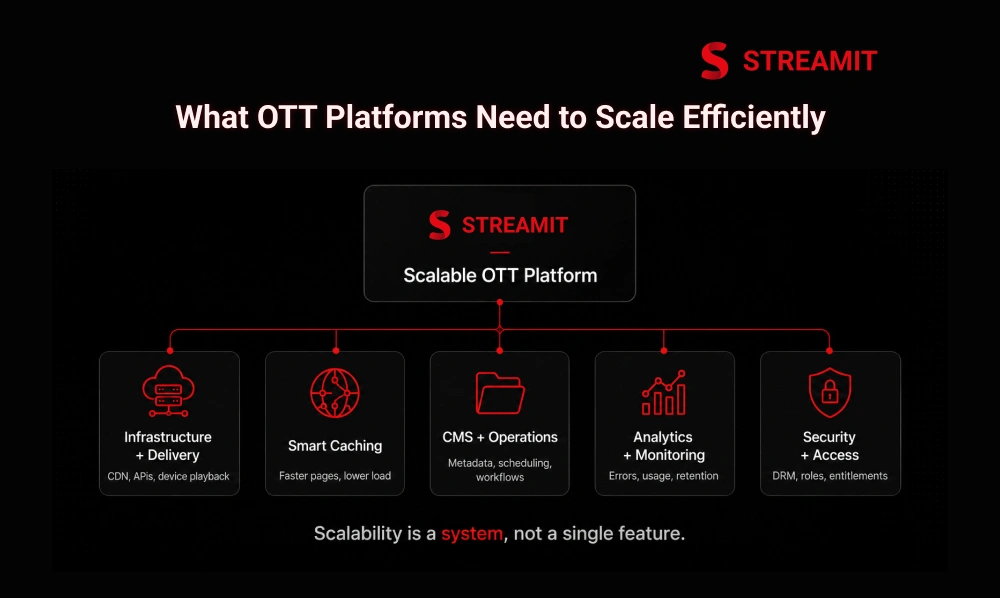
A scalable OTT platform is not one feature. It is a system of decisions working together.
The platform should support infrastructure, delivery, devices, CMS, analytics, security, and operations without forcing teams into constant patchwork.
Flexible Infrastructure, Delivery, and Device Support
The platform should grow across web, mobile, and TV without behaving like three separate products.
Users expect one connected experience across every screen.
Delivery should be designed for both performance and control.
That means strong CDN usage, reliable APIs, and device-aware playback.
Smart Caching, Monitoring, and Performance Analytics
Caching reduces pressure only when it is planned properly.
Teams need to know what to cache, where to cache it, and when to refresh it.
Analytics should show what affects retention.
Watch time, return frequency, playback errors, search success, and recommendation clicks all matter.
Reliable CMS, Metadata, and Operations Workflows
A strong CMS keeps the business moving.
Teams should have clear control over content, metadata, banners, categories, languages, rights, and schedules without depending on scattered workflows.
Operations workflows should reduce dependency on developers.
That is how OTT teams move faster without making the platform unstable.
Security, DRM, and User Access Controls That Grow With Traffic
Access control should scale with the business model.
Subscriptions, rentals, device limits, geography, user roles, and premium content all need clean enforcement.
Security must protect both content and revenue.
Weak access logic can quietly create revenue leakage before anyone notices.
Part 12
Why Streamit Fits Teams That Want to Scale OTT Platforms Efficiently
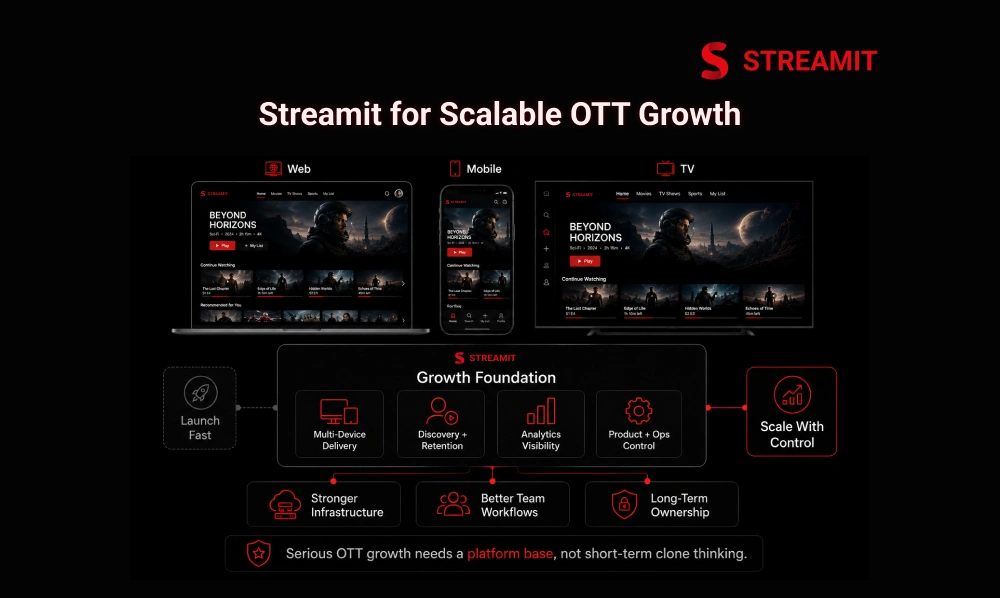
Streamit is built for teams that see streaming as a business, not just an app launch.
The real value is in giving founders and teams a stronger base for ownership, performance, infrastructure, analytics, and long-term growth.
It Supports Multi-Device OTT Delivery With Stronger Infrastructure Layers
Serious OTT products need web, mobile, and TV to work as one connected system.
Streamit supports that direction by focusing on infrastructure, delivery, and product layers together.
This helps teams avoid the common trap of launching fast and rebuilding soon after. The platform is planned for scale, not only for launch week.
It Supports Better Discovery, Analytics, and Retention at Scale
Growth is not useful if users cannot find content or return consistently.
Discovery, recommendations, analytics, and user engagement signals become more important as the content library expands.
Streamit helps teams think beyond playback.
The platform supports the wider retention system around viewing behavior, insights, and product improvement.
It Gives Teams a More Complete Base for Product, Ops, and Delivery Growth
A good OTT base should support both the viewer and the team behind the platform. That means better workflows for content, operations, monitoring, and future product decisions.
Streamit is positioned for teams that want control. Ownership, flexibility, and scalability matter more than short-term “clone” thinking.
Summary
Key Takeaways
Plan Before Traffic Arrives
OTT platforms usually break when real users, multiple devices, content libraries, payments, recommendations, and playback demand start working together – not at launch.
A CDN Alone Is Not Enough
Smooth OTT scaling needs cloud infrastructure, load balancing, adaptive delivery, caching, APIs, monitoring, and backend systems all working as one connected layer.
Playback Is Only One Part of Performance
Homepage APIs, search, recommendations, billing, login, and user access can slow down before video delivery fully fails – and users feel it first.
Live Events Need Separate Scaling Plans
Live traffic arrives faster, peaks harder, and gives teams less time to recover than normal VOD traffic. Treat live readiness as core product work.
CMS and Monitoring Must Keep Pace
As content grows, structured metadata, publishing workflows, and rights logic become critical. Monitoring should catch issues in real time – before users complain.
Efficient Scaling Protects the Business
The goal is not just uptime. It is stable playback, lower waste, better retention, stronger ownership, and long-term platform control as the audience grows.
Conclusion
Conclusion
The best OTT platforms are built for long-term growth, not just a smooth first release.
A smooth demo does not prove scalability. Real scalability appears when users grow, devices multiply, content expands, and traffic becomes less predictable.
For founders and teams building serious streaming businesses, efficient scaling is a strategic decision.
Streamit helps teams build with more ownership, stronger infrastructure thinking, and a platform base that can grow without breaking under real demand.
FAQs
Frequently Asked Questions
-
What breaks first when OTT traffic grows faster than expected?
Usually, APIs, homepage logic, caching, login, and billing flows show pressure before video delivery fully fails. Users may see slow loading, missing content rows, or access issues first.
-
Why do OTT APIs slow down before video delivery fully fails?
APIs handle user state, content lists, subscriptions, search, recommendations, and playback authorization. When these requests increase together, weak backend planning becomes visible quickly.
-
Why is CDN not enough to scale an OTT platform by itself?
A CDN improves delivery, but it does not fix slow APIs, poor caching logic, billing failures, weak CMS workflows, or broken personalization. OTT scaling needs the full system to work.
-
Why do live events break OTT platforms faster than normal traffic?
Live events create compressed traffic where many users arrive, refresh, log in, and start playback at the same time. There is less room to recover quietly.
-
How much caching does an OTT platform really need?
It needs caching across static assets, metadata, homepage rows, search, recommendations, and frequently requested data. The real question is what should refresh instantly and what can safely stay cached.
-
How do CMS workflows become a bottleneck in OTT growth?
As content grows, teams need better metadata, scheduling, rights rules, thumbnails, languages, and approvals. Without structure, publishing becomes slow and error-prone.
-
When should an OTT platform move to microservices?
It should move when different parts of the platform need to scale, deploy, or fail independently. The move should solve real operational pressure, not follow a trend.
Read Also
Read Also
1. Top 7 Features of Streamit OTT TV App for Smooth Streaming
2. Top OTT Content Management Features Every Platform Needs
3. Why Streamit Focuses on AI-First Streaming Infrastructure
4. 11 Ways to Improve Streaming Performance & Reduce Buffering
5. Multi CDN vs Single CDN: Which Is Best for OTT Streaming?