Why Streamit Focuses on AI-First Streaming Infrastructure


Most streaming platforms do not fail on launch day. They fail when the business finally starts growing. The app may look polished at first, but as users, devices, content, payments, analytics, and retention needs grow together, the weak foundation starts to show.
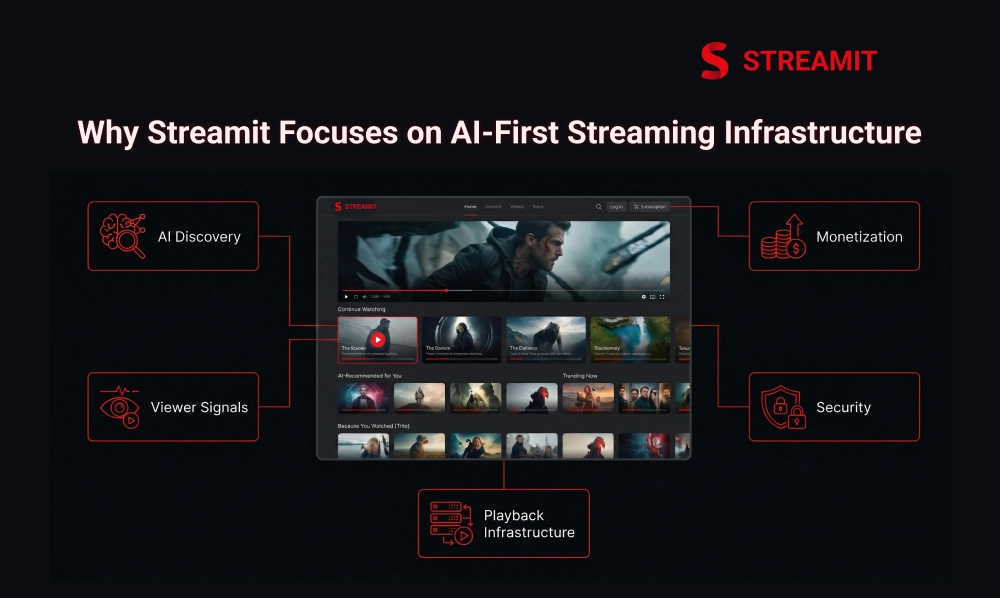
That is why Streamit focuses on AI-first streaming infrastructure. Not AI as a decorative feature. Not AI added later as a plugin. Streamit treats AI, playback, data, monetization, security, and ownership as connected systems from day one, because serious OTT businesses need more than a streaming app. They need infrastructure that can grow without forcing a rebuild later. Streamit positions itself as a builder, scaler, and advisor for AI-first streaming businesses across technology, infrastructure, consultancy, and AI insights.
Foundation
Why Streaming Platforms Need AI-First Infrastructure From Day One
A streaming business becomes harder to fix after users arrive. Early architecture decisions quietly shape playback quality, data visibility, personalization, cloud cost, and product flexibility for years.
If the platform is not built for intelligence from the start, every future improvement becomes slower. Recommendations need clean metadata. Analytics need reliable events. Retention systems need behavior patterns. Monetization needs connected usage data.
Basic Streaming Apps Struggle When Users, Content, and Devices Grow
A basic streaming app can work for a small library, one device type, and limited traffic. But growth changes the pressure. More users create playback demand. More content creates discovery problems. More devices create inconsistent viewing experiences.
This is where many OTT solutions fail. The issue is not only video buffering. It is the whole system becoming harder to manage, optimize, and scale.
Adding AI Later Creates Technical Debt
AI added late often becomes a patch, not a system. Teams try to add recommendation engines, analytics dashboards, or churn prediction after the core platform is already live.
That creates technical debt because the platform was never structured to collect the right data, process it cleanly, or use it across discovery, pricing, playback, and retention.
AI Works Better When the Platform Is Built to Collect the Right Data
AI is only as useful as the data pipeline behind it. Watch history, completion rate, search behavior, pause points, device type, location, subscription status, and content metadata all matter.
When those signals are planned from the start, AI analytics and content personalization become practical. The platform can understand viewer behavior instead of simply showing reports after the damage is done.
Definition
What AI-First Streaming Infrastructure Actually Means
AI-first streaming infrastructure means the platform is designed for decisions, not just delivery. It connects content, viewers, playback, monetization, and security into one working system.
Here is the simple difference:
| Area | Basic Streaming Stack | AI-First Streaming Infrastructure |
|---|---|---|
| Content | Uploaded and categorized manually | Structured for discovery and personalization |
| Analytics | Reports what happened | Helps understand what may happen next |
| Playback | Plays video | Optimizes quality, delivery, and experience |
| Monetization | Fixed plans and payments | Pricing and offers can respond to behavior |
| Retention | Manual campaigns | Signal-based retention actions |
Multi-CDN helps reduce delivery risk and regional latency.
Content discovery begins before the user searches. Every title needs clean metadata, genre logic, tags, language data, cast details, thumbnails, viewing type, and audience fit.
Without this structure, even the best AI recommendation engine has limited value. It cannot suggest content properly if the content library itself is messy.
Viewer Data and Behavior Tracking
Every viewer action is a business signal. What users search, skip, finish, replay, save, abandon, and subscribe to tells the platform what is working.
AI-first OTT infrastructure captures these signals with purpose. The goal is not to collect data for dashboards. The goal is to make better product, content, and revenue decisions.
Playback, Delivery, and Transcoding Infrastructure
Playback is still the heart of streaming. If video delivery is weak, personalization will not save the experience.
Streamit includes systems like multi-CDN, adaptive transcoding with HLS and DASH, and performance-focused delivery so video can play smoothly across devices and network conditions.
Monetization and Retention Systems
Revenue improves when pricing understands behavior. A viewer who watches daily should not be treated the same as a user who is about to cancel.
AI-first infrastructure connects subscription data, engagement signals, content preferences, and churn risk. That makes smarter monetization and subscriber retention easier to build into the platform.
Discovery
Why AI-First Infrastructure Improves Content Discovery
Discovery is no longer a content problem. It is an infrastructure problem. If users cannot find something worth watching fast, they leave with the feeling that the platform has “nothing good.”
The content may be strong, but weak discovery hides it. AI-first infrastructure helps the platform guide users toward the right title faster.
Recommendations: Turn Viewer Signals Into Better Suggestions
Good recommendations come from patterns, not guesses. Watch history, completion rate, genre affinity, language preference, and search behavior all shape better suggestions.
Streamit’s recommendation engine is positioned around turning viewer signals into personalized content suggestions that adapt to user taste.
Smart Discovery Helps Users Find Content Faster
Search should reduce effort, not create more clicks. Smart discovery helps users find content even when they do not know the exact title, category, or spelling.
Users do not spend endless time searching for something to watch. When the platform helps them find relevant content faster, they are more likely to press play and stay engaged.
Better Discovery Increases Watch Time and Retention
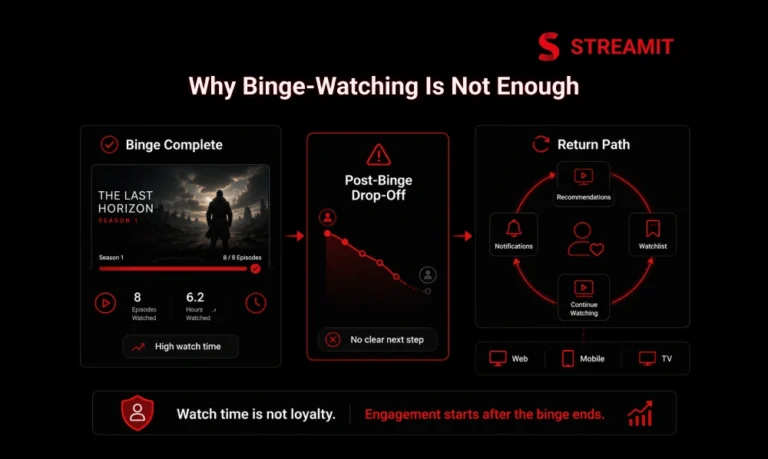
Retention begins inside the browsing experience. If the platform keeps surfacing useful content, users build a habit.
Better discovery improves watch time, repeat visits, and subscriber retention because the viewer feels understood without needing to work hard.
Analytics
Why AI Analytics Matter for Retention and Revenue
Basic analytics tells you what happened. AI analytics helps explain why it happened. That difference matters when churn, pricing, and content performance directly affect revenue.
For OTT teams, the real value is not another dashboard. The value is knowing which viewer segments are engaged, which titles create drop-offs, and which users need action before they leave.
Basic Reports Show Activity, but AI Analytics Shows Intent
A view count alone is not a strategy. A title may get clicks, but poor completion. Another title may have fewer starts but stronger retention.
AI analytics helps connect watch time, completion rate, session depth, and repeat behavior so teams can understand the intent behind activity.
Churn Signals Help Teams Act Before Users Leave
Most users show warning signs before they cancel. Lower watch time, fewer sessions, repeated searches with no play, payment hesitation, or ignored recommendations can all indicate churn risk.
When these patterns are visible early, teams can act with better offers, smarter recommendations, or improved onboarding before the user disappears.
Revenue Insights Help Improve Pricing and Content Strategy
Revenue is not only a payment problem. It is a product behavior problem. Pricing, content depth, device experience, and engagement all influence lifetime value.
AI-first infrastructure helps OTT teams connect monetization with user behavior. That creates stronger pricing, better bundles, and more useful retention planning.
Playback
Why Playback Infrastructure Still Matters in an AI-First OTT Platform
AI cannot compensate for poor playback. If the video stalls, starts slowly, or looks inconsistent across devices, the user will not care how smart the recommendation engine is.
This is why Streamit keeps the playback infrastructure central to the platform. Multi-CDN delivery, transcoding, adaptive streaming, monitoring, and optimization are not technical extras. They are business protection.
Multi-CDN Helps Reduce Delivery Risk and Regional Latency
One CDN can become one point of failure. Multi-CDN infrastructure helps reduce delivery risk, manage traffic better, and improve regional performance.
For live events, sports, launches, and high-concurrency moments, this matters even more. Users remember buffering faster than they remember features.
Adaptive Streaming Matches Video Quality to Real Network Conditions
Every viewer is watching under different conditions. Device, bandwidth, location, and network stability can change from one session to another.
Adaptive streaming and video transcoding help match video quality to real conditions. Streamit highlights transcoding across HLS and DASH so content can play smoothly across networks and devices.
Better Playback Improves Trust, Watch Time, and Retention
Playback quality is a trust signal. When the experience feels stable, users stay longer and return more often.
Better QoE reduces frustration, improves watch time, and supports OTT retention. This is why performance cannot be treated as only a backend concern.
Monetization
Why Monetization Works Better When Data and AI Are Connected
OTT monetization should not be disconnected from viewer behavior. Fixed pricing may work at the start, but as the audience grows, different users show different value patterns.
Some users prefer subscriptions. Some respond to bundles. Some need trial-to-paid nudges. Some are close to churn. AI-first systems help make monetization more responsive.
Monetization Should Follow Viewer Behavior
The best monetization strategy is shaped by usage. A platform should understand who watches daily, who watches occasionally, who explores premium content, and who drops after one session.
When viewer behavior and platform analytics are connected, pricing and offers become more strategic.
Pricing Systems Should Adapt as Users and Content Grow
Pricing should evolve with the platform. A simple plan may work during launch, but growth often demands bundles, pay-per-view, rentals, premium access, family plans, or hybrid models.
Streamit’s custom OTT platform positioning includes subscriptions, pay-per-view, ads, bundles, pricing tiers, and hybrid monetization models built into the platform from the start.
AI Helps OTT Platforms Improve Lifetime Value
Lifetime value improves when retention and revenue work together. AI can help identify which users need better discovery, which users may respond to pricing changes, and which content increases repeat sessions.
That makes monetization less reactive and more connected to actual platform behavior.
Security
Why Security Still Belongs Inside AI-First Streaming Infrastructure
A smarter platform still needs stronger protection. AI-first does not remove the need for security. It increases the need for secure architecture because more data, automation, content, and access rules are involved.
For OTT businesses, security protects three things: content, users, and revenue. Weak security can damage all three.
Content Protection Should Be Planned Before Launch
Premium content needs protection before it reaches users. DRM, video encryption, access rules, and anti-piracy systems should not be added after the platform is already live.
Streamit’s custom OTT platform security positioning includes multi-DRM support, piracy and fraud prevention, and secure access control.
Secure Access Control Protects Users, Content, and Revenue
Access control is not just login security. It decides who can watch what, on which device, under which plan, and with which permissions.
For paid content, private content, enterprise video, and membership-based platforms, secure access control directly protects revenue.
AI-First Platforms Still Need Strong Security Architecture
Intelligence without security creates risk. A platform using analytics, recommendations, pricing logic, and user data must protect the full chain.
That includes authentication, authorization, encryption, monitoring, compliance, and alert systems. Streamit’s OTT infrastructure page also highlights monitoring, backup, disaster recovery, DRM, encryption, firewalls, and compliance as part of infrastructure planning.
Use Cases
When AI-First Streaming Infrastructure Matters Most
AI-first infrastructure matters when streaming is becoming a business, not just a content experiment. If you have serious growth plans, early decisions around architecture, data, playback, and ownership become critical.
It matters most for platforms with growing libraries, multiple devices, paid subscriptions, live streaming, regional audiences, creator networks, sports content, education content, fitness programs, or enterprise video needs.
Alternatives
When a Basic Streaming Stack May Still Be Enough
Not every project needs enterprise OTT infrastructure on day one. A basic stack can be enough when the goal is testing, validating content demand, or creating a simple demo.
The problem starts when teams confuse a simple MVP with a long-term foundation. Those are different decisions.
You Only Need a Simple MVP or Demo
A basic streaming app may work for early validation. If the goal is to show a concept, test a small library, or pitch an idea, low-code or white-label OTT solutions may be enough.
At this stage, speed can matter more than depth.
You Do Not Need Personalization or Deep Analytics Yet
If the audience is very small, advanced analytics may not be urgent. You may not need recommendation systems, churn signals, or detailed content intelligence immediately.
But the platform should still be planned carefully if you expect growth.
You Are Not Ready for Scale, AI, or Multi-Device Growth
Simple stacks are fine when expectations are simple. If there is no need for multi-device expansion, complex monetization, AI discovery, or high-traffic performance, a basic OTT software solution may be enough.
The key is honesty. Do not buy a starter stack and expect it to behave like growth infrastructure later.
Streamit Fit
When Streamit Is the Better AI-First Infrastructure Choice
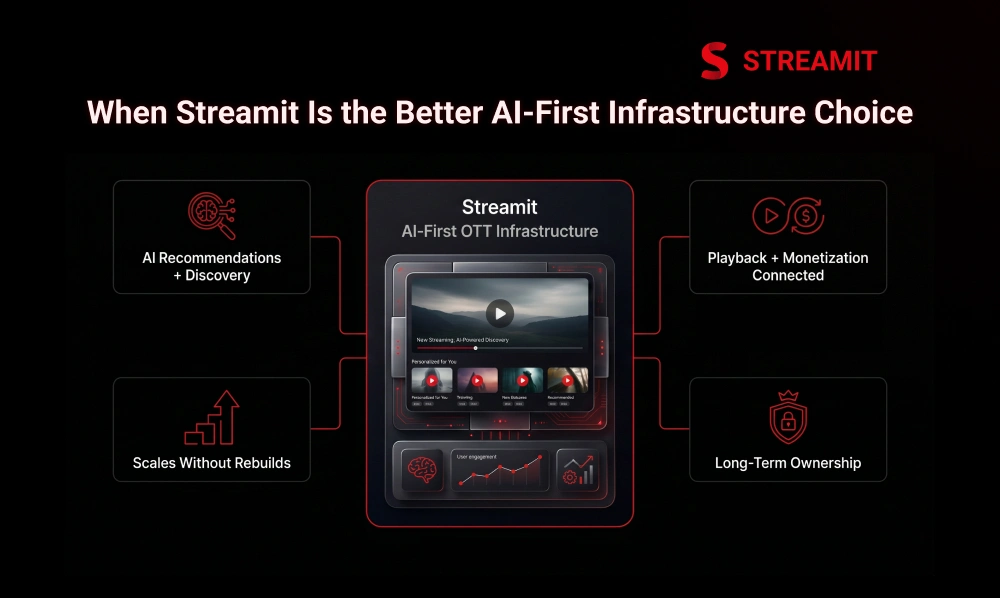
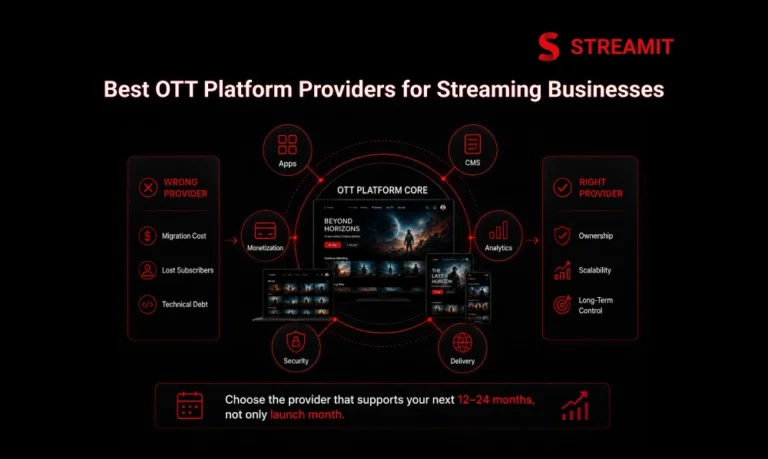
Streamit is a better fit when the platform must become a serious streaming business. That means the business cares about performance, monetization, ownership, security, analytics, and long-term control.
Streamit’s custom OTT platform is positioned around real traffic, monetization, long-term ownership, and enterprise-grade architecture across web, mobile, and smart TVs.
You Want AI Recommendations, Analytics, and Discovery Built In
If discovery and retention matter, AI cannot be an afterthought. Streamit supports recommendation, analytics, smart thumbnails, smart seek, and discovery systems as part of its feature ecosystem.
This makes the platform stronger for businesses that need engagement, not just video playback.
You Want Playback, Monetization, and Retention Connected
Growth is easier when systems talk to each other. Playback data, viewer behavior, pricing, subscriptions, and content discovery should not live in separate silos.
Streamit focuses on connecting these areas so the platform can improve as usage grows.
You Want Infrastructure That Can Grow Without Rebuilding Later
The expensive rebuild usually begins with a cheap shortcut. If the architecture cannot support future AI, devices, monetization, or performance needs, growth creates pressure.
Streamit’s positioning is built around preventing technical debt and supporting long-term scalability.
You Want a Platform Built for Long-Term Ownership
Ownership is a business decision, not only a technical one. When you own the codebase, infrastructure, data, and roadmap, you can make faster decisions as the business evolves.
Streamit’s custom OTT platform page states that clients own the codebase, infrastructure, data, and roadmap, with no vendor lock-ins or black boxes.
Checklist
AI-First Infrastructure Checklist Before You Build an OTT Platform
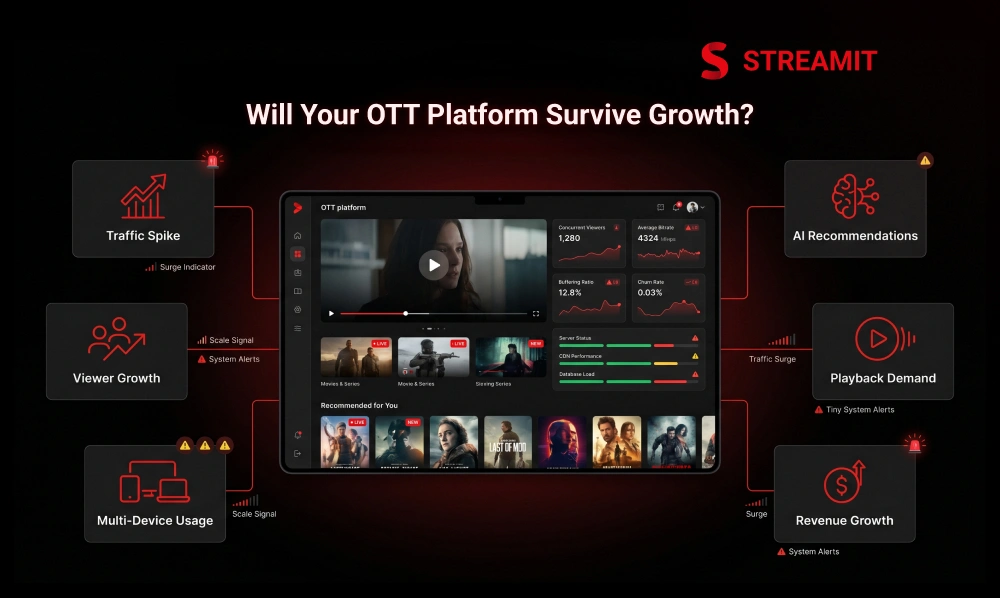
Before building an OTT platform, check the foundation, not just the feature list. A beautiful interface cannot fix weak infrastructure.
| Checklist Area | What to Confirm |
|---|---|
| Architecture | Can it support growth without a rebuild? |
| Content System | Is metadata structured for discovery? |
| Viewer Data | Are useful behavior signals being tracked? |
| Playback | Does it support adaptive streaming and transcoding? |
| Delivery | Is a CDN strategy planned for traffic spikes? |
| Analytics | Can the team understand retention and churn? |
| Monetization | Can pricing evolve with the business model? |
| Security | Are DRM, encryption, and access control planned? |
| Ownership | Do you control code, data, infrastructure, and roadmap? |
If most answers are unclear, the platform is not ready for serious growth yet.
Summary
Key Takeaways
AI Must Be Built In, Not Bolted On
AI-first means data, playback, discovery, monetization, retention, and security all work together from day one – not after the platform is live.
Basic Apps Fail When Growth Arrives
As users, content, devices, and traffic increase, weak infrastructure creates playback issues, poor analytics, and compounding technical debt.
Right Data Makes AI Actually Useful
Watch history, completion rate, search behavior, and device usage are the signals that let the platform make smarter personalization and retention decisions.
Discovery Drives Watch Time and Retention
AI-first infrastructure helps users find relevant content faster, building habit and improving subscriber retention more than any manual content strategy.
Monetization Connected to Behavior Performs Better
AI-first systems help OTT platforms understand pricing opportunities, churn risk, subscription patterns, and lifetime value – making revenue less reactive.
Security and Ownership Are Non-Negotiable
DRM, encryption, and access control must be planned before launch. Owning your codebase, data, and roadmap gives founders long-term business control.
Conclusion
Conclusion
The future of OTT will not be won by platforms that only stream video. It will be won by platforms that understand viewers, deliver reliably, protect content, adapt monetization, and give founders long-term control.
That is why Streamit focuses on AI-first streaming infrastructure. It is about building the foundation that serious streaming businesses need before scale makes every weak decision more expensive.
FAQs
Frequently Asked Questions
-
What is an AI-first streaming infrastructure?
AI-first streaming infrastructure means the OTT platform is built to use data, analytics, personalization, discovery, playback, monetization, and retention systems from day one. It is not AI added later as a separate feature.
-
Why does Streamit focus on AI-first OTT infrastructure?
Streamit focuses on AI-first OTT infrastructure because serious streaming platforms need more than an app interface. They need scalable architecture, viewer intelligence, reliable playback, monetization systems, and long-term ownership.
-
Is AI useful for OTT platforms beyond recommendations?
Yes. AI can support analytics, discovery, churn signals, smart thumbnails, retention pricing, content decisions, and user engagement. Recommendations are only one part of a larger AI-first OTT platform.
-
How does AI-first infrastructure improve viewer retention?
It helps the platform understand viewer behavior, detect drop-off signals, improve content discovery, and personalize user journeys. This makes users more likely to find value and return.
-
Does Streamit help improve streaming performance?
Yes. Streamit includes infrastructure-focused systems such as multi-CDN, transcoding, adaptive streaming, analytics, monitoring, and security planning to support better streaming performance.
-
Who should choose an AI-first streaming infrastructure?
AI-first infrastructure is best for OTT founders, media companies, creators, sports platforms, education brands, fitness businesses, and enterprises that want scalable streaming with ownership, performance, and long-term control.