Top 7 Features of Streamit OTT TV App for Smooth Streaming


A smooth OTT TV app is not built by adding more screens. It is built by removing the small delays that stop viewers from watching. For modern streaming businesses, the real problem is not only content quality. It is playback speed, TV navigation, resume flow, search-to-play time, monetization flexibility, and infrastructure stability working together.
Streamit is built for OTT businesses that need more than a basic video app. Its streaming TV app solution supports Android TV, Smart TVs, and Fire TV, with a focus on smooth playback, remote-friendly UX, flexible monetization, secure access, and scalable delivery for long-term growth.
Context
Why Smooth Streaming Matters More Than Ever in OTT TV Apps
Smooth streaming is no longer just a better experience. It can decide whether a viewer continues watching or leaves within seconds. When people open an OTT TV app today, they expect the content to load fast, play clearly, and continue without unnecessary friction.
Streaming is now a serious part of TV consumption. Nielsen reported that streaming captured 47.5% of total U.S. TV viewing in December 2025, which shows how strongly viewers have shifted toward internet-based entertainment.
Today’s Viewers Expect Instant, Frictionless Streaming
A 2-second delay can quietly damage the first impression of an OTT product. Research around video startup time has shown that viewers begin abandoning videos when startup delay crosses 2 seconds, with abandonment increasing by 5.8% for every additional second.
This is why smooth video playback is not just a technical metric. It affects trust, watch time, retention, and revenue. A viewer may not understand CDN routing, adaptive bitrate, or device performance, but they instantly understand when an app feels slow.
Smart TVs Have Changed How People Consume OTT Content
TV apps are not mobile apps stretched onto a larger screen. A smart TV user is sitting farther away, browsing with a remote, and expecting a relaxed viewing flow. That changes the entire design logic.
A smooth OTT TV app needs big-screen readability, clear focus states, simple movement, and fast content access. Streamit’s TV app solution is built for Android TV, Smart TVs, and Fire TV, with large-screen optimization and remote-friendly browsing as part of the platform experience.
Fundamentals
What Actually Makes an OTT TV App Feel Smooth?
Smoothness is not one feature. It is the result of performance, UX, infrastructure, and content discovery working together. A platform can have great content and still feel weak if users struggle to find, play, resume, or pay for that content.
For OTT businesses, the real goal is not just “buffer-free playback”. The goal is to remove hesitation from the viewer journey: open the app, find something relevant, press play, continue across devices, and return.
| Smoothness Factor | What It Means for Viewers | Business Impact |
|---|---|---|
| Fast playback | The video starts without a long wait | Better first impression |
| Adaptive quality | Video adjusts to network conditions | Fewer drop-offs |
| TV-first UX | Easy browsing with a remote control | Higher engagement |
| Smart discovery | Users find relevant content faster | More watch time |
| Resume memory | Users continue without effort | Stronger retention |
| Scalable delivery | App handles traffic growth | Lower failure risk |
Playback Performance Shapes the Entire Viewing Experience
The play button is the most important conversion point in an OTT app. If the app feels slow at that moment, the viewer questions the whole platform. This is especially true for paid platforms where users expect a premium experience.
Playback performance depends on startup time, bitrate selection, CDN delivery, buffering behavior, and device compatibility. Streamit positions its TV app architecture around smooth playback, low-latency delivery, and real-world concurrency rather than only interface design.
TV Apps Need a Different UX Approach Than Mobile Apps
On TV, every extra click feels heavier. Mobile users tap quickly, but TV users move through rows, cards, menus, and focus states with a remote. If navigation is crowded or unclear, discovery slows down.
That is why OTT TV UX needs fewer distractions, a stronger hierarchy, readable artwork, and simple content rows. The interface should help users decide quickly without making them work for every action.
Discovery and Viewing Continuity Increase Watch Time
People do not leave only because playback fails. They also leave when they cannot decide what to watch. Discovery, recommendations, search, and continue watching are part of the smooth streaming experience.
A strong OTT TV app should remember user intent. If someone watched half an episode yesterday, the app should bring them back without effort. If they search for a genre, language, actor, or series, the route from search to play should feel direct.
Core Features
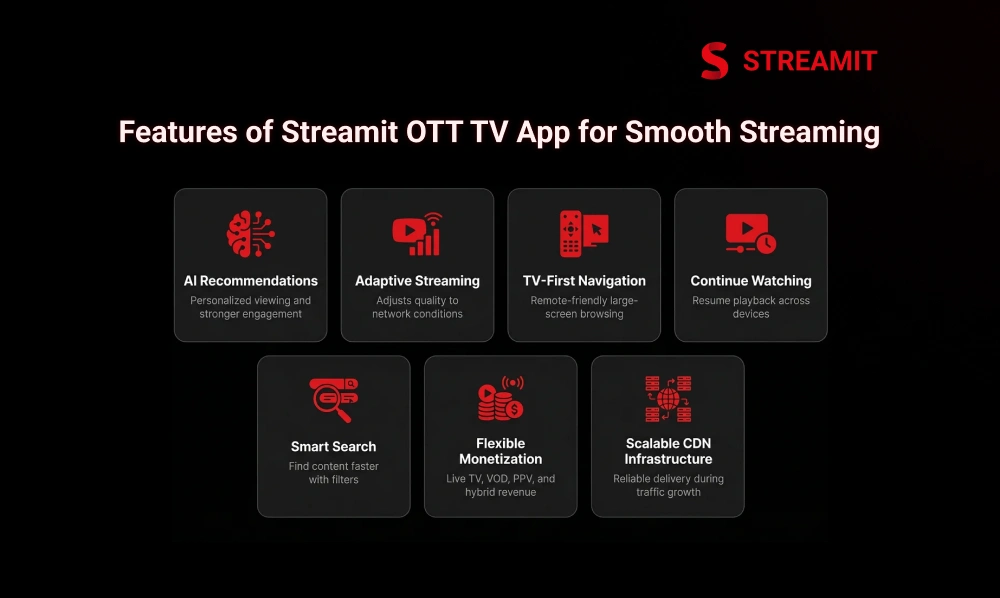
Top 7 Streamit OTT TV App Features for Smooth Streaming
Streamit is built for streaming businesses that care about control, performance, monetization, and long-term scale. Its TV app solution supports Android TV, Smart TVs, and Fire TV with features designed for real OTT operations, not just a basic app launch.
The seven features below matter because they connect directly to user behavior. They help viewers discover better, play faster, browse easier, resume smoothly, and stay longer.
1. AI-Powered Recommendations That Personalize Viewing
Personalization helps reduce the “what should I watch?” problem. When a viewer opens an OTT TV app, they should not feel like they are browsing a cold library. The app should start learning what they prefer and surface content that feels relevant.
Streamit includes smart content recommendations designed to increase engagement by tailoring content to viewer preferences. For founders, this matters because better discovery can increase watch time without constantly spending more on new content.
2. Adaptive Streaming That Adjusts to Network Conditions
Smooth streaming is not about forcing the highest quality every time. It is about serving the best possible quality for the viewer’s current condition. Network speed changes, devices vary, and viewing environments are never perfectly stable.
Adaptive streaming helps maintain playback by adjusting video quality based on available bandwidth. This gives users fewer interruptions while still delivering strong visual quality when the connection allows it.
3. TV-First Navigation Built for Remote-Based Browsing
A TV interface should feel calm, readable, and easy to control from 8 feet away. If users have to think too much about where they are or what to press next, the experience becomes tiring.
Streamit supports modern TV-optimized interfaces designed for remote navigation and large-screen comfort. This helps OTT businesses create an app that feels native to the living room instead of looking like a resized mobile product.
4. Continue Watching and Cross-Device Sync
Resume playback is one of the smallest features with one of the biggest retention impacts. Viewers often move between phone, web, and TV. If their progress does not follow them, the platform feels broken.
Streamit’s TV app capabilities include continue watching across supported TV platforms, allowing users to resume content more easily. This removes friction and makes the platform feel more reliable.
5. Faster Search and Smarter Content Discovery
Search should shorten the path to play, not create another browsing problem. A viewer may search by title, genre, language, mood, actor, category, or topic. If results feel slow or irrelevant, the app loses momentum.
Streamit supports powerful search and filtering so viewers can find content faster. For OTT teams, better discovery also improves content ROI because more of the library gets seen.
6. Flexible Monetization With Live TV, VOD, and PPV
A serious OTT platform should not force one revenue model forever. Many streaming businesses begin with subscriptions, then add ads, premium events, rentals, or live channels later.
Streamit supports monetization models such as subscription video on demand, ad-supported streaming, transactional video on demand, pay-per-view, and hybrid monetization. This gives founders more room to grow without rebuilding the platform each time the business model evolves.
7. Scalable Streaming Infrastructure With CDN Support
Most OTT problems appear only when the platform starts growing. Small traffic can hide weak infrastructure. Peak traffic exposes it. That is when buffering, crashes, slow loads, and delivery costs become real business issues.
Streamit’s broader platform positioning focuses on scalable infrastructure, multi-CDN streaming, high availability, advanced analytics, personalization, and enterprise-grade security for platforms where downtime is expensive.
| Streamit Feature | Viewer Benefit | Business Benefit |
|---|---|---|
| AI recommendations | Finds relevant content faster | Higher engagement |
| Adaptive streaming | Fewer playback interruptions | Better retention |
| TV-first navigation | Easier remote browsing | Better session depth |
| Continue watching | Smooth resume experience | Lower drop-off |
| Smart search | Faster search-to-play path | Better library usage |
| Live TV, VOD, PPV | More viewing options | Flexible revenue |
| CDN-ready infrastructure | Stable delivery at scale | Long-term growth |
UX Insights
Small OTT UX Details That Quietly Improve Watch Time
The biggest retention gains often come from fixing small points of friction. A smoother button state, a better content row, a faster resume action, or cleaner search results can change how long people stay.
These details do not look dramatic in a feature list, but users feel them. A strong OTT TV app should reduce effort at every step, especially when the user is browsing from a sofa with a remote.
Resume Memory Helps Prevent Viewer Drop-Off
A viewer should never have to remember where they stopped. If they watched 27 minutes of a movie, the app should bring them back to that exact point.
Resume memory makes the experience feel personal without needing a complicated explanation. It also helps users return more often because the next action is already prepared for them.
Search-to-Play Speed Often Matters More Than Search Accuracy
A perfect search result is not enough if it takes too long to reach playback. The real metric is how quickly a viewer can go from intent to watching.
This includes search speed, result clarity, filters, artwork, content details, and the play action itself. The fewer steps between search and playback, the smoother the product feels.
Remote Navigation Friction Hurts Engagement Faster Than Most Teams Expect
On TV, friction multiplies because every movement depends on directional control. If rows are too crowded, cards are unclear, or focus states are weak, users slow down.
Good TV browsing should feel predictable. Users should always know where they are, what is selected, and what will happen when they press OK.
Platform Fit
Why Streamit Fits Modern OTT Businesses
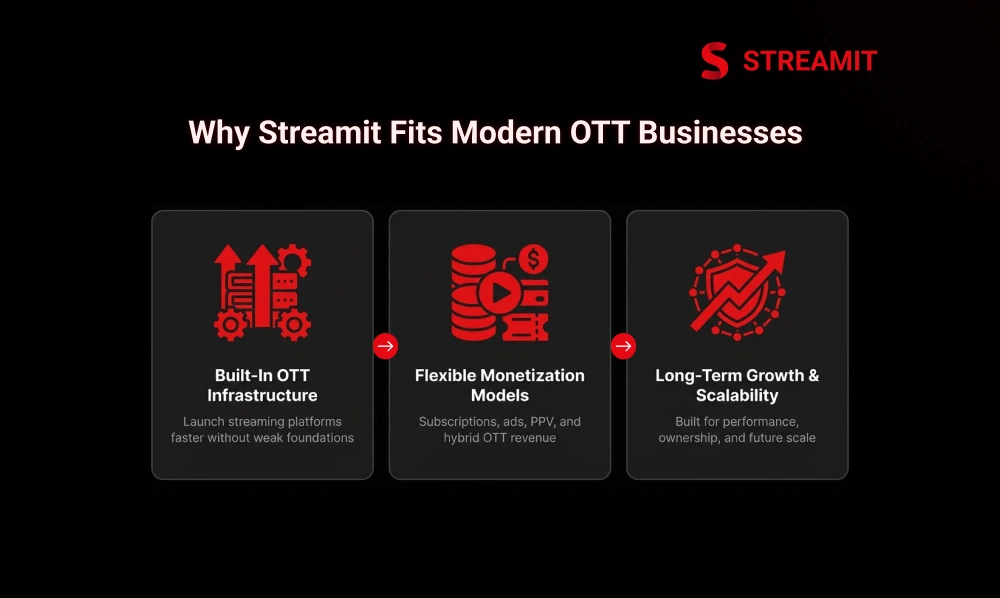
Modern OTT businesses need more than an app. They need a streaming foundation that can survive growth. Content, users, payments, playback, devices, analytics, and delivery all need to work together.
Streamit is positioned for founders and operators building serious streaming businesses, with a focus on ownership, scale, performance, retention, monetization, and long-term infrastructure.
Launch Faster With Built-In OTT Infrastructure
Speed matters, but not at the cost of rebuilding later. Many OTT products launch quickly with weak foundations, then struggle when the audience grows.
Streamit’s TV app page states that most streaming TV apps can launch in 1–2 weeks, depending on features and customization. That gives teams a faster route to market while still keeping the platform structured for serious use.
Support Multiple Monetization Models From One Platform
Revenue strategy should be flexible from day one. Some platforms need subscriptions. Some need ads. Some need pay-per-view. Many will need a hybrid model as they grow.
Streamit supports subscriptions, ads, pay-per-view, and hybrid monetization inside the TV app foundation. This gives businesses more control over how they package, price, and expand content access.
Build for Long-Term Streaming Growth and Scalability
The real test of an OTT platform is not launch day. It is month 12, when traffic, content, and expectations are higher. A serious platform must handle more users, more devices, more content, and more revenue pressure.
Streamit’s approach is built around performance, intelligence, infrastructure, consultancy, and long-term control. Its positioning also emphasizes ownership, with the platform built so that clients own the systems created for them.
Summary
Key Takeaways
OTT Growth Is Strong, But Patience Is Lower
The OTT market is projected to reach USD 383.52 billion in 2026, meaning platforms need smoother viewing experiences to compete for and retain users.
Smooth Streaming Protects Watch Time
Fast playback, reduced buffering, and stable video quality help users stay longer instead of leaving before the content starts.
TV-First UX Improves Engagement
Smart TV users need simple remote navigation, clear content rows, and easy browsing – TV behavior is fundamentally different from mobile and requires its own UX logic.
Discovery and Resume Flow Increase Retention
Smart search, continue watching, and cross-device sync help users find and continue content faster, directly improving session depth and return visits.
Scalable Infrastructure Supports Long-Term Growth
CDN support, adaptive streaming, and stable backend systems help OTT platforms handle more users, devices, and traffic as the audience grows.
Flexible Monetization Gives Founders More Control
Supporting subscriptions, ads, pay-per-view, and hybrid models from day one means the business model can evolve without requiring a platform rebuild.
Conclusion
Conclusion
The best OTT TV apps feel smooth because the hard work is hidden. Users do not see the infrastructure, CDN logic, playback decisions, recommendation systems, or UX planning. They only feel whether the app works.
Streamit helps OTT businesses build that kind of experience with a TV app foundation focused on performance, scale, monetization, and long-term ownership. For founders who want more than a basic video app, that difference matters.
FAQs
Frequently Asked Questions
-
Why does an OTT TV app feel slow even when the internet is fast?
An OTT TV app can feel slow because the issue is not always the viewer’s internet. It may come from poor CDN setup, heavy app design, weak device optimization, slow search, or inefficient playback startup.
-
What makes TV app navigation harder than mobile app navigation?
TV apps are controlled with a remote, not touch. That means users need larger text, simple rows, clear focus states, and fewer steps to move from browsing to playback.
-
Why do users leave before they start watching on OTT TV apps?
Users leave before watching when discovery feels confusing, search is slow, content rows are weak, or playback takes too long to begin. The issue is usually friction before the first frame.
-
How do you reduce buffering in an OTT TV app?
Buffering can be reduced with adaptive streaming, CDN support, optimized encoding, better player logic, and infrastructure that adjusts to changing network conditions and traffic spikes.
-
Why does resume playback matter so much in OTT apps?
Resume playback matters because it removes effort from returning viewers. If users can continue instantly, they are more likely to finish content and come back again.
-
How can an OTT TV app improve content discovery?
An OTT TV app can improve discovery through better recommendations, faster search, useful filters, clear categories, personalized rows, and a shorter path from content interest to playback.
-
What monetization models should an OTT TV app support?
A serious OTT TV app should support subscriptions, ads, pay-per-view, rentals, live TV, and hybrid models. This gives the business flexibility as the audience and content strategy evolve.
-
Why is OTT TV app development better than building from scratch for many businesses?
OTT TV app development is better when it gives teams a ready foundation for playback, monetization, UX, security, and scaling. Building everything from scratch can slow launch and increase technical risk.
Read Also
Read Also
1. Multi-CDN vs Single-CDN for OTT Streaming: Which Is Right for You?
2. How Adaptive Streaming Works and Why It Matters for OTT Platforms
3. OTT Monetization Models: AVOD, SVOD, TVOD, and FAST Explained
4. How to Improve Subscriber Retention on OTT Platforms and Reduce Churn
5. How a Personalized Recommendation Engine Increases OTT Engagement