How to Create a Video Streaming Website Like Netflix


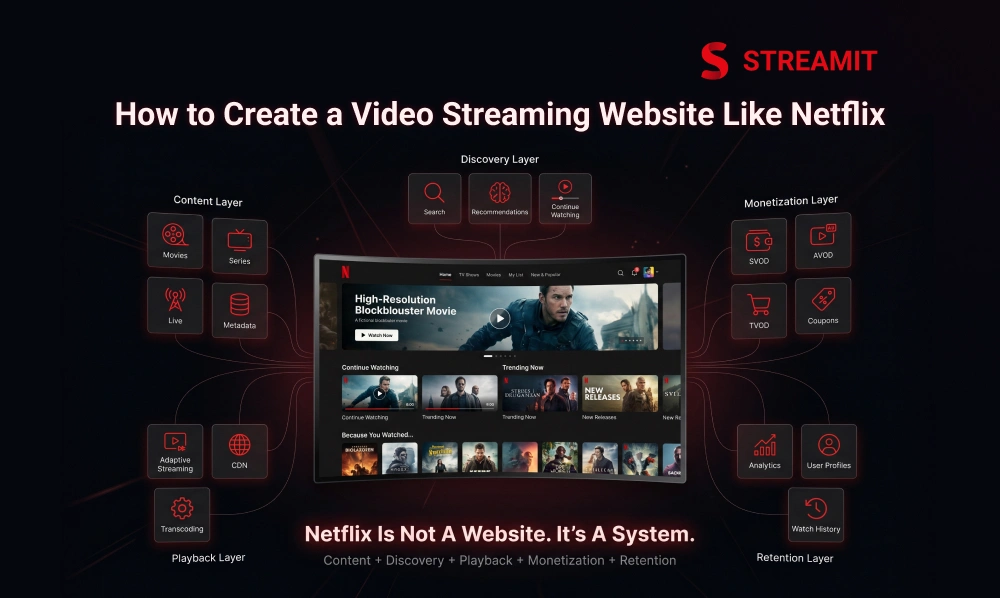
Most people do not fail because they cannot build a video website. They fail because they build only the visible layer. A Netflix-like streaming website is not just a homepage, a video player, and a few subscription plans. It is a product system built around discovery, playback, retention, monetization, and long-term control.
If you are planning to create a video streaming website like Netflix, the smarter question is not “How do I copy Netflix?” The better question is: “What kind of streaming business do I want to own 12 months after launch?”
Foundation
What It Really Means to Create a Video Streaming Website Like Netflix
A Netflix-like website is a business model, not a design reference. The real product is how quickly users find something worth watching, how smoothly playback starts, and how easily they return.
A strong video streaming website development plan should connect content, technology, user experience, monetization, and infrastructure from day one.
A Netflix-Like Website Is More Than a Video Player and Homepage
The homepage is only the front door. Behind it, you need content organization, user profiles, playback logic, recommendations, payments, analytics, and admin control.
A good OTT website should feel simple to viewers, but it should give the business enough structure to manage content, users, plans, and performance without chaos.
The Real Goal Is Smooth Discovery, Playback, and Retention
Retention starts before the first video plays. If users cannot find the right title quickly, the platform starts losing trust before playback begins.
Discovery, recommendations, watch history, continue watching, and fast playback all work together to increase viewing sessions and reduce drop-offs.
You Do Not Need Netflix-Level Scale to Use a Netflix-Like Product Model
You do not need millions of users to think like a serious streaming business. You only need the right foundation before growth makes mistakes expensive.
Even a niche OTT platform can use the same product logic: strong content structure, smooth streaming, clear monetization, and scalable architecture.
Planning
What to Plan Before You Start Building
The first planning mistake is treating the build as a design project. A streaming platform needs product clarity before screens are designed.
Before development starts, define your niche, content model, monetization strategy, device roadmap, and ownership expectations.
| Planning Area | Why It Matters |
|---|---|
| Audience | Decides content, pricing, and UX |
| Content Type | Impacts storage, playback, and monetization |
| Monetization | Changes user flow and access rules |
| Devices | Affects development scope and testing |
| Ownership | Controls long-term flexibility |
Define Your Niche, Audience, and Content Strategy
A vague audience creates an expensive platform. If your content is for everyone, your homepage, categories, pricing, and recommendations become harder to design.
Start with a clear segment: entertainment, education, fitness, regional media, creator content, sports, or premium niche content.
Decide If You Need Movies, Series, Live Content, or a Hybrid Model
Different content formats create different technical demands. VOD platforms need strong library management, while live content needs real-time stability.
A hybrid model can work well, but it should be planned early because live streaming, replays, schedules, and access rules increase complexity.
Choose the Monetization Model Before the Build Starts
Monetization is not a payment page decision. It shapes plans, content access, free trials, coupons, renewals, ads, and user journeys.
SVOD, AVOD, TVOD, freemium, and hybrid models all need different backend logic and different viewer experiences.
Choose Between a Website-First Launch and a Full OTT Platform
A website-first launch can be smart, but only if the backend is ready for expansion. Teams often launch the web version first and bring in mobile or TV apps as the platform grows.
The risk appears when the first version is built too narrowly and cannot support apps, profiles, payments, analytics, or device-specific playback later.
Step-by-Step
Step-by-Step Process to Create a Video Streaming Website Like Netflix
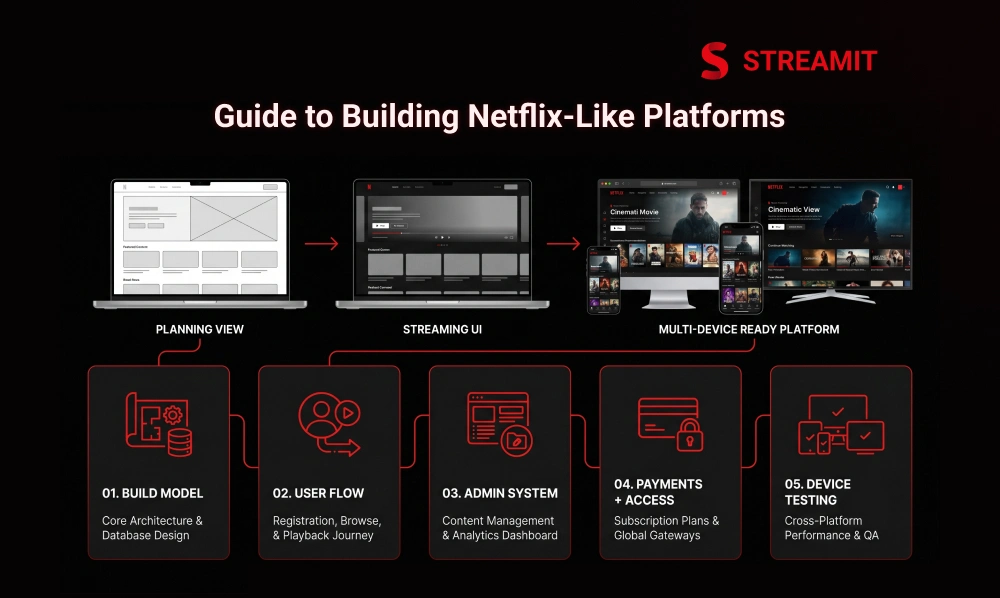
The build should move from strategy to structure before design. A clean process avoids rework and keeps the platform aligned with business goals.
The aim is not just to launch quickly, but to launch with a platform that can grow. The goal is to launch with enough control to improve without rebuilding too early.
Choose Your Build Model: White Label, Custom, or Hybrid
Your build model decides how much control you keep. White label is faster, custom gives deeper flexibility, and hybrid sits between speed and ownership.
| Build Model | Best For | Main Trade-Off |
|---|---|---|
| White Label | Fast launch | Limited flexibility |
| Custom | Strong control | Higher cost and timeline |
| Hybrid | Balanced growth | Needs clear architecture |
Choose based on what the platform must become, not only what it needs on launch day.
Plan the User Flow Before You Design the Interface
Good streaming UX is invisible when it works. Users should move from landing to browsing to playback without thinking too much.
Map the viewer journey first: sign up, choose plan, browse content, search, watch, pause, resume, upgrade, and return.
Build the Admin Side Along With the Viewer Side
The admin panel decides how well the business operates after launch. If content upload, metadata, plans, users, and reports are hard to manage, growth slows.
A proper OTT asset management solution should help your team control content, categories, banners, pricing, users, analytics, and publishing.
Connect Payments, User Accounts, and Content Access Rules
Every monetization model needs clear entitlement logic. The platform must know who can watch what, on which plan, and under what conditions.
Monetization rules like subscriptions, free trials, coupons, pay-per-view access, expiry dates, and regional limits should not be added as afterthoughts.
Test the Product Across Devices Before You Think About Launch
A platform is not launch-ready just because it works in one browser. Streaming behavior changes across mobile, desktop, tablets, smart TVs, and different networks.
Test sign-up, payment, search, playback start time, resume playback, subtitles, login sessions, and plan access before release.
Features
Core Features Every Netflix-Like Streaming Website Needs
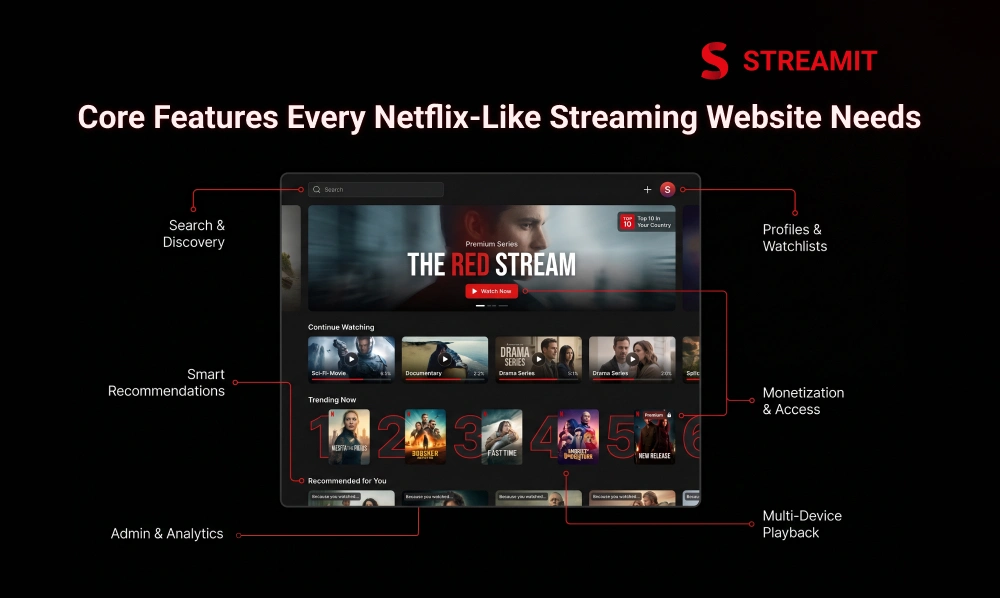
Features matter only when they support viewing behavior. A long feature list means nothing if users cannot find, watch, and return easily.
Start with the core systems that directly affect discovery, playback, retention, and revenue.
Content Library, Search, Filters, and Category Browsing
Content value drops when users cannot find it. Search, filters, genres, collections, trending rows, and curated categories help users move faster.
Metadata matters here. Titles, tags, cast, language, duration, and categories all improve browsing and recommendation quality.
User Accounts, Profiles, Watchlists, and Continue Watching
Retention improves when the platform remembers the user. Profiles, watchlists, watch history, and continue watching reduce friction for returning viewers.
These features also create useful behavior signals that help improve personalization and content decisions.
Smart Recommendations and Personalized Discovery
Recommendations should guide users, not overwhelm them. A strong system can use watch history, categories, completion patterns, and user interests.
The goal is simple: help every viewer find the next good thing faster.
Multi-Device Playback Across Web, Mobile, and TV
Device expansion changes the product. TV apps need remote-friendly navigation, mobile needs speed and simplicity, and web needs flexible browsing.
A serious streaming platform should plan for multi-device playback even if it launches with only the website first.
Subscriptions, Payments, and Access Control
Revenue logic should be built into the platform foundation. Subscriptions, ads, rentals, bundles, and premium content all need clean access control.
Without strong billing and entitlement rules, monetization becomes messy as plans grow.
Admin Panel for Content, Users, Plans, and Reports
A strong admin panel saves operational time every week. Your team should not need developers for every content, pricing, or homepage change.
Reports should show what users watch, where they drop off, which content performs, and which plans convert.
Technology
Streaming Technology Behind a Netflix-Like Website
Streaming quality is where trust is won or lost. Viewers rarely care about your tech stack, but they immediately notice buffering, slow starts, and broken playback.
A strong OTT platform architecture connects storage, encoding, delivery, player logic, APIs, database, and analytics.
Video Hosting, Storage, and Delivery Setup
Raw video files are not enough. Content must be stored, processed, secured, and delivered efficiently.
Cloud storage, organized media assets, backup rules, and delivery planning should be part of the foundation.
Adaptive Streaming and Protocol Choice
Adaptive streaming keeps playback stable when networks change. HLS and DASH help deliver video in different quality levels based on device and bandwidth.
This is important because users do not all watch from the same internet speed, device, or region.
Encoding and Transcoding for Multiple Quality Levels
One video file should become multiple playable versions. Transcoding creates different resolutions and bitrates so the platform can serve the right version.
This helps reduce buffering and improves playback quality across slow and fast networks.
CDN and Multi-CDN for Smoother Streaming at Scale
Delivery gets harder when traffic grows. A CDN helps serve video from locations closer to users.
Multi-CDN can become useful when your platform expands across regions, traffic spikes, or premium live events.
Backend, Database, and API Layer for User, Billing, and Playback Logic
The backend is where product control lives. It manages users, subscriptions, content access, watch history, recommendations, billing, and playback rules.
A rigid backend may look fine at launch but becomes a blocker when the business needs new plans, apps, reports, or workflows.
Security
Security and Content Protection for a Netflix-Like Platform
Security should match content value. A small free content library may not need the same protection as licensed premium content.
But user data, payments, access control, and video delivery should be secured from the beginning.
DRM Support for Premium and Licensed Content
DRM becomes important when content rights matter. Premium content often needs protection across browsers, mobile devices, and TV platforms.
Widevine, FairPlay, and PlayReady are commonly used across different device ecosystems for protected playback.
Tokenized Access, Secure URLs, and Viewer Entitlements
Access should be verified every time content is played. Tokenized URLs, encrypted delivery, signed access, and entitlement checks reduce unauthorized viewing.
This is especially important for paid plans, rentals, private libraries, and premium releases.
Monetization
Monetization Options for a Netflix-Like Streaming Website
The best monetization model is the one your audience accepts naturally. Do not copy a model just because it works for a larger platform.
Your pricing should match content value, viewing frequency, audience behavior, and market positioning.
Subscription Model for Premium Libraries
SVOD works when users see ongoing value. It fits premium libraries, series, exclusive content, learning platforms, and repeat-viewing audiences.
The platform needs renewals, trials, plan upgrades, cancellations, and retention flows.
Ad-Supported and Freemium Models for Reach
AVOD and freemium models work when reach matters more than immediate subscription revenue. They reduce entry friction for new users.
The challenge is balancing ad revenue with viewer experience so the platform does not feel cheap or interrupted.
Pay-Per-View and Hybrid Models for Special Content
TVOD works well for special content. Events, premieres, classes, sports matches, and premium releases can be sold individually.
A hybrid model gives flexibility, but it needs clean billing rules and strong content packaging.
Billing Logic Should Match Content Type and User Behavior
Billing is product strategy in disguise. A monthly plan, annual plan, rental, bundle, or free trial changes how users behave.
Build the platform so pricing can evolve as the content library and audience mature.
Product Insight
What People Copy From Netflix That Matters Less Than They Think
Most teams copy the surface and miss the system. Dark UI, hero banners, and horizontal rows are easy to imitate.
The harder work is building the logic behind discovery, playback quality, watch-state sync, and retention.
Visual Polish Matters Less Than Strong Discovery and Content Structure
A beautiful platform with weak discovery still loses users. Viewers need clear categories, relevant rows, strong search, and useful recommendations.
Visual design matters, but structure decides whether users keep watching.
The Real Advantage Comes From Playback Quality, Watch-State Sync, and Recommendation Flow
The best streaming experience feels continuous. Users expect playback to resume correctly across devices and suggestions to feel relevant.
That smoothness comes from backend logic, data, player behavior, and thoughtful product design.
Post-Launch
What Usually Slows Down a Netflix-Like Website After Launch
Post-launch problems usually come from shortcuts taken before launch. The first version may look complete, but weak foundations show up once users arrive.
The common blockers are metadata, device support, delivery setup, and rigid backend architecture.
Weak Metadata Hurts Search, Recommendations, and Watch Time
Metadata is not admin work; it is growth infrastructure. Poor tags, categories, descriptions, and content relationships weaken discovery.
Better metadata improves search, personalization, analytics, and user engagement.
Device Support Gets Harder as You Expand Beyond Web
TV and mobile apps are not just smaller or larger websites. They need different navigation, playback handling, login flows, and testing.
Plan early if you want Android TV, Apple TV, Fire TV, mobile apps, or multi-screen access later.
Poor Delivery Setup Leads to Buffering and Playback Complaints
Buffering is not just an internet problem. It can come from weak encoding, poor CDN setup, bad player logic, or overloaded systems.
A serious streaming website should be tested under real traffic and real network conditions.
Product Changes Become Slow if the Backend Is Too Rigid
Growth creates new product requests. Teams may need new pricing, bundles, user segments, regional rules, analytics, or integrations.
If the backend is not flexible, every improvement becomes slow and expensive.
Budget & Team
Cost, Timeline, and Team Model for a Netflix-Like Build
Cost depends less on the word “Netflix-like” and more on scope. Devices, security, live support, design depth, and infrastructure all change the budget.
For serious streaming businesses, the right question is not the cheapest build. It is the build that avoids expensive rebuilding.
What Changes the Timeline: Features, Devices, Live Support, and Security
A web-only VOD platform is different from a full OTT ecosystem. Mobile apps, TV apps, DRM, live streaming, analytics, and recommendations add time.
Timeline should be planned around product risk, not only feature quantity.
What Changes the Cost: Design Depth, Infrastructure, and Product Complexity
The real cost lives in architecture decisions. Simple design with complex billing may cost more than rich design with basic subscriptions.
Infrastructure, cloud setup, CDN strategy, admin depth, user roles, and scalability all affect cost.
In-House Build vs Agency vs White-Label OTT Provider
Every team model has a trade-off. In-house gives control but needs hiring. White label gives speed but limits flexibility. A strategic OTT partner gives execution plus product thinking.
Choose the team that understands streaming as a business, not just an app build.
Decision Guide
How to Choose the Right Path to Build a Netflix-Like Website
The right path depends on your 12-month product vision. A fast launch is useful only if the platform can support what comes next.
Choose based on control, speed, budget, monetization, content rights, and growth expectations.
Choose White Label if Speed and Simplicity Matter Most
White label works when the model is standard. It is useful for teams that need to launch quickly with common OTT workflows.
The limitation is that deeper customization may become harder as the business grows.
Choose Custom if Product Control and Differentiation Matter More
Custom development works when your platform experience is part of your advantage. It gives more control over UX, backend logic, integrations, and monetization.
It is better suited for teams that want flexibility and long-term ownership.
Choose Based on the Product You Want 12 Months Later, Not Just Launch Day
Launch day should not trap the business. Many platforms look fine at first but struggle when content, users, devices, and monetization expand.
Build for the next stage, not only the first release.
Why Streamit
Why Streamit Fits Teams Building a Netflix-Like Streaming Website
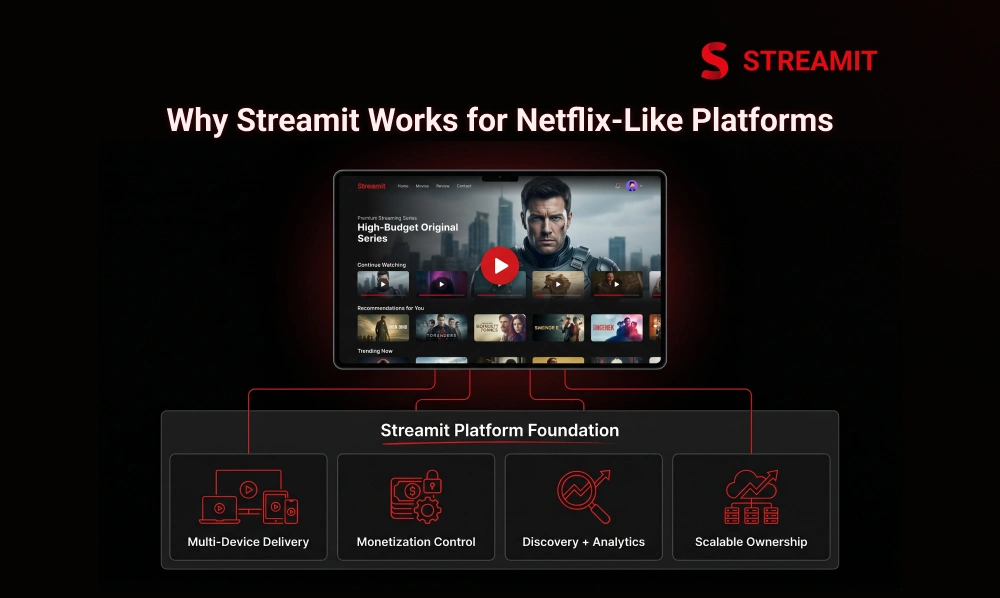
Streamit is built for teams that want more than a basic video website. It fits founders and operators thinking about infrastructure, ownership, monetization, performance, and retention.
The focus is not “Netflix clone” energy. The focus is building a serious streaming business foundation.
It Supports Multi-Device Apps, Monetization, and Better Streaming Delivery
A streaming business needs more than one screen. Streamit supports the kind of foundation required for web, mobile, and TV experiences.
It also supports monetization and delivery planning so the product can grow beyond a simple launch.
It Supports Better Discovery, Analytics, and Viewer Retention
Retention improves when teams understand viewer behavior. Discovery, recommendations, analytics, and engagement insights help operators make smarter decisions.
This helps teams improve content performance instead of guessing what users want.
It Gives Teams Room to Scale Without Rebuilding Too Early
The best platform is the one that does not punish growth. Streamit is designed around scalability, long-term control, and structured OTT growth.
That matters when traffic increases, content expands, and the product roadmap becomes more ambitious.
Summary
Key Takeaways
It Is a Product System, Not a Design
A Netflix-like website is built around smooth discovery, fast playback, user retention, monetization, and long-term platform control – not just a dark UI with rows.
Content Structure Matters From Day One
Categories, metadata, search, filters, and content rows must be planned early. Weak structure directly hurts discovery and watch time after launch.
Plan Monetization Before Development
SVOD, AVOD, TVOD, freemium, and hybrid models all need different payment flows, access rules, and backend logic – so pick yours before a line of code is written.
Playback Quality Depends on Infrastructure
Smooth streaming requires proper encoding, adaptive streaming, CDN setup, backend performance, and testing across different networks and devices.
Admin Control Is Part of Scalability
A strong admin panel lets teams manage content, users, plans, reports, and platform changes without depending on developers for every update.
Build for 12 Months Later, Not Just Launch Day
Post-launch problems, poor metadata, rigid backend, limited devices, weak delivery – usually trace back to shortcuts made before launch.
Conclusion
Conclusion
Creating a video streaming website like Netflix is not about copying a famous interface. It is about building a platform that helps users discover content, watch smoothly, return often, and pay without friction.
If you want to build a serious OTT platform, think beyond launch day. Build for performance, ownership, scalability, and the product decisions your business will need 12 months from now.
FAQs
Frequently Asked Questions
-
Can I launch without every Netflix-like feature?
No. Start with the features that support discovery, playback, monetization, and retention. You can start with the essentials first and add advanced features later if the architecture allows it.
-
What matters more in a Netflix-like website: design or discovery?
Design matters, but discovery matters more for long-term viewing. If users cannot find the right content quickly, even a beautiful interface will underperform.
-
Why do some Netflix-like websites look good but still fail?
They often copy the visual layout but miss the system behind it. Weak metadata, poor playback, bad recommendations, and rigid backend logic usually hurt growth.
-
What causes buffering in a Netflix-like website after launch?
Buffering can come from poor encoding, weak CDN setup, bad player logic, heavy traffic, or limited adaptive streaming. It is rarely just the viewer’s internet.
-
Do I need DRM before my content library becomes large?
You need DRM when your content value, licensing terms, or piracy risk requires stronger protection. Small free libraries may start with lighter security.
-
What should I test before launching a Netflix-like website?
Test sign-up, payments, search, playback, subtitles, plan access, resume watching, mobile experience, and performance across devices. Real launch quality comes from real scenario testing.
Read Also
Read Also
1. How to Develop a Video Streaming Website for OTT Brands
2. Video Streaming App Development Company for OTT Growth
3. How Netflix’s Recommendation System Boosts Watch Time
4. OTT Platform Development Cost in 2026: Full Breakdown
5. OTT Platform Architecture: Setup & Hosting Costs Explained