Streamit vs Dacast: Which Streaming Platform Is Better in 2026?


A platform that starts at $39 per month can still become the more expensive choice if it limits ownership, product freedom, or scale later. Dacast publishes SaaS pricing starting at $39/month for Starter, $63/month for Event, and $165/month for Scale when billed annually, while Streamit positions itself as a custom OTT platform built around ownership, monetization, and long-term control rather than a fixed self-serve plan.
That is the real comparison here: platform access versus platform ownership. Dacast is a professional live streaming and video hosting platform with OTT distribution, APIs, monetization, analytics, and 24/7 support. Streamit, by contrast, presents itself as a production-ready streaming platform foundation for web, mobile, and smart TVs, built for businesses that want to own the codebase, infrastructure, data, and roadmap.
The better choice depends on what you are actually building in 2026. If you need a faster hosted setup for events, webinars, or lighter OTT distribution, Dacast is easier to enter. If you are building a serious OTT business where brand control, device coverage, monetization flexibility, and long-term architecture matter, Streamit is the stronger strategic fit.
Overview
Streamit vs Dacast: Quick Comparison
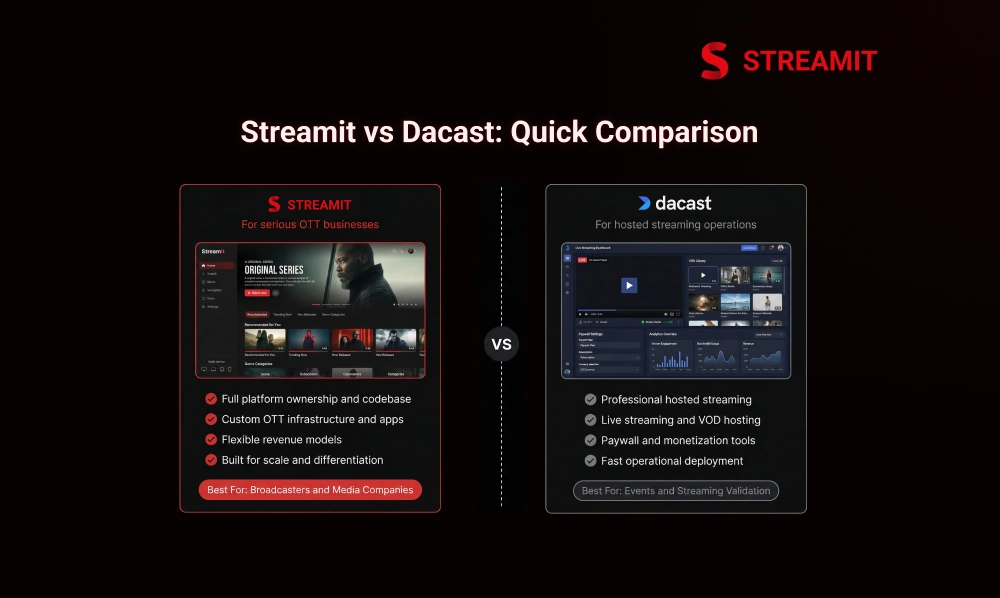
The main difference is not just features. It is where control lives after launch. Dacast gives you a hosted streaming platform with pricing tiers, built-in monetization, APIs, OTT distribution, analytics, and support. Streamit is not positioned as a locked SaaS product; it is presented as a custom OTT platform partner built for ownership, customization, and long-term platform evolution.
In practical terms, Dacast helps you operate on top of its platform, while Streamit helps you build a platform that is yours. That difference matters more over 12 months than it does in the first 12 days, especially once apps, pricing models, integrations, and infrastructure decisions start compounding.
What is the main difference between Streamit and Dacast?
Streamit is built around enterprise OTT foundations; Dacast is built around hosted streaming operations. Streamit emphasizes enterprise architecture, high-concurrency delivery, centralized CMS and operations, flexible revenue models, and full ownership of codebase, OTT infrastructure, data, and roadmap. Dacast emphasizes live streaming, VOD hosting, OTT distribution, paywall monetization, APIs, analytics, and support through structured plans.
That means the decision is less about “which one has more features” and more about “which model matches the business”. One is better for fast operational deployment. The other is better for serious founders who do not want future growth constrained by a platform boundary they did not design.
Who should choose Streamit?
Streamit fits businesses that treat streaming as a long-term product, not a launch asset. Its own positioning targets founders and teams planning for scale, where audience growth, monetization, user experience, and platform stability matter from day one. It also supports web, mobile, smart TVs, high-concurrency live streaming, evolving monetization, and infrastructure management.
It is the stronger fit for broadcasters, media companies, sports platforms, creator businesses, and OTT operators who care about ownership and future flexibility. If your roadmap includes branded apps, deeper viewer analytics, custom flows, multi-device experiences, or platform-level differentiation, Streamit is closer to that business need.
Who should choose Dacast?
Dacast fits teams that want professional streaming without taking on a custom platform build first. Its Starter plan is explicitly positioned as affordable for small audiences, and its platform includes live streaming, VOD, analytics, domain and country restriction, paywall tools, OTT distribution, developer APIs, and 24/7 support.
It is especially practical for events, webinars, training, and businesses that want to validate streaming demand before investing in a fully owned OTT stack. That is where a hosted model can be commercially sensible.
At a Glance
Streamit vs Dacast: Comparison Table
| Area | Streamit | Dacast |
|---|---|---|
| Core model | Custom OTT platform foundation | Hosted streaming SaaS/platform |
| Ownership | Codebase, infrastructure, data, roadmap ownership | Platform access with APIs and player customization |
| Pricing | Custom quote based on scope, devices, and monetization | Starter $39/mo, Event $63/mo, Scale $165/mo billed annually |
| Best for | OTT businesses building for long-term control | Events, webinars, professional streaming, and faster setup |
| Monetization | Subscriptions, ads, PPV, bundles, hybrid models | Built-in paywall, TVOD, SVOD, promos, group pricing, ads |
| Device strategy | Web, mobile, smart TVs, custom-branded apps | HTML5 all-device player, OTT app distribution, mobile SDKs |
| Performance focus | High concurrency, multi-device delivery, evolving infrastructure | CDN-backed delivery, multi-CDN on Event+, analytics, support |
| Scalability style | Custom architecture for business evolution | Tiered scaling through plans and custom enterprise packages |
Platform Deep Dive
What Is Streamit OTT Platform?
Streamit presents itself as a production-ready streaming platform built for real traffic, monetization, and long-term ownership. Its platform messaging focuses on enterprise architecture, multi-device delivery, centralized operations, high-concurrency streaming, flexible revenue models, and avoiding the technical debt that comes from short-term launch decisions.
Streamit is designed for businesses that want more control over how their OTT platform grows over time. Instead of offering a limited one-size-fits-all setup, it supports a more flexible foundation for brands that need custom apps, stronger platform control, scalable infrastructure, and a better fit for long-term streaming goals.
Streamit OTT platform overview
Streamit is built around ownership, evolution, and platform durability. It supports web, mobile, smart TVs, infrastructure management, live plus on-demand streaming, monetization changes over time, and architecture designed for concurrency and stability.
That makes Streamit less attractive to buyers looking for a quick tool and more attractive to buyers looking for strategic control. It is a better fit when streaming is a business line that needs to hold up under growth, device expansion, and revenue experimentation.
Platform Deep Dive
What Is Dacast Live Streaming Platform?
Dacast is a hosted live streaming and online video platform with VOD, OTT delivery, analytics, APIs, paywall monetization, and support. Its public product pages position it around secure video hosting, live events, video monetization, OTT distribution across devices, and a developer layer for integration and customization.
It is a stronger fit when operational convenience matters more than full platform ownership. Dacast reduces setup friction, offers a free trial, and makes professional streaming capabilities available through packaged plans.
Dacast platform overview
Dacast combines live streaming, video hosting, white-label playback, OTT distribution, APIs, and analytics inside a managed product. Its all-device HTML5 player supports modern devices and browsers, and its white-label controls let businesses customize logo and colors.
That said, Dacast still behaves like a platform you configure rather than a platform you truly own. Its player documentation recommends the default player and notes that using your own player can limit access to some features, which is a useful signal about where control boundaries exist.
Feature by Feature
Streamit vs Dacast Feature Comparison
Streamit and Dacast differ most in control, flexibility, and long-term scale. Dacast suits simpler hosted streaming, while Streamit fits businesses that want stronger ownership and deeper customization.
Pricing and long-term cost
Dacast’s entry cost is clear: $39/month for Starter, $63/month for Event, and $165/month for Scale, all with annual billing on those listed tiers. Its plans also package bandwidth and storage, and storage overages can cost $0.15 per GB. That makes the pricing transparent, but also ties cost to usage and plan structure over time.
Streamit does not present public fixed SaaS plans. Instead, its site frames pricing around platform scope, devices, features, and monetization requirements, which usually signals a project-based or custom-quote model rather than a subscription-first product.
Streamit pricing model
Streamit pricing is shaped by scope, not by a generic tier. The company states that pricing depends on features, devices, and monetization, which fits a custom OTT build model.
That usually makes initial conversations more consultative, but it also means the platform can be designed around your actual business rather than around a plan ceiling.
Dacast pricing and bandwidth costs
Dacast publishes a clear commercial ladder, and that is one of its strengths. Starter includes 2.4 TB per year and 500 GB storage, Event includes 6 TB upfront, and Scale includes 24 TB per year with 2 TB storage.
That clarity is useful for forecasting smaller or mid-sized workloads, but the model can become more operationally restrictive as usage, feature needs, and delivery complexity rise.
Which platform offers better long-term value?
Long-term value depends on whether you are optimizing for launch speed or future control. Dacast is often more affordable to start. Streamit is often more defensible to grow with when ownership, architecture, monetization flexibility, and roadmap freedom matter more than entry pricing.
Branding, white-label control, and ownership
White-label does not always mean full ownership. Dacast offers a customizable player with logo and color controls, while Streamit explicitly promises ownership of codebase, infrastructure, data, and roadmap.
That distinction matters because many streaming businesses eventually need more than logo control. They need product control.
Branding flexibility in Streamit
Streamit is designed for businesses that want their platform to feel theirs fully. It supports branded web, mobile, and TV experiences and frames ownership as a core advantage rather than an add-on.
That gives operators more room to shape UX, flows, monetization logic, and long-term product decisions without being boxed into template-level branding.
Branding and player control in Dacast
Dacast offers practical white-label controls at the player layer. You can brand the HTML5 player with your logo and colors, and Dacast also provides APIs and SDKs for deeper implementation work.
But Dacast’s own documentation also notes that not all features are available when you use your own player, which is a useful reminder that customization still happens inside a hosted system.
Which platform gives you more ownership?
Streamit wins this category clearly. Its public language is explicit about ownership and avoiding vendor lock-in, while Dacast gives you a professional, hosted environment with customization options rather than full platform possession.
Monetization and revenue flexibility
Monetization looks similar on the surface until the business model matures. Both platforms support common revenue paths, but Streamit frames monetization as platform architecture, while Dacast frames it as built-in tools and paywall options.
That difference becomes important when pricing logic, bundles, regional strategies, and device-specific commerce start getting more complex.
Monetization in Streamit
Streamit is built to support subscriptions, pay-per-view, ads, bundles, pricing tiers, and hybrid monetization from the platform layer. It also emphasizes the ability to launch with one model and expand later without re-platforming.
That is a strong fit for OTT businesses that expect their revenue model to change as the audience and content strategy mature.
Monetization in Dacast
Dacast offers built-in monetization with a paywall, global payments, rate controls, promos, TVOD, SVOD, group pricing, and advertising support. Its Event plan includes paywall and ad support, and its monetization page states that those tools are available across plans.
That makes Dacast commercially useful for businesses that want revenue tools without building custom billing logic first.
Which platform gives you more revenue flexibility?
Streamit offers more structural flexibility; Dacast offers more immediate convenience. If you want fast monetization, Dacast is practical. If you want monetization woven into a product you control and can evolve, Streamit is stronger.
Live streaming, video delivery, and performance
Performance is where buyer mistakes get expensive. Dacast offers CDN-backed delivery, multi-CDN on Event+, analytics, and support. Streamit emphasizes high-concurrency architecture, multi-device delivery, infrastructure management, and a multi-CDN, zero-buffer delivery approach.
This is not just a technical issue. It affects churn, watch time, and operating confidence. Streamit’s own recommendation content notes that over 80% of viewing on leading OTT platforms comes from recommendations, which is a reminder that platform performance and discovery both matter to retention, not only content supply.
Live streaming and OTT delivery in Streamit
Streamit leans hard into performance architecture. Its platform pages emphasize high-concurrency streaming, multi-device delivery, and infrastructure designed for traffic spikes, while its demo pages show multi-CDN routing and zero-buffer delivery positioning.
That makes it better suited for businesses that cannot afford playback instability during scale moments.
Live streaming technology in Dacast
Dacast gives you professional delivery without forcing a full infrastructure build. Starter includes RTMP and HLS channels, Event adds multi-CDN, and the platform positions itself around scalable CDN-backed streaming and OTT distribution across devices.
For many operators, that is enough. It becomes less effective when you need deeper control over the delivery strategy itself.
Which platform is better for streaming performance?
For controlled, long-term OTT performance, Streamit has a stronger architecture story. For simpler professional delivery with lower setup friction, Dacast remains attractive.
Multi-device support and OTT apps
Device support is no longer a checklist feature. It is a retention layer. Streamit supports web, mobile, smart TVs, and branded app development, while Dacast supports all-device playback, OTT distribution, and mobile SDKs.
The real difference is that Streamit is positioned to build the app ecosystem itself, while Dacast is positioned to help you distribute and power video experiences within its platform model.
Streamit device and app support
Streamit builds production-ready Android, iOS, Android TV, Smart TV, and Fire TV experiences. Its product messaging focuses on surviving peak concurrency, monetizing across devices, and keeping the experience aligned across screens.
That is stronger for OTT brands that want the app layer to be part of their long-term moat.
Dacast device compatibility and player access
Dacast supports wide device compatibility through its HTML5 player and SDK layer. It states that the player works across modern devices and browsers, including smartphones and smart TVs, and its mobile SDK materials extend that app-building path further.
That is strong for playback reach, even if it is not the same thing as owning a fully custom OTT app ecosystem.
Which platform offers the better viewer experience?
Streamit is the better bet when the viewer experience needs to become part of the product strategy. Dacast is sufficient for broad playback compatibility and professional delivery. Streamit has a stronger positioning around branded apps, discovery, personalized experience, and platform-level control.
Analytics, support, and long-term scalability
Dacast offers analytics and 24/7 support out of the box; Streamit positions analytics and infrastructure as part of a larger operating system for growth. Dacast’s analytics focus on viewer behavior and content performance, while Streamit emphasizes centralized analytics, unified revenue tracking, infrastructure decisions, and long-term performance management.
This is another category where the right answer depends on how far you expect the platform to go.
Analytics and support in Streamit
Streamit treats analytics as a business layer, not just a dashboard layer. Its site highlights centralized analytics, unified revenue tracking, and AI-powered platform intelligence tied to engagement, retention, and monetization decisions.
That is more valuable when the platform is central to the business model.
Analytics and support in Dacast
Dacast gives operators usable visibility quickly. Its analytics product tracks audience behavior and performance, and its OTT pages emphasize 24/7 support plus knowledge base access.
That makes it approachable for teams that need professional tooling without building a larger internal operating stack.
Which platform is better for long-term growth?
Streamit is better for long-term growth when streaming is core to the business. Dacast is better when streaming is important, but it does not yet justify a custom-owned OTT foundation.
Decision Guide
Streamit vs Dacast: Which Platform Should You Choose?
The right platform depends on what you are building and how much control you want over the business. Dacast works well for simpler streaming needs, while Streamit is the better fit for brands planning long-term growth, ownership, and deeper platform flexibility.
Best platform for OTT businesses and content ownership
Streamit is the better choice for OTT operators that care about owning the platform layer, shaping the roadmap, and building a business that does not outgrow its foundation too early.
Best platform for live events, webinars, and simpler streaming needs
Dacast is the better choice for businesses that want professional live streaming, OTT distribution, built-in monetization, and support without starting with a custom platform build.
Final verdict: Streamit or Dacast?
For serious OTT businesses in 2026, Streamit is the stronger strategic platform. For faster, hosted, professional streaming operations, Dacast remains a credible option.
Why Switch
Why Streamit Is a Strong Dacast Alternative
Streamit is a strong Dacast alternative because it is not trying to be a lighter hosted tool. It is trying to solve a different problem: long-term OTT ownership, flexibility, and scale.
Better ownership and flexibility
Streamit is a strong Dacast alternative because it is not trying to be a lighter hosted tool. It is trying to solve a different problem: long-term OTT ownership, flexibility, and scale.
More control over branding, apps, and long-term growth
If your roadmap includes branded apps, custom monetization, infrastructure decisions, and platform differentiation, Streamit gives you more room to build that advantage directly into the product.
See How Streamit Fits Your OTT Business
If you are building beyond simple hosting and want a platform you can actually grow into, Streamit is worth evaluating as a strategic OTT partner rather than just another software tool.
Summary
Key Takeaways
Platform Model Defines Everything
Streamit is a custom OTT ownership foundation; Dacast is a hosted streaming service. This fundamental difference shapes every decision downstream – pricing, control, and scalability.
Dacast Is Faster to Enter
Fixed plans starting at $39/month with bundled bandwidth, live streaming, monetization, and 24/7 support make Dacast the more accessible choice for events and lighter OTT workloads.
Streamit Is Built to Own
Streamit hands you the codebase, infrastructure, and roadmap – making it the right fit when brand control, app customization, and long-term platform architecture matter more than launch speed.
Monetization Flexibility Favors Streamit
Both platforms support subscriptions, PPV, and ads – but Streamit lets you evolve hybrid revenue models from the platform layer without re-platforming as your strategy matures.
Performance at Scale Needs Architecture
Streamit’s high-concurrency, multi-CDN, zero-buffer delivery architecture gives serious OTT operators the infrastructure resilience that Dacast’s hosted model cannot fully replicate.
Device Strategy Is a Retention Layer
Streamit builds production-ready branded apps for Android, iOS, Smart TV, and Fire TV. Dacast provides broad playback compatibility – a different strategic position entirely.
Final Word
Conclusion
Streamit vs Dacast is not a debate between a good platform and a bad one. It is a choice between two operating models. Dacast is a solid hosted streaming platform for teams that want professional delivery, monetization, and support with less setup friction. Streamit is the stronger option for businesses that want to own the platform, control the roadmap, and build for scale without handing strategic leverage to a third-party system.
If the goal is to test streaming, Dacast makes sense. If the goal is to build a streaming business that still makes sense 12 months later, Streamit is the more serious answer.
FAQs
Frequently Asked Questions
-
What is the main difference between Streamit and Dacast?
Streamit is positioned as a custom OTT platform foundation built for ownership, scale, and long-term control. Dacast is a hosted streaming platform with packaged plans, built-in monetization, APIs, analytics, and support.
-
Is Streamit a better Dacast alternative for OTT businesses in 2026?
Yes, for businesses that want ownership, branded apps, evolving monetization, and a platform that can be shaped around their roadmap.
-
Which platform has better pricing and long-term value: Streamit or Dacast?
Dacast has clearer entry pricing. Streamit usually offers stronger long-term value when control, flexibility, and future scale are more important than a lower starting fee.
-
Can I migrate from Dacast to Streamit without losing content and control?
Streamit’s positioning includes migrations, integrations, and a full ownership-focused platform strategy, so it is a reasonable fit for teams planning a move away from a hosted model.
-
Is Dacast a video hosting platform or a full OTT platform?
It is both a professional video hosting/live streaming platform and an OTT distribution platform. The more precise distinction is that it is a hosted OTT-capable platform, not a custom-owned OTT foundation in the way Streamit positions itself.