Streamit vs Uscreen: Which OTT Platform Is Better in 2026?


The OTT market in 2026 is more mature than many operators expected. Launching a streaming platform is no longer the hard part. The harder part is choosing a platform model that still works once your audience grows, your monetization expands, and your product needs become more specific.
That is where comparisons like Streamit vs Uscreen become useful. On the surface, both help businesses launch and grow video platforms. But underneath, they are built for very different operating models.
Uscreen is designed to make membership-led video businesses easier to launch and manage. Streamit is positioned more around ownership, flexibility, infrastructure control, and long-term platform growth.
For creators, educators, and subscription-first businesses, Uscreen can make the early stages simpler. For founders, media businesses, and OTT brands that want more control over product direction, branding, monetization, and architecture, Streamit becomes a more strategic option.
Overview
Streamit vs Uscreen: Quick Comparison
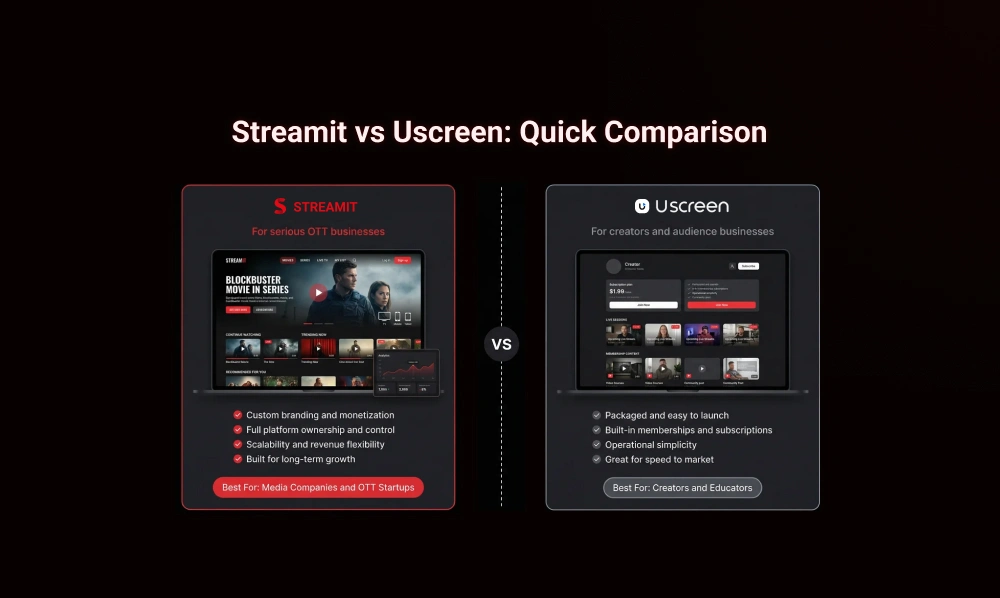
Choosing between Streamit and Uscreen is not really about asking which platform is “good” and which one is “bad”. Both platforms solve real business problems. The better question is what kind of OTT business you are planning to build over the next 12 to 24 months.
One platform is designed to help you launch quickly within a structured environment. The other is better suited to businesses that want more control over how the platform works, grows, and earns over time.
What is the main difference between Streamit and Uscreen?
Uscreen is built as a creator-friendly, membership-focused OTT platform. It offers a more packaged path to launching a video business, especially for creators, coaches, educators, and audience-led brands that want subscriptions, live streaming, apps, and built-in commerce without shaping the technical stack from the ground up.
Streamit is positioned differently. It is better understood as a more ownership-oriented, custom OTT solution. Instead of focusing mainly on packaged convenience, it leans toward giving businesses more control over branding, monetization, device strategy, infrastructure decisions, and long-term platform direction.
In practical terms, Uscreen is often easier at the beginning. Streamit often becomes more attractive when the business starts thinking beyond launch and asks harder questions about scalability, revenue flexibility, and platform independence.
Who should choose Streamit?
Streamit is a stronger fit for businesses that see OTT as a serious product, not just a content storefront.
That includes media companies, broadcasters, growing OTT startups, entertainment businesses, premium streaming brands, and funded companies that want more control over how the platform is built and how it evolves.
It also makes sense for founders who do not want to be boxed into a fixed product path too early. If your monetization model may change, your app roadmap may expand, or your business needs more than standard templates and preset workflows, Streamit fits that direction better.
In other words, Streamit is better for teams that think long-term. It is less about getting online quickly and more about building a platform that can keep up with the business as complexity increases.
Who should choose Uscreen?
Uscreen is a very practical choice for content creators and audience-led businesses that want to monetize through subscriptions, live sessions, memberships, and premium video access.
It works especially well for people who want an easier starting point. If the goal is to launch a branded video business without designing too much of the technical foundation, Uscreen offers a clearer, more packaged path.
This makes it attractive for coaches, fitness brands, educators, niche communities, and creator businesses that prioritize speed, built-in monetization, and operational simplicity.
For those businesses, Uscreen’s structure is not a weakness. It is often the reason the platform makes sense.
Streamit vs Uscreen: Comparison Table
A side-by-side table is useful, but it should not replace interpretation. Most OTT buyers do not struggle because they missed a feature. They struggle because they picked a platform model that looked convenient early and was limited later.
That is why the table below should be read as a starting point, not the final answer.
| Category | Streamit | Uscreen |
|---|---|---|
| Core model | Custom, ownership-led OTT platform | Packaged creator/membership OTT platform |
| Best fit | Broadcasters, brands, OTT startups, media businesses | Creators, educators, coaches, memberships |
| Pricing approach | Consultation-led, scoped solution | Public monthly plans with platform structure |
| Branding | Deep custom branding and platform control | Strong branded presence within platform limits |
| Monetization | Flexible SVOD, AVOD, TVOD, hybrid models | Subscriptions, bundles, rentals, one-time sales |
| Live streaming | Built with performance and delivery in mind | Creator-friendly live streaming workflows |
| Apps and devices | Web, mobile, TV, connected ecosystem | Web, iOS, Android, Roku, Apple TV, Fire TV, more |
| Analytics | Business, viewer, retention, engagement intelligence | Accessible business and content analytics |
| Security | Strong content protection and DRM-ready positioning | Platform security with growing protection options |
| Long-term control | High | Moderate |
The key takeaway is simple. Uscreen is easier for a more defined use case. Streamit is stronger when the business needs more room to grow, adapt, and differentiate.
Platform Deep Dive
What Is Streamit OTT Platform?
Streamit positions itself as more than a basic video platform. Its broader value is in helping businesses build a streaming ecosystem that spans devices, monetization, security, analytics, and long-term operational control.
That is an important distinction because many OTT businesses do not fail from a lack of content alone. They run into friction around platform limits, monetization restrictions, app consistency, or weak infrastructure choices once the audience becomes more serious.
Streamit OTT platform overview
Streamit is best understood as an OTT platform solution designed around flexibility and ownership.
Instead of presenting itself as a narrow creator subscription tool, it is positioned as a broader streaming solution for businesses that want to build across web, mobile, and TV while keeping more control over how the platform behaves and evolves.
Its public positioning also suggests a stronger emphasis on performance, streaming architecture, monetization flexibility, and content protection. That makes it more relevant for businesses that want to shape the platform around their needs rather than simply work inside a fixed product model.
This creates a different buying decision. Streamit is not only about what features you get on day one. It is about whether the platform can support the business you are trying to become.
Who Streamit is best for
Streamit is a strong fit for businesses that want their OTT platform to become a long-term asset.
That includes media brands, streaming startups, broadcasters, entertainment businesses, and companies that want more than a branded video portal. It also fits businesses that expect to grow into more complex monetization, more advanced analytics, stronger app ecosystems, or more specific user journeys.
It is particularly useful when founders care about ownership. Not only ownership of branding, but ownership of the product direction, the monetization logic, and the broader platform strategy.
That is why Streamit tends to make more sense for businesses thinking beyond launch and into scale.
Platform Deep Dive
What Is Uscreen OTT Platform?
Uscreen is one of the more established names in the creator and membership video platform space. Its appeal comes from making monetized video businesses more accessible for operators who want less technical complexity.
That matters because many businesses do not actually want to build an OTT system from the ground up. They want a practical platform that helps them publish content, sell subscriptions, stream live, and reach viewers across devices.
Uscreen platform overview
Uscreen is built around a simpler OTT operating model.
It offers tools for subscriptions, memberships, live streaming, branded experiences, apps, analytics, and audience monetization inside a structured platform environment. That makes it especially attractive for businesses that want a clearer go-to-market path and less technical overhead.
Its strength is not that it promises infinite flexibility. Its strength is that it reduces decision fatigue for operators who want a business-ready system rather than a platform they need to shape extensively.
For the right business, that is extremely valuable.
Who Uscreen is best for
Uscreen is best for creators, coaches, educators, membership brands, and niche audience businesses that want to monetize premium video without turning platform architecture into a major project.
It is especially useful when the business model is already clear. If you know you want subscriptions, live sessions, app-based access, and a polished, branded experience, Uscreen gives you a more direct route.
It is also a good fit for businesses where operational simplicity matters as much as product quality. Teams without a large technical roadmap often benefit from that structure.
In that sense, Uscreen is not trying to be everything. It is trying to solve a narrower problem very efficiently.
Feature by Feature
Streamit vs Uscreen Feature Comparison
Feature comparisons are useful, but not all features carry equal strategic weight.
For medium to high-ticket OTT businesses, the most important factors are usually not cosmetic. They are pricing logic, ownership, monetization flexibility, scalability, viewer experience, analytics, and content protection.
That is where the deeper comparison becomes more interesting.
Pricing and long-term cost
A platform can look affordable at launch and still become expensive over time. This is one of the most overlooked parts of OTT buying.
The real cost is not only what you pay to get started. It is what the platform model costs once you have more users, more revenue, more content, and more operational needs.
Streamit pricing model
Streamit appears to follow a more consultation-led pricing model for its broader OTT services.
That usually suggests a more custom-scoped engagement. Rather than asking buyers to choose between preset plans, it positions the platform more as a solution that is shaped around business requirements, delivery scope, device needs, and growth goals.
For some buyers, that feels less convenient upfront. But for larger OTT businesses, this often makes more sense because the platform is being aligned with the business model rather than squeezed into a standard package.
That can be a better foundation for long-term clarity, especially when requirements are more specific.
Uscreen pricing model
Uscreen’s pricing structure is more transparent and easier to understand early.
This is one of its advantages. Businesses can evaluate entry plans more quickly and see how the platform scales across tiers, features, and app access. That makes the decision-making process simpler for creators and leaner teams.
At the same time, structured pricing models also reflect platform boundaries. They tell you what is included, what is gated by tier, and how the business is expected to operate inside the platform.
For many businesses, that is perfectly acceptable. For others, it becomes restrictive later.
Which platform offers better long-term value?
Uscreen often offers better short-term clarity. Streamit often offers better long-term strategic value.
That is because value is not only about a lower monthly entry point. It is also about whether the platform continues to fit as the business becomes more demanding.
If you want faster launch, easier pricing visibility, and a simpler operating structure, Uscreen is the more direct answer. If you care more about control, customization, ownership, and the ability to shape the platform around changing business goals, Streamit can deliver stronger long-term value.
Branding and white-label control
Many OTT businesses say they want white-labeling, but they often mean different things by it.
For some, white-label means changing logos, colors, and domains. For others, it means deeper control over the product, the experience, and how the brand behaves across devices and workflows.
Branding flexibility in Streamit
Streamit’s advantage appears to go beyond visual branding.
Its broader positioning suggests stronger flexibility around how the platform is structured, how the user journey is designed, and how brand presence extends across web, mobile, and TV.
That matters because real brand differentiation in OTT rarely comes from color palettes alone. It comes from how content is discovered, how subscriptions are structured, how playback feels, and how the product supports the brand’s wider business model.
This is where a more ownership-led platform usually becomes more valuable.
Branding options in Uscreen
Uscreen supports branded OTT experiences in a more accessible way.
For many businesses, that is enough. A strong branded website, branded apps, and a professional membership experience can already go a long way in helping the business look polished and credible.
But it still operates within the logic of the platform. That does not make it weak. It simply means the brand experience is shaped within a more predefined environment.
This works well for businesses that prioritize speed and packaged consistency over deeper product-level control.
Which platform gives you more ownership?
Streamit gives more ownership.
That is one of the clearest differences in the comparison. If ownership means having more say over how the platform evolves, how the experience is designed, and how monetization and workflows are handled, Streamit has the stronger position.
Uscreen offers strong branded experiences, but it is still a platform-defined system. For businesses that care deeply about long-term independence, that distinction matters.
Monetization options
Monetization is one of the most important areas in OTT because it shapes not only revenue but pricing freedom, packaging freedom, and long-term business adaptability.
A platform that only supports the first version of your business model can quickly become a limit instead of an asset.
Monetization in Streamit
Streamit appears better suited for businesses that want more flexibility in how monetization is structured.
That includes subscriptions, ads, pay-per-view, rentals, hybrid models, bundles, and more tailored revenue logic depending on the platform strategy. This is especially useful for OTT businesses that expect their monetization to evolve.
For example, a platform may begin as subscription-led, then add event-based payments, regional offers, or advertising as the audience matures. A more flexible OTT solution supports that transition more naturally.
That is one reason Streamit becomes attractive for growth-stage businesses.
Monetization in Uscreen
Uscreen is strong on practical monetization for creator-led businesses.
It supports the most common recurring and transactional monetization models in a way that is easier to operate. This works well for subscriptions, content access, memberships, bundles, and premium sessions where the offer is already defined.
That simplicity is useful because many creators do not want to reinvent monetization logic. They want proven revenue flows that are easy to launch and manage.
For those use cases, Uscreen performs well.
Which platform gives you more revenue flexibility?
Uscreen gives better packaged monetization simplicity. Streamit gives broader monetization freedom.
That distinction is important. If your goal is to launch with a proven subscription model and manage it efficiently, Uscreen is a very practical solution. If your goal is to build a monetization engine that may become more layered and customized over time, Streamit offers a stronger foundation.
Live streaming, video delivery, and performance
Viewer patience is low. That is true across content categories.
A strong OTT platform is not judged only by what it can publish. It is judged by how reliably it delivers that content under real usage conditions.
Live and on-demand video in Streamit
Streamit appears to be positioned more heavily around delivery quality, performance architecture, and streaming infrastructure.
That suggests stronger alignment with businesses where playback reliability, latency, adaptive streaming, and long-term technical quality matter more than just basic publishing.
This is particularly relevant for live events, high-engagement OTT environments, premium content businesses, and brands where playback quality directly affects retention and revenue.
A platform built with performance in mind usually ages better as scale increases.
Live and on-demand video in Uscreen
Uscreen supports live and on-demand streaming in a way that is more accessible for creators and audience-led operators.
Its strength is reducing complexity for businesses that want to go live, create a video, publish content, and manage access without handling too much of the delivery logic themselves.
That is useful for memberships, online learning, coaching, wellness, and similar businesses where operational ease matters. For those businesses, creator-friendly live streaming is often the right level of sophistication.
Which platform is better for streaming performance?
Streamit looks stronger for businesses where performance strategy is a core business concern.
If live quality, delivery control, multi-device consistency, and platform-level optimization matter heavily, Streamit is the better fit. Uscreen is still a solid option for many creator-focused live and on-demand businesses. But its value comes more from usability and packaged operation than from deep delivery control.
That difference should guide the decision.
Multi-device support and OTT app availability
Multi-device access is no longer optional in serious OTT. Viewers expect continuity across phone, web, and TV.
The real question is whether the platform simply supports devices or whether it helps the business create a more consistent viewer experience across those environments.
Streamit device and app support
Streamit is positioned as a broader OTT ecosystem rather than only a browser-first video business.
That means its value is tied not just to app availability, but to how web, mobile, and TV experiences can be managed as one coordinated platform. This matters for brands that want stronger continuity, better watch progression, and a more controlled cross-device product experience.
For businesses building a multi-platform OTT brand, that is important. Device support is one thing. Product cohesion is another.
Uscreen device and app support
Uscreen is very strong in this area from a packaged product perspective.
It offers a clear app story across major environments, which is highly valuable for businesses that want audience reach without building a device distribution strategy from scratch. For many video businesses, that app ecosystem is a major selling point.
It helps operators move beyond the website quickly and build a more complete viewer presence. That makes Uscreen especially attractive for creators who know apps are critical to retention and viewing time.
Which platform offers the better viewer experience?
Uscreen offers a better packaged viewer reach model. Streamit offers more room to shape the viewer experience strategically.
So the answer depends on what “better” means for the business. If better means launching across devices faster, Uscreen has a clear advantage. If better means controlling how the viewer experiences across those devices over time, Streamit becomes stronger.
Analytics and growth insights
Analytics matter most when they influence action.
A dashboard only becomes valuable when it helps the business improve retention, understand behavior, identify friction, and make better product or monetization decisions.
Analytics in Streamit
Streamit appears to position analytics in a more strategic way.
Rather than limiting the value to reporting, it leans toward helping OTT operators understand behavior, performance, retention, and platform intelligence in a way that informs growth decisions.
That can be more useful for businesses that want analytics tied to long-term platform improvement, not just content stats. When growth becomes more complex, this type of insight becomes more valuable.
Analytics in Uscreen
Uscreen offers analytics in a more accessible, business-friendly format.
For many operators, that is exactly what is needed. They want visibility into revenue, content performance, engagement trends, and operational outcomes without building a more advanced data layer.
That makes Uscreen’s analytics useful for everyday decision-making, especially for teams that value clarity over complexity. It is a very practical setup for the audience-led businesses it serves.
Which analytics setup is more useful for growth?
Uscreen is easier for operational visibility. Streamit appears stronger for strategic growth intelligence.
If the business wants reporting that is easier to use immediately, Uscreen works well. If the business wants analytics that support broader product, retention, and platform decisions, Streamit looks better aligned.
Again, the better answer depends on the scale and ambition of the business model.
Security, DRM, and content protection
Content protection becomes more important as the platform becomes more commercially serious.
Smaller creators may be comfortable with lighter protection in the early stage. Premium OTT businesses usually cannot afford to treat security as an afterthought.
Security and DRM in Streamit
Streamit appears to place stronger emphasis on enterprise-grade security, DRM readiness, and broader content protection.
That matters for businesses distributing premium video, region-sensitive content, subscription libraries, or live events where unauthorized access and content leakage can damage revenue and trust.
A stronger security posture is often a sign that the platform is built for more demanding commercial environments. That aligns with Streamit’s broader enterprise-focused positioning.
Security and DRM in Uscreen
Uscreen supports important security functions, and for many creator-led businesses, that level of protection may be sufficient.
Its security value comes more from helping operators protect content inside a managed platform structure than from behaving like a deeply infrastructure-led security environment. That is still useful, especially for memberships and premium communities.
But businesses with stricter content protection requirements may want a platform that treats DRM and security as a more central part of the architecture.
Which platform is better for OTT content protection?
Streamit appears stronger for businesses where content protection is a high-priority commercial requirement.
Uscreen provides practical security for its core use cases, but Streamit is better aligned with premium OTT environments where DRM, tighter access control, and stronger platform-level protection matter more.
That makes Streamit the more serious choice for high-value content ecosystems.
Support, onboarding, and scalability
Support matters at the beginning. Scalability matters later. A strong OTT decision usually needs both.
Many businesses choose based on onboarding comfort and then discover later that the platform’s growth ceiling matters more than the initial setup experience.
Streamit support and onboarding
Streamit appears to follow a more consultative and solution-led engagement style.
That usually means more direct guidance around platform scope, business fit, and implementation logic. For larger OTT businesses, that can be more useful than a purely self-serve experience because the platform is being shaped around specific goals.
This is especially valuable when the business has more than one device target, more than one monetization model, or a longer-term product ambition. In those cases, hands-on alignment can be worth more than quick setup.
Uscreen support and onboarding
Uscreen’s support and onboarding model are among its strengths.
It is designed to help businesses launch efficiently and operate within the platform with less friction. For many creator-led businesses, that kind of clarity is a major advantage because it reduces time-to-launch and keeps operations simpler.
That is one reason Uscreen is attractive to lean teams. It is not trying to behave like a custom product partner. It is trying to help operators run faster within its ecosystem.
Which platform is better for long-term scaling?
Uscreen scales well for the type of businesses it is designed for.
But Streamit is the stronger choice when scaling means deeper customization, broader infrastructure needs, stronger product control, and more complex growth requirements.
That is the real separation point. If scaling means getting more users into a structured membership system, Uscreen performs well. If scaling means expanding the platform’s strategic flexibility as the business matures, Streamit is the better long-term fit.
Decision Guide
Streamit vs Uscreen: Which Platform Should You Choose?
The answer depends less on preference and more on business model.
This is not a comparison where one platform wins every category. It is a comparison where different strengths become important at different stages and for different types of operators.
Best OTT platform for creators and memberships
Uscreen is the better option for creators, educators, coaches, and membership-led businesses.
It gives these operators a more direct path to monetization, audience access, live streaming, and branded distribution without requiring deeper platform planning. For many businesses in this category, that simplicity is exactly the point.
If you want to focus more on content and customers than on platform decisions, Uscreen is a very sensible choice.
Best OTT platform for startups and growing businesses
This depends on the type of startup.
A startup that wants speed, clarity, and a proven subscription model may find Uscreen more practical. A startup that wants to build a differentiated OTT product with more ownership, more flexibility, and more room to evolve will likely find Streamit more strategic.
The right answer depends on whether the startup is trying to launch a video business or build a long-term OTT product asset. That is an important difference.
Best OTT platform for media, broadcasters, and brands that want more control
Streamit is the better fit here.
Media businesses and serious OTT brands usually need more than content hosting, subscriptions, and apps. They need stronger control over performance, monetization, branding, security, and long-term product decisions.
That is where Streamit’s positioning becomes more compelling. It aligns better with operators who want more than a platform they rent.
Final verdict: Streamit or Uscreen?
Uscreen is better for businesses that want a cleaner, faster, more packaged OTT path.
Streamit is better for businesses that want more control, more flexibility, stronger ownership, and a platform model that can support more serious growth over time.
So the better platform in 2026 depends on what stage you are at and what kind of business you are trying to build.
If convenience is the priority, choose Uscreen. If control is the priority, Streamit is the stronger answer.
Alternative Comparison
Why Streamit Is a Strong Uscreen Alternative
A strong alternative is not just a platform with similar features. It is a platform that solves the same business problem from a more strategic angle.
That is what makes Streamit a meaningful Uscreen alternative for a certain kind of OTT buyer.
Better ownership and flexibility
Streamit offers a stronger ownership story.
That matters because many OTT businesses eventually want more control over the platform than they initially expected. They want to shape monetization differently, manage their product roadmap more freely, or build a more distinct viewer journey.
A platform built around ownership gives them more room to do that. This is one of the clearest reasons Streamit stands out.
More control over branding and platform evolution
Branding is not just what viewers see. It is also how the platform behaves.
Streamit offers a stronger case for businesses that want more say over how the product evolves, how features are prioritized, and how the overall experience aligns with business goals.
That makes it more suitable for brands that do not want their long-term product direction limited by a standard platform structure. For serious OTT businesses, that is a meaningful advantage.
A stronger fit for businesses planning long-term growth
Long-term growth creates new demands.
What works at 500 paying users may not work at 50,000. What feels flexible at launch may feel limiting once content volume, app usage, monetization complexity, and retention pressure increase.
Streamit is a stronger fit for businesses planning with that reality in mind. It is less about early comfort and more about future readiness.
Next Steps
See How Streamit Fits Your OTT Business
If your OTT business is moving beyond a basic creator model, Streamit deserves serious consideration.
It is especially relevant for businesses that want stronger platform ownership, better long-term flexibility, broader monetization options, deeper app and device strategy, and a platform that can be shaped around more demanding growth goals.
For founders and operators who care about scalability, performance, and long-term control, that positioning matters.
A platform should not only help you launch. It should help you avoid rebuilding too soon.
Summary
Key Takeaways
Two Different Platform Models
Streamit is a custom, ownership-led OTT solution built for scale, while Uscreen is a packaged creator platform optimized for fast, membership-driven launches.
Pricing and Long-Term Value
Uscreen’s transparent pricing is easier to evaluate early; Streamit’s consultation-led model delivers stronger long-term strategic value for complex growth requirements.
Branding and Ownership
Streamit goes beyond visual branding – it gives businesses control over platform evolution, user journeys, and product direction that Uscreen cannot match.
Monetization Flexibility
Uscreen handles subscriptions and memberships cleanly; Streamit supports SVOD, AVOD, TVOD, and hybrid models for businesses whose revenue logic will evolve.
Streaming Performance
Streamit prioritizes delivery quality, adaptive streaming, and infrastructure control – critical for live events and premium content where buffering directly affects revenue.
Security and DRM
Streamit’s enterprise-grade DRM and content protection architecture makes it the stronger choice for premium OTT environments with high-value content at risk.
Conclusion
Conclusion
In 2026, OTT platform decisions need to be made with more discipline.
Too many businesses still choose based on launch speed alone. That works until the platform starts shaping the business more than the business shapes the platform.
Uscreen is a very strong option when simplicity, subscriptions, audience monetization, and operational ease matter most. It understands its audience well and serves that audience effectively.
Streamit is the stronger option when the business wants more control over product direction, monetization architecture, branding depth, platform ownership, and long-term scalability.
That is why this comparison is less about which platform is more popular and more about which platform matches the seriousness of your OTT roadmap.
FAQs
Frequently Asked Questions
-
What is the main difference between Streamit and Uscreen?
Uscreen is a more packaged creator-focused OTT platform, while Streamit is a more custom, ownership-led OTT solution built for long-term control.
-
Is Streamit a better Uscreen alternative for OTT businesses in 2026?
Yes, Streamit is a stronger Uscreen alternative for OTT businesses that want more flexibility, branding control, and platform ownership.
-
Which platform has better pricing and long-term value: Streamit or Uscreen?
Uscreen offers clearer starting pricing, while Streamit can deliver better long-term value for businesses with more complex growth needs.
-
Does Streamit or Uscreen offer better live streaming and video delivery performance?
Streamit appears better suited for businesses that need stronger streaming performance, infrastructure control, and delivery reliability.
-
Which platform is better for OTT startups and growing streaming businesses?
Uscreen is better for faster launch, while Streamit is better for startups that want to scale with more control and flexibility.
-
Can I migrate from Uscreen to Streamit without losing content and control?
Yes, with proper planning, businesses can migrate from Uscreen to Streamit while maintaining content, users, and platform control.