Subscription vs Ads: Best OTT Monetization Strategy for Your Niche


Most OTT platforms do not fail because they picked the wrong design. They fail because they picked the wrong revenue model for their audience. A subscription model can create predictable monthly revenue, but only if users feel enough value to keep paying. An ad-based model can bring faster user growth, but only if your platform has strong watch time, repeat users, and enough traffic to make ad revenue meaningful.
For niche OTT platforms, the decision is even more important. A fitness platform, education platform, sports platform, entertainment app, and creator-led streaming business cannot follow the same monetization strategy. Each audience has a different willingness to pay, different content expectations, and different tolerance for ads.
That is why the real question is not simply “subscription or ads?” The smarter question is: which monetization model matches your content value, audience behaviour, platform stage, and long-term growth plan? In this blog, we will break down SVOD, AVOD, and hybrid OTT monetization models so you can choose the right strategy for your niche without guessing.
Fundamentals
What Is OTT Monetization and How Streaming Platforms Make Money
OTT monetization is not just about adding a payment gateway or showing ads. It is the revenue architecture behind your streaming platform. It decides how users access content, how money flows into the business, and how predictable that revenue becomes over time.
In simple terms, OTT monetization means turning video content, live streams, courses, shows, sports, or niche libraries into revenue. Platforms usually make money through subscriptions, ads, rentals, pay-per-view, sponsorships, bundles, or a mix of models.
Why Monetization Is Critical for OTT Platforms
A streaming platform can grow traffic and still fail if the revenue model is weak. Many founders focus on app design, content upload, and launch speed, but monetization decides whether the platform becomes a business or just another media expense.
The right OTT business model affects pricing, retention, content strategy, infrastructure cost, and long-term growth. If your users love the content but the payment model feels wrong, churn starts quietly.
Main OTT Monetization Models Explained
Most OTT revenue models fall into three practical buckets: subscription, ads, and hybrid. Each model works differently, and none of them is automatically better for every niche.
A serious streaming business should not base monetization on trends. It should be chosen based on audience behaviour, content value, platform maturity, and the cost of serving each viewer.
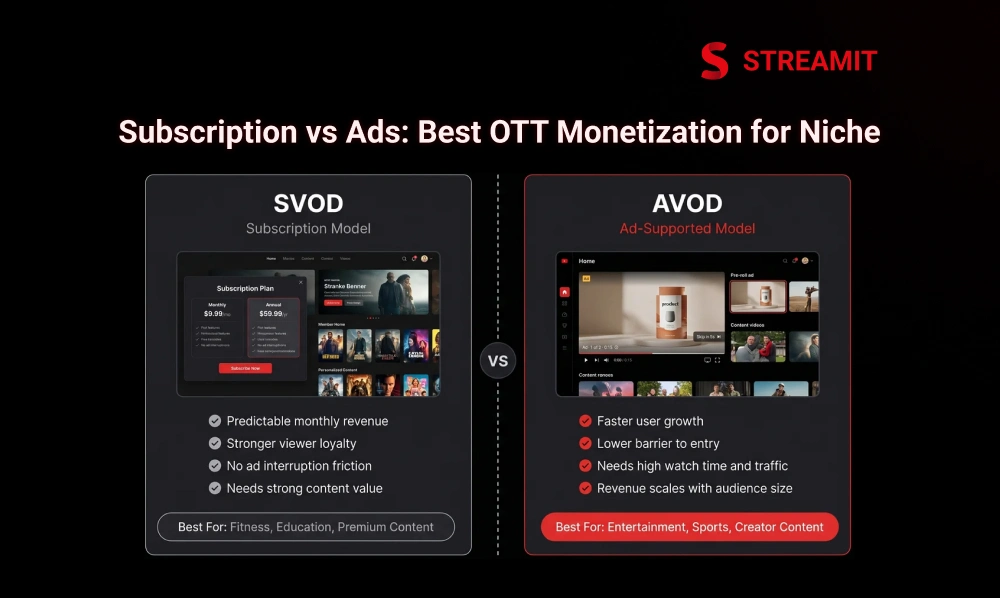
Subscription Model (SVOD)
SVOD works best when users see enough value to pay repeatedly. This model gives viewers access to content through a monthly, quarterly, or yearly plan.
It is common for premium education, fitness, niche entertainment, expert-led content, spiritual content, and professional learning platforms where users expect depth, structure, and an ad-free experience.
Ad-Based Model (AVOD)
AVOD works best when reach matters more than upfront payment. Users watch content for free, while the platform earns through video ads, display ads, sponsorships, or targeted campaigns.
This model can support mass entertainment, news, sports clips, creator-led content, regional content, and platforms where users may not be ready to pay from day one.
Hybrid Model (SVOD + AVOD)
Hybrid monetization is growing because it solves a real pricing problem. It gives price-sensitive users a lower-cost or free option while keeping premium plans available for serious users.
This model can include free content with ads, paid ad-free plans, ad-lite plans, freemium upgrades, premium episodes, or locked high-value content behind a subscription.
Strategy
Why Subscription vs Ads Is the Biggest OTT Monetization Decision
Your monetization model shapes the entire product, not just the revenue page. It affects onboarding, content packaging, playback experience, analytics, billing, ad tech, user data, and retention.
Current market data shows why this decision matters. Ad-supported streaming has moved strongly into the mainstream, with 68% of SVOD-subscribing households having at least one AVOD service in March 2026, up from 54% in March 2025.
How Monetization Impacts Growth, Retention, and Revenue
Subscription protects revenue predictability, while ads protect accessibility. The hard part is deciding which one your audience will tolerate, trust, and continue using.
Paid models usually need stronger retention systems. Ad-based models usually require higher traffic, longer watch time, and stronger ad operations. Hybrid models need both discipline and technology.
Model Deep Dive
Subscription-Based OTT Monetization (SVOD) Explained
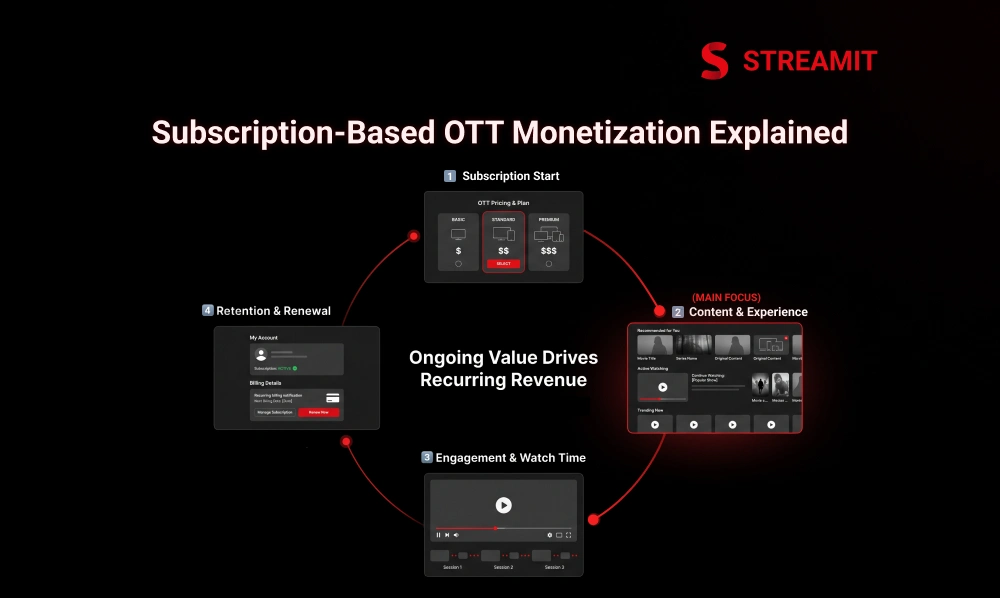
SVOD is not just “charge users monthly”. It is a promise of ongoing value. Users pay because they believe the platform will keep giving them something useful, exclusive, or emotionally worth returning to.
This model works when the content has a clear perceived value. A fitness platform with structured programs, an education platform with expert-led courses, or a niche creator platform with loyal fans can often justify a subscription better than generic entertainment.
How Subscription Models Work in OTT
The subscription model depends on recurring access. Users select a plan, enter payment details, and continue getting access as long as the plan remains active.
A strong OTT subscription system needs pricing plans, renewals, failed payment handling, coupon logic, access control, account management, content restrictions, and analytics. Without these systems, revenue leakage becomes invisible.
Key Benefits of Subscription OTT
Recurring revenue gives founders better control over forecasting. If churn is managed well, monthly recurring revenue makes hiring, content planning, infrastructure investment, and marketing decisions more predictable.
Subscription also protects the viewing experience. Since users are paying directly, the platform can avoid intrusive ads and focus on content quality, personalization, and long-term user loyalty.
Challenges of Subscription OTT
Subscription fatigue is real, and users now cancel faster when value feels weak. A 2025 consumer study found 39% of surveyed consumers had cancelled at least one paid SVOD service in the previous six months.
The biggest challenge is not getting the first payment. It is earning the second, third, and fourth payment through fresh content, strong discovery, smooth playback, and clear ongoing value.
Model Deep Dive
Ad-Based OTT Monetization (AVOD) Explained
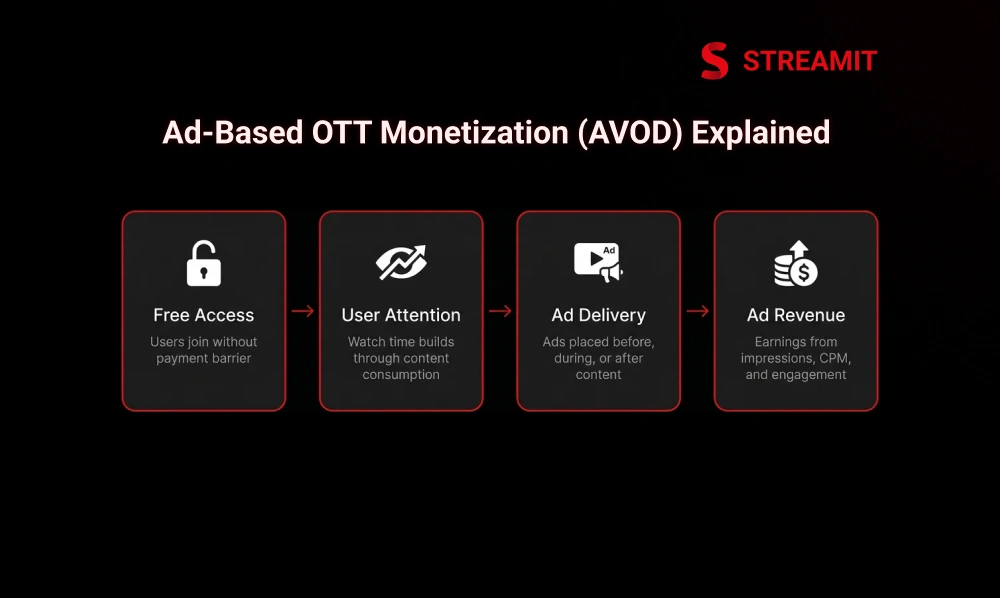
AVOD lowers the entry barrier but raises the execution standard. Users may join faster because the content is free, but the platform must generate enough viewing volume to make advertising revenue meaningful.
This model depends heavily on watch time, ad fill rate, targeting, CPM, user segmentation, and advertiser demand. Weak engagement means weak ad revenue, even if registrations look strong.
How Ad-Supported OTT Platforms Work
In ad-supported streaming, users pay with attention instead of money. The platform serves ads before, during, after, or around content, and earns based on impressions, completed views, clicks, sponsorships, or programmatic demand.
For this to work well, the platform needs clean user data, ad server integration, placement rules, brand safety controls, frequency capping, and reporting. Without this, ads become noise instead of revenue.
Types of Ads in OTT Platforms
OTT ads are not limited to simple pre-roll videos. Platforms can use pre-roll, mid-roll, post-roll, pause ads, display banners, sponsored rows, branded content, and targeted campaigns.
| Ad Type | Best Use Case | Risk If Poorly Managed |
|---|---|---|
| Pre-roll ads | Short videos and free content | Users drop before playback |
| Mid-roll ads | Long-form content and live streams | Breaks the viewing flow |
| Pause ads | Non-intrusive brand placement | Can feel forced |
| Sponsored rows | Homepage monetization | Weak if irrelevant |
| Targeted ads | Higher CPM campaigns | Needs strong data control |
Key Benefits of Ad-Based OTT
AVOD is powerful when the goal is user growth and market entry. It lets users experience the platform without payment friction, which can help early-stage platforms build awareness faster.
It also creates a monetization path for audiences who may never pay for a subscription. This matters in price-sensitive markets, regional content segments, and mass entertainment niches.
Challenges of Ad-Based OTT
Ad revenue usually needs scale before it becomes meaningful. If your platform has low watch time, weak traffic, or poor ad fill, the revenue per user can stay limited.
There is also a user experience risk. Too many ads, repeated ads, or badly placed ads can damage retention faster than a paid plan with clear value.
Comparison
Subscription vs Ads: Key Differences That Matter
The real difference is not paid vs free. It is predictability vs reach. Subscription gives stronger control over revenue per user. Ads give a wider reach but depend on traffic quality and advertiser demand.
| Factor | Subscription Model | Ad-Based Model |
|---|---|---|
| Revenue style | Recurring user payment | Advertiser-funded |
| User barrier | Higher | Lower |
| Best for | Premium/niche content | Mass/free content |
| Main risk | Churn | Low ARPU |
| Tech need | Billing and access control | Ad tech and targeting |
| UX impact | Usually cleaner | Can be interrupted |
Revenue Potential and ARPU Comparison
SVOD usually gives a higher ARPU per active paying user. A smaller but loyal paid audience can sometimes outperform a large free audience if engagement and retention are strong.
AVOD can scale well when viewership is high. But if your niche has limited traffic, ad revenue alone may not cover content, hosting, CDN, and product costs.
User Growth vs User Experience Trade-Off
Free access increases reach, but it does not guarantee loyalty. Users may join quickly, but they may also leave quickly if ads feel repetitive or the content library lacks depth.
Subscription creates friction at signup, but it can also filter for serious users. These users often expect better performance, better recommendations, and fewer interruptions.
Technology and Infrastructure Requirements
Monetization decisions create technical decisions. Subscription needs billing, invoices, renewal logic, entitlement checks, plan upgrades, and payment failure recovery.
Ad-based OTT needs ad server integration, campaign management, targeting, frequency caps, consent management, reporting, and reliable playback around ad breaks. Hybrid platforms need both systems working together.
Hybrid Strategy
Hybrid OTT Monetization: Combining Subscription and Ads
Hybrid is becoming the practical middle ground for many OTT businesses. It allows founders to serve free users, price-sensitive users, and premium users without forcing everyone into one model.
Market research also shows hybrid tiers are one of the fastest-growing OTT service models, with projected growth of 12.81% CAGR through 2031.
Freemium Model (Free + Paid Upgrade)
Freemium works when free content creates trust and paid content creates value. Users can explore selected content for free, then upgrade for premium content, deeper access, downloads, live sessions, or an ad-free experience.
This is useful for education, fitness, coaching, religious content, regional libraries, and creator-led platforms. The free tier becomes the sampling layer, not the whole business.
Ad-Lite Subscription Models
Ad-lite pricing helps users who want a lower cost but can tolerate limited ads. It gives the platform a second revenue stream without fully turning the product into a free ad platform.
The key is control. Fewer ads, better placement, and clear communication matter more than simply adding ads everywhere.
Decision Framework
How to Choose the Best OTT Monetization Strategy for Your Niche
The best OTT monetization strategy is the one that your audience behaviour can support for 12 months, not just launch week. Should a founder ask: will users pay, will they watch often, and will the model still work when infrastructure costs rise?
Streamit‘s own positioning focuses on building streaming businesses end to end, including technology, infrastructure, consultancy, AI, and insights, because monetization works only when the underlying platform can support growth and retention.
Audience Behaviour and Willingness to Pay
If your audience has urgent intent, subscription becomes easier. People are more willing to pay for fitness transformation, exam preparation, business learning, coaching, or exclusive expert access.
If your audience is casual, price-sensitive, or entertainment-driven, ads or freemium may reduce resistance. The audience decides the model more than the founder does.
Content Type and Value Perception
Premium content needs premium packaging. Users pay when the content feels structured, exclusive, outcome-driven, or hard to find elsewhere.
Free content works when the platform can attract repeat viewing at scale. If users watch once and disappear, ad monetization becomes fragile.
Niche-Based Monetization Strategy Examples
Different niches need different revenue logic. A single monetization model across every category usually creates either pricing friction or revenue weakness.
| Niche | Best Starting Model | Reason |
|---|---|---|
| Fitness | SVOD or freemium | Users pay for programs and progress |
| Education | SVOD or hybrid | Structured learning has clear value |
| Sports | Hybrid | Live reach plus premium access |
| Entertainment | AVOD or hybrid | Large audience potential |
| Spiritual content | Freemium or SVOD | Loyalty can support recurring plans |
| Creator-led content | Hybrid | Free reach plus fan upgrades |
Fitness, Education, and Coaching Platforms
Fitness, education, and coaching users usually pay for outcomes, not just videos. If your content helps them lose weight, pass an exam, build a skill, or follow a guided plan, a subscription can work well.
A freemium model can still help. Free sample lessons, beginner workouts, or short guides can bring users in, while advanced programs sit behind paid access.
Sports, Entertainment, and Mass Content Platforms
Sports and entertainment often need reach before monetization becomes strong. Fans may watch clips for free, but pay for live events, premium matches, archives, or exclusive analysis.
For mass entertainment, AVOD or hybrid can reduce signup friction. Paid plans can still exist for ad-free access, early releases, or exclusive content bundles.
Business Impact
Business Impact of Choosing the Right Monetization Model
A wrong monetization model does not always fail loudly. Sometimes it slowly weakens retention, margins, and product direction. This is why monetization should be decided before the platform architecture is finalized.
A subscription-first product and an ad-first product need different data systems, user journeys, dashboards, and scaling priorities. Choosing late creates expensive rebuilds.
Retention, Engagement, and Lifetime Value
Retention is where monetization becomes visible. If users keep watching, paying, upgrading, or returning, the model is working.
If users register but do not watch, subscribe but cancel quickly, or leave after too many ads, the model needs adjustment. Monetization success is behaviour-led, not assumption-led.
Scaling Revenue With the Right Model
Scalable OTT monetization needs pricing, analytics, infrastructure, and content strategy to work together. You cannot fix weak monetization only by changing plan names.
Platforms should monitor which content drives upgrades, which users tolerate ads, which segments churn, and which plans create the best lifetime value.
Metrics
Key Metrics to Track for OTT Monetization Success
A serious OTT platform should not run on guesswork. Monetization needs metrics that show revenue quality, not just app downloads or total views.
The most useful metrics include ARPU, LTV, churn rate, conversion rate, watch time, ad fill rate, CPM, payment failure rate, plan upgrade rate, and content-level retention.
ARPU, LTV, and Churn Rate
ARPU shows how much revenue each user brings. LTV shows how much they are worth over time. Churn shows how fast value is leaking.
For subscription platforms, churn is often the most important warning signal. For ad-based platforms, low ARPU may show that traffic is growing, but revenue quality is not.
Ad Revenue Metrics (CPM, Fill Rate)
CPM tells you what advertisers pay per thousand impressions. Fill rate tells you how much of your ad inventory is actually sold.
A platform with strong traffic but poor fill rate may still earn less than expected. That usually means the ad stack, targeting, or demand setup needs improvement.
Best Practices
Best Practices to Maximize OTT Monetization Revenue
The strongest monetization systems are designed before revenue problems appear. Waiting until churn rises or ad revenue drops makes the fix harder.
Good OTT monetization depends on pricing tests, content packaging, audience segmentation, analytics, ad control, and platform performance. Revenue is not one feature. It is a system.
Improve Retention and Reduce Churn
Retention improves when users quickly find a reason to return. Better recommendations, watchlists, reminders, content progress, and personalized rows can increase repeat usage.
Churn drops when value stays visible. If users forget why they subscribed, cancellation becomes easy.
Optimize Pricing and Subscription Plans
Pricing should be tested, not guessed. Monthly, yearly, starter, premium, family, creator, and ad-lite plans can behave very differently across niches.
Do not copy another platform’s pricing. Use your content value, audience income level, local market, and churn data to shape the plan structure.
Balance Ads and User Experience
Ads should support the business without punishing the viewer. The goal is not to show the maximum number of ads. The goal is to create sustainable revenue without damaging watch time.
Use frequency caps, smart placements, shorter ad loads, and clear ad-lite options. User trust is part of monetization.
Decision Guide
Subscription vs Ads – What Should You Choose?
Choose a subscription if your content has high repeat value. Choose ads if your platform needs reach. Choose a hybrid if your audience has mixed willingness to pay.
The slightly contrarian truth is simple: most OTT platforms should not choose one model forever. They should choose a starting model, then evolve based on real behaviour.
When the Subscription Model Works Best
Choose SVOD when your content is premium, structured, exclusive, or outcome-driven. This is common in education, fitness, coaching, professional learning, spirituality, and niche community platforms.
Subscription also works when users expect a clean experience. If ads reduce perceived quality, paid access may protect the brand.
When Ad-Based Model Works Best
Choose AVOD when your audience is large, casual, and price-sensitive. This works for entertainment, short-form video, regional content, news, clips, and high-frequency viewing.
But AVOD needs scale. If your traffic is small, ads alone may not create enough revenue to support growth.
Why Hybrid Is the Smart Choice for Most OTT Platforms
Hybrid gives founders room to grow without forcing one audience behaviour. Free users can watch with ads, serious users can upgrade, and loyal users can move into premium plans.
This is often the strongest long-term strategy because it protects reach, revenue, and user choice at the same time.
Summary
Key Takeaways
Monetization Is a System, Not a Feature
It impacts pricing, user experience, content strategy, infrastructure, and the long-term scalability of your OTT platform – decide it before development, not after launch.
SVOD Rewards Consistent Content Value
Users will only keep paying if they feel ongoing benefit. Subscription fatigue is real – 39% of consumers cancelled at least one SVOD service in a recent six-month period.
AVOD Needs Scale to Generate Real Revenue
Without strong engagement, traffic, and ad fill rate, ad revenue stays limited even when user numbers look high. Build watch time first, then ad ops.
Hybrid Reduces Risk and Expands Opportunity
Serving both free users and premium users without forcing one model too early is the fastest-growing OTT service approach, with 12.81% CAGR projected through 2031.
Your Niche Defines Your Pricing Power
Fitness, education, and coaching platforms can charge more because content is outcome-driven. Mass entertainment and regional content usually need scale and ad support.
Start Right, Then Evolve
The best OTT platforms evolve their monetization over time. Start with what fits your audience today, then optimize based on real user data – not assumptions or industry trends.
Conclusion
Conclusion
The best OTT monetization strategy is not subscription or ads in isolation. It is the model that matches your audience’s real behaviour.
If users see strong repeated value, a subscription gives control and predictable revenue. If your niche depends on reach, ads can help remove payment friction. If your audience includes both casual viewers and serious fans, a hybrid usually gives the strongest foundation.
For serious OTT founders, this decision should happen before development, not after launch. Monetization affects billing, ad tech, analytics, content access, infrastructure, and user experience.
A streaming platform is not just an app with videos. It is a business system. The platform that wins is the one that understands how users watch, why they pay, when they leave, and what makes them return.
FAQs
Frequently Asked Questions
-
How do SVOD, AVOD, and TVOD differ in OTT monetization?
SVOD means users pay a recurring subscription. AVOD means users watch free content supported by ads, while TVOD means users pay for one-time access to specific content.
-
Subscription vs Ads: Which OTT monetization model generates more revenue?
Subscription usually creates higher revenue per paying user, while ads need larger traffic and watch time. The better model depends on your niche, audience size, and content value.
-
What is a hybrid OTT monetization model and why is it growing fast?
A hybrid model combines subscriptions and ads in one platform. It is growing because it gives users flexible pricing while helping platforms earn from both free and paid audiences.
-
Is ad-supported streaming a good choice for new OTT startups?
Yes, if the startup needs reach and has content that can attract frequent viewing. But if traffic is low, ad revenue alone may not be enough in the early stage.
-
How does the OTT monetization strategy affect churn rate and subscriber retention?
A weak monetization strategy increases churn when users feel the price, ads, or content value do not match. A strong model improves retention by aligning access, pricing, and experience.
-
What is the fastest way to monetize a new OTT platform successfully?
The fastest practical route is often a focused hybrid model. Start with free or low-friction access, then convert serious users into paid plans using premium content and a better experience.
Read Also
Read Also
1. How to Reduce Subscriber Churn Rate on OTT Platforms
2. Best Revenue Models to Monetize Video Content
3. 10 Powerful Netflix Retention Strategies Every Brand Should Use
4. Smart Retention Engine: Driving Growth Through Smarter Monetization
5. How to Reduce Subscriber Churn in OTT Platforms: Lessons from Netflix