Uscreen Alternatives to Compare Before Building Your Streaming App


Most streaming teams do not outgrow their content. They outgrow the platform decisions made too early. Uscreen is a strong choice for many creators and membership-led video businesses, but it is not the only path for building a serious streaming app.
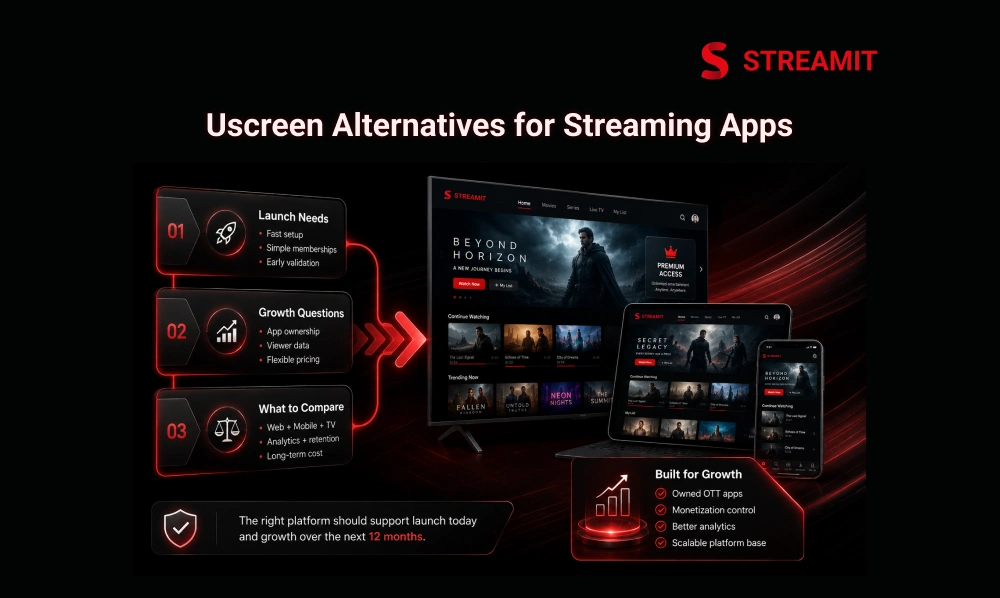
Before choosing any Uscreen alternative, the real question is not “Which platform has more features?” It is “Which platform fits the business we are trying to build over the next 12 months?”
Overview
Why Teams Compare Uscreen Alternatives Before Building a Streaming App
A streaming app is not just a video library. It is a revenue system, content system, user system, and retention system working together. That is why teams compare Uscreen alternatives before they commit.
For early creators, a simple launch matters. For growing streaming brands, control matters more. The platform must support web, mobile, TV, payments, analytics, content access, and future growth without forcing a rebuild.
Uscreen Works Well for Fast Membership Video Launches
Speed is useful when the goal is validation. Uscreen works well for creators who want to launch a video membership, publish a catalog, manage subscribers, and start monetizing without a long development cycle.
That makes it a practical option for education brands, fitness creators, coaches, and content businesses that need structure quickly. The limitation appears when the business starts needing deeper control over apps, data, pricing, and platform experience.
Growing Streaming Brands Often Need More Control Over Apps, Data, and Pricing
The first 500 subscribers test demand. The next 5,000 test infrastructure. At that stage, teams begin asking who controls the app experience, subscriber data, billing logic, content access, and retention workflows.
This is where Uscreen alternatives become important. A growing OTT business may need custom onboarding, deeper analytics, flexible monetization, branded TV apps, platform ownership, or integrations that go beyond a standard membership setup.
The Right Alternative Depends on Your Business Model, Not Only Features
A long feature list does not automatically mean a better platform. The right Uscreen alternative depends on the type of streaming business you want to build, whether that is a creator membership, branded app, enterprise OTT platform, or fully custom video platform.
A platform should match your revenue model, content depth, launch timeline, technical control, and scale target. Choosing a platform only by its feature list can feel right at launch, but it may limit control, flexibility, and growth as the streaming business scales.
Evaluation
What to Compare in Uscreen Alternatives
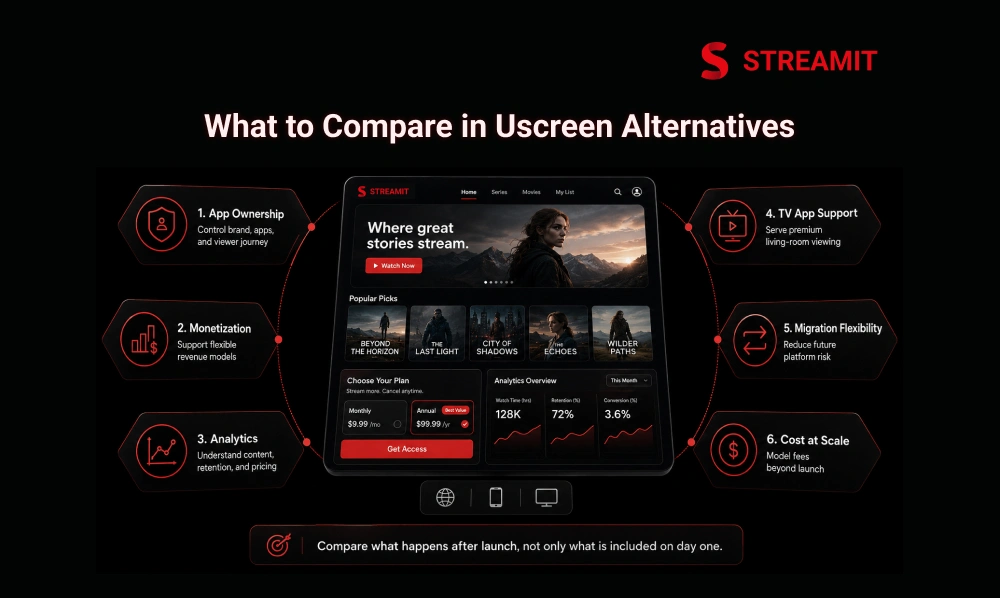
A better comparison starts with business risk, not software screens. Teams should compare ownership, monetization, app coverage, analytics, infrastructure, support, and long-term cost before making a decision.
| Comparison Area | Why It Matters |
|---|---|
| App ownership | Controls brand, store presence, and viewer experience |
| Monetization | Shapes revenue flexibility and margins |
| Analytics | Helps improve content, retention, and pricing |
| TV app support | Important for premium living-room viewing |
| Migration flexibility | Reduces future platform risk |
| Support model | Matters during launches, traffic spikes, and app issues |
A streaming platform decision becomes expensive when it blocks growth. The right comparison should show what happens after launch, not only what is included on day one.
App Ownership and Web, Mobile, and TV Coverage
Viewers do not think in platforms. They think in screens. A serious streaming app should work across web, mobile, and TV because each device supports a different viewing habit.
Web is useful for discovery and checkout. Mobile helps repeat engagement. TV apps create a premium viewing experience. If your content is meant for regular viewing, TV coverage should be part of the platform discussion early.
Monetization Models, Payments, and Revenue Flexibility
One monetization model can limit a growing streaming business. Subscriptions are useful for recurring value, but many platforms also need rentals, pay-per-view, bundles, free trials, coupons, ads, or hybrid access.
The better Uscreen alternative is the one that supports your revenue strategy without forcing workarounds. Payment flexibility matters because pricing is not fixed forever. It changes with audience, content, and demand.
CMS, Analytics, Retention Tools, and Integrations
Content management becomes harder once the catalog grows. A basic CMS may be enough for 50 videos, but it can become slow when teams manage categories, series, seasons, languages, creators, and access rules.
Analytics and retention tools matter just as much. Teams need to know what viewers watch, where they drop off, which content drives renewals, and which campaigns bring serious subscribers.
Pricing, Subscriber Fees, Add-Ons, and Support Costs
A low monthly fee can become expensive when subscriber or usage costs grow. Some platforms charge subscriber fees, transaction fees, storage fees, bandwidth fees, app fees, or support costs separately.
This does not make those platforms bad. It simply means the real cost should be calculated at 1,000, 5,000, and 10,000 subscribers before choosing the platform.
Platform Guide
Best Uscreen Alternatives by Streaming Business Need
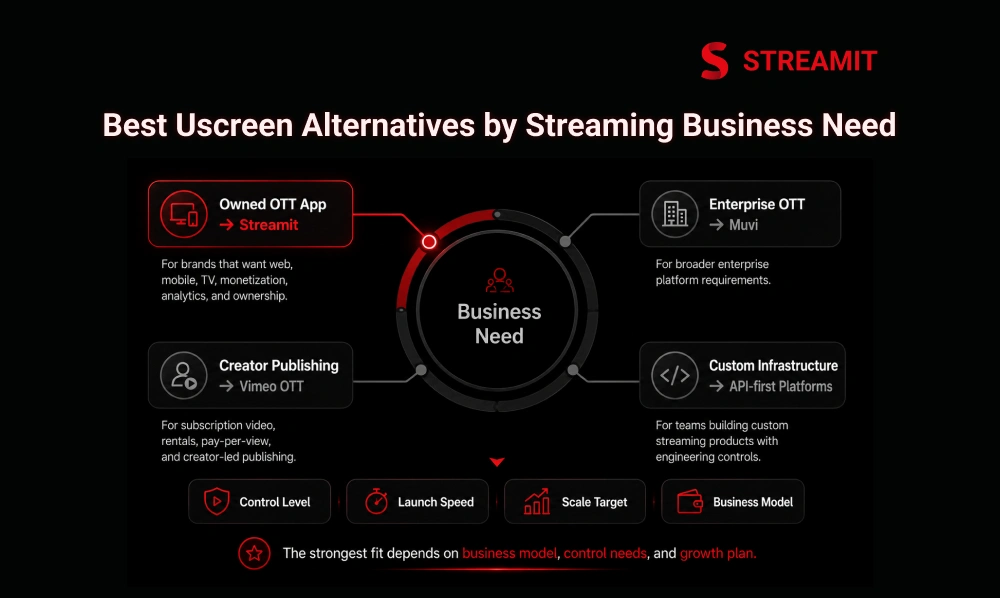
There is no single best Uscreen alternative for every team. A creator, media brand, training company, and enterprise OTT business all need different levels of control.
| Business Need | Better Fit |
|---|---|
| Owned OTT app | Streamit |
| Enterprise OTT requirements | Muvi |
| Creator-led video publishing | Vimeo OTT |
| Custom product infrastructure | API-first platforms |
The strongest decision comes from matching the platform to the business model. The wrong fit usually looks convenient at the beginning and expensive later.
Streamit for Brands Building Owned OTT Streaming Apps
Streamit fits teams that see streaming as a business, not a temporary content project. It is built for brands that want ownership across web, mobile, TV, monetization, analytics, and long-term platform control.
This makes Streamit a strong Uscreen alternative for businesses that want a structured OTT platform solution. This makes it a better fit for teams that want stronger scalability, smoother performance, better retention control, and fewer restrictions from generic streaming platforms.
Muvi for Broader Enterprise OTT Platform Requirements
Enterprise OTT decisions usually involve more than video playback. Teams may need multiple apps, monetization options, security, content management, user management, and global delivery from one platform.
Muvi can make sense for larger OTT requirements where the team wants a broad managed platform. It is often compared by businesses that want more enterprise-style OTT software coverage rather than a creator-first membership tool.
Vimeo OTT for Publishing, Distribution, and Creator-Led Video
Vimeo OTT can suit teams focused on publishing and video monetization. It is useful for brands and creators that want subscription video, rentals, pay-per-view, and a branded video destination.
The key point is cost modeling. Per-subscriber or transaction-based pricing may work well early, but brands should calculate how the model changes when subscriber volume grows.
API-First Platforms for Custom Streaming Products
API-first platforms are not complete OTT businesses out of the box. They give development teams building blocks for video upload, encoding, playback, live streaming, storage, and delivery.
This route is better for teams building a custom streaming product with internal engineering capacity. It offers control, but it also requires more planning around CMS, payments, apps, analytics, entitlement, and support.
Strategy
The Pre-Build Test Most Streaming Brands Skip
The most expensive mistake is building before deciding what kind of streaming business you are building. Many teams choose a platform before defining the product model.
Before choosing a Uscreen alternative, map the platform against your audience, content type, monetization plan, launch speed, operating team, and long-term ownership goals.
Decide If You Need a Membership Tool, Owned App, or Full OTT Product
A membership tool is not the same as a full OTT platform. A membership tool helps you charge for content. An owned app gives you brand control. A full OTT product supports a larger streaming business.
This distinction matters. If your goal is simple paid video access, a lighter platform may work. If your goal is a branded multi-device streaming business, you need a stronger foundation.
Check Whether Your Main Risk Is Launch Speed, Cost, Control, or Scale
Every streaming business has one primary risk at the start. Some need to launch quickly. Some need to control cost. Some need custom features. Some need infrastructure that can scale.
Choosing the right platform means solving the right risk first. A fast platform is not always the right platform if your real risk is migration, retention, or long-term margin.
Avoid Choosing a Platform You May Outgrow After Your First Audience Milestone
The first milestone should not create the next rebuild. If a platform works for launch but blocks TV apps, analytics, pricing, or ownership later, the early savings may disappear.
Teams should ask what happens after the first audience milestone. Can the platform support more viewers, more content, more payment models, more devices, and more control?
Platform Deep-Dive
Why Streamit Is a Strong Uscreen Alternative for Owned Streaming Apps
Streamit is built for teams that want control beyond launch. It is a strong Uscreen alternative for brands that want an owned OTT streaming app instead of a standard membership setup.
The difference is strategic. Streamit focuses on helping streaming businesses build a foundation for growth, monetization, analytics, performance, and long-term ownership across devices.
It Helps Brands Build Across Web, Mobile, and TV
A premium streaming business needs to work where the viewer wants to watch. Streamit supports the idea of building across web, mobile, and TV so the platform can serve different viewing habits.
This matters for brands with serious content libraries, premium audiences, or recurring subscribers. The viewing experience should feel consistent, fast, and controlled across every screen.
It Supports Monetization, Content Control, Analytics, and Retention
Revenue does not come only from putting videos behind a paywall. It comes from packaging content well, pricing it correctly, tracking user behavior, and improving retention.
Streamit supports this broader OTT requirement by focusing on monetization, content control, analytics, and retention systems. These are the areas that decide whether a streaming app becomes a real business.
It Gives Streaming Brands a Better Base for Long-Term Ownership
Ownership is not a design preference. It is a business advantage. When teams control their platform direction, they can make better decisions around pricing, experience, data, integrations, and growth.
For brands investing serious money into streaming, that control matters. Streamit gives teams a better base for building a platform they can scale, improve, and own over time.
Summary
Key Takeaways
Fast launch vs. long-term control
Uscreen can work well for early video membership launches, but growing streaming brands should compare what happens after the first audience milestone.
App ownership before features
Teams need control over web, mobile, TV apps, subscriber data, pricing, and the overall viewer experience – not just a feature checklist.
Calculate pricing at scale
Subscriber fees, storage, bandwidth, TV apps, support, and add-ons can change the real cost of an OTT platform as the audience grows.
Match platform to business model
A creator membership, owned OTT app, enterprise platform, and custom streaming product all need different levels of flexibility, infrastructure, and control.
Never ignore migration risk
If a platform works for launch but limits analytics, monetization, TV apps, or ownership later, moving away can become costly and operationally difficult.
Streamit for owned OTT apps
For teams that want web, mobile, TV, monetization, analytics, retention, and long-term platform ownership, Streamit gives a better base for scalable streaming growth.
Conclusion
Conclusion
Most OTT platforms do not fail because the idea is weak. They fail because the platform was chosen for launch speed instead of long-term control. That is the real reason teams compare Uscreen alternatives before building a streaming app.
If your goal is to test a paid video membership, a simple platform may be enough. If your goal is to build an owned streaming business across web, mobile, and TV, Streamit is the stronger direction to consider.
FAQs
Frequently Asked Questions
-
When should a team look for Uscreen alternatives?
A team should look for Uscreen alternatives when it needs more control over apps, pricing, data, analytics, monetization, or long-term platform ownership. This usually happens when the streaming business moves beyond simple membership video access.
-
What limits can appear as a streaming app grows?
Limits can appear around TV apps, custom monetization, subscriber data, analytics, storage, bandwidth, integrations, and platform flexibility. These issues usually become visible after the first serious audience milestone.
-
Why does app ownership matter before choosing a platform?
App ownership matters because it affects branding, user experience, store presence, data control, and long-term flexibility. Without ownership, the business may depend too heavily on platform rules and limitations.
-
Should creators choose Uscreen or a full OTT platform?
Creators can choose Uscreen when they mainly need a fast membership video launch. A full OTT platform makes more sense when the goal is a branded streaming business with deeper control and multi-device growth.
-
How can brands avoid outgrowing their first streaming platform?
Brands can avoid outgrowing their first platform by planning around 12-month scale, not only launch week. They should compare ownership, cost, TV apps, analytics, monetization, and migration before committing.
Read Also
Read Also
1. Streamit vs Uscreen: Which OTT Platform Is Better in 2026?
2. Best Vimeo Alternatives for OTT and Streaming Platforms
3. Streamit vs Vodlix: Which OTT Platform Is Better in 2026?
4. Streamit vs VPlayed: Which OTT Platform Is Better in 2026?
5. Streamit vs Dacast: Which Streaming Platform Is Better in 2026?