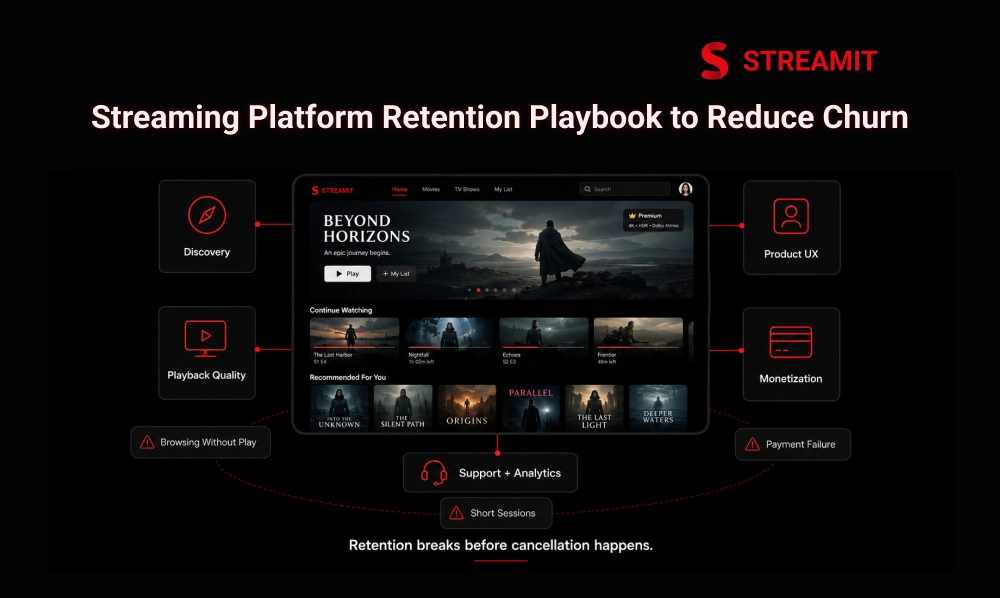
Streaming Platform Retention Playbook to Reduce Churn


Most streaming platforms do not lose users in one dramatic moment. They lose them through small repeated frictions: weak discovery, slow playback, poor plan design, confusing UX, and support gaps that quietly damage trust.
A strong streaming platform retention playbook is not a list of random tactics. It is a structured way to understand why users stop returning and what the platform must fix before churn becomes visible in revenue.
Part 1
Why Streaming Platform Retention Matters More Than Most Teams Think
Sign-ups create momentum, but retention creates business value. A platform with strong acquisition and weak retention is usually buying the same user twice.
This is why serious OTT teams now think beyond launch traffic. They view viewing habits, session quality, return frequency, payment behaviour, and product friction as core growth signals.
Sign-Ups Do Not Matter Much if Users Do Not Stay
A new user only becomes valuable when they return. One trial, one login, or one content click does not prove product-market fit.
Streaming growth becomes real when users build a habit. That habit depends on discovery, playback quality, pricing clarity, and the sense that the platform is worth reopening.
Churn Hurts Revenue Faster Than Most Platforms Expect
Even a small churn leak compounds quickly. When users leave every month, the platform must keep spending just to stay in the same place.
This is where many OTT teams misread growth. Revenue may look healthy during launch, but weak subscriber retention usually shows up later through rising acquisition cost and weaker lifetime value.
Retention Beats Acquisition When Growth Costs Start Rising
Acquisition is useful, but it gets expensive when every competitor is also buying attention. Retention gives the business more control.
A platform that keeps users longer can spend smarter, test better pricing, and build stronger content strategies without depending only on new campaigns.
Part 2
What a Retention Playbook Really Means for a Streaming Platform
A retention playbook is the operating system for keeping users engaged. It connects product experience, content discovery, performance, monetization, support, and analytics.
The goal is not to copy large streaming companies. The goal is to design a platform where users find value faster and face fewer reasons to leave.
It Is a System, Not a Single Feature
Retention does not come from one recommendation row or one discount offer. It comes from many decisions working together.
Content structure, app speed, search quality, user journeys, plan logic, and device experience all shape whether a user returns.
The Goal Is to Make the Platform Feel Worth Returning To
A user returns when the platform reduces effort. They should not need to think too much, search too hard, or restart their journey every time.
Good retention design makes the next action obvious. Continue watching, saved lists, smart rows, reminders, and cross-device sync all support that behaviour.
Part 3
The Main Reasons Streaming Platforms Lose Users
Most churn starts before cancellation. Users browse less, watch less, complain less, and slowly stop caring.
The mistake is waiting until cancellation data appears. By then, the platform has already lost the user’s habit.
Weak Discovery Makes Good Content Feel Invisible
A strong library can still fail if users cannot find what to watch. Discovery is where content value becomes visible.
Rows, search, categories, thumbnails, recommendations, and previews should reduce decision time. If users keep scrolling without starting, discovery is broken.
Poor Viewing Experience Breaks User Habit
Buffering, playback errors, slow app loading, and device issues interrupt the session. Once the habit breaks, return visits become weaker.
Streaming performance is not only technical hygiene. It is retention protection.
Generic UX Makes the Platform Forgettable
If the platform feels like every other video app, users do not form a strong memory of it. Generic UX weakens brand recall.
The interface should reflect the audience, content type, and business model. Serious OTT retention depends on a product experience that feels intentional.
Rigid Monetization Pushes Users Away
Pricing should match viewer behaviour, not only business ambition. A weak plan structure can create early drop-off.
Trials, upgrades, bundles, rentals, annual plans, and regional pricing all need clear logic. Confused pricing often becomes quiet churn.
Part 4
The Core Pillars of a Streaming Platform Retention Playbook
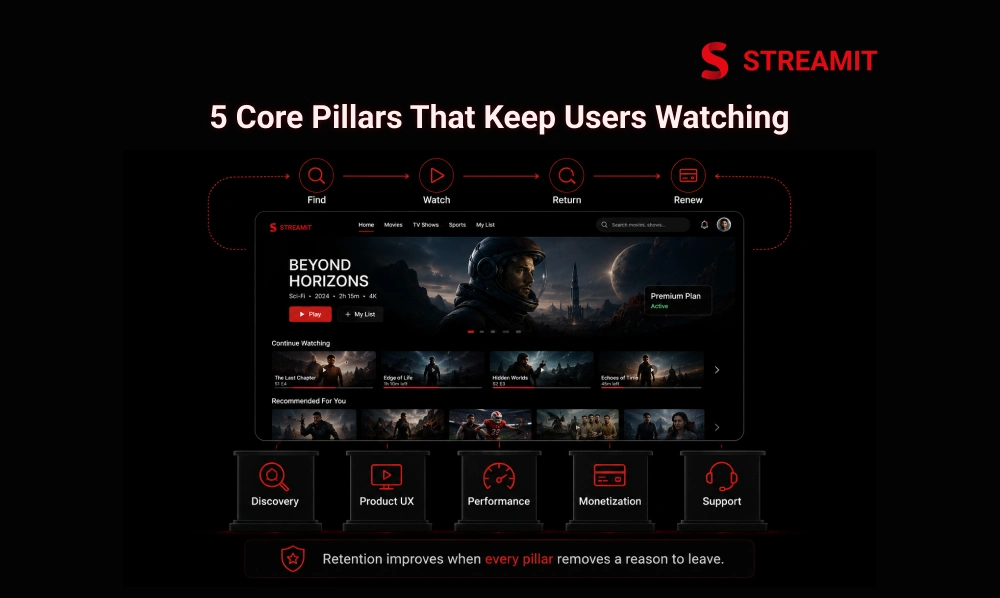
Retention needs structure. Without pillars, teams usually chase symptoms instead of solving the system.
| Pillar | What It Improves | Retention Impact |
|---|---|---|
| Discovery | Finding content faster | More starts |
| Product UX | Easier viewing habits | More returns |
| Performance | Smooth sessions | Fewer exits |
| Monetization | Better plan fit | Lower cancellations |
| Support | Faster issue resolution | More trust |
A good playbook gives each pillar an owner. It also connects each pillar to measurable user behaviour, not vague opinions.
Better Discovery and Faster Decision-Making
Users should reach a good viewing decision quickly. The longer they browse without watching, the higher the friction.
Personalized rows, cleaner categories, better search, and stronger thumbnails help users move from interest to play.
Product Experience That Builds Habit
Habit is built through repeated ease. Continue watching, watchlists, reminders, progress tracking, and cross-device sync make the platform feel familiar.
Every return visit should feel lighter than the last one. That is the quiet power of good OTT user engagement.
Performance That Protects the Session
The first job of a streaming app is simple: play smoothly. If playback fails, every other feature loses value.
Teams should track startup time, buffering rate, playback errors, and device-level gaps. These are not backend metrics only; they are business metrics.
Monetization That Matches Viewer Behaviour
Not every user wants the same commitment. Flexible pricing helps the platform meet different intent levels.
A good monetization model supports trials, upgrades, downgrades, renewals, offers, and payment recovery without making the user feel trapped.
Customer Support That Protects Trust
Support is retention infrastructure. When billing, access, or playback issues happen, fast resolution protects confidence.
Users do not expect perfection. They expect the platform to respond when something breaks.
Part 5
How Discovery and Product Experience Reduce Churn
Discovery reduces churn by lowering the gap between opening the app and finding value. Product experience reduces churn by making that value repeatable.
Together, they shape the user’s habit loop: open, find, watch, continue, return.
Recommendation Systems Help Users Find Something Worth Watching Faster
A good recommendation system does not need to feel complicated. It should simply help users find relevant content faster.
The real test is not whether recommendations look smart. The test is whether they increase starts, watch time, and return frequency.
Smart Rows, Search, Thumbnails, and Previews Reduce Friction
Small product details create large behaviour changes. A better thumbnail or clearer row can shorten decision time.
Search should understand intent, not just exact titles. Previews and smart seek moments help users feel confident before they commit.
Continue Watching and Cross-Device Sync Build Return Behaviour
Continue watching is one of the simplest retention features because it respects user context. It tells the user, “You can continue without effort.”
Cross-device sync matters because modern viewing is fragmented. A user may discover on mobile, continue on TV, and finish later on a tablet.
Part 6
Why Performance and Pricing Quietly Increase Churn
Performance and pricing are often treated separately, but both affect trust. One breaks the session; the other breaks perceived value.
Users rarely explain these issues in detail. They simply stop opening the platform or cancel when the next billing cycle arrives.
Buffering and Slow Load Times Break the Session
A slow start creates doubt before the content begins. Repeated buffering teaches users that the platform is unreliable.
For live content, the tolerance is even lower. Sports, events, and premieres need stronger delivery planning because failure happens in public.
Inconsistent Playback Across Devices Damages Trust
A streaming app cannot feel excellent on mobile and weak on TV. Users judge the platform as one experience.
Multi-device OTT needs consistent login, access, playback, subtitles, watch history, and payment status across screens.
Pricing Friction and Weak Plan Design Drive Early Drop-Off
Users leave faster when plans feel confusing or unfair. Pricing should be easy to understand before checkout.
Weak payment gateway handling, failed renewals, limited local payment options, and unclear trials can create churn before the content has a chance to prove value.
Part 7
The Retention Signals Most Platforms Notice Too Late
Churn is usually the final signal, not the first one. The earlier signals live inside behaviour.
| Signal | What It May Mean | Action Needed |
|---|---|---|
| Browsing without play | Discovery friction | Improve rows/search |
| Short sessions | Weak content fit or playback issues | Check UX and QoE |
| Lower return frequency | Habit weakening | Trigger re-engagement |
| Payment failures | Monetization friction | Improve billing recovery |
The best platforms watch these signals weekly. They do not wait for monthly cancellation reports.
Users Browse but Do Not Start Watching
Browsing without playback is a discovery warning. It means users are interested enough to open the platform but not convinced enough to start.
This can point to weak recommendations, unclear categories, poor thumbnails, or content rows that do not match intent.
Users Start Sessions but Do Not Finish Them
Dropped sessions can reveal content mismatch, playback errors, or poor user experience. Completion matters because it shows commitment.
Watch time and session length should be read with context. A short session caused by buffering is different from a short session caused by content choice.
Users Return Less Often Even Before They Cancel
Lower return frequency is one of the clearest churn signals. It means the platform is losing space in the user’s routine.
This is where re-engagement, better recommendations, personalized reminders, and stronger product loops can help.
Part 8
What to Measure in a Retention Playbook
A retention playbook should measure what users actually do, not only what the business hopes they do.
The right analytics help teams see where the platform is leaking attention, trust, and revenue.
Watch Time, Session Length, and Return Frequency
These metrics show whether users are building a relationship with the platform. They are more useful than surface-level traffic alone.
A platform with moderate traffic but strong return behaviour is often healthier than one with high traffic and weak habit.
Churn Rate, Plan Retention, and Trial Conversion
Churn rate shows the outcome. Plan retention and trial conversion explain where the outcome begins.
Teams should compare retention by plan, device, campaign source, content type, and payment method.
Search Success, Recommendation Clicks, and Drop-Off Points
Search success shows whether users find what they want. Recommendation clicks show whether the platform understands user intent.
Drop-off points reveal the exact moments where friction appears. These moments deserve product attention, not guesswork.
Playback Complaints, Buffering Rate, and Device Gaps
Playback analytics should be connected to user behaviour. If buffering rises and return frequency drops, the platform has a clear retention problem.
Device gaps are especially important for OTT TV apps. TV users are less patient with broken navigation and slow playback.
Part 9
The Mistake Most Streaming Platforms Make
Most teams build for launch excitement. Fewer build for month-three behaviour. The real question is not “Can we go live?” It is “Will users still care after the first billing cycle?”
They Build for Launch Excitement Instead of Return Behaviour
Launch features create movement, but retention features create stability. A platform needs both.
Return behaviour should be planned early. It affects architecture, analytics, UX, content strategy, and monetization.
They Track Content Output More Than Viewing Habit
Publishing more content is not the same as improving retention. If users cannot find or finish content, output alone will not solve churn.
Teams should measure content performance by starts, completion, saves, repeat views, and subscriber impact.
They Treat Retention as Marketing Instead of Product Design
Marketing can bring users back once. Product design keeps them returning naturally.
Retention should sit inside the platform: discovery, playback, personalization, pricing, support, and analytics.
Part 10
Retention Tactics by Streaming Business Type
Different streaming businesses lose users for different reasons. A serious retention playbook should match the business model.
Entertainment, sports, learning, fitness, and creator platforms need different product loops.
Entertainment Platforms Need Better Discovery and Habit Design
Entertainment platforms usually need stronger recommendations, watchlists, collections, and personalized rows.
The library must feel alive. Users should always see a relevant reason to continue watching.
Sports Platforms Need Fast Access and Strong Live Reliability
Sports users care about speed, timing, and reliability. Even a short delay or failed stream can weaken user trust almost instantly.
Live sports streaming platforms need low latency planning, high-concurrency readiness, and clear access flows.
Learning and Fitness Platforms Need Progress-Based Retention
Learning and fitness users return when they see progress. The platform should show streaks, completion, next lessons, and personal goals.
Retention here is not only about content discovery. It is about momentum.
Creator Platforms Need Community and Repeat Viewing Triggers
Creator platforms need direct audience relationships. Community, exclusive drops, reminders, comments, and memberships support repeat behaviour.
Monetization should feel connected to access and belonging, not only payment.
Part 11
What a Good OTT Platform Must Support for Retention to Work
Retention cannot work on a weak platform foundation. The architecture must support personalization, playback, pricing, analytics, and scale.
This is why serious teams invest in platform thinking early. The wrong base becomes expensive when traffic grows.
Personalization, Discovery, and Better Recommendation Logic
The platform should learn from user behaviour and improve discovery over time. This makes the experience feel more relevant.
Better recommendation logic helps reduce browsing fatigue and improves the chance of every session turning into a play.
Smooth Playback, Multi-Device Experience, and Better Delivery
Playback quality is the foundation of trust. Users may forgive limited content, but they rarely forgive repeated playback problems.
A good OTT platform must support web, mobile, and TV experiences with consistent access, delivery, and performance.
Flexible Pricing, Trials, and Retention-Focused Monetization
Monetization should create long-term fit, not short-term pressure. Trials, bundles, annual plans, rentals, and upgrade paths all need clean backend logic.
The best pricing systems give teams room to test without rebuilding the product every time.
Analytics That Show What Is Breaking Before Users Leave
Analytics should reveal friction before cancellation happens. Teams need to see browsing behaviour, playback quality, subscription health, and user journeys together.
Good analytics turns retention from guesswork into operating discipline.
Part 12
Two Streamit Playbooks Every Streaming Platform Should Study
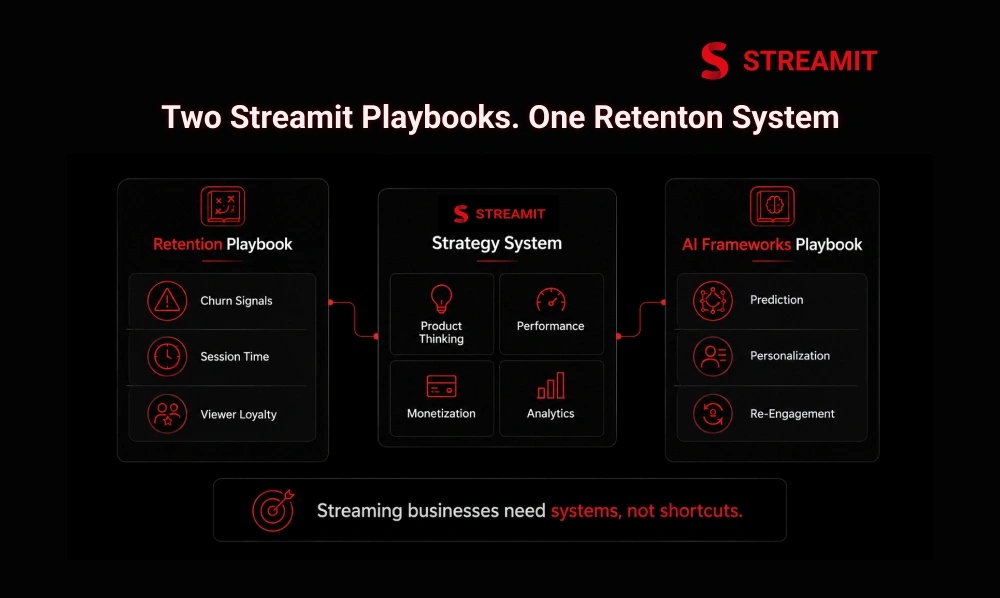
Streamit is built around a simple belief: streaming businesses need systems, not shortcuts.
The strongest retention work comes from combining product thinking, performance engineering, monetization logic, and analytics into one platform strategy.
Retention Playbooks Track Churn, Session Time, and Viewer Loyalty
The first playbook is about understanding why users stay. It looks at viewing behaviour, churn signals, return frequency, and loyalty patterns.
This helps teams move from reactive fixes to structured retention planning.
The AI Frameworks Playbook Focuses on Prediction, Personalization, and Re-Engagement
The second playbook is about making the platform smarter as it grows. It focuses on prediction, personalization, discovery, and re-engagement.
The point is not to add complexity. The point is to help the platform make better decisions from real user behaviour.
Play Books
Netflix Retention Playbook
The Netflix retention playbook focuses on improving engagement through personalized discovery and smooth streaming performance. Platforms that combine recommendations and a strong user experience retain viewers longer.
Visit Netflix Retention PlaybookNetflix AI Framework Playbook
The Netflix AI Framework Playbook explains how streaming platforms use AI to analyze viewer behavior and deliver personalized content recommendations. This approach improves discovery, engagement, and long-term subscriber retention across the platform.
Visit Netflix AI Framework PlaybookSummary
Key Takeaways
Retention Is a Product Problem
Users usually leave because discovery, playback, pricing, or access flows create friction before the cancellation happens – not because of marketing failures.
Sign-Ups Don’t Prove Platform Health
A streaming platform becomes stronger when users return often, watch longer, and build a habit around the product.
Discovery Decides Whether Content Gets Watched
Even a strong content library feels weak when users cannot find something relevant quickly. Discovery turns content value into actual viewing.
Playback Performance Protects Trust
Buffering, slow load times, and playback errors make users question the platform before they question the content.
Churn Signals Appear Before Cancellation
Lower return frequency, short sessions, failed searches, and browsing without playback often reveal retention problems weeks before cancellation.
Analytics Should Show Friction Before Users Leave
A strong retention playbook tracks watch time, session length, playback quality, search success, plan retention, and device gaps continuously.
Conclusion
Conclusion
Reducing churn is not about one feature, one campaign, or one discount. It is about building a streaming platform that protects user habit.
A serious streaming platform retention playbook connects discovery, product experience, performance, pricing, support, and analytics. That is how OTT teams move from launch excitement to long-term control.
For founders building a serious streaming business, retention should not be handled later. It should be designed into the platform from day one.
FAQs
Frequently Asked Questions
-
What is the first churn signal most streaming teams miss?
The first signal is usually a drop in return frequency. Users often stop visiting regularly before they cancel.
-
Can weak discovery increase churn more than weak content?
Yes, because strong content can still fail when users cannot find it. Discovery turns content value into actual viewing.
-
How much buffering is enough to hurt retention?
Even small buffering patterns can damage trust when they repeat. Users remember interruptions more than backend explanations.
-
Why does poor cross-device sync reduce return visits?
Poor sync makes the platform feel disconnected. Users expect their watch history, access, and progress to follow them across devices.
-
Which pricing mistake causes the fastest early churn?
Unclear trials, limited plan choices, and weak payment flows can make users leave early. Before subscribing, users need pricing that feels simple and easy to understand.
-
What should a retention playbook measure beyond churn rate?
It should measure watch time, return frequency, session length, search success, recommendation clicks, playback issues, and plan retention.