Retention vs Acquisition: The Big Profit Shift in OTT Streaming


41% of paid streaming users cancelled at least one subscription in the last six months. That number says something most OTT founders already feel: growth is no longer only about bringing more users in. It is about keeping the right users long enough to make the business profitable.
The old OTT growth model was simple: launch content, run ads, acquire users, repeat. But in 2026, that model is becoming expensive. Viewers have more choices, prices are rising, and loyalty is weaker. The real profit shift is moving from acquisition-first growth to retention-first growth.
Foundations
What Is User Retention and Acquisition in OTT Streaming?
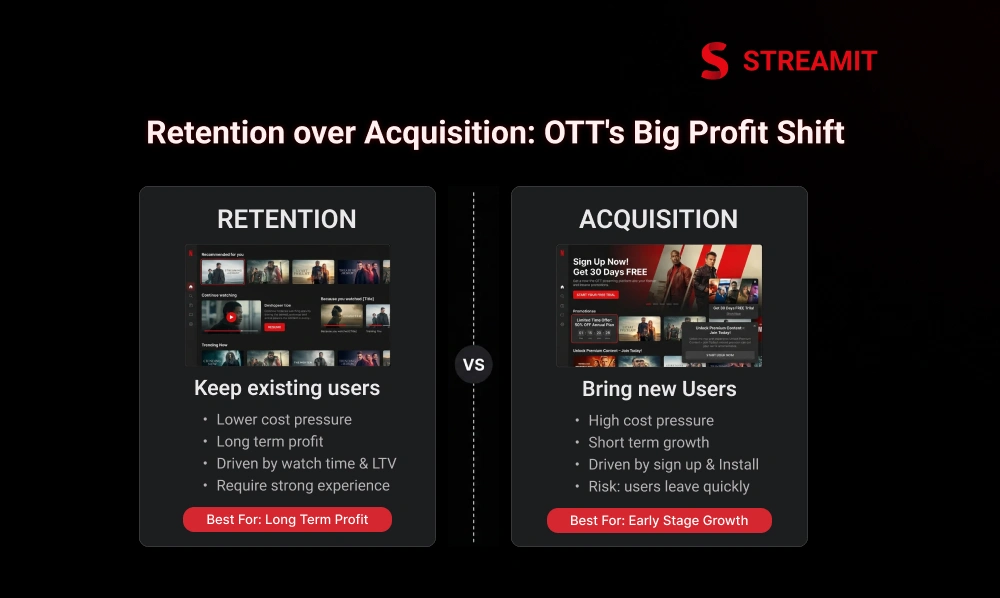
Retention and acquisition are both growth levers, but they solve different business problems. Acquisition brings new users into the platform. Retention keeps existing users active, engaged, and paying.
For OTT platforms, the smartest growth strategy is not “retention vs acquisition” as a fight. It is understanding which one deserves more budget at each stage of growth.
What Is Subscriber Retention in OTT Platforms?
Subscriber retention means keeping users subscribed for a longer period. It includes reducing churn rate, increasing watch time, improving content discovery, and making the platform feel valuable every month.
A retained user is more profitable because the platform has already paid to acquire them. Every extra month they stay improves customer lifetime value.
What Is User Acquisition in OTT Platforms?
User acquisition means attracting new users through ads, SEO, partnerships, app store visibility, influencer campaigns, free trials, and referral programs.
Acquisition is necessary, especially for new OTT platforms. But acquisition becomes risky when users sign up, watch one thing, and leave before the platform recovers its marketing cost.
Retention vs Acquisition: Key Differences
| Area | Acquisition | Retention |
|---|---|---|
| Main goal | Bring new users | Keep existing users |
| Cost pressure | High | Lower |
| Success metric | Sign-ups, trials, installs | Churn, LTV, watch time |
| Business impact | Short-term growth | Long-term profit |
| Risk | Users may leave quickly | Requires a better product experience |
Profit Reality
Why “More Users” Doesn’t Always Mean More Revenue in OTT
A platform can grow users and still lose money. This happens when the acquisition cost is higher than the revenue those users generate before cancelling.
In OTT, “more users” only matters when those users watch regularly, convert to paid plans, renew subscriptions, or generate ad revenue. Otherwise, growth becomes a vanity number.
Vanity Metrics vs Real Profit Metrics
Downloads, sign-ups, and trial starts look good in reports. But they do not prove business health.
Real OTT KPIs include ARPU, LTV, CAC, churn rate, content completion rate, repeat viewing, and paid conversion. These numbers show whether the platform is actually building a business.
High Acquisition + Low Retention = Negative Growth
When a platform spends heavily to acquire users but loses them quickly, it creates negative growth.
The business keeps paying to replace lost users instead of building a stronger revenue base. This is why retention is not a “later stage” problem. It is a profit problem from day one.
Market Shift
Why the OTT Market Is Shifting Toward Retention
The average consumer now has limited attention, a limited budget, and too many content choices. One major industry survey found that users spend around six hours per day on media and entertainment, but that time is split across streaming, social video, gaming, music, and other formats.
This means OTT platforms are not only competing with other streaming apps. They are competing with every screen habit in the user’s day.
Rising Customer Acquisition Cost
Acquisition is getting harder because ad costs, content competition, and audience fatigue are rising.
Industry commentary often estimates that acquiring a new customer can cost five to seven times more than retaining an existing one. For OTT, that gap becomes even more painful when users cancel after a short trial period.
Subscription Fatigue and High Churn Rates
Almost 75% of consumers say they are frustrated by rising entertainment subscription prices, and around 40% say they have recently cut back due to financial concerns.
This is why pricing alone cannot save an OTT platform. Users need to feel consistent value, not just a lower monthly bill.
Changing User Behaviour Across Devices
Users now move between mobile, web, TV, tablets, and sometimes connected devices in the same journey.
If the experience breaks across devices, retention suffers. A user may discover content on mobile, continue on TV, and expect the platform to remember everything smoothly.
The Profit Case
Why Retention Is More Profitable Than Acquisition in OTT
Retention improves profit because it increases revenue without restarting the acquisition cost every month. Once a user is already inside the platform, the next goal is to increase value from that relationship.
This does not mean acquisition is unimportant. It means acquisition without retention is incomplete.
Retention Increases Customer Lifetime Value
CLV grows when users stay longer, upgrade plans, consume more content, and form habits around the platform.
A user who stays for 12 months is not just worth more than a one-month user. They also give the platform better behavioural data, better recommendation signals, and stronger revenue predictability.
Lower Cost Compared to Continuous Acquisition
Retention usually depends on product quality, personalization, communication, pricing flexibility, and support.
These areas still require investment, but they compound. Paid acquisition resets every campaign. Retention systems improve over time.
Retention Drives Recurring Revenue Growth
Recurring revenue works only when the user has a reason to return.
The strongest OTT platforms do not rely only on new releases. They build discovery, recommendations, watchlists, notifications, and habit loops that make the platform part of the user’s routine.
Engagement Science
Retention Loops: How OTT Platforms Build Habit-Forming Experiences
Retention is built through repeat behaviour, not one-time satisfaction. The goal is to create a loop where users open the platform, find something relevant, enjoy it, and come back again.
The best OTT retention loops feel natural. They do not force users. They reduce effort.
Trigger → Watch → Reward → Repeat Loop
| Step | What It Means | OTT Example |
|---|---|---|
| Trigger | Reason to return | New episode alert |
| Watch | Easy playback | One-click resume |
| Reward | User gets value | Relevant recommendation |
| Repeat | Habit forms | Daily or weekly viewing |
Role of Continue Watching & Smart Notifications
Continue Watching is not a small feature. It is a retention shortcut.
Smart notifications also help when they are timely and relevant. Random alerts annoy users. Contextual alerts bring them back.
Micro-Interactions That Increase Daily Usage
Small moments improve retention. Examples include skip intro, smooth autoplay, watch progress, saved preferences, faster search, and personalized rows.
These features do not look big in a sales deck, but users feel them every day.
Strategy
Top OTT Retention Strategies That Actually Work
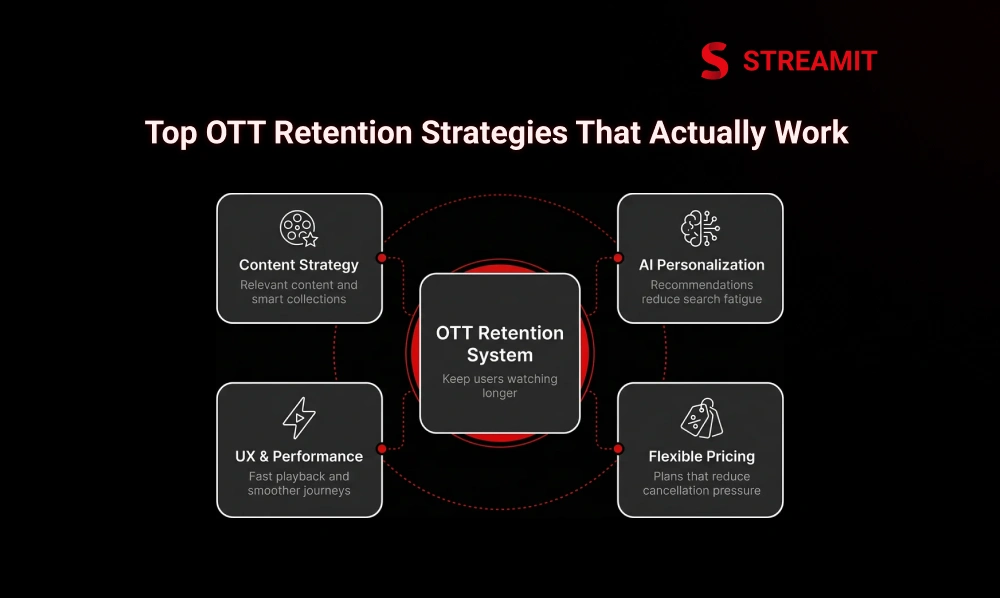
The strongest retention strategies connect content, data, pricing, and performance. One tactic alone rarely fixes churn.
A platform needs a retention system, not a retention hack.
Content Strategy That Keeps Users Hooked
Exclusive content helps, but consistency matters more.
Users stay when they keep finding content that feels relevant. That requires strong metadata, good categorization, smart collections, and clear content planning.
AI Personalization and Smart Recommendations
Better recommendations reduce search fatigue.
In a 2026 media survey, almost one-quarter of fans said better AI recommendations would increase their streaming use. That shows personalization is not a “nice to have” feature anymore.
Smart Pricing and Flexible Subscription Models
Ad-supported plans are growing because users want lower-cost options. Around two-thirds of streaming subscribers now pay for an ad-supported plan, showing a clear shift toward price-sensitive viewing behaviour.
Flexible pricing, hybrid models, pause options, annual plans, and bundles can reduce cancellation pressure.
UX & Performance Optimization
Buffering, slow startup, poor TV navigation, and broken payments kill retention quietly. A user may forgive one issue. But repeated friction makes cancellation feel logical.
Balanced Growth
When Acquisition Still Matters in OTT Growth
Acquisition still matters when the platform needs market entry, awareness, or expansion. Retention-first does not mean acquisition-free.
The real mistake is acquiring users before the platform is ready to keep them.
Early-Stage Platforms Need User Growth
New OTT platforms need users to test content-market fit, pricing, UX, and onboarding.
But early acquisition should be controlled. The goal is not just more traffic. The goal is to learn which users stay.
Expansion Into New Markets and Niches
Acquisition becomes important when entering a new geography, language, content niche, or device category.
In this stage, retention data from existing users should guide targeting. Better acquisition starts with understanding who already stays.
Monetization Models
Retention vs Acquisition by OTT Business Model
Every OTT monetization model needs retention, but the balance changes by revenue type.
SVOD, AVOD, and hybrid platforms all depend on repeat engagement, but the profit logic is different.
| Model | Acquisition Role | Retention Role | Key Focus |
|---|---|---|---|
| SVOD | Drives subscriptions | Protects recurring revenue | Churn reduction |
| AVOD | Builds audience scale | Increases ad inventory | Watch time |
| Hybrid | Fills both funnels | Maximizes LTV | User segmentation |
SVOD Platforms: Retention Is Survival
In subscription OTT, churn directly affects revenue.
If users cancel after one month, the platform must keep spending to replace them. That is not scalable growth.
AVOD Platforms: Acquisition + Engagement Balance
AVOD needs audience volume, but volume alone is not enough.
Users must watch long enough and often enough to generate meaningful ad revenue.
Hybrid Models: Where Profit Maximization Happens
Hybrid OTT models allow users to choose free, ad-supported, or paid experiences.
This creates more flexibility and helps platforms monetize different user segments without forcing everyone into one plan.
Growth Stages
Retention Maturity Model for OTT Platforms
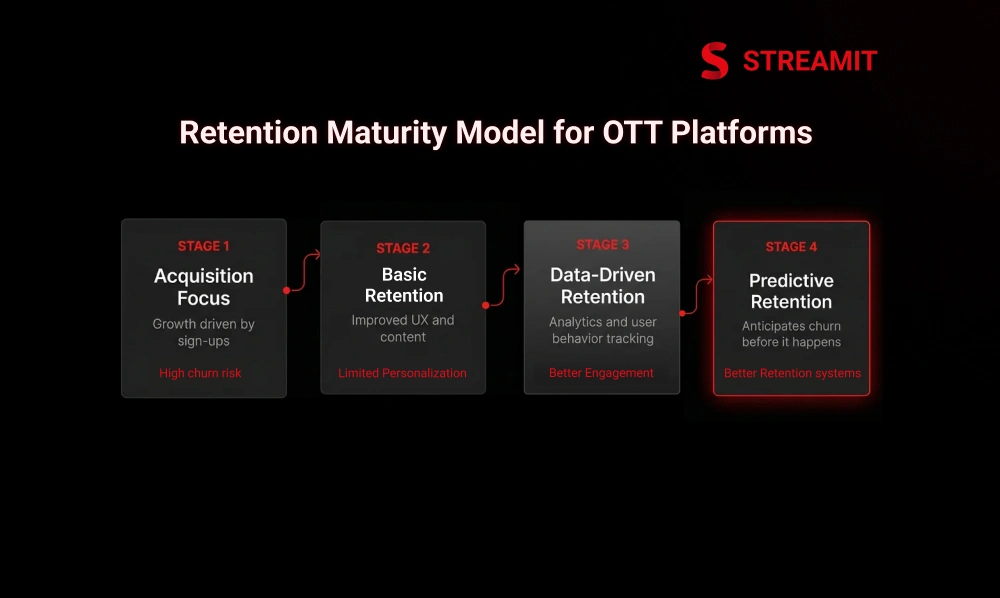
Most OTT platforms move through four retention stages. The problem is that many stay stuck in Stage 1 for too long.
| Stage | Platform Behavior | Risk |
|---|---|---|
| Stage 1 | Acquisition-focused | High churn |
| Stage 2 | Basic retention | Limited personalization |
| Stage 3 | Data-driven retention | Needs strong analytics |
| Stage 4 | Predictive retention | Requires mature systems |
Stage 1: Acquisition-Focused
The platform runs campaigns, pushes trials, and measures sign-ups. Growth looks active, but churn is usually high because the experience is not yet strong enough.
Stage 2: Basic Retention
The platform improves content quality, UI, onboarding, and playback. This stage reduces obvious friction and gives users better reasons to stay.
Stage 3: Data-Driven Retention
The platform uses analytics, segmentation, and personalization. Teams start tracking what users watch, where they drop off, and what content drives renewal.
Stage 4: Predictive Retention
The platform identifies churn signals before cancellation.
This includes inactive users, payment risk, low watch time, poor recommendation response, and plan downgrade behaviour.
Profit Model
How to Balance Retention and Acquisition for Maximum Profit
The right model is retention-first acquisition. That means you do not stop acquiring users. You acquire users who are more likely to stay.
This is how OTT platforms move from growth activity to profit discipline.
Retention-First Growth Model
Start by fixing onboarding, playback, discovery, pricing, and analytics.
Then use acquisition to scale what already works. A leaky platform should not pour more money into traffic before fixing the leak.
Key Metrics to Track
Track CAC, LTV, ARPU, churn rate, trial-to-paid conversion, watch time, content completion, and reactivation rate.
These metrics show whether the platform is growing users or growing profit.
Technology
How OTT Platforms Improve Retention With Technology
Retention is not only a marketing problem. It is a technology problem.
The platform architecture decides how fast users can watch, how easily they discover content, and how reliably they return.
AI-Powered Personalization Systems
Personalized OTT experiences help users find the right content faster. This improves engagement, reduces search fatigue, and gives users fewer reasons to leave.
Multi-Device Streaming Apps
Users expect smooth streaming across TV, mobile, and web.
If the mobile app is strong but the TV app feels weak, retention still suffers because the viewing journey is broken.
Scalable Infrastructure
CDN strategy, low-latency streaming, adaptive bitrate, encoding, and backend scalability all affect retention.
Performance is not a backend-only concern. It directly shapes user trust.
Platform Choice
Choosing the Right OTT Solution for Retention-Driven Growth
The right OTT solution should be built for 12 months of growth, not just launch week. A serious platform needs ownership, scalability, performance, analytics, and flexibility.
Must-Have Features in an OTT Platform
Important features include multi-device apps, subscriptions, AVOD support, hybrid monetization, analytics, AI recommendations, watchlists, secure payments, DRM support, and scalable video delivery.
These features should not feel patched together. They should work as one system.
Why End-to-End OTT Solutions Improve Retention
End-to-end OTT solutions reduce gaps between frontend, backend, video delivery, analytics, and monetization.
When these layers work together, users get a smoother experience, and the business gets better control.
Final Verdict
Final Verdict: Retention vs Acquisition in OTT
Acquisition creates attention. Retention creates profit.
In 2026, OTT platforms cannot afford to chase users who leave quickly. The smarter move is to build systems that keep the right users engaged longer.
Why Retention Is the Real Profit Driver in 2026
Retention improves LTV, lowers dependency on paid marketing, strengthens personalization, and protects recurring revenue.
Acquisition still matters, but retention decides whether acquisition becomes profit or waste.
Conclusion
Retention vs acquisition is no longer just a marketing debate in OTT streaming. It is a profitable decision.
Acquisition helps platforms grow visibility, but retention turns that visibility into long-term revenue. The OTT platforms that win in 2026 will not be the ones chasing the most users. They will be the ones building better experiences for the users they already have.
Summary
Key Takeaways
Retention Is the Real Profit Driver
OTT platforms do not become profitable only by adding more users. They become profitable when users stay longer, watch more, and keep paying.
High Churn Creates Hidden Losses
Churn not only reduces subscription revenue – it also weakens content ROI, user data, personalization accuracy, and brand trust.
Vanity Metrics vs Real KPIs
App installs and free trials look good in reports. Real OTT growth depends on ARPU, LTV, CAC, churn rate, and watch time.
Personalization Improves Engagement
AI-powered recommendations help users find relevant content faster, reduce search fatigue, and increase repeat viewing across the platform.
Hybrid Monetization Supports Growth
SVOD, AVOD, and hybrid models help OTT platforms serve different user segments and reduce cancellation pressure across the subscriber base.
Technology Directly Shapes Retention
CDN performance, low-latency streaming, scalable infrastructure, smart TV apps, and analytics all affect whether users keep coming back.
FAQs
Frequently Asked Questions
-
Why does OTT growth not increase revenue?
OTT growth does not increase revenue when users sign up but leave quickly. If churn is high, the platform keeps spending on acquisition without building long-term income.
-
Can high acquisition reduce OTT profit?
Yes. High acquisition can reduce profit when CAC is higher than the user’s lifetime value. This creates growth on paper but weak margins in reality.
-
Why don’t OTT users convert to paying users?
Users often do not convert when they fail to see enough value during the trial or free experience. Weak onboarding, poor content discovery, and unclear pricing also reduce conversion.
-
Do free trials increase OTT churn?
Free trials can increase churn when users join only to watch one title and cancel. Trials work better when the platform builds a habit before asking users to pay.
-
What data improves OTT personalization?
Watch history, search behaviour, completion rate, genre preference, device usage, language preference, and skipped content all improve personalization accuracy.
-
What UX mistakes kill OTT engagement?
Slow playback, confusing navigation, weak search, poor TV experience, and irrelevant recommendations reduce engagement. These issues quietly push users toward cancellation.
-
What is retention-first OTT growth?
Retention-first OTT growth means improving user experience, engagement, and lifetime value before scaling acquisition aggressively. It focuses on profitable growth, not just more sign-ups.
Read Also
Read Also
1. Why OTT Streaming Founders Fail Without Strong Retention
2. Netflix Retention Secrets OTT Platforms Must Learn
3. 10 Powerful Netflix Retention Strategies Every Brand Should Use
4. The Subscriber Retention Secrets Netflix Doesn’t Want Streaming Platforms to Know
5. 7 Reasons Why OTT Platforms Will Fail in 2026 Without Retention