Laravel vs Node.js: Best Choice for OTT Platform Development


The backend of an OTT platform is not just a technical layer. It decides how content is managed, how users move through the product, how billing behaves, how data flows, and how the platform holds up when traffic grows.
The global OTT market is projected to reach USD 383.52 billion in 2026, which means streaming businesses are no longer competing only on content. They are competing on performance, reliability, personalization, and long-term platform control.
Laravel and Node.js can both power strong OTT platforms. The real question is not “Which technology is better?” The better question is: “Which backend fits the way your streaming business actually works?”
Foundation
Why Backend Choice Matters in OTT Platform Development
A streaming platform can look polished on the frontend and still fail behind the scenes. The backend controls content workflows, APIs, subscriptions, user permissions, recommendations, analytics, and admin operations.
For serious OTT platform development, the backend should support growth before growth becomes painful. A cheap or rushed backend may work during launch, but it can create expensive rebuilds when users, content, and traffic increase.
OTT Platforms Depend on Much More Than Frontend Experience
Users judge the app by the screen they see. But the experience they feel comes from the systems they never see.
Search, playback access, watch history, subscription status, profile data, content availability, and recommendations all depend on the OTT backend. If these systems are weak, even a beautiful interface starts feeling unreliable.
Streaming Performance Depends on Architecture Decisions
Streaming performance is not decided by Laravel or Node.js alone. It depends on CDN setup, transcoding, adaptive bitrate streaming, caching, APIs, queues, and infrastructure design.
Adaptive bitrate streaming adjusts video quality based on network conditions, helping improve playback across different devices and internet speeds. That means backend architecture and video delivery choices matter as much as the framework itself.
Choosing the Wrong Stack Can Limit Future Growth
The wrong backend stack does not always break immediately. It usually starts by limiting the platform slowly.
Admin tasks become harder, APIs become messy, scaling gets expensive, and new features take longer. For a growing OTT business, this becomes a strategic problem, not just a developer problem.
Overview
Laravel vs Node.js in Simple Terms
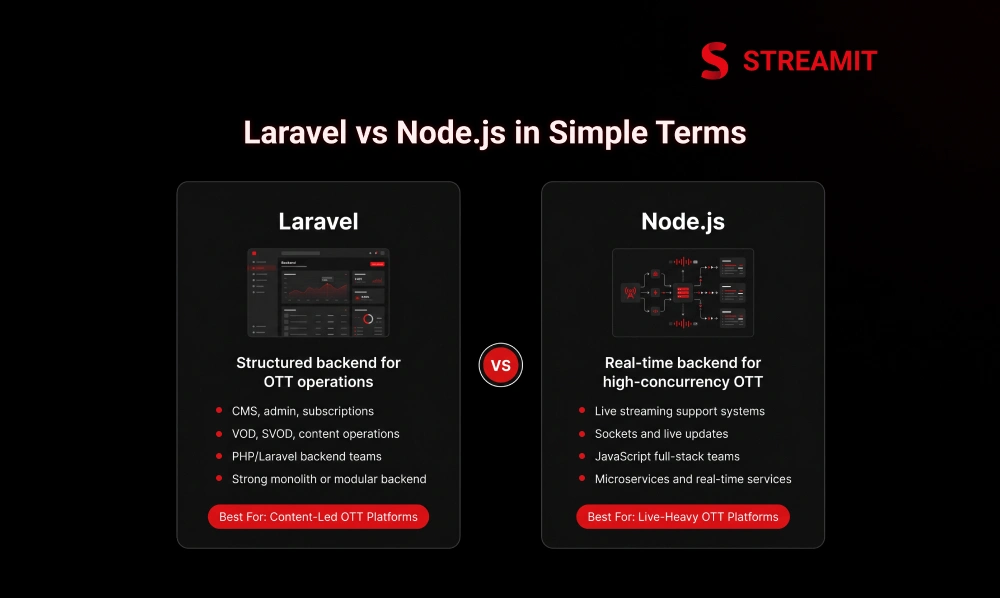
Laravel is a structured PHP framework. Node.js is a JavaScript runtime built around asynchronous, event-driven systems.
Both can be used in OTT platform development. But they solve different problems better when the architecture is planned correctly.
Laravel Is a Structured Backend Framework Built for Business Logic
Laravel works well when the platform needs clear business rules, admin panels, content management, subscriptions, roles, permissions, and billing logic.
Laravel includes strong support for routing, authentication, queues, caching, database operations, and structured application development, which makes it useful for CMS-heavy platforms.
Node.js Is Built for Real-Time and Event-Driven Systems
Node.js is designed as an asynchronous, event-driven JavaScript runtime for scalable network applications. This makes it strong for real-time communication and high-concurrency workloads.
For OTT, this can matter in live chat, live sports updates, watch parties, real-time analytics, notifications, and event-heavy user activity.
The Choice Depends on Product Type, Not Popularity
Choosing Laravel or Node.js based only on trends is a weak decision. OTT platforms need stack decisions based on product behavior.
A VOD platform with heavy admin workflows may need a different backend than a live sports platform with real-time engagement. The right answer depends on the business model.
Comparison
How Laravel and Node.js Compare for OTT Platform Development
| Area | Laravel | Node.js |
|---|---|---|
| Best fit | CMS, admin, subscriptions, structured backend | Real-time, event-driven, high-concurrency features |
| Development style | Opinionated and structured | Flexible and service-oriented |
| Strong use case | VOD, SVOD, content operations | Live streaming support systems, sockets, live updates |
| Team advantage | PHP/Laravel backend teams | JavaScript full-stack teams |
| Best architecture | Strong monolith or modular backend | Microservices and real-time services |
Both Laravel and Node.js can scale when designed properly. Neither framework automatically creates a scalable OTT platform.
The real difference is how each one fits the workload. Laravel is strong for structured business operations, while Node.js is strong for real-time, non-blocking systems.
Performance Depends on Workload Type
Laravel can perform well for content APIs, admin dashboards, user management, subscriptions, and backend workflows. It is especially effective when caching, queues, and database design are handled properly.
Node.js performs strongly when the system needs to handle many simultaneous network requests or real-time events. This is useful for interactive OTT features and live-user activity.
Scalability Depends on Architecture Design
A scalable OTT backend is not created by selecting a popular framework. It is created by designing the right architecture around traffic, data, delivery, and business workflows.
Laravel can scale with queues, caching, load balancing, optimized databases, and modular services. Node.js can scale with event-driven services, horizontal scaling, message queues, and microservice patterns.
Development Speed Depends on Team Structure
Laravel often helps teams move faster when the product requires admin panels, CMS logic, billing workflows, and structured backend development.
Node.js can be faster when the same team is already working heavily in JavaScript across the frontend and backend. In that case, shared language knowledge can reduce handoff friction.
Security and Content Protection Are Architecture-Driven
Security in OTT is not only about the backend framework. It includes authentication, access control, DRM, signed URLs, content encryption, secure APIs, and payment protection.
Laravel gives a strong structure for authentication and access control. Node.js can also be secure, but it requires disciplined architecture, package control, and careful service design.
Data Handling Depends on Use Case
A content-managed OTT platform needs a clean database structure for videos, categories, genres, languages, subscriptions, users, and metadata.
Laravel is often comfortable for relational data and admin-driven workflows. Node.js can work well when data moves through real-time services, event streams, and APIs.
Live Streaming Support Depends More on Pipeline Than Framework
Live streaming does not become strong just because the backend is Node.js. It depends on ingestion, encoding, transcoding, packaging, CDN delivery, and playback logic.
For example, live streaming architectures often include ingest, transcoding, adaptive bitrate outputs, and delivery layers. These systems sit around the backend, not inside the framework alone.
Architecture
The Real Bottleneck in OTT Platforms Is Architecture
Most OTT platforms do not fail because the team chose Laravel or Node.js. They fail because the architecture was not designed for real streaming behavior.
The real bottlenecks usually appear in playback startup, content ingestion, CDN routing, database load, billing errors, analytics delay, and poor workflow design.
CDN, Transcoding, and Delivery Matter More Than Framework
A good backend cannot fix a weak video delivery layer. CDN, transcoding, packaging, and adaptive streaming shape the actual viewing experience.
Transcoding converts source video into delivery-ready formats, while packaging prepares media for streaming protocols and players. These layers are critical for smooth playback.
Poor Workflow Design Slows Down Even Good Tech Stacks
Even a strong tech stack can feel slow when workflows are badly designed. Content upload, review, processing, publishing, and scheduling must move cleanly.
If background jobs are not planned properly, the platform becomes fragile. Admin users feel delays, viewers see errors, and the team spends time fixing avoidable problems.
A Strong OTT System Combines Multiple Layers
A serious OTT platform needs more than backend code. A scalable OTT product depends on connected systems, from CMS and APIs to payments, analytics, content delivery, security, personalization, and infrastructure.
Streamit positions itself around this full-stack thinking: streaming apps, websites, TV apps, multi-CDN, transcoding, analytics, discovery, recommendations, and encryption as connected platform layers.
Laravel
When Laravel Is the Better Choice
Laravel is often the better choice when the OTT platform is business-logic heavy. This includes content workflows, subscriptions, admin control, and structured user management.
If the platform behaves more like a controlled digital media business than a live event system, Laravel can be a practical foundation.
CMS-Heavy and Content-Managed OTT Platforms
Laravel is a strong fit for platforms where admins need to upload, organize, approve, schedule, and manage large content libraries.
It gives teams a structured way to build content panels, metadata systems, roles, permissions, and publishing workflows without overcomplicating the backend.
Subscription-Based VOD Platforms With Structured Logic
SVOD platforms often need subscription plans, billing states, coupon logic, renewals, invoices, user roles, and access rules.
Laravel fits this type of structured backend well. The logic is predictable, business-heavy, and better handled with a clean framework approach.
Teams That Prioritize Rapid Backend Delivery
Laravel can help teams move fast because many backend decisions are already organized. Developers can focus more on product logic and less on basic structure.
For an OTT platform that needs a stable launch, strong admin control, and clear monetization workflows, faster backend delivery can reduce early development risk.
Node.js
When Node.js Is the Better Choice
Node.js is often the better choice when real-time behavior is central to the product. This includes live interaction, high-concurrency events, instant updates, and event-driven systems.
If the OTT product depends heavily on live engagement, Node.js can provide a strong foundation for those services.
Live Streaming and Real-Time OTT Experiences
Live streaming platforms often need real-time chat, viewer counts, live reactions, alerts, match updates, or watch-party features.
Node.js is well-suited for these systems because it handles concurrent network activity efficiently. That makes it useful around live OTT experiences.
Event-Driven Platforms With High User Interaction
Some OTT products are not just video libraries. They are interactive platforms with comments, live polls, personalized alerts, creator dashboards, and real-time engagement.
For these workloads, event-driven architecture matters. Node.js can support these features cleanly when paired with the right infrastructure.
JavaScript-First Full Stack Teams
Node.js can make sense when the team already works deeply with JavaScript across the frontend and backend.
This does not automatically make it better. But it can improve team speed, reduce context switching, and simplify hiring for JavaScript-first product teams.
Hybrid Strategy
When a Hybrid Laravel + Node.js Architecture Makes Sense
For many serious OTT platforms, the best answer is not Laravel or Node.js. It is Laravel and Node.js, each used for the right responsibility.
This is where architecture becomes more mature. Instead of forcing one tool to do everything, the platform separates stable business logic from real-time services.
Separating CMS and Real-Time Responsibilities
Laravel can handle CMS, admin panels, user management, subscriptions, and content workflows. Node.js can handle sockets, live updates, notifications, and event-driven services.
This separation keeps the system cleaner. Each backend layer does what it is naturally good at.
Hybrid Systems Scale Better for Growing OTT Products
A hybrid system can scale better because high-pressure services are separated from core business operations.
If live events spike, the real-time layer can scale independently. If admin workloads increase, the CMS layer can be optimized without affecting live features.
Decision Guide
So Which Backend Should You Choose for Your OTT Platform?
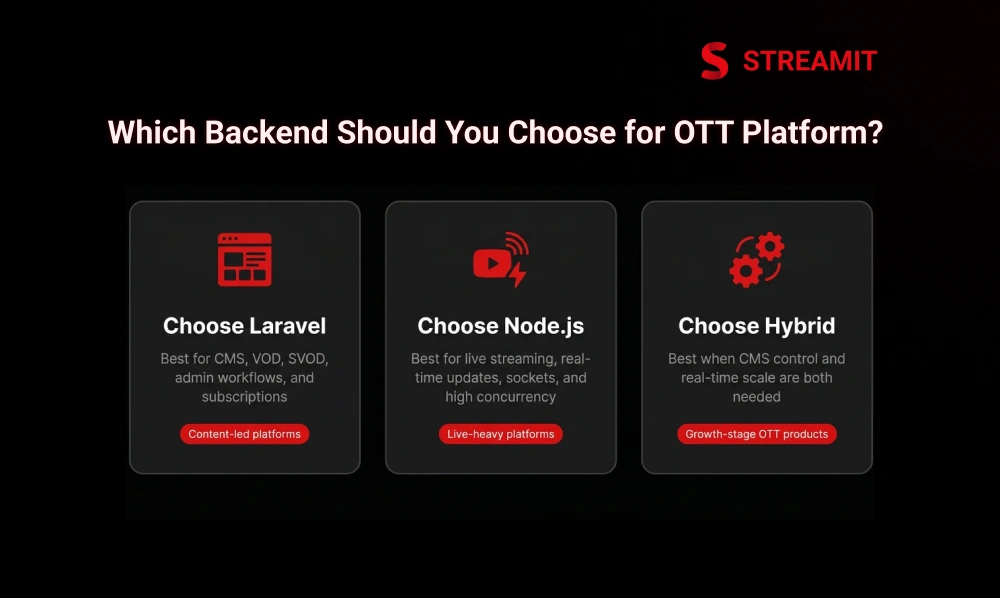
The best backend depends on the streaming model, team capability, feature roadmap, and growth expectations.
A $50K platform decision should not be based on developer preference. It should be based on what the business needs to own, scale, and control over the next 12 to 24 months.
Choose Laravel If Your Platform Is Content and CMS Driven
Choose Laravel if your platform depends heavily on content management, admin workflows, subscriptions, payment rules, and structured backend operations.
This is common for VOD, SVOD, education, fitness libraries, creator platforms, and content-led streaming businesses.
Choose Node.js If Your Platform Is Real-Time and Live Heavy
Choose Node.js if your platform depends on live interaction, high-concurrency events, real-time updates, socket-based features, and fast network communication.
This is common for live sports, live events, watch parties, creator live streams, and interactive entertainment platforms.
Choose Hybrid If You Need Both Scale and Real-Time Capabilities
Choose a hybrid architecture if your platform needs strong CMS operations and real-time engagement at the same time.
This is often the strongest direction for growing OTT products because it avoids forcing one backend to carry every responsibility.
Model Matching
Best Backend Choice Based on Streaming Model
| Streaming Model | Better Backend Direction | Why It Fits |
|---|---|---|
| Subscription VOD | Laravel | Strong CMS, billing, user access, and admin workflows |
| Live sports | Node.js or hybrid | Real-time events, viewer spikes, live updates |
| Education streaming | Laravel | Structured courses, access control, progress tracking |
| Creator platform | Laravel + Node.js | Content library plus live/community features |
| Hybrid OTT platform | Hybrid | Separates CMS, streaming, analytics, and real-time systems |
This table is not a fixed rule. It is a practical decision guide.
The stronger your roadmap becomes, the more architecture matters. Serious platforms usually need a backend strategy, not just a backend framework.
Subscription-Based VOD Platforms
For subscription-based VOD, Laravel is often a strong fit. The platform usually needs predictable workflows around content, users, billing, access, and admin operations.
Node.js can still be used for supporting services. But the core backend may benefit from Laravel’s structure.
Live Sports and Real-Time Streaming Platforms
For live sports and real-time streaming, Node.js or a hybrid setup often makes more sense. These platforms deal with traffic spikes, live status updates, and interactive features.
The framework is still only one part of the system. CDN, encoding, delivery, observability, and failover planning are equally important.
Hybrid Platforms With Mixed Content Types
Many modern OTT platforms mix VOD, live streaming, short-form content, subscriptions, and real-time engagement.
For these products, hybrid architecture gives more control. Laravel can manage the business layer while Node.js supports real-time and event-heavy services.
Summary
Key Takeaways
Backend Choice Depends on the OTT Model
Laravel works better for CMS-heavy and subscription-based OTT platforms, while Node.js fits live, real-time, and event-driven streaming features.
Laravel Is Strong for Structured Backend Control
It is useful for admin panels, content workflows, authentication, queues, billing logic, and user access management.
Node.js Is Strong for Real-Time Performance
Built as an asynchronous, event-driven runtime, it is suitable for live chat, viewer activity, instant updates, and high-concurrency features.
Architecture Matters More Than the Framework
CDN, caching, database design, queues, transcoding, and APIs decide how well an OTT platform performs at scale.
Smooth Streaming Depends on Delivery Setup
Adaptive bitrate streaming adjusts video quality based on network conditions, helping reduce buffering and improve playback.
Hybrid Architecture Is Often the Smarter Choice
Laravel can handle CMS, subscriptions, and admin logic, while Node.js can manage real-time features and live interactions.
Closing Thoughts
Conclusion
Laravel vs Node.js is not a winner-takes-all debate for OTT platform development. Both can be the right choice when used for the right job.
If your OTT platform is content-heavy, structured, and subscription-driven, Laravel gives you a clean foundation. If your platform is live, interactive, and event-driven, Node.js gives you strong real-time capability.
For serious streaming businesses, the smartest decision is often architectural, not emotional. Build for ownership, performance, scalability, and long-term control from day one.
That is also where Streamit’s approach fits: not as a quick app build, but as an OTT technology foundation designed around streaming infrastructure, growth, and platform control.
FAQs
Frequently Asked Questions
-
Which breaks first in an OTT backend when traffic spikes?
Usually, the first weak points are APIs, database queries, background jobs, CDN routing, and authentication services. The framework may get blamed, but the real issue is often poor architecture.
-
What matters more for OTT speed: framework or architecture?
Architecture matters more. Laravel and Node.js can both perform well, but CDN setup, caching, database design, transcoding, queues, and delivery logic decide the real user experience.
-
Which backend handles live sports traffic better?
Node.js or a hybrid backend usually fits live sports better because real-time updates and high-concurrency activity are central to the experience. Laravel can still support admin and business workflows.
-
Which backend makes OTT admin panel development easier?
Laravel is usually stronger for OTT admin panel development because it supports structured backend logic, authentication, roles, queues, and CMS-style workflows very well.
-
Can a poor CDN and transcoding setup cancel out a good backend choice?
Yes. Even a strong Laravel or Node.js backend cannot save playback if CDN, transcoding, packaging, and adaptive streaming are poorly planned.