White Label OTT Platforms for Startups and Enterprises


Most OTT businesses do not fail because they launched late. They fail because the first version was built without a scale plan. A white label OTT platform gives startups and enterprises a faster route to launch, but the real decision is not just speed. It is ownership, performance, monetization, and the ability to grow without rebuilding the entire product later.
For founders, media companies, creators, broadcasters, and enterprise teams, the smarter question is not “Can we create an OTT platform quickly?” The better question is “Can we launch fast without losing control of the audience, content, revenue model, and long-term platform direction?”
Foundation
What Is a White Label OTT Platform?
A white label OTT platform is a ready foundation that can be branded and launched as your own streaming product. Instead of building every backend, app, player, payment, and content workflow from zero, you start with an existing OTT platform solution and customize it around your brand.
This approach helps businesses reduce early technical complexity. The platform still needs serious planning, but the base structure is already available for content, users, subscriptions, apps, playback, analytics, and monetization.
A White Label OTT Platform Helps You Launch Under Your Own Brand
Your users should experience your brand, not your vendor’s system. A good white label streaming platform lets you control the logo, colors, domain, app identity, content categories, subscription plans, and user journey.
This is useful when speed matters but brand perception cannot look cheap. The goal is not to rent a generic video portal. The goal is to launch a branded streaming platform that feels owned.
How White Label OTT Is Different From Building From Scratch
Building from scratch gives deeper control, but it also increases the first 6 to 12 months of technical risk. Custom OTT platform development means architecture, backend, apps, video pipeline, payment logic, analytics, and support systems are planned from the ground up.
White label OTT starts with a prebuilt foundation. You trade some early flexibility for faster launch, lower complexity, and fewer moving parts in the first version.
Why Startups and Enterprises Use White Label OTT Solutions
Startups use white label OTT to reach the market faster. Enterprises use it to avoid unnecessary rebuild cycles. Both care about speed, but for different reasons.
A startup may need to test pricing, audience demand, and content-market fit. An enterprise may need a stable end-to-end OTT solution without distracting internal teams from their core business.
Market Context
Why White Label OTT Platforms Are Growing
The streaming market has moved from “having content” to owning the full viewer relationship. Businesses no longer want to depend only on third-party platforms where algorithms, revenue rules, and audience access can change.
White label OTT platforms are growing because they offer a middle path. They help teams create OTT platform experiences without carrying the full cost and delay of a deep custom build from day one.
More Businesses Want to Own Their Streaming Audience
Audience ownership is now a strategic asset, not a marketing feature. When users sign up on your own OTT platform, you control the data, relationship, pricing, retention flow, and communication.
This matters for entertainment brands, content creators, educators, sports communities, and niche media businesses. The platform becomes a business engine, not just a content library.
Faster Launch Has Become a Major Business Advantage
In OTT, 90 days of delay can mean missed campaigns, missed content windows, and missed revenue tests. White label OTT solutions help teams launch faster because the base product is already structured.
Speed is useful only when the foundation is stable. A fast launch with weak playback, poor payment logic, or limited device support creates new problems instead of solving old ones.
Viewers Expect Smooth Streaming Across Every Device
The viewer does not care how complex streaming technology is. They only care whether the video starts fast and plays smoothly. This makes device coverage a core business requirement.
Modern OTT platforms need support for web, mobile, smart TV, Android TV, and connected devices. A weak experience on one major screen can quietly reduce watch time and trust.
Decision Guide
White Label OTT Platform vs Custom OTT Platform
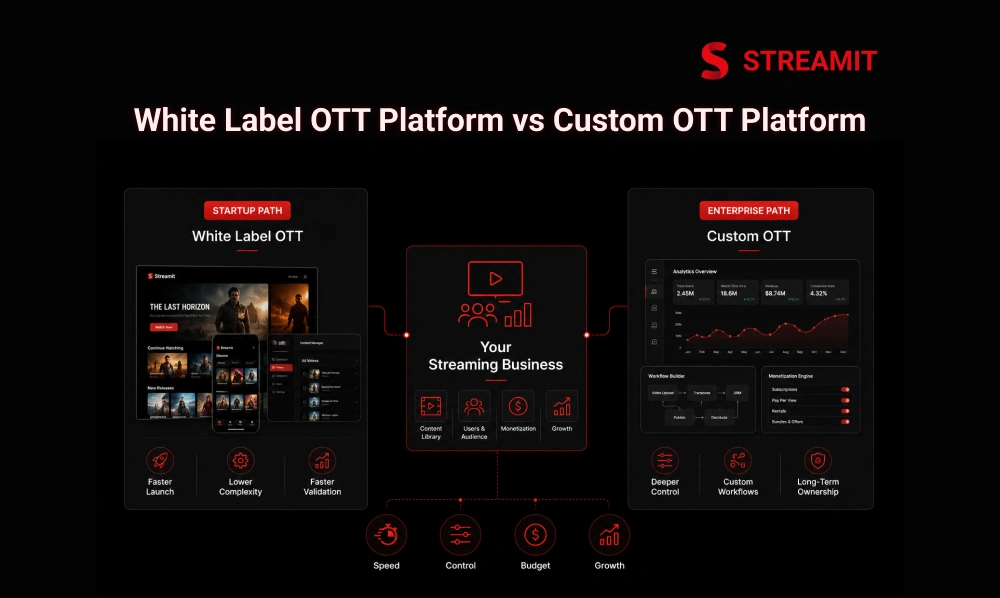
White label and custom OTT are not enemies. They solve different business stages. White label is often the stronger choice when a business needs a faster launch with a more structured foundation. Custom is better when the platform needs unusual workflows, deep data control, or advanced product logic.
| Decision Area | White Label OTT Platform | Custom OTT Platform |
|---|---|---|
| Launch speed | Faster | Slower |
| Upfront complexity | Lower | Higher |
| Custom logic | Limited to flexible | Deep control |
| Best for | MVP, early growth, quick expansion | Enterprise control, unique workflows |
| Long-term scale | Depends on provider architecture | Depends on build quality |
The mistake is choosing based only on price. The better approach is to match the platform route with your budget, timeline, growth plan, and technical expectations.
White Label OTT Is Better When Speed Matters Most
If the priority is market entry, white label OTT often wins. It gives teams a working structure for apps, content, users, payment, and streaming delivery.
This is valuable for founders who need real users before making bigger product decisions. Early traction gives better direction than months of internal assumptions.
Custom OTT Is Better When You Need Deep Control
Custom OTT is stronger when your platform model is not standard. This includes complex rights management, unique subscription logic, advanced personalization, regional pricing, custom workflows, or enterprise integrations.
It also works better when OTT is the core business, not just a digital extension. In that case, deeper ownership can become a serious competitive advantage.
The Best Choice Depends on Budget, Timeline, and Growth Plans
A $25K decision and a $75K decision should not produce the same architecture. The right OTT solution depends on where the business is today and what it needs to become in 12 months.
A practical route is to launch with a structured white label OTT solution, then add custom OTT features as the business validates audience behavior and revenue.
Benefits
Key Benefits of White Label OTT Platforms
The main benefit is not just lower development work. It is controlled speed. A white label OTT platform helps teams move faster while still supporting brand identity, monetization, multi-device access, and operational workflows.
The strongest platforms also reduce hidden work. They bring content management, playback, payments, user roles, analytics, and security into one connected system.
Faster Time to Market and Lower Development Complexity
A prebuilt OTT foundation can remove months of backend and app planning. Teams can focus on content, launch strategy, pricing, and audience growth instead of basic platform wiring.
This does not mean zero work. It means the first version becomes more manageable and less dependent on large engineering teams.
Full Brand Control Across Apps and Website
Brand control matters because users judge trust within seconds. Your OTT website design, app screens, thumbnails, categories, and subscription pages should feel consistent.
A good white label OTT solution should allow front-end customization without forcing every brand into the same visual structure. Generic design is where premium positioning starts leaking.
Built-In Monetization and Payment Options
Monetization should be designed before launch, not patched after users arrive. A strong platform should support subscriptions, ads, rentals, paid events, coupons, trials, and hybrid models.
Payment gateways, billing status, access rules, and renewals need to stay connected. If payment works but content access fails, users lose trust quickly.
Multi-Device Streaming Support
OTT is not a single-screen business. Users may discover content on mobile, continue on web, and watch fully on TV.
White label platforms should support multi-device app journeys with consistent accounts, watch history, plans, and playback behavior. Device gaps create friction that users rarely explain. They just leave.
Better Scalability for Growing Audiences
Scalability is invisible until traffic exposes weak decisions. A platform may work during testing and still fail during a live event, campaign spike, or regional traffic surge.
Better scalability comes from stronger infrastructure, CDN planning, adaptive streaming, clean backend logic, and performance monitoring. It is not one feature. It is a system.
Platform Features
Must-Have Features in a White Label OTT Platform
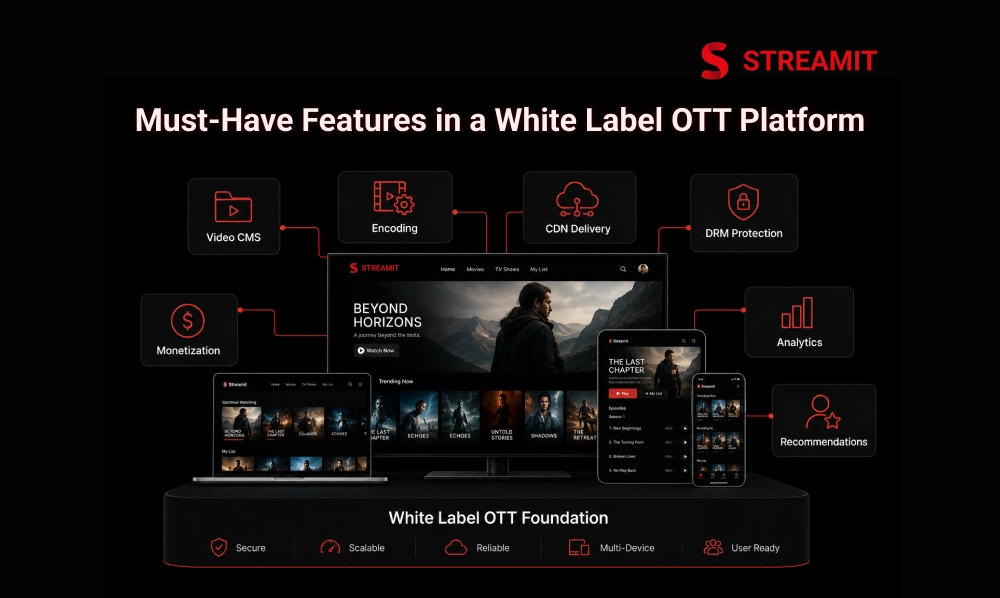
A serious OTT platform is not just an app with videos. It needs content operations, streaming delivery, monetization, security, analytics, and retention systems working together.
| Feature Area | Why It Matters |
|---|---|
| Video CMS | Organizes content and metadata |
| Encoding | Prepares videos for smooth playback |
| CDN | Delivers video closer to users |
| DRM | Protects premium content |
| Monetization | Turns content into revenue |
| Analytics | Shows viewer and platform behavior |
| Recommendations | Improves discovery and watch time |
The best white label OTT platform is the one that reduces operational chaos after launch, not just development effort before launch.
Content Management and OTT Asset Management
Content becomes hard to manage after the first 100 videos. A video CMS should support categories, metadata, thumbnails, trailers, tags, cast details, seasons, episodes, and publishing rules.
OTT asset management keeps the content library structured. Without it, discovery gets weaker and internal teams waste time fixing basic catalog issues.
Video Encoding, Transcoding, and Adaptive Streaming
One video file is not enough for modern streaming. Videos need encoding and transcoding so they can play across different devices, networks, and screen sizes.
Adaptive streaming helps the player adjust quality based on the viewer’s connection. This is one of the biggest reasons smooth OTT playback depends on backend preparation, not only internet speed.
CDN, Multi-CDN, and Edge Caching Support
Distance affects performance. A video CDN helps deliver content closer to the viewer, reducing load on the origin and improving playback reliability.
For larger platforms, multi-CDN and edge caching can improve resilience. This becomes important when traffic is spread across regions or spikes during live events.
Secure Video Player and DRM Protection
Premium content needs controlled access. A secure video player should work with encryption, token-based access, watermarking, and DRM where required.
DRM is especially important for licensed, paid, or exclusive content. Weak protection can damage revenue, partnerships, and user trust.
Monetization for SVOD, AVOD, TVOD, and Hybrid Models
The best revenue model may change as the audience grows. Some platforms start with subscriptions, while others need ads, rentals, paid events, or a hybrid model.
A flexible OTT monetization setup gives the business room to test. Locking into one model too early can limit growth.
Analytics, Viewer Data, and Platform Insights
You cannot improve what you cannot see. Platform analytics should show watch time, churn signals, drop-off points, device performance, playback errors, and content engagement.
Good analytics help teams make better decisions. They show whether the problem is content, pricing, discovery, device experience, or retention.
Personalization and Recommendation Engine
Large libraries fail when discovery is weak. Personalization helps users find relevant content faster instead of scrolling through generic rows.
A recommendation engine can improve watch time when it is built on clean metadata and viewer behavior. Without that foundation, recommendations feel random.
Multi-Platform App Support
Your app strategy should follow viewer behavior, not internal convenience. Web and mobile are important, but TV apps often define serious viewing time.
Before choosing a white label OTT solution, check support for mobile apps, web apps, Android TV, smart TV, and connected devices. Device coverage should not be an afterthought.
Use Cases
White Label OTT Use Cases for Startups and Enterprises
White label OTT works best when the business has content, community, expertise, or media rights that deserve a direct platform. It is not limited to entertainment companies.
Fitness brands, learning businesses, sports communities, broadcasters, spiritual platforms, creators, and enterprises can all use OTT when video becomes part of the business model.
Content Creators, Influencers, and Subscription Communities
Creators with loyal audiences need more than social reach. A white label streaming platform lets them create premium libraries, member-only content, paid communities, and subscription access.
This helps reduce dependency on changing social algorithms. The creator owns the audience relationship more directly.
Fitness, Wellness, and Online Learning Brands
Structured video programs work better when the platform supports progress. Fitness, wellness, and learning brands need categories, plans, reminders, subscriptions, and sometimes live sessions.
A white label OTT solution can help these brands turn content into a recurring business. The platform becomes the delivery system for transformation, not just videos.
Broadcasters, Media Companies, and Entertainment Brands
Media companies need reliability, rights control, and a strong viewer experience. White label OTT can help broadcasters and entertainment brands launch direct-to-consumer platforms faster.
The bigger requirement is performance. If the audience is large, infrastructure and device support matter as much as content.
Sports, Live Events, and Community Streaming Platforms
Live audiences are less forgiving than on-demand viewers. Sports, events, spiritual programs, and community broadcasts need stable streaming, low latency, and clear access control.
A white label OTT route can work well when the platform is built for spikes. Live streaming needs planning before the first major event.
Technology
Technology That Makes White Label OTT Reliable
Reliable OTT is built under the surface. Users see the app, but the real experience depends on delivery, player logic, encoding, CDN performance, device optimization, and backend stability.
A good platform hides complexity from the viewer. The business still needs to understand what sits underneath before choosing a solution provider.
Video Delivery, Low Latency, and Playback Stability
Playback stability is a business metric. Poor startup time, buffering, and failed playback directly affect trust and watch time.
Low latency matters most for live sports, events, auctions, classes, and interactive content. For VOD, consistency and smooth playback usually matter more than ultra-low delay.
HLS, DASH, CMAF, and Codec Support
Streaming formats decide how content travels to devices. HLS and DASH are commonly used for adaptive streaming, while CMAF helps support efficient segmented delivery across workflows.
Codec support also matters. H.265 and AV1 can improve efficiency, but support depends on device compatibility and business priorities.
Reducing Buffering and Playback Errors
Buffering is rarely one problem. It can come from weak encoding ladders, CDN issues, poor player logic, heavy files, origin load, or device limitations.
The right platform should monitor playback errors and not just guess. OTT performance improves when the team can see where the failure happens.
Mobile Optimization and Smart TV Performance
Mobile and TV do not behave the same. Mobile needs speed, lightweight flows, and flexible network handling. Smart TV needs simple navigation, remote-friendly UX, and stable playback.
A white label OTT solution should be tested on real devices, not only in a browser demo. Device reality is where many platforms get exposed.
Revenue & Security
Security, Monetization, and Retention Features to Check
Security, monetization, and retention decide whether the platform becomes a business. Playback alone does not create revenue.
These features should be checked before launch, not after the platform is live. Retrofitting them later is usually more expensive and disruptive.
DRM, Encryption, and Anti-Piracy Controls
Security should match content value. Free content may need basic access control, but premium or licensed content often needs DRM, encryption, signed URLs, and anti-piracy measures.
A secure OTT platform protects both revenue and relationships. Content owners need confidence that access is controlled.
Subscription, Ads, Rentals, and Hybrid Revenue Models
One monetization model may not serve every viewer. Subscriptions bring recurring revenue, ads support free access, and rentals work well for premium or time-sensitive content.
Hybrid monetization gives the business more flexibility. It also requires clean entitlement logic so users get the right access at the right time.
Retention Tools That Reduce Churn
Churn often starts before cancellation. Weak discovery, poor reminders, confusing pricing, and slow playback can reduce engagement long before users leave.
Retention tools should support watch history, continue watching, notifications, recommendations, offers, and user segmentation. Small improvements here can protect long-term revenue.
Personalized Discovery and Analytics That Improve Watch Time
Discovery is not only a design problem. It depends on metadata, behavior tracking, recommendations, search, categories, thumbnails, and editorial strategy.
Analytics show what users actually watch, skip, finish, and return to. Better discovery turns a content library into a viewing habit.
Provider Evaluation
How to Choose the Right White Label OTT Solution Provider
The provider decision shapes your next 12 months. A good demo is useful, but it is not enough.
You need to evaluate device coverage, monetization flexibility, infrastructure, customization, ownership, support, and long-term scalability. The wrong provider can make growth expensive.
Check Device Coverage Before You Choose
Ask for device support clearly, not vaguely. Web and mobile are not enough for many OTT businesses.
Check Android TV, smart TV, Fire TV, iOS, Android, web, and connected-device support based on your audience. Your best screen may not be the first screen users discover you on.
Compare Monetization Flexibility and Payment Options
Revenue logic should not be limited by the platform. Check subscriptions, ads, rentals, coupons, trials, bundles, regional pricing, and payment gateway support.
Also ask how payment status connects with content access. That connection is where many platforms create user frustration.
Review Infrastructure and Streaming Performance
A platform should be judged during pressure, not calm demos. Ask about CDN setup, adaptive streaming, video processing, scalability, monitoring, and traffic spikes.
If the provider cannot explain performance clearly, that is a warning sign. OTT reliability needs engineering clarity.
Ask About Customization, Ownership, and Support
Customization is not just colors and logos. Ask what can be changed in the user journey, admin panel, payment flow, app layout, content structure, and analytics.
Ownership also matters. You should understand user data access, source code options, hosting control, revenue share, and future migration possibilities.
Check Maintenance and Long-Term Scalability
The platform after launch matters more than the platform before launch. Apps need updates, stores change rules, devices evolve, and content libraries grow.
Choose a provider that can support maintenance, upgrades, performance tuning, and future custom features. OTT is not a one-time website project.
Pitfalls
Common Mistakes to Avoid When Choosing a White Label OTT Platform
Most bad OTT decisions look affordable at the start. The cost appears later through poor performance, limited customization, weak support, or forced rebuilds.
A white label OTT platform should reduce risk, not hide it. Founders should pressure-test the decision before signing.
Choosing Only Based on Low Cost
Low cost can become expensive when the platform cannot scale. Cheap solutions often limit customization, device support, monetization, analytics, or support.
The better question is total cost over 12 months. Launch price is only one part of the real platform cost.
Ignoring App Store and Smart TV Requirements
TV app approval and maintenance are serious workflows. Smart TV and app store requirements can affect timelines, design, performance, and updates.
Ignoring this early can delay launch. A strong provider should understand these requirements before development starts.
Overlooking Security and DRM
Security gaps are harder to fix after users arrive. If your content has commercial value, DRM and encryption should be part of the early conversation.
Do not wait until piracy or access misuse becomes visible. Prevention is easier than recovery.
Not Planning for Scale and Performance
A platform that works for 500 users may fail at 50,000. Traffic spikes, larger libraries, new regions, and live events all create pressure.
Scalability should be part of the architecture discussion from day one. It should not be treated as a future upgrade only.
Right Fit
When a White Label OTT Platform Is the Right Choice
White label OTT is right when speed matters, but shortcuts are not acceptable. It works well for teams that need branded apps, faster launch, and a structured platform foundation.
It is not right for every business. If the model needs deep custom logic from day one, a custom OTT platform may be better.
You Need to Launch Faster Without Building Everything From Scratch
If the market is ready, waiting 12 months may be unnecessary. A white label OTT route helps you launch faster and test with real users.
This is especially useful when you already have content, audience, or distribution channels. The platform should help you move, not slow you down.
You Want Branded Apps Without Heavy Technical Complexity
A branded experience can still be built on a white label foundation. The key is choosing a platform with enough design and workflow flexibility.
You should not accept a generic app that looks like every other platform. Brand control still matters.
You Need Room to Scale Into Custom OTT Features Later
The smartest white label choice leaves room for the next stage. Your first version should not trap your future product roadmap.
Look for a provider that can support custom OTT features later. Growth should not require starting again.
Streamit
How Streamit Helps Startups and Enterprises Launch OTT Platforms
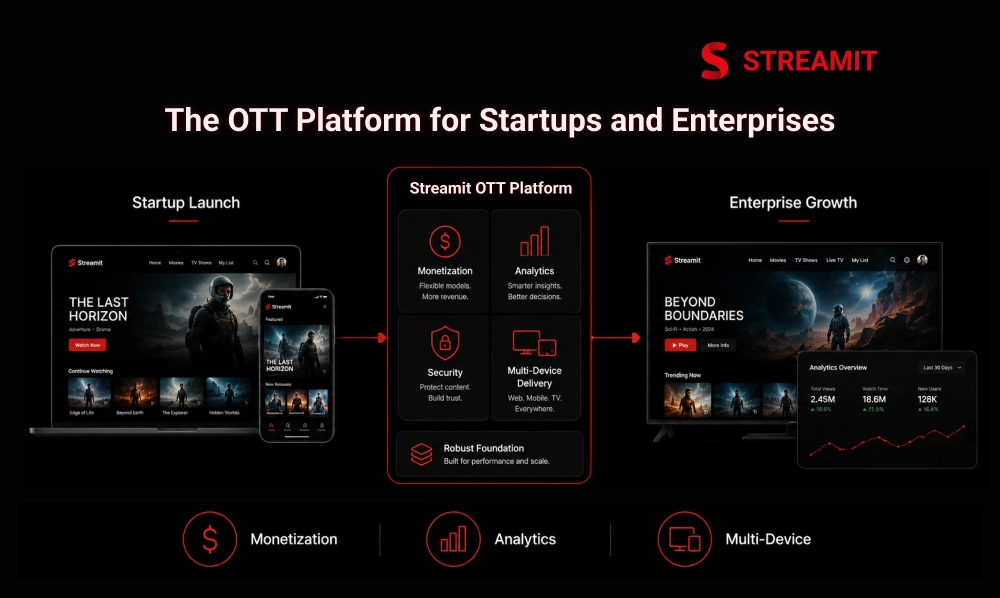
Streamit is built for businesses that want to launch, monetize, scale, and own their OTT platform. The focus is not just creating an app. It is building a streaming business with stronger control across web, mobile, and TV.
For startups, Streamit can support faster launch through a structured OTT foundation. For enterprises, it can strengthen the platform with advanced infrastructure, clearer analytics, stronger security, and better long-term scalability.
Launch Faster With a White Label OTT Route
Streamit helps teams move faster without treating speed as the only goal. The platform route can support branding, content management, user access, monetization, and multi-device streaming.
This gives founders a practical way to go live sooner. The early version can still be planned with scale in mind.
Build Custom OTT Features When You Need More Control
Not every streaming business should stay generic. As the audience grows, some platforms need custom workflows, advanced recommendations, deeper analytics, unique monetization, or special integrations.
Streamit can support custom OTT platform development when the business needs more control. This helps teams avoid getting stuck in a limited setup.
Support Web, Mobile, TV, Monetization, Analytics, and Security Together
OTT works best when the system is connected. Web apps, mobile apps, TV apps, payments, analytics, content access, and security should not operate in silos.
Streamit brings these areas together as an end-to-end OTT platform solution. That structure helps reduce operational friction as the platform grows.
Scale From Startup Launch to Enterprise Streaming Growth
The first version should not block the second version. Streamit is designed to support businesses from initial launch to serious growth stages.
That means thinking beyond the demo. The platform needs performance, ownership, monetization, analytics, and infrastructure that can keep improving after launch.
Summary
Key Takeaways
Reduce Launch Complexity
A white label OTT platform helps startups and enterprises go live faster without building every app, backend, payment flow, and streaming workflow from scratch.
Brand Ownership at the Center
Your OTT platform should carry your logo, design language, domain, app identity, and user experience so viewers remember your brand, not the technology provider.
Multi-Device Is Non-Negotiable
Viewers expect smooth access across web, mobile, Android TV, smart TVs, and streaming devices – device coverage must be confirmed before choosing a platform.
Monetization Flexibility from Day One
A strong white label OTT solution should support subscriptions, ads, rentals, paid content, and hybrid revenue models without forcing a single fixed path.
Plan for Scale Before Traffic Grows
CDN support, adaptive streaming, encoding, playback stability, and infrastructure planning decide whether the platform can handle real audience growth.
White Label vs Custom – Different Stages
White label OTT suits speed and structure; custom OTT is better for unique workflows and deep control. The right choice depends on where the business is today.
Conclusion
Conclusion
The strongest OTT platforms are built for the next 12 months, not only the launch week. A white label OTT solution can help startups and enterprises enter the market faster, but only if the foundation is strong enough for real users, real payments, real playback, and real growth.
Streamit helps businesses build, scale, monetize, and own OTT platforms across web, mobile, and TV. If your goal is not just to launch an app but to build a streaming business with long-term control, the platform decision deserves strategic attention from day one.
FAQs
Frequently Asked Questions
-
Why do some white label OTT platforms become expensive after launch?
They become expensive when the base plan does not include key needs like TV apps, CDN usage, DRM, customization, support, or scaling. The real cost appears when the platform starts growing.
-
Will I own my user data if I choose a white label OTT solution?
It depends on the provider and contract. Always confirm data access, export options, analytics ownership, hosting structure, and user account control before choosing.
-
Can I move from a white label OTT platform to a custom OTT platform later?
Yes, but it is easier when the first platform is planned with migration and ownership in mind. Ask about data portability, source control, APIs, and future custom development.
-
How much customization is too limited in a white label OTT platform?
It is too limited when you cannot control user journeys, monetization rules, app experience, analytics, or content structure. Basic logo and color changes are not enough for serious OTT growth.
-
Can startups launch with white label OTT first and add custom features later?
Yes, and this is often a practical route. Startups can validate audience, pricing, and content demand first, then invest in deeper custom features after traction.
-
Can a white label OTT platform support both subscription users and ad-supported viewers?
Yes, if the platform supports hybrid monetization. The important part is clean entitlement logic, so paid users, free users, rental users, and ad-supported viewers receive the correct experience.