White Label OTT Platform Explained: A Practical Guide


A white label OTT platform is not a shortcut for every streaming business. It is a faster foundation for teams that know what they want to launch, test, and monetize first.
For many founders, the real question is not “Can we build an OTT platform?” The better question is, “How much of the platform do we need to own from day one?”
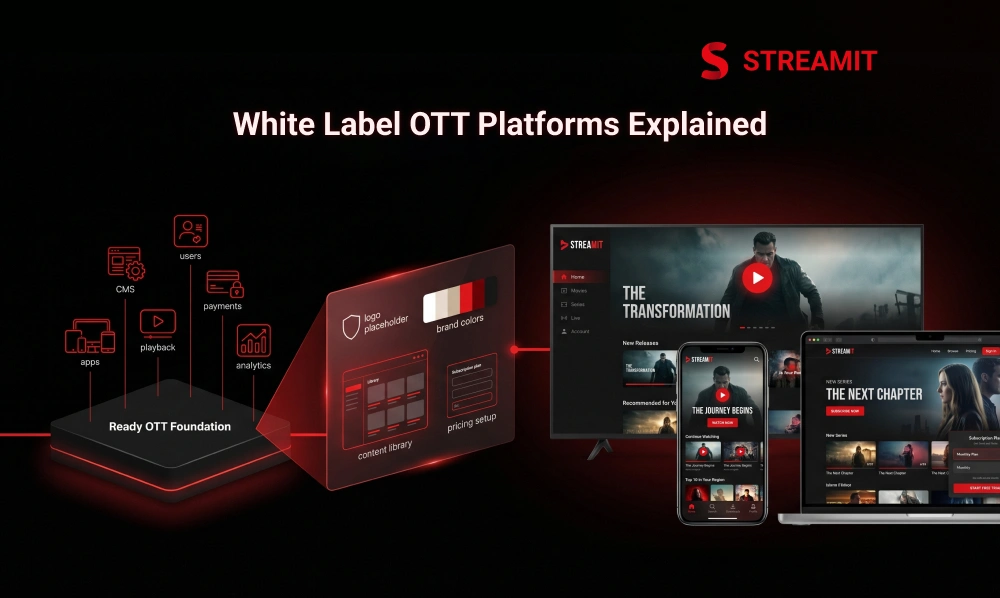
A white label OTT platform gives you a ready-made streaming system that can be branded, configured, and launched under your business name. Instead of building the full OTT stack from zero, you use an existing foundation for apps, content management, playback, users, payments, and analytics.
It is practical when speed matters. But it should still be judged like infrastructure, not like a cheap template.
Overview
What a White Label OTT Platform Is and How It Works
A white label OTT platform provides the core foundation first, then allows your brand to shape the viewer-facing experience.
The provider usually supplies the core technology. Your team adds the content, branding, pricing, audience strategy, and operational decisions.
The result is a branded streaming platform that can go live faster than a fully custom product. But the quality depends on what is already built under the surface.
It Is a Ready-Made Streaming Product You Can Brand
A white label OTT platform is a pre-built streaming product that can carry your logo, colors, domain, apps, and content experience.
Your audience does not need to see the provider behind it. They interact with your brand, your library, and your payment flow.
The Provider Handles the Core Tech While You Handle Brand, Content, and Pricing
The provider usually manages the technical foundation such as hosting, playback, app structure, CMS, security, and updates.
Your business focuses on what actually drives growth: content quality, pricing, positioning, offers, and retention.
It Helps You Launch Faster Without Building the Full OTT Stack From Scratch
Building an OTT platform from zero means planning web apps, mobile apps, TV apps, video delivery, payments, analytics, and admin systems.
A white label OTT solution compresses that timeline because many of those layers already exist. That is the real value.
Business Case
Why Businesses Choose White Label OTT Platform
Most early OTT businesses do not fail because they launched too small. They fail because they overbuilt before proving demand.
White label helps teams start with a working product instead of spending months stuck in planning and development.
It is especially useful when a business already has content, audience access, or a monetization idea, but does not want to carry a full engineering burden immediately.
Faster Time to Market and Lower Upfront Cost
Speed is the first reason businesses choose white label OTT. You can move from concept to launch without designing every system from scratch.
The upfront cost is also usually more predictable. This makes it easier for founders to control risk before scaling aggressively.
Multi-Device Reach Without Building Everything From Scratch
Modern viewers expect streaming access across web, mobile, and TV screens. That expectation creates serious technical work.
A strong white label streaming platform gives you a faster path to multi-device delivery without hiring separate teams for every app environment.
Less Technical Overhead for Teams That Want to Move Quickly
Not every media business wants to become a software company immediately. Some teams need a stable OTT foundation that does not demand daily engineering decisions.
White label works well when your team wants to focus on content, subscribers, marketing, and partnerships first.
Platform Features
Core Features a Good White Label OTT Platform Should Include
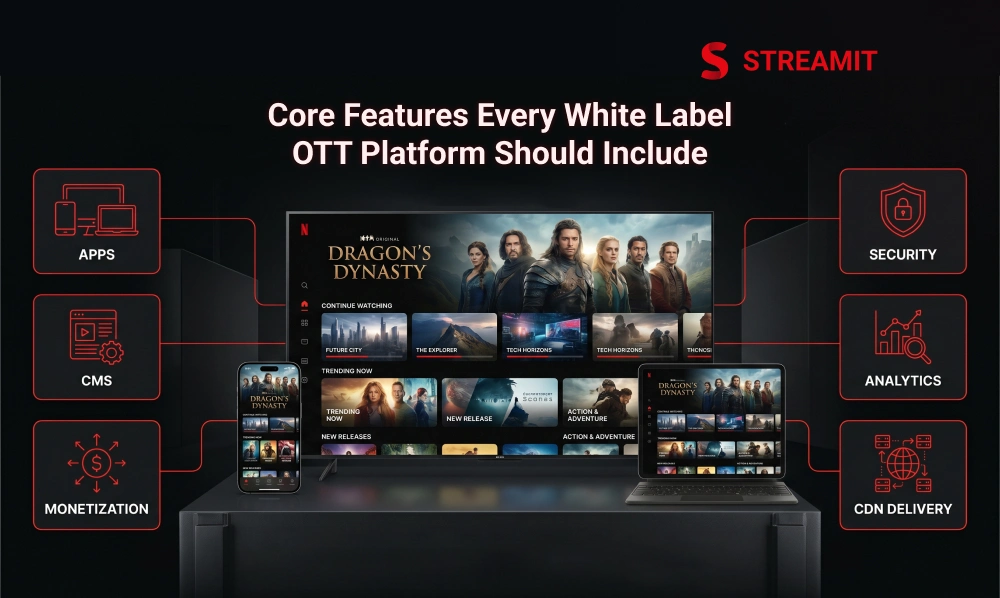
A good white label OTT platform is not just a video player. It is an operating system for streaming.
The platform should help you manage content, users, revenue, access, delivery, and performance from one clear structure.
| Feature Area | Why It Matters |
|---|---|
| Apps | Expands reach across devices |
| CMS | Keeps content operations manageable |
| Monetization | Turns viewers into revenue |
| Security | Protects paid and licensed content |
| Analytics | Shows what users actually do |
| CDN and delivery | Reduces playback issues |
Web, Mobile, and Smart TV Apps
Your platform should support web, Android, iOS, and smart TV experiences if your audience watches across devices.
Do not judge this only by a feature list. The real question is whether each app feels stable, usable, and polished.
Live Streaming, VOD, and Catch-Up Support
Some OTT businesses need on-demand libraries. Others need live channels, events, classes, sports, or catch-up viewing.
A practical white label OTT solution should support the streaming formats that match your business model, not just one content type.
Content Management, User Management, and Admin Controls
The admin panel matters more than many founders expect. It decides how easily your team can upload, organize, price, and control content.
A weak admin system creates daily friction. A strong one keeps operations clean as the content library grows.
Monetization Support for SVOD, AVOD, TVOD, PPV, and Hybrid
Streaming revenue is no longer limited to subscriptions. Many platforms use a mix of subscriptions, ads, rentals, purchases, and pay-per-view.
Your OTT monetization setup should support your current model and leave space to test new offers later.
DRM, Secure Playback, and Access Control
Paid video needs protection. DRM, encrypted playback, access rules, geo-controls, and user permissions help reduce misuse.
Security should not be treated as a later add-on. If your content has commercial value, protection belongs in the foundation.
Analytics, Viewer Insights, and Recommendation Features
Analytics show what people watch, where they drop, which content performs, and what keeps users engaged.
Recommendation features can improve discovery when they are built around real viewer behavior, not random content promotion.
Evaluation Guide
What to Check Before You Choose a White Label OTT Platform
The wrong white label choice feels cheap at launch and expensive after growth starts.
Before choosing a platform, evaluate what happens after the first 90 days: updates, scale, support, app quality, integrations, and control.
| Checklist Item | What to Ask |
|---|---|
| Device coverage | Are the apps real, stable, and tested? |
| Payments | Can it support your billing model? |
| Delivery | Is CDN and adaptive streaming ready? |
| APIs | Can you extend workflows later? |
| Support | What happens when something breaks? |
Device Coverage and Real App Quality
Many platforms claim multi-device support. That does not always mean the apps are smooth, current, and ready for real viewers.
Check web, mobile, and TV experiences separately. A strong website cannot hide a weak TV app.
Billing, CRM, and Payment Flow
Monetization depends on more than payment gateway integration. You need clean plans, trials, renewals, upgrades, cancellations, coupons, and user records.
If billing is clumsy, revenue operations become painful quickly. This is where many teams lose control.
Streaming Performance, CDN Setup, and Live Delivery Readiness
Playback quality is one of the fastest ways to lose viewer trust. Buffering, delay, and failed playback damage the brand immediately.
Check CDN readiness, adaptive streaming, live capacity, and peak traffic handling before committing.
Customization Depth, API Flexibility, and Developer Dependency
Every platform looks flexible during the sales stage. The real test is what can be changed without waiting for the provider.
API flexibility matters because your business may later need custom workflows, integrations, reporting, or front-end experiences.
Support Model, SLA, and Upgrade Path
Support is part of the product. When your app breaks during a campaign or live event, response speed matters.
Ask how updates work, what support includes, and whether the platform has a clear path from launch to scale.
Comparison
White Label OTT vs Building From Scratch
White label gives speed. Custom gives control. The mistake is pretending one is always better.
The right decision depends on your business stage, budget, timeline, and how unique your product needs to become.
| Factor | White Label OTT | Custom OTT Development |
|---|---|---|
| Launch speed | Faster | Slower |
| Upfront cost | Lower to moderate | Higher |
| Customization | Limited to supported options | Deep control |
| Ownership | Provider-influenced | Business-controlled |
| Best for | Fast launch and validation | Differentiation and scale |
White Label Wins on Speed and Simplicity
White label OTT is better when your main goal is to launch quickly, test demand, and start building an audience.
It reduces the number of early technical decisions. That can be valuable when your business model is still developing.
Custom Wins on Product Freedom and Deeper Control
Custom OTT development is stronger when the platform experience itself is your competitive advantage.
If you need unique workflows, deep integrations, special monetization logic, or full architecture ownership, custom gives more freedom.
The Better Choice Depends on Business Stage, Budget, and Product Complexity
A new content brand may not need a fully custom platform on day one. A growing media company might.
Think in stages. Choose what supports the next 12 to 24 months, not just what looks attractive this week.
Use Cases
Which Businesses Usually Fit White Label OTT Best
White label works best when the content strategy is clear and the platform does not need heavy invention from day one.
It is not limited to entertainment brands. Many education, fitness, coaching, media, and niche content businesses can use it well.
The best fit is a team that wants a branded streaming foundation without carrying the full cost and complexity of custom development immediately.
Broadcasters and Media Brands
Broadcasters and media companies often need a faster way to bring existing content libraries online.
White label helps them create branded streaming access without rebuilding every operational layer from zero.
Creator-Led and Niche Content Platforms
Creators with loyal audiences can use white label OTT to own the viewing experience instead of depending only on third-party platforms.
This is useful when the goal is direct subscriptions, community access, premium content, or branded content libraries.
Fitness, Learning, and Coaching Businesses
Fitness, learning, and coaching businesses often need structured video access, paid programs, live sessions, and member-only content.
A white label OTT platform gives them a cleaner product experience than scattered links, video folders, or generic course pages.
Lessons Learned
What Teams Usually Realize Too Late About White Label OTT
Most white label problems do not appear during the demo. They appear when real users, real revenue, and real operations arrive.
The early launch may feel simple. The complexity shows up when you need better apps, deeper customization, faster support, or new revenue experiments.
That is why selection should be based on growth readiness, not just launch convenience.
Device Coverage on Paper Is Not the Same as Strong App Quality
A provider may say they support TV apps, mobile apps, and web apps. That does not guarantee strong user experience across each device.
Test navigation, search, playback, login, payment, and content discovery. Viewers judge the full experience, not the feature sheet.
Customization Limits Often Show Up After the Business Starts Growing
At launch, basic branding may feel enough. After growth begins, teams often want deeper control over layouts, journeys, plans, and integrations.
This is where white label limits become visible. Ask about these limits before signing.
Hidden Costs Can Appear in App Updates, Add-Ons, and Support Tiers
The initial platform cost may not include every future need. App store updates, advanced features, extra devices, support, and integrations may add cost.
This does not make white label bad. It simply means the pricing model should be understood clearly.
The Real Test Comes After Launch, Not Before Launch
Launch is not the finish line. It is the first stress test.
After launch, your platform must handle user feedback, content growth, subscription changes, analytics needs, and performance demands.
Decision Framework
How to Decide If a White Label OTT Platform Is Right for You
The best platform choice is the one that protects momentum without creating future traps.
White label OTT is right when you need a branded, functional, scalable starting point and do not require deep product invention immediately.
It is wrong when your business depends on full architecture control, unusual workflows, or heavy differentiation from the first version.
Choose It When Speed and Simplicity Matter Most
Choose white label if your team wants to launch faster, reduce early development load, and start learning from real users.
It is a practical route for teams that already have content and need a professional delivery layer.
Avoid It if Your Product Needs Deep Workflow or Architecture Control
Avoid white label if your product requires custom algorithms, complex user journeys, unique billing logic, or deep third-party integrations.
In those cases, a custom OTT platform may protect you from rebuilding later.
Plan Around Your Next 12 to 24 Months
The first version should not block the second version. That is the main decision filter.
If your next 12 to 24 months are about validating audience and revenue, white label may fit. If they are about owning a differentiated platform, custom may fit better.
Why Streamit
Why Streamit Fits Teams Looking for a Practical White Label OTT Path
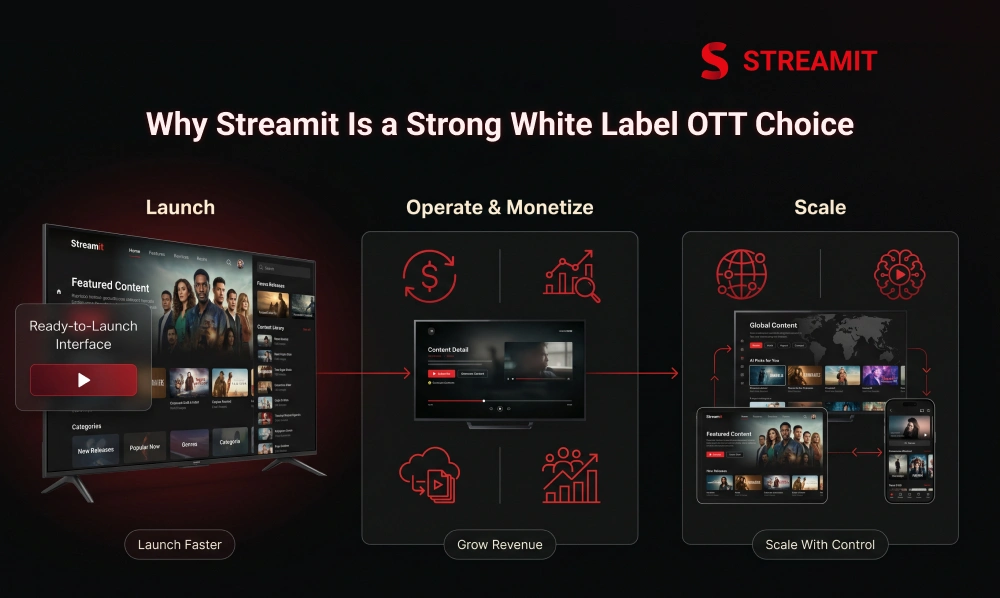
Streamit is built for teams that want faster launch paths without treating OTT as a cheap one-time setup.
The value is not only in launching. It is in helping businesses think through delivery, monetization, multi-device access, and future growth.
For serious founders, that matters. A streaming platform is not just a website with videos. It is a revenue system.
It Supports Multi-Device Apps, Monetization, and Better Streaming Delivery
Streamit helps businesses plan OTT experiences across web, mobile, and TV environments.
It also supports core business needs such as monetization, content management, secure access, and smoother streaming delivery.
It Gives Teams Faster Launch Paths Without Ignoring Long-Term Growth
Speed is useful only when the foundation can survive growth. Streamit’s approach is built around launch, growth, and scale.
That makes it suitable for teams that want to move quickly but still care about performance, ownership, and viewer experience.
It Fits Businesses That Need a Branded OTT Foundation Without Starting From Scratch
Some businesses do not need a fully custom platform immediately. They need a strong branded OTT foundation they can operate and grow from.
Streamit fits that middle path: practical enough for faster launch, but strategic enough for teams thinking beyond the first release.
Summary
Key Takeaways
White label OTT is strong for faster market entry
It helps businesses launch a branded streaming platform without building the full OTT stack from scratch – the biggest advantage is speed.
It is more than a branded video player
A complete white label OTT platform should include apps, CMS, monetization, DRM security, analytics, and reliable streaming delivery.
Speed is an advantage, but not the only decision factor
Teams must also check real app quality, CDN readiness, billing flexibility, support responsiveness, and long-term scalability before committing.
Customization limits appear after growth starts
Basic branding may feel sufficient at launch, but growing platforms often need deeper API access, workflow control, and front-end flexibility.
White label and custom OTT solve different problems
White label is better for speed and simplicity; custom OTT is stronger for deep control, unique workflows, and long-term product ownership.
The right choice depends on the next 12–24 months
Choose based on where the platform needs to go, not only what is needed on launch day. The first version should never block the second.
Conclusion
Conclusion
A white label OTT platform is a smart choice when speed, simplicity, and faster launch matter.
It helps you build a branded streaming experience without creating the full OTT stack from scratch. But the right decision depends on what your business needs to control, scale, and monetize over the next stage.
When your business needs a stable base to launch faster, a white label OTT platform can be a practical choice. If you need deeper product freedom and long-term architecture control, custom OTT may be the better path.
FAQs
Frequently Asked Questions
-
What do buyers usually misunderstand about white label OTT?
Many buyers think white label OTT gives unlimited flexibility, but it mainly gives faster launch, ready infrastructure, and provider-controlled customization.
-
How much customization is usually possible in white label OTT?
Most platforms allow branding, layout, content, monetization, and basic feature changes, but deeper control depends on the provider’s architecture.
-
What hidden costs show up after a white label OTT launch?
Hidden costs may appear in app updates, advanced features, integrations, storage, bandwidth, extra devices, and higher support tiers.
-
How do I know if a platform has real multi-device strength?
Test web, mobile, and TV apps separately because real quality shows in playback, login, search, payment, and navigation flow.
-
Why does API flexibility matter in white label OTT?
API flexibility matters because your business may later need custom workflows, CRM connections, reporting, billing logic, or front-end changes.
-
How do I judge whether a white label OTT platform is future-ready?
A future-ready platform should support scale, secure playback, multi-device apps, monetization, analytics, integrations, and clear upgrade paths.