OTT Solution for Broadcasters: Moving From TV to Streaming


Broadcasting is no longer limited to fixed schedules, fixed screens, and fixed distribution partners. Viewers still value live TV, but they now expect the same broadcaster to be available on mobile, web, smart TV, and connected devices.
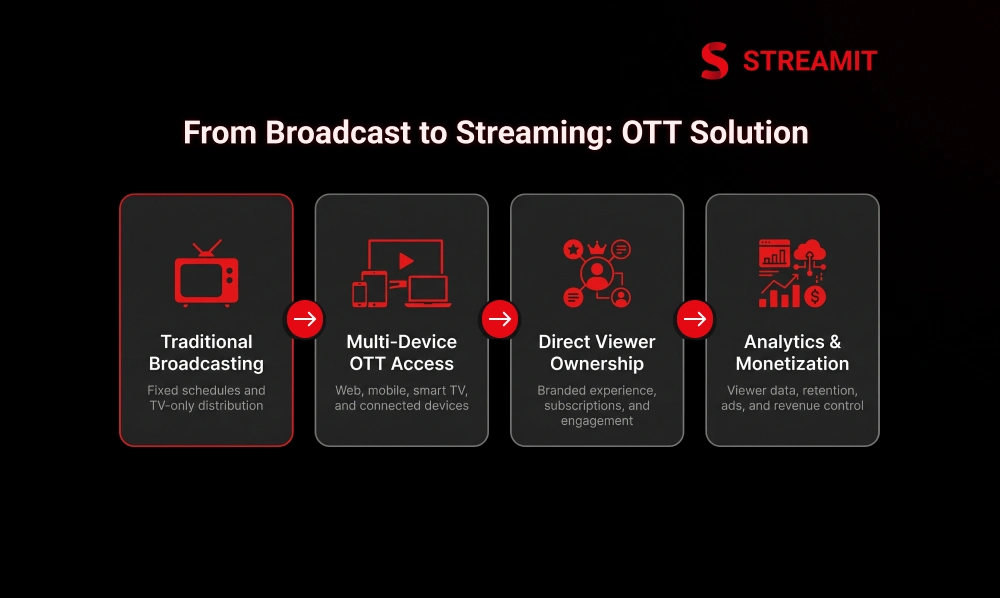
For broadcasters, the move to OTT is not just a technology upgrade. It is a shift toward direct audience ownership, better monetization, stronger analytics, and long-term platform control.
Part 1
Why Broadcasters Are Moving From TV to Streaming
Broadcasting is changing because viewer behavior has changed. People no longer want to wait for a fixed time slot when they can watch live, catch-up, or on-demand content from any device.
This is why an OTT solution for broadcasters is becoming a serious business decision. It helps broadcasters move from one-way TV distribution to a direct streaming model where they can control access, viewer experience, revenue, and data.
Traditional TV Reach Is Changing as Viewers Move to Internet-Based Streaming
The biggest shift is control. Viewers want to decide when, where, and how they watch. Traditional TV still works for live news, sports, and scheduled programming, but it no longer covers the full viewing journey.
A digital OTT solution helps broadcasters extend their reach beyond the TV screen. It allows them to keep the strength of live broadcasting while adding internet-based access for modern viewers.
OTT Gives Broadcasters Direct Access to Viewers Across More Devices
OTT platforms allow broadcasters to reach users through websites, mobile apps, smart TVs, and connected TV devices. This turns the broadcaster into a direct digital brand, not just a channel inside someone else’s distribution system.
A streaming app or OTT TV app also gives viewers a branded experience. The broadcaster controls the interface, content discovery, subscription flow, and viewer relationship.
The Shift Is About Revenue, Data, and Viewer Experience Too
OTT is not only about video delivery. It gives broadcasters more control over monetization, analytics, and user engagement.
With platform analytics, broadcasters can understand what people watch, where they drop off, which devices they use, and what content keeps them coming back.
Part 2
What Changes When Broadcasters Move From TV to OTT
Moving from TV to OTT changes how content is packaged, delivered, monetized, and measured. The broadcaster is no longer limited to fixed schedules or indirect distribution.
The real shift is from scheduled reach to flexible access. Live channels still matter, but they now sit beside catch-up TV, VOD libraries, premium events, clips, and personalized viewing journeys.
Content Moves From Scheduled Delivery to Live, Catch-Up, and On-Demand Access
Traditional TV depends on fixed timing. OTT allows broadcasters to offer live streaming, catch-up programs, and on-demand libraries from the same platform.
This increases content value. A show does not end after broadcast. It can become a catch-up episode, short clip, archive asset, or premium VOD title.
Viewer Relationships Move From Indirect Distribution to Direct Audience Access
In traditional TV, broadcasters often depend on third-party distributors for reach. OTT gives them a direct connection with viewers.
This direct access improves decision-making. Broadcasters can study viewing patterns, retention, device usage, and content performance in real time.
Revenue Moves Beyond Ads Into Subscriptions, PPV, FAST, and Hybrid Models
OTT opens more revenue models than traditional ad-led broadcasting. Broadcasters can combine subscriptions, advertising, pay-per-view, FAST channels, and hybrid access.
| Model | Best For | Benefit |
|---|---|---|
| Subscription | Premium channels and libraries | Recurring revenue |
| AVOD | Free access and reach | Larger audience base |
| Pay-per-view | Sports and events | High-value one-time revenue |
| FAST | Free linear channels | TV-like viewing habit |
| Hybrid | Mixed content | Multiple revenue streams |
Part 3
Step-by-Step Move From TV to Streaming
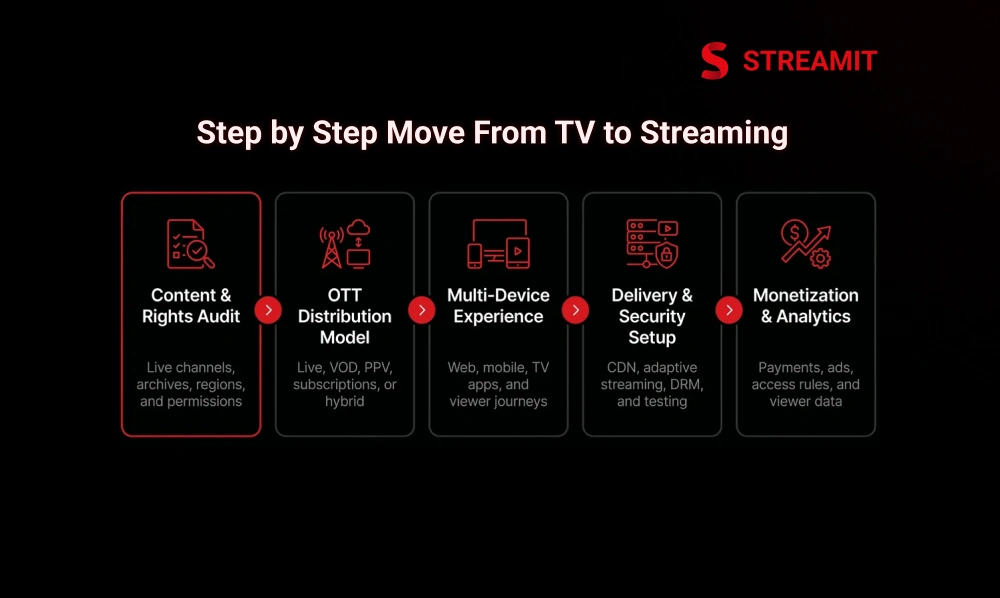
A broadcaster should not start OTT planning with app design. The stronger approach is to start with content rights, distribution model, device strategy, monetization, delivery infrastructure, and ownership.
This avoids a common mistake: launching quickly with a platform that looks fine at first but struggles with real viewers, real traffic, and real revenue.
-
1
Audit Your Content, Rights, and Audience First
Before asking which app to build, broadcasters should first clarify what content they are allowed to stream, in which markets, and for which audience. This includes reviewing live channels, archived programs, regional rights, sports rights, music usage, and premium content permissions. This content audit helps define the platform structure and prevents legal or operational issues later.
-
2
Separate Live Channels, Catch-Up Content, Archive Content, and Premium Events
Live channels, catch-up programs, VOD libraries, archives, and premium events need different workflows. Separating them early helps with pricing, access rules, recommendations, and content discovery.
-
3
Choose Your OTT Distribution Model Early
The OTT distribution model should match the broadcaster’s business goal. A news broadcaster may need live streaming and clips, while a sports broadcaster may need PPV, low-latency streaming, and peak traffic readiness. An entertainment broadcaster may need subscriptions, VOD, multilingual support, and smart TV apps. The model decides the roadmap.
-
4
Decide If You Need Live Linear Streaming, Catch-Up TV, VOD, FAST, or Hybrid
Live linear keeps the TV-style experience. Catch-up supports missed programs. VOD gives full viewing control. FAST and hybrid models help broadcasters mix free access, ads, and premium content.
-
5
Plan the Viewer Experience Across Devices
OTT website design, mobile UX, and TV app navigation should be planned together. Viewers should quickly understand what is live, what is new, what is paid, and what they can continue watching. A weak interface reduces watch time. A clear interface helps viewers move from discovery to playback without confusion.
-
6
Map Home Screen, EPG, Search, Content Detail Pages, and Playback Flow
The home screen should guide viewers. The EPG should make live schedules simple. Search, detail pages, watchlists, and playback should feel connected across devices.
-
7
Set Up Delivery, Security, and Playback Before Launch
Buffering is not a design issue. It is an architecture issue. Broadcasters need CDN planning, adaptive streaming, transcoding, DRM, and device testing before launch. Stable playback becomes especially important during sports, breaking news, live events, and premium releases.
-
8
Plan CDN, Multi-Bitrate Streaming, DRM, and Device Compatibility
A video CDN helps deliver content faster. Multi-bitrate streaming adjusts video quality based on internet speed. DRM protects premium content, and device testing ensures the platform works across mobile, web, and TV apps.
-
9
Add Monetization, Analytics, and Ad Tech Into the Product
Monetization should not be added later as a patch. Payment gateways, subscriptions, ads, coupons, PPV rules, and access control should be part of the product plan. Analytics should also be built early. Broadcasters need to track watch time, drop-offs, active users, device behavior, content performance, and revenue patterns.
Part 4
Core Features Every OTT Solution for Broadcasters Needs
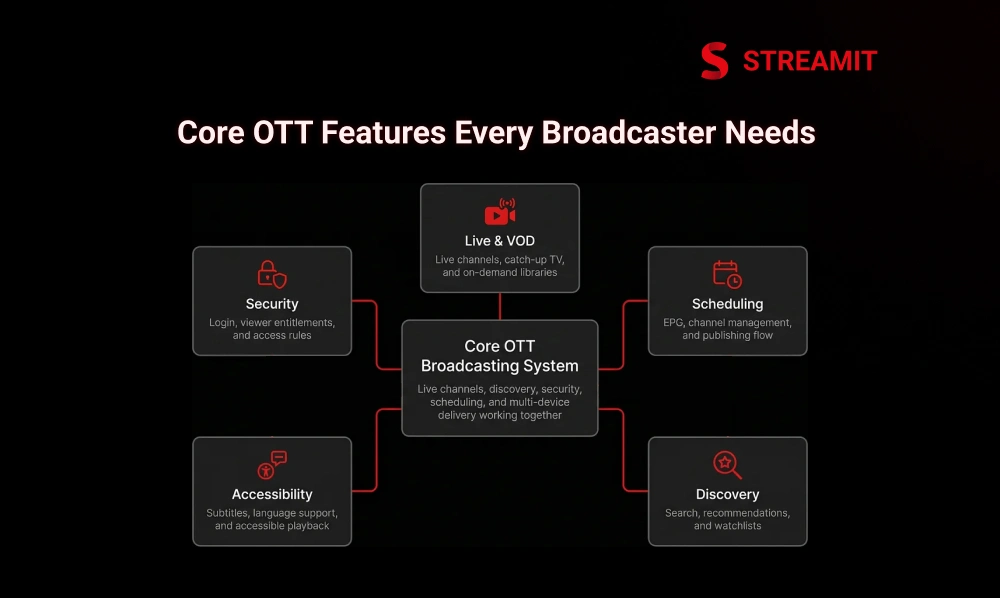
A serious OTT solution for broadcasters needs more than upload and playback. It needs systems for live channels, scheduling, user access, subscriptions, analytics, recommendations, security, and multi-device delivery.
If one part is weak, the viewer feels it quickly through poor discovery, login issues, payment friction, buffering, or limited device support.
| Feature Area | What It Includes |
|---|---|
| Live and VOD | Live channels, catch-up TV, and on-demand library |
| Scheduling | EPG, channel management, publishing flow |
| Discovery | Search, recommendations, watchlists |
| Accessibility | Subtitles, language support, accessible playback |
| Security | Login, access rules, viewer entitlements |
Live Linear Streaming, Catch-Up TV, and On-Demand Library
Live linear streaming keeps the familiar broadcast experience. Catch-up TV gives viewers access to missed programs. An on-demand library extends content value beyond the original broadcast window.
Electronic Program Guide, Scheduling, and Channel Management
An electronic program guide helps viewers understand what is live and what is coming next. Scheduling tools help broadcasters manage programming from the backend.
Search, Recommendations, Continue Watching, and Watchlists
Viewers do not always know what they want to watch. Search, recommendations, continue watching, and watchlists reduce friction and improve engagement.
Multi-Language Audio, Subtitles, and Accessibility
Broadcasters serving regional or global audiences need subtitles, multi-language audio, and accessibility support. These features help content reach more viewers.
Secure Login, Access Rules, and Viewer Entitlements
Secure login protects users. Access rules decide who can watch which content based on plan, region, device, subscription, or event access.
Part 5
Streaming Technology Broadcasters Need for Stable OTT Delivery
The technical side of OTT decides whether viewers trust the platform. A good-looking app will not matter if the stream fails during a major live moment.
Broadcasters need streaming infrastructure that supports adaptive playback, CDN delivery, encoding, transcoding, DRM, backend logic, and failover readiness.
Adaptive Bitrate Streaming and Multi-Bitrate Encoding
Adaptive bitrate streaming helps video quality adjust based on the viewer’s internet connection. This reduces buffering and improves playback consistency.
Multi-bitrate encoding prepares the same video in different quality levels so the player can switch smoothly when network strength changes.
Use HLS or DASH Based on Device Support and Playback Need
HLS and DASH are common streaming formats. The right choice depends on device support, DRM requirements, playback goals, and the broadcaster’s long-term platform roadmap.
CDN, Multi-CDN, and Failover for Peak Traffic
A CDN helps deliver video from locations closer to viewers. This improves speed and reduces pressure on origin servers.
For live sports, news, and major events, multi-CDN and failover planning are important. If one route struggles, the platform should have a backup path.
Reduce Buffering During Sports, News, and Large Live Events
Peak traffic reveals weak infrastructure fast. Broadcasters should plan load balancing, monitoring, low-latency delivery, and failover before the event starts.
Cloud Playout, Transcoding, and Recording Workflows
Cloud playout helps broadcasters manage live channels and programming through cloud-based workflows. Transcoding converts video into formats suitable for different devices and internet speeds.
Recording workflows also help turn live content into catch-up TV, VOD, clips, and archives.
APIs and Backend Systems for Users, Metadata, Billing, and Playback Logic
The backend controls much of the OTT experience. User accounts, metadata, billing, device limits, access rules, and playback logic all need reliable systems.
This is why OTT platform architecture matters. The visible app is only one layer. The real platform sits behind it.
Part 6
OTT Monetization Options for Broadcasters
OTT gives broadcasters more monetization flexibility than traditional TV. Instead of depending on one model, they can combine subscriptions, ads, PPV, FAST channels, and hybrid access.
The right model depends on content value and audience behavior. Premium content may support subscriptions, while free channels may perform better with ads.
Subscription Models for Premium Channels and Libraries
Subscriptions work well when viewers see ongoing value. Premium channels, exclusive shows, education content, and niche libraries can support recurring revenue.
Ad-Supported Models for Reach and Free Access
Ad-supported streaming works when the broadcaster wants to reach without asking every viewer to pay. This is useful for news, regional entertainment, and free content libraries.
Pay-Per-View for Sports, Events, and Premium Releases
Pay-per-view is useful for high-demand events such as sports, concerts, conferences, and exclusive releases. The platform must handle access, payment, and live traffic properly.
FAST and Hybrid Models for Multiple Revenue Streams
FAST channels create a free TV-like streaming experience supported by ads. Hybrid models help broadcasters combine free access, paid plans, and premium events.
Part 7
What Broadcasters Usually Underestimate When Moving to OTT
Many broadcasters focus on the app, website, and player. But the hidden work often decides whether the OTT platform succeeds after launch.
Metadata, TV app updates, content packaging, analytics, support, and infrastructure monitoring become ongoing responsibilities. OTT is a long-term operating system, not a one-time launch.
-
Metadata and Content Packaging Matter as Much as Video Quality
Good content can underperform if viewers cannot find it. Titles, thumbnails, descriptions, genres, and tags all affect discovery. Metadata also improves recommendations, analytics, and content organization.
-
App Store Work, Device Updates, and TV Support Become Ongoing Jobs
OTT apps need ongoing maintenance. Mobile updates, smart TV updates, app store reviews, OS changes, and device testing continue after launch.
-
Audience Data Ownership Changes the Business Model
First-party data helps broadcasters understand watch time, churn signals, content performance, and subscription behavior. This improves programming, pricing, and retention decisions.
-
Weak Support Hurts Most During Peak Live Moments
Support matters most when traffic is highest. A live sports final, breaking news event, or premium release cannot afford slow response times.
Part 8
Cost, Timeline, and Build Model for Broadcaster OTT Projects
OTT platform cost depends on product depth, not just screen count. A simple VOD website is very different from a full broadcaster OTT platform with live channels, DRM, TV apps, ads, subscriptions, and analytics.
Broadcasters should plan costs around business needs. The right build model should offer speed, control, and flexibility without forcing a rebuild too early.
What Changes Timeline: Channels, Apps, DRM, Ads, and Live Features
Timeline changes with the number of channels, devices, DRM needs, ad systems, live workflows, and custom backend logic. A phased roadmap often works better than launching everything at once.
What Changes Cost: Device Reach, Infrastructure, and Monetization Complexity
| Cost Driver | Why It Matters |
|---|---|
| Device coverage | More apps need more testing |
| Live streaming | Needs stronger delivery |
| DRM | Adds protection complexity |
| Monetization | Adds billing and access logic |
| Analytics | Needs tracking and dashboards |
White-Label vs Custom Build vs Managed OTT Partner
White-label can be faster for simple launches. Custom builds give more control. A managed OTT partner can work well when broadcasters need strategy, development, support, and scaling together.
Part 9
How to Choose the Right OTT Solution for Broadcasters
Choosing an OTT solution provider is not the same as hiring a general app team. Broadcasters need a partner who understands live delivery, rights, playback, monetization, analytics, TV apps, and post-launch operations.
The right provider should think beyond launch. The platform must support real viewers, real traffic, real revenue, and future expansion.
Broadcast Workflow Experience
Broadcast OTT involves live schedules, content rights, access rules, and media workflows. A provider should understand these before recommending features.
Live Delivery and Playback Quality
Playback quality, latency, CDN setup, failover, and TV app readiness matter because many viewers still prefer long-form content on larger screens.
Monetization and Rights Management
The provider should support subscriptions, ads, PPV, payment gateways, analytics, DRM, and content access control.
Post-Launch Support and Ownership
OTT does not end at launch. Broadcasters need updates, monitoring, scaling, new features, and ownership over the platform roadmap.
Part 10
Why Streamit Is a Strong OTT Solution for Broadcasters
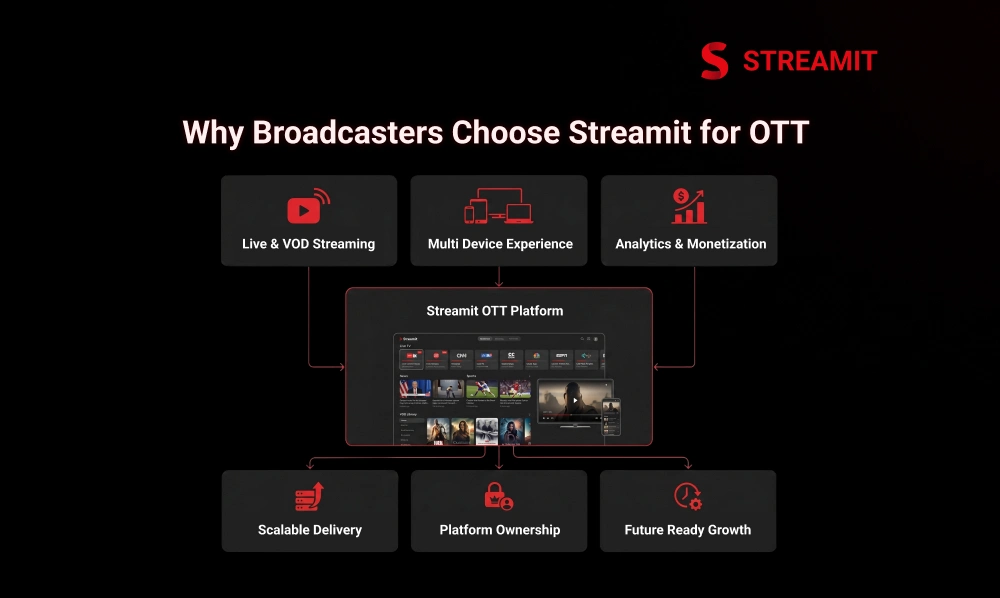
Streamit is built for broadcasters who want more than a basic streaming app. It supports live, VOD, multi-device viewing, monetization, analytics, and scalable OTT platform architecture.
For broadcasters moving from TV to streaming, Streamit connects the important parts of the business: content delivery, viewer experience, access control, revenue systems, and long-term platform growth.
-
Supports Live, VOD, and Multi-Device Viewer Experiences
Streamit supports live streaming, on-demand libraries, and multi-device access across web, mobile, and TV viewing journeys.
-
Connects Delivery, Monetization, Analytics, and Retention
Streamit helps broadcasters connect playback, revenue, analytics, and viewer engagement into one stronger streaming system.
-
Gives Broadcasters Room to Grow Without Rebuilding Later
Many OTT platforms work at launch but become limited later. Streamit is designed with scalability, ownership, and future upgrades in mind.
Summary
Key Takeaways
OTT Is a Business Shift, Not Just a Tech Upgrade
Broadcasters moving to OTT are shifting from fixed TV distribution to direct viewer relationships across web, mobile, smart TV, and connected devices.
Direct Audience Ownership Changes Everything
A strong OTT solution gives broadcasters control over content access, viewer data, monetization, analytics, playback quality, and long-term platform growth from one system.
Live TV Alone Is No Longer Enough
Broadcasters now need live streaming, catch-up TV, VOD libraries, premium events, and multi-device access to match modern viewer behavior.
Infrastructure Decides Viewer Trust
CDN planning, adaptive bitrate streaming, transcoding, DRM, device testing, and failover support are critical for reducing buffering during peak live moments.
Monetization Must Be Built In From Day One
Subscriptions, ads, pay-per-view, FAST channels, and hybrid models work best when they are built into the OTT platform from the beginning – not patched in after launch.
Choose a Partner Who Understands Broadcast OTT
Broadcasters need more than a general app team. The right partner understands live delivery, TV apps, rights management, analytics, scalability, and post-launch support.
Conclusion
Conclusion
Moving from TV to streaming is one of the most important shifts broadcasters can make. It protects the strength of traditional broadcasting while creating a direct digital relationship with modern viewers.
A strong OTT streaming solution should give broadcasters control over content, users, revenue, data, and future growth. With the right architecture and partner, OTT becomes the next stage of the broadcasting business.
FAQs
Frequently Asked Questions
-
When should a broadcaster move from TV to OTT?
A broadcaster should move to OTT when viewers want access beyond scheduled TV and the business needs direct audience data, flexible monetization, and multi-device reach.
-
Do broadcasters need live, catch-up, and VOD together?
Most broadcasters benefit from all three because each supports a different viewing habit. Live keeps the channel experience, catch-up supports missed programs, and VOD extends content value.
-
What is the biggest OTT mistake broadcasters make early?
The biggest mistake is treating OTT as only an app project. The real work includes rights, metadata, infrastructure, monetization, analytics, devices, and post-launch support.
-
What helps reduce buffering during live sports and news?
Adaptive bitrate streaming, CDN planning, multi-bitrate encoding, failover systems, and device testing help reduce buffering during peak viewing moments.
-
How does DRM protect broadcaster content?
DRM protects premium video by controlling access and reducing unauthorized viewing. It is important for subscriptions, PPV events, licensed content, and premium libraries.
-
Which monetization model fits broadcasters best?
The best model depends on the content and audience. Subscriptions, ads, PPV, FAST, and hybrid models can all work when matched to the right content strategy.
-
How do broadcasters choose the right OTT solution provider?
Broadcasters should choose a provider with experience in live delivery, TV apps, monetization, analytics, DRM, and post-launch support. General app experience is not enough.
Read Also
Read Also
1. OTT Monetization: AVOD vs SVOD vs TVOD vs FAST Compared
2. HLS vs DASH: What It Means for Streaming Buffering & Retention
3. How to Create Your Own OTT Platform From Scratch
4. 11 Ways to Improve Streaming Performance & Reduce Buffering
5. OTT Retention: The Biggest Lie Streaming Platforms Tell Themselves