7 Ways AI Improves Content Recommendations on OTT Platforms


Most OTT platforms do not lose users because they lack content. They lose users because the right content stays hidden. When viewers cannot quickly find something worth watching, they leave before the platform gets a real chance.
AI-powered recommendations help OTT platforms show more relevant content based on viewing history, preferences, and user behavior. A recommendation engine uses historical data and user preferences to suggest content users are more likely to engage with.
For OTT founders, this is not just about personalization. It directly affects watch time, retention, content discovery, and revenue growth.
Context
Why OTT Platforms Need AI-Powered Recommendation Systems
In 2026, streaming growth is not just a content problem. It is a discovery problem. Viewers now move across apps, devices, formats, and subscription choices faster than most platforms are designed to handle.
For OTT businesses, the real question is not “How much content do we have?” The better question is “How fast can the right viewer find the right content?” That is where AI-powered OTT content recommendation becomes a serious retention layer, not a nice extra.
Content Overload and Discovery Problems in OTT Platforms
More content can quietly reduce watch time if discovery is weak. When users open an OTT platform and see too many rows, unclear categories, or repeated titles, browsing turns into an effort.
This creates a direct OTT user experience problem. The platform may have strong content, but if the user cannot find something relevant quickly, they may leave before pressing play.
Why Traditional Recommendations Are No Longer Enough
Basic recommendations usually react to popularity, not personal intent. Trending rows, editor picks, and manual lists can work for early libraries, but they do not scale well when user behavior becomes more complex.
A basic recommendation system may show the same content to everyone. That limits discovery, ignores context, and often pushes high-performing content while hiding niche titles that could build loyalty.
How AI Improves Personalization and Retention
AI improves retention by reducing the distance between opening the app and starting playback. It studies viewing history, search behavior, completion rate, genres, devices, and timing patterns to understand what each user is likely to watch next.
This matters because churn is now a serious business pressure. Deloitte’s 2026 digital media data shows 41% of consumers overall had canceled an SVOD service in the previous six months, with millennials at 52%.
Technology
How AI Recommendation Engines Work in OTT Platforms
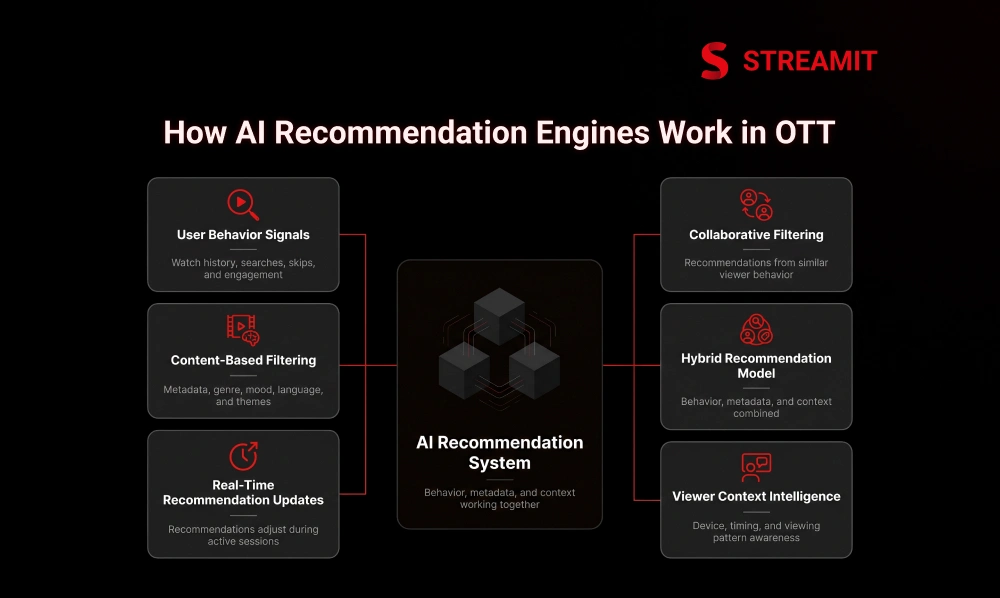
A good AI recommendation engine is not one model. It is a decision system. It connects user behavior, content metadata, viewing context, and business goals to create a smarter streaming experience.
At scale, this system keeps learning. It not only recommends what is popular; it recommends what is relevant, timely, and likely to move the viewer deeper into the platform.
Collecting and Understanding User Behavior
Every click tells a small part of the viewing story. AI systems learn from watching history, search terms, skipped titles, completed episodes, likes, watchlist activity, language preferences, and device usage.
The purpose is not to gather data endlessly, but to turn the right data into better content matching, smoother discovery, and stronger viewer engagement. The goal is to turn user behavior data into better content matching, smoother discovery, and stronger session depth.
Machine Learning Models Behind OTT Recommendations
Most serious recommendation systems combine more than one method. Collaborative filtering studies similar user behavior, while content-based filtering studies title attributes such as genre, cast, mood, language, and topic.
Hybrid recommendation systems combine both approaches to improve accuracy and reduce weak spots like the cold start problem. IBM explains recommendation engines as systems that use data and machine learning patterns to suggest relevant items to users.
| Recommendation Model | What It Uses | Best For | Limitation |
|---|---|---|---|
| Collaborative filtering | Similar user behavior | Finding content liked by similar users | Weak for new users |
| Content-based filtering | Title metadata and user history | Matching similar content | Can limit variety |
| Hybrid model | Behavior + metadata + context | Better personalization at scale | Needs a stronger data infrastructure |
Real-Time Recommendation Updates
Streaming behavior changes inside the same session. A viewer may start with comedy, shift to short-form drama, then move to live content later in the day.
Real-time recommendation updates help the platform adjust while the user is still active. Google Cloud also positions real-time personalization as a core capability of modern recommendation systems.
Core Strategies
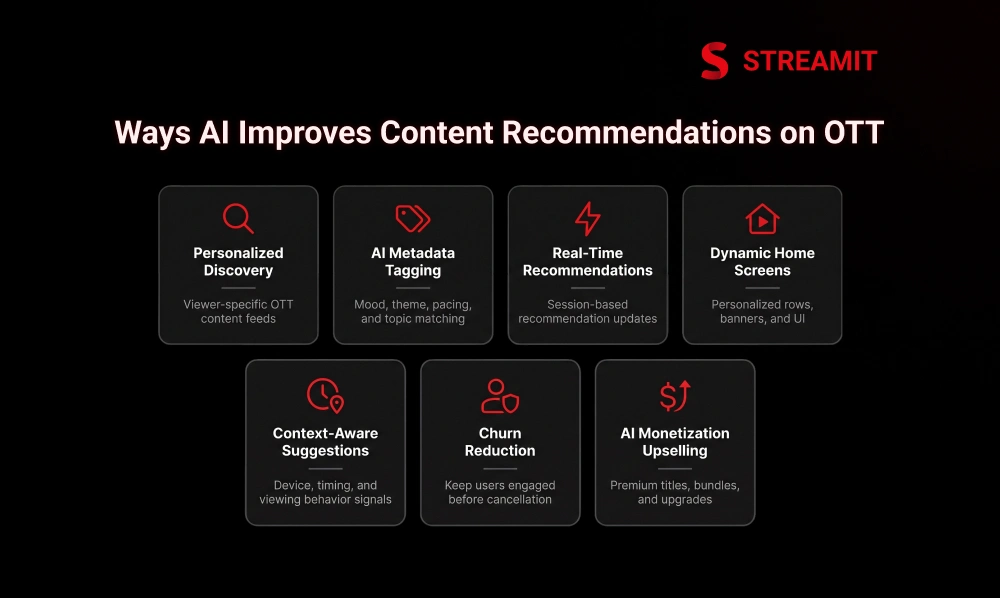
7 Ways AI Improves Content Recommendations and Watch Time
AI does not improve watch time by forcing more content in front of users. It improves watch time by making the next decision feel easier.
For OTT founders, this is the practical value. Better recommendations can improve discovery, engagement, retention, monetization, and content ROI without turning the product into a noisy dashboard.
1. Personalized Content Discovery for Every User
Two users should not see the same platform if their habits are different. AI creates a personalized OTT feed based on viewing behavior, content preferences, watch time, and interaction signals.
This helps users feel that the platform understands them. The more relevant the first screen feels, the more likely they are to continue browsing, start watching, and return later.
2. AI-Based Metadata Tagging for Better Content Matching
Weak metadata creates weak recommendations. If content is only tagged as “drama” or “action”, the recommendation system has very little to work with.
AI-based metadata tagging can identify mood, theme, scene type, language, pacing, characters, topics, and content depth. This makes content categorization more useful and improves matching across large libraries.
3. Real-Time Recommendations That Increase Engagement
A viewer’s current action is often more valuable than their old history. If someone skips three slow titles and watches two fast-paced episodes, the system should learn from that quickly.
Real-time recommendations help OTT platforms adjust rows, search suggestions, and next-watch prompts during the same session. This keeps engagement active instead of waiting for tomorrow’s data.
4. Personalized Home Screens and Dynamic UI
The homepage is not just a design. It is a retention tool. A personalized homepage can change rows, banners, thumbnails, collections, and continue-watching placements based on user behavior.
Dynamic UI helps the platform feel more relevant without overwhelming the viewer. For serious OTT businesses, homepage personalization becomes part of the product strategy, not just the interface layer.
5. Context-Aware Recommendations Based on User Behavior
Context changes what “relevant” means. A user watching on mobile during a commute may want shorter content, while the same user on a TV at night may prefer long-form viewing.
Context-aware AI can consider device, time, location signals, session length, language, profile type, and viewing pattern. This creates a more adaptive streaming experience.
6. AI Helps Reduce Churn and Improve Retention
Churn often starts before cancellation. It starts when the platform stops feeling useful. If users repeatedly fail to find content, they slowly disconnect from the product.
AI recommendation engines help reduce churn by keeping the content journey active. Parks Associates reported annualized churn rates greater than 30% across streaming video, which makes retention systems a business priority.
7. AI-Driven Monetization and Content Upselling
Personalization can improve revenue without making the platform feel pushy. AI can recommend premium titles, pay-per-view content, subscription upgrades, or bundles based on genuine user interest.
This is important for SVOD, AVOD, TVOD, and hybrid models. The stronger the content match, the better the chance of increasing watch time, ad inventory, upgrades, and paid access.
| AI Use Case | Impact on the Viewer | Impact on Business |
|---|---|---|
| Personalized feed | Faster discovery | Higher watch time |
| Smart metadata | Better content matching | Stronger library usage |
| Dynamic homepage | More relevant experience | Better retention |
| Context-aware rows | Better session fit | More engagement |
| Upsell recommendations | Useful paid suggestions | Higher revenue potential |
Challenges
Challenges in AI Recommendation Systems
AI recommendations are powerful, but they are not magic. Poor data, weak tagging, limited infrastructure, and unclear product goals can create poor results.
The strongest OTT platforms treat recommendation systems as long-term infrastructure. They test, measure, adjust, and improve instead of expecting one model to solve every discovery problem.
The Cold Start Problem for New Users
New users do not arrive with enough behavior history. This makes it harder for the platform to personalize recommendations from the first session.
A practical solution is to use onboarding choices, location-level preferences, content metadata, trending behavior, and early clicks. The first few minutes should help the system learn quickly.
Balancing Personalization With Content Discovery
Too much personalization can create a narrow viewing loop. If the platform only shows what users already watch, it may limit discovery and reduce content diversity.
A stronger system balances relevance with exploration. It should recommend familiar content, but also introduce fresh titles, new genres, and hidden catalog value.
Data Privacy and User Trust
Personalization only works when users trust the platform. OTT businesses must be careful with user data, consent, transparency, and security.
The goal is not to track everything. The goal is to use responsible data practices to improve the experience while protecting viewer confidence.
Best Practices
Best Practices for Implementing AI Recommendation Systems
A recommendation engine should be built around business goals, not just technical curiosity. Before building the system, OTT teams should first decide what they want to improve: watch time, retention, upsells, content ROI, or better discovery.
This clarity matters because every model needs direction. A system built for engagement may behave differently from one built for monetization or content diversity.
Using Hybrid Recommendation Models
Hybrid models are usually stronger because OTT behavior is layered. Viewers are influenced by personal history, similar users, content metadata, timing, device, and mood.
A hybrid recommendation system gives the platform more ways to understand intent. It also reduces dependency on only one data source.
Building Scalable Data Infrastructure
AI recommendations fail when the data layer is weak. OTT platforms need clean events, reliable analytics, structured metadata, fast processing, and scalable storage.
This is why infrastructure matters early. If the platform is not built to capture and process behavior properly, personalization becomes limited later.
Continuous Testing and Optimization
The first recommendation model is rarely the final one. OTT teams should test rows, ranking logic, thumbnails, search results, onboarding inputs, and homepage layouts.
A/B testing helps identify what actually improves user behavior. Without testing, platforms may confuse attractive design with real engagement.
Business Impact
How AI Impacts OTT Growth and Revenue
AI recommendations connect product experience with business growth. They help users watch more, return more often, and discover content that would otherwise stay buried.
For OTT operators, this means recommendations affect more than the homepage. They influence retention, monetization, content planning, and long-term platform value.
Higher Engagement and Longer Watch Sessions
The easiest way to grow watch time is to reduce wasted browsing time. When users find relevant titles faster, they spend less time searching and more time watching.
This supports binge watching, repeat sessions, and better content discovery. It also improves the perceived value of the platform.
Improved Subscriber Retention
Retention improves when the platform keeps proving its value. A viewer who consistently finds good content has fewer reasons to cancel.
AI helps OTT teams identify early signs of disengagement. This can support better win-back flows, personalized reminders, and smarter content placement.
Better Content ROI Through Data Insights
A content library is only valuable when users can discover it. AI can show which titles attract attention, where users drop off, and what content drives repeat sessions.
These insights help teams make better programming, acquisition, and production decisions. It turns content planning into a data-backed process instead of guesswork.
Platform
Building an AI-First OTT Platform With Streamit
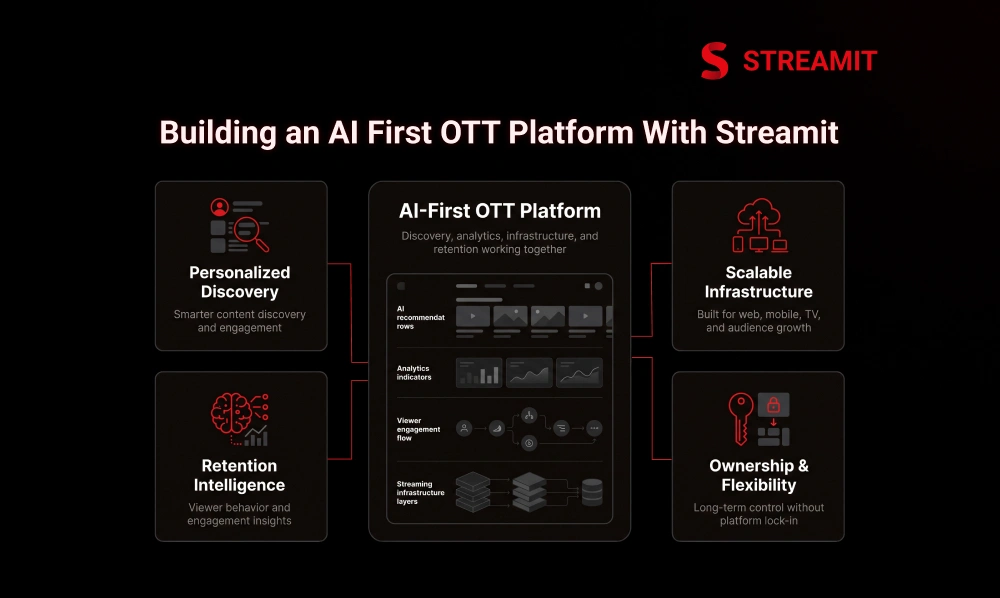
AI-first streaming means intelligence is part of the platform foundation, not a feature added at the end. Streamit is positioned for businesses that want better discovery, analytics, retention signals, infrastructure, and long-term ownership.
For founders, this matters because recommendation systems depend on the full stack. The content layer, data layer, app experience, analytics, and infrastructure must work together.
Personalized Content Discovery and Viewer Engagement
Streamit helps OTT businesses think beyond launch. Personalized content discovery can support smarter rows, better search behavior, stronger recommendations, and higher viewer engagement.
The goal is practical. Viewers should find relevant content faster, and platform owners should understand what keeps users watching.
Scalable Infrastructure for Modern OTT Platforms
Personalization needs an infrastructure that can handle real traffic. Streamit focuses on scalable OTT platform architecture across web, mobile, TV, and connected devices.
This is important because AI systems become more valuable as the audience grows. The foundation should support content growth, user growth, and data growth together.
Why Streamit Fits Growing OTT Businesses
Growing OTT businesses need control, not lock-in. Streamit is built around ownership, flexibility, performance, and long-term platform growth.
This makes it a better fit for founders who need a scalable OTT platform, not just another standard streaming app. It fits teams that care about retention, monetization, infrastructure, and future product control.
Decision Guide
Choosing the Right AI-Powered OTT Solution
The right OTT solution should support where the business is going, not only where it is today. AI recommendations become more important as the library, audience, and monetization model grow.
A serious platform should support personalization, multi-device delivery, analytics, scalability, and ownership. Without these layers, recommendation features can stay shallow.
Built-In AI Recommendation Capabilities
AI recommendation capabilities should be built into the product logic. They should connect with user profiles, content metadata, watch history, search, analytics, and monetization flows.
This creates an end-to-end OTT solution where personalization is part of the viewer journey. It also helps teams improve recommendations over time.
White-Label Personalization Features
White-label personalization should still feel custom to the business. The platform should allow different content rules, audience segments, branding, monetization models, and content priorities.
This helps OTT businesses avoid a generic experience. The platform feels owned, not rented.
Multi-Device Personalized Experience
Users do not think in devices. They think in continuity. A viewer may start on mobile, continue on TV, and return later on desktop.
A strong OTT TV app and streaming app experience should keep recommendations consistent across devices. Cross-platform personalization helps the platform feel connected.
Summary
Key Takeaways
Discovery Is the New Growth Lever
The global OTT market is projected to reach USD 383.52 billion in 2026. Platforms that solve discovery with AI will win more watch time, retention, and revenue than those that rely on content volume alone.
AI Makes Content Recommendations Personal
A strong AI recommendation engine learns from viewing history, preferences, and real-time behavior to surface the right content for each individual user – not just the most popular titles.
Retention Follows Personalization
When users consistently find content that matches their interests, they have fewer reasons to cancel. AI helps OTT teams spot early disengagement signals and keep the content journey active.
Metadata Quality Drives Match Quality
Genres, tags, mood, language, cast, and content categories give AI more to work with. Strong metadata tagging is the foundation of accurate content recommendations across large libraries.
Real-Time Signals Outperform Historical Data
What a user does right now – skipping, rewatching, pausing – is more predictive than what they watched last week. Real-time AI adjustments keep engagement high within the same session.
AI Recommendations Need Continuous Optimization
The first model is rarely the best one. OTT teams must test, measure, and refine recommendation logic alongside a clean, scalable data infrastructure for lasting results.
Conclusion
Conclusion
The next stage of OTT growth will not be won by the biggest library alone. It will be won by platforms that help users find the right content at the right moment with the least friction.
AI-powered recommendations help turn a streaming app into a smarter streaming business. For founders building seriously, this is not just a feature decision. It is a platform strategy decision.
FAQs
Frequently Asked Questions
-
What is an AI-powered content recommendation system in OTT platforms?
An AI-powered content recommendation system studies viewer behavior, content metadata, and preferences to suggest relevant movies, shows, or videos. It helps users discover content faster and improves engagement.
-
How does AI improve content recommendations on OTT platforms?
AI improves recommendations by learning from watch history, searches, skips, completion rates, and user context. This helps the platform show more relevant content instead of only popular or manual picks.
-
Can AI recommendation systems reduce churn in OTT platforms?
Yes, AI can help reduce churn by making the platform feel more useful and personal. When users find relevant content consistently, they have fewer reasons to leave.
-
What is a hybrid recommendation system in OTT platforms?
A hybrid recommendation system combines user behavior, similar-user patterns, and content metadata. This makes recommendations more accurate than using only one method.
-
How does AI recommendation improve OTT monetization and revenue?
AI can recommend premium titles, upgrades, pay-per-view content, and personalized offers based on user interest. This improves revenue potential without making the experience feel forced.
-
How do personalized recommendations improve content ROI?
Personalized recommendations help more users discover more of the content library. This increases the value of existing content and gives teams better insight into what performs.