Streamit vs Generic OTT App Development: What’s Different?


A streaming app can launch in weeks, but a streaming business is judged over months. Generic OTT app development usually focuses on what users can see: home screens, login pages, category pages, player screens, subscription pages, and basic admin panels.
Streamit takes a different route. It looks at the platform as a full business system, not just an app interface. That means architecture, playback, content delivery, monetization, analytics, AI recommendations, security, and long-term ownership are planned together from the start.
Part 1
Why Most OTT App Projects Struggle After Launch
The first 30 days after launch often hide the real platform problems. A generic streaming app may look fine during demos because only a few users are testing it, the content library is small, and traffic is controlled.
The struggle usually starts when users grow, content increases, and different devices behave differently.
Generic OTT Builds Usually Begin With Features, Not Foundation
Most generic OTT app development begins with visible features. The discussion usually revolves around app design, menus, content pages, video player, login, subscriptions, and admin upload.
Those things matter, but they are only the viewer layer. A polished interface cannot compensate for weak playback logic, poor content delivery, missing analytics, or limited backend control.
A Streaming App Alone Does Not Build a Streaming Business
A streaming app helps users access content. A streaming business needs revenue systems, audience data, content intelligence, retention planning, and reliable operations.
This is where many projects become limited. The app exists, but the business has no strong system to understand users, reduce churn, improve discovery, or scale revenue.
Real Problems Begin When Users, Content, and Traffic Grow
Growth exposes architecture. More users create a load. More videos create storage and delivery pressure. More subscriptions create billing complexity.
A basic OTT app may work at launch, but growth starts asking harder questions: Can playback stay smooth? Can the platform handle peak traffic?
Part 2
The Main Difference Between Generic OTT Development and Streamit
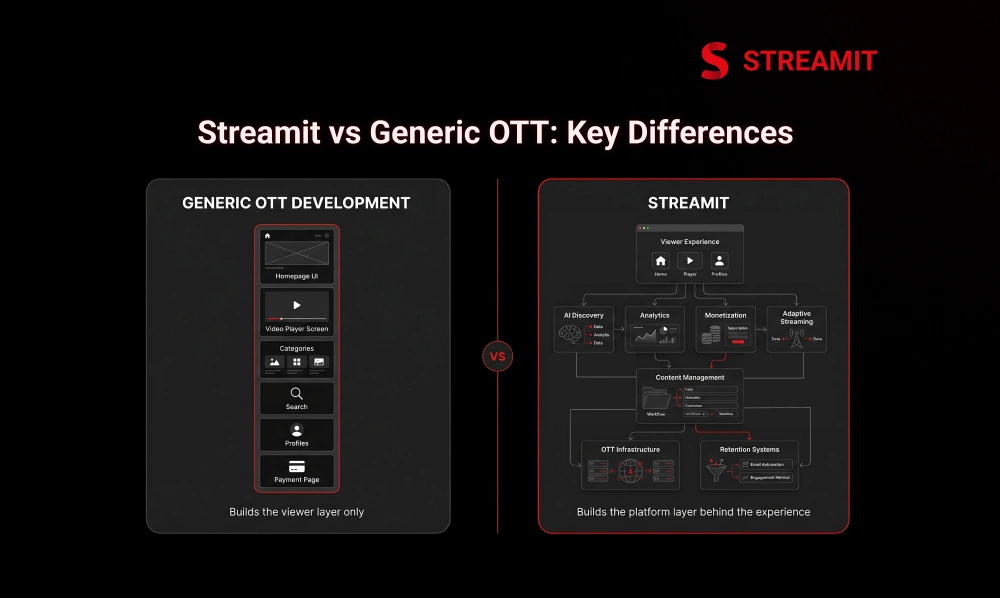
Generic OTT development usually builds the app. Streamit builds the operating system behind the app.
A generic build focuses on delivery. Streamit focuses on performance, intelligence, ownership, monetization, and long-term control.
Generic Development Builds the Viewer Layer
The viewer layer includes the screens people interact with: homepage, watch page, search, categories, profiles, and payment pages.
This layer is important, but it is not enough. If the backend, delivery, analytics, and retention systems are weak, the viewer experience eventually breaks.
Streamit Builds the Platform Layer Behind the Experience
Streamit focuses on the systems users may never notice directly, but always feel. These include video delivery, adaptive streaming, AI discovery, analytics, content management, access control, and monetization logic.
The goal is not just to make the app usable. The goal is to make the platform stable, measurable, and ready for serious growth.
Streamit Connects Product, Infrastructure, Revenue, and Retention
A strong OTT platform is not one department. It is a connected system. Product decisions affect engagement. Infrastructure affects playback. Analytics affects retention. Monetization affects lifetime value.
Streamit connects these layers so the platform is built around business outcomes, not just development output.
Part 3
Why App-First OTT Builds Create Long-Term Limits
A low-cost, app-first OTT build can feel practical at the beginning, but it often becomes costly as the business scales. The real expense shows up later through technical rework, performance gaps, migration challenges, and users dropping off.
The problem is that the platform was never planned as a scalable business system.
Weak Architecture Makes Scaling Expensive
A weak architecture may seem fine in the early stage, but growth exposes every hidden gap. As traffic increases, even small technical limits become harder and more expensive to fix.
Rebuilding payment flows, content structures, user roles, playback systems, or analytics after launch costs more than planning them properly early.
Poor Playback Planning Hurts Watch Time
Playback is one of the most important parts of any streaming platform. Users may forgive a simple design, but they rarely forgive constant buffering or playback errors.
Streamit treats playback as a core business function because watch time depends on delivery quality, adaptive streaming, transcoding, CDN planning, and device behavior.
Missing Analytics Makes Retention Hard to Improve
Basic reports can show views, users, and revenue. They often cannot explain why viewers stopped watching or why subscribers cancelled.
A strong OTT business needs data that links viewing habits with product improvements and monetization strategy.
Part 4
Generic OTT Apps Start With UI. Streamit Starts With Architecture.
The interface is what users see, but architecture is what keeps the business alive. Generic OTT apps often begin with design layouts and feature lists.
Streamit begins by mapping how the platform should work under real conditions: content flow, user access, playback delivery, subscriptions, analytics, security, and scaling.
Generic Apps Usually Focus on Pages, Menus, and Player Screens
A typical generic build may include the right screens, but not the right system behind them. This makes the product look complete before it is actually ready.
The issue appears when teams need deeper control over content, pricing, performance, user segments, or viewing behavior.
Streamit Plans the Full OTT System Before Development
Streamit looks at the OTT platform as a connected product. The planning includes apps, backend, CMS, delivery, payments, analytics, AI systems, and infrastructure.
This reduces the risk of building disconnected modules that work individually but fail as a business system.
Streamit Connects CMS, User Access, Payments, Analytics, and Delivery
A serious OTT platform needs a strong content management flow, clean user access rules, reliable payments, meaningful analytics, and stable video delivery.
Streamit connects these areas so the business can manage content, viewers, subscriptions, and performance from one strategic foundation.
Part 5
Generic OTT Apps May Play Video. Streamit Plans Playback for Real Traffic.
Video playback is not a feature. It is the product experience. If users face buffering, delays, or failed playback, the rest of the platform loses value.
Generic apps may play video in normal conditions. Streamit plans for real usage, different networks, device differences, content formats, and traffic spikes.
Generic Apps Can Work in Demos but Fail During Real Usage
A demo environment is clean. Real usage is not. Users come from different devices, locations, internet speeds, browsers, and app versions.
This is where generic OTT solutions often struggle. They were built to show playback, not to protect playback quality at scale.
Streamit Supports Multi-CDN and Edge Delivery Thinking
Streamit’s feature ecosystem includes multi-CDN and delivery optimization thinking, which helps streaming platforms reduce dependency on a single delivery path.
This matters because real-world streaming demand is uneven. A smarter delivery setup helps protect playback during traffic spikes and network variability.
Streamit Uses Adaptive Streaming and Transcoding for Better Playback
Adaptive streaming and transcoding help match video quality to the user’s device and network conditions.
The point is not to reduce quality blindly. The point is to deliver the best possible experience without making users wait.
Part 6
Generic OTT Apps Show Content. Streamit Improves Discovery and Watch Time
A large content library means very little if users cannot find what they want quickly. Many generic OTT apps depend on static categories such as latest, trending, popular, or genre.
That is a starting point, not a discovery strategy. Streamit brings AI recommendations, smart search, smart thumbnails, and discovery systems into the platform layer.
Generic OTT Apps Often Depend on Static Categories
Static categories treat most users the same. This creates a flat experience where discovery depends heavily on manual browsing.
For small libraries, this may work for a while. For growing platforms, it can reduce watch time because users do not quickly see relevant content.
Streamit Uses AI Recommendations to Increase Watch Time
Streamit supports AI recommendation systems that help surface content based on viewer behavior and platform intelligence.
This helps the platform move from passive browsing to guided discovery, where users are more likely to continue watching.
Streamit Uses Smart Discovery, Search, and Thumbnails
Search, thumbnails, and discovery directly affect play starts. If the content does not look relevant or cannot be found, users may leave even when the library is strong.
Streamit’s discovery and smart thumbnail systems are designed to improve how users find, choose, and engage with content.
Part 7
Generic OTT Apps Show Reports. Streamit Helps Improve Retention.
Views alone do not explain retention. A platform can have traffic and still lose subscribers because users do not find enough value to return.
Generic reports may show what happened. Streamit focuses on understanding what behavior means and how it connects to retention.
Basic Reports Do Not Explain Why Users Leave
Basic reporting often stops at views, signups, subscriptions, and revenue. That gives visibility, but not enough diagnosis.
Retention needs deeper signals such as watch time, completion rate, drop-off points, search behavior, content preference, and subscription patterns.
Streamit Tracks Viewer Behavior Across the Platform
Streamit includes analytics systems designed to turn streaming data into actionable viewer insights.
This helps teams understand how users move through the platform, what they watch, where they lose interest, and what keeps them engaged.
Streamit Connects Analytics With Monetization and Retention
Analytics becomes more useful when it connects with pricing, subscription behavior, and churn signals.
Streamit’s retention and pricing systems help streaming businesses think beyond basic dashboards and move toward smarter subscriber decisions.
Part 8
Generic OTT Apps Add Payments. Streamit Builds Revenue Systems.
Taking payment is not the same as building monetization. Many generic apps add a payment gateway and call the revenue layer complete.
A serious OTT platform needs monetization logic that fits the content model, audience behavior, pricing strategy, and growth stage.
Generic Apps May Treat Payments as a Simple Add-On
A payment gateway helps users pay. But it does not solve pricing structure, subscription tiers, renewals, churn, upgrades, bundles, or access logic.
That is why payment integration alone is not enough for a growing OTT business.
Streamit Plans Monetization Around the Business Model
Streamit looks at monetization as part of the platform strategy. The revenue system should match how the business wants to grow.
This could mean subscriptions, ads, rentals, pay-per-view, hybrid access, or custom pricing based on the audience and content type.
Streamit Supports SVOD, AVOD, TVOD, and Hybrid Models
Different OTT businesses need different revenue models. Some need subscriptions. Some need ad-supported access. Some need rentals or premium events.
Streamit is better suited for businesses that want flexible monetization instead of being locked into one fixed model.
Part 9
Generic OTT Apps Patch Security Later. Streamit Plans Protection Early.
Security added at the end usually protects less and costs more. OTT platforms handle premium content, user accounts, payments, and revenue access.
That makes security a business requirement, not just a technical checklist.
Security Cannot Be Treated as a Final Checklist
When security is added late, it often becomes a patchwork of fixes. This creates risk across content access, user authentication, payments, and video protection.
For OTT platforms, weak security can directly affect revenue and trust.
Streamit Plans Content Protection at the Platform Level
Streamit includes security thinking across the platform, including access control, encryption, and content protection.
This approach is stronger because protection is planned into the system instead of being attached after development.
Streamit Supports DRM, Secure Access, and Revenue Protection
Streamit’s official platform messaging includes multi-DRM support such as Widevine, FairPlay, and PlayReady, along with secure access control.
For premium content businesses, this helps protect both content value and revenue flow.
Part 10
When a Basic OTT App Build Can Still Make Sense
Not every business needs a full OTT platform from day one. A basic OTT app can make sense when the goal is learning, testing, or validating early demand.
The mistake is not choosing a simple build. The mistake is expecting a simple build to behave like a scalable platform.
You Only Need a Simple MVP or Internal Demo
If the goal is to show an idea, pitch investors, or test an internal concept, a basic MVP can be enough.
At this stage, speed may matter more than advanced infrastructure or deep customization.
You Are Testing Audience Demand Before Building Fully
If the audience is unproven, it may be smart to test content, pricing, and positioning before investing in a deeper platform.
A basic OTT solution can help validate whether people actually want the content experience.
You Do Not Need Deep Customization Yet
If the business model is simple and the content library is small, a white-label or basic streaming app may be practical.
But once the business needs stronger control, better analytics, AI discovery, or multi-device scale, limitations become clearer.
Part 11
When Streamit Becomes the Smarter Choice
Streamit makes more sense when streaming is the business, not just a feature. If the platform needs to grow, monetize, retain users, and support multiple devices, architecture matters from the beginning.
This is where Streamit becomes different from generic OTT app development.
You Want to Build a Serious OTT Business
If your goal is long-term growth, you need more than a video app. You need a system that supports content, users, revenue, and performance together.
Streamit is built for that type of thinking.
You Want Ownership Over Platform, Data, and Revenue
Ownership matters when the platform becomes valuable. Businesses need control over user data, monetization, content rules, platform behavior, and future roadmap.
Streamit positions itself around platform ownership and does not take a revenue share from the platform.
You Need Web, Mobile, TV, AI, Analytics, and Infrastructure Together
A serious OTT business often needs web, mobile, TV apps, AI recommendations, analytics, monetization, security, and infrastructure in one connected setup.
Streamit’s ecosystem covers streaming apps, websites, TV apps, infrastructure, and advanced platform features.
Part 12
Streamit vs Generic OTT App Development: Side-by-Side View
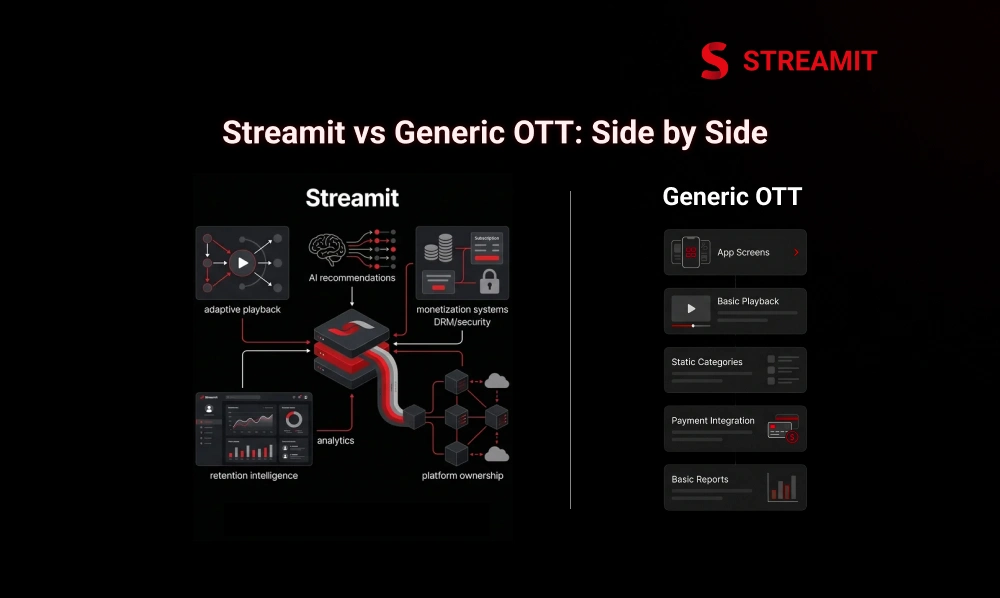
| Area | Generic OTT App Development | Streamit |
|---|---|---|
| Main focus | App screens and features | Full platform architecture |
| Playback | Basic video player setup | Performance-led playback planning |
| Infrastructure | Often added later | Planned from the start |
| Discovery | Static categories | AI recommendations and smart discovery |
| Analytics | Basic reports | Viewer behavior and retention insights |
| Monetization | Payment gateway integration | Revenue model planning |
| Security | Often patched later | DRM, encryption, and secure access thinking |
| Ownership | Limited control in many setups | Platform, data, and revenue control |
Launch Focus vs Long-Term Platform Focus
Generic builds often focus on getting the app live. Streamit focuses on what happens after launch.
That difference matters because OTT success depends on retention, performance, and revenue growth, not only launch speed.
Feature Delivery vs System Design
Features can be copied. Systems are harder to build.
Streamit’s advantage is in connecting features into a platform that supports real business operations.
Basic Playback vs Performance Planning
Basic playback answers one question: Can the video play?
Performance planning asks a better question: can the video play smoothly for different users, devices, and traffic conditions?
Basic Reports vs Retention Intelligence
Reports show numbers. Retention intelligence helps explain behavior.
That shift helps OTT businesses make better decisions around content, pricing, UX, and engagement.
App Ownership vs Platform Ownership
Owning an app is not always the same as owning the platform.
Streamit is better aligned for businesses that want long-term control over product, users, data, revenue, and infrastructure.
Summary
Key Takeaways
Generic Builds Work for Simple Launches
Generic OTT app development is useful for MVPs, demos, or early demand tests – but it cannot scale like a full platform system.
Streamit Is Built for Serious Streaming Businesses
Streamit focuses on architecture, playback, AI discovery, analytics, monetization, security, and long-term platform ownership.
The Layer Being Built Is the Key Difference
Generic development builds the visible app layer. Streamit builds the platform layer behind the experience that drives real business outcomes.
Playback, Retention, and Monetization Need Early Planning
These systems become harder and more expensive to fix after launch – planning them from the start saves significant cost and risk.
A Streaming Business Needs More Than a Video App
It needs infrastructure, intelligence, revenue control, and a roadmap that can handle growth without slowing down or breaking.
Ownership and Control Matter at Scale
Streamit gives businesses control over user data, monetization, content rules, and platform behavior – with no revenue share taken.
Conclusion
Conclusion
The real question is not whether you can launch an OTT app. The bigger question is whether the platform can scale without slowing down, breaking, or limiting growth. That is where Streamit stands apart from generic OTT app development.
Generic OTT development may help you launch faster. Streamit helps you think deeper. It connects the app experience with the systems that decide long-term success: architecture, delivery, AI discovery, analytics, monetization, security, and platform ownership.
For founders and businesses investing seriously in streaming, this difference matters. A simple app may get you online. A well-planned platform gives you control, stability, and room to grow.
FAQs
Frequently Asked Questions
-
Is Streamit different from normal OTT app development?
Yes. Normal OTT app development usually focuses on building the app interface and basic features. Streamit focuses on the full streaming platform, including architecture, playback, analytics, AI discovery, monetization, security, and long-term ownership.
-
Is Streamit only for building OTT apps?
No. Streamit supports OTT apps, streaming websites, TV apps, infrastructure, AI recommendations, analytics, monetization, and platform-level systems. It is designed as a complete streaming platform solution, not just an app development service.
-
When should I choose Streamit instead of a white-label OTT solution?
Choose Streamit when you need deeper customization, better ownership, stronger performance planning, flexible monetization, and long-term scalability. A white-label solution may work for simple testing, but it can limit control as the business grows.
-
Does Streamit help with streaming infrastructure?
Yes. Streamit supports streaming infrastructure planning, including video delivery, multi-CDN thinking, adaptive streaming, transcoding, analytics, and performance optimization. This helps platforms prepare for real users, real traffic, and growth.
-
Does Streamit support AI recommendations and analytics?
Yes. Streamit supports AI recommendations, smart discovery, analytics, smart thumbnails, retention pricing, and viewer behavior insights. These systems help improve content discovery, watch time, decision-making, and subscriber retention.