Best White Label OTT Platform Alternatives


One platform decision can shape five business systems at once: apps, revenue, data, operations, and future development. That is why the decision should not begin with templates or monthly pricing.
The better question is whether the platform fits the business you are building. The best alternatives solve different needs, from creator memberships and live broadcasting to enterprise video and owned streaming products.
Overview
Why Teams Look for White Label OTT Platform Alternatives
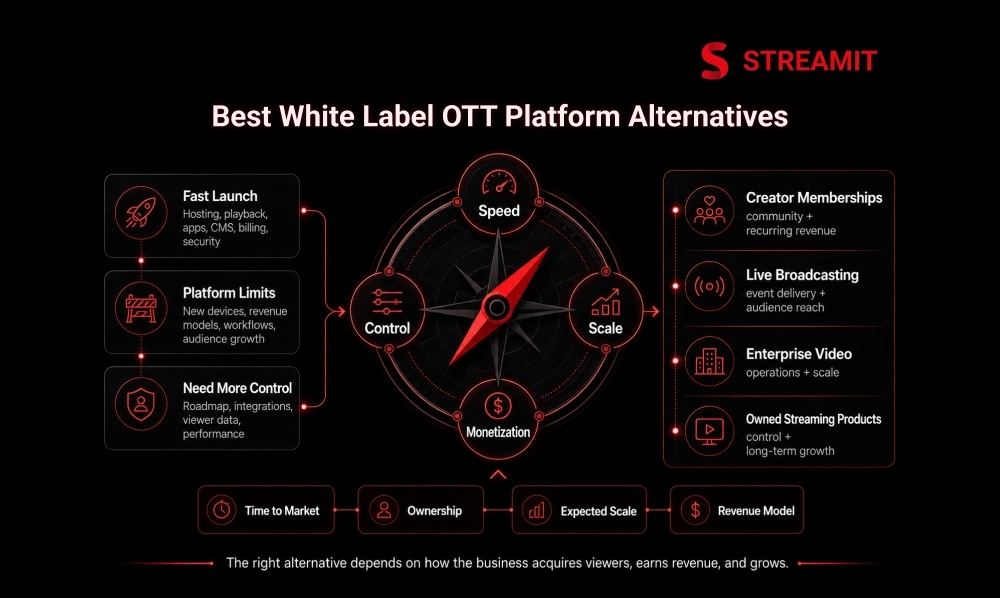
A fast launch can reduce early execution risk, but it does not automatically reduce long-term platform risk. Teams explore alternatives when their current solution cannot support new devices, revenue models, workflows, or audience growth.
This search is about finding the right balance of launch speed, operational simplicity, control, and room to evolve.
White Label OTT Platforms Help Teams Launch Faster
A ready platform can combine six launch requirements: hosting, playback, apps, CMS, billing, and security. That saves a new business from coordinating several vendors before validating demand.
A white label OTT solution is useful when speed matters more than deep customization. Teams can brand an existing system and enter the market without building every technical layer.
Growing Streaming Brands Often Need More Control Than Templates Allow
The requirements usually change after launch, not before it. A growing brand may need regional pricing, new TV apps, advanced analytics, content rights, or workflows that a fixed template cannot support.
At that stage, branding is not enough. The business needs control over its roadmap, integrations, viewer data, performance, and infrastructure.
The Right Alternative Depends on Speed, Control, Scale, and Monetization
Four variables should lead the decision: time to market, ownership, expected scale, and revenue model. A membership creator has different needs from a sports broadcaster or a global studio.
There is no universal best OTT solution. The right strategy supports how the business will acquire viewers, earn revenue, operate content, and grow.
Comparison Framework
What to Compare in White Label OTT Alternatives
A meaningful OTT platform comparison should cover the full operating model, not a polished demo. Buyers should evaluate what viewers see, what teams manage, what the vendor controls, and what becomes expensive later.
Use a structured comparison so polished interfaces do not hide gaps in billing, data access, migration, security, or support.
| Area | What to verify | Why it matters |
|---|---|---|
| Experience | Web, mobile, TV, branding | Determines reach and differentiation |
| Operations | CMS, live, VOD, workflows | Affects daily efficiency |
| Revenue | Plans, payments, entitlements | Controls monetization flexibility |
| Foundation | APIs, DRM, scale, analytics | Supports security and growth |
| Commercials | Ownership, support, migration | Shapes the long-term cost |
Web, Mobile, TV Apps, and Branding Control
A streaming app is not one product across different screen sizes. Web, mobile, and TV require different navigation, playback, app-store processes, account flows, and testing.
Compare devices, release ownership, design flexibility, update timelines, accessibility, and continuity. Basic rebranding may launch the service, but it rarely creates a distinctive experience.
Live Streaming, VOD, CMS, and Content Management
Live and on-demand video creates different operational pressures. Live requires scheduling, ingestion, monitoring, recording, latency, and traffic planning. VOD requires metadata, search, encoding, rights, and catalogue management.
The CMS should manage both models without fragile manual work. Check bulk uploads, roles, geo-rules, subtitles, playlists, live-to-VOD workflows, and publishing controls.
Monetization, Payments, Trials, and Subscriber Management
Revenue flexibility matters more than the number of pricing labels on a feature page. A platform may advertise subscriptions, ads, and pay-per-view while limiting bundles, regional pricing, trials, or mixed access rules.
Review payment gateways, currencies, taxes, app-store billing, entitlements, payment recovery, refunds, subscriber exports, and reporting. Monetization becomes interconnected as the audience grows.
Security, DRM, APIs, Integrations, and Scalability
Security protects content, while APIs protect strategic flexibility. DRM, encryption, watermarking, device limits, geo-blocking, and access controls matter for premium video.
APIs determine whether the platform connects with CRM, identity, analytics, advertising, and payments. Scalability should cover peaks, monitoring, recovery, delivery, and cost under load.
Pricing, Ownership, Support, Migration, and Long-Term Cost
The cheapest launch price can become the most expensive operating model. Monthly plans may exclude apps, bandwidth, storage, support, migration, custom work, or higher usage tiers.
Ask who owns the code, cloud accounts, app listings, user data, and integrations. Model the three-year cost, including switching and internal work.
Platform Fit
Best White Label OTT Platform Alternatives by Business Need
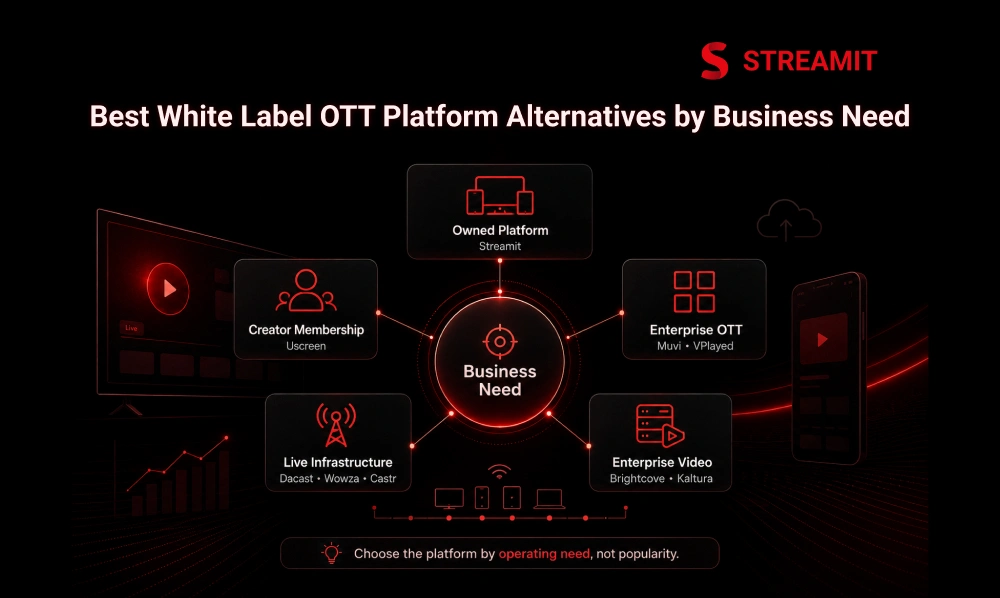
The market is easier to understand when providers are grouped by operating need. Some serve creators, others enterprise media, live infrastructure, or businesses building an owned platform.
This is a fit guide, not a universal ranking. A strong option in one category may be restrictive or excessive in another.
| Business need | Platforms to evaluate | Primary strength |
|---|---|---|
| Owned streaming product | Streamit | Control, customization, long-term roadmap |
| Creator membership | Uscreen | Subscription video and community |
| Enterprise OTT rollout | Muvi, VPlayed | Broad feature and workflow coverage |
| Live infrastructure | Dacast, Wowza, Castr | Live delivery and video operations |
| Enterprise video | Brightcove, Kaltura | Large-scale media and internal video workflows |
Streamit for Brands That Want an Owned OTT Platform
Ownership becomes valuable when the streaming service is a core business, not a temporary campaign. Streamit supports web, mobile, and TV while giving businesses stronger control over infrastructure, data, monetization, integrations, and roadmap.
It fits teams that expect requirements to change after launch. The focus is on creating an OTT platform solution that can be extended as the business matures.
Uscreen for Creator Membership and Subscription Video Businesses
Creator-led platforms usually win through recurring membership, content consistency, and community. Uscreen is positioned around branded video memberships, live streaming, mobile and TV apps, community features, and member management.
It suits creators wanting a managed subscription platform without a large technical team. Businesses needing unusual workflows or deeper ownership should examine their boundaries.
Muvi and VPlayed for Enterprise OTT Platform Requirements
Enterprise buyers often need breadth before they need simplicity. Muvi combines delivery, apps, CMS, monetization, encoding, CDN, and DRM, while VPlayed positions itself as a customizable enterprise streaming solution.
Both suit organizations needing broad OTT functionality and implementation support. Compare customization, deployment, support, pricing, and practical ownership rather than feature counts.
Dacast, Wowza, and Castr for Live Streaming Infrastructure
Live-first businesses should evaluate the video engine before the storefront. Dacast combines live and VOD delivery with monetization and APIs; Wowza provides deployable streaming technology; Castr focuses on live streaming, hosting, multistreaming, and branded OTT delivery.
They can fit events, sports, worship, broadcasting, and continuous channels. Teams should separately assess subscriber tools, retention, custom apps, and ownership.
Brightcove and Kaltura for Enterprise Video and Media Operations
Enterprise video is broader than direct-to-consumer OTT. Brightcove supports hosting, live streaming, monetization, analytics, APIs, and media workflows, while Kaltura offers modular infrastructure, enterprise portals, content management, and integration flexibility.
They suit large media, education, internal communications, and complex video operations. Because implementation can be demanding, define governance, technical resources, and use cases early.
Watch Out For
The White Label Trap Most Businesses Miss
White label describes presentation, not necessarily control. A vendor can remove its logo while retaining control over infrastructure, releases, data, billing, integrations, and product decisions.
Demos focus on the viewer experience, so deeper commercial and technical boundaries often appear only after growth begins.
A Branded App Does Not Always Mean Full Platform Ownership
Brand ownership and platform ownership are two different assets. You may own the brand, audience, and content while licensing the software, hosting, app framework, and environment.
Before signing, identify what can be exported, transferred, modified, or operated independently. Discuss app accounts, source code, subscriber data, cloud resources, and analytics explicitly.
Templates Can Launch Fast but Limit Differentiation Later
Templates reduce decisions early, then reduce options later. They suit standard catalogues but can restrict distinctive discovery, commerce, onboarding, recommendations, or viewing experiences.
Custom development is not always required from day one. Choose a roadmap that allows deeper customization when differentiation proves valuable.
Vendor Lock-In Can Make Migration Expensive After Growth Starts
Migration cost rises with every connected system. Files may be portable, but metadata, users, payment tokens, entitlements, watch progress, apps, analytics, and integrations are harder to move.
Ask about exports before launch. A credible provider should explain data formats, responsibilities, downtime, app-store processes, and non-transferable elements.
Long-Term Value Comes From Data, Monetization, Retention, and Control
The platform creates value when it improves decisions, not when it merely plays videos. Viewer behaviour should inform content investment, pricing, recommendations, campaigns, product changes, and retention.
That requires trustworthy analytics, flexible monetization, accessible data, and customer control. These capabilities compound, while static templates become easier to copy.
Beyond White Label
Why Streamit Fits Businesses Moving Beyond White Label OTT
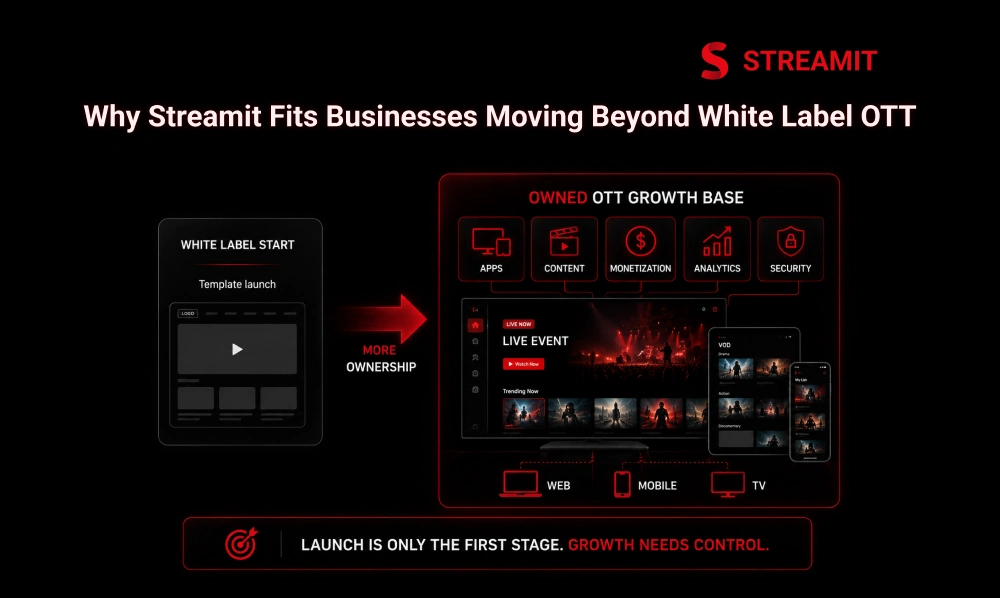
Moving beyond white label does not mean rebuilding everything without a plan. It means keeping proven components while gaining control over the areas that shape growth.
Streamit fits businesses that see OTT as an owned asset. It connects apps, infrastructure, content, monetization, security, analytics, and future development.
It Supports Branded OTT Apps Across Web, Mobile, and TV
Multi-device delivery is a product system, not a checklist item. Streamit supports branded experiences across web, mobile, smart TVs, and connected devices, with continuity between screens.
The experience can follow the audience, content model, and commercial strategy instead of one generic template. That creates room to differentiate after launch.
It Supports Monetization, Content Control, Analytics, and Retention
Growth depends on how well four systems work together: content, revenue, insight, and return behaviour. Streamit brings CMS, monetization, analytics, security, and engagement into the wider architecture.
This connects viewing behaviour with what the business publishes, promotes, prices, and improves. The goal is better decisions, not more dashboards.
It Gives Streaming Businesses a Stronger Base for Long-Term Growth
The right foundation makes future changes less disruptive. Streamit is designed for businesses adding devices, content models, integrations, markets, revenue methods, and performance requirements.
It suits teams whose platform must keep evolving. Launch is treated as the first stage, not the finish line.
Summary
Key Takeaways
There is no single best white label OTT alternative
The right choice depends on your audience, devices, monetization model, technical needs, and growth plans.
Different platform types solve different needs
Creator platforms, enterprise video systems, live streaming tools, and owned OTT solutions should be compared by business fit, not only by features.
Streamit fits businesses seeking more ownership
It is suitable for founders, broadcasters, studios, and media companies that need branded apps, CMS, monetization, analytics, security, and greater control.
Uscreen fits creator membership businesses
It works well for creators, educators, and community brands selling subscription video without managing complex infrastructure.
Muvi, VPlayed, Brightcove, and Kaltura fit enterprise needs
These platforms support larger teams with advanced video operations, integrations, monetization, and multi-device delivery.
Dacast, Wowza, and Castr fit live streaming use cases
They are useful for events and broadcasting but may not replace a complete OTT business platform.
Branding does not always mean ownership
Confirm control over source code, infrastructure, app accounts, customer data, integrations, and future updates.
Long-term value matters more than launch speed
Compare scalability, customization, APIs, support, migration risk, ownership, and total operating cost.
Wrap-Up
Conclusion
A white label OTT platform can help a business launch faster, but speed should not come at the cost of future control. As the platform grows, limitations around customization, monetization, data access, integrations, and migration can become more expensive to solve.
The better decision is to choose an OTT platform solution that supports both current requirements and long-term business plans. Streamit helps streaming businesses move beyond fixed templates with greater control over apps, content, revenue, analytics, security, and future platform development.
FAQs
Frequently Asked Questions
-
When should a business look for white label OTT alternatives?
A business should explore alternatives when it needs more control over apps, data, monetization, integrations, performance, or its product roadmap. The trigger is usually growth complexity, not launch failure.
-
Is a white label OTT platform enough for long-term growth?
It can be enough for a standardized business with predictable needs. It may become restrictive when differentiation, regional expansion, advanced retention, or infrastructure control becomes strategically important.
-
What limits appear after launching with a white label OTT app?
Common limits include fixed designs, slow feature requests, restricted APIs, limited data access, rigid billing, device gaps, and rising usage costs. The exact limits depend on the provider and contract.
-
Does a branded OTT app mean full platform ownership?
No. Branding may cover the interface while the vendor still owns the software, infrastructure, deployment process, or app framework. Ownership terms must be confirmed contractually.
-
What should I compare beyond white label OTT pricing?
Compare supported devices, customization, CMS workflows, monetization, payments, DRM, APIs, analytics, support, data portability, migration, app ownership, and total cost over multiple years.
-
When is custom OTT better than a white label OTT platform?
Custom OTT is better when the streaming product needs unique workflows, deeper integrations, differentiated experiences, stronger ownership, or a roadmap that standard templates cannot support economically.