Why Laravel Is Built for Modern OTT Platform Development


A modern OTT platform is not just a video website. It is a product system where users, content, subscriptions, devices, access rules, admin workflows, and delivery infrastructure must work together without friction.
That is why the backend foundation matters more than most teams think at the beginning. A basic web framework may help you launch screens, but OTT platform development needs a stronger product layer that can support authentication, APIs, billing logic, admin control, background jobs, and long-term scale. This is where Laravel becomes highly relevant.
Foundation
Why OTT Platforms Need More Than a Basic Web Framework
The first version of an OTT product usually looks simple: upload content, let users subscribe, and play videos. The real complexity starts when people actually use it.
Viewers expect fast login, smooth playback, correct access, simple billing, reliable recommendations, and consistent performance across devices. Behind that simple experience is a layered OTT platform solution that needs clean backend logic, stable infrastructure, and operational control.
Modern OTT Products Need Auth, APIs, Billing, Admin, and Content Logic
In OTT, access is the business model. If the backend cannot decide who can watch what, the product loses trust fast.
Laravel helps teams structure users, roles, sessions, plans, permissions, content metadata, and API responses in a clean way. This matters when the same subscriber may use web, mobile, and TV apps while expecting the same access everywhere.
Billing also needs to stay connected to content rules. If a user upgrades, cancels, pauses, or renews, the platform must update access without manual support work. That is not just a payment feature. It is core OTT platform architecture.
They Also Need Background Jobs, Storage Workflows, and Operational Control
OTT platforms do not only serve pages. They process files, send emails, sync payments, update reports, and prepare content in the background.
Laravel queues are useful because heavy tasks should not block the viewer experience. Upload processing, thumbnail generation triggers, notification emails, subscription syncs, report exports, and webhook handling all need background workflows.
This gives the team better control over operations. Instead of forcing everything into real-time requests, Laravel lets product teams separate urgent user actions from slower system work.
The Wrong Foundation Often Looks Fine at Launch but Breaks Later
Many OTT solutions fail quietly. They do not fail on day one. They fail when the product becomes real.
The early version may handle 100 users, 50 videos, and one payment plan. But once the platform adds more devices, more plans, more content categories, more admins, and more campaigns, weak architecture starts showing.
This is why scalable OTT platform planning must happen early. The wrong backend foundation creates growth blockers that become expensive to fix after users, content, and revenue are already inside the system.
Why Laravel
What Makes Laravel Relevant for Modern OTT Platform Development
Laravel is useful for OTT because it is strong where OTT products need structure: backend logic, workflows, APIs, security, and maintainability.
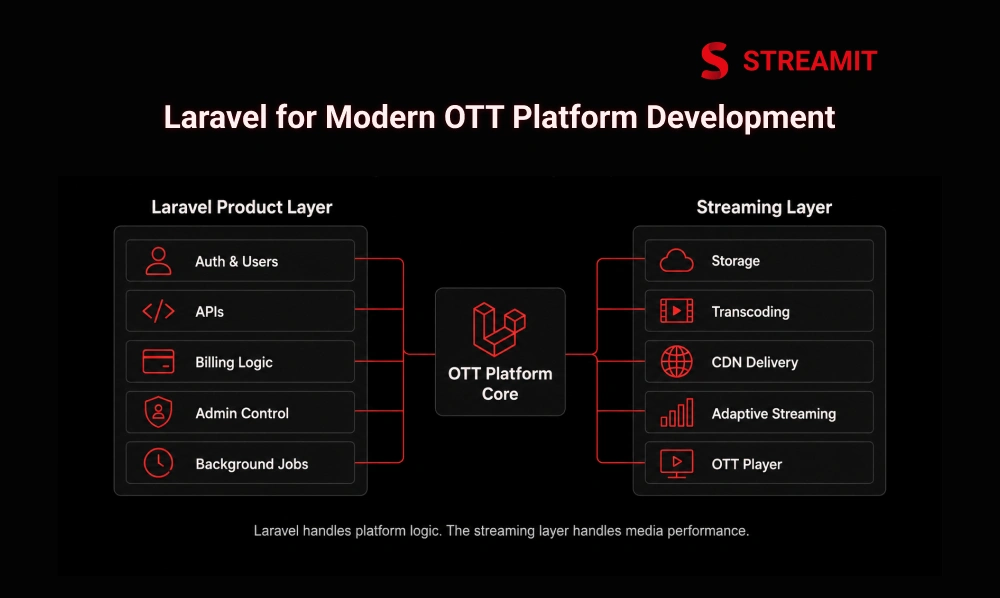
It should not be confused with the entire streaming pipeline. Laravel is not meant to replace storage, CDN, encoding, or adaptive playback layers. Its strength is the product layer that controls how the platform behaves.
Laravel Gives Teams a Strong Backend Foundation for Product Logic
OTT success depends on rules. Laravel gives teams a clean place to manage those rules.
For example, a viewer can only access a movie if their subscription is active, the content is available in their region, the device limit is not crossed, and the title is part of their plan. These rules need a serious backend.
Laravel helps organize models, controllers, policies, middleware, jobs, and APIs around this logic. This makes the platform easier to maintain as business requirements evolve.
It Helps Teams Build Faster Without Starting From a Low-Level Stack
Speed matters, but only when speed does not create technical debt from the first sprint.
Laravel gives development teams a mature starting point for routing, authentication, queues, caching, API structure, database work, validation, admin workflows, and integrations. That means the team does not need to rebuild basic backend systems from scratch.
For custom OTT solutions, this balance is important. Teams can move faster while still keeping enough structure to build a long-term product.
It Fits Products That Need to Evolve, Not Just Launch Once
A serious OTT platform is never finished after launch. It keeps changing with users, content, pricing, and devices.
Laravel fits products that need roadmap flexibility. A team may start with VOD, then add live events, premium plans, coupon logic, TV apps, enterprise accounts, or partner dashboards.
A rigid backend makes every new feature feel risky. A structured Laravel OTT platform gives the team a better base for change.
Planning
What to Decide Before Building an OTT Platform on Laravel
Before choosing the stack, teams should define the business model. Technology should follow the OTT strategy, not the other way around.
Laravel can support many OTT models, but the architecture should be planned around audience, content type, monetization, device strategy, and operational needs.
Define Your Audience, Content Model, and Monetization Approach
The audience decides the platform logic. A fitness OTT product and a movie streaming platform should not be built the same way.
Start by defining who will watch, how often they will return, what content they value, and how they will pay. This shapes plans, content categories, user journeys, access rules, and engagement features.
Monetization also matters early. Subscription, rental, pay-per-view, free content, hybrid access, and enterprise licensing all create different backend requirements.
Decide If You Need VOD, Live Streaming, or a Hybrid Product
VOD and live streaming may feel almost the same on the viewer’s screen, but the backend logic, delivery flow, and infrastructure planning behind them are very different.
VOD platforms need asset management, metadata, thumbnails, categories, watch history, and playback access. Live products need scheduling, low-latency planning, event access, real-time status, and stronger operational readiness.
A hybrid OTT video solution needs both. Laravel can manage the product logic, but the live and media delivery layer should be planned separately.
Decide If You Are Building Web First or a Full Multi-Device OTT Product
A streaming website is not the same as a full OTT ecosystem.
Web-first products may need fast onboarding, content browsing, checkout, and a responsive player experience. Multi-device products need API consistency across web, mobile, and TV apps.
If TV apps are part of the roadmap, API design becomes more important from day one. Laravel can support that structure when planned properly.
| Decision Area | Why It Matters | Laravel’s Role |
|---|---|---|
| Audience model | Shapes access and engagement logic | User roles, sessions, APIs |
| Monetization | Controls revenue and entitlement rules | Plans, billing sync, permissions |
| Device strategy | Impacts API and session design | Unified backend responses |
| Content model | Affects admin and metadata workflows | Content, categories, publishing logic |
Workflow
How Laravel Supports the Real Workflow of OTT Product Teams
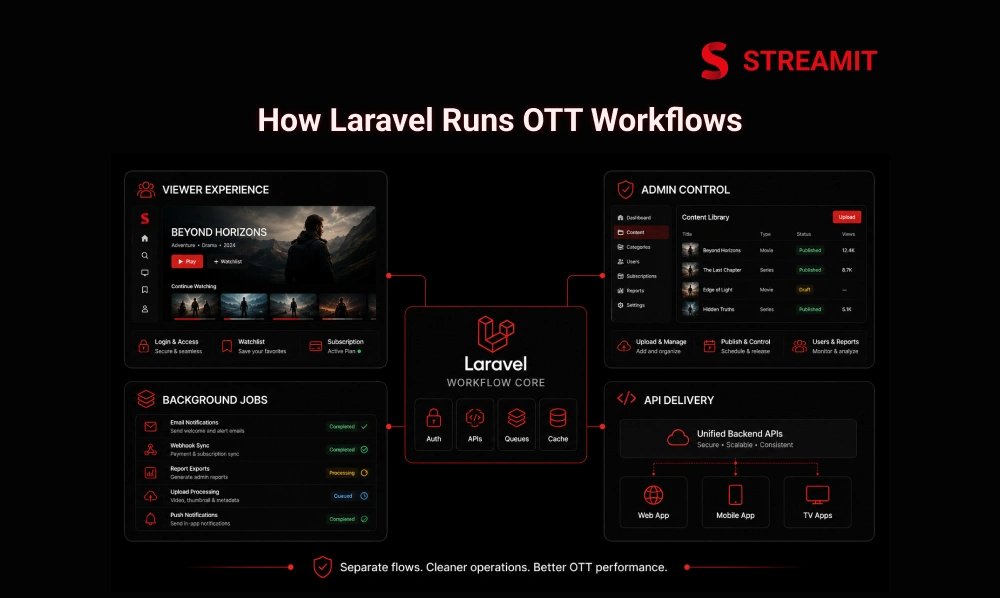
OTT teams do not only build features. They manage daily operations, content updates, access issues, payments, and user behavior.
Laravel supports this workflow because it is practical for backend-heavy products. It helps separate viewer experience, admin control, background jobs, and API delivery.
Authentication, APIs, Sessions, and Access Flows
The viewer experience starts before playback. Login, session handling, and access checks decide whether the platform feels reliable.
Laravel can support secure authentication, API tokens, session-based access, and role-based permissions for different user types. This is useful when the same account is used across different devices.
Access flows should be clear and predictable. A user should not pay successfully and still see locked content. That type of issue damages trust quickly.
Queues, Storage, Cache, and Rate Limiting
Performance is not only about faster servers. It is about putting the right work in the right place.
Queues can handle slow background tasks. Cache can reduce repeated database calls. Rate limiting can protect sensitive actions like login, search, coupon use, and API-heavy flows.
This makes the streaming platform backend more stable as usage grows. It also reduces pressure on the core app during campaigns, new releases, or live events.
Clean Separation of Viewer Flows, Admin Flows, and Background Jobs
A good OTT platform should not let admin work disturb viewer experience.
Viewer flows include browsing, playback access, watchlist, subscriptions, and account settings. Admin flows include uploading, publishing, tagging, reporting, and user management.
Background jobs should run separately from both. This separation keeps the platform cleaner, faster, and easier to maintain.
Architecture
Where Laravel Should Stop and the Streaming Pipeline Should Take Over
The biggest mistake is expecting one framework to do everything. Laravel should control the product, not carry the entire media pipeline.
A healthy OTT architecture separates business logic from video processing and delivery. This creates better scale, better performance, and fewer operational risks.
Laravel Should Own Auth, APIs, Billing, Metadata, and Admin Logic
Laravel should be the decision layer of the OTT platform.
It should manage users, subscriptions, content records, access permissions, watch history, admin panels, APIs, reports, and business workflows. This is where Laravel is strong.
It can also connect with payment systems, storage services, notification tools, and analytics systems. But it should not become overloaded with media-heavy work.
Storage, CDN, and Media Delivery Should Sit in the Streaming Layer
Video delivery needs infrastructure built for video, not just application servers.
Storage should hold media assets. CDN and edge delivery should serve video closer to viewers. The player should receive properly prepared streams based on device and network conditions.
Laravel can authorize access and provide playback metadata, but the actual video delivery should happen through the streaming layer.
Transcoding and Packaging Should Run as Background Infrastructure, Not as Request-Time Logic
Video processing is too heavy to sit inside normal user requests.
Transcoding, packaging, subtitles, thumbnails, and multi-format outputs should run as background infrastructure. This avoids slow admin uploads and protects the viewer-facing experience.
Laravel can trigger and track these workflows, but the heavy processing should happen outside the request cycle.
| Layer | Should Laravel Handle It? | Better Owner |
|---|---|---|
| User login | Yes | Laravel |
| Billing access | Yes | Laravel |
| Metadata | Yes | Laravel |
| Transcoding | No | Media pipeline |
| CDN delivery | No | Streaming infrastructure |
| Playback authorization | Yes | Laravel plus player layer |
Use Cases
Common OTT Use Cases Where Laravel Fits Well
Laravel fits best when the product needs strong logic, admin control, and long-term flexibility.
It works well across different OTT categories because the core problem is often the same: manage users, content, access, payments, and operations cleanly.
Entertainment and Media Platforms
Entertainment OTT platforms need more than a content grid.
They need genres, seasons, episodes, trailers, recommendations, subscriptions, watchlists, continue watching, and device-based playback access. Laravel can manage the backend logic behind these flows.
For movie streaming websites and media streaming solutions, the backend needs to stay flexible as the catalog grows.
Learning, Coaching, and Fitness Platforms
Learning and fitness platforms often need structured journeys, not just videos.
They may need courses, modules, progress tracking, certificates, trainer access, live sessions, paid communities, or member-only content.
Laravel fits these use cases because it can support both content delivery logic and business workflows around users, coaches, and plans.
Creator-Led Subscription Platforms
Creators need ownership, not just distribution.
A creator-led OTT platform may include subscriptions, premium content, community access, exclusive drops, and direct audience relationships.
Laravel helps build a branded streaming platform where the creator controls user data, pricing, content access, and product roadmap.
Broadcasters and Hybrid OTT Products
Broadcasters need OTT products that respect both scheduled content and on-demand behavior.
A hybrid product may include live channels, catch-up content, premium archives, regional access, and sponsor-supported sections.
Laravel can support the platform logic while dedicated infrastructure handles live stream delivery and media performance.
Risk
What Usually Breaks When Teams Use the Wrong Foundation
Weak OTT architecture does not always break loudly. It usually creates support tickets, slow admin work, and confused users.
These problems may look small at first, but they compound as the platform grows.
Background Jobs Start Blocking User Experience
When slow work is handled in the wrong place, users feel it immediately.
Uploads take longer. Emails delay. Webhooks fail. Reports timeout. Playback access updates slowly after payment.
Laravel queues help avoid this by moving slow work away from user-facing requests.
Admin Workflows Become Hard to Maintain
A messy admin panel becomes an internal growth blocker.
If the team cannot easily upload, categorize, schedule, publish, edit, or review content, the platform becomes operationally expensive.
A well-structured Laravel backend can keep admin workflows clean and easier to extend.
Scale Exposes Weak API, Cache, and Access Patterns
Scale does not create problems. It reveals the ones already inside the system.
Poor API design creates slow apps. A weak cache strategy increases database pressure. Loose access logic creates security and subscription issues.
This is why OTT security, performance, and architecture need to be planned before growth arrives.
Metrics
What to Measure in a Laravel-Based OTT Platform
You cannot improve an OTT platform only by looking at revenue. You need product and system signals together.
Laravel-based platforms should measure backend health, user behavior, and operational performance.
Queue Health, Failed Jobs, and Background Processing Delays
Queues are a direct signal of platform health.
Track failed jobs, delayed jobs, retry patterns, webhook failures, and processing time. These numbers show whether the backend is keeping up with real operations.
If background jobs are unhealthy, the viewer experience will eventually suffer.
API Speed, Cache Performance, and Access Response Time
Every device depends on the API. Slow APIs create slow products.
Measure response time, cache hit rate, error rate, login speed, subscription checks, and playback authorization time.
These metrics help teams catch performance issues before they become visible complaints.
User Retention, Playback Complaints, and Feature Adoption
The best technical system still has to prove itself through user behavior.
Track retention, churn, watch time, search usage, watchlist usage, support tickets, and playback complaints. These show whether the platform is actually useful.
Strong OTT analytics connect product decisions with technical improvements.
| Metric Type | What to Track | Why It Matters |
|---|---|---|
| Queue health | Failed jobs, delays | Shows backend reliability |
| API performance | Speed, errors, cache | Impacts all devices |
| Access logic | Unlock time, failures | Protects revenue trust |
| Retention | Repeat users, churn | Shows product value |
| Support issues | Playback and billing complaints | Reveals hidden friction |
Decision
When Laravel Is the Right Choice for OTT Platform Development
Laravel is the right choice when the OTT product needs serious backend logic, not just a quick interface.
It is especially useful for teams that want ownership, flexibility, custom workflows, and a platform that can evolve after launch.
Choose Laravel When Product Logic and Long-Term Flexibility Matter
Laravel makes sense when your OTT platform has rules that matter.
Plans, permissions, user types, device access, content categories, admin approvals, and reporting all need clean backend structure.
If your roadmap includes ongoing product growth, Laravel gives you a stronger base than a shortcut build.
Choose Laravel When You Need a Serious Backend, Not Just a Quick Demo
A demo can hide weak architecture. A real OTT platform cannot.
When users start paying, watching, requesting support, and using multiple devices, backend quality becomes visible.
Laravel is useful for teams that want a serious backend from the beginning, not a rebuild after the first growth phase.
Avoid the Wrong Expectation: Laravel Is Stronger as the Product Layer Than the Media Pipeline
Laravel is powerful, but it should not be treated as a video delivery engine.
Its best role is product logic, APIs, billing, admin, users, and workflows. The media pipeline should handle encoding, storage, CDN, and adaptive playback.
This separation creates a more scalable streaming platform solution.
Streamit
Why Streamit Fits Teams Building Modern OTT Platforms
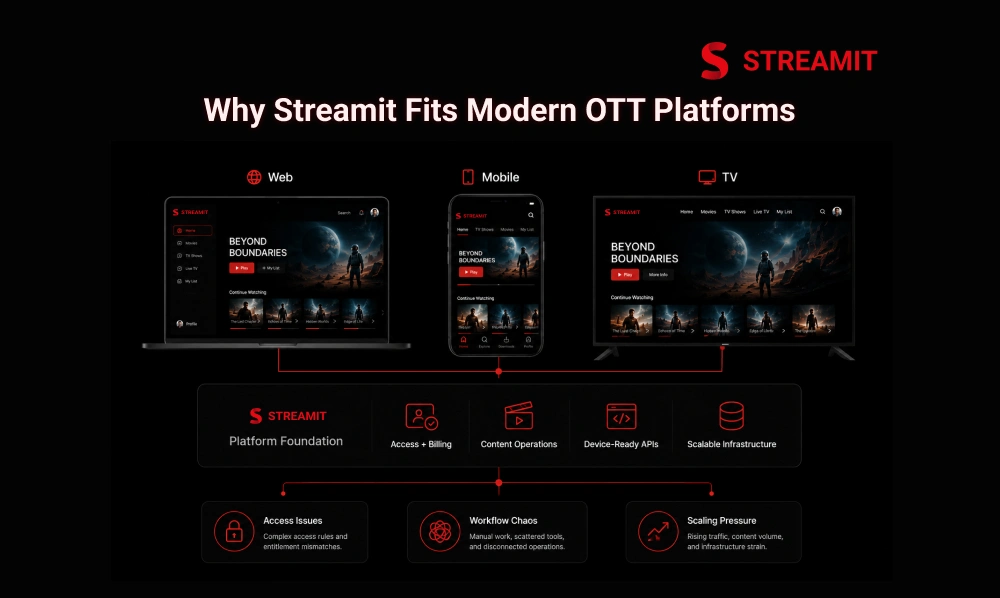
Streamit is built around the real problems OTT teams face after launch, not only the excitement before launch.
It fits businesses that need structure, ownership, scalability, and better product thinking across web, mobile, and TV experiences.
It Is Aligned With the Real Platform Problems Teams Hit After Launch
Most OTT problems are not design problems. They are access, billing, workflow, and infrastructure problems.
Streamit is aligned with the areas that matter once users arrive: scalable OTT platform architecture, content management, subscription logic, device-ready APIs, and operational workflows.
That makes it more relevant for teams thinking beyond the first version.
It Fits Businesses That Need Web, Mobile, TV, and Better Product Logic Together
Modern OTT users do not think in platforms. They expect one account to work everywhere.
Streamit supports the idea of a connected OTT product across streaming websites, mobile apps, and OTT TV apps.
This matters for businesses that want a stronger branded streaming experience instead of disconnected tools.
It Helps Teams Build on a Stronger Technical Foundation Earlier
The cheapest build often becomes expensive after launch.
Streamit helps teams think earlier about structure, scalability, access control, admin workflows, and long-term ownership.
For founders and teams building serious OTT products, that foundation can save months of rework later.
Summary
Key Takeaways
Laravel Is the Product Layer, Not the Pipeline
It should handle users, APIs, billing, metadata, and admin logic while storage, CDN, transcoding, and delivery sit in the dedicated streaming infrastructure.
Billing and Access Must Stay in Sync
If payment succeeds but content remains locked, users lose trust quickly and support issues increase – these two systems must always be tightly connected.
Structure Must Come Before Scale
A basic build may look fine at launch, but weak backend logic breaks when users, devices, plans, and content volume grow together – plan architecture early.
Queues Protect the Viewer Experience
Upload processing, webhook handling, emails, and content tasks should run in the background instead of blocking user-facing actions like playback and checkout.
Laravel Enables Speed Without Losing Control
It gives a strong foundation for APIs, admin workflows, caching, validation, and billing integrations – without building from a low-level stack from scratch.
The Right Foundation Reduces Future Rebuild Costs
A rushed OTT build becomes expensive when the team later needs mobile apps, TV support, advanced subscription plans, analytics, or improved admin workflows.
Conclusion
Conclusion
Laravel is built for modern OTT platform development because it gives teams a strong product layer where business logic, APIs, subscriptions, admin control, and background workflows can stay organized.
But Laravel should be used with the right expectation. It should control the platform logic while streaming infrastructure handles video processing, CDN delivery, and adaptive playback.
For teams building a serious OTT platform solution, the goal is not to launch a “Netflix-like app”. The goal is to build a product that can survive real users, real payments, real content operations, and real growth. That is where Laravel and Streamit fit well together.
FAQs
Frequently Asked Questions
-
Why do OTT teams regret the wrong backend after launch?
They regret it because weak backend logic creates billing issues, access problems, slow APIs, and hard-to-maintain admin workflows. These issues usually appear when users, content, and devices start growing together.
-
What should Laravel handle in an OTT platform backend?
Laravel should handle users, authentication, APIs, billing logic, subscriptions, metadata, access rules, admin workflows, reports, and background job coordination. It should act as the product and business logic layer.
-
What should not be handled directly inside Laravel in OTT?
Laravel should not directly handle heavy video delivery, transcoding, packaging, or CDN-level streaming. These should sit in the media and infrastructure layer built for video performance.
-
When do Laravel queues become critical in OTT development?
Queues become critical when the platform handles uploads, payment webhooks, email notifications, reports, thumbnails, content processing triggers, or large admin tasks. They keep slow work away from user-facing requests.
-
Can Laravel handle serious OTT APIs for web, mobile, and TV?
Yes, Laravel can support serious OTT APIs when planned properly with clean routes, authentication, caching, rate limiting, and structured responses. This is important for consistent access across devices.
-
How do cache and rate limiting help an OTT platform grow safely?
Cache reduces repeated database work and helps APIs respond faster. Rate limiting protects sensitive actions like login, checkout, search, and playback access from abuse or accidental overload.