7 Features That Make a White Label OTT Platform Future-Ready


A white label OTT platform is not future-ready because it launches fast. It is future-ready when it can survive the next 12 months of growth without forcing a rebuild.
For founders, media businesses, creators, broadcasters, and content-led brands, the real question is not “Can we launch an app?” The better question is, “Can this platform handle more users, more devices, more revenue models, more regions, and more pressure without breaking?”
That is where many white label OTT decisions go wrong. Teams choose speed first, then discover later that scaling, personalization, monetization, DRM, and content operations were never properly planned.
A future-ready white label OTT platform should give you speed without trapping your business inside short-term technical limits.
Foundation
What Makes a White Label OTT Platform Future-Ready
A future-ready OTT platform should support three things from day one: scale, retention, and monetization. If one of these is weak, the platform may still launch, but it will struggle when real users arrive.
A white label streaming platform should not only help you publish videos. It should help your business operate like a real streaming product, with content control, viewer data, secure delivery, device coverage, and room to evolve.
It Must Support Scale, Retention, and Monetization
The first 1,000 users test your product. The next 100,000 users will test your platform architecture. A scalable OTT platform needs to handle growing traffic, more concurrent viewers, larger content libraries, and more complex user behavior.
Retention matters just as much. If users cannot find relevant content, face buffering, or feel the app is difficult to use, they leave. Monetization also needs flexibility because many streaming businesses now test subscriptions, ads, pay-per-view, rentals, and hybrid models instead of depending on one revenue stream.
Fast Launch Matters, but Long-Term Flexibility Matters More
Launching in weeks is useful only if the platform can still support you after month 6. Fast OTT launch is valuable, but not when it creates limits around device expansion, monetization, analytics, branding, or infrastructure.
A strong white label OTT platform gives you a working foundation quickly while still allowing deeper customization later. That balance is what separates a launch tool from a growth-ready platform.
A Weak Foundation Leads to Rebuilds, Churn, and Tech Debt
Most OTT problems do not appear during the demo. They appear during traffic spikes, content growth, and monetization changes. A weak foundation can create technical debt that quietly limits the business.
This can show up as slow apps, poor playback, limited CMS control, broken device experiences, missing APIs, or expensive rebuilds. For serious streaming businesses, the hidden cost is not development. It is rebuilding after users have already lost trust.
Core Features
7 Features That Make a White Label OTT Platform Future-Ready
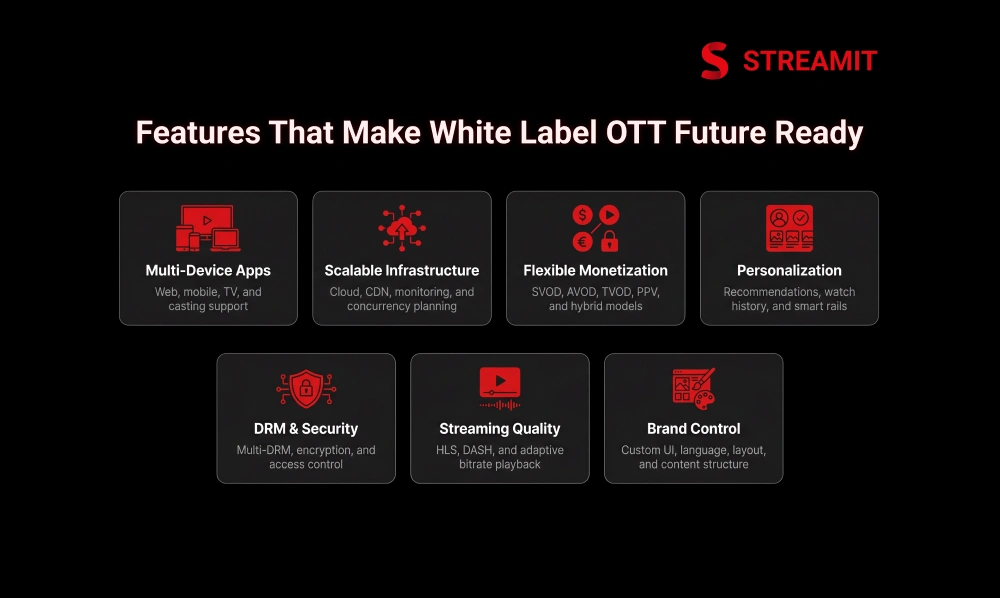
A future-ready streaming platform is built around 7 core systems: devices, infrastructure, monetization, personalization, security, playback quality, and brand control.
Here is the clean way to evaluate them.
| Feature | Why It Matters | Future-Ready Signal |
|---|---|---|
| Multi-device apps | Viewers watch across screens | Web, mobile, TV, casting support |
| Scalable infrastructure | Traffic grows unpredictably | Cloud, CDN, monitoring, concurrency planning |
| Flexible monetization | Revenue models change | SVOD, AVOD, TVOD, PPV, hybrid |
| Personalization | Discovery affects retention | Recommendations, watch history, smart rails |
| DRM and security | Paid content needs protection | Multi-DRM, access control, encryption |
| Streaming quality | Playback shapes trust | HLS, DASH, adaptive bitrate |
| Brand control | The platform must feel owned | Custom UI, language, layout, and content structure |
1. Multi-Device Apps Across TV, Mobile, and Web
A serious OTT business cannot depend on one screen. Viewers may discover content on mobile, continue watching on the web, and finish on TV. That journey needs to feel connected.
Your white label OTT platform should support web, Android, iOS, smart TV, and casting, where needed. If device expansion requires heavy rework, the platform is not truly future-ready.
2. Scalable Infrastructure That Handles Growth Without Playback Failure
Infrastructure is invisible until it fails. A scalable OTT platform needs cloud readiness, CDN delivery, monitoring, backup planning, traffic handling, and performance optimization before growth creates pressure.
This is especially important for live events, sports, regional premieres, creator drops, and viral content. Future-ready infrastructure should protect the viewing experience when traffic becomes unpredictable.
3. Flexible Monetization That Can Evolve With the Business
One revenue model rarely stays enough after the first growth phase. Many OTT businesses begin with subscriptions, then add ads, rentals, pay-per-view, live event access, or bundles.
Recent streaming data shows why this flexibility matters. In Q1 2025, ad-supported premium streaming subscriptions reached 46%, and ad-supported tiers represented nearly 60% of gross additions, showing that viewers are becoming more open to lower-cost ad-supported plans.
4. AI-Powered Personalization That Improves Discovery and Retention
Content libraries do not create retention by themselves. Discovery does. If users cannot quickly find something relevant, even a strong catalog can feel empty.
A future-ready OTT platform should support personalized rows, watch history, user behavior signals, search improvements, and recommendation logic. The point is not to add “AI” as a buzzword. The point is to reduce friction between the viewer and the next piece of content they will actually watch.
5. DRM and Anti-Piracy Controls That Protect Paid Content
If content creates revenue, protection cannot be an afterthought. DRM, secure authentication, access rules, encryption, and anti-piracy controls help protect premium content from unauthorized access and misuse.
Modern web video protection often depends on systems that manage encrypted media, license exchange, and key systems. The W3C Encrypted Media Extensions specification supports content protection mechanisms and license/key exchange for browser-based playback.
6. High-Quality Streaming for Live and On-Demand Content
Playback quality is not a feature. It is the product experience. Buffering, slow start time, poor quality switching, and playback failure directly damage trust.
Future-ready OTT platforms should support adaptive streaming using formats such as HLS and MPEG-DASH. HLS is designed to adapt playback based on network conditions, while MPEG-DASH also enables quality switching by segmenting and encoding video at different levels.
7. Brand Control Through Customizable UI, Language, and Content Layouts
A white label OTT platform should look like your business, not rented software. Brand control includes logo, colors, homepage layout, content rails, category structure, language support, plan pages, and user journeys.
This matters more as the platform grows. Your design, content hierarchy, and regional experience should evolve with audience behavior instead of staying locked inside a fixed template.
Evaluation
How to Tell If a White Label OTT Platform Is Truly Future-Ready
The easiest test is simple: ask what happens after growth starts. A future-ready OTT platform should not become fragile when you add more devices, countries, languages, plans, content types, or user segments.
Use the platform not only as a launch decision, but as a 12-month business decision.
Can It Add Devices, Regions, and New Monetization Models Without Rework
If every expansion needs redevelopment, the platform is not scalable. A future-ready OTT platform should let you add devices, regions, and monetization options without disturbing the core architecture.
This becomes important when you move from a local launch to a wider audience. Multilingual support, currency flexibility, regional content layouts, and plan variations can become growth levers.
Can Your Team Manage Content, Pricing, and Updates Without Heavy Technical Dependency
Your team should not need a developer for every content or pricing change. A strong OTT CMS should allow your team to manage videos, categories, metadata, banners, subscriptions, user access, and updates from a central dashboard.
This improves operating speed. It also keeps your technical team focused on product improvements instead of repetitive admin work.
Can It Keep Improving Retention Without Rebuilding the Product
Retention is not solved once. It improves through data, testing, and iteration. Your platform should support analytics, watch behavior, drop-off signals, recommendation improvements, and better content discovery over time.
The platform should help you understand what users watch, where they stop, what they ignore, and what keeps them returning. Without that loop, growth becomes guesswork.
Checklist
What to Check Before Choosing a White Label OTT Platform
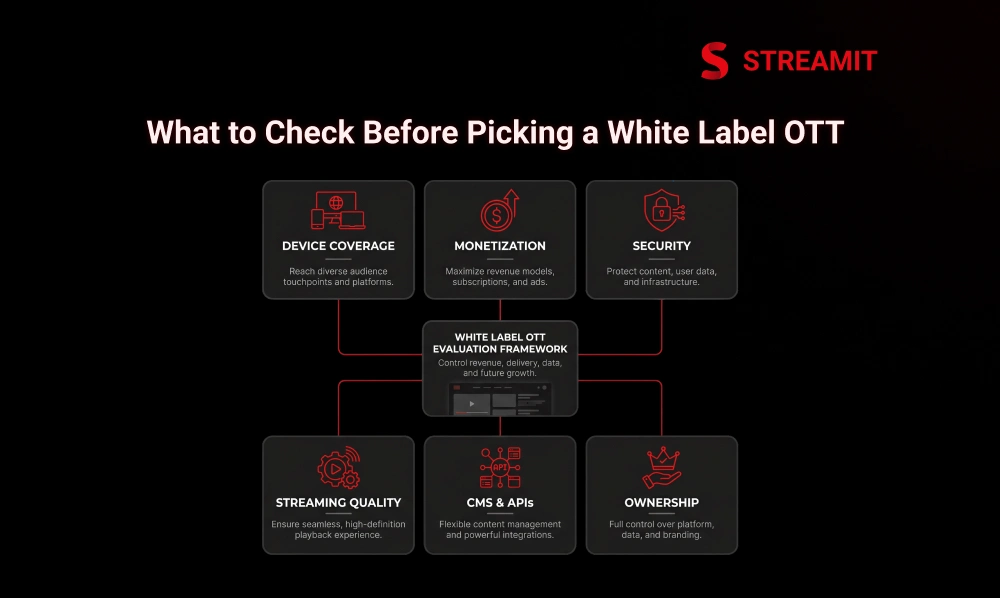
Before choosing a white label OTT solution, look beyond the launch promise. The right platform should give you control over experience, revenue, data, delivery, and future product direction.
Here is a practical checklist.
| Area to Check | Ask This Before Buying |
|---|---|
| Device coverage | Does it support web, mobile, TV, and casting? |
| Monetization | Can it handle SVOD, AVOD, TVOD, PPV, and hybrid? |
| Security | Does it support DRM, encryption, and access control? |
| Streaming quality | Does it support adaptive bitrate, HLS, DASH, and CDN delivery? |
| CMS | Can the team manage content without constant technical help? |
| APIs | Can it connect with other tools and workflows? |
| Ownership | Do you control the brand, data, roadmap, and growth direction? |
Check Device Coverage, DRM, Monetization, and API Flexibility
A good OTT vendor should be able to explain the platform beyond the interface. Ask about smart TV support, mobile apps, DRM, payment flows, ad support, APIs, analytics, and admin workflows.
If the answer is vague, that is a warning sign. Future-ready OTT platform selection should be based on business flexibility, not only feature screenshots.
Check Scalability, Streaming Quality, and Support Commitments
Support matters most when something goes wrong at scale. Ask how the platform handles traffic spikes, live events, CDN issues, monitoring, uptime, bug fixes, and performance tuning.
Streaming hours and connected TV usage continue to rise. In 2025, reported connected TV streaming reached 96.4 million internet-enabled U.S. households, with total time spent streaming reaching 13.9 billion hours in the measured period.
Check How Much Branding and Product Control You Actually Get
White label should not mean surface-level branding only. Real control means you can shape the viewer experience, content structure, pricing strategy, user journeys, and future roadmap.
If the platform only lets you change logos and colors, it may be enough for a basic launch. But it may feel limiting once the business needs deeper product control.
Platform Spotlight
Why Streamit Is a Strong Choice for a Future-Ready OTT Platform
Streamit is built for founders and operators who see streaming as a business, not just an app. Its positioning focuses on infrastructure, monetization, performance, AI-powered insights, and long-term ownership.
For medium and high-ticket OTT projects, that matters. The goal is not to launch something that looks ready. The goal is to build a platform foundation that can handle real growth.
It Combines Fast Launch With the Features Needed for Long-Term Growth
Streamit focuses on building, scaling, and advising AI-first streaming businesses end-to-end. Its platform positioning covers technology, infrastructure, consultancy, and AI insights, with a focus on helping teams move from launch to peak traffic.
That makes it suitable for businesses that want speed but do not want to trade away control. The value is in reducing technical complexity while keeping the platform ready for long-term growth.
It Supports Multi-Device Apps, Monetization, Security, and Better Streaming Delivery
Streamit’s OTT foundation is built around real traffic, monetization, and long-term ownership. Its platform pages highlight web, mobile, and smart TV architecture, centralized CMS, high-concurrency streaming, and multi-device delivery.
It also supports flexible monetization models such as subscriptions, ads, pay-per-view, and hybrid models, along with enterprise-grade DRM, encryption, authentication, and multi-DRM support.
It Gives Businesses a Branded OTT Foundation Without Starting From Scratch
The strongest white label OTT platforms reduce build time without removing ownership. Streamit is positioned around branded streaming apps, content control, monetization flexibility, and long-term platform direction.
For founders, that creates a practical middle path. You do not start from zero, but you also do not settle for a generic streaming setup that limits your future roadmap.
Summary
Key Takeaways
Future-Ready Growth
A future-ready OTT platform supports scale, retention, monetization, security, and device expansion without requiring a rebuild when growth arrives.
Multi-Device Support
Delivering smooth viewing across web, mobile, smart TVs, and connected devices is a baseline requirement, not a premium feature.
Strong Infrastructure
CDN readiness, adaptive streaming, and stable playback protect the viewer experience during traffic spikes, live events, and viral content moments.
Flexible Monetization
Platforms that support subscriptions, ads, pay-per-view, rentals, and hybrid revenue models give businesses the room to evolve beyond their launch model.
AI Personalization
Improving discovery through personalized rows, watch history, and recommendation logic directly reduces churn and keeps viewers returning.
Content Security and Brand Control
DRM, encryption, and access control protect paid content, while full UI and layout customization ensures the platform feels owned, not rented.
Conclusion
Conclusion
A future-ready white label OTT platform is not judged by launch speed alone. It is judged by how well it supports growth after launch.
The right platform should help you manage multiple devices, protect paid content, stream reliably, personalize discovery, test revenue models, control your brand, and keep improving retention.
For serious OTT businesses, the platform is not just technology. It is the operating foundation behind audience growth, revenue, content delivery, and long-term control.
If you are building for the next 12 months, not just the next demo, choose a white label OTT platform that can grow with the business.
FAQs
Frequently Asked Questions
-
Do I need multi-CDN before my OTT platform starts scaling?
Not always. You can start with a strong CDN setup, but your OTT platform should be flexible enough to add multi-CDN later as traffic, regions, and peak viewing hours grow.
-
Can AI recommendations work well on a smaller content library?
Yes, if the platform uses simple signals like watch history, categories, user interests, and trending content. The goal is to help viewers find relevant content faster, not to overcomplicate personalization early.
-
What makes one white label OTT platform easier to scale than another?
A white label OTT platform scales better when it can handle more users, devices, content, regions, and monetization models without major redevelopment. Strong infrastructure, flexible APIs, and a usable CMS make scaling much easier.
-
What hurts OTT growth more over time: weak UX or weak infrastructure?
Both hurt growth, but in different ways. Weak UX reduces engagement, while weak infrastructure creates buffering, slow playback, crashes, and trust issues.
-
How important is local language support in OTT retention?
Local language support is important when your platform serves regional or global audiences. Users stay longer when navigation, subtitles, metadata, and content discovery feel familiar.
-
When does a white label OTT platform start feeling limiting?
It starts feeling limiting when you cannot add devices, change pricing, customize user journeys, access data, or improve security without heavy vendor dependency. That is when a fast launch tool becomes a long-term growth blocker.
Read Also
Read Also
1. 7 Ways AI Improves Content Recommendations on OTT Platforms
2. Top 10 OTT Streaming Trends That Will Shape 2026
3. 10 Streaming Features Every OTT Service Needs
4. Subscriber Retention for OTT Platforms: 15 Proven Tactics to Reduce Churn
5. 7 Reasons Why OTT Platforms Will Fail in 2026 Without Retention